Learner-Centered
Psychological
Principles
(LCP)
mddecio@cpu.edu.ph
Corpus, B. et al., (2018).
Child and Adolescent Learners
and Learning Principles. OBE-PPST-Based.
Metro Manila. Lorimar Publishing.
Educ 1101
What is the
learner-centered
approach to
teaching?
The learner is the center of
instruction.
The world of instruction
revolves around the learner.
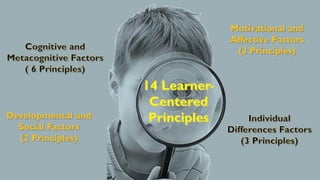
Cognitive and
Metacognitive Factors
( 6 Principles)
14 Learner-
Centered
Principles
Motivational and
Affective Factors
(3 Principles)
Individual
Differences Factors
(3 Principles)
Developmental and
Social Factors
(2 Principles)
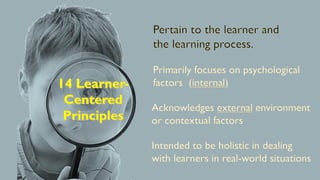
14 Learner-
Centered
Principles
Pertain to the learner and
the learning process.
Primarily focuses on psychological
factors (internal)
Acknowledges external environment
or contextual factors
Intended to be holistic in dealing
with learners in real-world situations
1. Cognitive and Metacognitive Factors
( 6 Principles)
Cognitive
-Mental process
-Reasoning
-Remembering
-Encompasses
language,
perception,
imagination,
planning
Metacognitive
-Thinking about
one’s thinking
-processes used
to plan, monitor,
and assess
understanding of
one’s performance
1. Nature of the Learning Process
-The learning of complex subject matter is most effective when it is an
intentional process of constructing meaning from information and experience.
- Habit formation in motor learning
- Learning in schools emphasizes
the use of intentional processes
- Successful learners are active,
goal-directed, self-regulating, and
assume personal responsibility, for
contributing to their own learning
2. Goals of the Learning Process
-The successful learner, over time and with support and instructional
guidance, can create meaningful, coherent representations of knowledge.
Student needs to be goal-oriented
Must generate and pursue personally
relevant goals
helpfulprofessor.com
5.Thinking aboutThinking
- Higher order strategies for selecting and monitoring mental operations
facilitate creative and critical thinking
Successful learners reflect how they
think and learn, set reasonable goals,
select potentially appropriate
strategies, and monitor progress
They know what to do if a problem
occurs
Instructional methods should focus on
helping learners develop higher order
(metacognitive) strategies
6. Context of Learning
- Learning is influenced by environmental factors, including culture,
technology, and instructional practices.
Educators play the interactive role
with both the learner and the learning
environment
Cultural or group influences
Technologies and instructional
practices must be developmentally
appropriate
Learning environment (classroom)
II. Motivational or Affective Factors
( 3 Principles)
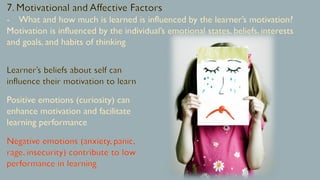
7. Motivational and Affective Factors
What and how much is learned is influenced by the learner’s motivation?
Motivation is influenced by the individual’s emotional states, beliefs, interests
and goals, and habits of thinking
Learner’s beliefs about self can
influence their motivation to learn
Positive emotions (curiosity) can
enhance motivation and facilitate
learning performance
Negative emotions (anxiety, panic,
rage, insecurity) contribute to low
performance in learning
8. Intrinsic Motivation to Learn
The learner’s creativity, higher order thinking, and natural curiosity all
contribute to motivation to learn. Intrinsic motivation is stimulated by
tasks of optimal novelty and difficulty, relevant to personal interests, and
providing for personal choice and control.
Curiosity, flexible thinking, creativity
(indicators of intrinsic motivation)
Tasks need to be comparable to
realistic situations
Educators need to support learner’s
natural curiosity and motivation to
learn
9. Effects of Motivation on Effort
Acquisition of complex knowledge and skills requires extended learner
effort and guided practice.Without the learner’s motivation to learn, the
willingness to exert this effort is unlikely without coercion.
Effort as an indicator of motivation
to learn
Educators need to facilitate
motivation to enhance their effort
to learning
III. Developmental and Social Factors
( 2 Principles)
10. Developmental Influences on Learning
As individuals develop, there are different opportunities and constraints
for learning. Learning is most effective when differential development
within and across physical, intellectual, emotional, and social domains is
taken into account.
Learning materials need to be
appropriate
Individual development varies
across domains
Awareness of developmental
differences can facilitate optimal
learning contexts.
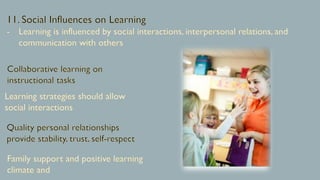
11. Social Influences on Learning
Learning is influenced by social interactions, interpersonal relations, and
communication with others
Collaborative learning on
instructional tasks
Learning strategies should allow
social interactions
Quality personal relationships
provide stability, trust, self-respect
Family support and positive learning
climate and
IV. Individual Differences Factors
( 2 Principles)
12. Individual Differences in Learning
Learners have different strategies, approaches, and capabilities for learning
that are a function of prior experiences and heredity.
Individuals are born with and
develop their own capabilities and
talents
Learning and social acculturation
help learners acquire preferences in
terms of how they like to learn and
pace at
Educators need to be sensitive to
individual differences
13. Learning and Diversity
Learning is most effective when differences in learners’ linguistic, cultural,
and social backgrounds are taken into account.
Language, ethnicity, race, beliefs, and
socioeconomic status influence
learning
When the learners perceive that
they are respected , levels of
motivation and achievement are
enhanced.
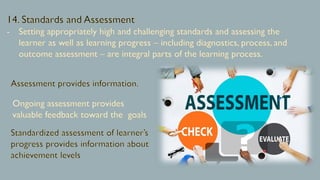
14. Standards and Assessment
Setting appropriately high and challenging standards and assessing the
learner as well as learning progress – including diagnostics, process, and
outcome assessment – are integral parts of the learning process.
Assessment provides information.
Ongoing assessment provides
valuable feedback toward the goals
Standardized assessment of learner’s
progress provides information about
achievement levels
Performance Assessment provide
information about attainment of
learning outcomes
Self-assessment of learning progress
improves student’s self-appraisal
skills and enhance motivation ad
self-directed learning

1_14 Learner-Centered Principles (1).pdf

  • 1.
    Learner-Centered Psychological Principles (LCP) mddecio@cpu.edu.ph Corpus, B. etal., (2018). Child and Adolescent Learners and Learning Principles. OBE-PPST-Based. Metro Manila. Lorimar Publishing. Educ 1101
  • 2.
    What is the learner-centered approachto teaching? The learner is the center of instruction. The world of instruction revolves around the learner.
  • 3.
    Cognitive and Metacognitive Factors (6 Principles) 14 Learner- Centered Principles Motivational and Affective Factors (3 Principles) Individual Differences Factors (3 Principles) Developmental and Social Factors (2 Principles)
  • 4.
    14 Learner- Centered Principles Pertain tothe learner and the learning process. Primarily focuses on psychological factors (internal) Acknowledges external environment or contextual factors Intended to be holistic in dealing with learners in real-world situations
  • 5.
    1. Cognitive andMetacognitive Factors ( 6 Principles) Cognitive -Mental process -Reasoning -Remembering -Encompasses language, perception, imagination, planning Metacognitive -Thinking about one’s thinking -processes used to plan, monitor, and assess understanding of one’s performance
  • 6.
    1. Nature ofthe Learning Process -The learning of complex subject matter is most effective when it is an intentional process of constructing meaning from information and experience. - Habit formation in motor learning - Learning in schools emphasizes the use of intentional processes - Successful learners are active, goal-directed, self-regulating, and assume personal responsibility, for contributing to their own learning
  • 7.
    2. Goals ofthe Learning Process -The successful learner, over time and with support and instructional guidance, can create meaningful, coherent representations of knowledge. Student needs to be goal-oriented Must generate and pursue personally relevant goals
  • 9.
  • 10.
    5.Thinking aboutThinking - Higherorder strategies for selecting and monitoring mental operations facilitate creative and critical thinking Successful learners reflect how they think and learn, set reasonable goals, select potentially appropriate strategies, and monitor progress They know what to do if a problem occurs Instructional methods should focus on helping learners develop higher order (metacognitive) strategies
  • 11.
    6. Context ofLearning - Learning is influenced by environmental factors, including culture, technology, and instructional practices. Educators play the interactive role with both the learner and the learning environment Cultural or group influences Technologies and instructional practices must be developmentally appropriate Learning environment (classroom)
  • 12.
    II. Motivational orAffective Factors ( 3 Principles)
  • 13.
    7. Motivational andAffective Factors What and how much is learned is influenced by the learner’s motivation? Motivation is influenced by the individual’s emotional states, beliefs, interests and goals, and habits of thinking Learner’s beliefs about self can influence their motivation to learn Positive emotions (curiosity) can enhance motivation and facilitate learning performance Negative emotions (anxiety, panic, rage, insecurity) contribute to low performance in learning
  • 14.
    8. Intrinsic Motivationto Learn The learner’s creativity, higher order thinking, and natural curiosity all contribute to motivation to learn. Intrinsic motivation is stimulated by tasks of optimal novelty and difficulty, relevant to personal interests, and providing for personal choice and control. Curiosity, flexible thinking, creativity (indicators of intrinsic motivation) Tasks need to be comparable to realistic situations Educators need to support learner’s natural curiosity and motivation to learn
  • 15.
    9. Effects ofMotivation on Effort Acquisition of complex knowledge and skills requires extended learner effort and guided practice.Without the learner’s motivation to learn, the willingness to exert this effort is unlikely without coercion. Effort as an indicator of motivation to learn Educators need to facilitate motivation to enhance their effort to learning
  • 16.
    III. Developmental andSocial Factors ( 2 Principles)
  • 17.
    10. Developmental Influenceson Learning As individuals develop, there are different opportunities and constraints for learning. Learning is most effective when differential development within and across physical, intellectual, emotional, and social domains is taken into account. Learning materials need to be appropriate Individual development varies across domains Awareness of developmental differences can facilitate optimal learning contexts.
  • 18.
    11. Social Influenceson Learning Learning is influenced by social interactions, interpersonal relations, and communication with others Collaborative learning on instructional tasks Learning strategies should allow social interactions Quality personal relationships provide stability, trust, self-respect Family support and positive learning climate and
  • 19.
    IV. Individual DifferencesFactors ( 2 Principles)
  • 20.
    12. Individual Differencesin Learning Learners have different strategies, approaches, and capabilities for learning that are a function of prior experiences and heredity. Individuals are born with and develop their own capabilities and talents Learning and social acculturation help learners acquire preferences in terms of how they like to learn and pace at Educators need to be sensitive to individual differences
  • 21.
    13. Learning andDiversity Learning is most effective when differences in learners’ linguistic, cultural, and social backgrounds are taken into account. Language, ethnicity, race, beliefs, and socioeconomic status influence learning When the learners perceive that they are respected , levels of motivation and achievement are enhanced.
  • 22.
    14. Standards andAssessment Setting appropriately high and challenging standards and assessing the learner as well as learning progress – including diagnostics, process, and outcome assessment – are integral parts of the learning process. Assessment provides information. Ongoing assessment provides valuable feedback toward the goals Standardized assessment of learner’s progress provides information about achievement levels
  • 23.
    Performance Assessment provide informationabout attainment of learning outcomes Self-assessment of learning progress improves student’s self-appraisal skills and enhance motivation ad self-directed learning