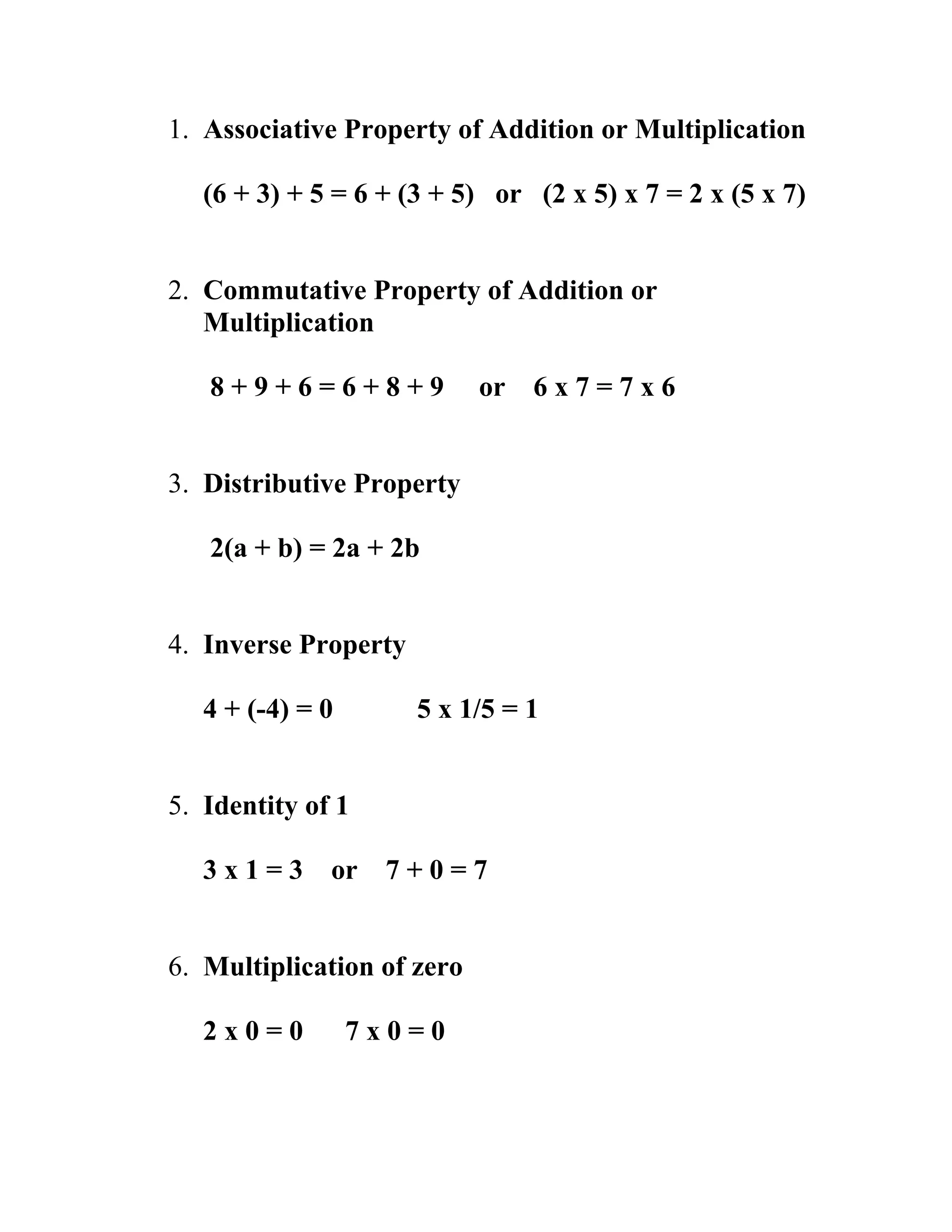
1. Associative Property of Addition or Multiplication

   (6 + 3) + 5 = 6 + (3 + 5) or (2 x 5) x 7 = 2 x (5 x 7)


2. Commutative Property of Addition or
   Multiplication

   8+9+6=6+8+9              or   6x7=7x6


3. Distributive Property

   2(a + b) = 2a + 2b


4. Inverse Property

   4 + (-4) = 0       5 x 1/5 = 1


5. Identity of 1

   3x1=3      or    7+0=7


6. Multiplication of zero

   2x0=0          7x0=0
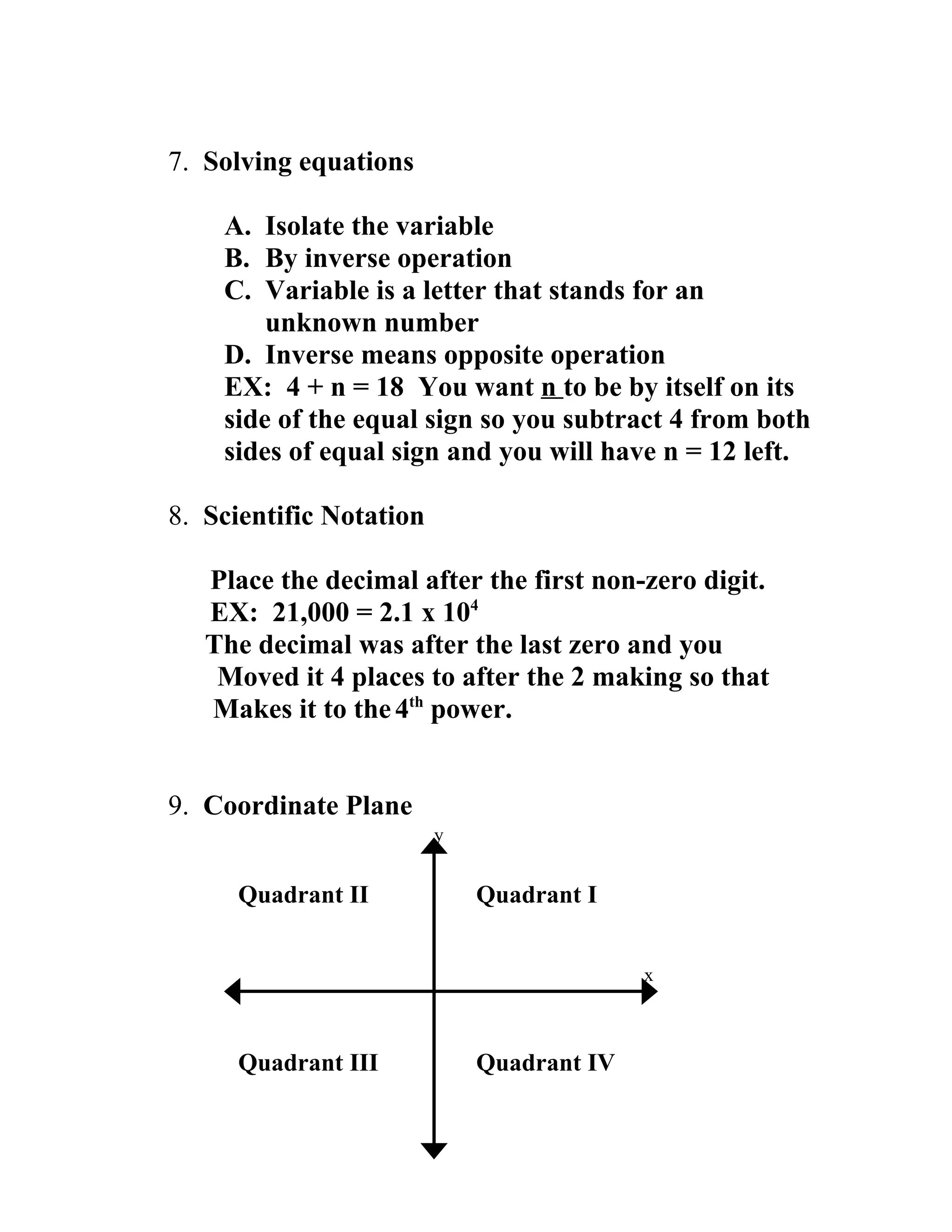
7. Solving equations

    A. Isolate the variable
    B. By inverse operation
    C. Variable is a letter that stands for an
        unknown number
    D. Inverse means opposite operation
    EX: 4 + n = 18 You want n to be by itself on its
    side of the equal sign so you subtract 4 from both
    sides of equal sign and you will have n = 12 left.

8. Scientific Notation

   Place the decimal after the first non-zero digit.
   EX: 21,000 = 2.1 x 10⁴
   The decimal was after the last zero and you
    Moved it 4 places to after the 2 making so that
   Makes it to the 4th power.


9. Coordinate Plane
                         y


      Quadrant II            Quadrant I


                                           x


      Quadrant III           Quadrant IV
10. Absolute Value

   The distance a number is from zero.
   Ex: |-5| = 5        |5| = 5


11. Adding Integers:
    With like signs:
     Add and use the sign they have in common.

    With unlike signs:
    Subtract the smallest absolute value from the
    Largest absolute value and use the sign of the
    Largest absolute value.


12. Subtracting Integers

   Change sign to addition
   Change 2nd number to it’s opposite
   Follow rules of addition


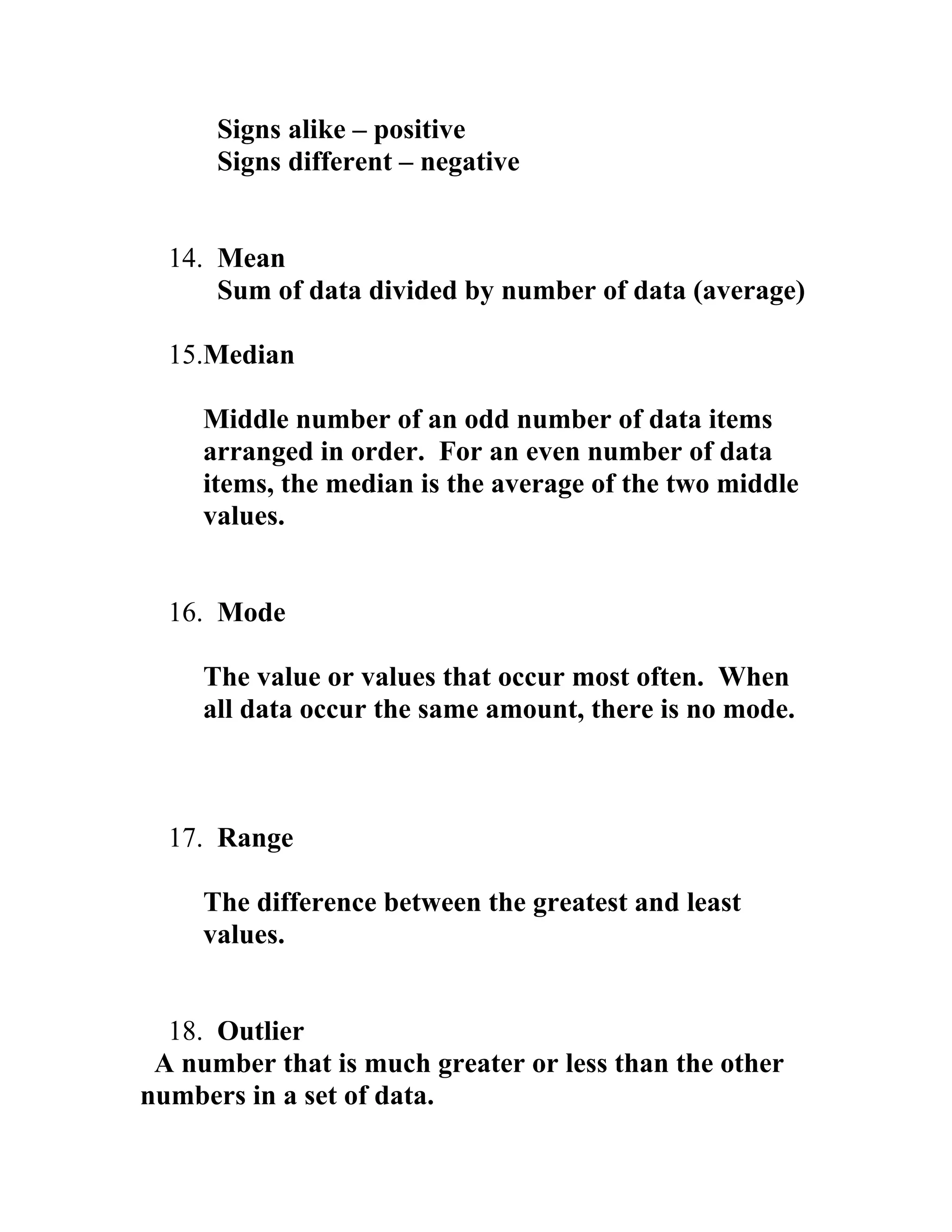
13. Multiply and Divide Integers
Signs alike – positive
      Signs different – negative


  14. Mean
      Sum of data divided by number of data (average)

  15.Median

     Middle number of an odd number of data items
     arranged in order. For an even number of data
     items, the median is the average of the two middle
     values.


  16. Mode

     The value or values that occur most often. When
     all data occur the same amount, there is no mode.


  17. Range

     The difference between the greatest and least
     values.


  18. Outlier
 A number that is much greater or less than the other
numbers in a set of data.
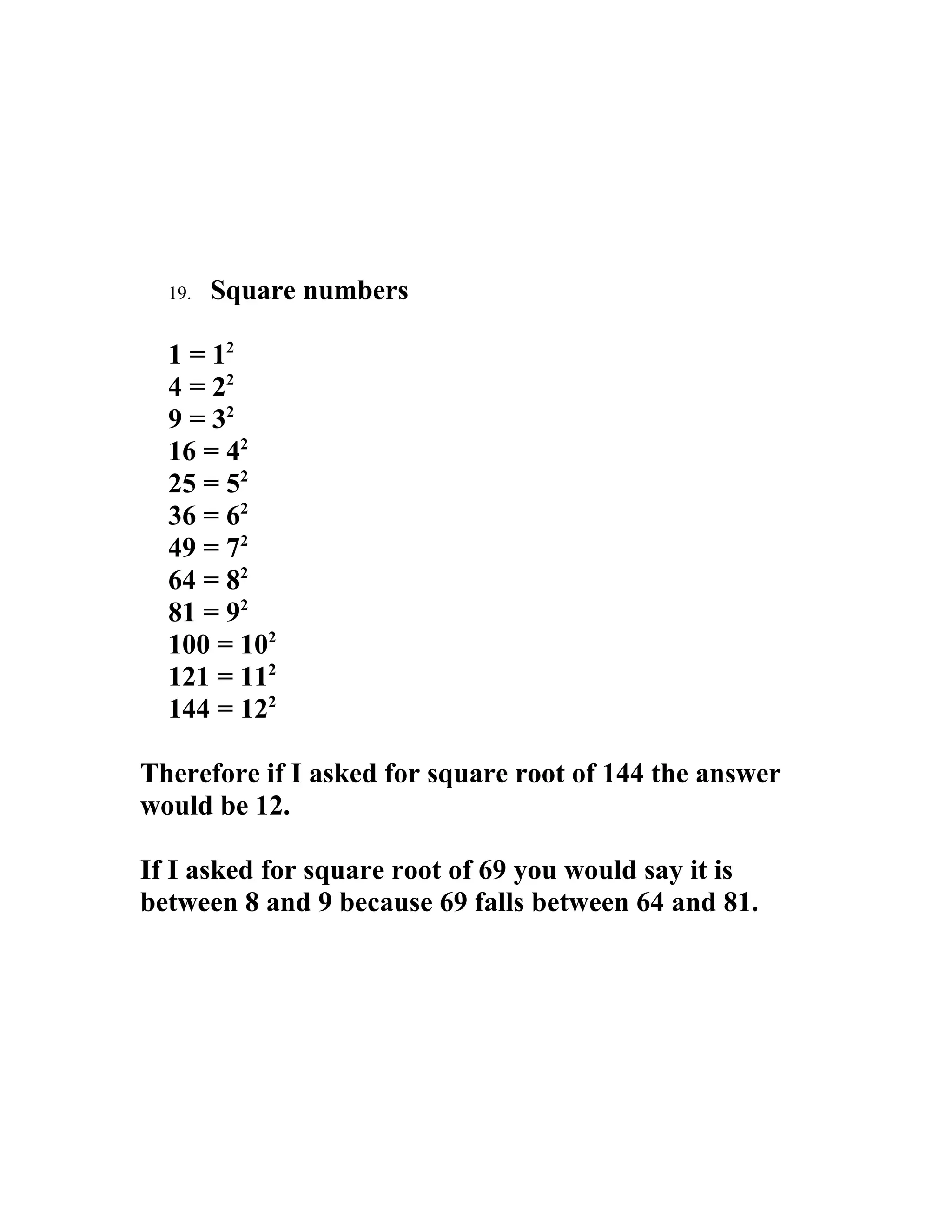
19.   Square numbers

  1 = 12
  4 = 22
  9 = 32
  16 = 42
  25 = 52
  36 = 62
  49 = 72
  64 = 82
  81 = 92
  100 = 102
  121 = 112
  144 = 122

Therefore if I asked for square root of 144 the answer
would be 12.

If I asked for square root of 69 you would say it is
between 8 and 9 because 69 falls between 64 and 81.
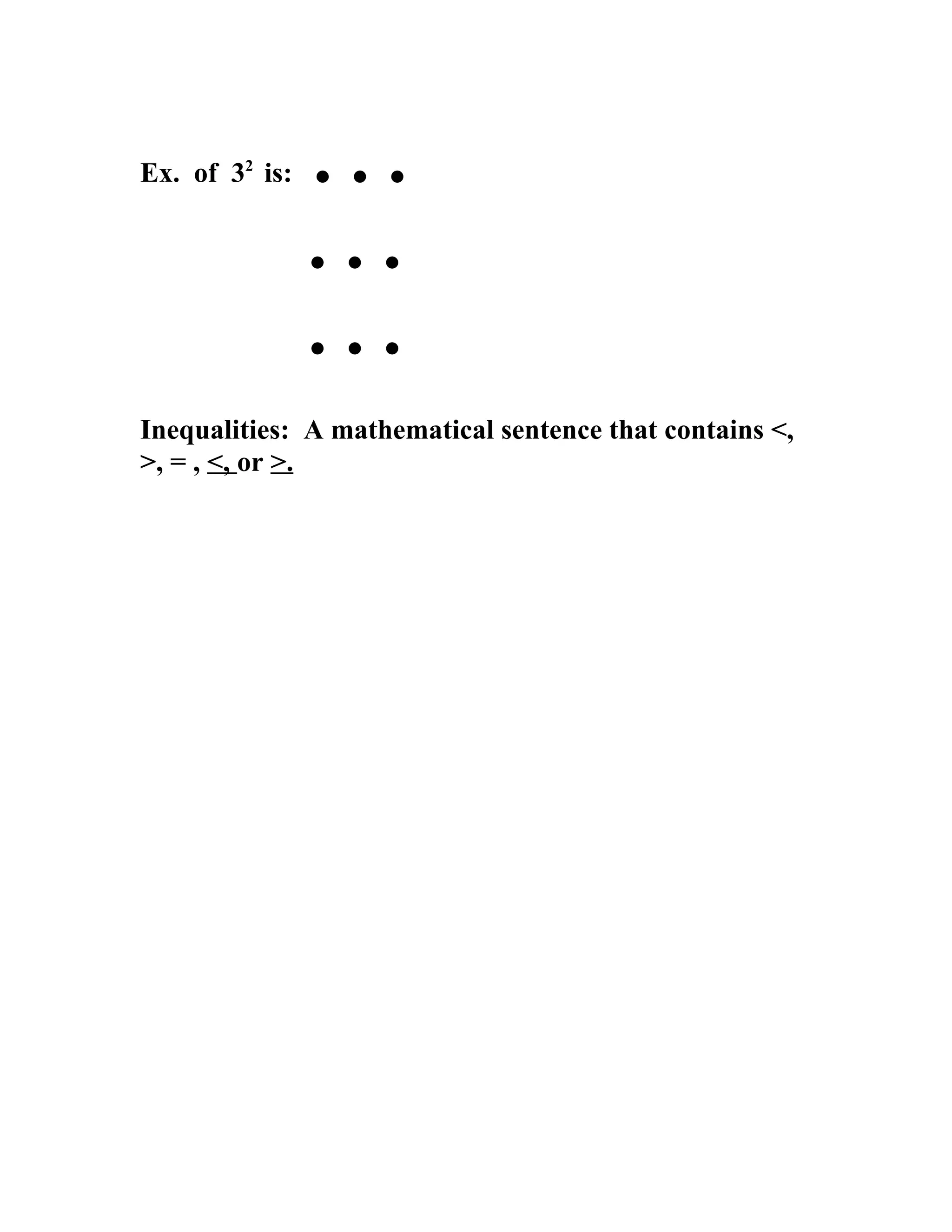
Ex. of 32 is:   ...
                ...
                ...
Inequalities: A mathematical sentence that contains <,
>, = , <, or >.

1st Semester 7th Grade Math Notes To Memorize

  • 1.
    1. Associative Propertyof Addition or Multiplication (6 + 3) + 5 = 6 + (3 + 5) or (2 x 5) x 7 = 2 x (5 x 7) 2. Commutative Property of Addition or Multiplication 8+9+6=6+8+9 or 6x7=7x6 3. Distributive Property 2(a + b) = 2a + 2b 4. Inverse Property 4 + (-4) = 0 5 x 1/5 = 1 5. Identity of 1 3x1=3 or 7+0=7 6. Multiplication of zero 2x0=0 7x0=0
  • 2.
    7. Solving equations A. Isolate the variable B. By inverse operation C. Variable is a letter that stands for an unknown number D. Inverse means opposite operation EX: 4 + n = 18 You want n to be by itself on its side of the equal sign so you subtract 4 from both sides of equal sign and you will have n = 12 left. 8. Scientific Notation Place the decimal after the first non-zero digit. EX: 21,000 = 2.1 x 10⁴ The decimal was after the last zero and you Moved it 4 places to after the 2 making so that Makes it to the 4th power. 9. Coordinate Plane y Quadrant II Quadrant I x Quadrant III Quadrant IV
  • 3.
    10. Absolute Value The distance a number is from zero. Ex: |-5| = 5 |5| = 5 11. Adding Integers: With like signs: Add and use the sign they have in common. With unlike signs: Subtract the smallest absolute value from the Largest absolute value and use the sign of the Largest absolute value. 12. Subtracting Integers Change sign to addition Change 2nd number to it’s opposite Follow rules of addition 13. Multiply and Divide Integers
  • 4.
    Signs alike –positive Signs different – negative 14. Mean Sum of data divided by number of data (average) 15.Median Middle number of an odd number of data items arranged in order. For an even number of data items, the median is the average of the two middle values. 16. Mode The value or values that occur most often. When all data occur the same amount, there is no mode. 17. Range The difference between the greatest and least values. 18. Outlier A number that is much greater or less than the other numbers in a set of data.
  • 5.
    19. Square numbers 1 = 12 4 = 22 9 = 32 16 = 42 25 = 52 36 = 62 49 = 72 64 = 82 81 = 92 100 = 102 121 = 112 144 = 122 Therefore if I asked for square root of 144 the answer would be 12. If I asked for square root of 69 you would say it is between 8 and 9 because 69 falls between 64 and 81.
  • 6.
    Ex. of 32is: ... ... ... Inequalities: A mathematical sentence that contains <, >, = , <, or >.