1) The study investigated the effect of adding zirconium oxide nanoparticles to carbon black electrode materials on surface morphology and electrochemical performance.
2) Scanning electron microscopy showed that adding nanoparticles partially filled gaps between carbon black particles, increasing the specific surface area available for charge storage.
3) Electrochemical analysis found that increasing nanoparticle content initially increased total charge storage due to higher surface area and pseudocapacitive charge storage, but further increases reduced performance due to higher electrode resistance.
![Short Communication
Effect of zirconium oxide nanoparticles on surface
morphology and energy storage of electrochemical capacitors
Mahdi Nasibi a,b,n
, Mahdi R. Sarpoushi a
, Rouhallah Hesan c
,
Mohammad Ali Golozar d
, Masoud Moshrefifar c
a
Technical Inspection Engineering Department, Petroleum University of Technology, Abadan, Iran
b
Health and Safety Engineering (HSE) Office, NIOPDC, Yazd Region, Yazd, Iran
c
Materials and Mining Engineering Department, Yazd University, Yazd, Iran
d
Materials Science and Engineering Department, Isfahan University of Technology, Isfahan, Iran
a r t i c l e i n f o
Keywords:
Supercapacitors
Nanomaterials
Morphology
ZrO2
a b s t r a c t
In this study, the effect of mixing zirconium oxide nanoparticles and carbon black particles
on surface morphology and electrochemical performance of prepared electrodes were
investigated. Scanning electron microscopy was used to characterize microstructure and
nature of nanocomposites. Charge stored (q) on different nanoparticle containing
electrodes was calculated and the effect of surface morphology on charge storage was
discussed. It is concluded that charge stored on the electrode shows an n-like change by
increasing nanoparticle content of electrodes. Addition of nanoparticle increases qn
O/qn
T
(from 0.05 to 0.18) which confirms the higher current response and higher voltage
reversal at the end potentials.
Crown Copyright & 2014 Published by Elsevier Ltd. All rights reserved.
1. Introduction
Electrochemical capacitors (ECs), with a combination of
high power density and high energy density, can be used
as a complementary energy-storage device along with a
primary power source, such as a battery or a fuel cell, for
power enhancement in short pulse applications [1]. High
cycle life, high energy efficiency and high self-discharge
rate are some of the supercapacitors characteristics [2,3].
Today, many laboratories are actively engaged in develop-
ment of well-known type of supercapacitors, viz., electro-
chemical double-layer, pseudo and hybrid supercapacitors,
and most research has been focused on development of
different electrode materials [4,5]. For practical applica-
tions, an EC must fulfill the following technical require-
ments: high specific capacitance, long cycle life and
high charge/discharge rate. Today, using nanoparticles is
of interest in order to improve these parameters. So,
nanoparticles distribution quality on the electrode surface
is of most important parameters [6]. In our previous work,
we investigated the effect of different mixing processes of
electrode material on dispersion quality of nanoparticles
which change their electrochemical performance. In this
work, we investigate the effect of nanoparticle contents of
the electrode material on microstructure and nature of
prepared electrodes using scanning electron microscopy,
and potentiodynamic polarization techniques. At the
end, quantitative measurements were reported for further
investigations.
2. Experimental
2.1. Materials
High purity (499%) nano-sized zirconium oxide (ZrO2)
particles (o100 nm), nickel foil (99.99% with 0.125 mm
Contents lists available at ScienceDirect
journal homepage: www.elsevier.com/locate/mssp
Materials Science in Semiconductor Processing
http://dx.doi.org/10.1016/j.mssp.2014.03.037
1369-8001/Crown Copyright & 2014 Published by Elsevier Ltd. All rights reserved.
n
Corresponding author. Tel.: þ98 9113708480; fax: þ98 6314423520.
E-mail address: mahdi.nasibi@gmail.com (M. Nasibi).
Materials Science in Semiconductor Processing 24 (2014) 260–264](https://image.slidesharecdn.com/86527cba-7f64-4ca5-a7e7-114620ead606-150508112534-lva1-app6891/85/1-s2-0-S1369800114001711-main-1-320.jpg)
![Short Communication
Effect of zirconium oxide nanoparticles on surface
morphology and energy storage of electrochemical capacitors
Mahdi Nasibi a,b,n
, Mahdi R. Sarpoushi a
, Rouhallah Hesan c
,
Mohammad Ali Golozar d
, Masoud Moshrefifar c
a
Technical Inspection Engineering Department, Petroleum University of Technology, Abadan, Iran
b
Health and Safety Engineering (HSE) Office, NIOPDC, Yazd Region, Yazd, Iran
c
Materials and Mining Engineering Department, Yazd University, Yazd, Iran
d
Materials Science and Engineering Department, Isfahan University of Technology, Isfahan, Iran
a r t i c l e i n f o
Keywords:
Supercapacitors
Nanomaterials
Morphology
ZrO2
a b s t r a c t
In this study, the effect of mixing zirconium oxide nanoparticles and carbon black particles
on surface morphology and electrochemical performance of prepared electrodes were
investigated. Scanning electron microscopy was used to characterize microstructure and
nature of nanocomposites. Charge stored (q) on different nanoparticle containing
electrodes was calculated and the effect of surface morphology on charge storage was
discussed. It is concluded that charge stored on the electrode shows an n-like change by
increasing nanoparticle content of electrodes. Addition of nanoparticle increases qn
O/qn
T
(from 0.05 to 0.18) which confirms the higher current response and higher voltage
reversal at the end potentials.
Crown Copyright & 2014 Published by Elsevier Ltd. All rights reserved.
1. Introduction
Electrochemical capacitors (ECs), with a combination of
high power density and high energy density, can be used
as a complementary energy-storage device along with a
primary power source, such as a battery or a fuel cell, for
power enhancement in short pulse applications [1]. High
cycle life, high energy efficiency and high self-discharge
rate are some of the supercapacitors characteristics [2,3].
Today, many laboratories are actively engaged in develop-
ment of well-known type of supercapacitors, viz., electro-
chemical double-layer, pseudo and hybrid supercapacitors,
and most research has been focused on development of
different electrode materials [4,5]. For practical applica-
tions, an EC must fulfill the following technical require-
ments: high specific capacitance, long cycle life and
high charge/discharge rate. Today, using nanoparticles is
of interest in order to improve these parameters. So,
nanoparticles distribution quality on the electrode surface
is of most important parameters [6]. In our previous work,
we investigated the effect of different mixing processes of
electrode material on dispersion quality of nanoparticles
which change their electrochemical performance. In this
work, we investigate the effect of nanoparticle contents of
the electrode material on microstructure and nature of
prepared electrodes using scanning electron microscopy,
and potentiodynamic polarization techniques. At the
end, quantitative measurements were reported for further
investigations.
2. Experimental
2.1. Materials
High purity (499%) nano-sized zirconium oxide (ZrO2)
particles (o100 nm), nickel foil (99.99% with 0.125 mm
Contents lists available at ScienceDirect
journal homepage: www.elsevier.com/locate/mssp
Materials Science in Semiconductor Processing
http://dx.doi.org/10.1016/j.mssp.2014.03.037
1369-8001/Crown Copyright & 2014 Published by Elsevier Ltd. All rights reserved.
n
Corresponding author. Tel.: þ98 9113708480; fax: þ98 6314423520.
E-mail address: mahdi.nasibi@gmail.com (M. Nasibi).
Materials Science in Semiconductor Processing 24 (2014) 260–264](https://image.slidesharecdn.com/86527cba-7f64-4ca5-a7e7-114620ead606-150508112534-lva1-app6891/75/1-s2-0-S1369800114001711-main-1-2048.jpg)
![thickness) and polytetrafluoroethylene (o2 μm) were
purchased from Aldrich, USA. All other chemicals used in
this study were purchased from Merck, Germany. Carbon
black particles (o2 μm) were purchased from Degussa,
Germany. In order to prepare electrodes, the mixture
containing different wt% ZrO2 and carbon black (CB) and
10 wt% polytetrafluoroethylene (PTFE) was well mixed in
ethanol to form a paste and then was pressed onto the
nickel foil (25 MPa), which served as a current collector
(surface was 0.785 cm2
). The typical mass weight of
electrode material was 30 mg. The used electrolyte was
2 M KCl.
2.2. Characterization
The electrochemical measurements were performed
using an Autolab (Netherlands) potentiostat Model
PGSTAT 302N. CV tests were conducted at various scan
rates (s) with recording of potential response currents, I,
which is related by C¼I/s where C is the capacitance of the
electrode interface. The specific capacitance C (FgÀ1
) of the
active material was determined by integrating either the
oxidative or reductive parts of the cyclic voltammogram
curve to obtain voltammetric charge Q (C). This charge was
divided by mass of active material m (g) in the electrode
and width of the potential window of the cyclic voltam-
mogram ΔE (V), i.e., C¼Q/(ΔEm) [7]. The morphology and
nature of the prepared electrodes were studied using
scanning electron microscopy (TESCAN, USA).
3. Results and discussion
Nanoparticles distribution quality on the electrode
surface is one of the key parameters which controls the
electrical performance of nanoparticle containing electro-
des for supercapacitors. Using macroparticles like used
carbon black particles which store electrical energy
through the double layer mechanism, will make macro-
pores and macrogrooves with deep and hollow shapes on
surface of the electrode. Using the nanoparticles will make
nanopores with shallow shapes. Therefore, mixing the
nanoparticles with macroparticles will have a significant
effect on the morphology and nature of the prepared
electrodes. One of the thinkable morphology changes
by mixing of the nanoparticles with macroparticles is
schematically illustrated in Fig. 1. In the absence of the
nanoparticles, macrogrooves produced between CB parti-
cles and these grooves are exposed to the electrolyte for
charge storage (Fig. 1(a)). As the nanoparticle content of
Fig. 1. (a–d) Schematic illustration of the surface changes by addition of
nanoparticles into the electrode material and, (e) SEM image obtained
from 30:60:10 electrode. (For interpretation of the references to color in
this figure, the reader is referred to the web version of this article.)
Fig. 2. Nyquist diagrams of different ZrO2-content electrodes in 2 M KCl
electrolyte.
M. Nasibi et al. / Materials Science in Semiconductor Processing 24 (2014) 260–264 261](https://image.slidesharecdn.com/86527cba-7f64-4ca5-a7e7-114620ead606-150508112534-lva1-app6891/85/1-s2-0-S1369800114001711-main-2-320.jpg)
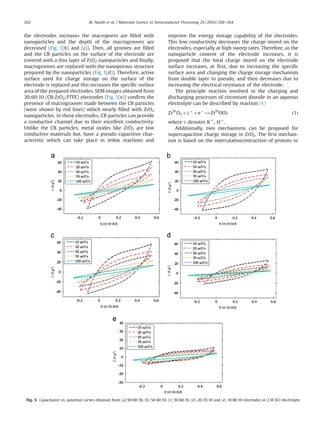
![alkali cations into the oxide particles (denoted as reaction
(2)), whereas the second mechanism involves the surface
adsorption/desorption of proton or alkali cations probably
(denoted as reaction (3)):
ZrO2 þMþ
þeÀ
¼ ZrOOM ð2Þ
and
ðZrO2Þsurface þMþ
þeÀ
¼ ðZrOOMÞsurface ð3Þ
where Mþ
denotes Kþ
or H3Oþ
.
In order to gain a quantitative information on the effect of
surface changes on charge storage mechanism of the ZrO2/CB
electrodes by increasing the nanoparticle content of the
electrodes, the voltammograms obtained from different
nanoparticle containing electrodes were analyzed as a func-
tion of scan rate, according to the procedure reported by
Ardizzone et al. [8]. Then, the total charge and charge related
to the most accessible surface area were calculated.
Four prominent characteristics can be reported by chan-
ging the nanoparticle content of the electrodes from
obtained CV curves (Fig. 3): changing the shape of the CV
curves, changing the specific capacitance, deviation of the CV
curves from the classical square waveform expected for a
pure capacitor by increasing the sweep rate and, increasing
the voltage reversal at end potentials. As the nanoparticle
content of the electrodes increases electrical resistance of the
electrode increases (Fig. 2) and, up to 60%, the energy stored
on the electrode increases at first and then decreases due to
the electrical resistance and specific surface area changes of
the electrodes. Additionally, scan rate dependence of the
capacitance can be related to the less accessible surface area
(pores, cracks, etc) which become excluded as the rate
reaction is enhanced [9,10]. Ion diffusion ability of the
electrolyte into the surface of the electrode will have a
significant effect on the voltage reversal of the electrodes.
Improvement of the voltage reversal of the high nanoparticle
containing electrodes may be related to surface morphology
changes which change the active energy storage sites from
down the deep macropores to shallow nanopores. Calculat-
ing the total charge stored on electrodes and the charge
stored on less and more accessible surface area of the
electrodes are efficient indicators which indicate the charge
distribution on the electrode. In charge and discharge cycles,
the total charge can be written as a sum of an inner charge
from the less accessible reaction sites and an outer charge
from the more accessible reaction sites, i.e., q*
T¼q*
I þq*
O,
where q*
T, q*
I and q*
O are the total charge and charges related
to the inner and the outer surfaces, respectively [11]. The
extrapolation of q*
to v¼0 from 1/q*
vs. v1/2
plots obtained
from different nanoparticle containing electrodes (Fig. 4(a))
give the total charge qT which is the charge related to the
entire active surface of the electrode. In addition, extrapola-
tion of q*
to v¼1 (vÀ1/2
¼0) from the q*
vs. vÀ1/2
plots (Fig.
4(b)) give the outer charge q*
O, which is the charge due to
redox process on the most accessible active surface [8,11].
Total and outer charges vs. nanoparticle content of the
electrode obtained from different nanoparticle electrodes
were plotted in Fig. 4(c). Total and outer charge plots confirm
that the addition of nanoparticles increases and then
decreases the charge stored on the electrode surface, as
expected and explained above. Although, electrodes which
contain higher nanoparticle contents show higher ratio of the
outer charge to total charge (q*
O/q*
T) (increases from 0.05 to
0.18) which confirms the higher current response on voltage
reversal of high nanoparticle containing electrodes. Finally, it
is concluded that the 40:50:10 (CB:ZrO2:PTFE) electrodes
show better charge storage capability ($57C gÀ1
cmÀ2
)
(Fig. 4(c)). It may be due to the synergistic effect of the double
layer characteristic of the CB particles and the pseudo
characteristic of the ZrO2 nanoparticles. Changing the surface
morphology from macrogrooves to nanoporous structure
makes the 10:80:10 electrode to show the high outer charge
to total charge (q*
O/q*
T) ratio of as-high-as 0.18 which confirms
its high current response on voltage reversal.
4. Conclusions
In this study, effect of nanoparticle content of the ZrO2/
carbon black nanocomposite electrodes on the microstruc-
ture, nature and the electrochemical performance of the
prepared electrode were investigated. SEM images confirm
Fig. 4. (a) Extrapolation of q to v¼0 from the qÀ1
vs. v0.5
plot given the
total charge and (b) extrapolation of q to v¼1 from the q vs. vÀ0.5
plot
given the outer charge for CB electrodes. (c) Total and outer charge stored
on the different nanoparticle containing electrodes.
M. Nasibi et al. / Materials Science in Semiconductor Processing 24 (2014) 260–264 263](https://image.slidesharecdn.com/86527cba-7f64-4ca5-a7e7-114620ead606-150508112534-lva1-app6891/85/1-s2-0-S1369800114001711-main-4-320.jpg)
![the surface changes from hallow macrogrooves to shallow
nanoporous structure by increasing the nanoparticle content
of the electrodes. Charge stored on the electrode surface
increases ($57C gÀ1
cmÀ2
obtained from 40:50:10 elec-
trode) at first, due to the synergistic effect of the carbon
black and ZrO2 nanoparticles, and then decreases by increas-
ing the nanoparticle content due to the electrical resistance
of the electrode. Finally, it is concluded that the current
response of the electrodes (q*
O/q*
T ratio of 0.18 obtained from
10:80:10 electrode) increases by addition of the nanoparti-
cles due to the surface changes from hollow macrogrooves to
the nanoporous structure.
References
[1] W. Wei, X. Cu, W. Chen, D.G. Ivey, J. Power Sources 186 (2009)
543–550.
[2] R. Kotz, M. Carlen, Electrochim. Acta 45 (2000) 2483–2498.
[3] I. Hadjipaschalis, A. Poullikkas, V. Efthimiou, Renew. Sustain. Energy
Rev. 13 (2009) 1513–1522.
[4] Y. Zhang, H. Feng, X. Wu, L. Wang, A. Zhang, T. Xia, Int. J. Hydrog.
Energy 34 (2009) 4889–4899.
[5] B.E. Conway, Electrochemical Capacitors Scientific Fundamental and
Technological Applications, Klumer Academic/Plenum, New York,
1999, 105–124.
[6] B. Babakhani, D.G. Ivey, J. Power Sources 195 (2010) 2110–2117.
[7] G. Sun, W. Song, X. Liu, W. Qiao, D. Long, L. Ling, Mater. Lett. 65
(2011) 1392–1395.
[8] S. Ardizzone, G. Fregonara, S. Trasatti, Electrochim. Acta 35 (1990)
263–267.
[9] B.E. Conway, W.G. Pell, J. Power Sources 105 (2002) 169–181.
[10] M. Nasibi, M.A. Golozar, Gh. Rashed, Mater. Lett. 91 (2013) 323–325.
[11] M. Nasibi, M.A. Golozar, Gh. Rashed, Mater. Lett. 85 (2012) 40–43.
M. Nasibi et al. / Materials Science in Semiconductor Processing 24 (2014) 260–264264](https://image.slidesharecdn.com/86527cba-7f64-4ca5-a7e7-114620ead606-150508112534-lva1-app6891/85/1-s2-0-S1369800114001711-main-5-320.jpg)


