UNIVERSITY OF MINDANAO
COLLEGE OF HEALTH SCIENCES EDUCATION
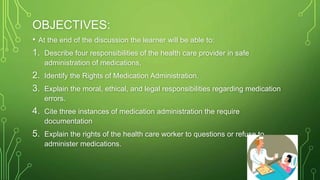
OBJECTIVES:
• At the end of the discussion the learner will be able to:
1. Describe four responsibilities of the health care provider in safe
administration of medications,
2. Identify the Rights of Medication Administration.
3. Explain the moral, ethical, and legal responsibilities regarding medication
errors.
4. Cite three instances of medication administration the require
documentation
5. Explain the rights of the health care worker to questions or refuse to
administer medications.
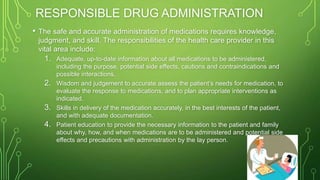
RESPONSIBLE DRUG ADMINISTRATION
• The safe and accurate administration of medications requires knowledge,
judgment, and skill. The responsibilities of the health care provider in this
vital area include:
1. Adequate, up-to-date information about all medications to be administered,
including the purpose, potential side effects, cautions and contraindications and
possible interactions.
2. Wisdom and judgement to accurate assess the patient’s needs for medication, to
evaluate the response to medications, and to plan appropriate interventions as
indicated.
3. Skills in delivery of the medication accurately, in the best interests of the patient,
and with adequate documentation.
4. Patient education to provide the necessary information to the patient and family
about why, how, and when medications are to be administered and potential side
effects and precautions with administration by the lay person.
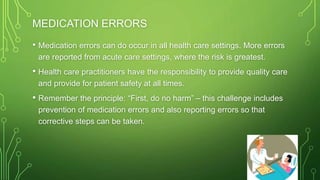
MEDICATION ERRORS
• Medication errors can do occur in all health care settings. More errors
are reported from acute care settings, where the risk is greatest.
• Health care practitioners have the responsibility to provide quality care
and provide for patient safety at all times.
• Remember the principle: “First, do no harm” – this challenge includes
prevention of medication errors and also reporting errors so that
corrective steps can be taken.
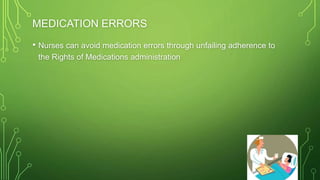
MEDICATION ERRORS
• Nurses can avoid medication errors through unfailing adherence to
the Rights of Medications administration
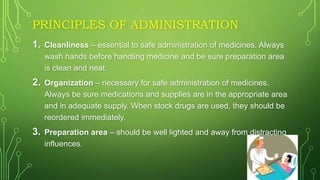
PRINCIPLES OF ADMINISTRATION
1. Cleanliness – essential to safe administration of medicines. Always
wash hands before handling medicine and be sure preparation area
is clean and neat.
2. Organization – necessary for safe administration of medicines.
Always be sure medications and supplies are in the appropriate area
and in adequate supply. When stock drugs are used, they should be
reordered immediately.
3. Preparation area – should be well lighted and away from distracting
influences.
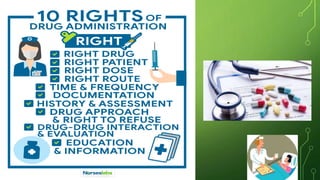
10 RIGHTS OF MEDICATION
ADMINISTRATION
• 1.Right Patient: Verify the patient's identity using two identifiers, such as name and
date of birth, to ensure that the medication is given to the intended individual.
• 2.Right Medication: Check the medication label against the medication order to
ensure the correct medication is administered.
• 3.Right Dose: Confirm that the dosage amount is appropriate for the patient's age,
weight, and condition.
• 4.Right Route: Ensure that the medication is delivered by the correct route (e.g.,
orally, intravenously, topically).
• 5.Right Time: Administer the medication at the correct time, including the frequency
of administration (e.g., every 8 hours).
10 RIGHTS OF MEDICATION
ADMINISTRATION
• 6.Right Documentation: Record the medication administration details promptly,
including the drug, dose, time, route, and any patient observations or reactions.
• 7.Right Reason: Understand and confirm the reason for the medication, ensuring it is
appropriate for the patient's diagnosis or condition.
• 8.Right Response: Monitor and document the patient's response to the medication,
noting any therapeutic effects or adverse reactions.
• 9.Right to Refuse: Respect the patient's right to refuse medication, and document
the refusal along with the reason, if provided by the patient.
• 10.Right Education: Provide the patient (or caregiver) with information about the
medication, including its purpose, how to take it, possible side effects, and any
necessary monitoring.
ADMINISTRATION OF MEDICATIONS ORALLY:
• Guidelines for Oral Medications Administration:
1. Wash your hands
2. Locate appropriate medication sheet and check for completeness of the order
(example: date, patient’s name, medication name, dosage, route, and time).
3. Check for special circumstances (e.g. allergies, or NPO).
4. Be sure that you know the purpose of the drug, possible side effects,
contraindications, cautions, interactions, and normal dosage range.
5. Select appropriate receptacle in which to place the medicine
6. Locate medication in the medication cart drawer and compare the label against the
doctor orders sheet/medication sheet/medicine ticket.
ADMINISTRATION OF MEDICATIONS ORALLY:
• Guidelines for Oral Medications Administration:
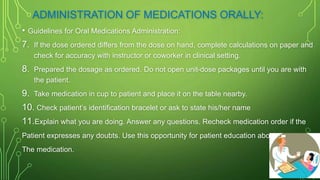
7. If the dose ordered differs from the dose on hand, complete calculations on paper and
check for accuracy with instructor or coworker in clinical setting.
8. Prepared the dosage as ordered. Do not open unit-dose packages until you are with
the patient.
9. Take medication in cup to patient and place it on the table nearby.
10. Check patient’s identification bracelet or ask to state his/her name
11.Explain what you are doing. Answer any questions. Recheck medication order if the
Patient expresses any doubts. Use this opportunity for patient education about
The medication.
ADMINISTRATION OF MEDICATIONS ORALLY:
• Guidelines for Oral Medications Administration:
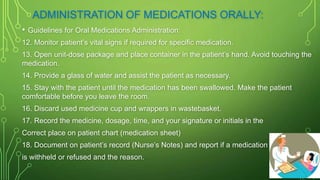
12. Monitor patient’s vital signs if required for specific medication.
13. Open unit-dose package and place container in the patient’s hand. Avoid touching the
medication.
14. Provide a glass of water and assist the patient as necessary.
15. Stay with the patient until the medication has been swallowed. Make the patient
comfortable before you leave the room.
16. Discard used medicine cup and wrappers in wastebasket.
17. Record the medicine, dosage, time, and your signature or initials in the
Correct place on patient chart (medication sheet)
18. Document on patient’s record (Nurse’s Notes) and report if a medication
is withheld or refused and the reason.
1. If patient is NPO, check with the person in charge regarding appropriate
procedure, based on the reason for NPO.
2. Always check the patient’s record carefully for allergies and be aware of the
components of combination products.
3. Give the most important medicine first (e.g. cardiac medicine before vitamin)
4. Elevate the patient’s head, if not contraindicated by the patient’s condition, to aid
in swallowing.
5. Stay with the patient until the medication is swallowed.
6. Administer oral medication with water; unless ordered otherwise.
7. Medications whose action depends on contact with the mucous
Membranes of the mouth or throat, should not be administered with fluids or
Foods.
SPECIAL CONSIDERATIONS FOR ORAL
ADMINISTRATION:
8. Do not open or crush time-release capsules or enteric -coated tablets.
9. If tablets must be divided, do not break by hand. If available, a pill-cutter may be
used.
10. When removing tablets or capsules from the stock bottle, pour into lid and from
there into medicine cup. Do no touch tablets or capsules.
11. Do not administered any medications that is discolored, has precipitated, is
contaminated, or is outdated.
12. If a patient is NPO, refuses the medication, or vomits within 20-30 minutes of
taking the medication, always report this to the person in charge.
A written order from the physician is required to change either the
Medication or the route of administration
SPECIAL CONSIDERATIONS FOR ORAL
ADMINISTRATION:

1-Responsibilities-and-Principles-of-Drug-Administration.pptx

  • 1.
    UNIVERSITY OF MINDANAO COLLEGEOF HEALTH SCIENCES EDUCATION
  • 2.
    OBJECTIVES: • At theend of the discussion the learner will be able to: 1. Describe four responsibilities of the health care provider in safe administration of medications, 2. Identify the Rights of Medication Administration. 3. Explain the moral, ethical, and legal responsibilities regarding medication errors. 4. Cite three instances of medication administration the require documentation 5. Explain the rights of the health care worker to questions or refuse to administer medications.
  • 3.
    RESPONSIBLE DRUG ADMINISTRATION •The safe and accurate administration of medications requires knowledge, judgment, and skill. The responsibilities of the health care provider in this vital area include: 1. Adequate, up-to-date information about all medications to be administered, including the purpose, potential side effects, cautions and contraindications and possible interactions. 2. Wisdom and judgement to accurate assess the patient’s needs for medication, to evaluate the response to medications, and to plan appropriate interventions as indicated. 3. Skills in delivery of the medication accurately, in the best interests of the patient, and with adequate documentation. 4. Patient education to provide the necessary information to the patient and family about why, how, and when medications are to be administered and potential side effects and precautions with administration by the lay person.
  • 4.
    MEDICATION ERRORS • Medicationerrors can do occur in all health care settings. More errors are reported from acute care settings, where the risk is greatest. • Health care practitioners have the responsibility to provide quality care and provide for patient safety at all times. • Remember the principle: “First, do no harm” – this challenge includes prevention of medication errors and also reporting errors so that corrective steps can be taken.
  • 5.
    MEDICATION ERRORS • Nursescan avoid medication errors through unfailing adherence to the Rights of Medications administration
  • 6.
    PRINCIPLES OF ADMINISTRATION 1.Cleanliness – essential to safe administration of medicines. Always wash hands before handling medicine and be sure preparation area is clean and neat. 2. Organization – necessary for safe administration of medicines. Always be sure medications and supplies are in the appropriate area and in adequate supply. When stock drugs are used, they should be reordered immediately. 3. Preparation area – should be well lighted and away from distracting influences.
  • 8.
    10 RIGHTS OFMEDICATION ADMINISTRATION • 1.Right Patient: Verify the patient's identity using two identifiers, such as name and date of birth, to ensure that the medication is given to the intended individual. • 2.Right Medication: Check the medication label against the medication order to ensure the correct medication is administered. • 3.Right Dose: Confirm that the dosage amount is appropriate for the patient's age, weight, and condition. • 4.Right Route: Ensure that the medication is delivered by the correct route (e.g., orally, intravenously, topically). • 5.Right Time: Administer the medication at the correct time, including the frequency of administration (e.g., every 8 hours).
  • 9.
    10 RIGHTS OFMEDICATION ADMINISTRATION • 6.Right Documentation: Record the medication administration details promptly, including the drug, dose, time, route, and any patient observations or reactions. • 7.Right Reason: Understand and confirm the reason for the medication, ensuring it is appropriate for the patient's diagnosis or condition. • 8.Right Response: Monitor and document the patient's response to the medication, noting any therapeutic effects or adverse reactions. • 9.Right to Refuse: Respect the patient's right to refuse medication, and document the refusal along with the reason, if provided by the patient. • 10.Right Education: Provide the patient (or caregiver) with information about the medication, including its purpose, how to take it, possible side effects, and any necessary monitoring.
  • 10.
    ADMINISTRATION OF MEDICATIONSORALLY: • Guidelines for Oral Medications Administration: 1. Wash your hands 2. Locate appropriate medication sheet and check for completeness of the order (example: date, patient’s name, medication name, dosage, route, and time). 3. Check for special circumstances (e.g. allergies, or NPO). 4. Be sure that you know the purpose of the drug, possible side effects, contraindications, cautions, interactions, and normal dosage range. 5. Select appropriate receptacle in which to place the medicine 6. Locate medication in the medication cart drawer and compare the label against the doctor orders sheet/medication sheet/medicine ticket.
  • 11.
    ADMINISTRATION OF MEDICATIONSORALLY: • Guidelines for Oral Medications Administration: 7. If the dose ordered differs from the dose on hand, complete calculations on paper and check for accuracy with instructor or coworker in clinical setting. 8. Prepared the dosage as ordered. Do not open unit-dose packages until you are with the patient. 9. Take medication in cup to patient and place it on the table nearby. 10. Check patient’s identification bracelet or ask to state his/her name 11.Explain what you are doing. Answer any questions. Recheck medication order if the Patient expresses any doubts. Use this opportunity for patient education about The medication.
  • 12.
    ADMINISTRATION OF MEDICATIONSORALLY: • Guidelines for Oral Medications Administration: 12. Monitor patient’s vital signs if required for specific medication. 13. Open unit-dose package and place container in the patient’s hand. Avoid touching the medication. 14. Provide a glass of water and assist the patient as necessary. 15. Stay with the patient until the medication has been swallowed. Make the patient comfortable before you leave the room. 16. Discard used medicine cup and wrappers in wastebasket. 17. Record the medicine, dosage, time, and your signature or initials in the Correct place on patient chart (medication sheet) 18. Document on patient’s record (Nurse’s Notes) and report if a medication is withheld or refused and the reason.
  • 13.
    1. If patientis NPO, check with the person in charge regarding appropriate procedure, based on the reason for NPO. 2. Always check the patient’s record carefully for allergies and be aware of the components of combination products. 3. Give the most important medicine first (e.g. cardiac medicine before vitamin) 4. Elevate the patient’s head, if not contraindicated by the patient’s condition, to aid in swallowing. 5. Stay with the patient until the medication is swallowed. 6. Administer oral medication with water; unless ordered otherwise. 7. Medications whose action depends on contact with the mucous Membranes of the mouth or throat, should not be administered with fluids or Foods. SPECIAL CONSIDERATIONS FOR ORAL ADMINISTRATION:
  • 14.
    8. Do notopen or crush time-release capsules or enteric -coated tablets. 9. If tablets must be divided, do not break by hand. If available, a pill-cutter may be used. 10. When removing tablets or capsules from the stock bottle, pour into lid and from there into medicine cup. Do no touch tablets or capsules. 11. Do not administered any medications that is discolored, has precipitated, is contaminated, or is outdated. 12. If a patient is NPO, refuses the medication, or vomits within 20-30 minutes of taking the medication, always report this to the person in charge. A written order from the physician is required to change either the Medication or the route of administration SPECIAL CONSIDERATIONS FOR ORAL ADMINISTRATION: