Motion Activated Video Surveillance Using TI DSP


                           Ching-Kai Huang and Tsuhan Chen
                       Dept. of Electrical and Computer Engineering
                                Carnegie Mellon University
                        5000 Forbes Avenue, Pittsburgh, PA 15213
                                     tsuhan@cmu.edu


                                          Abstract
Traditional video surveillance takes a huge amount of storage space. Recording
everything captured by a surveillance camera consumes excessively the storage space and
hence limits the duration of video that can be stored. In addition, recording everything
makes it time-consuming for a human to review the stored video. All these disadvantages
limit the effectiveness of traditional video surveillance. In this paper, we propose to solve
these problems by recording only video that contains important information, i.e., video
that contains motion in the scene. This can be done with a digital video camera and a DSP
algorithm that detects motion. The TI DSP ‘     C54 is perfect for this application, since it is
small, cheap and requires very low power. In this paper, we report a video surveillance
system we developed based on TI DSP ‘      C54. In this system, reliable motion detection is a
non-trivial task. Especially, when the lighting condition changes, it is difficult to
distinguish real motion from lighting changes. We present our algorithm that robustly
distinguishes motion from lighting changes by removing the mean from the frame
difference signal.

Introduction
Video takes a lot of storage space. To have a surveillance camera record everything is a
waste of storage space. Furthermore, that makes it difficult to review things that have
been recorded. These problems can be resolved by having the camera record only the
important part of the captured video. For video surveillance applications, that means we
should record the captured video only when there is motion in the scene. Reliable motion
detection, although having been studied for many years, is a non-trivial problem. In
particular, reliable motion detection has to be able to distinguish motion from lighting
condition changes. This can be done with a digital video camera and TI DSP chip. The
TI DSP ‘  C54 is perfect for this job, since it is small, cheap and requires very low power,
which makes it perfect to be used in consumer video cameras.


                                                          DSPS FEST '99, Houston, Texas, August 4-6, 1999
Motion Detection
Motion in video frames can be estimated by calculating the difference in consecutive
frames. Generally speaking, the more pixels changing their values between two
consecutive frames, the larger the difference, and hence the more the motion. Therefore,
to detect motion, we can first subtract the current frame from the past frame, pixel by
pixel, to get the frame difference. The, we sum up the absolute values of the pixel
difference to get the Sum Average Difference (SAD). Due to camera noise, the SAD
between two consecutive frames may be nonzero even if there is no motion. Therefore,
we need to set a threshold to filter out camera noise. The threshold therefore also
determines the sensitivity of motion detection. In our experiments, we set the threshold to
be slightly above the camera noise level.
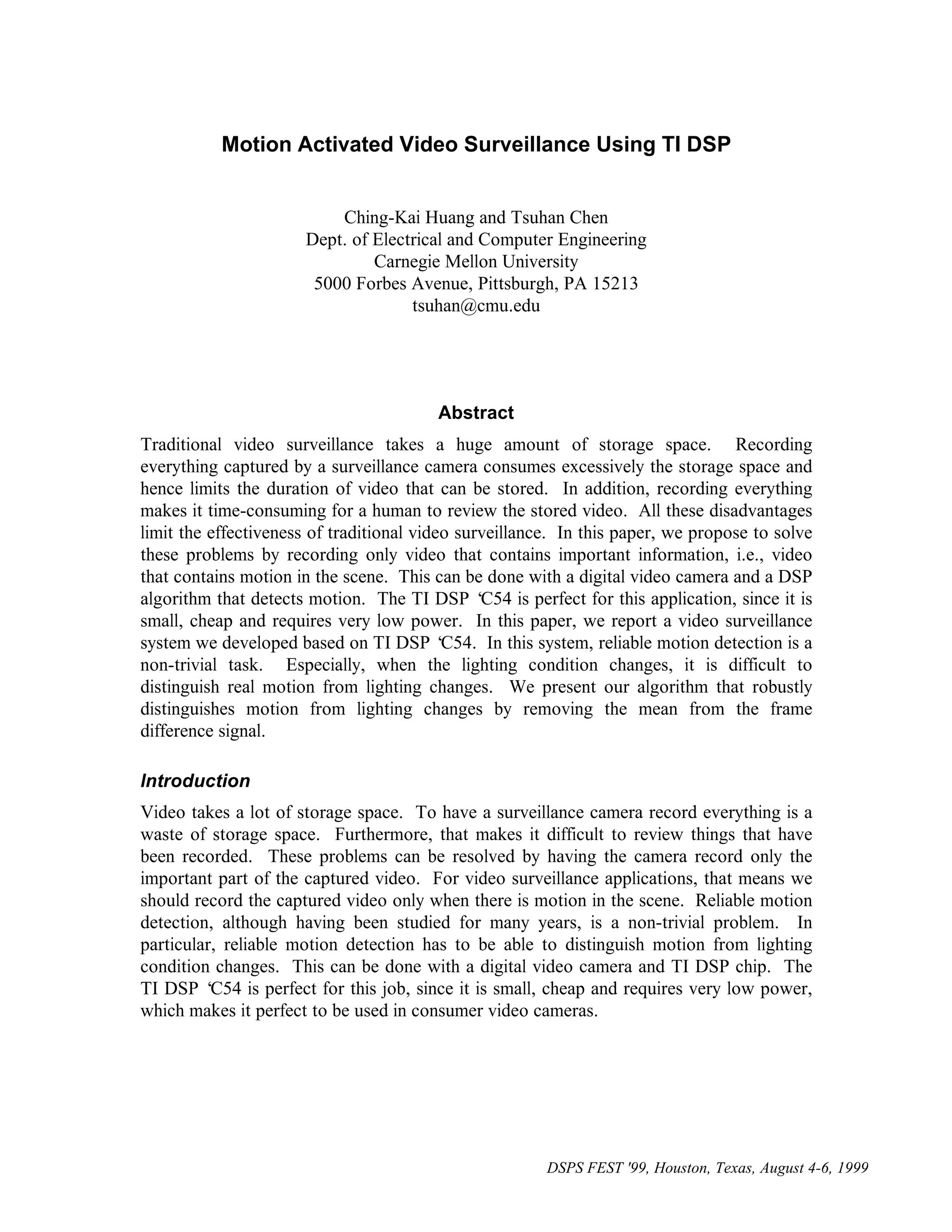
However, the SAD method as described above is not robust to lighting changes. As
shown in Figure 1, lighting changes alter the pixel values of the image and thus can result
in a very high value of SAD which may be mistaken as motion. In order to avoid this
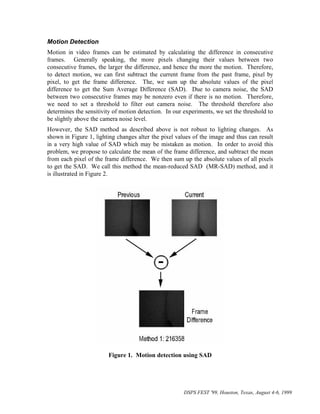
problem, we propose to calculate the mean of the frame difference, and subtract the mean
from each pixel of the frame difference. We then sum up the absolute values of all pixels
to get the SAD. We call this method the mean-reduced SAD (MR-SAD) method, and it
is illustrated in Figure 2.


                        Figure 1. Motion detection using SAD


                                                       DSPS FEST '99, Houston, Texas, August 4-6, 1999
Figure 2. Motion detection using MR-SAD

Suppose the camera is facing a white wall. When the light is dimmed, the camera would
observe a dark wall. The SAD obtained from simple frame difference would be very large,
hence may be mistaken as very heavy motion. However, with mean subtracted from the
frame difference, the resulting MR-SAD would be zero. Therefore, using MR-SAD for
motion detection is more robust to lighting changes than using the simple SAD.
The concept of MR-SAD is good as long as the scene is simple. When the scene is very
complex, objects in the scene may react differently when lighting condition changes.
Some objects may reflect more light than others do. In that case, MR-SAD may not be
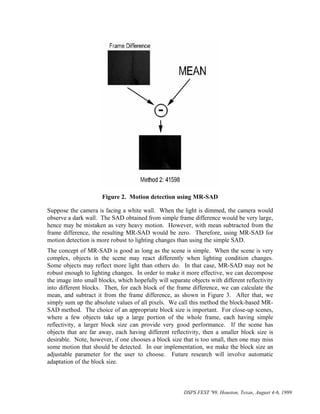
robust enough to lighting changes. In order to make it more effective, we can decompose
the image into small blocks, which hopefully will separate objects with different reflectivity
into different blocks. Then, for each block of the frame difference, we can calculate the
mean, and subtract it from the frame difference, as shown in Figure 3. After that, we
simply sum up the absolute values of all pixels. We call this method the block-based MR-
SAD method. The choice of an appropriate block size is important. For close-up scenes,
where a few objects take up a large portion of the whole frame, each having simple
reflectivity, a larger block size can provide very good performance. If the scene has
objects that are far away, each having different reflectivity, then a smaller block size is
desirable. Note, however, if one chooses a block size that is too small, then one may miss
some motion that should be detected. In our implementation, we make the block size an
adjustable parameter for the user to choose. Future research will involve automatic
adaptation of the block size.


                                                        DSPS FEST '99, Houston, Texas, August 4-6, 1999
Figure 3. Motion detection using blocked-based MR-SAD

We performed several experiments by taking two consecutive frames captured during
lighting changes when there was no real motion in the scene, and showed that both the
MR-SAD method and the blocked-based MR-SAD method do improve the robustness to
lighting changes, when compared with the simple SAD method. In one example, we
obtained SAD equal to 216,358 using SAD, 41,598 using MR-SAD, and 18,658 using
block-based MR-SAD. The camera noise was at the level of 16000 to 17000. We can see
that the block-based MR-SAD method has the highest robustness to lighting changes.

Implementation
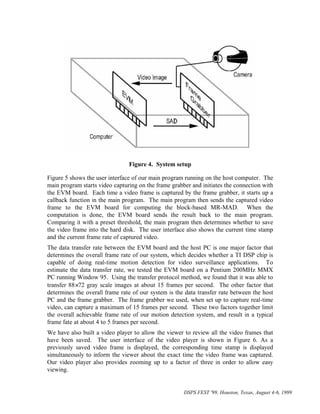
We built our system using an EVM board with TI C541 to detect motion using the block-
based MR-SAD method as described above. The EVM board receives video form the
host computer that has a frame grabber connected to a video camera. The EVM board
then calculates the frame difference and sends the blocked-based MR-MAD back to the
host computer. The host computer then compares it with a threshold, set by the user
according to the camera noise and the sensitive requirement, to decide whether to save the
video frames. Figure 4 shows the setup of the system.


                                                      DSPS FEST '99, Houston, Texas, August 4-6, 1999
Figure 4. System setup

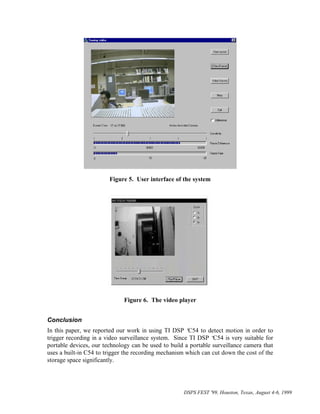
Figure 5 shows the user interface of our main program running on the host computer. The
main program starts video capturing on the frame grabber and initiates the connection with
the EVM board. Each time a video frame is captured by the frame grabber, it starts up a
callback function in the main program. The main program then sends the captured video
frame to the EVM board for computing the block-based MR-MAD. When the
computation is done, the EVM board sends the result back to the main program.
Comparing it with a preset threshold, the main program then determines whether to save
the video frame into the hard disk. The user interface also shows the current time stamp
and the current frame rate of captured video.
The data transfer rate between the EVM board and the host PC is one major factor that
determines the overall frame rate of our system, which decides whether a TI DSP chip is
capable of doing real-time motion detection for video surveillance applications. To
estimate the data transfer rate, we tested the EVM board on a Pentium 200MHz MMX
PC running Window 95. Using the transfer protocol method, we found that it was able to
transfer 88×72 gray scale images at about 15 frames per second. The other factor that
determines the overall frame rate of our system is the data transfer rate between the host
PC and the frame grabber. The frame grabber we used, when set up to capture real-time
video, can capture a maximum of 15 frames per second. These two factors together limit
the overall achievable frame rate of our motion detection system, and result in a typical
frame fate at about 4 to 5 frames per second.
We have also built a video player to allow the viewer to review all the video frames that
have been saved. The user interface of the video player is shown in Figure 6. As a
previously saved video frame is displayed, the corresponding time stamp is displayed
simultaneously to inform the viewer about the exact time the video frame was captured.
Our video player also provides zooming up to a factor of three in order to allow easy
viewing.


                                                      DSPS FEST '99, Houston, Texas, August 4-6, 1999
Figure 5. User interface of the system


                              Figure 6. The video player


Conclusion
In this paper, we reported our work in using TI DSP ‘   C54 to detect motion in order to
trigger recording in a video surveillance system. Since TI DSP ‘ C54 is very suitable for
portable devices, our technology can be used to build a portable surveillance camera that
uses a built-in C54 to trigger the recording mechanism which can cut down the cost of the
storage space significantly.


                                                     DSPS FEST '99, Houston, Texas, August 4-6, 1999

1paper

  • 1.
    Motion Activated VideoSurveillance Using TI DSP Ching-Kai Huang and Tsuhan Chen Dept. of Electrical and Computer Engineering Carnegie Mellon University 5000 Forbes Avenue, Pittsburgh, PA 15213 tsuhan@cmu.edu Abstract Traditional video surveillance takes a huge amount of storage space. Recording everything captured by a surveillance camera consumes excessively the storage space and hence limits the duration of video that can be stored. In addition, recording everything makes it time-consuming for a human to review the stored video. All these disadvantages limit the effectiveness of traditional video surveillance. In this paper, we propose to solve these problems by recording only video that contains important information, i.e., video that contains motion in the scene. This can be done with a digital video camera and a DSP algorithm that detects motion. The TI DSP ‘ C54 is perfect for this application, since it is small, cheap and requires very low power. In this paper, we report a video surveillance system we developed based on TI DSP ‘ C54. In this system, reliable motion detection is a non-trivial task. Especially, when the lighting condition changes, it is difficult to distinguish real motion from lighting changes. We present our algorithm that robustly distinguishes motion from lighting changes by removing the mean from the frame difference signal. Introduction Video takes a lot of storage space. To have a surveillance camera record everything is a waste of storage space. Furthermore, that makes it difficult to review things that have been recorded. These problems can be resolved by having the camera record only the important part of the captured video. For video surveillance applications, that means we should record the captured video only when there is motion in the scene. Reliable motion detection, although having been studied for many years, is a non-trivial problem. In particular, reliable motion detection has to be able to distinguish motion from lighting condition changes. This can be done with a digital video camera and TI DSP chip. The TI DSP ‘ C54 is perfect for this job, since it is small, cheap and requires very low power, which makes it perfect to be used in consumer video cameras. DSPS FEST '99, Houston, Texas, August 4-6, 1999
  • 2.
    Motion Detection Motion invideo frames can be estimated by calculating the difference in consecutive frames. Generally speaking, the more pixels changing their values between two consecutive frames, the larger the difference, and hence the more the motion. Therefore, to detect motion, we can first subtract the current frame from the past frame, pixel by pixel, to get the frame difference. The, we sum up the absolute values of the pixel difference to get the Sum Average Difference (SAD). Due to camera noise, the SAD between two consecutive frames may be nonzero even if there is no motion. Therefore, we need to set a threshold to filter out camera noise. The threshold therefore also determines the sensitivity of motion detection. In our experiments, we set the threshold to be slightly above the camera noise level. However, the SAD method as described above is not robust to lighting changes. As shown in Figure 1, lighting changes alter the pixel values of the image and thus can result in a very high value of SAD which may be mistaken as motion. In order to avoid this problem, we propose to calculate the mean of the frame difference, and subtract the mean from each pixel of the frame difference. We then sum up the absolute values of all pixels to get the SAD. We call this method the mean-reduced SAD (MR-SAD) method, and it is illustrated in Figure 2. Figure 1. Motion detection using SAD DSPS FEST '99, Houston, Texas, August 4-6, 1999
  • 3.
    Figure 2. Motiondetection using MR-SAD Suppose the camera is facing a white wall. When the light is dimmed, the camera would observe a dark wall. The SAD obtained from simple frame difference would be very large, hence may be mistaken as very heavy motion. However, with mean subtracted from the frame difference, the resulting MR-SAD would be zero. Therefore, using MR-SAD for motion detection is more robust to lighting changes than using the simple SAD. The concept of MR-SAD is good as long as the scene is simple. When the scene is very complex, objects in the scene may react differently when lighting condition changes. Some objects may reflect more light than others do. In that case, MR-SAD may not be robust enough to lighting changes. In order to make it more effective, we can decompose the image into small blocks, which hopefully will separate objects with different reflectivity into different blocks. Then, for each block of the frame difference, we can calculate the mean, and subtract it from the frame difference, as shown in Figure 3. After that, we simply sum up the absolute values of all pixels. We call this method the block-based MR- SAD method. The choice of an appropriate block size is important. For close-up scenes, where a few objects take up a large portion of the whole frame, each having simple reflectivity, a larger block size can provide very good performance. If the scene has objects that are far away, each having different reflectivity, then a smaller block size is desirable. Note, however, if one chooses a block size that is too small, then one may miss some motion that should be detected. In our implementation, we make the block size an adjustable parameter for the user to choose. Future research will involve automatic adaptation of the block size. DSPS FEST '99, Houston, Texas, August 4-6, 1999
  • 4.
    Figure 3. Motiondetection using blocked-based MR-SAD We performed several experiments by taking two consecutive frames captured during lighting changes when there was no real motion in the scene, and showed that both the MR-SAD method and the blocked-based MR-SAD method do improve the robustness to lighting changes, when compared with the simple SAD method. In one example, we obtained SAD equal to 216,358 using SAD, 41,598 using MR-SAD, and 18,658 using block-based MR-SAD. The camera noise was at the level of 16000 to 17000. We can see that the block-based MR-SAD method has the highest robustness to lighting changes. Implementation We built our system using an EVM board with TI C541 to detect motion using the block- based MR-SAD method as described above. The EVM board receives video form the host computer that has a frame grabber connected to a video camera. The EVM board then calculates the frame difference and sends the blocked-based MR-MAD back to the host computer. The host computer then compares it with a threshold, set by the user according to the camera noise and the sensitive requirement, to decide whether to save the video frames. Figure 4 shows the setup of the system. DSPS FEST '99, Houston, Texas, August 4-6, 1999
  • 5.
    Figure 4. Systemsetup Figure 5 shows the user interface of our main program running on the host computer. The main program starts video capturing on the frame grabber and initiates the connection with the EVM board. Each time a video frame is captured by the frame grabber, it starts up a callback function in the main program. The main program then sends the captured video frame to the EVM board for computing the block-based MR-MAD. When the computation is done, the EVM board sends the result back to the main program. Comparing it with a preset threshold, the main program then determines whether to save the video frame into the hard disk. The user interface also shows the current time stamp and the current frame rate of captured video. The data transfer rate between the EVM board and the host PC is one major factor that determines the overall frame rate of our system, which decides whether a TI DSP chip is capable of doing real-time motion detection for video surveillance applications. To estimate the data transfer rate, we tested the EVM board on a Pentium 200MHz MMX PC running Window 95. Using the transfer protocol method, we found that it was able to transfer 88×72 gray scale images at about 15 frames per second. The other factor that determines the overall frame rate of our system is the data transfer rate between the host PC and the frame grabber. The frame grabber we used, when set up to capture real-time video, can capture a maximum of 15 frames per second. These two factors together limit the overall achievable frame rate of our motion detection system, and result in a typical frame fate at about 4 to 5 frames per second. We have also built a video player to allow the viewer to review all the video frames that have been saved. The user interface of the video player is shown in Figure 6. As a previously saved video frame is displayed, the corresponding time stamp is displayed simultaneously to inform the viewer about the exact time the video frame was captured. Our video player also provides zooming up to a factor of three in order to allow easy viewing. DSPS FEST '99, Houston, Texas, August 4-6, 1999
  • 6.
    Figure 5. Userinterface of the system Figure 6. The video player Conclusion In this paper, we reported our work in using TI DSP ‘ C54 to detect motion in order to trigger recording in a video surveillance system. Since TI DSP ‘ C54 is very suitable for portable devices, our technology can be used to build a portable surveillance camera that uses a built-in C54 to trigger the recording mechanism which can cut down the cost of the storage space significantly. DSPS FEST '99, Houston, Texas, August 4-6, 1999