Introduction to Time Series Analysis. Lecture 1.
Peter Bartlett
1. Organizational issues.
2. Objectives of time series analysis. Examples.
3. Overview of the course.
4. Time series models.
5. Time series modelling: Chasing stationarity.
1
Organizational Issues
• Peter Bartlett. bartlett@stat. Office hours: Thu 1:30-2:30 (Evans 399).
Fri 3-4 (Soda 527).
• Brad Luen. bradluen@stat. Office hours: Tue/Wed 2-3pm (Room
TBA).
• http://www.stat.berkeley.edu/∼bartlett/courses/153-fall2005/
Check it for announcements, assignments, slides, ...
• Text: Time Series Analysis and its Applications, Shumway and Stoffer.
2
Organizational Issues
Computer Labs: Wed 12–1 and Wed 2–3, in 342 Evans.
You need to choose one of these times. Please email bradluen@stat with
your preference. First computer lab sections are on September 7.
Classroom Lab Section: Fri 12–1, in 330 Evans. First classroom lab
section is on September 2.
Assessment:
Lab/Homework Assignments (40%): posted on the website.
These involve a mix of pen-and-paper and computer exercises. You may use
any programming language you choose (R, Splus, Matlab). The last
assignment will involve analysis of a data set that you choose.
Midterm Exam (25%): scheduled for October 20, at the lecture.
Final Exam (35%): scheduled for Thursday, December 15.
3
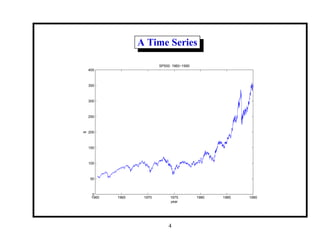
A Time Series
1960 1965 1970 1975 1980 1985 1990
0
50
100
150
200
250
300
350
400
year
$
SP500: 1960−1990
4
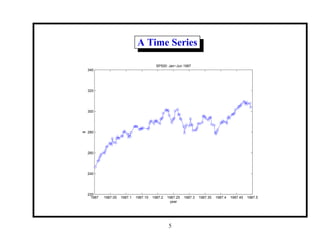
A Time Series
1987 1987.05 1987.1 1987.15 1987.2 1987.25 1987.3 1987.35 1987.4 1987.45 1987.5
220
240
260
280
300
320
340
year
$
SP500: Jan−Jun 1987
5
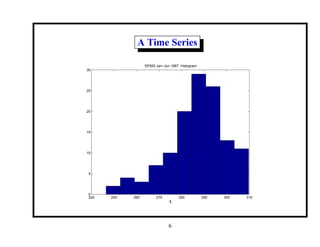
A Time Series
240 250 260 270 280 290 300 310
0
5
10
15
20
25
30
$
SP500 Jan−Jun 1987. Histogram
6
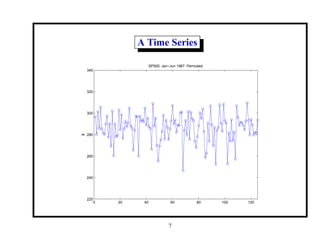
A Time Series
0 20 40 60 80 100 120
220
240
260
280
300
320
340
$
SP500: Jan−Jun 1987. Permuted.
7
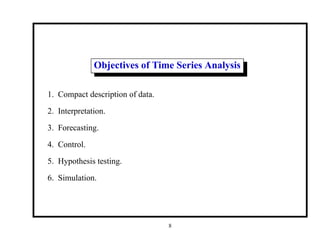
Objectives of Time Series Analysis
1. Compact description of data.
2. Interpretation.
3. Forecasting.
4. Control.
5. Hypothesis testing.
6. Simulation.
8
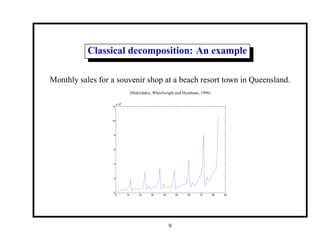
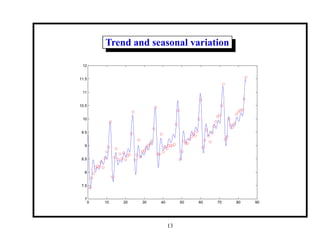
Classical decomposition: An example
Monthly sales for a souvenir shop at a beach resort town in Queensland.
(Makridakis, Wheelwright and Hyndman, 1998)
0 10 20 30 40 50 60 70 80 90
0
2
4
6
8
10
12
x 10
4
9
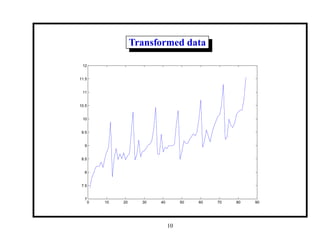
Transformed data
0 10 20 30 40 50 60 70 80 90
7
7.5
8
8.5
9
9.5
10
10.5
11
11.5
12
10
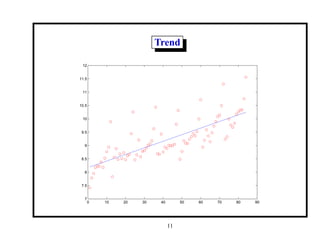
Trend
0 10 20 30 40 50 60 70 80 90
7
7.5
8
8.5
9
9.5
10
10.5
11
11.5
12
11
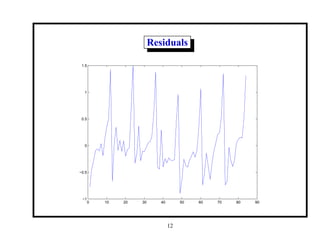
Residuals
0 10 20 30 40 50 60 70 80 90
−1
−0.5
0
0.5
1
1.5
12
Trend and seasonal variation
0 10 20 30 40 50 60 70 80 90
7
7.5
8
8.5
9
9.5
10
10.5
11
11.5
12
13
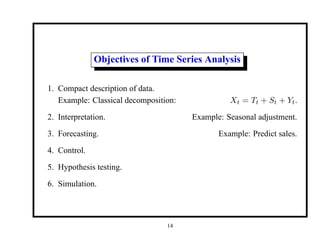
Objectives of Time Series Analysis
1. Compact description of data.
Example: Classical decomposition: Xt = Tt + St + Yt.
2. Interpretation. Example: Seasonal adjustment.
3. Forecasting. Example: Predict sales.
4. Control.
5. Hypothesis testing.
6. Simulation.
14
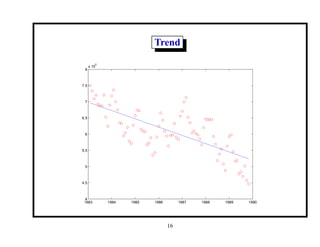
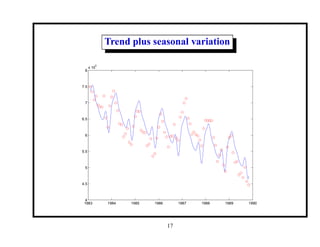
Unemployment data
Monthly number of unemployed people in Australia. (Hipel and McLeod, 1994)
1983 1984 1985 1986 1987 1988 1989 1990
4
4.5
5
5.5
6
6.5
7
7.5
8
x 10
5
15
Trend
1983 1984 1985 1986 1987 1988 1989 1990
4
4.5
5
5.5
6
6.5
7
7.5
8
x 10
5
16
Trend plus seasonal variation
1983 1984 1985 1986 1987 1988 1989 1990
4
4.5
5
5.5
6
6.5
7
7.5
8
x 10
5
17
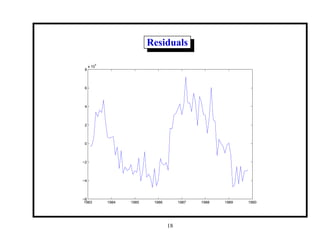
Residuals
1983 1984 1985 1986 1987 1988 1989 1990
−6
−4
−2
0
2
4
6
8
x 10
4
18
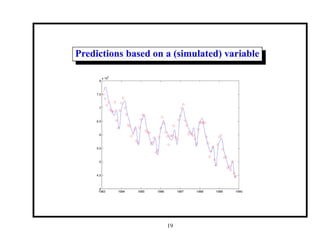
Predictions based on a (simulated) variable
1983 1984 1985 1986 1987 1988 1989 1990
4
4.5
5
5.5
6
6.5
7
7.5
8
x 10
5
19
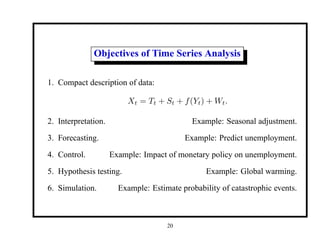
Objectives of Time Series Analysis
1. Compact description of data:
Xt = Tt + St + f(Yt) + Wt.
2. Interpretation. Example: Seasonal adjustment.
3. Forecasting. Example: Predict unemployment.
4. Control. Example: Impact of monetary policy on unemployment.
5. Hypothesis testing. Example: Global warming.
6. Simulation. Example: Estimate probability of catastrophic events.
20
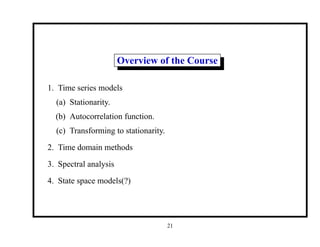
Overview of the Course
1. Time series models
(a) Stationarity.
(b) Autocorrelation function.
(c) Transforming to stationarity.
2. Time domain methods
3. Spectral analysis
4. State space models(?)
21
Overview of the Course
1. Time series models
2. Time domain methods
(a) AR/MA/ARMA models.
(b) ACF and partial autocorrelation function.
(c) Forecasting
(d) Parameter estimation
(e) ARIMA models/seasonal ARIMA models
3. Spectral analysis
4. State space models(?)
22
Overview of the Course
1. Time series models
2. Time domain methods
3. Spectral analysis
(a) Spectral density
(b) Periodogram
(c) Spectral estimation
4. State space models(?)
23
Overview of the Course
1. Time series models
2. Time domain methods
3. Spectral analysis
4. State space models(?)
(a) ARMAX models.
(b) Forecasting, Kalman filter.
(c) Parameter estimation.
24
Time Series Models
A time series model specifies the joint distribution of the se-
quence {Xt} of random variables.
For example:
P[X1 ≤ x1, . . . , Xt ≤ xt] for all t and x1, . . . , xt.
Notation:
X1, X2, . . . is a stochastic process.
x1, x2, . . . is a single realization.
We’ll mostly restrict our attention to second-order properties only:
EXt, E(Xt1 Xt2 ).
25
Time Series Models
Example: White noise: Xt ∼ WN(0, σ2
).
i.e., {Xt} uncorrelated, EXt = 0, VarXt = σ2
.
Example: i.i.d. noise: {Xt} independent and identically distributed.
P[X1 ≤ x1, . . . , Xt ≤ xt] = P[X1 ≤ x1] · · · P[Xt ≤ xt].
Not interesting for forecasting:
P[Xt ≤ xt|X1, . . . , Xt−1] = P[Xt ≤ xt].
26
Gaussian white noise
P[Xt ≤ xt] = Φ(xt) =
1
√
2π
Z xt
−∞
e−x2
/2
dx.
0 5 10 15 20 25 30 35 40 45 50
−2.5
−2
−1.5
−1
−0.5
0
0.5
1
1.5
2
2.5
27
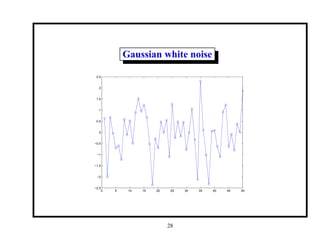
Gaussian white noise
0 5 10 15 20 25 30 35 40 45 50
−2.5
−2
−1.5
−1
−0.5
0
0.5
1
1.5
2
2.5
28
Time Series Models
Example: Binary i.i.d. P[Xt = 1] = P[Xt = −1] = 1/2.
0 5 10 15 20 25 30 35 40 45 50
−1
−0.8
−0.6
−0.4
−0.2
0
0.2
0.4
0.6
0.8
1
29
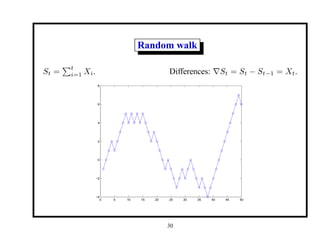
Random walk
St =
Pt
i=1 Xi. Differences: ∇St = St − St−1 = Xt.
0 5 10 15 20 25 30 35 40 45 50
−4
−2
0
2
4
6
8
30
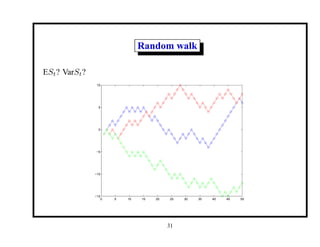
Random walk
ESt? VarSt?
0 5 10 15 20 25 30 35 40 45 50
−15
−10
−5
0
5
10
31
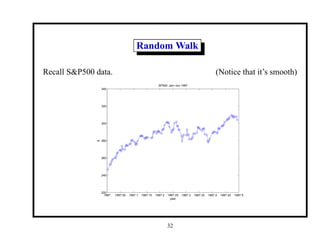
Random Walk
Recall S&P500 data. (Notice that it’s smooth)
1987 1987.05 1987.1 1987.15 1987.2 1987.25 1987.3 1987.35 1987.4 1987.45 1987.5
220
240
260
280
300
320
340
year
$
SP500: Jan−Jun 1987
32
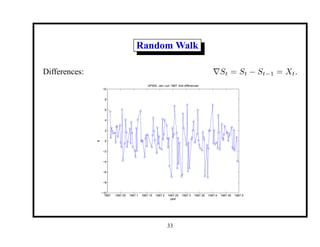
Random Walk
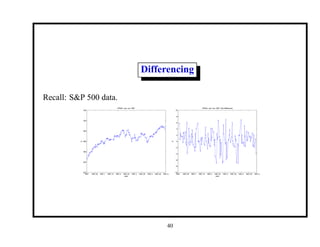
Differences: ∇St = St − St−1 = Xt.
1987 1987.05 1987.1 1987.15 1987.2 1987.25 1987.3 1987.35 1987.4 1987.45 1987.5
−10
−8
−6
−4
−2
0
2
4
6
8
10
year
$
SP500, Jan−Jun 1987. first differences
33
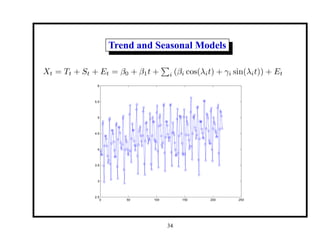
Trend and Seasonal Models
Xt = Tt + St + Et = β0 + β1t +
P
i (βi cos(λit) + γi sin(λit)) + Et
0 50 100 150 200 250
2.5
3
3.5
4
4.5
5
5.5
6
34
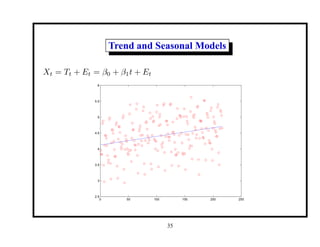
Trend and Seasonal Models
Xt = Tt + Et = β0 + β1t + Et
0 50 100 150 200 250
2.5
3
3.5
4
4.5
5
5.5
6
35
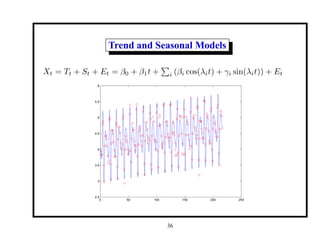
Trend and Seasonal Models
Xt = Tt + St + Et = β0 + β1t +
P
i (βi cos(λit) + γi sin(λit)) + Et
0 50 100 150 200 250
2.5
3
3.5
4
4.5
5
5.5
6
36
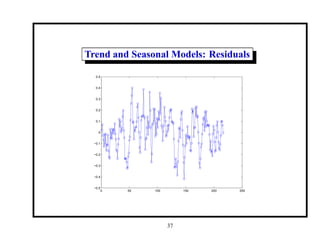
Trend and Seasonal Models: Residuals
0 50 100 150 200 250
−0.5
−0.4
−0.3
−0.2
−0.1
0
0.1
0.2
0.3
0.4
0.5
37
Time Series Modelling
1. Plot the time series.
Look for trends, seasonal components, step changes, outliers.
2. Transform data so that residuals are stationary.
(a) Estimate and subtract Tt, St.
(b) Differencing.
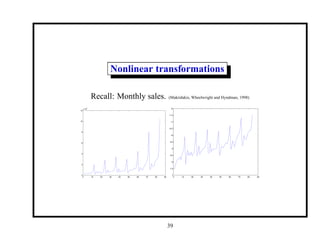
(c) Nonlinear transformations (log,
√
·).
3. Fit model to residuals.
38
Nonlinear transformations
Recall: Monthly sales. (Makridakis, Wheelwright and Hyndman, 1998)
0 10 20 30 40 50 60 70 80 90
0
2
4
6
8
10
12
x 10
4
0 10 20 30 40 50 60 70 80 90
7
7.5
8
8.5
9
9.5
10
10.5
11
11.5
12
39
Differencing
Recall: S&P 500 data.
1987 1987.05 1987.1 1987.15 1987.2 1987.25 1987.3 1987.35 1987.4 1987.45 1987.5
220
240
260
280
300
320
340
year
$
SP500: Jan−Jun 1987
1987 1987.05 1987.1 1987.15 1987.2 1987.25 1987.3 1987.35 1987.4 1987.45 1987.5
−10
−8
−6
−4
−2
0
2
4
6
8
10
year
$
SP500, Jan−Jun 1987. first differences
40
Differencing and Trend
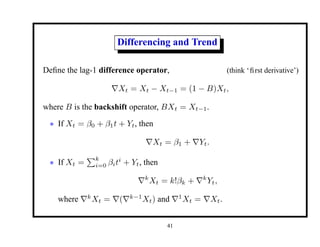
Define the lag-1 difference operator, (think ‘first derivative’)
∇Xt = Xt − Xt−1 = (1 − B)Xt,
where B is the backshift operator, BXt = Xt−1.
• If Xt = β0 + β1t + Yt, then
∇Xt = β1 + ∇Yt.
• If Xt =
Pk
i=0 βiti
+ Yt, then
∇k
Xt = k!βk + ∇k
Yt,
where ∇k
Xt = ∇(∇k−1
Xt) and ∇1
Xt = ∇Xt.
41
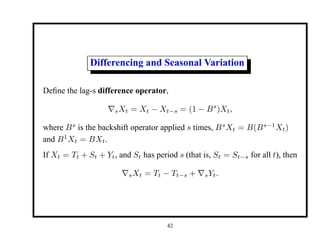
Differencing and Seasonal Variation
Define the lag-s difference operator,
∇sXt = Xt − Xt−s = (1 − Bs
)Xt,
where Bs
is the backshift operator applied s times, Bs
Xt = B(Bs−1
Xt)
and B1
Xt = BXt.
If Xt = Tt + St + Yt, and St has period s (that is, St = St−s for all t), then
∇sXt = Tt − Tt−s + ∇sYt.
42
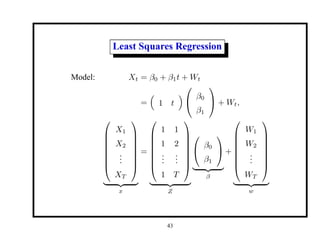
Least Squares Regression
Model: Xt = β0 + β1t + Wt
=

1 t



β0
β1

 + Wt,








X1
X2
.
.
.
XT








| {z }
x
=








1 1
1 2
.
.
.
.
.
.
1 T








| {z }
Z


β0
β1


| {z }
β
+








W1
W2
.
.
.
WT








| {z }
w
43
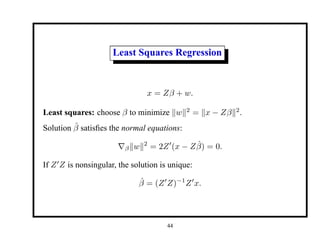
Least Squares Regression
x = Zβ + w.
Least squares: choose β to minimize kwk2
= kx − Zβk2
.
Solution β̂ satisfies the normal equations:
∇βkwk2
= 2Z0
(x − Zβ̂) = 0.
If Z0
Z is nonsingular, the solution is unique:
β̂ = (Z0
Z)−1
Z0
x.
44
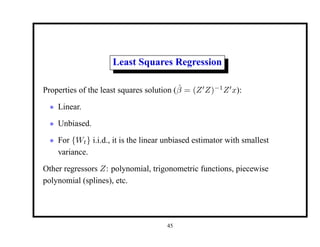
Least Squares Regression
Properties of the least squares solution (β̂ = (Z0
Z)−1
Z0
x):
• Linear.
• Unbiased.
• For {Wt} i.i.d., it is the linear unbiased estimator with smallest
variance.
Other regressors Z: polynomial, trigonometric functions, piecewise
polynomial (splines), etc.
45
Outline
1. Objectives of time series analysis. Examples.
2. Overview of the course.
3. Time series models.
4. Time series modelling: Chasing stationarity.
46

1notes

  • 1.
    Introduction to TimeSeries Analysis. Lecture 1. Peter Bartlett 1. Organizational issues. 2. Objectives of time series analysis. Examples. 3. Overview of the course. 4. Time series models. 5. Time series modelling: Chasing stationarity. 1
  • 2.
    Organizational Issues • PeterBartlett. bartlett@stat. Office hours: Thu 1:30-2:30 (Evans 399). Fri 3-4 (Soda 527). • Brad Luen. bradluen@stat. Office hours: Tue/Wed 2-3pm (Room TBA). • http://www.stat.berkeley.edu/∼bartlett/courses/153-fall2005/ Check it for announcements, assignments, slides, ... • Text: Time Series Analysis and its Applications, Shumway and Stoffer. 2
  • 3.
    Organizational Issues Computer Labs:Wed 12–1 and Wed 2–3, in 342 Evans. You need to choose one of these times. Please email bradluen@stat with your preference. First computer lab sections are on September 7. Classroom Lab Section: Fri 12–1, in 330 Evans. First classroom lab section is on September 2. Assessment: Lab/Homework Assignments (40%): posted on the website. These involve a mix of pen-and-paper and computer exercises. You may use any programming language you choose (R, Splus, Matlab). The last assignment will involve analysis of a data set that you choose. Midterm Exam (25%): scheduled for October 20, at the lecture. Final Exam (35%): scheduled for Thursday, December 15. 3
  • 4.
    A Time Series 19601965 1970 1975 1980 1985 1990 0 50 100 150 200 250 300 350 400 year $ SP500: 1960−1990 4
  • 5.
    A Time Series 19871987.05 1987.1 1987.15 1987.2 1987.25 1987.3 1987.35 1987.4 1987.45 1987.5 220 240 260 280 300 320 340 year $ SP500: Jan−Jun 1987 5
  • 6.
    A Time Series 240250 260 270 280 290 300 310 0 5 10 15 20 25 30 $ SP500 Jan−Jun 1987. Histogram 6
  • 7.
    A Time Series 020 40 60 80 100 120 220 240 260 280 300 320 340 $ SP500: Jan−Jun 1987. Permuted. 7
  • 8.
    Objectives of TimeSeries Analysis 1. Compact description of data. 2. Interpretation. 3. Forecasting. 4. Control. 5. Hypothesis testing. 6. Simulation. 8
  • 9.
    Classical decomposition: Anexample Monthly sales for a souvenir shop at a beach resort town in Queensland. (Makridakis, Wheelwright and Hyndman, 1998) 0 10 20 30 40 50 60 70 80 90 0 2 4 6 8 10 12 x 10 4 9
  • 10.
    Transformed data 0 1020 30 40 50 60 70 80 90 7 7.5 8 8.5 9 9.5 10 10.5 11 11.5 12 10
  • 11.
    Trend 0 10 2030 40 50 60 70 80 90 7 7.5 8 8.5 9 9.5 10 10.5 11 11.5 12 11
  • 12.
    Residuals 0 10 2030 40 50 60 70 80 90 −1 −0.5 0 0.5 1 1.5 12
  • 13.
    Trend and seasonalvariation 0 10 20 30 40 50 60 70 80 90 7 7.5 8 8.5 9 9.5 10 10.5 11 11.5 12 13
  • 14.
    Objectives of TimeSeries Analysis 1. Compact description of data. Example: Classical decomposition: Xt = Tt + St + Yt. 2. Interpretation. Example: Seasonal adjustment. 3. Forecasting. Example: Predict sales. 4. Control. 5. Hypothesis testing. 6. Simulation. 14
  • 15.
    Unemployment data Monthly numberof unemployed people in Australia. (Hipel and McLeod, 1994) 1983 1984 1985 1986 1987 1988 1989 1990 4 4.5 5 5.5 6 6.5 7 7.5 8 x 10 5 15
  • 16.
    Trend 1983 1984 19851986 1987 1988 1989 1990 4 4.5 5 5.5 6 6.5 7 7.5 8 x 10 5 16
  • 17.
    Trend plus seasonalvariation 1983 1984 1985 1986 1987 1988 1989 1990 4 4.5 5 5.5 6 6.5 7 7.5 8 x 10 5 17
  • 18.
    Residuals 1983 1984 19851986 1987 1988 1989 1990 −6 −4 −2 0 2 4 6 8 x 10 4 18
  • 19.
    Predictions based ona (simulated) variable 1983 1984 1985 1986 1987 1988 1989 1990 4 4.5 5 5.5 6 6.5 7 7.5 8 x 10 5 19
  • 20.
    Objectives of TimeSeries Analysis 1. Compact description of data: Xt = Tt + St + f(Yt) + Wt. 2. Interpretation. Example: Seasonal adjustment. 3. Forecasting. Example: Predict unemployment. 4. Control. Example: Impact of monetary policy on unemployment. 5. Hypothesis testing. Example: Global warming. 6. Simulation. Example: Estimate probability of catastrophic events. 20
  • 21.
    Overview of theCourse 1. Time series models (a) Stationarity. (b) Autocorrelation function. (c) Transforming to stationarity. 2. Time domain methods 3. Spectral analysis 4. State space models(?) 21
  • 22.
    Overview of theCourse 1. Time series models 2. Time domain methods (a) AR/MA/ARMA models. (b) ACF and partial autocorrelation function. (c) Forecasting (d) Parameter estimation (e) ARIMA models/seasonal ARIMA models 3. Spectral analysis 4. State space models(?) 22
  • 23.
    Overview of theCourse 1. Time series models 2. Time domain methods 3. Spectral analysis (a) Spectral density (b) Periodogram (c) Spectral estimation 4. State space models(?) 23
  • 24.
    Overview of theCourse 1. Time series models 2. Time domain methods 3. Spectral analysis 4. State space models(?) (a) ARMAX models. (b) Forecasting, Kalman filter. (c) Parameter estimation. 24
  • 25.
    Time Series Models Atime series model specifies the joint distribution of the se- quence {Xt} of random variables. For example: P[X1 ≤ x1, . . . , Xt ≤ xt] for all t and x1, . . . , xt. Notation: X1, X2, . . . is a stochastic process. x1, x2, . . . is a single realization. We’ll mostly restrict our attention to second-order properties only: EXt, E(Xt1 Xt2 ). 25
  • 26.
    Time Series Models Example:White noise: Xt ∼ WN(0, σ2 ). i.e., {Xt} uncorrelated, EXt = 0, VarXt = σ2 . Example: i.i.d. noise: {Xt} independent and identically distributed. P[X1 ≤ x1, . . . , Xt ≤ xt] = P[X1 ≤ x1] · · · P[Xt ≤ xt]. Not interesting for forecasting: P[Xt ≤ xt|X1, . . . , Xt−1] = P[Xt ≤ xt]. 26
  • 27.
    Gaussian white noise P[Xt≤ xt] = Φ(xt) = 1 √ 2π Z xt −∞ e−x2 /2 dx. 0 5 10 15 20 25 30 35 40 45 50 −2.5 −2 −1.5 −1 −0.5 0 0.5 1 1.5 2 2.5 27
  • 28.
    Gaussian white noise 05 10 15 20 25 30 35 40 45 50 −2.5 −2 −1.5 −1 −0.5 0 0.5 1 1.5 2 2.5 28
  • 29.
    Time Series Models Example:Binary i.i.d. P[Xt = 1] = P[Xt = −1] = 1/2. 0 5 10 15 20 25 30 35 40 45 50 −1 −0.8 −0.6 −0.4 −0.2 0 0.2 0.4 0.6 0.8 1 29
  • 30.
    Random walk St = Pt i=1Xi. Differences: ∇St = St − St−1 = Xt. 0 5 10 15 20 25 30 35 40 45 50 −4 −2 0 2 4 6 8 30
  • 31.
    Random walk ESt? VarSt? 05 10 15 20 25 30 35 40 45 50 −15 −10 −5 0 5 10 31
  • 32.
    Random Walk Recall S&P500data. (Notice that it’s smooth) 1987 1987.05 1987.1 1987.15 1987.2 1987.25 1987.3 1987.35 1987.4 1987.45 1987.5 220 240 260 280 300 320 340 year $ SP500: Jan−Jun 1987 32
  • 33.
    Random Walk Differences: ∇St= St − St−1 = Xt. 1987 1987.05 1987.1 1987.15 1987.2 1987.25 1987.3 1987.35 1987.4 1987.45 1987.5 −10 −8 −6 −4 −2 0 2 4 6 8 10 year $ SP500, Jan−Jun 1987. first differences 33
  • 34.
    Trend and SeasonalModels Xt = Tt + St + Et = β0 + β1t + P i (βi cos(λit) + γi sin(λit)) + Et 0 50 100 150 200 250 2.5 3 3.5 4 4.5 5 5.5 6 34
  • 35.
    Trend and SeasonalModels Xt = Tt + Et = β0 + β1t + Et 0 50 100 150 200 250 2.5 3 3.5 4 4.5 5 5.5 6 35
  • 36.
    Trend and SeasonalModels Xt = Tt + St + Et = β0 + β1t + P i (βi cos(λit) + γi sin(λit)) + Et 0 50 100 150 200 250 2.5 3 3.5 4 4.5 5 5.5 6 36
  • 37.
    Trend and SeasonalModels: Residuals 0 50 100 150 200 250 −0.5 −0.4 −0.3 −0.2 −0.1 0 0.1 0.2 0.3 0.4 0.5 37
  • 38.
    Time Series Modelling 1.Plot the time series. Look for trends, seasonal components, step changes, outliers. 2. Transform data so that residuals are stationary. (a) Estimate and subtract Tt, St. (b) Differencing. (c) Nonlinear transformations (log, √ ·). 3. Fit model to residuals. 38
  • 39.
    Nonlinear transformations Recall: Monthlysales. (Makridakis, Wheelwright and Hyndman, 1998) 0 10 20 30 40 50 60 70 80 90 0 2 4 6 8 10 12 x 10 4 0 10 20 30 40 50 60 70 80 90 7 7.5 8 8.5 9 9.5 10 10.5 11 11.5 12 39
  • 40.
    Differencing Recall: S&P 500data. 1987 1987.05 1987.1 1987.15 1987.2 1987.25 1987.3 1987.35 1987.4 1987.45 1987.5 220 240 260 280 300 320 340 year $ SP500: Jan−Jun 1987 1987 1987.05 1987.1 1987.15 1987.2 1987.25 1987.3 1987.35 1987.4 1987.45 1987.5 −10 −8 −6 −4 −2 0 2 4 6 8 10 year $ SP500, Jan−Jun 1987. first differences 40
  • 41.
    Differencing and Trend Definethe lag-1 difference operator, (think ‘first derivative’) ∇Xt = Xt − Xt−1 = (1 − B)Xt, where B is the backshift operator, BXt = Xt−1. • If Xt = β0 + β1t + Yt, then ∇Xt = β1 + ∇Yt. • If Xt = Pk i=0 βiti + Yt, then ∇k Xt = k!βk + ∇k Yt, where ∇k Xt = ∇(∇k−1 Xt) and ∇1 Xt = ∇Xt. 41
  • 42.
    Differencing and SeasonalVariation Define the lag-s difference operator, ∇sXt = Xt − Xt−s = (1 − Bs )Xt, where Bs is the backshift operator applied s times, Bs Xt = B(Bs−1 Xt) and B1 Xt = BXt. If Xt = Tt + St + Yt, and St has period s (that is, St = St−s for all t), then ∇sXt = Tt − Tt−s + ∇sYt. 42
  • 43.
    Least Squares Regression Model:Xt = β0 + β1t + Wt = 1 t   β0 β1   + Wt,         X1 X2 . . . XT         | {z } x =         1 1 1 2 . . . . . . 1 T         | {z } Z   β0 β1   | {z } β +         W1 W2 . . . WT         | {z } w 43
  • 44.
    Least Squares Regression x= Zβ + w. Least squares: choose β to minimize kwk2 = kx − Zβk2 . Solution β̂ satisfies the normal equations: ∇βkwk2 = 2Z0 (x − Zβ̂) = 0. If Z0 Z is nonsingular, the solution is unique: β̂ = (Z0 Z)−1 Z0 x. 44
  • 45.
    Least Squares Regression Propertiesof the least squares solution (β̂ = (Z0 Z)−1 Z0 x): • Linear. • Unbiased. • For {Wt} i.i.d., it is the linear unbiased estimator with smallest variance. Other regressors Z: polynomial, trigonometric functions, piecewise polynomial (splines), etc. 45
  • 46.
    Outline 1. Objectives oftime series analysis. Examples. 2. Overview of the course. 3. Time series models. 4. Time series modelling: Chasing stationarity. 46