Supersymmetric Q-balls and boson stars in
(d + 1) dimensions
Jürgen Riedel
in Collaboration with Betti Hartmann, Jacobs University Bremen
School of Engineering and Science
Jacobs University Bremen, Germany
INTERNAL WORKSHOP JUB TALK
Bremen, Jan 19th 2013
Jürgen Riedel & Betti Hartmann Supersymmetric Q-balls and boson stars in (d + 1) dimensions
Introduction
Q-balls
Boson stars
AdS/CFT correspondence
SUSY Q-balls in AdS background
SUSY boson stars in AdS background
Summary results in 4 dimensions
Q-Balls and boson stars in d + 1 dimensions
Numerical results in d + 1 dimensions
Outline
1 Introduction
2 Q-balls in 3+1 dimensions
3 Boson stars in 3+1 dimensions
4 AdS/CFT correspondence
5 SUSY Q-balls in AdS5 background
6 SUSY boson stars in AdS background
7 Summary results in 4 dimensions
8 Q-Balls and boson stars in d + 1 dimensions
9 Numerical results in d + 1 dimensions
Jürgen Riedel & Betti Hartmann Supersymmetric Q-balls and boson stars in (d + 1) dimensions
Solitons in non-linear field theories
General properties of soliton solutions
localized, finite energy, stable, regular solutions of
non-linear equations
can be viewed as models of elementary particles
dimension
Examples and restrictions
Skyrme model of hadrons in high energy physics one of
first models
Derrick’s theorem puts restrictions to localized soliton
solutions in more than one spatial dimension
Jürgen Riedel & Betti Hartmann Supersymmetric Q-balls and boson stars in (d + 1) dimensions
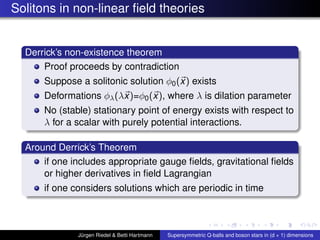
Solitons in non-linear field theories
Derrick’s non-existence theorem
Proof proceeds by contradiction
Suppose a solitonic solution φ0(x) exists
Deformations φλ(λx)=φ0(x), where λ is dilation parameter
No (stable) stationary point of energy exists with respect to
λ for a scalar with purely potential interactions.
Around Derrick’s Theorem
if one includes appropriate gauge fields, gravitational fields
or higher derivatives in field Lagrangian
if one considers solutions which are periodic in time
Jürgen Riedel & Betti Hartmann Supersymmetric Q-balls and boson stars in (d + 1) dimensions
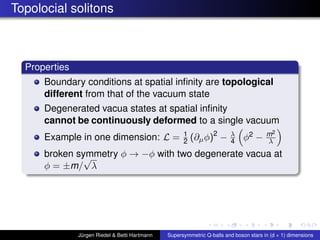
Topolocial solitons
Properties
Boundary conditions at spatial infinity are topological
different from that of the vacuum state
Degenerated vacua states at spatial infinity
cannot be continuously deformed to a single vacuum
Example in one dimension: L = 1
2 (∂µφ)2
− λ
4 φ2 − m2
λ
broken symmetry φ → −φ with two degenerate vacua at
φ = ±m/
√
λ
Jürgen Riedel & Betti Hartmann Supersymmetric Q-balls and boson stars in (d + 1) dimensions
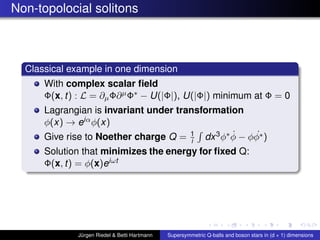
Non-topolocial solitons
Classical example in one dimension
With complex scalar field
Φ(x, t) : L = ∂µΦ∂µΦ∗ − U(|Φ|), U(|Φ|) minimum at Φ = 0
Lagrangian is invariant under transformation
φ(x) → eiαφ(x)
Give rise to Noether charge Q = 1
i dx3φ∗ ˙φ − φ ˙φ∗)
Solution that minimizes the energy for fixed Q:
Φ(x, t) = φ(x)eiωt
Jürgen Riedel & Betti Hartmann Supersymmetric Q-balls and boson stars in (d + 1) dimensions
Prominent examples for topological solitons
Further examples
vortices, magnetic monopoles, domain walls, cosmic
strings, textures
Prominent examples for non-topological solitons
Q-balls
Boson stars
Jürgen Riedel & Betti Hartmann Supersymmetric Q-balls and boson stars in (d + 1) dimensions
The model
Lagrangian L =∂µΦ∂µΦ∗ − U(|Φ|); the signature of the
metric is (+,-,-,-)
Noether current j = i(Φ∗ ˙Φ − Φ ˙Φ∗) symmetry under U(1)
Conserved Noether charge Q = 1
i d3(Φ∗ ˙Φ − Φ ˙Φ∗), with
Φ := Φ(t, r) we have dQ
dt = 0
Ansatz for solution Φ(x, t) = φ(x)eiωt
Energy-momentum tensor
Tµν = ∂µΦ∂νΦ∗ + ∂νΦ∂µΦ∗ − gµνL
Total Energy E = d3xT0
0 = d3x[| ˙Φ|2 + | Φ|2 + U(|Φ|)]
under assumption that gµν is time-independent
Jürgen Riedel & Betti Hartmann Supersymmetric Q-balls and boson stars in (d + 1) dimensions
Existence conditions of Q-balls
Condition 1
V (0) < 0; Φ ≡ 0 local maximum ⇒ ω2 < ω2
max ≡ U (0)
Condition 2
ω2 > ω2
min ≡ minφ[2U(φ)/φ2] minimum over all φ
Consequences
Restricted interval ω2
min < ω2 < ω2
max ;
U (0) > minφ[2U(φ)/φ2]
Q-balls are rotating in inner space with ω stabilized by
having a lower energy to charge ratio as the free particles
Jürgen Riedel & Betti Hartmann Supersymmetric Q-balls and boson stars in (d + 1) dimensions
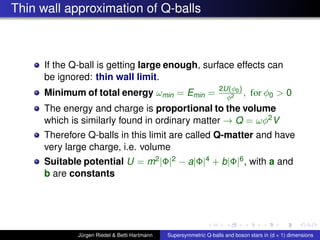
Thin wall approximation of Q-balls
If the Q-ball is getting large enough, surface effects can
be ignored: thin wall limit.
Minimum of total energy ωmin = Emin = 2U(φ0)
φ2 , for φ0 > 0
The energy and charge is proportional to the volume
which is similarly found in ordinary matter → Q = ωφ2V
Therefore Q-balls in this limit are called Q-matter and have
very large charge, i.e. volume
Suitable potential U = m2|Φ|2 − a|Φ|4 + b|Φ|6, with a and
b are constants
Jürgen Riedel & Betti Hartmann Supersymmetric Q-balls and boson stars in (d + 1) dimensions
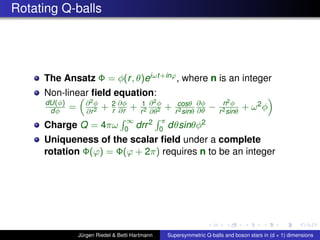
Rotating Q-balls
The Ansatz Φ = φ(r, θ)eiωt+inϕ, where n is an integer
Non-linear field equation:
dU(φ)
dφ = ∂2φ
∂r2 + 2
r
∂φ
∂r + 1
r2
∂2φ
∂θ2 + cosθ
r2sinθ
∂φ
∂θ − n2φ
r2sinθ
+ ω2φ
Charge Q = 4πω
∞
0 drr2 π
0 dθsinθφ2
Uniqueness of the scalar field under a complete
rotation Φ(ϕ) = Φ(ϕ + 2π) requires n to be an integer
Jürgen Riedel & Betti Hartmann Supersymmetric Q-balls and boson stars in (d + 1) dimensions
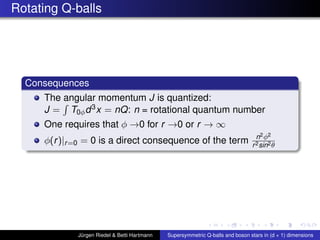
Rotating Q-balls
Consequences
The angular momentum J is quantized:
J = T0φd3x = nQ: n = rotational quantum number
One requires that φ →0 for r →0 or r → ∞
φ(r)|r=0 = 0 is a direct consequence of the term n2φ2
r2sin2θ
Jürgen Riedel & Betti Hartmann Supersymmetric Q-balls and boson stars in (d + 1) dimensions
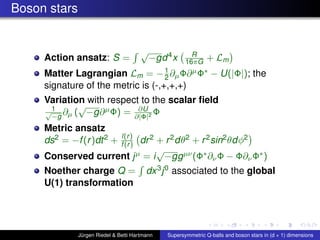
Boson stars
Action ansatz: S =
√
−gd4x R
16πG + Lm
Matter Lagrangian Lm = −1
2 ∂µΦ∂µΦ∗ − U(|Φ|); the
signature of the metric is (-,+,+,+)
Variation with respect to the scalar field
1√
−g
∂µ (
√
−g∂µΦ) = ∂U
∂|Φ|2 Φ
Metric ansatz
ds2 = −f(r)dt2 + l(r)
f(r) dr2 + r2dθ2 + r2sin2θdφ2
Conserved current jµ = i
√
−ggµν(Φ∗∂νΦ − Φ∂νΦ∗)
Noether charge Q = dx3j0 associated to the global
U(1) transformation
Jürgen Riedel & Betti Hartmann Supersymmetric Q-balls and boson stars in (d + 1) dimensions
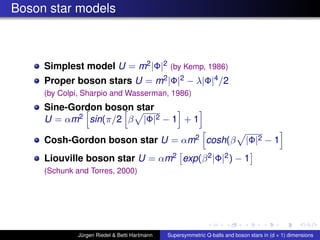
Boson star models
Simplest model U = m2|Φ|2 (by Kemp, 1986)
Proper boson stars U = m2|Φ|2 − λ|Φ|4/2
(by Colpi, Sharpio and Wasserman, 1986)
Sine-Gordon boson star
U = αm2 sin(π/2 β |Φ|2 − 1 + 1
Cosh-Gordon boson star U = αm2 cosh(β |Φ|2 − 1
Liouville boson star U = αm2 exp(β2|Φ|2) − 1
(Schunk and Torres, 2000)
Jürgen Riedel & Betti Hartmann Supersymmetric Q-balls and boson stars in (d + 1) dimensions
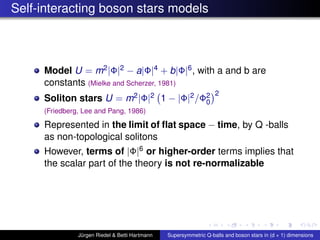
Self-interacting boson stars models
Model U = m2|Φ|2 − a|Φ|4 + b|Φ|6, with a and b are
constants (Mielke and Scherzer, 1981)
Soliton stars U = m2|Φ|2 1 − |Φ|2/Φ2
0
2
(Friedberg, Lee and Pang, 1986)
Represented in the limit of flat space − time, by Q -balls
as non-topological solitons
However, terms of |Φ|6 or higher-order terms implies that
the scalar part of the theory is not re-normalizable
Jürgen Riedel & Betti Hartmann Supersymmetric Q-balls and boson stars in (d + 1) dimensions
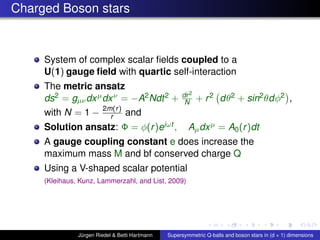
Charged Boson stars
System of complex scalar fields coupled to a
U(1) gauge field with quartic self-interaction
The metric ansatz
ds2 = gµνdxµdxν = −A2Ndt2 + dr2
N + r2 dθ2 + sin2θdφ2 ,
with N = 1 − 2m(r)
r and
Solution ansatz: Φ = φ(r)eiωt , Aµdxµ = A0(r)dt
A gauge coupling constant e does increase the
maximum mass M and bf conserved charge Q
Using a V-shaped scalar potential
(Kleihaus, Kunz, Lammerzahl, and List, 2009)
Jürgen Riedel & Betti Hartmann Supersymmetric Q-balls and boson stars in (d + 1) dimensions
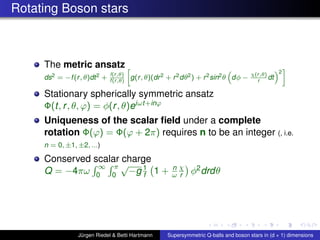
Rotating Boson stars
The metric ansatz
ds2 = −f(r, θ)dt2 +
l(r,θ)
f(r,θ)
g(r, θ)(dr2 + r2dθ2) + r2sin2θ dφ −
χ(r,θ)
r
dt
2
Stationary spherically symmetric ansatz
Φ(t, r, θ, ϕ) = φ(r, θ)eiωt+inϕ
Uniqueness of the scalar field under a complete
rotation Φ(ϕ) = Φ(ϕ + 2π) requires n to be an integer (, i.e.
n = 0, ±1, ±2, ...)
Conserved scalar charge
Q = −4πω
∞
0
π
0
√
−g 1
f 1 + n
ω
χ
r φ2drdθ
Jürgen Riedel & Betti Hartmann Supersymmetric Q-balls and boson stars in (d + 1) dimensions
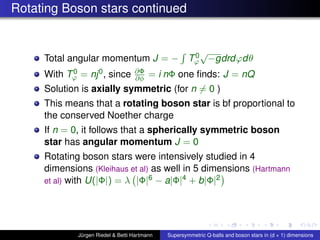
Rotating Boson stars continued
Total angular momentum J = − T0
ϕ
√
−gdrdϕdθ
With T0
ϕ = nj0, since ∂Φ
∂φ = i nΦ one finds: J = nQ
Solution is axially symmetric (for n = 0 )
This means that a rotating boson star is bf proportional to
the conserved Noether charge
If n = 0, it follows that a spherically symmetric boson
star has angular momentum J = 0
Rotating boson stars were intensively studied in 4
dimensions (Kleihaus et al) as well in 5 dimensions (Hartmann
et al) with U(|Φ|) = λ |Φ|6 − a|Φ|4 + b|Φ|2
Jürgen Riedel & Betti Hartmann Supersymmetric Q-balls and boson stars in (d + 1) dimensions
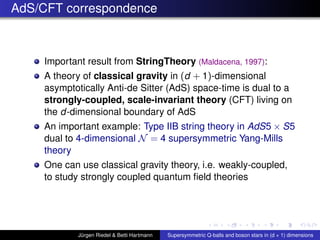
AdS/CFT correspondence
Important result from StringTheory (Maldacena, 1997):
A theory of classical gravity in (d + 1)-dimensional
asymptotically Anti-de Sitter (AdS) space-time is dual to a
strongly-coupled, scale-invariant theory (CFT) living on
the d-dimensional boundary of AdS
An important example: Type IIB string theory in AdS5 × S5
dual to 4-dimensional N = 4 supersymmetric Yang-Mills
theory
One can use classical gravity theory, i.e. weakly-coupled,
to study strongly coupled quantum field theories
Jürgen Riedel & Betti Hartmann Supersymmetric Q-balls and boson stars in (d + 1) dimensions
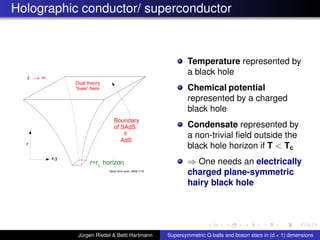
Holographic conductor/ superconductor
Taken from arxiv: 0808.1115
Boundary
of SAdS
≡
AdS
Dual theory
“lives” here
r → ∞
r
x,y
r=rh
horizon
Temperature represented by
a black hole
Chemical potential
represented by a charged
black hole
Condensate represented by
a non-trivial field outside the
black hole horizon if T < Tc
⇒ One needs an electrically
charged plane-symmetric
hairy black hole
Jürgen Riedel & Betti Hartmann Supersymmetric Q-balls and boson stars in (d + 1) dimensions
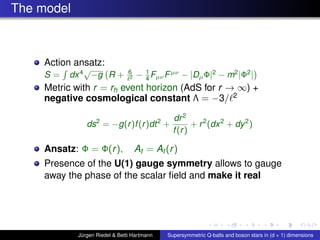
The model
Action ansatz:
S = dx4√
−g R + 6
2 − 1
4 FµνFµν
− |DµΦ|2
− m2
|Φ2
|
Metric with r = rh event horizon (AdS for r → ∞) +
negative cosmological constant Λ = −3/ 2
ds2
= −g(r)f(r)dt2
+
dr2
f(r)
+ r2
(dx2
+ dy2
)
Ansatz: Φ = Φ(r), At = At (r)
Presence of the U(1) gauge symmetry allows to gauge
away the phase of the scalar field and make it real
Jürgen Riedel & Betti Hartmann Supersymmetric Q-balls and boson stars in (d + 1) dimensions
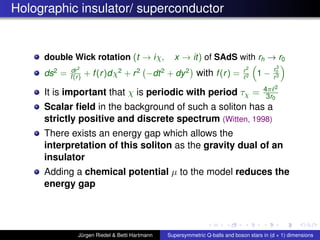
Holographic insulator/ superconductor
double Wick rotation (t → iχ, x → it) of SAdS with rh → r0
ds2
= dr2
f(r) + f(r)dχ2
+ r2
−dt2
+ dy2
with f(r) = r2
2 1 −
r3
0
r3
It is important that χ is periodic with period τχ = 4π 2
3r0
Scalar field in the background of such a soliton has a
strictly positive and discrete spectrum (Witten, 1998)
There exists an energy gap which allows the
interpretation of this soliton as the gravity dual of an
insulator
Adding a chemical potential µ to the model reduces the
energy gap
Jürgen Riedel & Betti Hartmann Supersymmetric Q-balls and boson stars in (d + 1) dimensions
The e = 0 limit
In the case of vanishing gauge coupling constant e:
The scalar field decouples from gauge field
One cannot use gauge to make scalar field real
The simplest ansatz for complex scalar field:
φ(r) = φeiωt
This leads to Q-balls and boson stars solutions
Jürgen Riedel & Betti Hartmann Supersymmetric Q-balls and boson stars in (d + 1) dimensions
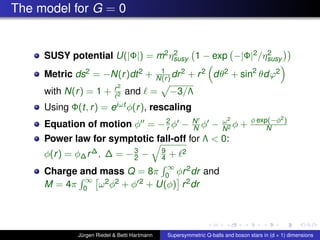
The model for G = 0
SUSY potential U(|Φ|) = m2η2
susy 1 − exp −|Φ|2/η2
susy
Metric ds2 = −N(r)dt2 + 1
N(r) dr2 + r2 dθ2 + sin2
θdϕ2
with N(r) = 1 + r2
2 and = −3/Λ
Using Φ(t, r) = eiωt φ(r), rescaling
Equation of motion φ = −2
r φ − N
N φ − ω2
N2 φ + φ exp(−φ2)
N
Power law for symptotic fall-off for Λ < 0:
φ(r) = φ∆r∆, ∆ = −3
2 − 9
4 + 2
Charge and mass Q = 8π
∞
0 φr2dr and
M = 4π
∞
0 ω2φ2 + φ 2 + U(φ) r2dr
Jürgen Riedel & Betti Hartmann Supersymmetric Q-balls and boson stars in (d + 1) dimensions
First results of the numerical analysis
ω
M
0.5 0.6 0.7 0.8 0.9 1.0 1.1 1.2
5010020050010002000
Mass over Omega
Λ
= 0
= −0.01
= −0.02
= −0.025
ω
M
0.5 0.6 0.7 0.8 0.9 1.0 1.1 1.2
5010020050010002000
Charge over Omega
Λ
= 0
= −0.01
= −0.02
= −0.025
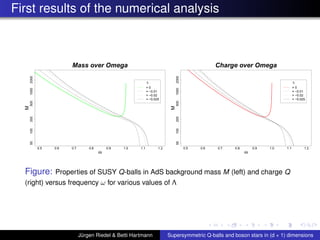
Figure: Properties of SUSY Q-balls in AdS background mass M (left) and charge Q
(right) versus frequency ω for various values of Λ
Jürgen Riedel & Betti Hartmann Supersymmetric Q-balls and boson stars in (d + 1) dimensions
First results of the numerical analysis
φ(0)
M
0 2 4 6 8 10
110100100010000
Mass over Phi(0)
Λ
= 0
= −0.01
= −0.02
= −0.025
φ(0)
Q
0 2 4 6 8 10
110100100010000
Charge over Phi(0)
Λ
= 0
= −0.5
= −0.−1
= −5
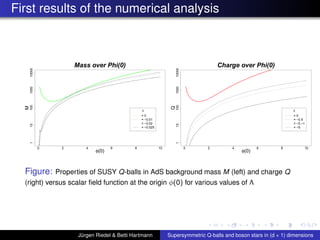
Figure: Properties of SUSY Q-balls in AdS background mass M (left) and charge Q
(right) versus scalar field function at the origin φ(0) for various values of Λ
Jürgen Riedel & Betti Hartmann Supersymmetric Q-balls and boson stars in (d + 1) dimensions
First results of the numerical analysis
M
Q
200 500 1000 2000 5000 10000 20000
200500200050002000050000
Charge over Mass
Λ
= 0
= −0.01
= −0.02
= −0.025
ω
φ(0)
0.2 0.4 0.6 0.8 1.0 1.2
0246810
Phi(0) over Omega
Λ
= 0
= −0.01
= −0.02
= −0.025
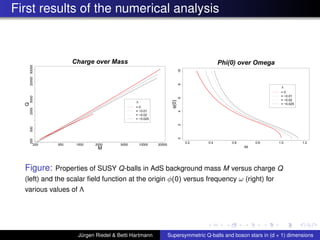
Figure: Properties of SUSY Q-balls in AdS background mass M versus charge Q
(left) and the scalar field function at the origin φ(0) versus frequency ω (right) for
various values of Λ
Jürgen Riedel & Betti Hartmann Supersymmetric Q-balls and boson stars in (d + 1) dimensions
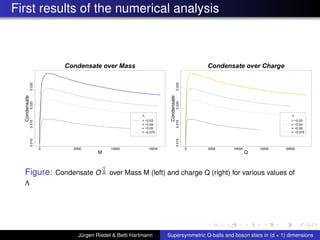
First results of the numerical analysis
M
Condensate
0 5000 10000 15000
0.0100.0150.0200.025
Condensate over Mass
Λ
= −0.03
= −0.04
= −0.05
= −0.075
Q
Condensate
0 5000 10000 15000 20000
0.0100.0150.0200.025
Condensate over Charge
Λ
= −0.03
= −0.04
= −0.05
= −0.075
Figure: Condensate O
1
∆ over Mass M (left) and charge Q (right) for various values of
Λ
Jürgen Riedel & Betti Hartmann Supersymmetric Q-balls and boson stars in (d + 1) dimensions
First results of the numerical analysis
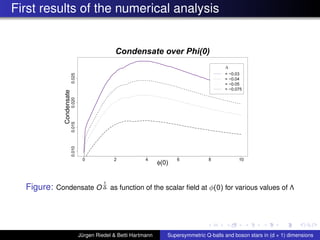
φ(0)
Condensate
0 2 4 6 8 10
0.0100.0150.0200.025
Condensate over Phi(0)
Λ
= −0.03
= −0.04
= −0.05
= −0.075
Figure: Condensate O
1
∆ as function of the scalar field at φ(0) for various values of Λ
Jürgen Riedel & Betti Hartmann Supersymmetric Q-balls and boson stars in (d + 1) dimensions
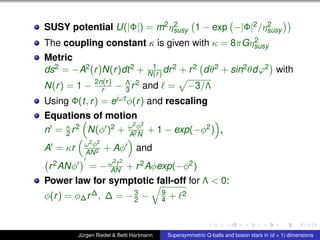
SUSY potential U(|Φ|) = m2η2
susy 1 − exp −|Φ|2/η2
susy
The coupling constant κ is given with κ = 8πGη2
susy
Metric
ds2 = −A2(r)N(r)dt2 + 1
N(r) dr2 + r2 dθ2 + sin2θdϕ2 with
N(r) = 1 − 2n(r)
r − Λ
3 r2 and = −3/Λ
Using Φ(t, r) = eiωt φ(r) and rescaling
Equations of motion
n = κ
2 r2 N(φ )2 + ω2φ2
A2N
+ 1 − exp(−φ2) ,
A = κr ω2φ2
AN2 + Aφ and
r2ANφ = −ω2r2
AN + r2Aφexp(−φ2)
Power law for symptotic fall-off for Λ < 0:
φ(r) = φ∆r∆, ∆ = −3
2 − 9
4 + 2
Jürgen Riedel & Betti Hartmann Supersymmetric Q-balls and boson stars in (d + 1) dimensions
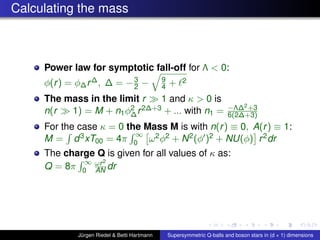
Calculating the mass
Power law for symptotic fall-off for Λ < 0:
φ(r) = φ∆r∆, ∆ = −3
2 − 9
4 + 2
The mass in the limit r 1 and κ > 0 is
n(r 1) = M + n1φ2
∆r2∆+3 + ... with n1 = −Λ∆2+3
6(2∆+3)
For the case κ = 0 the Mass M is with n(r) ≡ 0, A(r) ≡ 1:
M = d3xT00 = 4π
∞
0 ω2φ2 + N2(φ )2 + NU(φ) r2dr
The charge Q is given for all values of κ as:
Q = 8π
∞
0
ωr2
AN dr
Jürgen Riedel & Betti Hartmann Supersymmetric Q-balls and boson stars in (d + 1) dimensions
First results of the numerical analysis
ω
M
0.2 0.4 0.6 0.8 1.0
10505005000
Mass over Omega
κ
= 0.0
= 0.001
= 0.01
= 0.05
= 0.1
ω
Q
0.2 0.4 0.6 0.8 1.0
10505005000
Charge over Omega
κ
= 0.0
= 0.001
= 0.01
= 0.05
= 0.1
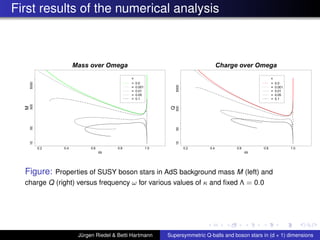
Figure: Properties of SUSY boson stars in AdS background mass M (left) and
charge Q (right) versus frequency ω for various values of κ and fixed Λ = 0.0
Jürgen Riedel & Betti Hartmann Supersymmetric Q-balls and boson stars in (d + 1) dimensions
First results of the numerical analysis
φ(0)
Q
0 2 4 6 8 10
10505005000
Charge over Phi(0)
κ
= 0.0
= 0.001
= 0.01
= 0.05
= 0.1
ω
φ(0)
0.2 0.4 0.6 0.8 1.0
051015
Phi(0) over Omega
κ
= 0.0
= 0.001
= 0.01
= 0.05
= 0.1
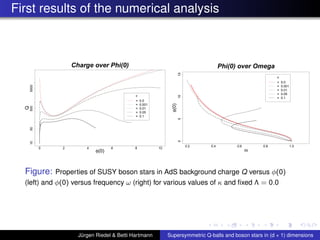
Figure: Properties of SUSY boson stars in AdS background charge Q versus φ(0)
(left) and φ(0) versus frequency ω (right) for various values of κ and fixed Λ = 0.0
Jürgen Riedel & Betti Hartmann Supersymmetric Q-balls and boson stars in (d + 1) dimensions
First results of the numerical analysis
ω
Q
0.2 0.4 0.6 0.8 1.0
10505005000
Charge over Omega
κ
= 0.0
= 0.001
= 0.01
= 0.075
= 0.1
ω
Q
0.2 0.4 0.6 0.8 1.0
10505005000
Charge over Omega
κ
= 0.0
= 0.001
= 0.01
= 0.075
= 0.1
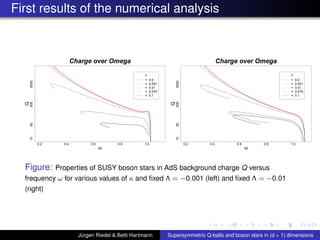
Figure: Properties of SUSY boson stars in AdS background charge Q versus
frequency ω for various values of κ and fixed Λ = −0.001 (left) and fixed Λ = −0.01
(right)
Jürgen Riedel & Betti Hartmann Supersymmetric Q-balls and boson stars in (d + 1) dimensions
First results of the numerical analysis
ω
φ(0)
0.2 0.4 0.6 0.8 1.0
05101520
Phi(0) over Omega
κ
= 0.0
= 0.001
= 0.01
= 0.075
= 0.1
ω
φ(0)
0.2 0.4 0.6 0.8 1.0
05101520
Phi(0) over Omega
κ
= 0.0
= 0.001
= 0.01
= 0.075
= 0.1
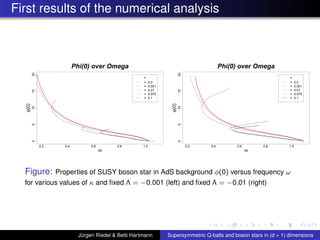
Figure: Properties of SUSY boson star in AdS background φ(0) versus frequency ω
for various values of κ and fixed Λ = −0.001 (left) and fixed Λ = −0.01 (right)
Jürgen Riedel & Betti Hartmann Supersymmetric Q-balls and boson stars in (d + 1) dimensions
First results of the numerical analysis
ω
Q
0.2 0.4 0.6 0.8 1.0 1.2 1.4
10505005000
Charge over Omega
Λ
= 0.0
= −0.001
= −0.01
= −0.05
= −0.1
ω
Q
0.2 0.4 0.6 0.8 1.0 1.2 1.4
10505005000
Charge over Omega
Λ
= 0.0
= −0.001
= −0.01
= −0.05
= −0.1
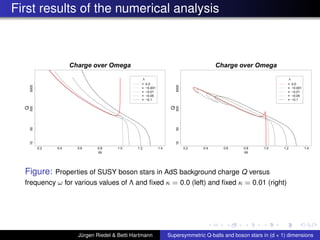
Figure: Properties of SUSY boson stars in AdS background charge Q versus
frequency ω for various values of Λ and fixed κ = 0.0 (left) and fixed κ = 0.01 (right)
Jürgen Riedel & Betti Hartmann Supersymmetric Q-balls and boson stars in (d + 1) dimensions
First results of the numerical analysis
ω
φ(0)
0.2 0.4 0.6 0.8 1.0 1.2 1.4
0246810
Phi(0) over Omega
Λ
= 0.0
= −0.001
= −0.01
= −0.05
= −0.1
ω
φ(0)
0.2 0.4 0.6 0.8 1.0 1.2 1.4
0246810
Phi(0) over Omega
Λ
= 0.0
= −0.001
= −0.01
= −0.05
= −0.1
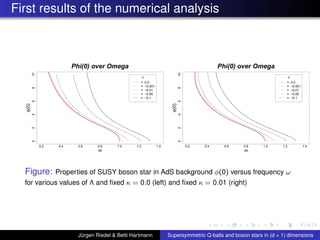
Figure: Properties of SUSY boson star in AdS background φ(0) versus frequency ω
for various values of Λ and fixed κ = 0.0 (left) and fixed κ = 0.01 (right)
Jürgen Riedel & Betti Hartmann Supersymmetric Q-balls and boson stars in (d + 1) dimensions
Summary of first Results
Shift of ωmax for Q-balls and boson stars to higher values
for increasingly negative values of Λ, i.e.
ωmax → ∞ for Λ → −∞
The minimum value of the frequency for Q-balls is
ωmin = 0 for all Λ
The minimum value of the frequency for boson stars
ωmin increases for increasingly negative values of Λ
The curves mass M over frequency ω and charge Q
versus ω for Q-balls and boson stars show
M → 0 for ω → ωmax
Q → 0 for ω → ωmax
Jürgen Riedel & Betti Hartmann Supersymmetric Q-balls and boson stars in (d + 1) dimensions
Summary of first Results continued
For boson stars the cosmological constant Λ ’kills’ the
local maximum of the charge Q and Mass M near ωmax ,
similarly as large values of κ
The curve of the condensate for Q-balls, i.e. O
1
∆ as a
function of the scalar field φ(0), has qualitatively the
same shape as in Horowitz and Way, JHEP 1011:011, 2010
[arXiv:1007.3714v2]
Jürgen Riedel & Betti Hartmann Supersymmetric Q-balls and boson stars in (d + 1) dimensions
The model for d + 1 dimensions
Action
S =
√
−gdd+1x R−2Λ
16πGd+1
+ Lm + 1
8πGd+1
dd x
√
−hK
negative cosmological constant Λ = −d(d − 1)/(2 2)
Matter Lagrangian
Lm = −∂MΦ∂MΦ∗ − U(|Φ|) , M = 0, 1, ...., d
Gauge mediated potential
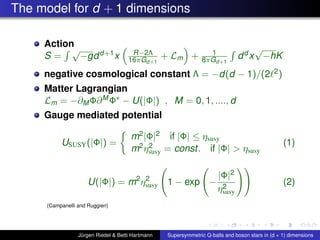
USUSY(|Φ|) =
m2|Φ|2 if |Φ| ≤ ηsusy
m2η2
susy = const. if |Φ| > ηsusy
(1)
U(|Φ|) = m2
η2
susy 1 − exp −
|Φ|2
η2
susy
(2)
(Campanelli and Ruggieri)
Jürgen Riedel & Betti Hartmann Supersymmetric Q-balls and boson stars in (d + 1) dimensions
The model for d + 1 dimensions
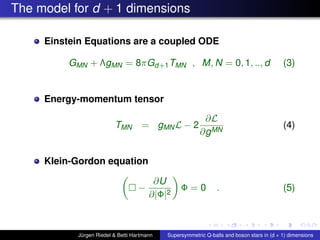
Einstein Equations are a coupled ODE
GMN + ΛgMN = 8πGd+1TMN , M, N = 0, 1, .., d (3)
Energy-momentum tensor
TMN = gMNL − 2
∂L
∂gMN
(4)
Klein-Gordon equation
−
∂U
∂|Φ|2
Φ = 0 . (5)
Jürgen Riedel & Betti Hartmann Supersymmetric Q-balls and boson stars in (d + 1) dimensions
The model for d + 1 dimensions
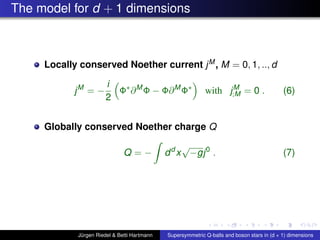
Locally conserved Noether current jM, M = 0, 1, .., d
jM
= −
i
2
Φ∗
∂M
Φ − Φ∂M
Φ∗
with jM
;M = 0 . (6)
Globally conserved Noether charge Q
Q = − dd
x
√
−gj0
. (7)
Jürgen Riedel & Betti Hartmann Supersymmetric Q-balls and boson stars in (d + 1) dimensions
The model Ansatz for d + 1 dimensions
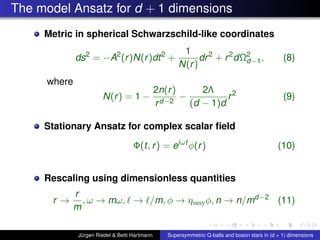
Metric in spherical Schwarzschild-like coordinates
ds2
= −A2
(r)N(r)dt2
+
1
N(r)
dr2
+ r2
dΩ2
d−1, (8)
where
N(r) = 1 −
2n(r)
rd−2
−
2Λ
(d − 1)d
r2
(9)
Stationary Ansatz for complex scalar field
Φ(t, r) = eiωt
φ(r) (10)
Rescaling using dimensionless quantities
r →
r
m
, ω → mω, → /m, φ → ηsusyφ, n → n/md−2
(11)
Jürgen Riedel & Betti Hartmann Supersymmetric Q-balls and boson stars in (d + 1) dimensions
Coupled system of non-linear ordinary differential
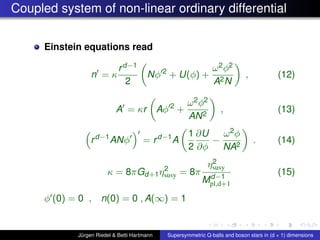
Einstein equations read
n = κ
rd−1
2
Nφ 2
+ U(φ) +
ω2φ2
A2N
, (12)
A = κr Aφ 2
+
ω2φ2
AN2
, (13)
rd−1
ANφ = rd−1
A
1
2
∂U
∂φ
−
ω2φ
NA2
. (14)
κ = 8πGd+1η2
susy = 8π
η2
susy
Md−1
pl,d+1
(15)
φ (0) = 0 , n(0) = 0 , A(∞) = 1
Jürgen Riedel & Betti Hartmann Supersymmetric Q-balls and boson stars in (d + 1) dimensions
Expressions for Charge Q and Mass M
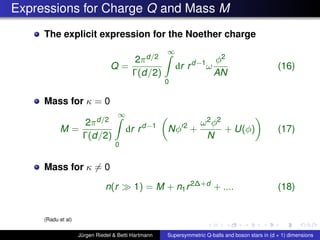
The explicit expression for the Noether charge
Q =
2πd/2
Γ(d/2)
∞
0
dr rd−1
ω
φ2
AN
(16)
Mass for κ = 0
M =
2πd/2
Γ(d/2)
∞
0
dr rd−1
Nφ 2
+
ω2φ2
N
+ U(φ) (17)
Mass for κ = 0
n(r 1) = M + n1r2∆+d
+ .... (18)
(Radu et al)
Jürgen Riedel & Betti Hartmann Supersymmetric Q-balls and boson stars in (d + 1) dimensions
Expressions for Charge Q and Mass M
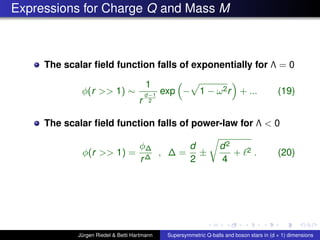
The scalar field function falls of exponentially for Λ = 0
φ(r >> 1) ∼
1
r
d−1
2
exp − 1 − ω2r + ... (19)
The scalar field function falls of power-law for Λ < 0
φ(r >> 1) =
φ∆
r∆
, ∆ =
d
2
±
d2
4
+ 2 . (20)
Jürgen Riedel & Betti Hartmann Supersymmetric Q-balls and boson stars in (d + 1) dimensions
Numerical analysis Q-balls in Minkowski (Λ = 0) and
AdS background (Λ < 0) background
ω
M
0.4 0.6 0.8 1.0 1.2 1.4
1e+001e+021e+041e+06
Λ
= 0.0 2d
= 0.0 3d
= 0.0 4d
= 0.0 5d
= 0.0 6d
= −0.1 2d
= −0.1 3d
= −0.1 4d
= −0.1 5d
= −0.1 6d
ω= 1.0
ωQ
0.2 0.4 0.6 0.8 1.0 1.2 1.4
1e+001e+021e+041e+06
Λ
= 0.0 2d
= 0.0 3d
= 0.0 4d
= 0.0 5d
= 0.0 6d
= −0.1 2d
= −0.1 3d
= −0.1 4d
= −0.1 5d
= −0.1 6d
ω= 1.0
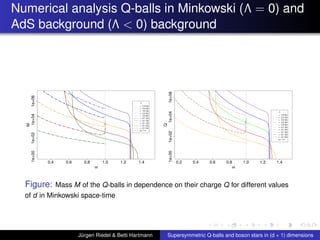
Figure: Mass M of the Q-balls in dependence on their charge Q for different values
of d in Minkowski space-time
Jürgen Riedel & Betti Hartmann Supersymmetric Q-balls and boson stars in (d + 1) dimensions
Numerical analysis Q-balls in Minkowski (Λ = 0) and
AdS background (Λ < 0) background
Q
M
1e+00 1e+02 1e+04 1e+06
1e+001e+021e+041e+06
Λ
= 0.0 2d
= 0.0 3d
= 0.0 4d
= 0.0 5d
= 0.0 6d
= (M=Q)
20 40 60 100
204080
2d
200 300 400
200300450
3d
1500 2500 4000
15003000
4d
16000 19000 22000
1600020000
5d
140000 170000 200000
140000180000
6d
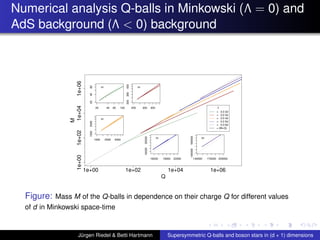
Figure: Mass M of the Q-balls in dependence on their charge Q for different values
of d in Minkowski space-time
Jürgen Riedel & Betti Hartmann Supersymmetric Q-balls and boson stars in (d + 1) dimensions
Numerical analysis Q-balls in Minkowski (Λ = 0) and
AdS background (Λ < 0) background
Q
M
1e+00 1e+02 1e+04 1e+06 1e+08
1e+001e+021e+041e+061e+08
Λ
= −0.1 2d
= −0.1 3d
= −0.1 4d
= −0.1 5d
= −0.1 6d
= (M=Q)
1500 2500 4000
15003000 2d
1500 2500 4000
15003000
3d
1500 2500 4000
15003000
4d
1500 2500 4000
15003000
5d
1500 2500 4000
15003000
6d
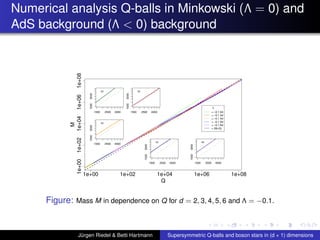
Figure: Mass M in dependence on Q for d = 2, 3, 4, 5, 6 and Λ = −0.1.
Jürgen Riedel & Betti Hartmann Supersymmetric Q-balls and boson stars in (d + 1) dimensions
Numerical analysis Q-balls in Minkowski (Λ = 0)
background
φ
V
−5 0 5
−0.050.050.150.25
ω
= 0.02
= 0.05
= 0.7
= 0.9
= 1.2
φ
V
−5 0 5
01234
Λ
= 0.0
= −0.01
= −0.05
= −0.1
= −0.5
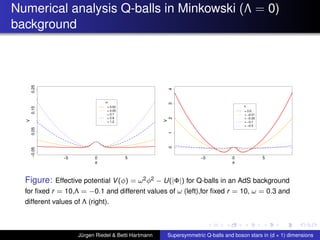
Figure: Effective potential V(φ) = ω2φ2 − U(|Φ|) for Q-balls in an AdS background
for fixed r = 10,Λ = −0.1 and different values of ω (left),for fixed r = 10, ω = 0.3 and
different values of Λ (right).
Jürgen Riedel & Betti Hartmann Supersymmetric Q-balls and boson stars in (d + 1) dimensions
Numerical analysis Q-balls in Minkowski (Λ = 0)
background
Λ
ωmax
−0.10 −0.15 −0.20 −0.25 −0.30 −0.35 −0.40 −0.45
1.21.41.61.82.0
φ(0) = 0
= 2d
= 4d
= 6d
= 8d
= 10d
= 2d (analytical)
= 4d (analytical)
= 6d (analytical)
= 8d (analytical)
= 10d (analytical)
−0.1010 −0.1014 −0.1018
1.2651.2751.285
6d
8d
d + 1
ωmax
3 4 5 6 7 8 9 10
1.01.21.41.61.82.0
Λ
= −0.01
= −0.1
= −0.5
= −0.01 (analytical)
= −0.1 (analytical)
= −0.5 (analytical)
3.0 3.2 3.4
1.321.341.36
Λ = −0.1
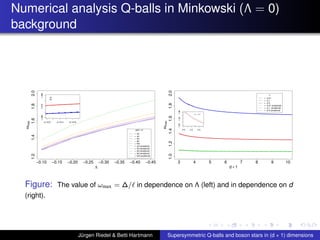
Figure: The value of ωmax = ∆/ in dependence on Λ (left) and in dependence on d
(right).
Jürgen Riedel & Betti Hartmann Supersymmetric Q-balls and boson stars in (d + 1) dimensions
Numerical analysis Q-balls in Minkowski (Λ = 0)
background
r
φ
0 5 10 15 20
−0.10.10.20.30.40.5
k
= 0
= 1
= 2
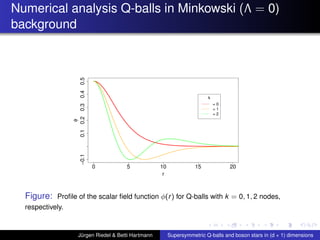
Figure: Profile of the scalar field function φ(r) for Q-balls with k = 0, 1, 2 nodes,
respectively.
Jürgen Riedel & Betti Hartmann Supersymmetric Q-balls and boson stars in (d + 1) dimensions
Numerical analysis Q-balls in Minkowski (Λ = 0)
background
ω
M
0.5 1.0 1.5 2.0
110100100010000
Λ & k
= −0.1 & 0 4d
= −0.1 & 1 4d
= −0.1 & 2 4d
= −0.1 & 0 3d
= −0.1 & 1 3d
= −0.1 & 2 3d
QM
1e+01 1e+02 1e+03 1e+04 1e+05
1e+011e+021e+031e+041e+05
Λ & k
= −0.1 & 0 4d
= −0.1 & 1 4d
= −0.1 & 2 4d
= −0.1 & 0 3d
= −0.1 & 1 3d
= −0.1 & 2 3d
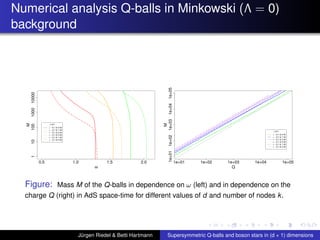
Figure: Mass M of the Q-balls in dependence on ω (left) and in dependence on the
charge Q (right) in AdS space-time for different values of d and number of nodes k.
Jürgen Riedel & Betti Hartmann Supersymmetric Q-balls and boson stars in (d + 1) dimensions
Numerical analysis Q-balls in Minkowski (Λ = 0) and
AdS background (Λ < 0) background
φ(0)
<O>
1
∆
0 5 10 15 20
0.000.050.100.150.20
Λ
= −0.1 2d
= −0.1 3d
= −0.1 4d
= −0.1 5d
= −0.1 6d
= −0.1 7d
= −0.5 2d
= −0.5 3d
= −0.5 4d
= −0.5 5d
= −0.5 6d
= −0.5 7d
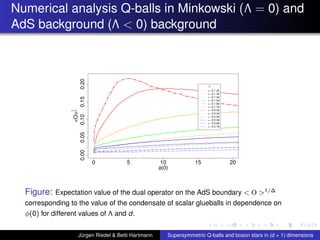
Figure: Expectation value of the dual operator on the AdS boundary < O >1/∆
corresponding to the value of the condensate of scalar glueballs in dependence on
φ(0) for different values of Λ and d.
Jürgen Riedel & Betti Hartmann Supersymmetric Q-balls and boson stars in (d + 1) dimensions
Numerical analysis boson stars in Minkowski (Λ = 0)
and AdS background (Λ < 0) background
ω
M
0.2 0.4 0.6 0.8 1.0 1.2
10505005000
κ
= 0.005 5d
= 0.01 5d
= 0.005 4d
= 0.01 4d
= 0.005 3d
= 0.01 3d
= 0.005 2d
= 0.01 2d
ω= 1.0
0.95 0.98 1.01
50200500
3d
0.995 0.998 1.001
20006000
4d
0.95 0.98 1.01
20006000
5d
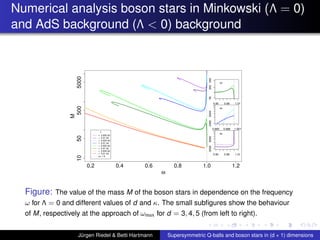
Figure: The value of the mass M of the boson stars in dependence on the frequency
ω for Λ = 0 and different values of d and κ. The small subfigures show the behaviour
of M, respectively at the approach of ωmax for d = 3, 4, 5 (from left to right).
Jürgen Riedel & Betti Hartmann Supersymmetric Q-balls and boson stars in (d + 1) dimensions
Numerical analysis boson stars in Minkowski (Λ = 0)
and AdS background (Λ < 0) background
ω
M
0.9980 0.9985 0.9990 0.9995 1.0000
1e+011e+031e+051e+07 D
= 4.0d
= 4.5d
= 4.8d
= 5.0d
ω= 1.0
0.9990 0.9994 0.9998
5e+035e+05
5d
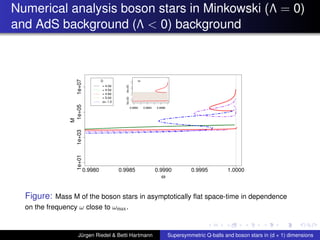
Figure: Mass M of the boson stars in asymptotically flat space-time in dependence
on the frequency ω close to ωmax.
Jürgen Riedel & Betti Hartmann Supersymmetric Q-balls and boson stars in (d + 1) dimensions
Numerical analysis boson stars in Minkowski (Λ = 0)
and AdS background (Λ < 0) background
r
φ
φ(0)
0 200 400 600 800 1000
0.00.20.40.60.81.0 φ(0) & ω
= 2.190 & 0.9995 lower branch
= 1.880 & 0.9999 middle branch
= 0.001 & 0.9999 upper branch
0 5 10 15 20
0.000.100.20
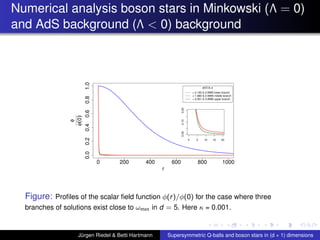
Figure: Profiles of the scalar field function φ(r)/φ(0) for the case where three
branches of solutions exist close to ωmax in d = 5. Here κ = 0.001.
Jürgen Riedel & Betti Hartmann Supersymmetric Q-balls and boson stars in (d + 1) dimensions
Numerical analysis boson stars in Minkowski (Λ = 0)
and AdS background (Λ < 0) background
Q
M
1e+01 1e+03 1e+05 1e+07
1e+011e+031e+051e+07 κ
= 0.001 5d
= 0.005 5d
= 0.001 4d
= 0.005 4d
= 0.001 3d
= 0.005 3d
= 0.001 3d
= 0.005 2d
ω= 1.0
10000 15000 20000 25000
200030005000
100000 150000 250000 400000
1e+045e+04
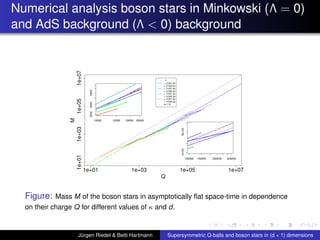
Figure: Mass M of the boson stars in asymptotically flat space-time in dependence
on their charge Q for different values of κ and d.
Jürgen Riedel & Betti Hartmann Supersymmetric Q-balls and boson stars in (d + 1) dimensions
Numerical analysis boson stars in Minkowski (Λ = 0)
and AdS background (Λ < 0) background
Q
M
1 10 100 1000 10000
110100100010000
κ
= 0.01 6d
= 0.005 6d
= 0.01 5d
= 0.005 5d
= 0.01 4d
= 0.005 4d
= 0.01 3d
= 0.005 3d
= 0.01 2d
= 0.005 2d
ω= 1.0
1000 1500 2000 2500
5006008001000
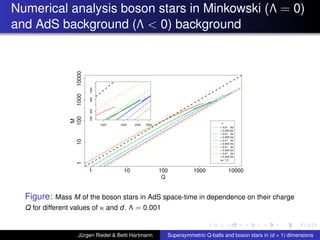
Figure: Mass M of the boson stars in AdS space-time in dependence on their charge
Q for different values of κ and d. Λ = 0.001
Jürgen Riedel & Betti Hartmann Supersymmetric Q-balls and boson stars in (d + 1) dimensions
Numerical analysis boson stars in Minkowski (Λ = 0)
and AdS background (Λ < 0) background
ω
M
0.2 0.4 0.6 0.8 1.0 1.2 1.4
110100100010000
κ
= 0.005 5d
= 0.01 5d
= 0.005 4d
= 0.01 4d
= 0.005 3d
= 0.01 3d
= 0.005 2d
= 0.01 2d
ω= 1.0
ω
Q
0.2 0.4 0.6 0.8 1.0 1.2 1.4
1101001000
κ
= 0.005 5d
= 0.01 5d
= 0.005 4d
= 0.01 4d
= 0.005 3d
= 0.01 3d
= 0.005 2d
= 0.01 2d
ω= 1.0
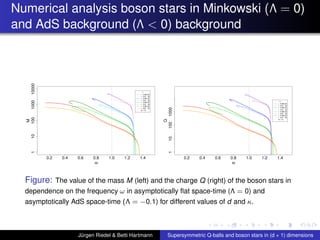
Figure: The value of the mass M (left) and the charge Q (right) of the boson stars in
dependence on the frequency ω in asymptotically flat space-time (Λ = 0) and
asymptotically AdS space-time (Λ = −0.1) for different values of d and κ.
Jürgen Riedel & Betti Hartmann Supersymmetric Q-balls and boson stars in (d + 1) dimensions
Numerical analysis boson stars in Minkowski (Λ = 0)
and AdS background (Λ < 0) background
φ(0)
<O>
1
∆
0 1 2 3 4 5 6 7
0.000.050.100.150.20
κ
= 0.005 5d
= 0.01 5d
= 0.005 4d
= 0.01 4d
= 0.005 3d
= 0.01 3d
M
<O>
1
∆
0 500 1000 1500 2000 2500
0.000.050.100.15
κ
= 0.005 5d
= 0.01 5d
= 0.005 4d
= 0.01 4d
= 0.005 3d
= 0.01 3d
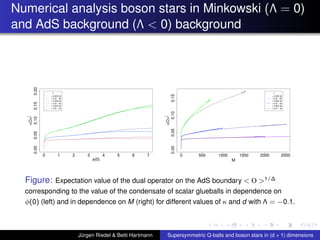
Figure: Expectation value of the dual operator on the AdS boundary < O >1/∆
corresponding to the value of the condensate of scalar glueballs in dependence on
φ(0) (left) and in dependence on M (right) for different values of κ and d with Λ = −0.1.
Jürgen Riedel & Betti Hartmann Supersymmetric Q-balls and boson stars in (d + 1) dimensions

Internal workshop jub talk jan 2013

  • 1.
    Supersymmetric Q-balls andboson stars in (d + 1) dimensions Jürgen Riedel in Collaboration with Betti Hartmann, Jacobs University Bremen School of Engineering and Science Jacobs University Bremen, Germany INTERNAL WORKSHOP JUB TALK Bremen, Jan 19th 2013 Jürgen Riedel & Betti Hartmann Supersymmetric Q-balls and boson stars in (d + 1) dimensions
  • 2.
    Introduction Q-balls Boson stars AdS/CFT correspondence SUSYQ-balls in AdS background SUSY boson stars in AdS background Summary results in 4 dimensions Q-Balls and boson stars in d + 1 dimensions Numerical results in d + 1 dimensions Outline 1 Introduction 2 Q-balls in 3+1 dimensions 3 Boson stars in 3+1 dimensions 4 AdS/CFT correspondence 5 SUSY Q-balls in AdS5 background 6 SUSY boson stars in AdS background 7 Summary results in 4 dimensions 8 Q-Balls and boson stars in d + 1 dimensions 9 Numerical results in d + 1 dimensions Jürgen Riedel & Betti Hartmann Supersymmetric Q-balls and boson stars in (d + 1) dimensions
  • 3.
    Solitons in non-linearfield theories General properties of soliton solutions localized, finite energy, stable, regular solutions of non-linear equations can be viewed as models of elementary particles dimension Examples and restrictions Skyrme model of hadrons in high energy physics one of first models Derrick’s theorem puts restrictions to localized soliton solutions in more than one spatial dimension Jürgen Riedel & Betti Hartmann Supersymmetric Q-balls and boson stars in (d + 1) dimensions
  • 4.
    Solitons in non-linearfield theories Derrick’s non-existence theorem Proof proceeds by contradiction Suppose a solitonic solution φ0(x) exists Deformations φλ(λx)=φ0(x), where λ is dilation parameter No (stable) stationary point of energy exists with respect to λ for a scalar with purely potential interactions. Around Derrick’s Theorem if one includes appropriate gauge fields, gravitational fields or higher derivatives in field Lagrangian if one considers solutions which are periodic in time Jürgen Riedel & Betti Hartmann Supersymmetric Q-balls and boson stars in (d + 1) dimensions
  • 5.
    Topolocial solitons Properties Boundary conditionsat spatial infinity are topological different from that of the vacuum state Degenerated vacua states at spatial infinity cannot be continuously deformed to a single vacuum Example in one dimension: L = 1 2 (∂µφ)2 − λ 4 φ2 − m2 λ broken symmetry φ → −φ with two degenerate vacua at φ = ±m/ √ λ Jürgen Riedel & Betti Hartmann Supersymmetric Q-balls and boson stars in (d + 1) dimensions
  • 6.
    Non-topolocial solitons Classical examplein one dimension With complex scalar field Φ(x, t) : L = ∂µΦ∂µΦ∗ − U(|Φ|), U(|Φ|) minimum at Φ = 0 Lagrangian is invariant under transformation φ(x) → eiαφ(x) Give rise to Noether charge Q = 1 i dx3φ∗ ˙φ − φ ˙φ∗) Solution that minimizes the energy for fixed Q: Φ(x, t) = φ(x)eiωt Jürgen Riedel & Betti Hartmann Supersymmetric Q-balls and boson stars in (d + 1) dimensions
  • 7.
    Prominent examples fortopological solitons Further examples vortices, magnetic monopoles, domain walls, cosmic strings, textures Prominent examples for non-topological solitons Q-balls Boson stars Jürgen Riedel & Betti Hartmann Supersymmetric Q-balls and boson stars in (d + 1) dimensions
  • 8.
    The model Lagrangian L=∂µΦ∂µΦ∗ − U(|Φ|); the signature of the metric is (+,-,-,-) Noether current j = i(Φ∗ ˙Φ − Φ ˙Φ∗) symmetry under U(1) Conserved Noether charge Q = 1 i d3(Φ∗ ˙Φ − Φ ˙Φ∗), with Φ := Φ(t, r) we have dQ dt = 0 Ansatz for solution Φ(x, t) = φ(x)eiωt Energy-momentum tensor Tµν = ∂µΦ∂νΦ∗ + ∂νΦ∂µΦ∗ − gµνL Total Energy E = d3xT0 0 = d3x[| ˙Φ|2 + | Φ|2 + U(|Φ|)] under assumption that gµν is time-independent Jürgen Riedel & Betti Hartmann Supersymmetric Q-balls and boson stars in (d + 1) dimensions
  • 9.
    Existence conditions ofQ-balls Condition 1 V (0) < 0; Φ ≡ 0 local maximum ⇒ ω2 < ω2 max ≡ U (0) Condition 2 ω2 > ω2 min ≡ minφ[2U(φ)/φ2] minimum over all φ Consequences Restricted interval ω2 min < ω2 < ω2 max ; U (0) > minφ[2U(φ)/φ2] Q-balls are rotating in inner space with ω stabilized by having a lower energy to charge ratio as the free particles Jürgen Riedel & Betti Hartmann Supersymmetric Q-balls and boson stars in (d + 1) dimensions
  • 10.
    Thin wall approximationof Q-balls If the Q-ball is getting large enough, surface effects can be ignored: thin wall limit. Minimum of total energy ωmin = Emin = 2U(φ0) φ2 , for φ0 > 0 The energy and charge is proportional to the volume which is similarly found in ordinary matter → Q = ωφ2V Therefore Q-balls in this limit are called Q-matter and have very large charge, i.e. volume Suitable potential U = m2|Φ|2 − a|Φ|4 + b|Φ|6, with a and b are constants Jürgen Riedel & Betti Hartmann Supersymmetric Q-balls and boson stars in (d + 1) dimensions
  • 11.
    Rotating Q-balls The AnsatzΦ = φ(r, θ)eiωt+inϕ, where n is an integer Non-linear field equation: dU(φ) dφ = ∂2φ ∂r2 + 2 r ∂φ ∂r + 1 r2 ∂2φ ∂θ2 + cosθ r2sinθ ∂φ ∂θ − n2φ r2sinθ + ω2φ Charge Q = 4πω ∞ 0 drr2 π 0 dθsinθφ2 Uniqueness of the scalar field under a complete rotation Φ(ϕ) = Φ(ϕ + 2π) requires n to be an integer Jürgen Riedel & Betti Hartmann Supersymmetric Q-balls and boson stars in (d + 1) dimensions
  • 12.
    Rotating Q-balls Consequences The angularmomentum J is quantized: J = T0φd3x = nQ: n = rotational quantum number One requires that φ →0 for r →0 or r → ∞ φ(r)|r=0 = 0 is a direct consequence of the term n2φ2 r2sin2θ Jürgen Riedel & Betti Hartmann Supersymmetric Q-balls and boson stars in (d + 1) dimensions
  • 13.
    Boson stars Action ansatz:S = √ −gd4x R 16πG + Lm Matter Lagrangian Lm = −1 2 ∂µΦ∂µΦ∗ − U(|Φ|); the signature of the metric is (-,+,+,+) Variation with respect to the scalar field 1√ −g ∂µ ( √ −g∂µΦ) = ∂U ∂|Φ|2 Φ Metric ansatz ds2 = −f(r)dt2 + l(r) f(r) dr2 + r2dθ2 + r2sin2θdφ2 Conserved current jµ = i √ −ggµν(Φ∗∂νΦ − Φ∂νΦ∗) Noether charge Q = dx3j0 associated to the global U(1) transformation Jürgen Riedel & Betti Hartmann Supersymmetric Q-balls and boson stars in (d + 1) dimensions
  • 14.
    Boson star models Simplestmodel U = m2|Φ|2 (by Kemp, 1986) Proper boson stars U = m2|Φ|2 − λ|Φ|4/2 (by Colpi, Sharpio and Wasserman, 1986) Sine-Gordon boson star U = αm2 sin(π/2 β |Φ|2 − 1 + 1 Cosh-Gordon boson star U = αm2 cosh(β |Φ|2 − 1 Liouville boson star U = αm2 exp(β2|Φ|2) − 1 (Schunk and Torres, 2000) Jürgen Riedel & Betti Hartmann Supersymmetric Q-balls and boson stars in (d + 1) dimensions
  • 15.
    Self-interacting boson starsmodels Model U = m2|Φ|2 − a|Φ|4 + b|Φ|6, with a and b are constants (Mielke and Scherzer, 1981) Soliton stars U = m2|Φ|2 1 − |Φ|2/Φ2 0 2 (Friedberg, Lee and Pang, 1986) Represented in the limit of flat space − time, by Q -balls as non-topological solitons However, terms of |Φ|6 or higher-order terms implies that the scalar part of the theory is not re-normalizable Jürgen Riedel & Betti Hartmann Supersymmetric Q-balls and boson stars in (d + 1) dimensions
  • 16.
    Charged Boson stars Systemof complex scalar fields coupled to a U(1) gauge field with quartic self-interaction The metric ansatz ds2 = gµνdxµdxν = −A2Ndt2 + dr2 N + r2 dθ2 + sin2θdφ2 , with N = 1 − 2m(r) r and Solution ansatz: Φ = φ(r)eiωt , Aµdxµ = A0(r)dt A gauge coupling constant e does increase the maximum mass M and bf conserved charge Q Using a V-shaped scalar potential (Kleihaus, Kunz, Lammerzahl, and List, 2009) Jürgen Riedel & Betti Hartmann Supersymmetric Q-balls and boson stars in (d + 1) dimensions
  • 17.
    Rotating Boson stars Themetric ansatz ds2 = −f(r, θ)dt2 + l(r,θ) f(r,θ) g(r, θ)(dr2 + r2dθ2) + r2sin2θ dφ − χ(r,θ) r dt 2 Stationary spherically symmetric ansatz Φ(t, r, θ, ϕ) = φ(r, θ)eiωt+inϕ Uniqueness of the scalar field under a complete rotation Φ(ϕ) = Φ(ϕ + 2π) requires n to be an integer (, i.e. n = 0, ±1, ±2, ...) Conserved scalar charge Q = −4πω ∞ 0 π 0 √ −g 1 f 1 + n ω χ r φ2drdθ Jürgen Riedel & Betti Hartmann Supersymmetric Q-balls and boson stars in (d + 1) dimensions
  • 18.
    Rotating Boson starscontinued Total angular momentum J = − T0 ϕ √ −gdrdϕdθ With T0 ϕ = nj0, since ∂Φ ∂φ = i nΦ one finds: J = nQ Solution is axially symmetric (for n = 0 ) This means that a rotating boson star is bf proportional to the conserved Noether charge If n = 0, it follows that a spherically symmetric boson star has angular momentum J = 0 Rotating boson stars were intensively studied in 4 dimensions (Kleihaus et al) as well in 5 dimensions (Hartmann et al) with U(|Φ|) = λ |Φ|6 − a|Φ|4 + b|Φ|2 Jürgen Riedel & Betti Hartmann Supersymmetric Q-balls and boson stars in (d + 1) dimensions
  • 19.
    AdS/CFT correspondence Important resultfrom StringTheory (Maldacena, 1997): A theory of classical gravity in (d + 1)-dimensional asymptotically Anti-de Sitter (AdS) space-time is dual to a strongly-coupled, scale-invariant theory (CFT) living on the d-dimensional boundary of AdS An important example: Type IIB string theory in AdS5 × S5 dual to 4-dimensional N = 4 supersymmetric Yang-Mills theory One can use classical gravity theory, i.e. weakly-coupled, to study strongly coupled quantum field theories Jürgen Riedel & Betti Hartmann Supersymmetric Q-balls and boson stars in (d + 1) dimensions
  • 20.
    Holographic conductor/ superconductor Takenfrom arxiv: 0808.1115 Boundary of SAdS ≡ AdS Dual theory “lives” here r → ∞ r x,y r=rh horizon Temperature represented by a black hole Chemical potential represented by a charged black hole Condensate represented by a non-trivial field outside the black hole horizon if T < Tc ⇒ One needs an electrically charged plane-symmetric hairy black hole Jürgen Riedel & Betti Hartmann Supersymmetric Q-balls and boson stars in (d + 1) dimensions
  • 21.
    The model Action ansatz: S= dx4√ −g R + 6 2 − 1 4 FµνFµν − |DµΦ|2 − m2 |Φ2 | Metric with r = rh event horizon (AdS for r → ∞) + negative cosmological constant Λ = −3/ 2 ds2 = −g(r)f(r)dt2 + dr2 f(r) + r2 (dx2 + dy2 ) Ansatz: Φ = Φ(r), At = At (r) Presence of the U(1) gauge symmetry allows to gauge away the phase of the scalar field and make it real Jürgen Riedel & Betti Hartmann Supersymmetric Q-balls and boson stars in (d + 1) dimensions
  • 22.
    Holographic insulator/ superconductor doubleWick rotation (t → iχ, x → it) of SAdS with rh → r0 ds2 = dr2 f(r) + f(r)dχ2 + r2 −dt2 + dy2 with f(r) = r2 2 1 − r3 0 r3 It is important that χ is periodic with period τχ = 4π 2 3r0 Scalar field in the background of such a soliton has a strictly positive and discrete spectrum (Witten, 1998) There exists an energy gap which allows the interpretation of this soliton as the gravity dual of an insulator Adding a chemical potential µ to the model reduces the energy gap Jürgen Riedel & Betti Hartmann Supersymmetric Q-balls and boson stars in (d + 1) dimensions
  • 23.
    The e =0 limit In the case of vanishing gauge coupling constant e: The scalar field decouples from gauge field One cannot use gauge to make scalar field real The simplest ansatz for complex scalar field: φ(r) = φeiωt This leads to Q-balls and boson stars solutions Jürgen Riedel & Betti Hartmann Supersymmetric Q-balls and boson stars in (d + 1) dimensions
  • 24.
    The model forG = 0 SUSY potential U(|Φ|) = m2η2 susy 1 − exp −|Φ|2/η2 susy Metric ds2 = −N(r)dt2 + 1 N(r) dr2 + r2 dθ2 + sin2 θdϕ2 with N(r) = 1 + r2 2 and = −3/Λ Using Φ(t, r) = eiωt φ(r), rescaling Equation of motion φ = −2 r φ − N N φ − ω2 N2 φ + φ exp(−φ2) N Power law for symptotic fall-off for Λ < 0: φ(r) = φ∆r∆, ∆ = −3 2 − 9 4 + 2 Charge and mass Q = 8π ∞ 0 φr2dr and M = 4π ∞ 0 ω2φ2 + φ 2 + U(φ) r2dr Jürgen Riedel & Betti Hartmann Supersymmetric Q-balls and boson stars in (d + 1) dimensions
  • 25.
    First results ofthe numerical analysis ω M 0.5 0.6 0.7 0.8 0.9 1.0 1.1 1.2 5010020050010002000 Mass over Omega Λ = 0 = −0.01 = −0.02 = −0.025 ω M 0.5 0.6 0.7 0.8 0.9 1.0 1.1 1.2 5010020050010002000 Charge over Omega Λ = 0 = −0.01 = −0.02 = −0.025 Figure: Properties of SUSY Q-balls in AdS background mass M (left) and charge Q (right) versus frequency ω for various values of Λ Jürgen Riedel & Betti Hartmann Supersymmetric Q-balls and boson stars in (d + 1) dimensions
  • 26.
    First results ofthe numerical analysis φ(0) M 0 2 4 6 8 10 110100100010000 Mass over Phi(0) Λ = 0 = −0.01 = −0.02 = −0.025 φ(0) Q 0 2 4 6 8 10 110100100010000 Charge over Phi(0) Λ = 0 = −0.5 = −0.−1 = −5 Figure: Properties of SUSY Q-balls in AdS background mass M (left) and charge Q (right) versus scalar field function at the origin φ(0) for various values of Λ Jürgen Riedel & Betti Hartmann Supersymmetric Q-balls and boson stars in (d + 1) dimensions
  • 27.
    First results ofthe numerical analysis M Q 200 500 1000 2000 5000 10000 20000 200500200050002000050000 Charge over Mass Λ = 0 = −0.01 = −0.02 = −0.025 ω φ(0) 0.2 0.4 0.6 0.8 1.0 1.2 0246810 Phi(0) over Omega Λ = 0 = −0.01 = −0.02 = −0.025 Figure: Properties of SUSY Q-balls in AdS background mass M versus charge Q (left) and the scalar field function at the origin φ(0) versus frequency ω (right) for various values of Λ Jürgen Riedel & Betti Hartmann Supersymmetric Q-balls and boson stars in (d + 1) dimensions
  • 28.
    First results ofthe numerical analysis M Condensate 0 5000 10000 15000 0.0100.0150.0200.025 Condensate over Mass Λ = −0.03 = −0.04 = −0.05 = −0.075 Q Condensate 0 5000 10000 15000 20000 0.0100.0150.0200.025 Condensate over Charge Λ = −0.03 = −0.04 = −0.05 = −0.075 Figure: Condensate O 1 ∆ over Mass M (left) and charge Q (right) for various values of Λ Jürgen Riedel & Betti Hartmann Supersymmetric Q-balls and boson stars in (d + 1) dimensions
  • 29.
    First results ofthe numerical analysis φ(0) Condensate 0 2 4 6 8 10 0.0100.0150.0200.025 Condensate over Phi(0) Λ = −0.03 = −0.04 = −0.05 = −0.075 Figure: Condensate O 1 ∆ as function of the scalar field at φ(0) for various values of Λ Jürgen Riedel & Betti Hartmann Supersymmetric Q-balls and boson stars in (d + 1) dimensions
  • 30.
    SUSY potential U(|Φ|)= m2η2 susy 1 − exp −|Φ|2/η2 susy The coupling constant κ is given with κ = 8πGη2 susy Metric ds2 = −A2(r)N(r)dt2 + 1 N(r) dr2 + r2 dθ2 + sin2θdϕ2 with N(r) = 1 − 2n(r) r − Λ 3 r2 and = −3/Λ Using Φ(t, r) = eiωt φ(r) and rescaling Equations of motion n = κ 2 r2 N(φ )2 + ω2φ2 A2N + 1 − exp(−φ2) , A = κr ω2φ2 AN2 + Aφ and r2ANφ = −ω2r2 AN + r2Aφexp(−φ2) Power law for symptotic fall-off for Λ < 0: φ(r) = φ∆r∆, ∆ = −3 2 − 9 4 + 2 Jürgen Riedel & Betti Hartmann Supersymmetric Q-balls and boson stars in (d + 1) dimensions
  • 31.
    Calculating the mass Powerlaw for symptotic fall-off for Λ < 0: φ(r) = φ∆r∆, ∆ = −3 2 − 9 4 + 2 The mass in the limit r 1 and κ > 0 is n(r 1) = M + n1φ2 ∆r2∆+3 + ... with n1 = −Λ∆2+3 6(2∆+3) For the case κ = 0 the Mass M is with n(r) ≡ 0, A(r) ≡ 1: M = d3xT00 = 4π ∞ 0 ω2φ2 + N2(φ )2 + NU(φ) r2dr The charge Q is given for all values of κ as: Q = 8π ∞ 0 ωr2 AN dr Jürgen Riedel & Betti Hartmann Supersymmetric Q-balls and boson stars in (d + 1) dimensions
  • 32.
    First results ofthe numerical analysis ω M 0.2 0.4 0.6 0.8 1.0 10505005000 Mass over Omega κ = 0.0 = 0.001 = 0.01 = 0.05 = 0.1 ω Q 0.2 0.4 0.6 0.8 1.0 10505005000 Charge over Omega κ = 0.0 = 0.001 = 0.01 = 0.05 = 0.1 Figure: Properties of SUSY boson stars in AdS background mass M (left) and charge Q (right) versus frequency ω for various values of κ and fixed Λ = 0.0 Jürgen Riedel & Betti Hartmann Supersymmetric Q-balls and boson stars in (d + 1) dimensions
  • 33.
    First results ofthe numerical analysis φ(0) Q 0 2 4 6 8 10 10505005000 Charge over Phi(0) κ = 0.0 = 0.001 = 0.01 = 0.05 = 0.1 ω φ(0) 0.2 0.4 0.6 0.8 1.0 051015 Phi(0) over Omega κ = 0.0 = 0.001 = 0.01 = 0.05 = 0.1 Figure: Properties of SUSY boson stars in AdS background charge Q versus φ(0) (left) and φ(0) versus frequency ω (right) for various values of κ and fixed Λ = 0.0 Jürgen Riedel & Betti Hartmann Supersymmetric Q-balls and boson stars in (d + 1) dimensions
  • 34.
    First results ofthe numerical analysis ω Q 0.2 0.4 0.6 0.8 1.0 10505005000 Charge over Omega κ = 0.0 = 0.001 = 0.01 = 0.075 = 0.1 ω Q 0.2 0.4 0.6 0.8 1.0 10505005000 Charge over Omega κ = 0.0 = 0.001 = 0.01 = 0.075 = 0.1 Figure: Properties of SUSY boson stars in AdS background charge Q versus frequency ω for various values of κ and fixed Λ = −0.001 (left) and fixed Λ = −0.01 (right) Jürgen Riedel & Betti Hartmann Supersymmetric Q-balls and boson stars in (d + 1) dimensions
  • 35.
    First results ofthe numerical analysis ω φ(0) 0.2 0.4 0.6 0.8 1.0 05101520 Phi(0) over Omega κ = 0.0 = 0.001 = 0.01 = 0.075 = 0.1 ω φ(0) 0.2 0.4 0.6 0.8 1.0 05101520 Phi(0) over Omega κ = 0.0 = 0.001 = 0.01 = 0.075 = 0.1 Figure: Properties of SUSY boson star in AdS background φ(0) versus frequency ω for various values of κ and fixed Λ = −0.001 (left) and fixed Λ = −0.01 (right) Jürgen Riedel & Betti Hartmann Supersymmetric Q-balls and boson stars in (d + 1) dimensions
  • 36.
    First results ofthe numerical analysis ω Q 0.2 0.4 0.6 0.8 1.0 1.2 1.4 10505005000 Charge over Omega Λ = 0.0 = −0.001 = −0.01 = −0.05 = −0.1 ω Q 0.2 0.4 0.6 0.8 1.0 1.2 1.4 10505005000 Charge over Omega Λ = 0.0 = −0.001 = −0.01 = −0.05 = −0.1 Figure: Properties of SUSY boson stars in AdS background charge Q versus frequency ω for various values of Λ and fixed κ = 0.0 (left) and fixed κ = 0.01 (right) Jürgen Riedel & Betti Hartmann Supersymmetric Q-balls and boson stars in (d + 1) dimensions
  • 37.
    First results ofthe numerical analysis ω φ(0) 0.2 0.4 0.6 0.8 1.0 1.2 1.4 0246810 Phi(0) over Omega Λ = 0.0 = −0.001 = −0.01 = −0.05 = −0.1 ω φ(0) 0.2 0.4 0.6 0.8 1.0 1.2 1.4 0246810 Phi(0) over Omega Λ = 0.0 = −0.001 = −0.01 = −0.05 = −0.1 Figure: Properties of SUSY boson star in AdS background φ(0) versus frequency ω for various values of Λ and fixed κ = 0.0 (left) and fixed κ = 0.01 (right) Jürgen Riedel & Betti Hartmann Supersymmetric Q-balls and boson stars in (d + 1) dimensions
  • 38.
    Summary of firstResults Shift of ωmax for Q-balls and boson stars to higher values for increasingly negative values of Λ, i.e. ωmax → ∞ for Λ → −∞ The minimum value of the frequency for Q-balls is ωmin = 0 for all Λ The minimum value of the frequency for boson stars ωmin increases for increasingly negative values of Λ The curves mass M over frequency ω and charge Q versus ω for Q-balls and boson stars show M → 0 for ω → ωmax Q → 0 for ω → ωmax Jürgen Riedel & Betti Hartmann Supersymmetric Q-balls and boson stars in (d + 1) dimensions
  • 39.
    Summary of firstResults continued For boson stars the cosmological constant Λ ’kills’ the local maximum of the charge Q and Mass M near ωmax , similarly as large values of κ The curve of the condensate for Q-balls, i.e. O 1 ∆ as a function of the scalar field φ(0), has qualitatively the same shape as in Horowitz and Way, JHEP 1011:011, 2010 [arXiv:1007.3714v2] Jürgen Riedel & Betti Hartmann Supersymmetric Q-balls and boson stars in (d + 1) dimensions
  • 40.
    The model ford + 1 dimensions Action S = √ −gdd+1x R−2Λ 16πGd+1 + Lm + 1 8πGd+1 dd x √ −hK negative cosmological constant Λ = −d(d − 1)/(2 2) Matter Lagrangian Lm = −∂MΦ∂MΦ∗ − U(|Φ|) , M = 0, 1, ...., d Gauge mediated potential USUSY(|Φ|) = m2|Φ|2 if |Φ| ≤ ηsusy m2η2 susy = const. if |Φ| > ηsusy (1) U(|Φ|) = m2 η2 susy 1 − exp − |Φ|2 η2 susy (2) (Campanelli and Ruggieri) Jürgen Riedel & Betti Hartmann Supersymmetric Q-balls and boson stars in (d + 1) dimensions
  • 41.
    The model ford + 1 dimensions Einstein Equations are a coupled ODE GMN + ΛgMN = 8πGd+1TMN , M, N = 0, 1, .., d (3) Energy-momentum tensor TMN = gMNL − 2 ∂L ∂gMN (4) Klein-Gordon equation − ∂U ∂|Φ|2 Φ = 0 . (5) Jürgen Riedel & Betti Hartmann Supersymmetric Q-balls and boson stars in (d + 1) dimensions
  • 42.
    The model ford + 1 dimensions Locally conserved Noether current jM, M = 0, 1, .., d jM = − i 2 Φ∗ ∂M Φ − Φ∂M Φ∗ with jM ;M = 0 . (6) Globally conserved Noether charge Q Q = − dd x √ −gj0 . (7) Jürgen Riedel & Betti Hartmann Supersymmetric Q-balls and boson stars in (d + 1) dimensions
  • 43.
    The model Ansatzfor d + 1 dimensions Metric in spherical Schwarzschild-like coordinates ds2 = −A2 (r)N(r)dt2 + 1 N(r) dr2 + r2 dΩ2 d−1, (8) where N(r) = 1 − 2n(r) rd−2 − 2Λ (d − 1)d r2 (9) Stationary Ansatz for complex scalar field Φ(t, r) = eiωt φ(r) (10) Rescaling using dimensionless quantities r → r m , ω → mω, → /m, φ → ηsusyφ, n → n/md−2 (11) Jürgen Riedel & Betti Hartmann Supersymmetric Q-balls and boson stars in (d + 1) dimensions
  • 44.
    Coupled system ofnon-linear ordinary differential Einstein equations read n = κ rd−1 2 Nφ 2 + U(φ) + ω2φ2 A2N , (12) A = κr Aφ 2 + ω2φ2 AN2 , (13) rd−1 ANφ = rd−1 A 1 2 ∂U ∂φ − ω2φ NA2 . (14) κ = 8πGd+1η2 susy = 8π η2 susy Md−1 pl,d+1 (15) φ (0) = 0 , n(0) = 0 , A(∞) = 1 Jürgen Riedel & Betti Hartmann Supersymmetric Q-balls and boson stars in (d + 1) dimensions
  • 45.
    Expressions for ChargeQ and Mass M The explicit expression for the Noether charge Q = 2πd/2 Γ(d/2) ∞ 0 dr rd−1 ω φ2 AN (16) Mass for κ = 0 M = 2πd/2 Γ(d/2) ∞ 0 dr rd−1 Nφ 2 + ω2φ2 N + U(φ) (17) Mass for κ = 0 n(r 1) = M + n1r2∆+d + .... (18) (Radu et al) Jürgen Riedel & Betti Hartmann Supersymmetric Q-balls and boson stars in (d + 1) dimensions
  • 46.
    Expressions for ChargeQ and Mass M The scalar field function falls of exponentially for Λ = 0 φ(r >> 1) ∼ 1 r d−1 2 exp − 1 − ω2r + ... (19) The scalar field function falls of power-law for Λ < 0 φ(r >> 1) = φ∆ r∆ , ∆ = d 2 ± d2 4 + 2 . (20) Jürgen Riedel & Betti Hartmann Supersymmetric Q-balls and boson stars in (d + 1) dimensions
  • 47.
    Numerical analysis Q-ballsin Minkowski (Λ = 0) and AdS background (Λ < 0) background ω M 0.4 0.6 0.8 1.0 1.2 1.4 1e+001e+021e+041e+06 Λ = 0.0 2d = 0.0 3d = 0.0 4d = 0.0 5d = 0.0 6d = −0.1 2d = −0.1 3d = −0.1 4d = −0.1 5d = −0.1 6d ω= 1.0 ωQ 0.2 0.4 0.6 0.8 1.0 1.2 1.4 1e+001e+021e+041e+06 Λ = 0.0 2d = 0.0 3d = 0.0 4d = 0.0 5d = 0.0 6d = −0.1 2d = −0.1 3d = −0.1 4d = −0.1 5d = −0.1 6d ω= 1.0 Figure: Mass M of the Q-balls in dependence on their charge Q for different values of d in Minkowski space-time Jürgen Riedel & Betti Hartmann Supersymmetric Q-balls and boson stars in (d + 1) dimensions
  • 48.
    Numerical analysis Q-ballsin Minkowski (Λ = 0) and AdS background (Λ < 0) background Q M 1e+00 1e+02 1e+04 1e+06 1e+001e+021e+041e+06 Λ = 0.0 2d = 0.0 3d = 0.0 4d = 0.0 5d = 0.0 6d = (M=Q) 20 40 60 100 204080 2d 200 300 400 200300450 3d 1500 2500 4000 15003000 4d 16000 19000 22000 1600020000 5d 140000 170000 200000 140000180000 6d Figure: Mass M of the Q-balls in dependence on their charge Q for different values of d in Minkowski space-time Jürgen Riedel & Betti Hartmann Supersymmetric Q-balls and boson stars in (d + 1) dimensions
  • 49.
    Numerical analysis Q-ballsin Minkowski (Λ = 0) and AdS background (Λ < 0) background Q M 1e+00 1e+02 1e+04 1e+06 1e+08 1e+001e+021e+041e+061e+08 Λ = −0.1 2d = −0.1 3d = −0.1 4d = −0.1 5d = −0.1 6d = (M=Q) 1500 2500 4000 15003000 2d 1500 2500 4000 15003000 3d 1500 2500 4000 15003000 4d 1500 2500 4000 15003000 5d 1500 2500 4000 15003000 6d Figure: Mass M in dependence on Q for d = 2, 3, 4, 5, 6 and Λ = −0.1. Jürgen Riedel & Betti Hartmann Supersymmetric Q-balls and boson stars in (d + 1) dimensions
  • 50.
    Numerical analysis Q-ballsin Minkowski (Λ = 0) background φ V −5 0 5 −0.050.050.150.25 ω = 0.02 = 0.05 = 0.7 = 0.9 = 1.2 φ V −5 0 5 01234 Λ = 0.0 = −0.01 = −0.05 = −0.1 = −0.5 Figure: Effective potential V(φ) = ω2φ2 − U(|Φ|) for Q-balls in an AdS background for fixed r = 10,Λ = −0.1 and different values of ω (left),for fixed r = 10, ω = 0.3 and different values of Λ (right). Jürgen Riedel & Betti Hartmann Supersymmetric Q-balls and boson stars in (d + 1) dimensions
  • 51.
    Numerical analysis Q-ballsin Minkowski (Λ = 0) background Λ ωmax −0.10 −0.15 −0.20 −0.25 −0.30 −0.35 −0.40 −0.45 1.21.41.61.82.0 φ(0) = 0 = 2d = 4d = 6d = 8d = 10d = 2d (analytical) = 4d (analytical) = 6d (analytical) = 8d (analytical) = 10d (analytical) −0.1010 −0.1014 −0.1018 1.2651.2751.285 6d 8d d + 1 ωmax 3 4 5 6 7 8 9 10 1.01.21.41.61.82.0 Λ = −0.01 = −0.1 = −0.5 = −0.01 (analytical) = −0.1 (analytical) = −0.5 (analytical) 3.0 3.2 3.4 1.321.341.36 Λ = −0.1 Figure: The value of ωmax = ∆/ in dependence on Λ (left) and in dependence on d (right). Jürgen Riedel & Betti Hartmann Supersymmetric Q-balls and boson stars in (d + 1) dimensions
  • 52.
    Numerical analysis Q-ballsin Minkowski (Λ = 0) background r φ 0 5 10 15 20 −0.10.10.20.30.40.5 k = 0 = 1 = 2 Figure: Profile of the scalar field function φ(r) for Q-balls with k = 0, 1, 2 nodes, respectively. Jürgen Riedel & Betti Hartmann Supersymmetric Q-balls and boson stars in (d + 1) dimensions
  • 53.
    Numerical analysis Q-ballsin Minkowski (Λ = 0) background ω M 0.5 1.0 1.5 2.0 110100100010000 Λ & k = −0.1 & 0 4d = −0.1 & 1 4d = −0.1 & 2 4d = −0.1 & 0 3d = −0.1 & 1 3d = −0.1 & 2 3d QM 1e+01 1e+02 1e+03 1e+04 1e+05 1e+011e+021e+031e+041e+05 Λ & k = −0.1 & 0 4d = −0.1 & 1 4d = −0.1 & 2 4d = −0.1 & 0 3d = −0.1 & 1 3d = −0.1 & 2 3d Figure: Mass M of the Q-balls in dependence on ω (left) and in dependence on the charge Q (right) in AdS space-time for different values of d and number of nodes k. Jürgen Riedel & Betti Hartmann Supersymmetric Q-balls and boson stars in (d + 1) dimensions
  • 54.
    Numerical analysis Q-ballsin Minkowski (Λ = 0) and AdS background (Λ < 0) background φ(0) <O> 1 ∆ 0 5 10 15 20 0.000.050.100.150.20 Λ = −0.1 2d = −0.1 3d = −0.1 4d = −0.1 5d = −0.1 6d = −0.1 7d = −0.5 2d = −0.5 3d = −0.5 4d = −0.5 5d = −0.5 6d = −0.5 7d Figure: Expectation value of the dual operator on the AdS boundary < O >1/∆ corresponding to the value of the condensate of scalar glueballs in dependence on φ(0) for different values of Λ and d. Jürgen Riedel & Betti Hartmann Supersymmetric Q-balls and boson stars in (d + 1) dimensions
  • 55.
    Numerical analysis bosonstars in Minkowski (Λ = 0) and AdS background (Λ < 0) background ω M 0.2 0.4 0.6 0.8 1.0 1.2 10505005000 κ = 0.005 5d = 0.01 5d = 0.005 4d = 0.01 4d = 0.005 3d = 0.01 3d = 0.005 2d = 0.01 2d ω= 1.0 0.95 0.98 1.01 50200500 3d 0.995 0.998 1.001 20006000 4d 0.95 0.98 1.01 20006000 5d Figure: The value of the mass M of the boson stars in dependence on the frequency ω for Λ = 0 and different values of d and κ. The small subfigures show the behaviour of M, respectively at the approach of ωmax for d = 3, 4, 5 (from left to right). Jürgen Riedel & Betti Hartmann Supersymmetric Q-balls and boson stars in (d + 1) dimensions
  • 56.
    Numerical analysis bosonstars in Minkowski (Λ = 0) and AdS background (Λ < 0) background ω M 0.9980 0.9985 0.9990 0.9995 1.0000 1e+011e+031e+051e+07 D = 4.0d = 4.5d = 4.8d = 5.0d ω= 1.0 0.9990 0.9994 0.9998 5e+035e+05 5d Figure: Mass M of the boson stars in asymptotically flat space-time in dependence on the frequency ω close to ωmax. Jürgen Riedel & Betti Hartmann Supersymmetric Q-balls and boson stars in (d + 1) dimensions
  • 57.
    Numerical analysis bosonstars in Minkowski (Λ = 0) and AdS background (Λ < 0) background r φ φ(0) 0 200 400 600 800 1000 0.00.20.40.60.81.0 φ(0) & ω = 2.190 & 0.9995 lower branch = 1.880 & 0.9999 middle branch = 0.001 & 0.9999 upper branch 0 5 10 15 20 0.000.100.20 Figure: Profiles of the scalar field function φ(r)/φ(0) for the case where three branches of solutions exist close to ωmax in d = 5. Here κ = 0.001. Jürgen Riedel & Betti Hartmann Supersymmetric Q-balls and boson stars in (d + 1) dimensions
  • 58.
    Numerical analysis bosonstars in Minkowski (Λ = 0) and AdS background (Λ < 0) background Q M 1e+01 1e+03 1e+05 1e+07 1e+011e+031e+051e+07 κ = 0.001 5d = 0.005 5d = 0.001 4d = 0.005 4d = 0.001 3d = 0.005 3d = 0.001 3d = 0.005 2d ω= 1.0 10000 15000 20000 25000 200030005000 100000 150000 250000 400000 1e+045e+04 Figure: Mass M of the boson stars in asymptotically flat space-time in dependence on their charge Q for different values of κ and d. Jürgen Riedel & Betti Hartmann Supersymmetric Q-balls and boson stars in (d + 1) dimensions
  • 59.
    Numerical analysis bosonstars in Minkowski (Λ = 0) and AdS background (Λ < 0) background Q M 1 10 100 1000 10000 110100100010000 κ = 0.01 6d = 0.005 6d = 0.01 5d = 0.005 5d = 0.01 4d = 0.005 4d = 0.01 3d = 0.005 3d = 0.01 2d = 0.005 2d ω= 1.0 1000 1500 2000 2500 5006008001000 Figure: Mass M of the boson stars in AdS space-time in dependence on their charge Q for different values of κ and d. Λ = 0.001 Jürgen Riedel & Betti Hartmann Supersymmetric Q-balls and boson stars in (d + 1) dimensions
  • 60.
    Numerical analysis bosonstars in Minkowski (Λ = 0) and AdS background (Λ < 0) background ω M 0.2 0.4 0.6 0.8 1.0 1.2 1.4 110100100010000 κ = 0.005 5d = 0.01 5d = 0.005 4d = 0.01 4d = 0.005 3d = 0.01 3d = 0.005 2d = 0.01 2d ω= 1.0 ω Q 0.2 0.4 0.6 0.8 1.0 1.2 1.4 1101001000 κ = 0.005 5d = 0.01 5d = 0.005 4d = 0.01 4d = 0.005 3d = 0.01 3d = 0.005 2d = 0.01 2d ω= 1.0 Figure: The value of the mass M (left) and the charge Q (right) of the boson stars in dependence on the frequency ω in asymptotically flat space-time (Λ = 0) and asymptotically AdS space-time (Λ = −0.1) for different values of d and κ. Jürgen Riedel & Betti Hartmann Supersymmetric Q-balls and boson stars in (d + 1) dimensions
  • 61.
    Numerical analysis bosonstars in Minkowski (Λ = 0) and AdS background (Λ < 0) background φ(0) <O> 1 ∆ 0 1 2 3 4 5 6 7 0.000.050.100.150.20 κ = 0.005 5d = 0.01 5d = 0.005 4d = 0.01 4d = 0.005 3d = 0.01 3d M <O> 1 ∆ 0 500 1000 1500 2000 2500 0.000.050.100.15 κ = 0.005 5d = 0.01 5d = 0.005 4d = 0.01 4d = 0.005 3d = 0.01 3d Figure: Expectation value of the dual operator on the AdS boundary < O >1/∆ corresponding to the value of the condensate of scalar glueballs in dependence on φ(0) (left) and in dependence on M (right) for different values of κ and d with Λ = −0.1. Jürgen Riedel & Betti Hartmann Supersymmetric Q-balls and boson stars in (d + 1) dimensions