READING STRATEGIES: 
MAKING PREDICTION 
THROUGH FIX-UP CHART 
Presented By Tri Ilma
The Objective of Learning: 
• After accomplishing this session, every 
students is expected to be able to use 
predicting strategy to assist them in 
comprehending authentic material (the 
Jakarta Post) deeply, systematically, and 
comprehensively.
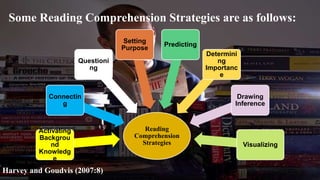
Some Reading Comprehension Strategies are as follows: 
Reading 
Comprehension 
Strategies 
Connectin 
Activating 
Backgrou 
nd 
Knowledg 
e 
g 
Questioni 
ng 
Setting 
Purpose 
Predicting 
Determini 
ng 
Importanc 
e 
Drawing 
Inference 
Visualizing 
Harvey and Goudvis (2007:8)
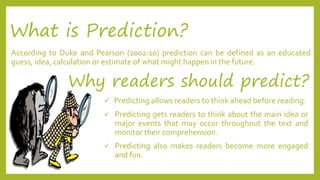
What is Prediction? 
According to Duke and Pearson (2002:10) prediction can be defined as an educated 
guess, idea, calculation or estimate of what might happen in the future. 
Why readers should predict? 
 Predicting allows readers to think ahead before reading. 
 Predicting gets readers to think about the main idea or 
major events that may occur throughout the text and 
monitor their comprehension. 
 Predicting also makes readers become more engaged 
and fun.
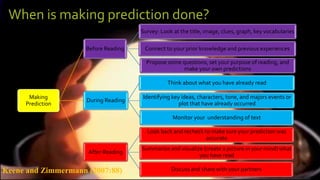
When is making prediction done? 
Making 
Prediction 
Before Reading 
Survey: Look at the title, image, clues, graph, key vocabularies 
Connect to your prior knowledge and previous experiences 
Propose some questions, set your purpose of reading, and 
make your own predictions 
During Reading 
Think about what you have already read 
Identifying key ideas, characters, tone, and majors events or 
plot that have already occurred 
Monitor your understanding of text 
After Reading 
Look back and recheck to make sure your prediction was 
accurate 
Summarize and visualize (create a picture in your mind) what 
you have read 
Keene and Zimmermann (2007:88) Discuss and share with your partners
Let’s 
Practice 
Predicting!
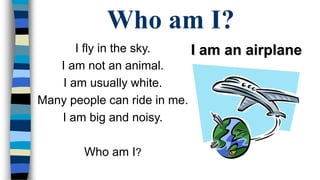
Who am I? 
I fly in the sky. 
I am not an animal. 
I am usually white. 
Many people can ride in me. 
I am big and noisy. 
Who am I? 
I am an airplane
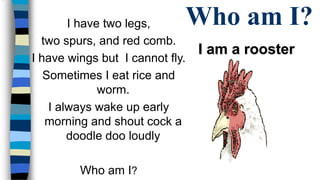
Who am I? I have two legs, 
two spurs, and red comb. 
I have wings but I cannot fly. 
Sometimes I eat rice and 
worm. 
I always wake up early 
morning and shout cock a 
doodle doo loudly 
Who am I? 
I am a rooster 
.
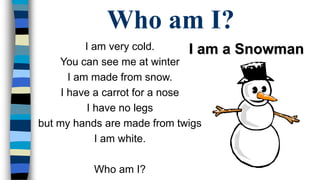
Who am I? 
I am very cold. 
You can see me at winter 
I am made from snow. 
I have a carrot for a nose 
I have no legs 
but my hands are made from twigs 
I am white. 
Who am I? 
I am a Snowman
How do you predict text? 
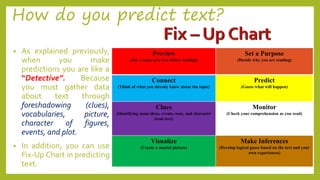
• As explained previously, 
when you make 
predictions you are like a 
“Detective”. Because 
you must gather data 
about text through 
foreshadowing (clues), 
vocabularies, picture, 
character of figures, 
events, and plot. 
• In addition, you can use 
Fix-Up Chart in predicting 
text. 
Preview 
(Get a sense of a text before reading) 
Set a Purpose 
(Decide why you are reading) 
Connect 
(Think of what you already know about the topic) 
Predict 
(Guess what will happen) 
Clues 
(Identifying main ideas, events, tone, and character 
from text) 
Monitor 
(Check your comprehension as you read) 
Visualize 
(Create a mental picture) 
Make Inferences 
(Develop logical guess based on the text and your 
own experiences)
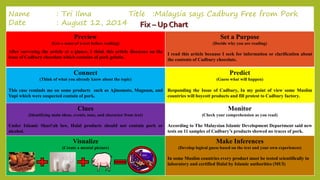
Name : Tri Ilma Title :Malaysia says Cadbury Free from Pork 
Date : August 12, 2014 
Preview 
(Get a sense of a text before reading) 
After surveying the article at a glance, I think this article discusses on the 
issue of Cadbury chocolate which contains of pork gelatin. 
Set a Purpose 
(Decide why you are reading) 
I read this article because I seek for information or clarification about 
the contents of Cadbury chocolate. 
Connect 
(Think of what you already know about the topic) 
This case reminds me on some products such as Ajinomoto, Magnum, and 
Yupi which were suspected contain of pork. 
Predict 
(Guess what will happen) 
Responding the Issue of Cadbury, In my point of view some Muslim 
countries will boycott products and fill protest to Cadbury factory. 
Clues 
(Identifying main ideas, events, tone, and character from text) 
Under Islamic Shari'ah law, Halal products should not contain pork or 
alcohol. 
Monitor 
(Check your comprehension as you read) 
According to The Malaysian Islamic Development Department said new 
tests on 11 samples of Cadbury’s products showed no traces of pork. 
Visualize 
(Create a mental picture) 
Make Inferences 
(Develop logical guess based on the text and your own experiences) 
In some Muslim countries every product must be tested scientifically in 
laboratory and certified Halal by Islamic authorities (MUI)
References: 
 Duke, N. K., and Pearson, P.D. (2002). Effective practice for developing 
reading comprehension. In A.E. Farstrup & S.J. Samuels (Eds), What 
research has to say about reading instruction (3rd ed., pp. 205 – 242). 
Newark, DE: International Reading Association. 
 Harvey, S., and Goudvis, A. (2007). Strategies that work: Teaching 
comprehension for understanding and engagement (2nd ed.). Portland, ME: 
Stenhouse. 
 Keene, E.O., and Zimmermann, S. (2007). Mosaic of thought: The power 
of comprehension strategy instruction strategy (2nd ed.) Portsmouth, NH: 
Heinemann. 
 McKnight, K.S., (2010). The teacher’s big book of graphic organizers. San 
Francisco: John Wiley & Sons, Inc. 
 Tompkins, G.E. (2011). Literacy in the early grades (3rd ed.) Boston: 
Pearson Education, Inc.

Ilma making prediction

  • 1.
    READING STRATEGIES: MAKINGPREDICTION THROUGH FIX-UP CHART Presented By Tri Ilma
  • 2.
    The Objective ofLearning: • After accomplishing this session, every students is expected to be able to use predicting strategy to assist them in comprehending authentic material (the Jakarta Post) deeply, systematically, and comprehensively.
  • 3.
    Some Reading ComprehensionStrategies are as follows: Reading Comprehension Strategies Connectin Activating Backgrou nd Knowledg e g Questioni ng Setting Purpose Predicting Determini ng Importanc e Drawing Inference Visualizing Harvey and Goudvis (2007:8)
  • 4.
    What is Prediction? According to Duke and Pearson (2002:10) prediction can be defined as an educated guess, idea, calculation or estimate of what might happen in the future. Why readers should predict?  Predicting allows readers to think ahead before reading.  Predicting gets readers to think about the main idea or major events that may occur throughout the text and monitor their comprehension.  Predicting also makes readers become more engaged and fun.
  • 5.
    When is makingprediction done? Making Prediction Before Reading Survey: Look at the title, image, clues, graph, key vocabularies Connect to your prior knowledge and previous experiences Propose some questions, set your purpose of reading, and make your own predictions During Reading Think about what you have already read Identifying key ideas, characters, tone, and majors events or plot that have already occurred Monitor your understanding of text After Reading Look back and recheck to make sure your prediction was accurate Summarize and visualize (create a picture in your mind) what you have read Keene and Zimmermann (2007:88) Discuss and share with your partners
  • 6.
  • 7.
    Who am I? I fly in the sky. I am not an animal. I am usually white. Many people can ride in me. I am big and noisy. Who am I? I am an airplane
  • 8.
    Who am I?I have two legs, two spurs, and red comb. I have wings but I cannot fly. Sometimes I eat rice and worm. I always wake up early morning and shout cock a doodle doo loudly Who am I? I am a rooster .
  • 9.
    Who am I? I am very cold. You can see me at winter I am made from snow. I have a carrot for a nose I have no legs but my hands are made from twigs I am white. Who am I? I am a Snowman
  • 10.
    How do youpredict text? • As explained previously, when you make predictions you are like a “Detective”. Because you must gather data about text through foreshadowing (clues), vocabularies, picture, character of figures, events, and plot. • In addition, you can use Fix-Up Chart in predicting text. Preview (Get a sense of a text before reading) Set a Purpose (Decide why you are reading) Connect (Think of what you already know about the topic) Predict (Guess what will happen) Clues (Identifying main ideas, events, tone, and character from text) Monitor (Check your comprehension as you read) Visualize (Create a mental picture) Make Inferences (Develop logical guess based on the text and your own experiences)
  • 11.
    Name : TriIlma Title :Malaysia says Cadbury Free from Pork Date : August 12, 2014 Preview (Get a sense of a text before reading) After surveying the article at a glance, I think this article discusses on the issue of Cadbury chocolate which contains of pork gelatin. Set a Purpose (Decide why you are reading) I read this article because I seek for information or clarification about the contents of Cadbury chocolate. Connect (Think of what you already know about the topic) This case reminds me on some products such as Ajinomoto, Magnum, and Yupi which were suspected contain of pork. Predict (Guess what will happen) Responding the Issue of Cadbury, In my point of view some Muslim countries will boycott products and fill protest to Cadbury factory. Clues (Identifying main ideas, events, tone, and character from text) Under Islamic Shari'ah law, Halal products should not contain pork or alcohol. Monitor (Check your comprehension as you read) According to The Malaysian Islamic Development Department said new tests on 11 samples of Cadbury’s products showed no traces of pork. Visualize (Create a mental picture) Make Inferences (Develop logical guess based on the text and your own experiences) In some Muslim countries every product must be tested scientifically in laboratory and certified Halal by Islamic authorities (MUI)
  • 12.
    References:  Duke,N. K., and Pearson, P.D. (2002). Effective practice for developing reading comprehension. In A.E. Farstrup & S.J. Samuels (Eds), What research has to say about reading instruction (3rd ed., pp. 205 – 242). Newark, DE: International Reading Association.  Harvey, S., and Goudvis, A. (2007). Strategies that work: Teaching comprehension for understanding and engagement (2nd ed.). Portland, ME: Stenhouse.  Keene, E.O., and Zimmermann, S. (2007). Mosaic of thought: The power of comprehension strategy instruction strategy (2nd ed.) Portsmouth, NH: Heinemann.  McKnight, K.S., (2010). The teacher’s big book of graphic organizers. San Francisco: John Wiley & Sons, Inc.  Tompkins, G.E. (2011). Literacy in the early grades (3rd ed.) Boston: Pearson Education, Inc.