1H 2008 Results
2 
Disclaimer 
This presentation (“Presentation”), is strictly confidential to the recipient, may not be distributed to the press or any other person, and may not be reproduced in any form. Failure to comply with this restriction may 
constitute a violation of applicable securities laws. 
This Presentation does not constitute or form part of and should not be construed as, an offer to sell or issue or the solicitation of an offer to buy or acquire securities of OJSC Magnit (the “Company”) or any of its 
subsidiaries in any jurisdiction or an inducement to enter into investment activity. No part of this Presentation, nor the fact of its distribution, should form the basis of, or be relied on in connection with, any contract or 
commitment or investment decision whatsoever. 
The materials comprised in this Presentation have been prepared solely for use at the Presentation and have not been independently verified. No representation, warranty or undertaking, express or implied, is made 
as to, and no reliance should be placed on, the fairness, accuracy, completeness or correctness of the information or the opinions contained herein. None of the Company, nor any shareholder of the Company, nor 
any of its or their affiliates, advisors or representatives shall have any liability whatsoever (in negligence or otherwise) for any loss howsoever arising from any use of this Presentation or its contents or otherwise 
arising in connection with the Presentation. 
This Presentation is made to and directed only at (i) persons outside the United Kingdom, (ii) persons in the United Kingdom falling within Articles 19, 47 and/or 49 of the Financial Services and Markets Act 2000 
(Financial Promotion) Order 2005 and only where the conditions contained in these Articles have been, or will at the relevant time be, satisfied (such persons collectively being referred to as "Relevant Persons"). 
Neither this Presentation nor any copy of it may be taken or transmitted into the United States of America, its territories or possessions, or distributed, directly or indirectly, in the United States of America, its territories 
or possessions, except in reliance on an exemption from the registration requirements of the Securities Act of 1933, as amended (the “Securities Act”). Any failure to comply with this restriction may constitute a 
violation of United States securities laws. The presentation is not an offer of securities for sale in the United States. 
Neither this Presentation nor any copy of it may be taken or transmitted into Canada, Australia or Japan or to Canadian persons or to any securities analyst or other person in any of those jurisdictions. Any failure to 
comply with this restriction may constitute a violation of Australian, Canadian or Japanese securities law. The distribution of this Presentation in other jurisdictions may be restricted by law and persons into whose 
possession this document comes should inform themselves about, and observe, any such restrictions. The Company has not registered and does not intend to register any of its securities under the applicable 
securities laws of Canada, Australia or Japan. 
This Presentation is not an offer to the public or an advertisement of any securities in the Russian Federation. 
This Presentation is not directed to, or intended for distribution to or use by, any person or entity that is a citizen or resident or located in any locality, state, country or other jurisdiction where such distribution, 
publication, availability or use would be contrary to law or regulation or which would require any registration or licensing within such jurisdiction. 
The information contained in this Presentation does not constitute a public offer under any applicable legislation, or an offer to sell or solicitation of an offer to buy any securities. 
Matters discussed in this Presentation may constitute forward-looking statements. Forward-looking statements include statements concerning plans, objectives, goals, strategies, future events or performance, and 
underlying assumptions and other statements, which are other than statements of historical facts. The words “believe,” “expect,” “anticipate,” “intends,” “estimate,” “forecast,” “project,” “will,” “may,” “should” and 
similar expressions identify forward-looking statements. Forward-looking statements include statements regarding: strategies, outlook and growth prospects; future plans and potential for future growth; liquidity, 
capital resources and capital expenditures; growth in demand for products; economic outlook and industry trends; developments of markets; the impact of regulatory initiatives; and the strength of competitors. 
The forward-looking statements in this Presentation are based upon various assumptions, many of which are based, in turn, upon further assumptions, including without limitation, management’s examination of 
historical operating trends, data contained in the Company’s records and other data available from third parties. These assumptions are inherently subject to significant uncertainties and contingencies which are 
difficult or impossible to predict and are beyond its control and it may not achieve or accomplish these expectations, beliefs or projections. In addition, important factors that, in the view of the Company, could cause 
actual results to differ materially from those discussed in the forward-looking statements include the achievement of the anticipated levels of profitability, growth, cost and its recent acquisitions, the timely development 
of new projects, the impact of competitive pricing, the ability to obtain necessary regulatory approvals, and the impact of general business and global economic conditions. Past performance should not be taken as an 
indication or guarantee of future results, and no representation or warranty, express or implied, is made regarding future performance. 
Neither the Company, nor any of its agents, employees or advisors intend or have any duty or obligation to supplement, amend, update or revise any of the forward-looking statements contained in this Presentation or 
to update or to keep current any other information contained in this Presentation. The information and opinions contained in this document are provided as at the date of this Presentation and are subject to change 
without notice. 
By attending this Presentation and/or accepting a copy of this document, you acknowledge and agree to be bound by the foregoing.
3 
Table of Contents 
1. Introduction 
2. Business Overview 
- Convenience Format 
- Hypermarket Format 
- General Overview 
3. Financial Overview 
4. Summary Conclusions
4 
Our History 
1994 –– 1998 
Early years: 
wholesale 
distribution 
 Foundation of wholesale 
business by 
Mr. Galitskiy 
 Tander becomes 
one of the major 
distributors of household 
products and cosmetics 
in Russia 
 Decision to expand into 
food retail market 
 First 
1998 –– 1999 
Entrance 
into 
food retail 
convenience store 
opened 
in Krasnodar 
 Experiments with format 
 Stores merged into 
Magnit discounter 
retail chain 
2001 –– 2005 
Extensive 
roll-out 
to capture 
market share 
 Rapid regional 
roll-out: 1,500 stores by 
the end of 2005 
 Adoption of IFRS 
 Strict financial control 
 Performance-linked 
compensation 
2006 –– 2007 
Continued growth 
with focus on 
margin expansion 
and multi-format 
 Leading food retailer in 
Russia by number of 
stores 
 IPO 
 Started building 
hypermarkets 
 Independent director 
elected to the Board 
 Audit Committee 
established 
 Corporate governance 
rules established to 
comply with best practice 
 3 hypermarkets opened 
in 2007 
 14 hypermarkets under 
construction 
2008 –– YTD 
Active 
hypermarket 
roll-out program 
going forward 
 2,367 convenience 
stores and 10 
hypermarkets as of 
31 August 2008 
 In 8 months 2008 net 
store openings amounted 
to 180 stores, including 7 
hypermarkets (against 
153 stores in 8 months 
2007) 
 8 months 2008 net sales 
increased by 52.5% 
(compared to 8 months 
2007) and amounted to 
US$ 3,420 MM (1) 
Note (1) 6M 2008 sales are provided from management accounts
02-07 CAGR: 43% 
Source: Company 
($MM) (%) 
5 
Magnit Today 
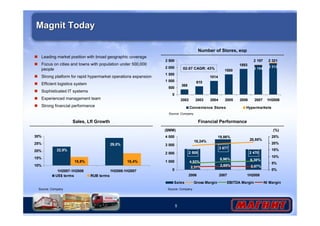
 Leading market position with broad geographic coverage 
 Focus on cities and towns with population under 500,000 
people 
 Strong platform for rapid hypermarket operations expansion 
 Efficient logistics system 
 Sophisticated IT systems 
 Experienced management team 
 Strong financial performance 
Number of Stores, eop 
2 197 2 321 
2 194 2 312 
1893 
1500 
1014 
610 
368 
2 500 
2 000 
1 500 
1 000 
500 
0 
2002 2003 2004 2005 2006 2007 1H2008 
Convenience Stores Hypermarkets 
Financial Performance 
2 470 
3 677 
2 505 
20,85% 
19,86% 
18,24% 
5,96% 6,38% 
4,93% 
2,31% 2,65% 2,67% 
4 000 
3 000 
2 000 
1 000 
0 
2006 2007 1H2008 
25% 
20% 
15% 
10% 
5% 
0% 
Sales Gross Margin EBITDA Margin NI Margin 
Sales, Lfl Growth 
29,0% 
22,9% 
15,8% 18,4% 
30% 
25% 
20% 
15% 
10% 
1H2007-1H2006 1H2008-1H2007 
US$ terms RUB terms 
Source: Company Source: Company
6 
Strategy 
Further expansion 
of convenience 
store operations 
Hypermarket 
roll-out 
Efficiency 
improvements
Further Expansion of Convenience Store Operations 
7 
Medium term plans 
Further expansion 
of convenience 
store operations 
 High level growth of convenience store operations 
 Plan to add 200 – 400 convenience stores annually 
 Acquisition of land plots to secure pipeline for future stores 
Store opening 
decision factors 
Hypermarket 
roll-out 
 Proximity to existing distribution centres 
 Ability to find suitable retail space 
 Level of modern format penetration and consumer disposable income 
Further penetration 
in existing and 
expansion into new 
regions 
 Areas with low modern format penetration 
 Expansion into towns with population as low as 5,000 people 
 Expansion into new locations within regions where Magnit is already present 
Efficiency 
improvement 
Adjusting format to 
customers’ needs 
 Higher share of fresh food products and ready-made meals offering to stimulate frequency of 
shopping 
 Gradual shift to larger convenience store size to improve store attractiveness 
 Promotion of one-stop shopping concept for everyday needs
8 
Hypermarkets Roll-Out 
Strong operational 
platform 
 Strong brand name recognition and customer awareness generated by a large regional 
network of convenience stores 
 Economies of scale in purchasing and efficient logistics system capable of supporting both 
formats in existing and new locations 
 Existing retail expertise strengthened by a team of hypermarket specialists brought in to 
manage execution risks 
Target locations 
 Low or limited competition from other hypermarkets or modern retail formats 
 Relatively low prices of land plots for hypermarket construction in towns with population of 
50,000 to 500,000 people 
 Benefiting from strong growth of disposable income and consumer spendings in the Russian 
regions 
Roll-out plan 
 Locations are chosen on the basis of competition from other hypermarkets in the area, the 
strongest growth of disposable income of the population and minimum negative impact on 
existing convenience stores 
 In small towns hypermarkets will be located in central locations which will give advantage of 
targeting consumers who do not own cars 
 Hypermarkets total selling space (1) will vary from 2,000 to 12,500 sq. m.(2) depending on 
availability of land plots 
Further expansion 
of convenience 
store operations 
Hypermarket 
roll-out 
Efficiency 
improvement 
Note (1) Including selling space designated for leases to third parties 
(2) For hypermarkets currently under construction
9 
Efficiency Improvement 
Product mix 
development 
Further expansion 
of convenience 
store operations 
Hypermarket 
roll-out 
Efficiency 
improvement 
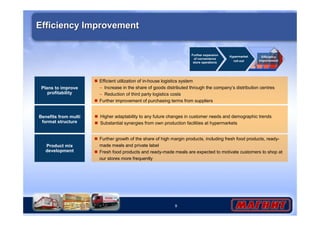
 Further growth of the share of high margin products, including fresh food products, ready-made 
meals and private label 
 Fresh food products and ready-made meals are expected to motivate customers to shop at 
our stores more frequently 
Benefits from multi 
format structure 
 Higher adaptability to any future changes in customer needs and demographic trends 
 Substantial synergies from own production facilities at hypermarkets 
Plans to improve 
profitability 
 Efficient utilization of in-house logistics system 
– Increase in the share of goods distributed through the company’s distribution centres 
– Reduction of third party logistics costs 
 Further improvement of purchasing terms from suppliers
Business Overview
11 
A Shift to Multi Format 
Convenience Store Hypermarket 
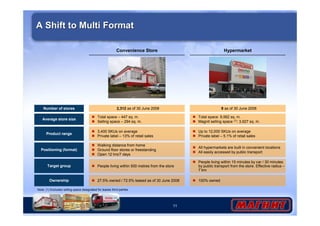
Number of stores 2,312 as of 30 June 2008 9 as of 30 June 2008 
Average store size 
 Total space – 447 sq. m. 
 Selling space – 294 sq. m. 
 Total space: 9,562 sq. m. 
 Magnit selling space (1): 3,927 sq. m. 
Product range 
 3,400 SKUs on average 
 Private label – 13% of retail sales 
 Up to 12,000 SKUs on average 
 Private label – 5.1% of retail sales 
Positioning (format) 
 Walking distance from home 
 Ground floor stores or freestanding 
 Open 12 hrs/7 days 
 All hypermarkets are built in convenient locations 
 All easily accessed by public transport 
Target group  People living within 500 metres from the store 
 People living within 15 minutes by car / 30 minutes 
by public transport from the store. Effective radius – 
7 km 
Ownership  27.5% owned / 72.5% leased as of 30 June 2008  100% owned 
Note: (1) Excludes selling space designated for leases third parties
Convenience Format
2 500 
2 000 
1 500 
1 000 
500 
Source: Company 
13 
Format Description 
Format Highlights 
 Low prices 
 Convenient locations 
 Carefully selected product mix 
 Standardised exterior and car parking 
 Functional interior design 
 Attention to customers 
 Increasing customer convenience 
 Main target group: mid-income consumers 
 Target locations: towns with potential high growth of 
disposable income of population 
Number of Stores, eop 
610 
Geographical Breakdown (% of total stores) 
North-West FD 
4% 
South FD 
40% Urals FD 
2% 
Volga FD 
29% 
Central FD 
25% 
1 014 
1 500 
1 893 
2 194 2 312 
368 
0 
2002 2003 2004 2005 2006 2007 1H2008 
Operating Statistics 
4,746 5,341 
6,279 
8,000 
6,000 
4,000 
2,000 
0 
2005 2006 2007 
Sales 
4,0 3,9 3,6 3,4 
8 
6 
4 
2 
0 
2005 
2006 
2007 
1H2008 
Tickets 
$ / sq. m. / year 
Source: Company 
Source: Company 
tickets / sq. m. / day
14 
Typical Store Opening Process 
 Considerable experience of store openings 
 Preference given to leased store due 
to quick roll out in new markets 
 Acquisitions and construction are 
preferred in existing markets with 
already high penetration 
 Key store opening criterion is payback 
period of not more than 3 years if leased; 
6 – 7 years if owned 
 Average total cost of a new outlet is 
USD165,000 (excluding cost of inventory 
and real estate, but including US$95,000 
cost of equipment) 
 Stores reach traffic comparable to their 
average levels within 6 months 
from opening 
 Rationalisation of store portfolio 
Identification of a property 
or a land plot 
Feasibility report and 
opening budget prepared 
Approval by the regional 
director and branch 
director 
MOU signed with landlord 
Legal due diligence 
Technical due diligence 
Approval by Committee on 
Store Openings 
Lease agreement or SPA 
signed 
Repair and maintenance 
Purchasing and 
installation of equipment 
Personnel hiring and 
training 
Sublet agreements signed 
Store opened 
W 
1 
W 
2 
W 
3 
W 
4 
W 
1 
W 
2 
W 
3 
W 
4 
W 
1 
W 
2 
W 
3 
W 
4 
Month 1 Month 2 Month 3
2003 
387 
100 
114 
9 
610 
259 
15 
Store Opening Dynamics 
1H2008 
937 
654 
577 
98 
55 
2,321 
167 
43 
124 
2005 
684 
379 
368 
61 
8 
1,500 
550 
64 
486 
2006 
783 
461 
536 
84 
29 
1,893 
513 
120 
393 
2007 
889 
546 
628 
89 
45 
2,197 
412 
108 
304 
Southern 
Central 
Volga 
North West 
Urals 
Total 
New 
openings 
2004 
550 
224 
214 
26 
1,014 
438 
Closings 17 34 
Net 
openings 
242 
404 
 108 / 43 convenience stores were 
closed in 2007 / 1H2008 
– 39 / 11 due to poor performance 
– 31 / 13 were relocated to better 
locations 
– 38 / 19 were shut due to 
disagreements with landlords
As of 30 June 2008 the company owned 635 stores and leased 1,677 
 Store ownership is gained on the basis of the following documents: 
– Sale-purchase agreements 
– Lease agreements with redemption rights 
– Construction share holding agreements 
– Investment contracts 
Lease Maturity Profile Store Ownership Structure 
16 
Store Ownership Structure 
27,5% 
72,5% 
Owned Leased 
44% 
17% 
27% 
12% 
1 year 1-3 years 
3-5 years over 5 years 
Source: Company Source: Company as of 30 June 2008
(tickets / sq. m. / day) 
6,0 
4,0 
2,0 
Source: Company 
(sq. m.) 
600 
400 
200 
17 
Key Operating Statistics 
Average Ticket 
3,3 3,8 
Sales Mix 
4,8 
14,3% 12,9% 12,1% 11,4% 
88,6% 
85.7% 87.1% 87.9% 
6,0 
4,0 
2,0 
Source: Company 
100,0% 
80,0% 
60,0% 
40,0% 
20,0% 
0,0% 
2005 2006 2007 1H2008 
Food Non Food 
5,9 
0,0 
2005 2006 2007 1H2008 
($) 
Traffic 
4,0 3,9 3,6 3,4 
0,0 
2005 2006 2007 1H2008 
Average Floor Size 
376 410 
443 447 
255 276 292 294 
0 
2005 2006 2007 1H2008 
Selling Space Total Space 
Source: Company 
Source: Company 
05-07 CAGR: 20% 
05-07 Total Space CAGR: 9%
30% 
25% 
20% 
15% 
10% 
5% 
18 
Lfl Sales Analysis 
Traffic, Lfl 
Average Ticket, Lfl 
33,4% 
22,0% 
Source: Company 
14,3% 
22,5% 
14,8% 
10,1% 
4,0% 
2,0% 
0,0% 
-2,0% 
30% 
20% 
10% 
0% 
2006 2007 1H2008 
US$ terms RUB terms 
-3,3% 
-0,8% 
2,8% 
-4,0% 
2006 2007 1H2008 
Sales, Lfl 
29,0% 
21,1% 
17,5% 
18,4% 
13,9% 
13,2% 
0% 
2006 2007 1H2008 
US$ terms RUB terms 
Source: Company 
Source: Company
Hypermarket Format
Sub-Leased 
Space (1), sq. m. 
Magnit Selling 
Space, sq. m. 
Total Space, 
sq. m. 
Existing hypermarkets 
Location Population 
Krasnodar 800,000 11,283 4,200 3,000 
Kingisepp 52,000 6,264 2,790 445 
Solnechnogorsk 57,600 11,655 4,600 2,650 
Kamyshin 131,000 11,200 4,200 2,800 
Bataysk 107,000 11,200 4,200 2,800 
Anapa 63,000 8,270 4,550 90 
Volgodonsk 178,900 10,200 4,200 2,662 
Volgograd 987,000 4,787 2,400 0 
20 
Format Description 
Format Highlights 
 3 principal hypermarket sub-formats 
– Small: total space of 3,200 - 4,700 
sq. m., selling space (2) of 
2,000 - 2,500 sq. m. 
– Medium: total space of 11,100 - 11,700 
sq. m., selling space (2) of 
6,000 – 8,100 sq. m. 
– Large: total space up to 21,000 sq. m., 
selling space (2) up to 12,500 sq. m. 
 The decision with regards to hypermarket 
format principally depends on the following 
factors: 
– Consumer disposable budget of the region 
– 5-7 year budget forecast 
– Percentage of the budget, attributable to 
hypermarket 
Kingisepp 
– Population of the region 
Bryansk 
– Competition Kamyshin 
Krasnodar 
Solnechnogorsk 
Volgodonsk 
Bataysk 
Source: Company 
Notes (1) Selling space designated for leases to third parties 
(2) Including selling space designated for leases to third parties 
Bryansk 420,000 11,200 4,200 2,800 
Anapa 
Volgograd
21 
Typical Store Opening Process 
M 
1 
M 
2 
M 
3 
M 
4 
M 
5 
M 
6 
M 
7 
M 
8 
M 
9 
M 
10 
M 
11 
M 
12 
M 
13 
M 
14 
M 
15 
M 
16 
M 
17 
M 
18 
Identification 
Land plot audit 
Land plot approval 
SPA signed 
Ownership right received 
Construction permit 
Building design 
Construction 
Financing 
Interior design / equipment 
Licences approval 
Hypermarket launch 
Ownership rights received 
 Key store opening criterion is payback 
period of not more than 6-7 years 
 Average total cost of a new outlet (based 
on hypermarkets launched in 2007) varies 
between US$12.0 – 23.5 MM depending 
on format (excluding cost of inventory and 
real estate, but including US$ 1.3 – 3.1 MM 
cost of equipment) 
 Expected store maturity pattern: 9-12 
months from opening 
 Capex per sq. m. (incl. land) – US$ 1,861 – 
2,098 depending on format
General Overview
Youth (Up to 30 Years Old) 
23 
Pensioners (60+ Years Old) 
Priorities 
 Price 
 Location 
 Assortment 
 Comfort 
Key Features 
 Shopping habits formed in Soviet time 
 Conservative shoppers 
 Most are low income 
Key Focus Areas 
 Increased offering of Private Label 
products to reduce prices for 
essential goods 
Priorities 
 Assortment 
 Location 
 Comfort 
 Price 
Key Features 
 More open to western lifestyles and 
oriented towards modern retail 
formats 
Key Focus Areas 
 Offering product categories 
appealing to young audience 
Target Audience 
Families (30 – 60 Years Old) 
Priorities 
 Location 
 Assortment 
 Price 
 Comfort 
Key Features 
 Time is of greater value than for 
other groups 
 Growing car ownership 
 High level of responsibility for quality of 
purchased food and family budget 
Key Focus Areas 
 Increased share of fresh dairy, 
semi-prepared products and 
ready meals 
 Ensure quick shopping, avoid 
bottlenecks in rush hour 
 One stop shopping: ATMs, pharmacies, 
payment of mobile phone bills, etc 
 Building more parking spaces at the 
stores 
64% 12% 
24% 
Shopping Motivation 
Convenience Stores 
 Daily fresh shopping 
 First need products 
Hypermarkets 
 Weekly shopping
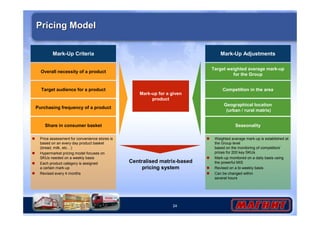
Mark-up for a given 
24 
product 
Overall necessity of a product 
Target audience for a product 
Purchasing frequency of a product 
Share in consumer basket 
Mark-Up Adjustments 
Target weighted average mark-up 
for the Group 
Competition in the area 
Geographical location 
(urban / rural matrix) 
Mark-Up Criteria 
 Price assessment for convenience stores is 
based on an every day product basket 
(bread, milk, etc…) 
 Hypermarket pricing model focuses on 
SKUs needed on a weekly basis 
 Each product category is assigned 
a certain mark-up 
 Revised every 4 months 
Seasonality 
 Weighted average mark-up is established at 
the Group level 
based on the monitoring of competitors’ 
prices for 200 key SKUs 
 Mark-up monitored on a daily basis using 
the powerful MIS 
 Revised on a bi-weekly basis 
 Can be changed within 
several hours 
Centralised matrix-based 
pricing system 
Pricing Model
Suppliers, Purchasing and Private Label 
800 
600 
400 
200 
25 
Share of Private Label Products in Revenue 
(%) 
162 265 
508 551 
700 708 
46 
0 
2002 2003 2004 2005 2006 2007 1H2008 
15 
12 
9 
6 
3 
0 
Number of Items Share in Retail Sales 
Magnit is the largest buyer for many domestic and 
international FMCG producers 
 Weekly Assortment Committee approves the assortment 
and suppliers 
 Direct purchasing and delivery contracts 
 Economies of scale and wide geographical presence 
enable low prices and favorable contract terms 
– Volume discounts 
– Compensation of external and internal logistics costs 
– Average credit term in 2007 was 45 days and could 
be up to 60 days 
– Contract term is typically 1-year 
– Often can be unilaterally terminated by Magnit with 
no penalties 
 Supplier bonuses criteria is based on 
– Meeting sales targets 
– Store promotions 
– Loyalty 
Private label products are designed to replace the 
cheapest SKUs to maximise returns on each metre of 
shelving space 
 708 private label SKUs 
 Private label products accounted for 13% 
(convenience format)/5%(hypermarket) share of retail 
revenue in 1H2008 
 Approximately 85% of private label products are food 
 Share of non-food products in private label is 
expected to increase 
Source: Company
Stores Main Office 
26 
2006-2007 IT Systems Update 
 Transport management system 
– Optimal route planning 
– All cars are equipped with GPS locating systems 
 Warehouse management systems 
– Introduction of WiFi operated data collection terminals 
– Warehouses are customised to work with hypermarket product traffic 
 Oracle IT platform introduced to convenience store format 
 New price management system introduced to both formats 
 Electronic document traffic system with suppliers 
 Introduction of Corporate Information System based on 1C platform 
Cashiers 
Internet 
Database 
Server 
Store 
Director 
Mail Server 
ADSL / GPRS 
Database Server (cluster) 
Distribution Centres 
Tasks Processor (robot)
Federal 
District 
Southern 
Southern 
27 
Logistics System 
In 1H2008 approximately 72% of COGS were 
distributed through the company’s distribution 
centers and the long-term target is to increase 
this share up to 85%. At the moment 
Company’s logistics system includes: 
 Automated stock replenishment system 
 8 distribution centers with approximately 
138,624 sq. m. capacity 
 Fleet of 1,030 vehicles 
Warehousing 
Space sq.m. 
16,138 
30,048 
Number of 
Serviced Stores Leased / Owned 
287 
510 
Owned 
Owned 
City 
Bataysk 
Kropotkin 
Engels Volga 19,495 339 Owned 
Togliatti Volga 8,379 239 Leased 
Tver Central 10,714 180 Owned 
Oryol Central 12,472 346 Owned 
Ivanovo Central 25,226 293 Owned 
Ural 
16,152 
138,624 
127 
2,321 
Owned 
Chelyabinsk 
Total 
DC Processed Goods 
2005 1H2008 Target 
43% 
57% 
Outsourced 
Owned 
Outsourced 28% 72% Owned 
85% 
Outsourced 15% 
Owned 
Source: Company
Well trained dedicated personnel 
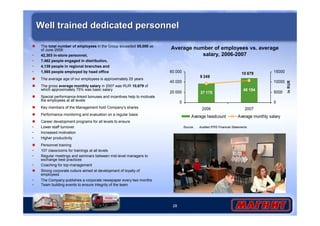
Average number of employees vs. average 
60 000 
40 000 
20 000 
28 
salary, 2006-2007 
37 170 
48 194 
9 249 
10 679 
0 
2006 2007 
15000 
10000 
5000 
0 
in RUR 
Average headcount Average monthly salary 
 The total number of employees in the Group exceeded 55,000 as 
of June 2008: 
• 42,303 in-store personnel, 
• 7,462 people engaged in distribution, 
• 4,139 people in regional branches and 
• 1,565 people employed by head office 
 The average age of our employees is approximately 25 years 
 The gross average monthly salary in 2007 was RUR 10,679 of 
which approximately 75% was basic salary 
 Special performance-linked bonuses and incentives help to motivate 
the employees at all levels 
 Key members of the Management hold Company’s shares 
 Performance monitoring and evaluation on a regular basis 
 Career development programs for all levels to ensure 
• Lower staff turnover 
• Increased motivation 
• Higher productivity 
 Personnel training 
• 107 classrooms for trainings at all levels 
• Regular meetings and seminars between mid-level managers to 
exchange best practices 
• Coaching for top-management 
 Strong corporate culture aimed at development of loyalty of 
employees 
• The Company publishes a corporate newspaper every two months 
• Team building events to ensure integrity of the team 
Source: Audited IFRS Financial Statements
Financial Overview
30 
Summary PL 
1H08 / 1H07 
Y-o-Y Growth 
50.77% 
47.00% 
67.01% 
60.52% 
90.22% 
65.66% 
100.24% 
75.34% 
2007 / 2006 
Y-o-Y Growth 
46.77% 
43.87% 
59.74% 
54.46% 
77.40% 
84.50% 
75.22% 
68.02% 
1H2008 
2,469.9 
(1,954.8) 
515,1 
20.85% 
(362.2) 
4.7 
157.6 
6.38% 
(39.8) 
117.8 
(26.8) 
91.0 
25.1 
27.55% 
65.9 
2.67% 
In US$ MM 2006 2007 
Net sales 2,505.0 3,676.6 
Cost of sales (2,048.0) (2,946.5) 
Gross profit 457.0 730.0 
Gross margin, % 18.24% 19.86% 
SGA (332.2) (513.2) 
Other income/(expense) (1.2) 2.4 
EBITDA 123.6 219.2 
EBITDA margin,% 4.93% 5.96% 
Depreciation (29.1) (53.7) 
EBIT 94.5 165.6 
Net finance costs (13.0) (35.5) 
Profit before tax 81.5 130.1 
Taxes (23.5) (32.7) 
Effective tax rate 28.85% 25.15% 
Net income 58.0 97.4 
Net margin, % 2.31% 2.65% 
Source: IFRS accounts
Gross Margin Bridge / SGA Expense Structure 
0,0 
31 
20,9 
18,2 
19,9 
0,9 1,1 
0,1 
(0,2) (0,1) 
(0,1) 
1,0 
22 
20 
18 
16 
14 
12 
10 
Trading Margin% 
GM 2006 
Rebates% 
Transport 
Losses 
Trading Margin% 
GM 2007 
Rebates% 
Transport% 
Losses 
GM 1H 2008 
Gross Margin Bridge 
As % of Sales 
Source: Company, IFRS accounts 
SGA Expense Structure 
15,2%* 16,3%* 
9,3% 9,79% 
1,2% 1,87% 
2,1% 1,76% 
9,5% 9,76% 
24,9% 22,56% 
52,9% 54,26% 
1H2007 1H2008 
* As a % of sales 
other expenses 
repair and maintanance 
packaging and raw materials 
depriciation 
rent and utilities 
payroll and related taxes
32 
EBITDA Bridge 
EBITDA Bridge 
As % of Sales 
8,0 
6,0 
4,0 
2,0 
Source: Company, IFRS accounts 
6,4 
6,0 
4,9 
0,1 
(0,01) (0,1) 
0,03 
(0,6) 
1,0 
1,6 
0,4 
(0,1) (0,3) 
(0,6) 
0,03 
0,0 
EBITDA 2006 
GM 
Packaging 
Salaries 
Rent and Utilities 
Repair 
Other 
EBITDA 2007 
GM 
Packaging 
Salaries 
Rent and Utilities 
Repair 
EBITDA 1H08 
Other
’000 US$ 2006 2007 1H2008 
ASSETS 
Property plant and equipment 468,401 1,074,248 1,433,312 
Other non-current assets 1,487 1,330 2,024 
Cash and cash equivalents 89,789 120,959 74,867 
Trade accounts receivable 5,344 2,415 1,732 
Merchandise 247,466 330,409 355,191 
Other current assets 77,717 90,659 124,051 
TOTAL ASSETS 890,204 1,620,020 1,991,177 
EQUITY AND LIABILITIES 
Equity 305,239 428,347 980,364 
Long-term debt 89,346 183,444 207,172 
Other long-term liabilities 14,714 15,811 19,268 
Trade accounts payable 281,401 437,643 463,388 
Short-term debt 167,135 509,190 240,119 
Other current liabilities 32,369 45,585 80,866 
33 
Balance Sheet 
TOTAL EQUITY AND LIABILITIES 890,204 1,620,020 1,991,177 
Source: IFRS accounts
34 
1H 2008 Capex ((1)) Analysis 
US ‘000 
Source: IFRS accounts 
Notes (1) Capex calculated as additions + transfers of PPE in each period 
5 794 
6 965 
37 203 
39 583 
239 538 
14 984 
Other assets 
Construction in progress 
Machinery and equipment 
Equipment under finance lease 
Bulidings 
Land 
Total as of June 30, 2008: $344 mn
‘000 US$ 2007 1H2008 
OPERATING ACTIVITIES: 
Operating profit before movements in working capital 219,054 158,227 
Net cash generated from operating activities 242,355 153,319 
INVESTING ACTIVITIES: 
Net Cash used in investing activities (568,698) (346,520) 
Net cash generated from financing activities 354,832 143,555 
Net increase in cash and cash equivalents 28,489 46,092 
Cash and cash equivalents, end of period 120,959 74,867 
35 
Cash Flow Statement 
2006 
124,785 
85,983 
(301,552) 
258,712 
43,143 
89,789 
FINANCING ACTIVITIES: 
Source: IFRS accounts
36 
35 
34 
33 
32 
31 
3,0 
2,0 
1,0 
36 
Working Capital Analysis 
43.9 41.5 
38.3 
40 
- 
(40) 
(80) 
(120) 
50 
40 
30 
20 
10 
0 
2006 2007 1H2008 
Inventory Management Days (2) 
31.6 
35.3 
35.0 
30 
2006 2007 1H2008 
Trade Accounts Payable Days (3) 
Source: Company 
Source: Company 
Net Debt (4)/ EBITDA 
Source: Company, IFRS accounts 
Working Capital (1) 
14.6 
(72.5) 
(118.1) 
(160) 
2006 2007 1H2008 
Source: Company 
Notes: (1) Current assets (less CCE and short-term investments) – current liabilities (less short-term debt) 
(2) 2006-2007: 360 / (Cost of sales/year average inventory), 1H2008: 180 / (Cost of sales/half year average inventory) 
(3) 2006-2007: 360 / (Cost of sales/year average trade accounts payable), 1H2008: 180 / (Cost of sales/half year average trade accounts payable) 
(4) Net debt = long / short-term bonds and borrowings + finance lease liabilities – cash and cash equivalents 
(5) Company’s estimates 
1.1 
2.6 
1.3 
0,0 
2006 2007 1H2008 (5)
Summary Conclusions
Strong foothold in Russia’s cities and towns with population under 500,000 people: first 
mover advantage (first retailer in many locations to establish a modern format); low competition 
from other chains outside of Russia’s large cities 
38 
Summary Conclusions 
Leading Russian retailer: broadest geographic coverage with 2,321 stores (as of 30 June 
2008) in more than 760 cities in five out of seven federal districts in Russia 
Further organic growth of store operations: continued roll-out of established business model 
in existing markets and selective expansion into new geographic areas 
Expanding hypermarket operations: leveraging strong existing platform (operations, logistics, 
brand, scale) to develop a leading hypermarket chain in the European part of Russia 
Additional measures to improve profitability: enhancing product mix, increasing private label 
and increasing distribution through own logistics system to achieve margin improvements and 
cost savings 
Financing of expansion program: implementation of the Company’s mid-term strategy will be 
executed through a mix of debt and equity raisings

1H2008 Results

  • 1.
  • 2.
    2 Disclaimer Thispresentation (“Presentation”), is strictly confidential to the recipient, may not be distributed to the press or any other person, and may not be reproduced in any form. Failure to comply with this restriction may constitute a violation of applicable securities laws. This Presentation does not constitute or form part of and should not be construed as, an offer to sell or issue or the solicitation of an offer to buy or acquire securities of OJSC Magnit (the “Company”) or any of its subsidiaries in any jurisdiction or an inducement to enter into investment activity. No part of this Presentation, nor the fact of its distribution, should form the basis of, or be relied on in connection with, any contract or commitment or investment decision whatsoever. The materials comprised in this Presentation have been prepared solely for use at the Presentation and have not been independently verified. No representation, warranty or undertaking, express or implied, is made as to, and no reliance should be placed on, the fairness, accuracy, completeness or correctness of the information or the opinions contained herein. None of the Company, nor any shareholder of the Company, nor any of its or their affiliates, advisors or representatives shall have any liability whatsoever (in negligence or otherwise) for any loss howsoever arising from any use of this Presentation or its contents or otherwise arising in connection with the Presentation. This Presentation is made to and directed only at (i) persons outside the United Kingdom, (ii) persons in the United Kingdom falling within Articles 19, 47 and/or 49 of the Financial Services and Markets Act 2000 (Financial Promotion) Order 2005 and only where the conditions contained in these Articles have been, or will at the relevant time be, satisfied (such persons collectively being referred to as "Relevant Persons"). Neither this Presentation nor any copy of it may be taken or transmitted into the United States of America, its territories or possessions, or distributed, directly or indirectly, in the United States of America, its territories or possessions, except in reliance on an exemption from the registration requirements of the Securities Act of 1933, as amended (the “Securities Act”). Any failure to comply with this restriction may constitute a violation of United States securities laws. The presentation is not an offer of securities for sale in the United States. Neither this Presentation nor any copy of it may be taken or transmitted into Canada, Australia or Japan or to Canadian persons or to any securities analyst or other person in any of those jurisdictions. Any failure to comply with this restriction may constitute a violation of Australian, Canadian or Japanese securities law. The distribution of this Presentation in other jurisdictions may be restricted by law and persons into whose possession this document comes should inform themselves about, and observe, any such restrictions. The Company has not registered and does not intend to register any of its securities under the applicable securities laws of Canada, Australia or Japan. This Presentation is not an offer to the public or an advertisement of any securities in the Russian Federation. This Presentation is not directed to, or intended for distribution to or use by, any person or entity that is a citizen or resident or located in any locality, state, country or other jurisdiction where such distribution, publication, availability or use would be contrary to law or regulation or which would require any registration or licensing within such jurisdiction. The information contained in this Presentation does not constitute a public offer under any applicable legislation, or an offer to sell or solicitation of an offer to buy any securities. Matters discussed in this Presentation may constitute forward-looking statements. Forward-looking statements include statements concerning plans, objectives, goals, strategies, future events or performance, and underlying assumptions and other statements, which are other than statements of historical facts. The words “believe,” “expect,” “anticipate,” “intends,” “estimate,” “forecast,” “project,” “will,” “may,” “should” and similar expressions identify forward-looking statements. Forward-looking statements include statements regarding: strategies, outlook and growth prospects; future plans and potential for future growth; liquidity, capital resources and capital expenditures; growth in demand for products; economic outlook and industry trends; developments of markets; the impact of regulatory initiatives; and the strength of competitors. The forward-looking statements in this Presentation are based upon various assumptions, many of which are based, in turn, upon further assumptions, including without limitation, management’s examination of historical operating trends, data contained in the Company’s records and other data available from third parties. These assumptions are inherently subject to significant uncertainties and contingencies which are difficult or impossible to predict and are beyond its control and it may not achieve or accomplish these expectations, beliefs or projections. In addition, important factors that, in the view of the Company, could cause actual results to differ materially from those discussed in the forward-looking statements include the achievement of the anticipated levels of profitability, growth, cost and its recent acquisitions, the timely development of new projects, the impact of competitive pricing, the ability to obtain necessary regulatory approvals, and the impact of general business and global economic conditions. Past performance should not be taken as an indication or guarantee of future results, and no representation or warranty, express or implied, is made regarding future performance. Neither the Company, nor any of its agents, employees or advisors intend or have any duty or obligation to supplement, amend, update or revise any of the forward-looking statements contained in this Presentation or to update or to keep current any other information contained in this Presentation. The information and opinions contained in this document are provided as at the date of this Presentation and are subject to change without notice. By attending this Presentation and/or accepting a copy of this document, you acknowledge and agree to be bound by the foregoing.
  • 3.
    3 Table ofContents 1. Introduction 2. Business Overview - Convenience Format - Hypermarket Format - General Overview 3. Financial Overview 4. Summary Conclusions
  • 4.
    4 Our History 1994 –– 1998 Early years: wholesale distribution Foundation of wholesale business by Mr. Galitskiy Tander becomes one of the major distributors of household products and cosmetics in Russia Decision to expand into food retail market First 1998 –– 1999 Entrance into food retail convenience store opened in Krasnodar Experiments with format Stores merged into Magnit discounter retail chain 2001 –– 2005 Extensive roll-out to capture market share Rapid regional roll-out: 1,500 stores by the end of 2005 Adoption of IFRS Strict financial control Performance-linked compensation 2006 –– 2007 Continued growth with focus on margin expansion and multi-format Leading food retailer in Russia by number of stores IPO Started building hypermarkets Independent director elected to the Board Audit Committee established Corporate governance rules established to comply with best practice 3 hypermarkets opened in 2007 14 hypermarkets under construction 2008 –– YTD Active hypermarket roll-out program going forward 2,367 convenience stores and 10 hypermarkets as of 31 August 2008 In 8 months 2008 net store openings amounted to 180 stores, including 7 hypermarkets (against 153 stores in 8 months 2007) 8 months 2008 net sales increased by 52.5% (compared to 8 months 2007) and amounted to US$ 3,420 MM (1) Note (1) 6M 2008 sales are provided from management accounts
  • 5.
    02-07 CAGR: 43% Source: Company ($MM) (%) 5 Magnit Today Leading market position with broad geographic coverage Focus on cities and towns with population under 500,000 people Strong platform for rapid hypermarket operations expansion Efficient logistics system Sophisticated IT systems Experienced management team Strong financial performance Number of Stores, eop 2 197 2 321 2 194 2 312 1893 1500 1014 610 368 2 500 2 000 1 500 1 000 500 0 2002 2003 2004 2005 2006 2007 1H2008 Convenience Stores Hypermarkets Financial Performance 2 470 3 677 2 505 20,85% 19,86% 18,24% 5,96% 6,38% 4,93% 2,31% 2,65% 2,67% 4 000 3 000 2 000 1 000 0 2006 2007 1H2008 25% 20% 15% 10% 5% 0% Sales Gross Margin EBITDA Margin NI Margin Sales, Lfl Growth 29,0% 22,9% 15,8% 18,4% 30% 25% 20% 15% 10% 1H2007-1H2006 1H2008-1H2007 US$ terms RUB terms Source: Company Source: Company
  • 6.
    6 Strategy Furtherexpansion of convenience store operations Hypermarket roll-out Efficiency improvements
  • 7.
    Further Expansion ofConvenience Store Operations 7 Medium term plans Further expansion of convenience store operations High level growth of convenience store operations Plan to add 200 – 400 convenience stores annually Acquisition of land plots to secure pipeline for future stores Store opening decision factors Hypermarket roll-out Proximity to existing distribution centres Ability to find suitable retail space Level of modern format penetration and consumer disposable income Further penetration in existing and expansion into new regions Areas with low modern format penetration Expansion into towns with population as low as 5,000 people Expansion into new locations within regions where Magnit is already present Efficiency improvement Adjusting format to customers’ needs Higher share of fresh food products and ready-made meals offering to stimulate frequency of shopping Gradual shift to larger convenience store size to improve store attractiveness Promotion of one-stop shopping concept for everyday needs
  • 8.
    8 Hypermarkets Roll-Out Strong operational platform Strong brand name recognition and customer awareness generated by a large regional network of convenience stores Economies of scale in purchasing and efficient logistics system capable of supporting both formats in existing and new locations Existing retail expertise strengthened by a team of hypermarket specialists brought in to manage execution risks Target locations Low or limited competition from other hypermarkets or modern retail formats Relatively low prices of land plots for hypermarket construction in towns with population of 50,000 to 500,000 people Benefiting from strong growth of disposable income and consumer spendings in the Russian regions Roll-out plan Locations are chosen on the basis of competition from other hypermarkets in the area, the strongest growth of disposable income of the population and minimum negative impact on existing convenience stores In small towns hypermarkets will be located in central locations which will give advantage of targeting consumers who do not own cars Hypermarkets total selling space (1) will vary from 2,000 to 12,500 sq. m.(2) depending on availability of land plots Further expansion of convenience store operations Hypermarket roll-out Efficiency improvement Note (1) Including selling space designated for leases to third parties (2) For hypermarkets currently under construction
  • 9.
    9 Efficiency Improvement Product mix development Further expansion of convenience store operations Hypermarket roll-out Efficiency improvement Further growth of the share of high margin products, including fresh food products, ready-made meals and private label Fresh food products and ready-made meals are expected to motivate customers to shop at our stores more frequently Benefits from multi format structure Higher adaptability to any future changes in customer needs and demographic trends Substantial synergies from own production facilities at hypermarkets Plans to improve profitability Efficient utilization of in-house logistics system – Increase in the share of goods distributed through the company’s distribution centres – Reduction of third party logistics costs Further improvement of purchasing terms from suppliers
  • 10.
  • 11.
    11 A Shiftto Multi Format Convenience Store Hypermarket Number of stores 2,312 as of 30 June 2008 9 as of 30 June 2008 Average store size Total space – 447 sq. m. Selling space – 294 sq. m. Total space: 9,562 sq. m. Magnit selling space (1): 3,927 sq. m. Product range 3,400 SKUs on average Private label – 13% of retail sales Up to 12,000 SKUs on average Private label – 5.1% of retail sales Positioning (format) Walking distance from home Ground floor stores or freestanding Open 12 hrs/7 days All hypermarkets are built in convenient locations All easily accessed by public transport Target group People living within 500 metres from the store People living within 15 minutes by car / 30 minutes by public transport from the store. Effective radius – 7 km Ownership 27.5% owned / 72.5% leased as of 30 June 2008 100% owned Note: (1) Excludes selling space designated for leases third parties
  • 12.
  • 13.
    2 500 2000 1 500 1 000 500 Source: Company 13 Format Description Format Highlights Low prices Convenient locations Carefully selected product mix Standardised exterior and car parking Functional interior design Attention to customers Increasing customer convenience Main target group: mid-income consumers Target locations: towns with potential high growth of disposable income of population Number of Stores, eop 610 Geographical Breakdown (% of total stores) North-West FD 4% South FD 40% Urals FD 2% Volga FD 29% Central FD 25% 1 014 1 500 1 893 2 194 2 312 368 0 2002 2003 2004 2005 2006 2007 1H2008 Operating Statistics 4,746 5,341 6,279 8,000 6,000 4,000 2,000 0 2005 2006 2007 Sales 4,0 3,9 3,6 3,4 8 6 4 2 0 2005 2006 2007 1H2008 Tickets $ / sq. m. / year Source: Company Source: Company tickets / sq. m. / day
  • 14.
    14 Typical StoreOpening Process Considerable experience of store openings Preference given to leased store due to quick roll out in new markets Acquisitions and construction are preferred in existing markets with already high penetration Key store opening criterion is payback period of not more than 3 years if leased; 6 – 7 years if owned Average total cost of a new outlet is USD165,000 (excluding cost of inventory and real estate, but including US$95,000 cost of equipment) Stores reach traffic comparable to their average levels within 6 months from opening Rationalisation of store portfolio Identification of a property or a land plot Feasibility report and opening budget prepared Approval by the regional director and branch director MOU signed with landlord Legal due diligence Technical due diligence Approval by Committee on Store Openings Lease agreement or SPA signed Repair and maintenance Purchasing and installation of equipment Personnel hiring and training Sublet agreements signed Store opened W 1 W 2 W 3 W 4 W 1 W 2 W 3 W 4 W 1 W 2 W 3 W 4 Month 1 Month 2 Month 3
  • 15.
    2003 387 100 114 9 610 259 15 Store Opening Dynamics 1H2008 937 654 577 98 55 2,321 167 43 124 2005 684 379 368 61 8 1,500 550 64 486 2006 783 461 536 84 29 1,893 513 120 393 2007 889 546 628 89 45 2,197 412 108 304 Southern Central Volga North West Urals Total New openings 2004 550 224 214 26 1,014 438 Closings 17 34 Net openings 242 404 108 / 43 convenience stores were closed in 2007 / 1H2008 – 39 / 11 due to poor performance – 31 / 13 were relocated to better locations – 38 / 19 were shut due to disagreements with landlords
  • 16.
    As of 30June 2008 the company owned 635 stores and leased 1,677 Store ownership is gained on the basis of the following documents: – Sale-purchase agreements – Lease agreements with redemption rights – Construction share holding agreements – Investment contracts Lease Maturity Profile Store Ownership Structure 16 Store Ownership Structure 27,5% 72,5% Owned Leased 44% 17% 27% 12% 1 year 1-3 years 3-5 years over 5 years Source: Company Source: Company as of 30 June 2008
  • 17.
    (tickets / sq.m. / day) 6,0 4,0 2,0 Source: Company (sq. m.) 600 400 200 17 Key Operating Statistics Average Ticket 3,3 3,8 Sales Mix 4,8 14,3% 12,9% 12,1% 11,4% 88,6% 85.7% 87.1% 87.9% 6,0 4,0 2,0 Source: Company 100,0% 80,0% 60,0% 40,0% 20,0% 0,0% 2005 2006 2007 1H2008 Food Non Food 5,9 0,0 2005 2006 2007 1H2008 ($) Traffic 4,0 3,9 3,6 3,4 0,0 2005 2006 2007 1H2008 Average Floor Size 376 410 443 447 255 276 292 294 0 2005 2006 2007 1H2008 Selling Space Total Space Source: Company Source: Company 05-07 CAGR: 20% 05-07 Total Space CAGR: 9%
  • 18.
    30% 25% 20% 15% 10% 5% 18 Lfl Sales Analysis Traffic, Lfl Average Ticket, Lfl 33,4% 22,0% Source: Company 14,3% 22,5% 14,8% 10,1% 4,0% 2,0% 0,0% -2,0% 30% 20% 10% 0% 2006 2007 1H2008 US$ terms RUB terms -3,3% -0,8% 2,8% -4,0% 2006 2007 1H2008 Sales, Lfl 29,0% 21,1% 17,5% 18,4% 13,9% 13,2% 0% 2006 2007 1H2008 US$ terms RUB terms Source: Company Source: Company
  • 19.
  • 20.
    Sub-Leased Space (1),sq. m. Magnit Selling Space, sq. m. Total Space, sq. m. Existing hypermarkets Location Population Krasnodar 800,000 11,283 4,200 3,000 Kingisepp 52,000 6,264 2,790 445 Solnechnogorsk 57,600 11,655 4,600 2,650 Kamyshin 131,000 11,200 4,200 2,800 Bataysk 107,000 11,200 4,200 2,800 Anapa 63,000 8,270 4,550 90 Volgodonsk 178,900 10,200 4,200 2,662 Volgograd 987,000 4,787 2,400 0 20 Format Description Format Highlights 3 principal hypermarket sub-formats – Small: total space of 3,200 - 4,700 sq. m., selling space (2) of 2,000 - 2,500 sq. m. – Medium: total space of 11,100 - 11,700 sq. m., selling space (2) of 6,000 – 8,100 sq. m. – Large: total space up to 21,000 sq. m., selling space (2) up to 12,500 sq. m. The decision with regards to hypermarket format principally depends on the following factors: – Consumer disposable budget of the region – 5-7 year budget forecast – Percentage of the budget, attributable to hypermarket Kingisepp – Population of the region Bryansk – Competition Kamyshin Krasnodar Solnechnogorsk Volgodonsk Bataysk Source: Company Notes (1) Selling space designated for leases to third parties (2) Including selling space designated for leases to third parties Bryansk 420,000 11,200 4,200 2,800 Anapa Volgograd
  • 21.
    21 Typical StoreOpening Process M 1 M 2 M 3 M 4 M 5 M 6 M 7 M 8 M 9 M 10 M 11 M 12 M 13 M 14 M 15 M 16 M 17 M 18 Identification Land plot audit Land plot approval SPA signed Ownership right received Construction permit Building design Construction Financing Interior design / equipment Licences approval Hypermarket launch Ownership rights received Key store opening criterion is payback period of not more than 6-7 years Average total cost of a new outlet (based on hypermarkets launched in 2007) varies between US$12.0 – 23.5 MM depending on format (excluding cost of inventory and real estate, but including US$ 1.3 – 3.1 MM cost of equipment) Expected store maturity pattern: 9-12 months from opening Capex per sq. m. (incl. land) – US$ 1,861 – 2,098 depending on format
  • 22.
  • 23.
    Youth (Up to30 Years Old) 23 Pensioners (60+ Years Old) Priorities Price Location Assortment Comfort Key Features Shopping habits formed in Soviet time Conservative shoppers Most are low income Key Focus Areas Increased offering of Private Label products to reduce prices for essential goods Priorities Assortment Location Comfort Price Key Features More open to western lifestyles and oriented towards modern retail formats Key Focus Areas Offering product categories appealing to young audience Target Audience Families (30 – 60 Years Old) Priorities Location Assortment Price Comfort Key Features Time is of greater value than for other groups Growing car ownership High level of responsibility for quality of purchased food and family budget Key Focus Areas Increased share of fresh dairy, semi-prepared products and ready meals Ensure quick shopping, avoid bottlenecks in rush hour One stop shopping: ATMs, pharmacies, payment of mobile phone bills, etc Building more parking spaces at the stores 64% 12% 24% Shopping Motivation Convenience Stores Daily fresh shopping First need products Hypermarkets Weekly shopping
  • 24.
    Mark-up for agiven 24 product Overall necessity of a product Target audience for a product Purchasing frequency of a product Share in consumer basket Mark-Up Adjustments Target weighted average mark-up for the Group Competition in the area Geographical location (urban / rural matrix) Mark-Up Criteria Price assessment for convenience stores is based on an every day product basket (bread, milk, etc…) Hypermarket pricing model focuses on SKUs needed on a weekly basis Each product category is assigned a certain mark-up Revised every 4 months Seasonality Weighted average mark-up is established at the Group level based on the monitoring of competitors’ prices for 200 key SKUs Mark-up monitored on a daily basis using the powerful MIS Revised on a bi-weekly basis Can be changed within several hours Centralised matrix-based pricing system Pricing Model
  • 25.
    Suppliers, Purchasing andPrivate Label 800 600 400 200 25 Share of Private Label Products in Revenue (%) 162 265 508 551 700 708 46 0 2002 2003 2004 2005 2006 2007 1H2008 15 12 9 6 3 0 Number of Items Share in Retail Sales Magnit is the largest buyer for many domestic and international FMCG producers Weekly Assortment Committee approves the assortment and suppliers Direct purchasing and delivery contracts Economies of scale and wide geographical presence enable low prices and favorable contract terms – Volume discounts – Compensation of external and internal logistics costs – Average credit term in 2007 was 45 days and could be up to 60 days – Contract term is typically 1-year – Often can be unilaterally terminated by Magnit with no penalties Supplier bonuses criteria is based on – Meeting sales targets – Store promotions – Loyalty Private label products are designed to replace the cheapest SKUs to maximise returns on each metre of shelving space 708 private label SKUs Private label products accounted for 13% (convenience format)/5%(hypermarket) share of retail revenue in 1H2008 Approximately 85% of private label products are food Share of non-food products in private label is expected to increase Source: Company
  • 26.
    Stores Main Office 26 2006-2007 IT Systems Update Transport management system – Optimal route planning – All cars are equipped with GPS locating systems Warehouse management systems – Introduction of WiFi operated data collection terminals – Warehouses are customised to work with hypermarket product traffic Oracle IT platform introduced to convenience store format New price management system introduced to both formats Electronic document traffic system with suppliers Introduction of Corporate Information System based on 1C platform Cashiers Internet Database Server Store Director Mail Server ADSL / GPRS Database Server (cluster) Distribution Centres Tasks Processor (robot)
  • 27.
    Federal District Southern Southern 27 Logistics System In 1H2008 approximately 72% of COGS were distributed through the company’s distribution centers and the long-term target is to increase this share up to 85%. At the moment Company’s logistics system includes: Automated stock replenishment system 8 distribution centers with approximately 138,624 sq. m. capacity Fleet of 1,030 vehicles Warehousing Space sq.m. 16,138 30,048 Number of Serviced Stores Leased / Owned 287 510 Owned Owned City Bataysk Kropotkin Engels Volga 19,495 339 Owned Togliatti Volga 8,379 239 Leased Tver Central 10,714 180 Owned Oryol Central 12,472 346 Owned Ivanovo Central 25,226 293 Owned Ural 16,152 138,624 127 2,321 Owned Chelyabinsk Total DC Processed Goods 2005 1H2008 Target 43% 57% Outsourced Owned Outsourced 28% 72% Owned 85% Outsourced 15% Owned Source: Company
  • 28.
    Well trained dedicatedpersonnel Average number of employees vs. average 60 000 40 000 20 000 28 salary, 2006-2007 37 170 48 194 9 249 10 679 0 2006 2007 15000 10000 5000 0 in RUR Average headcount Average monthly salary The total number of employees in the Group exceeded 55,000 as of June 2008: • 42,303 in-store personnel, • 7,462 people engaged in distribution, • 4,139 people in regional branches and • 1,565 people employed by head office The average age of our employees is approximately 25 years The gross average monthly salary in 2007 was RUR 10,679 of which approximately 75% was basic salary Special performance-linked bonuses and incentives help to motivate the employees at all levels Key members of the Management hold Company’s shares Performance monitoring and evaluation on a regular basis Career development programs for all levels to ensure • Lower staff turnover • Increased motivation • Higher productivity Personnel training • 107 classrooms for trainings at all levels • Regular meetings and seminars between mid-level managers to exchange best practices • Coaching for top-management Strong corporate culture aimed at development of loyalty of employees • The Company publishes a corporate newspaper every two months • Team building events to ensure integrity of the team Source: Audited IFRS Financial Statements
  • 29.
  • 30.
    30 Summary PL 1H08 / 1H07 Y-o-Y Growth 50.77% 47.00% 67.01% 60.52% 90.22% 65.66% 100.24% 75.34% 2007 / 2006 Y-o-Y Growth 46.77% 43.87% 59.74% 54.46% 77.40% 84.50% 75.22% 68.02% 1H2008 2,469.9 (1,954.8) 515,1 20.85% (362.2) 4.7 157.6 6.38% (39.8) 117.8 (26.8) 91.0 25.1 27.55% 65.9 2.67% In US$ MM 2006 2007 Net sales 2,505.0 3,676.6 Cost of sales (2,048.0) (2,946.5) Gross profit 457.0 730.0 Gross margin, % 18.24% 19.86% SGA (332.2) (513.2) Other income/(expense) (1.2) 2.4 EBITDA 123.6 219.2 EBITDA margin,% 4.93% 5.96% Depreciation (29.1) (53.7) EBIT 94.5 165.6 Net finance costs (13.0) (35.5) Profit before tax 81.5 130.1 Taxes (23.5) (32.7) Effective tax rate 28.85% 25.15% Net income 58.0 97.4 Net margin, % 2.31% 2.65% Source: IFRS accounts
  • 31.
    Gross Margin Bridge/ SGA Expense Structure 0,0 31 20,9 18,2 19,9 0,9 1,1 0,1 (0,2) (0,1) (0,1) 1,0 22 20 18 16 14 12 10 Trading Margin% GM 2006 Rebates% Transport Losses Trading Margin% GM 2007 Rebates% Transport% Losses GM 1H 2008 Gross Margin Bridge As % of Sales Source: Company, IFRS accounts SGA Expense Structure 15,2%* 16,3%* 9,3% 9,79% 1,2% 1,87% 2,1% 1,76% 9,5% 9,76% 24,9% 22,56% 52,9% 54,26% 1H2007 1H2008 * As a % of sales other expenses repair and maintanance packaging and raw materials depriciation rent and utilities payroll and related taxes
  • 32.
    32 EBITDA Bridge EBITDA Bridge As % of Sales 8,0 6,0 4,0 2,0 Source: Company, IFRS accounts 6,4 6,0 4,9 0,1 (0,01) (0,1) 0,03 (0,6) 1,0 1,6 0,4 (0,1) (0,3) (0,6) 0,03 0,0 EBITDA 2006 GM Packaging Salaries Rent and Utilities Repair Other EBITDA 2007 GM Packaging Salaries Rent and Utilities Repair EBITDA 1H08 Other
  • 33.
    ’000 US$ 20062007 1H2008 ASSETS Property plant and equipment 468,401 1,074,248 1,433,312 Other non-current assets 1,487 1,330 2,024 Cash and cash equivalents 89,789 120,959 74,867 Trade accounts receivable 5,344 2,415 1,732 Merchandise 247,466 330,409 355,191 Other current assets 77,717 90,659 124,051 TOTAL ASSETS 890,204 1,620,020 1,991,177 EQUITY AND LIABILITIES Equity 305,239 428,347 980,364 Long-term debt 89,346 183,444 207,172 Other long-term liabilities 14,714 15,811 19,268 Trade accounts payable 281,401 437,643 463,388 Short-term debt 167,135 509,190 240,119 Other current liabilities 32,369 45,585 80,866 33 Balance Sheet TOTAL EQUITY AND LIABILITIES 890,204 1,620,020 1,991,177 Source: IFRS accounts
  • 34.
    34 1H 2008Capex ((1)) Analysis US ‘000 Source: IFRS accounts Notes (1) Capex calculated as additions + transfers of PPE in each period 5 794 6 965 37 203 39 583 239 538 14 984 Other assets Construction in progress Machinery and equipment Equipment under finance lease Bulidings Land Total as of June 30, 2008: $344 mn
  • 35.
    ‘000 US$ 20071H2008 OPERATING ACTIVITIES: Operating profit before movements in working capital 219,054 158,227 Net cash generated from operating activities 242,355 153,319 INVESTING ACTIVITIES: Net Cash used in investing activities (568,698) (346,520) Net cash generated from financing activities 354,832 143,555 Net increase in cash and cash equivalents 28,489 46,092 Cash and cash equivalents, end of period 120,959 74,867 35 Cash Flow Statement 2006 124,785 85,983 (301,552) 258,712 43,143 89,789 FINANCING ACTIVITIES: Source: IFRS accounts
  • 36.
    36 35 34 33 32 31 3,0 2,0 1,0 36 Working Capital Analysis 43.9 41.5 38.3 40 - (40) (80) (120) 50 40 30 20 10 0 2006 2007 1H2008 Inventory Management Days (2) 31.6 35.3 35.0 30 2006 2007 1H2008 Trade Accounts Payable Days (3) Source: Company Source: Company Net Debt (4)/ EBITDA Source: Company, IFRS accounts Working Capital (1) 14.6 (72.5) (118.1) (160) 2006 2007 1H2008 Source: Company Notes: (1) Current assets (less CCE and short-term investments) – current liabilities (less short-term debt) (2) 2006-2007: 360 / (Cost of sales/year average inventory), 1H2008: 180 / (Cost of sales/half year average inventory) (3) 2006-2007: 360 / (Cost of sales/year average trade accounts payable), 1H2008: 180 / (Cost of sales/half year average trade accounts payable) (4) Net debt = long / short-term bonds and borrowings + finance lease liabilities – cash and cash equivalents (5) Company’s estimates 1.1 2.6 1.3 0,0 2006 2007 1H2008 (5)
  • 37.
  • 38.
    Strong foothold inRussia’s cities and towns with population under 500,000 people: first mover advantage (first retailer in many locations to establish a modern format); low competition from other chains outside of Russia’s large cities 38 Summary Conclusions Leading Russian retailer: broadest geographic coverage with 2,321 stores (as of 30 June 2008) in more than 760 cities in five out of seven federal districts in Russia Further organic growth of store operations: continued roll-out of established business model in existing markets and selective expansion into new geographic areas Expanding hypermarket operations: leveraging strong existing platform (operations, logistics, brand, scale) to develop a leading hypermarket chain in the European part of Russia Additional measures to improve profitability: enhancing product mix, increasing private label and increasing distribution through own logistics system to achieve margin improvements and cost savings Financing of expansion program: implementation of the Company’s mid-term strategy will be executed through a mix of debt and equity raisings