FY 2006 Results
We work hard to increase the prosperity of our customers by minimizing 
their expenditure on quality consumer goods, through: 
•Efficient use of the Company’s resources 
•On-going improvements in technology 
•Adequate compensation for our employees
Important information 
This presentation is strictly confidential to the recipient, may not be distributed to the press or any other person, and may not be reproduced in any form. Failure to comply with this 
restriction may constitute a violation of applicable securities laws. 
This presentation does not constitute or form part of and should not be construed as, an offer to sell or issue or the solicitation of an offer to buy or acquire securities of OJSC “Magnit” (the 
“Company”) or any of its subsidiaries in any jurisdiction or an inducement to enter into investment activity. No part of this presentation, nor the fact of its distribution, should form the basis of, 
or be relied on in connection with, any contract or commitment or investment decision whatsoever. 
The information contained in this presentation has not been independently verified. No representation, warranty or undertaking, express or implied, is made as to, and no reliance should be 
placed on, the fairness, accuracy, completeness or correctness of the information or the opinions contained herein. None of the Company, nor any shareholder of the Company, nor any of 
its or their affiliates, advisors or representatives shall have any liability whatsoever (in negligence or otherwise) for any loss howsoever arising from any use of this presentation or its 
contents or otherwise arising in connection with the presentation. 
This presentation is intended only for persons having professional experience in matters relating to investments being Relevant Persons (as defined below). Solicitations resulting from this 
presentation will only be responded to if the person concerned is a Relevant Person. 
Neither the presentation nor any copy of it may be taken or transmitted into the United States of America, its territories or possessions, or distributed, directly or indirectly, in the United 
States of America, its territories or possessions. Any failure to comply with this restriction may constitute a violation of United States securities laws. The presentation is not an offer of 
securities for sale in the United States. The Company’s securities have not been and will not be registered under the Securities Act and may not be offered and sold in the United States 
except in reliance on an exemption from, or in a transaction not subject to, the registration requirements of the Securities Act. 
Neither this presentation nor any copy of it may be taken or transmitted into Australia, Canada or Japan or to Canadian persons or to any person in any of those jurisdictions. Any failure to 
comply with this restriction may constitute a violation of Australian, Canadian or Japanese securities law. The distribution of this presentation in other jurisdictions may be restricted by law 
and persons into whose possession this document comes should inform themselves about, and observe, any such restrictions. The Company has not registered and does not intend to 
register any portion the Offering under the applicable securities laws of Canada, Australia or Japan and, subject to certain exceptions, the shares may not be offered or sold within Canada, 
Australia or Japan or to any national, resident or citizen of Canada, Australia or Japan. 
This presentation is made to and directed only at persons in the United Kingdom having professional experience in matters relating to investments who fall within the definition of 
“investment professionals” in Article 19(5) of the Financial Services and Markets Act 2000 (Financial Promotions) Order 2005 (the “Order”), and to those persons to whom it can otherwise 
lawfully be distributed (such persons being referred to as “Relevant Persons”). 
Matters discussed in this presentation may constitute forward-looking statements. Forward-looking statements include statements concerning plans, objectives, goals, strategies, future 
events or performance, and underlying assumptions and other statements, which are other than statements of historical facts. The words “believe,” “expect,” “anticipate,” “intends,” “targets,” 
“estimate,” “forecast,” “project,” “will,” “may,” “should” and similar expressions identify forward-looking statements. Forward-looking statements include statements regarding: strategies, 
outlook and growth prospects; future plans and potential for future growth; liquidity, capital resources and capital expenditures; growth in demand for products; economic outlook and 
industry trends; developments of markets; the impact of regulatory initiatives; and the strength of competitors. 
The forward-looking statements in this presentation are based upon various assumptions, many of which are based, in turn, upon further assumptions, including without limitation, 
management's examination of historical operating trends, data contained in our records and other data available from third parties. Although the Company believes that these assumptions 
were reasonable when made, these assumptions are inherently subject to significant uncertainties and contingencies which are difficult or impossible to predict and are beyond its control 
and it may not achieve or accomplish these expectations, beliefs or projections. In addition, important factors that, in the view of the Company, could cause actual results to differ materially 
from those discussed in the forward-looking statements include the achievement of the anticipated levels of profitability, growth, cost and synergy of its recent acquisitions, the timely 
development and acceptance of new products, the impact of competitive pricing, the ability to obtain necessary regulatory approvals, the condition of the economy and political stability in 
Russia and the other markets of operations and the impact of general business and global economic conditions. 
Some of the information in the presentation is still in draft form and has not been legally verified and will only be finalised at the time of the Offering. 
Neither the Company, nor any of its agents, employees or advisors intend or have any duty or obligation to supplement, amend, update or revise any of the forward-looking statements 
contained in this presentation or to update or to keep current any other information contained in this presentation. 
The information and opinions contained in this document are provided as at the date of this presentation and are subject to change without notice. 
By attending this presentation and/or accepting a copy of this document, you agree to be bound by the foregoing limitations and conditions. 
2
Company & Strategy
Our history 
1994 - 1998 1998 - 2000 2000 - 2005 2006 
Extensive roll-out 
Continued growth 
1994 
 Foundation of 
wholesale 
distribution 
business by 
Mr. Galitskiy 
1998 
 Decision to 
expand into 
grocery retail 
market 
End of 1999 
 Stores 
merged into 
Magnit 
discounter 
retail chain 
2006 
 Leading food retailer in 
Russia by number of 
stores and customers 
 IPO 
 Started building 
Hypermarkets 
2001-2005 
 Rapid regional 
roll-out: 1 500 
stores by the 
end of 2005 
4 
Early Years: 
Wholesale distribution 
Entrance 
into food retail 
to capture 
market share 
with focus on 
margin expansion  
multiformat 
1997 
 Tander becomes 
one of the major 
official distributors of 
household products 
 cosmetics in 
Russia 
7 November 1998 
 First grocery 
store opened in 
Krasnodar 
1998-1999 
 Experiments 
with format 
2004 
 Adoption of IFRS 
 Strict financial 
control 
 Performance-linked 
compensation 
January - April 2006 
 Independent director elected to 
the Board 
 Audit Committee established 
 Corporate governance rules 
established to comply with best 
practice
To 2006 Magnit* is: 
Number Net sales, 2006, USD bn of stores*, 2006 
123 
619 
1 893 
Magnit 
X5 
7th Continent 
0,96 
2,51 
3,55 
X5 
Magnit 
7th Continent 
5 
* Excluding franchised stores 
2003** 2004 2005 2006 CAGR 
Net sales, million USD 440 849 1 578 2 505 79% 
Number of stores, eop 610 1 014 1 501 1 893 47% 
Selling space, ‘000 sq m 156.7 255.3 382.6 522.9 50% 
Number of customers, mn 158.8 273.2 469.3 640.1 60% 
Note: * Audited IFRS results ** Management accounts 
0 500 1 000 1 500 2 000 
Source: Companies 
0,0 1,0 2,0 3,0 4,0 
Source: Companies;
Opportunities 
 Our considerable experience in food retail, economies of scale, highly sophisticated in-house 
logistics system and other competitive advantages will help us to succeed in 
other food retail segments 
Further expansion 
of the core business 
 Strengthen our position in the regional markets (mainly in the cities with population of 
less then 500 000 people) using the advantages of our in-house logistics system 
Current format and 
hypermarket sector 
6 
 Continue Investment in IT and cost saving equipment 
 Own Label Products 
 Further development of in-house logistics system 
 Closer communication with our customers and immediate response to changes in their 
tastes, preferences and needs e.g. new or improved products 
Further product 
and process innovation 
Total quality management  Apply quality to every aspect of our business
Strategy 
 Increase market penetration in existing markets 
 Focus on expansion into cities in selected new regions with population of less than 
500 000 and a favorable competitive situation 
Organic growth in existing 
markets and selective 
geographic expansion 
 Obtain further economies of scale 
Focus on brand development 
 creation of customer loyalty 
 Value-for-money product mix 
 High-quality customer service 
 Study our customers 
 Marketing promo events for our customers 
7 
 Strict cost control 
 Continuous learning 
 Increase sales through optimization of the Sales Mix 
 Development of Own Label products 
 Improvement in efficiency of logistics 
 Productivity gains in logistics 
Further improvements in 
operating efficiency 
 Remain the largest multiformat food retail chain in Russia 
 Have the leading logistics platform in Russia 
 Sustain efficient growth with a track record of profitability 
 Show similar (to the main format) growth performance in the hypermarket sector. 
Where do we want 
to be in 5 years from now
Business Overview
Main Format features 
Typical Key features Magnit stores 
 Best prices for 200 indicative SKUs in the 
local market 
 Active price communication by priority 
shelving of special offers 
Outstanding 
value-for-money 
Convenient 
location 
 Convenient location close to customers’ 
homes 
 Freestanding or on the ground floor of 
apartment blocks 
 Open 7 days a week 12 hours a day at 
convenient times 
9 
Carefully 
selected 
assortment 
 SKU selection adjusted for local purchasing 
power and traditions 
 3 570 SKUs on average to capture larger 
audience 
 Food is about 87% of retail sales 
 Daily perishables are 30-40% of retail sales 
 Own Label products 
Modern 
functional 
interior 
 Functional design makes shopping quick and 
convenient 
 Visual interior and easy navigation 
 Quality service 
 Hygienic atmosphere and modern decor 
Visible exterior 
 Standardised design of facade 
 Clearly visible 
 Easy access by car 
Optimal size 
 410 sq. m total space as of FY2006 
 276 sq. m. trading space as of FY2006
Hypermarket Model features 
Projected Model Highlights Magnit Hypermarkets 
 14 Hypermarkets are already under 
construction 
 We aim to open our hypermarkets in regional 
cities of European part of Russia with 
population of 80 000--500 000 people 
Short-term 
expansion plans 
Convenient 
location 
 All the Hypermarkets will be built in 
convenient locations: mainly in the city centre 
 Easy access by public transport or car; 
sufficient parking space; walkable distance 
10 
Carefully 
selected 
assortment 
 SKU selection adjusted for local purchasing 
power and traditions 
 The assortment will consist of up to 18 000 
SKUs 
 Non-food will be 30% 
 Own Label products 
Modern 
functional 
interior 
 Functional design Visual interior and easy 
navigation 
 Quality service 
 Hygienic atmosphere and modern decor 
Visible exterior  
Brand 
recognition 
 Standardised design of facade: the 
hypermarkets will operate under already well-known 
“Magnit” brand 
 Clearly visible 
Optimal size 
 3 400 m²-18 000 m² of total space 
 3 000 m² -8 500 m² of selling space
Corporate and organizational structure 
Food retail and wholesale Holding company for Magnit 
ОJSC Magnit 
CJSC Tander 
LLC Selta 
LLC Alkotrading 
Group 
Transportation services for the Group 
100% 
Alcohol licence holder for Stavropol region 
Southern 
regional division 
Central 
regional division 
Volzhsky 
regional division 
Rostov-on-Don 
49 
regional 
1 893 
stores 
Group’s corporate structure 
(December, 2006) 
Group’s operating structure 
100% 
100% 
100% 
11 
LLC 
Tander-Magnit 
Food retail in the Moscow region 
LLC 
Tander-Petersburg 
100% Headquarters 
Food retail in St. Petersburg and the region 
LLC BestTorg 
Food retail in Moscow and Moscow region 
LLC 
Magnit Finans 
LLC Magnit – Nizhny 
Novgorod 
LLC 
Tandem 
Issuer of the Group’s bonds 
Food retail in Nizhny Novgorod 
…and the Group’s operations 
regional division 
Northern 
regional division 
Povolzhsky 
regional division 
Urals 
regional division 
Moscow 
regional division 
branches 
+ 1 
represent 
ative 
office 
6 
distribution 
centres 
100% 
51% 
Hypermarket’s 
Management 
Team 
Construction of 14 Hypermarkets 
and preparation of more land 
6 plots for Hypermarkets 
construction works in 
2007 
100%
Strong regional coverage FY2006 
Demographical breakdown of store locations Store portfolio by Federal district 
Central; 24.4% 
Volga; 28.4% 
North-Western; 
4.4% 
Southern ; 41.3% 
Urals; 1.5% 
1 million + 
residents; 
8.6% 
500-1000 
thousand 
residents; 
21.1% 
100-500 
thousand 
residents; 
up to 100 
thousand 
residents; 
43.1% 
12 
North-Western Federal 
district: 
Central Federal district: 84 stores 
461 stores 
3 Distribution centres 
Volga Federal district: 
538 stores 
2 Distribution centres 
Southern Federal district: 
782 stores 
1 Distribution centre 
Urals Federal district: 
28 stores 
Source: Company data 
27.3% 
Source: Company data
Addressing the needs of our target customers 
Youth (Pensioners (60+ years old) up to 30 years old) 
Families (30-60 years old) 
Priorities: 
1. Assortment 
2. Location 
3. Comfort 
4. Price 
Key features: 
 More open to western lifestyles and 
Priorities: 
1. Price 
2. Location 
3. Assortment 
4. Comfort 
Key features: 
 Shopping habits formed in Soviet 
Priorities: 
1. Location 
2. Assortment 
20% 
50% 
30% 
13 
oriented towards modern retail 
formats 
Key focus areas: 
 Offering product categories 
appealing to young audience 
time 
 Conservative shoppers 
 Most are low income 
Key focus areas: 
 Increased offering of Private Label 
products to reduce prices for 
essential goods 
3. Price 
4. Comfort 
Key features: 
 Time is of greater value than for other 
groups 
 Growing car ownership 
 High level of responsibility for quality 
of purchased food and family budget 
Key focus areas: 
 Increased share of fresh dairy, semi-prepared 
products and ready meals 
 Ensure quick shopping, avoid 
bottlenecks in rush hour 
 One stop shopping: ATMs, 
pharmacies, payment of mobile phone 
bills, etc 
 Building more parking slots at the 
stores
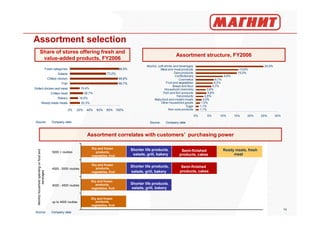
Assortment selection 
73,2% 
96,8% 
96,7% 
19,4% 
26,7% 
16,5% 
20,3% 
96,9% 
0% 20% 40% 60% 80% 100% 
Fresh categories 
Salads 
Chilled chicken 
Fish 
Grilled chicken and meat 
Chilled meat 
Bakery 
Ready made meals 
Assortment structure, FY2006 
Share of stores offering fresh and 
value-added products, FY2006 
24,9% 
15,6% 
15,0% 
9,9% 
6,7% 
6,2% 
5,7% 
3,6% 
3,9% 
2,8% 
2,0% 
1,5% 
1,1% 
1,1% 
Alcohol, soft-drinks and beverages 
Meat and meat products 
Dairy products 
Confectionary 
Cosmetics 
Fruit and vegetables 
Bread and flour 
Household chemistry 
Fish and fish products 
Fat products 
Baby food and instant meals 
Other household goods 
Eggs 
Non-core products 
14 
Source: Company data Source: Company data 
Assortment correlates with customers’ purchasing power 
5000 + roubles 
4500 - 5000 roubles 
4000 - 4500 roubles 
up to 4000 roubles 
Monthly household spending on food and 
beverages 
Source: Company data 
Dry and frozen 
products, 
vegetables, fruit 
Dry and frozen 
products, 
vegetables, fruit 
Dry and frozen 
products, 
vegetables, fruit 
Shorter life products, 
salads, grill, bakery 
Shorter life products, 
salads, grill, bakery 
Shorter life products, 
salads, grill, bakery 
Ready meals, fresh 
meat 
Semi-finished 
products, cakes 
Semi-finished 
products, cakes 
Dry and frozen 
products, 
vegetables, fruit 
0% 5% 10% 15% 20% 25% 30%
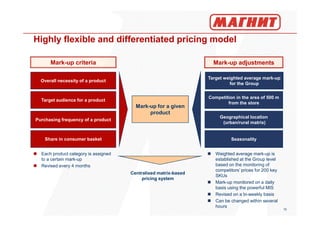
Highly flexible and differentiated pricing model 
Mark-up criteria Mark-up adjustments 
Mark-up for a given 
product 
Overall necessity of a product 
Target audience for a product 
Target weighted average mark-up 
for the Group 
Competition in the area of 500 m 
from the store 
15 
Purchasing frequency of a product 
Share in consumer basket 
Geographical location 
(urban/rural matrix) 
 Each product category is assigned 
to a certain mark-up 
 Revised every 4 months 
 Weighted average mark-up is 
established at the Group level 
based on the monitoring of 
competitors’ prices for 200 key 
SKUs 
 Mark-up monitored on a daily 
basis using the powerful MIS 
 Revised on a bi-weekly basis 
 Can be changed within several 
hours 
Seasonality 
Centralised matrix-based 
pricing system
Suppliers, purchasing and Private Label products 
Magnit is the largest buyer for many 
domestic and international FMCG 
producers. 
 Weekly Assortment Committee approves the 
assortment and suppliers. 
 Direct purchasing and delivery contracts 
 Large national suppliers account for 
approximately 64% of cost of goods sold 
 Economies of Scale and wide geographical 
Own Label products are designed to 
substitute the cheapest SKUs to 
maximise returns on each metre of 
shelving space: 
 551 Own Label SKUs (FY2006) 
 Own Label products accounted for 10.9% share of retail 
revenue in 2006 and 15.43% of total SKUs 
 Management aims to reach 20-21% the share of Own 
Label sales in retail revenue by 2015 
 Approximately 90% of Own Label products are food 
 The Gross margin of Private Label products is 8% and 
12% 
8% 
4% 
16 
presence ensure the best prices and most 
favourable contract terms 
– Volume discounts 
– Compensation of external and internal logistics costs 
– Average credit term in 2006 was 35 days and could 
vary up to 60 days 
– Contract term is typically 1 year 
– Often can be unilaterally terminated by Magnit with no 
penalties 
 Supplier bonuses 
– For meeting sales targets 
– For store promotions 
– For loyalty 
more percentage points higher than for similar product 
categories 
Share of Private Label products in revenue 
46 
162 
600 
400 
200 
Source: Company data 
265 
508 
551 
5,1% 
6,3% 
8,2% 
10,9% 
2,2% 
0 
2002 2003 2004 2005 2006 
0% 
Number of items Share in retail sales
Management Information System (MIS) and automated stock 
replenishment system 
 Clear visibility of remote markets and store performance: 
- Monthly consolidated PL reports 
- Daily detailed management reports on Key Performance Indicators (KPIs) 
- Real time access to information on inventory 
 Automated inventory management system 
- Monitor, manage and forecast changes in demand 
- Automated calculation of orders for each store for both national and local SKUs and preparation of data for 
settlements with suppliers at head office level 
- Automated preparation of price tags, invoicing, ordering and settlements at store level 
- Automated intake of goods, selection of goods and registration of inventory movement at Distribution Centres 
17 
Cashiers 
Stores Main Office 
Internet 
Database 
Server 
Store 
director 
Mail server 
ADSL/GPRS 
Database Server 
(cluster) 
Distribution centres 
Tasks processor (robot)
Logistics system 
As of 12M2006 up to 68% of cost of goods sold is 
processed through our in-house logistics systems 
and the long-term target for 2010 is to increase 
this share to 85% 
 Automated stock replenishment system 
 6 distribution centres with over 
100 thousand sq. m capacity 
 Fleet of over 730 vehicles 
The company’s breakdown of shares in 
turnover FY2006 
FY2006 
Turnover 
through DC 
68% 
Direct delivery 
f rom suplliers 
to the stores 
32% 
18 
City Federal 
district 
Space, 
sq. m. 
Share in 
total DC 
turnover 
, 
% 
Number 
of 
serviced 
stores 
Leased/ 
Owned 
Kropotkin Southern 30 048 43% 628 Owned 
Engels Volga 19 495 26% 432 Owned 
Togliatti Volga 8 379 8% 322 Leased 
Tver Central 10 714 9% 172 Owned 
Oryol Central 15 888 5% 166 Owned 
Ivanovo Central 15 669 8% 173 Owned 
Total 100 193 100% 1 893 
By 2010 
Note: as % of turnover 
Source: Company data Source: Company data 
Direc t delivery from suplliers to 
the s tores 
15% 
Turnover through DC 
85%
Well trained dedicated personnel 
 The total number of employees in the Group exceeded 
45 400 as of 31 March 2007: 
– 34 414 in-store personnel, 
– 6 673 people engaged in distribution, 
– 3 360 people in regional branches and 
– 953 people employed by head office 
 The average age of our employees is approximately 25 years 
 The gross average monthly salary in 2006 was RUR 9 249, 
of which approximately 75% was basic salary 
 Special performance-linked bonuses and incentives help to 
motivate the employees at all levels. 
 Key members of the Management hold Company’s shares 
Average number of employees vs. average 
salary, 2005-2006 
8 505 9 249 
24 870 
37 170 
40 000 
30 000 
20 000 
10 000 
0 
12 000 
9 000 
6 000 
3 000 
0 
in RUR 
19 
 Performance monitoring and evaluation on a regular basis 
 Training system provides: 
 Career development programmes for all levels to ensure 
– Lower staff turnover 
– Increased motivation 
– Higher productivity 
 Personnel training 
– 92 classrooms for trainings at all levels 
– Regular meetings and seminars between mid-level managers 
to exchange best practices 
– Coaching for top-management 
 Strong corporate culture aimed at development of loyalty of 
employees 
– The Company publishes a corporate newspaper every two 
months 
– Team building events to ensure integrity of the team 
2005 2006 
Average headcount Average monthly salary 
Source: audited IFRS Financial Statements, Management estimates
Store opening process varies from 1 to 3 months 
Month 1 Month 2 Month 3 
W 
1 
W 
2 
W 
3 
W 
4 
W 
1 
W 
2 
W 
3 
W 
4 
W 
1 
W 
2 
W 
3 
W 
4 
Identification of a 
property or a land plot 
Feasibility report and 
opening budget 
prepared 
Approval by the regional 
director and branch 
director 
MOU signed with 
landlord 
 Considerable experience of store 
openings 
 Preference given to leased store due to 
quick roll out in new markets 
 Acquisitions and construction are 
preferred in existing markets with already 
high penetration 
 Key store opening criterion is payback 
period of not more than 3 years if leased; 
20 
Legal due diligence 
Technical due diligence 
Approval by Committee 
on Store Openings 
Lease agreement or 
SPA signed 
Repair and maintenance 
Purchasing and 
installation of equipment 
Personnel hiring and 
training 
Sublet agreements 
signed 
Store opened 
6-7 years if owned 
 Average total cost of a new outlet is 
USD145 000 (excluding cost of inventory 
and real estate BUT including USD85 000 
cost of equipment ), 
 In the medium term, the Company plans to 
open between 200 and 400 stores each 
year 
 The store maturity pattern: 42% of 
maximum traffic by the end of the first 3 
months, 98% - within 6 months of opening 
 Rationalisation of store portfolio
Summary Magnit store statistics 
ow ned 
24.1% 
leased 
75.9% 
ow ned 
11.6% 
leased 
88.4% 
Store portfolio, 31 December 2006 
Owned and leased stores 
breakdown, FY2006 
Number of stores and 
Selling space, sq. m 
1 893 
1 501 
382 609 
522 916 
2 000 
1 600 
1 200 
800 
400 
0 
525 000 
500 000 
475 000 
450 000 
425 000 
400 000 
375 000 
350 000 
21 
Store openings 
2005 2006 
1998 1999 2000 2001 2002 2003 2004 2005 2006 
Southern 1 18 27 133 270 387 550 685 783 
Central 40 100 224 379 461 
Volga 2 1 19 53 114 214 368 536 
North-Western 1 5 9 26 61 84 
Urals 8 29 
Total 1 20 28 153 368 610 1 014 1 501 1893 
New openings 19 10 127 222 259 438 550 513 
Closings 0 2 2 7 17 34 64 120 
Net openings 19 8 125 215 242 404 486 393 
Source: Company data 
2 005 2 006 
Number of stores Selling space
Operating and financial results
Magnit today*: 
 The leading Russian food retailer by number of stores and customers 
– 1 893 stores in discounter format as of FY 2006 
– 640.1 million customers in 2006 
– The only retail chain with presence in 608 cities and towns in European Russia as of FY 2006 
 Net Sales in 2006 amounted to USD 2 505 million (RUR 68 100 million) 
 Over 44 295 employees as of FY2006 
23 
 In-house logistics based on 6 distribution centres with total warehousing space of 100 193 m² and a fleet of 
over 730 company-owned vehicles 
 The average ticket in 2006 was USD 3.8 (excl. VAT) (RUR 103.3) 
 Prepares to enter the Hypermarket sector in 2007 
– Developed own Hypermarket business model 
– 14 hypermarkets are already under construction. 
Note: * audited IFRS results
Regional store performance 
Sales per store*, 2004-2006 Sales per sq. m*, 2004-2006 
1 053 
1 358 
1 781 
1 270 
1 621 
2 195 
1568 
1339 
2282 
1829 
Moscow 
St. Petersburg 
Southern 
5 691 
5 415 
4 527 
4 089 
6 097 
4 938 
7 705 
5 868 
7 787 
Moscow 
St. Petersburg 
Southern 
24 
773 
737 
1 031 
970 
877 
1218 
1230 
476 
813 
0 500 1 000 1 500 2 000 2 500 3 000 
Volga 
Central** 
North-Western*** 
Urals 
thousand USD per annum 
2004 2005 2006 
3 310 
4 949 
4 573 
3 877 
3 026 
4 326 
3 000 
4 103 
3 122 
2 052 
0 5 000 10 000 
Volga 
Central** 
North-Western*** 
Urals 
USD per annum 
2004 2005 2006 
Note: * calculated as retail revenue in a year divided by weighted average number of stores and 
selling space in the same year 
** excluding Moscow and Moscow region 
*** excluding St. Petersburg and Leningrad region 
Source: Company data 
Source: Company data
sales analysis 
Tickets per store, 
LFL growth 
2.80% 
LFL revenue growth 
LFL 2006 to 2005*, RUR 
LFL 25 
Average ticket, 
LFL growth 
10.11% 
13.19% 
* For stores opened by July 2003 and not closed down permanently, expanded or 
downsized by the end of 2005, i.e. 399 stores 
** Applicable to 1 095 stores opened by July 2005 
Source: Company data 
LFL growth 3M 2007 to 3M 2006** 
Average ticket, RUR 12.76% 
Average ticket, USD 20.71% 
Number of tickets 2.52% 
Revenue, RUR 15.59% 
Revenue, USD 23.75%
Improved operating efficiency and capital structure 
2005 2006 
Non-current 
Non-current 
Current 
assets; 
60,63% 
Current 
assets; 
52,30% 
In US$m FY* 2005 FY* 2006 YoY, % 
net sales 1 577,7 2 505,0 58,8% 
cost of goods sold (1 312,9) (2 046,2) 55,9% 
gross profit 264,8 458,9 73,3% 
gross margin, % 16,8% 18,3% 
SGA (185,9) (336,3) 80,9% 
EBITDA 78,9 122,6 55,4% 
EBITDA margin, % 5,0% 4,9% 
26 
assets; 
39,37% 
assets; 
47,70% 
Equity; 
-12,07% 
Equity; 
LT Liabilities; - -33,80% 
23,01% 
LT Liabilities; - 
11,76% 
ST liabilities; 
-64,92% 
ST liabilities; 
-54,44% 
*Source: audited IFRS Financial Statements 
Net debt, 31.12.2006 - 165 mln. USD 
Depreciation  Amortization (15,1) (29,1) 
EBIT 63,8 93,5 46,5% 
Net finance costs (12,9) (13,0) 
Other income/(expense) (0,9) (1,0) 
Profit before tax 50,0 81,5 62,8% 
Taxes (13,2) (24,5) 
Effective tax rate 26,4% 30,1% 
Net income 36,8 56,9 
Net margin, % 2,3% 2,3%
Profitability analysis 
SGA expense dynamics, 12M2005-12M2006 
Changes in SGA expense structure 
GM dynamics, 12M2005-12M2006 
16,8% 18,3% 
EBITDA dynamics, 12M2005-12M2006 
365 
201 
12,74 14,59 
2005 2006 
SGA 
expense, 
million USD 
SGA 
expense, % 
of sales 
459 
265 
2005 2006 
Gross Profit, 
million USD 
Gross margin, 
% 
27 
4,8% 
1,2% 9,8% 
1,4% 
5,2% 
11,,23%% 
1,4% 
3,2% 2,4% 
7,5% 7,9% 
20,8% 
24,1% 
Source: Reviewed IFRS Financial Statements 
Net profit dynamics, 12M2005-12M2006 
2,30% 2,30% 
Source: Company Accounts 
123 
79 
5,0% 4,9% 
2005 2006 
EBITDA, 
million USD 
EBITDA 
margin, % 
36,83 
56,93 
2005 2006 
Net income, 
million USD 
Net margin, 
% 
56,0% 51,9% 
2005 2006 
as of % sales 
Other expenses 
Fuel 
Bank services 
Repair and 
maintenance 
Packaging and 
raw materials 
Depreciation 
Rent and utilities 
Payroll and related 
taxes
Working capital and capital expenditure 
Capital expenditure Inventory days, 2005-2006 structure, 2006 
Land and 
buildings; 
32,8% 
Machinery and 
equipment; 
20,8% 
Other assets; 
8,6% 
33 
35 
32 
35 
50 
40 
30 
20 
10 
28 
Construction 
in progress; 
37,8% 
Other 
investments; 
0,1% 
0 
2005 2006 
payables inventory 
 Working capital as of December, 31 2006 amounted to US$ 
14.6m vs. working capital as of December 31, 2005 of US$14,1m 
 Inventory turnover has increased marginally from 32 days in 2005 
to 35 days in 2006 
 Trade payables turnover has increased from 33 days in 2005 to 
35 days in 2006 
Source: Company data 
 2006 capex budget was 301 million USD 
 2007 capex budget: 
– Current format 
– Real estate 
– Logistics 
– Hypermarkets 
Source: IFRS Financial Statements
Consolidated balance sheet, FY2006 
29 
Source: reviewed IFRS Financial Statements
Consolidated balance sheet, FY2006 
30 
Source: reviewed IFRS Financial Statements
Consolidated cash flow statement, FY2006 
Source: reviewed IFRS Financial Statements 31
Consolidated cash flow statement, FY2006 
32 
Source: reviewed IFRS Financial Statements

FY2006 Results

  • 1.
  • 2.
    We work hardto increase the prosperity of our customers by minimizing their expenditure on quality consumer goods, through: •Efficient use of the Company’s resources •On-going improvements in technology •Adequate compensation for our employees
  • 3.
    Important information Thispresentation is strictly confidential to the recipient, may not be distributed to the press or any other person, and may not be reproduced in any form. Failure to comply with this restriction may constitute a violation of applicable securities laws. This presentation does not constitute or form part of and should not be construed as, an offer to sell or issue or the solicitation of an offer to buy or acquire securities of OJSC “Magnit” (the “Company”) or any of its subsidiaries in any jurisdiction or an inducement to enter into investment activity. No part of this presentation, nor the fact of its distribution, should form the basis of, or be relied on in connection with, any contract or commitment or investment decision whatsoever. The information contained in this presentation has not been independently verified. No representation, warranty or undertaking, express or implied, is made as to, and no reliance should be placed on, the fairness, accuracy, completeness or correctness of the information or the opinions contained herein. None of the Company, nor any shareholder of the Company, nor any of its or their affiliates, advisors or representatives shall have any liability whatsoever (in negligence or otherwise) for any loss howsoever arising from any use of this presentation or its contents or otherwise arising in connection with the presentation. This presentation is intended only for persons having professional experience in matters relating to investments being Relevant Persons (as defined below). Solicitations resulting from this presentation will only be responded to if the person concerned is a Relevant Person. Neither the presentation nor any copy of it may be taken or transmitted into the United States of America, its territories or possessions, or distributed, directly or indirectly, in the United States of America, its territories or possessions. Any failure to comply with this restriction may constitute a violation of United States securities laws. The presentation is not an offer of securities for sale in the United States. The Company’s securities have not been and will not be registered under the Securities Act and may not be offered and sold in the United States except in reliance on an exemption from, or in a transaction not subject to, the registration requirements of the Securities Act. Neither this presentation nor any copy of it may be taken or transmitted into Australia, Canada or Japan or to Canadian persons or to any person in any of those jurisdictions. Any failure to comply with this restriction may constitute a violation of Australian, Canadian or Japanese securities law. The distribution of this presentation in other jurisdictions may be restricted by law and persons into whose possession this document comes should inform themselves about, and observe, any such restrictions. The Company has not registered and does not intend to register any portion the Offering under the applicable securities laws of Canada, Australia or Japan and, subject to certain exceptions, the shares may not be offered or sold within Canada, Australia or Japan or to any national, resident or citizen of Canada, Australia or Japan. This presentation is made to and directed only at persons in the United Kingdom having professional experience in matters relating to investments who fall within the definition of “investment professionals” in Article 19(5) of the Financial Services and Markets Act 2000 (Financial Promotions) Order 2005 (the “Order”), and to those persons to whom it can otherwise lawfully be distributed (such persons being referred to as “Relevant Persons”). Matters discussed in this presentation may constitute forward-looking statements. Forward-looking statements include statements concerning plans, objectives, goals, strategies, future events or performance, and underlying assumptions and other statements, which are other than statements of historical facts. The words “believe,” “expect,” “anticipate,” “intends,” “targets,” “estimate,” “forecast,” “project,” “will,” “may,” “should” and similar expressions identify forward-looking statements. Forward-looking statements include statements regarding: strategies, outlook and growth prospects; future plans and potential for future growth; liquidity, capital resources and capital expenditures; growth in demand for products; economic outlook and industry trends; developments of markets; the impact of regulatory initiatives; and the strength of competitors. The forward-looking statements in this presentation are based upon various assumptions, many of which are based, in turn, upon further assumptions, including without limitation, management's examination of historical operating trends, data contained in our records and other data available from third parties. Although the Company believes that these assumptions were reasonable when made, these assumptions are inherently subject to significant uncertainties and contingencies which are difficult or impossible to predict and are beyond its control and it may not achieve or accomplish these expectations, beliefs or projections. In addition, important factors that, in the view of the Company, could cause actual results to differ materially from those discussed in the forward-looking statements include the achievement of the anticipated levels of profitability, growth, cost and synergy of its recent acquisitions, the timely development and acceptance of new products, the impact of competitive pricing, the ability to obtain necessary regulatory approvals, the condition of the economy and political stability in Russia and the other markets of operations and the impact of general business and global economic conditions. Some of the information in the presentation is still in draft form and has not been legally verified and will only be finalised at the time of the Offering. Neither the Company, nor any of its agents, employees or advisors intend or have any duty or obligation to supplement, amend, update or revise any of the forward-looking statements contained in this presentation or to update or to keep current any other information contained in this presentation. The information and opinions contained in this document are provided as at the date of this presentation and are subject to change without notice. By attending this presentation and/or accepting a copy of this document, you agree to be bound by the foregoing limitations and conditions. 2
  • 4.
  • 5.
    Our history 1994- 1998 1998 - 2000 2000 - 2005 2006 Extensive roll-out Continued growth 1994 Foundation of wholesale distribution business by Mr. Galitskiy 1998 Decision to expand into grocery retail market End of 1999 Stores merged into Magnit discounter retail chain 2006 Leading food retailer in Russia by number of stores and customers IPO Started building Hypermarkets 2001-2005 Rapid regional roll-out: 1 500 stores by the end of 2005 4 Early Years: Wholesale distribution Entrance into food retail to capture market share with focus on margin expansion multiformat 1997 Tander becomes one of the major official distributors of household products cosmetics in Russia 7 November 1998 First grocery store opened in Krasnodar 1998-1999 Experiments with format 2004 Adoption of IFRS Strict financial control Performance-linked compensation January - April 2006 Independent director elected to the Board Audit Committee established Corporate governance rules established to comply with best practice
  • 6.
    To 2006 Magnit*is: Number Net sales, 2006, USD bn of stores*, 2006 123 619 1 893 Magnit X5 7th Continent 0,96 2,51 3,55 X5 Magnit 7th Continent 5 * Excluding franchised stores 2003** 2004 2005 2006 CAGR Net sales, million USD 440 849 1 578 2 505 79% Number of stores, eop 610 1 014 1 501 1 893 47% Selling space, ‘000 sq m 156.7 255.3 382.6 522.9 50% Number of customers, mn 158.8 273.2 469.3 640.1 60% Note: * Audited IFRS results ** Management accounts 0 500 1 000 1 500 2 000 Source: Companies 0,0 1,0 2,0 3,0 4,0 Source: Companies;
  • 7.
    Opportunities Ourconsiderable experience in food retail, economies of scale, highly sophisticated in-house logistics system and other competitive advantages will help us to succeed in other food retail segments Further expansion of the core business Strengthen our position in the regional markets (mainly in the cities with population of less then 500 000 people) using the advantages of our in-house logistics system Current format and hypermarket sector 6 Continue Investment in IT and cost saving equipment Own Label Products Further development of in-house logistics system Closer communication with our customers and immediate response to changes in their tastes, preferences and needs e.g. new or improved products Further product and process innovation Total quality management Apply quality to every aspect of our business
  • 8.
    Strategy Increasemarket penetration in existing markets Focus on expansion into cities in selected new regions with population of less than 500 000 and a favorable competitive situation Organic growth in existing markets and selective geographic expansion Obtain further economies of scale Focus on brand development creation of customer loyalty Value-for-money product mix High-quality customer service Study our customers Marketing promo events for our customers 7 Strict cost control Continuous learning Increase sales through optimization of the Sales Mix Development of Own Label products Improvement in efficiency of logistics Productivity gains in logistics Further improvements in operating efficiency Remain the largest multiformat food retail chain in Russia Have the leading logistics platform in Russia Sustain efficient growth with a track record of profitability Show similar (to the main format) growth performance in the hypermarket sector. Where do we want to be in 5 years from now
  • 9.
  • 10.
    Main Format features Typical Key features Magnit stores Best prices for 200 indicative SKUs in the local market Active price communication by priority shelving of special offers Outstanding value-for-money Convenient location Convenient location close to customers’ homes Freestanding or on the ground floor of apartment blocks Open 7 days a week 12 hours a day at convenient times 9 Carefully selected assortment SKU selection adjusted for local purchasing power and traditions 3 570 SKUs on average to capture larger audience Food is about 87% of retail sales Daily perishables are 30-40% of retail sales Own Label products Modern functional interior Functional design makes shopping quick and convenient Visual interior and easy navigation Quality service Hygienic atmosphere and modern decor Visible exterior Standardised design of facade Clearly visible Easy access by car Optimal size 410 sq. m total space as of FY2006 276 sq. m. trading space as of FY2006
  • 11.
    Hypermarket Model features Projected Model Highlights Magnit Hypermarkets 14 Hypermarkets are already under construction We aim to open our hypermarkets in regional cities of European part of Russia with population of 80 000--500 000 people Short-term expansion plans Convenient location All the Hypermarkets will be built in convenient locations: mainly in the city centre Easy access by public transport or car; sufficient parking space; walkable distance 10 Carefully selected assortment SKU selection adjusted for local purchasing power and traditions The assortment will consist of up to 18 000 SKUs Non-food will be 30% Own Label products Modern functional interior Functional design Visual interior and easy navigation Quality service Hygienic atmosphere and modern decor Visible exterior Brand recognition Standardised design of facade: the hypermarkets will operate under already well-known “Magnit” brand Clearly visible Optimal size 3 400 m²-18 000 m² of total space 3 000 m² -8 500 m² of selling space
  • 12.
    Corporate and organizationalstructure Food retail and wholesale Holding company for Magnit ОJSC Magnit CJSC Tander LLC Selta LLC Alkotrading Group Transportation services for the Group 100% Alcohol licence holder for Stavropol region Southern regional division Central regional division Volzhsky regional division Rostov-on-Don 49 regional 1 893 stores Group’s corporate structure (December, 2006) Group’s operating structure 100% 100% 100% 11 LLC Tander-Magnit Food retail in the Moscow region LLC Tander-Petersburg 100% Headquarters Food retail in St. Petersburg and the region LLC BestTorg Food retail in Moscow and Moscow region LLC Magnit Finans LLC Magnit – Nizhny Novgorod LLC Tandem Issuer of the Group’s bonds Food retail in Nizhny Novgorod …and the Group’s operations regional division Northern regional division Povolzhsky regional division Urals regional division Moscow regional division branches + 1 represent ative office 6 distribution centres 100% 51% Hypermarket’s Management Team Construction of 14 Hypermarkets and preparation of more land 6 plots for Hypermarkets construction works in 2007 100%
  • 13.
    Strong regional coverageFY2006 Demographical breakdown of store locations Store portfolio by Federal district Central; 24.4% Volga; 28.4% North-Western; 4.4% Southern ; 41.3% Urals; 1.5% 1 million + residents; 8.6% 500-1000 thousand residents; 21.1% 100-500 thousand residents; up to 100 thousand residents; 43.1% 12 North-Western Federal district: Central Federal district: 84 stores 461 stores 3 Distribution centres Volga Federal district: 538 stores 2 Distribution centres Southern Federal district: 782 stores 1 Distribution centre Urals Federal district: 28 stores Source: Company data Source: Company data 27.3% Source: Company data
  • 14.
    Addressing the needsof our target customers Youth (Pensioners (60+ years old) up to 30 years old) Families (30-60 years old) Priorities: 1. Assortment 2. Location 3. Comfort 4. Price Key features: More open to western lifestyles and Priorities: 1. Price 2. Location 3. Assortment 4. Comfort Key features: Shopping habits formed in Soviet Priorities: 1. Location 2. Assortment 20% 50% 30% 13 oriented towards modern retail formats Key focus areas: Offering product categories appealing to young audience time Conservative shoppers Most are low income Key focus areas: Increased offering of Private Label products to reduce prices for essential goods 3. Price 4. Comfort Key features: Time is of greater value than for other groups Growing car ownership High level of responsibility for quality of purchased food and family budget Key focus areas: Increased share of fresh dairy, semi-prepared products and ready meals Ensure quick shopping, avoid bottlenecks in rush hour One stop shopping: ATMs, pharmacies, payment of mobile phone bills, etc Building more parking slots at the stores
  • 15.
    Assortment selection 73,2% 96,8% 96,7% 19,4% 26,7% 16,5% 20,3% 96,9% 0% 20% 40% 60% 80% 100% Fresh categories Salads Chilled chicken Fish Grilled chicken and meat Chilled meat Bakery Ready made meals Assortment structure, FY2006 Share of stores offering fresh and value-added products, FY2006 24,9% 15,6% 15,0% 9,9% 6,7% 6,2% 5,7% 3,6% 3,9% 2,8% 2,0% 1,5% 1,1% 1,1% Alcohol, soft-drinks and beverages Meat and meat products Dairy products Confectionary Cosmetics Fruit and vegetables Bread and flour Household chemistry Fish and fish products Fat products Baby food and instant meals Other household goods Eggs Non-core products 14 Source: Company data Source: Company data Assortment correlates with customers’ purchasing power 5000 + roubles 4500 - 5000 roubles 4000 - 4500 roubles up to 4000 roubles Monthly household spending on food and beverages Source: Company data Dry and frozen products, vegetables, fruit Dry and frozen products, vegetables, fruit Dry and frozen products, vegetables, fruit Shorter life products, salads, grill, bakery Shorter life products, salads, grill, bakery Shorter life products, salads, grill, bakery Ready meals, fresh meat Semi-finished products, cakes Semi-finished products, cakes Dry and frozen products, vegetables, fruit 0% 5% 10% 15% 20% 25% 30%
  • 16.
    Highly flexible anddifferentiated pricing model Mark-up criteria Mark-up adjustments Mark-up for a given product Overall necessity of a product Target audience for a product Target weighted average mark-up for the Group Competition in the area of 500 m from the store 15 Purchasing frequency of a product Share in consumer basket Geographical location (urban/rural matrix) Each product category is assigned to a certain mark-up Revised every 4 months Weighted average mark-up is established at the Group level based on the monitoring of competitors’ prices for 200 key SKUs Mark-up monitored on a daily basis using the powerful MIS Revised on a bi-weekly basis Can be changed within several hours Seasonality Centralised matrix-based pricing system
  • 17.
    Suppliers, purchasing andPrivate Label products Magnit is the largest buyer for many domestic and international FMCG producers. Weekly Assortment Committee approves the assortment and suppliers. Direct purchasing and delivery contracts Large national suppliers account for approximately 64% of cost of goods sold Economies of Scale and wide geographical Own Label products are designed to substitute the cheapest SKUs to maximise returns on each metre of shelving space: 551 Own Label SKUs (FY2006) Own Label products accounted for 10.9% share of retail revenue in 2006 and 15.43% of total SKUs Management aims to reach 20-21% the share of Own Label sales in retail revenue by 2015 Approximately 90% of Own Label products are food The Gross margin of Private Label products is 8% and 12% 8% 4% 16 presence ensure the best prices and most favourable contract terms – Volume discounts – Compensation of external and internal logistics costs – Average credit term in 2006 was 35 days and could vary up to 60 days – Contract term is typically 1 year – Often can be unilaterally terminated by Magnit with no penalties Supplier bonuses – For meeting sales targets – For store promotions – For loyalty more percentage points higher than for similar product categories Share of Private Label products in revenue 46 162 600 400 200 Source: Company data 265 508 551 5,1% 6,3% 8,2% 10,9% 2,2% 0 2002 2003 2004 2005 2006 0% Number of items Share in retail sales
  • 18.
    Management Information System(MIS) and automated stock replenishment system Clear visibility of remote markets and store performance: - Monthly consolidated PL reports - Daily detailed management reports on Key Performance Indicators (KPIs) - Real time access to information on inventory Automated inventory management system - Monitor, manage and forecast changes in demand - Automated calculation of orders for each store for both national and local SKUs and preparation of data for settlements with suppliers at head office level - Automated preparation of price tags, invoicing, ordering and settlements at store level - Automated intake of goods, selection of goods and registration of inventory movement at Distribution Centres 17 Cashiers Stores Main Office Internet Database Server Store director Mail server ADSL/GPRS Database Server (cluster) Distribution centres Tasks processor (robot)
  • 19.
    Logistics system Asof 12M2006 up to 68% of cost of goods sold is processed through our in-house logistics systems and the long-term target for 2010 is to increase this share to 85% Automated stock replenishment system 6 distribution centres with over 100 thousand sq. m capacity Fleet of over 730 vehicles The company’s breakdown of shares in turnover FY2006 FY2006 Turnover through DC 68% Direct delivery f rom suplliers to the stores 32% 18 City Federal district Space, sq. m. Share in total DC turnover , % Number of serviced stores Leased/ Owned Kropotkin Southern 30 048 43% 628 Owned Engels Volga 19 495 26% 432 Owned Togliatti Volga 8 379 8% 322 Leased Tver Central 10 714 9% 172 Owned Oryol Central 15 888 5% 166 Owned Ivanovo Central 15 669 8% 173 Owned Total 100 193 100% 1 893 By 2010 Note: as % of turnover Source: Company data Source: Company data Direc t delivery from suplliers to the s tores 15% Turnover through DC 85%
  • 20.
    Well trained dedicatedpersonnel The total number of employees in the Group exceeded 45 400 as of 31 March 2007: – 34 414 in-store personnel, – 6 673 people engaged in distribution, – 3 360 people in regional branches and – 953 people employed by head office The average age of our employees is approximately 25 years The gross average monthly salary in 2006 was RUR 9 249, of which approximately 75% was basic salary Special performance-linked bonuses and incentives help to motivate the employees at all levels. Key members of the Management hold Company’s shares Average number of employees vs. average salary, 2005-2006 8 505 9 249 24 870 37 170 40 000 30 000 20 000 10 000 0 12 000 9 000 6 000 3 000 0 in RUR 19 Performance monitoring and evaluation on a regular basis Training system provides: Career development programmes for all levels to ensure – Lower staff turnover – Increased motivation – Higher productivity Personnel training – 92 classrooms for trainings at all levels – Regular meetings and seminars between mid-level managers to exchange best practices – Coaching for top-management Strong corporate culture aimed at development of loyalty of employees – The Company publishes a corporate newspaper every two months – Team building events to ensure integrity of the team 2005 2006 Average headcount Average monthly salary Source: audited IFRS Financial Statements, Management estimates
  • 21.
    Store opening processvaries from 1 to 3 months Month 1 Month 2 Month 3 W 1 W 2 W 3 W 4 W 1 W 2 W 3 W 4 W 1 W 2 W 3 W 4 Identification of a property or a land plot Feasibility report and opening budget prepared Approval by the regional director and branch director MOU signed with landlord Considerable experience of store openings Preference given to leased store due to quick roll out in new markets Acquisitions and construction are preferred in existing markets with already high penetration Key store opening criterion is payback period of not more than 3 years if leased; 20 Legal due diligence Technical due diligence Approval by Committee on Store Openings Lease agreement or SPA signed Repair and maintenance Purchasing and installation of equipment Personnel hiring and training Sublet agreements signed Store opened 6-7 years if owned Average total cost of a new outlet is USD145 000 (excluding cost of inventory and real estate BUT including USD85 000 cost of equipment ), In the medium term, the Company plans to open between 200 and 400 stores each year The store maturity pattern: 42% of maximum traffic by the end of the first 3 months, 98% - within 6 months of opening Rationalisation of store portfolio
  • 22.
    Summary Magnit storestatistics ow ned 24.1% leased 75.9% ow ned 11.6% leased 88.4% Store portfolio, 31 December 2006 Owned and leased stores breakdown, FY2006 Number of stores and Selling space, sq. m 1 893 1 501 382 609 522 916 2 000 1 600 1 200 800 400 0 525 000 500 000 475 000 450 000 425 000 400 000 375 000 350 000 21 Store openings 2005 2006 1998 1999 2000 2001 2002 2003 2004 2005 2006 Southern 1 18 27 133 270 387 550 685 783 Central 40 100 224 379 461 Volga 2 1 19 53 114 214 368 536 North-Western 1 5 9 26 61 84 Urals 8 29 Total 1 20 28 153 368 610 1 014 1 501 1893 New openings 19 10 127 222 259 438 550 513 Closings 0 2 2 7 17 34 64 120 Net openings 19 8 125 215 242 404 486 393 Source: Company data 2 005 2 006 Number of stores Selling space
  • 23.
  • 24.
    Magnit today*: The leading Russian food retailer by number of stores and customers – 1 893 stores in discounter format as of FY 2006 – 640.1 million customers in 2006 – The only retail chain with presence in 608 cities and towns in European Russia as of FY 2006 Net Sales in 2006 amounted to USD 2 505 million (RUR 68 100 million) Over 44 295 employees as of FY2006 23 In-house logistics based on 6 distribution centres with total warehousing space of 100 193 m² and a fleet of over 730 company-owned vehicles The average ticket in 2006 was USD 3.8 (excl. VAT) (RUR 103.3) Prepares to enter the Hypermarket sector in 2007 – Developed own Hypermarket business model – 14 hypermarkets are already under construction. Note: * audited IFRS results
  • 25.
    Regional store performance Sales per store*, 2004-2006 Sales per sq. m*, 2004-2006 1 053 1 358 1 781 1 270 1 621 2 195 1568 1339 2282 1829 Moscow St. Petersburg Southern 5 691 5 415 4 527 4 089 6 097 4 938 7 705 5 868 7 787 Moscow St. Petersburg Southern 24 773 737 1 031 970 877 1218 1230 476 813 0 500 1 000 1 500 2 000 2 500 3 000 Volga Central** North-Western*** Urals thousand USD per annum 2004 2005 2006 3 310 4 949 4 573 3 877 3 026 4 326 3 000 4 103 3 122 2 052 0 5 000 10 000 Volga Central** North-Western*** Urals USD per annum 2004 2005 2006 Note: * calculated as retail revenue in a year divided by weighted average number of stores and selling space in the same year ** excluding Moscow and Moscow region *** excluding St. Petersburg and Leningrad region Source: Company data Source: Company data
  • 26.
    sales analysis Ticketsper store, LFL growth 2.80% LFL revenue growth LFL 2006 to 2005*, RUR LFL 25 Average ticket, LFL growth 10.11% 13.19% * For stores opened by July 2003 and not closed down permanently, expanded or downsized by the end of 2005, i.e. 399 stores ** Applicable to 1 095 stores opened by July 2005 Source: Company data LFL growth 3M 2007 to 3M 2006** Average ticket, RUR 12.76% Average ticket, USD 20.71% Number of tickets 2.52% Revenue, RUR 15.59% Revenue, USD 23.75%
  • 27.
    Improved operating efficiencyand capital structure 2005 2006 Non-current Non-current Current assets; 60,63% Current assets; 52,30% In US$m FY* 2005 FY* 2006 YoY, % net sales 1 577,7 2 505,0 58,8% cost of goods sold (1 312,9) (2 046,2) 55,9% gross profit 264,8 458,9 73,3% gross margin, % 16,8% 18,3% SGA (185,9) (336,3) 80,9% EBITDA 78,9 122,6 55,4% EBITDA margin, % 5,0% 4,9% 26 assets; 39,37% assets; 47,70% Equity; -12,07% Equity; LT Liabilities; - -33,80% 23,01% LT Liabilities; - 11,76% ST liabilities; -64,92% ST liabilities; -54,44% *Source: audited IFRS Financial Statements Net debt, 31.12.2006 - 165 mln. USD Depreciation Amortization (15,1) (29,1) EBIT 63,8 93,5 46,5% Net finance costs (12,9) (13,0) Other income/(expense) (0,9) (1,0) Profit before tax 50,0 81,5 62,8% Taxes (13,2) (24,5) Effective tax rate 26,4% 30,1% Net income 36,8 56,9 Net margin, % 2,3% 2,3%
  • 28.
    Profitability analysis SGAexpense dynamics, 12M2005-12M2006 Changes in SGA expense structure GM dynamics, 12M2005-12M2006 16,8% 18,3% EBITDA dynamics, 12M2005-12M2006 365 201 12,74 14,59 2005 2006 SGA expense, million USD SGA expense, % of sales 459 265 2005 2006 Gross Profit, million USD Gross margin, % 27 4,8% 1,2% 9,8% 1,4% 5,2% 11,,23%% 1,4% 3,2% 2,4% 7,5% 7,9% 20,8% 24,1% Source: Reviewed IFRS Financial Statements Net profit dynamics, 12M2005-12M2006 2,30% 2,30% Source: Company Accounts 123 79 5,0% 4,9% 2005 2006 EBITDA, million USD EBITDA margin, % 36,83 56,93 2005 2006 Net income, million USD Net margin, % 56,0% 51,9% 2005 2006 as of % sales Other expenses Fuel Bank services Repair and maintenance Packaging and raw materials Depreciation Rent and utilities Payroll and related taxes
  • 29.
    Working capital andcapital expenditure Capital expenditure Inventory days, 2005-2006 structure, 2006 Land and buildings; 32,8% Machinery and equipment; 20,8% Other assets; 8,6% 33 35 32 35 50 40 30 20 10 28 Construction in progress; 37,8% Other investments; 0,1% 0 2005 2006 payables inventory Working capital as of December, 31 2006 amounted to US$ 14.6m vs. working capital as of December 31, 2005 of US$14,1m Inventory turnover has increased marginally from 32 days in 2005 to 35 days in 2006 Trade payables turnover has increased from 33 days in 2005 to 35 days in 2006 Source: Company data 2006 capex budget was 301 million USD 2007 capex budget: – Current format – Real estate – Logistics – Hypermarkets Source: IFRS Financial Statements
  • 30.
    Consolidated balance sheet,FY2006 29 Source: reviewed IFRS Financial Statements
  • 31.
    Consolidated balance sheet,FY2006 30 Source: reviewed IFRS Financial Statements
  • 32.
    Consolidated cash flowstatement, FY2006 Source: reviewed IFRS Financial Statements 31
  • 33.
    Consolidated cash flowstatement, FY2006 32 Source: reviewed IFRS Financial Statements