NUMBER SYSTEMS & DATA
REPRESENTATIONS
FUNDAMENTALS OF COMPUTER & PROGRAMMING (COMP 1)
PREPARED BY: PHILLIP GLENN LIBAY
NUMBER SYSTEM
NUMBER SYSTEM
Is a method of expressing values, using a set of symbols in a
consistent manner.
Several number systems has been used in the past which can be
categorized into two (2): positional and non-positional number
systems.
POSITIONAL NUMBER SYSTEM
In a positional number system, the position the symbol occupies
determines the value it represents, thus, it is also often called the
PLACE VALUE system.
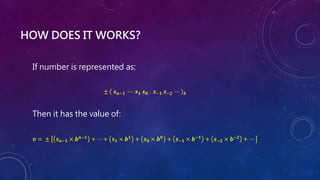
HOW DOES IT WORKS?
If number is represented as:
± 𝒔𝒏−𝟏 ⋯ 𝒔𝟏 𝒔𝟎 . 𝒔−𝟏 𝒔−𝟐 ⋯ 𝒃
Then it has the value of:
𝒗 = ± 𝒔𝒏−𝟏 × 𝒃𝒏−𝟏 + ⋯ + 𝒔𝟏 × 𝒃𝟏 + 𝒔𝟎 × 𝒃𝟎 + 𝒔−𝟏 × 𝒃−𝟏 + 𝒔−𝟐 × 𝒃−𝟐 + ⋯
DECIMAL number system
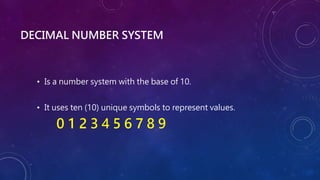
DECIMAL NUMBER SYSTEM
• Is a number system with the base of 10.
• It uses ten (10) unique symbols to represent values.
0 1 2 3 4 5 6 7 8 9
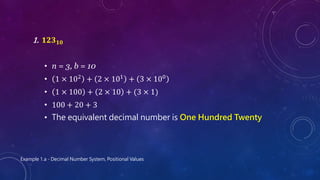
1. 𝟏𝟐𝟑𝟏𝟎
• n = 3, b = 10
• 1 × 10² + 2 × 101 + 3 × 100
• 1 × 100 + 2 × 10 + (3 × 1)
• 100 + 20 + 3
• The equivalent decimal number is One Hundred Twenty
Example 1.a - Decimal Number System, Positional Values
BINARY number system
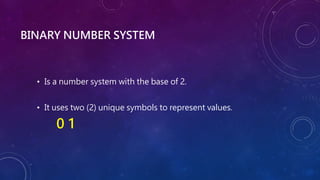
BINARY NUMBER SYSTEM
• Is a number system with the base of 2.
• It uses two (2) unique symbols to represent values.
0 1
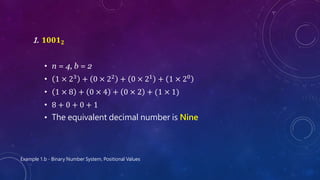
1. 𝟏𝟎𝟎𝟏𝟐
• n = 4, b = 2
• 1 × 23 + 0 × 22 + 0 × 21 + 1 × 20
• 1 × 8 + 0 × 4 + 0 × 2 + (1 × 1)
• 8 + 0 + 0 + 1
• The equivalent decimal number is Nine
Example 1.b - Binary Number System, Positional Values
OCTAL number system
OCTAL NUMBER SYSTEM
• Is a number system with the base of 8.
• It uses eight (8) unique symbols to represent values.
0 1 2 3 4 5 6 7
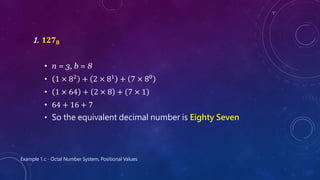
1. 𝟏𝟐𝟕𝟖
• n = 3, b = 8
• 1 × 82 + 2 × 81 + 7 × 80
• 1 × 64 + 2 × 8 + 7 × 1
• 64 + 16 + 7
• So the equivalent decimal number is Eighty Seven
Example 1.c - Octal Number System, Positional Values
HEXADECIMAL number system
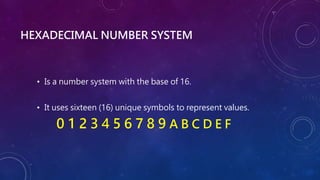
HEXADECIMAL NUMBER SYSTEM
• Is a number system with the base of 16.
• It uses sixteen (16) unique symbols to represent values.

0 1 2 3 4 5 6 7 8 9 A B C D E F
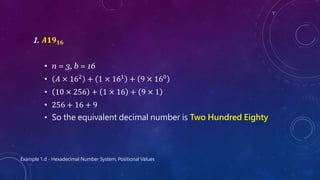
1. 𝑨𝟏𝟗𝟏𝟔
• n = 3, b = 16
• 𝐴 × 162 + 1 × 161 + 9 × 160
• 10 × 256 + 1 × 16 + 9 × 1
• 256 + 16 + 9
• So the equivalent decimal number is Two Hundred Eighty
Example 1.d - Hexadecimal Number System, Positional Values
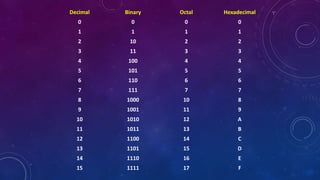
Decimal Binary Octal Hexadecimal
0 0 0 0
1 1 1 1
2 10 2 2
3 11 3 3
4 100 4 4
5 101 5 5
6 110 6 6
7 111 7 7
8 1000 10 8
9 1001 11 9
10 1010 12 A
11 1011 13 B
12 1100 14 C
13 1101 15 D
14 1110 16 E
15 1111 17 F
DECIMAL to BASE n conversions
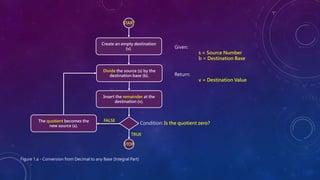
START
Create an empty destination
(v).
Divide the source (s) by the
destination base (b).
Insert the remainder at the
destination (v).
STOP
The quotient becomes the
new source (s).
TRUE
FALSE
Condition: Is the quotient zero?
Given:
s = Source Number
b = Destination Base
Return:
v = Destination Value
Figure 1.a - Conversion from Decimal to any Base (Integral Part)
DECIMAL TO BINARY conversion
INTEGRAL VALUES
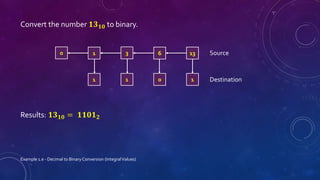
Convert the number 𝟏𝟑𝟏𝟎 to binary.
Results: 𝟏𝟑𝟏𝟎 = 𝟏𝟏𝟎𝟏𝟐
Example 1.e - Decimal to Binary Conversion (IntegralValues)
13
6
1 3
0
1
0
1
1
Source
Destination
DECIMAL TO OCTAL conversion
INTEGRAL VALUES
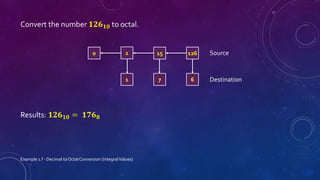
Example 1.f - Decimal to Octal Conversion (IntegralValues)
Convert the number 𝟏𝟐𝟔𝟏𝟎 to octal.
Results: 𝟏𝟐𝟔𝟏𝟎 = 𝟏𝟕𝟔𝟖
126
15
0 1
6
7
1
Source
Destination
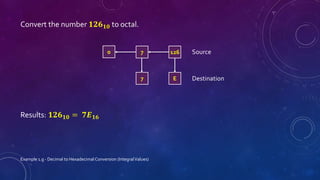
DECIMAL TO HEXADECIMAL conversion
INTEGRAL VALUES
Example 1.g - Decimal to Hexadecimal Conversion (IntegralValues)
Convert the number 𝟏𝟐𝟔𝟏𝟎 to octal.
Results: 𝟏𝟐𝟔𝟏𝟎 = 𝟕𝑬𝟏𝟔
126
7
0
E
7
Source
Destination
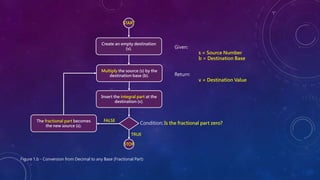
START
Create an empty destination
(v).
Multiply the source (s) by the
destination base (b).
Insert the integral part at the
destination (v).
STOP
The fractional part becomes
the new source (s).
TRUE
FALSE
Condition: Is the fractional part zero?
Given:
s = Source Number
b = Destination Base
Return:
v = Destination Value
Figure 1.b - Conversion from Decimal to any Base (Fractional Part)
DECIMAL TO BINARY conversion
FRACTIONAL VALUES
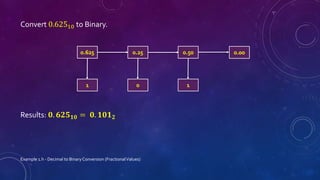
Convert 0.62510 to Binary.
Results: 𝟎. 𝟔𝟐𝟓𝟏𝟎 = 𝟎. 𝟏𝟎𝟏𝟐
Example 1.h - Decimal to Binary Conversion (FractionalValues)
0.625 0.25 0.50 0.00
1 0 1
DECIMAL TO OCTAL conversion
FRACTIONAL VALUES
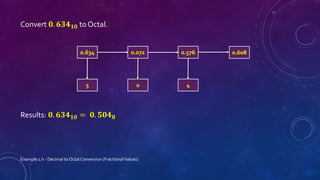
Convert 𝟎. 𝟔𝟑𝟒𝟏𝟎 to Octal.
Results: 𝟎. 𝟔𝟑𝟒𝟏𝟎 = 𝟎. 𝟓𝟎𝟒𝟖
Example 1.h - Decimal to Octal Conversion (FractionalValues)
0.634 0.072 0.576 0.608
5 0 4
DECIMAL TO HEXADECIMAL conversion
FRACTIONAL VALUES
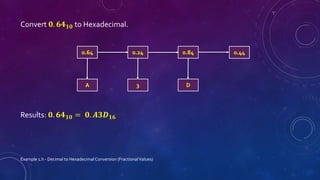
Convert 𝟎. 𝟔𝟒𝟏𝟎 to Hexadecimal.
Results: 𝟎. 𝟔𝟒𝟏𝟎 = 𝟎. 𝑨𝟑𝑫𝟏𝟔
Example 1.h - Decimal to Hexadecimal Conversion (FractionalValues)
0.64 0.24 0.84 0.44
A 3 D
BINARY to OCTAL conversion
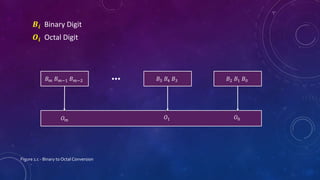
𝑩𝒊 Binary Digit
𝑶𝒊 Octal Digit
Figure 1.c - Binary to Octal Conversion
𝐵𝑚 𝐵𝑚−1 𝐵𝑚−2 𝐵5 𝐵4 𝐵3 𝐵2 𝐵1 𝐵0
…
𝑂𝑚
𝑂1 𝑂0
BINARY to HEXADECIMAL conversion
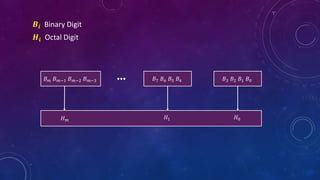
𝑩𝒊 Binary Digit
𝑯𝒊 Octal Digit
𝐵𝑚 𝐵𝑚−1 𝐵𝑚−2 𝐵𝑚−3 𝐵7 𝐵6 𝐵5 𝐵4 𝐵3 𝐵2 𝐵1 𝐵0
…
𝐻𝑚
𝐻1 𝐻0
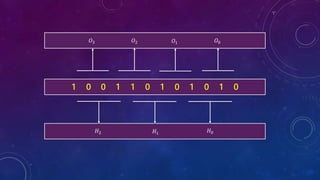
OCTAL to HEXADECIMAL conversion
𝐻2 𝐻1 𝐻0
1 0 0 1 1 0 1 0 1 0 1 0
𝑂3 𝑂2 𝑂1 𝑂0

1b-150720094704-lva1-app6892.pdf

  • 1.
    NUMBER SYSTEMS &DATA REPRESENTATIONS FUNDAMENTALS OF COMPUTER & PROGRAMMING (COMP 1) PREPARED BY: PHILLIP GLENN LIBAY
  • 2.
  • 3.
    NUMBER SYSTEM Is amethod of expressing values, using a set of symbols in a consistent manner. Several number systems has been used in the past which can be categorized into two (2): positional and non-positional number systems.
  • 4.
  • 5.
    POSITIONAL NUMBER SYSTEM Ina positional number system, the position the symbol occupies determines the value it represents, thus, it is also often called the PLACE VALUE system.
  • 6.
    HOW DOES ITWORKS? If number is represented as: ± 𝒔𝒏−𝟏 ⋯ 𝒔𝟏 𝒔𝟎 . 𝒔−𝟏 𝒔−𝟐 ⋯ 𝒃 Then it has the value of: 𝒗 = ± 𝒔𝒏−𝟏 × 𝒃𝒏−𝟏 + ⋯ + 𝒔𝟏 × 𝒃𝟏 + 𝒔𝟎 × 𝒃𝟎 + 𝒔−𝟏 × 𝒃−𝟏 + 𝒔−𝟐 × 𝒃−𝟐 + ⋯
  • 7.
  • 8.
    DECIMAL NUMBER SYSTEM •Is a number system with the base of 10. • It uses ten (10) unique symbols to represent values. 0 1 2 3 4 5 6 7 8 9
  • 9.
    1. 𝟏𝟐𝟑𝟏𝟎 • n= 3, b = 10 • 1 × 10² + 2 × 101 + 3 × 100 • 1 × 100 + 2 × 10 + (3 × 1) • 100 + 20 + 3 • The equivalent decimal number is One Hundred Twenty Example 1.a - Decimal Number System, Positional Values
  • 10.
  • 11.
    BINARY NUMBER SYSTEM •Is a number system with the base of 2. • It uses two (2) unique symbols to represent values. 0 1
  • 12.
    1. 𝟏𝟎𝟎𝟏𝟐 • n= 4, b = 2 • 1 × 23 + 0 × 22 + 0 × 21 + 1 × 20 • 1 × 8 + 0 × 4 + 0 × 2 + (1 × 1) • 8 + 0 + 0 + 1 • The equivalent decimal number is Nine Example 1.b - Binary Number System, Positional Values
  • 13.
  • 14.
    OCTAL NUMBER SYSTEM •Is a number system with the base of 8. • It uses eight (8) unique symbols to represent values. 0 1 2 3 4 5 6 7
  • 15.

    1. 𝟏𝟐𝟕𝟖 • n= 3, b = 8 • 1 × 82 + 2 × 81 + 7 × 80 • 1 × 64 + 2 × 8 + 7 × 1 • 64 + 16 + 7 • So the equivalent decimal number is Eighty Seven Example 1.c - Octal Number System, Positional Values
  • 16.
  • 17.
    HEXADECIMAL NUMBER SYSTEM •Is a number system with the base of 16. • It uses sixteen (16) unique symbols to represent values. 0 1 2 3 4 5 6 7 8 9 A B C D E F
  • 18.
    1. 𝑨𝟏𝟗𝟏𝟔 • n= 3, b = 16 • 𝐴 × 162 + 1 × 161 + 9 × 160 • 10 × 256 + 1 × 16 + 9 × 1 • 256 + 16 + 9 • So the equivalent decimal number is Two Hundred Eighty Example 1.d - Hexadecimal Number System, Positional Values
  • 19.
    Decimal Binary OctalHexadecimal 0 0 0 0 1 1 1 1 2 10 2 2 3 11 3 3 4 100 4 4 5 101 5 5 6 110 6 6 7 111 7 7 8 1000 10 8 9 1001 11 9 10 1010 12 A 11 1011 13 B 12 1100 14 C 13 1101 15 D 14 1110 16 E 15 1111 17 F
  • 20.
    DECIMAL to BASEn conversions
  • 21.
    START Create an emptydestination (v). Divide the source (s) by the destination base (b). Insert the remainder at the destination (v). STOP The quotient becomes the new source (s). TRUE FALSE Condition: Is the quotient zero? Given: s = Source Number b = Destination Base Return: v = Destination Value Figure 1.a - Conversion from Decimal to any Base (Integral Part)
  • 22.
    DECIMAL TO BINARYconversion INTEGRAL VALUES
  • 23.
    Convert the number𝟏𝟑𝟏𝟎 to binary. Results: 𝟏𝟑𝟏𝟎 = 𝟏𝟏𝟎𝟏𝟐 Example 1.e - Decimal to Binary Conversion (IntegralValues) 13 6 1 3 0 1 0 1 1 Source Destination
  • 24.
    DECIMAL TO OCTALconversion INTEGRAL VALUES
  • 25.
    Example 1.f -Decimal to Octal Conversion (IntegralValues) Convert the number 𝟏𝟐𝟔𝟏𝟎 to octal. Results: 𝟏𝟐𝟔𝟏𝟎 = 𝟏𝟕𝟔𝟖 126 15 0 1 6 7 1 Source Destination
  • 26.
    DECIMAL TO HEXADECIMALconversion INTEGRAL VALUES
  • 27.
    Example 1.g -Decimal to Hexadecimal Conversion (IntegralValues) Convert the number 𝟏𝟐𝟔𝟏𝟎 to octal. Results: 𝟏𝟐𝟔𝟏𝟎 = 𝟕𝑬𝟏𝟔 126 7 0 E 7 Source Destination
  • 28.
    START Create an emptydestination (v). Multiply the source (s) by the destination base (b). Insert the integral part at the destination (v). STOP The fractional part becomes the new source (s). TRUE FALSE Condition: Is the fractional part zero? Given: s = Source Number b = Destination Base Return: v = Destination Value Figure 1.b - Conversion from Decimal to any Base (Fractional Part)
  • 29.
    DECIMAL TO BINARYconversion FRACTIONAL VALUES
  • 30.
    Convert 0.62510 toBinary. Results: 𝟎. 𝟔𝟐𝟓𝟏𝟎 = 𝟎. 𝟏𝟎𝟏𝟐 Example 1.h - Decimal to Binary Conversion (FractionalValues) 0.625 0.25 0.50 0.00 1 0 1
  • 31.
    DECIMAL TO OCTALconversion FRACTIONAL VALUES
  • 32.
    Convert 𝟎. 𝟔𝟑𝟒𝟏𝟎to Octal. Results: 𝟎. 𝟔𝟑𝟒𝟏𝟎 = 𝟎. 𝟓𝟎𝟒𝟖 Example 1.h - Decimal to Octal Conversion (FractionalValues) 0.634 0.072 0.576 0.608 5 0 4
  • 33.
    DECIMAL TO HEXADECIMALconversion FRACTIONAL VALUES
  • 34.
    Convert 𝟎. 𝟔𝟒𝟏𝟎to Hexadecimal. Results: 𝟎. 𝟔𝟒𝟏𝟎 = 𝟎. 𝑨𝟑𝑫𝟏𝟔 Example 1.h - Decimal to Hexadecimal Conversion (FractionalValues) 0.64 0.24 0.84 0.44 A 3 D
  • 35.
    BINARY to OCTALconversion
  • 36.
    𝑩𝒊 Binary Digit 𝑶𝒊Octal Digit Figure 1.c - Binary to Octal Conversion 𝐵𝑚 𝐵𝑚−1 𝐵𝑚−2 𝐵5 𝐵4 𝐵3 𝐵2 𝐵1 𝐵0 … 𝑂𝑚 𝑂1 𝑂0
  • 37.
  • 38.
    𝑩𝒊 Binary Digit 𝑯𝒊Octal Digit 𝐵𝑚 𝐵𝑚−1 𝐵𝑚−2 𝐵𝑚−3 𝐵7 𝐵6 𝐵5 𝐵4 𝐵3 𝐵2 𝐵1 𝐵0 … 𝐻𝑚 𝐻1 𝐻0
  • 39.
  • 40.
    𝐻2 𝐻1 𝐻0 10 0 1 1 0 1 0 1 0 1 0 𝑂3 𝑂2 𝑂1 𝑂0