Informed search algorithms
Chapter 3
(Based on Slides by Stuart Russell,
Richard Korf and UW-AI faculty)
2
Informed (Heuristic) Search
Idea: be smart
about what paths
to try.
3
Blind Search vs. Informed Search
• What’s the difference?
• How do we formally specify this?
A node is selected for expansion based on an
evaluation function that estimates cost to goal.
4
General Tree Search Paradigm
function tree-search(root-node)
fringe  successors(root-node)
while ( notempty(fringe) )
{node  remove-first(fringe)
state  state(node)
if goal-test(state) return solution(node)
fringe  insert-all(successors(node),fringe) }
return failure
end tree-search
5
General Graph Search Paradigm
function tree-search(root-node)
fringe  successors(root-node)
explored  empty
while ( notempty(fringe) )
{node  remove-first(fringe)
state  state(node)
if goal-test(state) return solution(node)
fringe  insert-all(successors(node),fringe, if node not in explored)
explored  insert(node,explored)
}
return failure
end tree-search
6
Best-First Search
• Use an evaluation function f(n) for node n.
• Always choose the node from fringe that has
the lowest f value.
3 5 1
4 6
Best-first search
• A search strategy is defined by picking the order of node
expansion
• Idea: use an evaluation function f(n) for each node
– estimate of "desirability“
Expand most desirable unexpanded node
• Implementation:
Order the nodes in fringe in decreasing order of desirability
• Special cases:
– greedy best-first search
– A* search
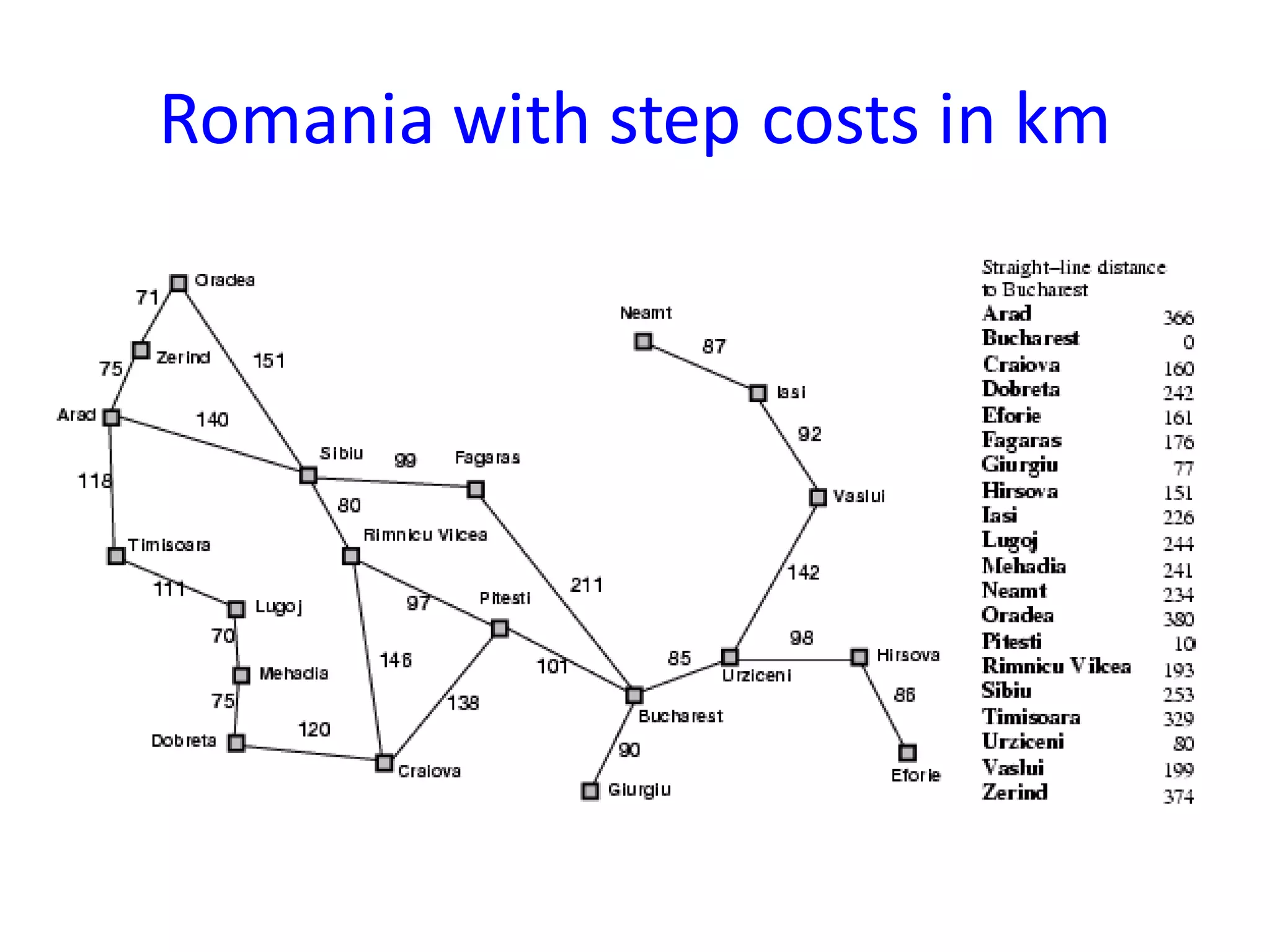
Romania with step costs in km
Greedy best-first search
• Evaluation function f(n) = h(n) (heuristic)
= estimate of cost from n to goal
• e.g., hSLD(n) = straight-line distance from n to
Bucharest
• Greedy best-first search expands the node
that appears to be closest to goal
Properties of greedy best-first search
• Complete?
• No – can get stuck in loops, e.g., Iasi  Neamt  Iasi 
Neamt 
• Time?
• O(bm),but a good heuristic can givedramatic
improvement
• Space?
• O(bm) -- keeps all nodes in memory
• Optimal?
• No
A* search
• Idea: avoid expanding paths that are already
expensive
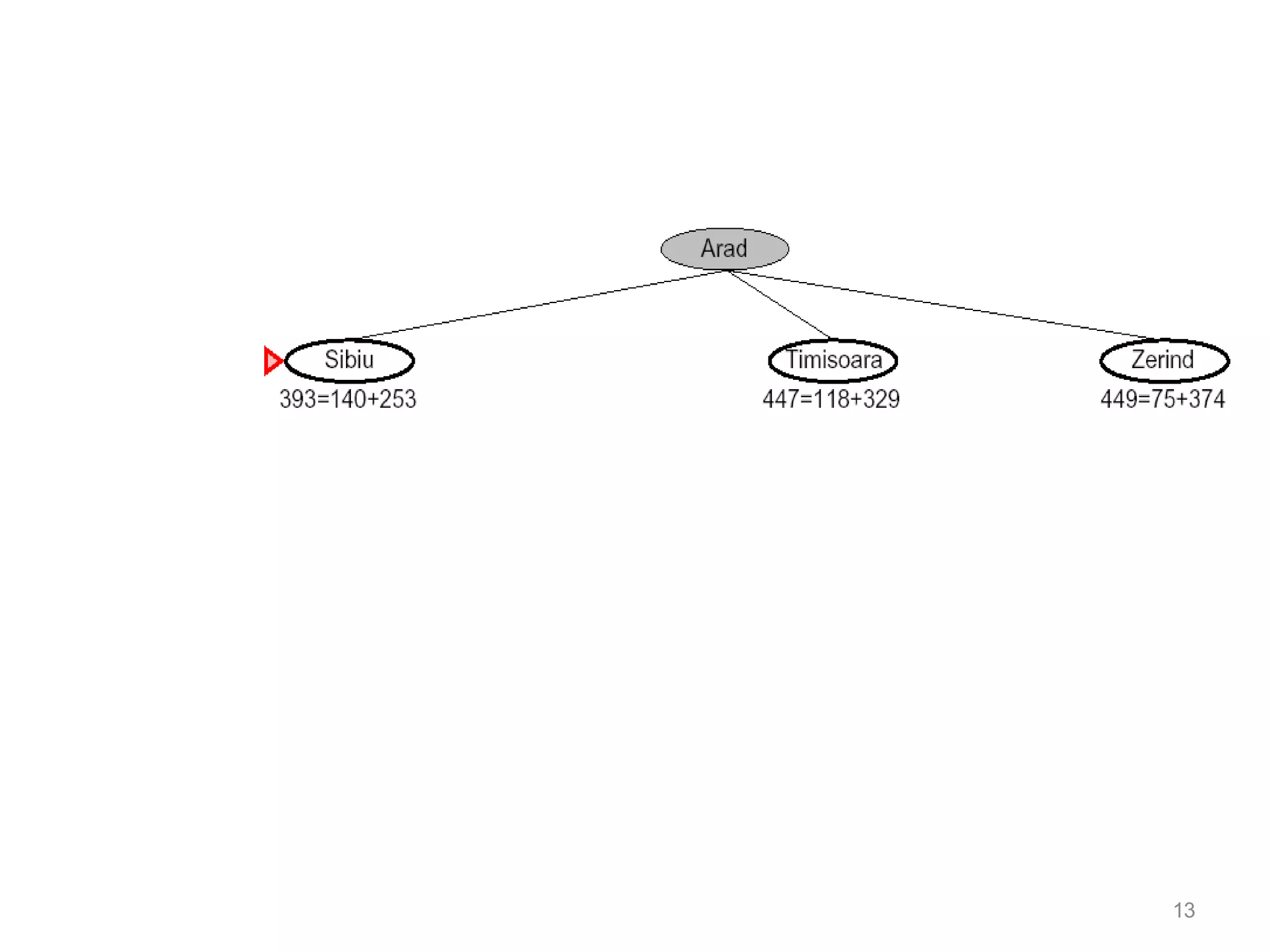
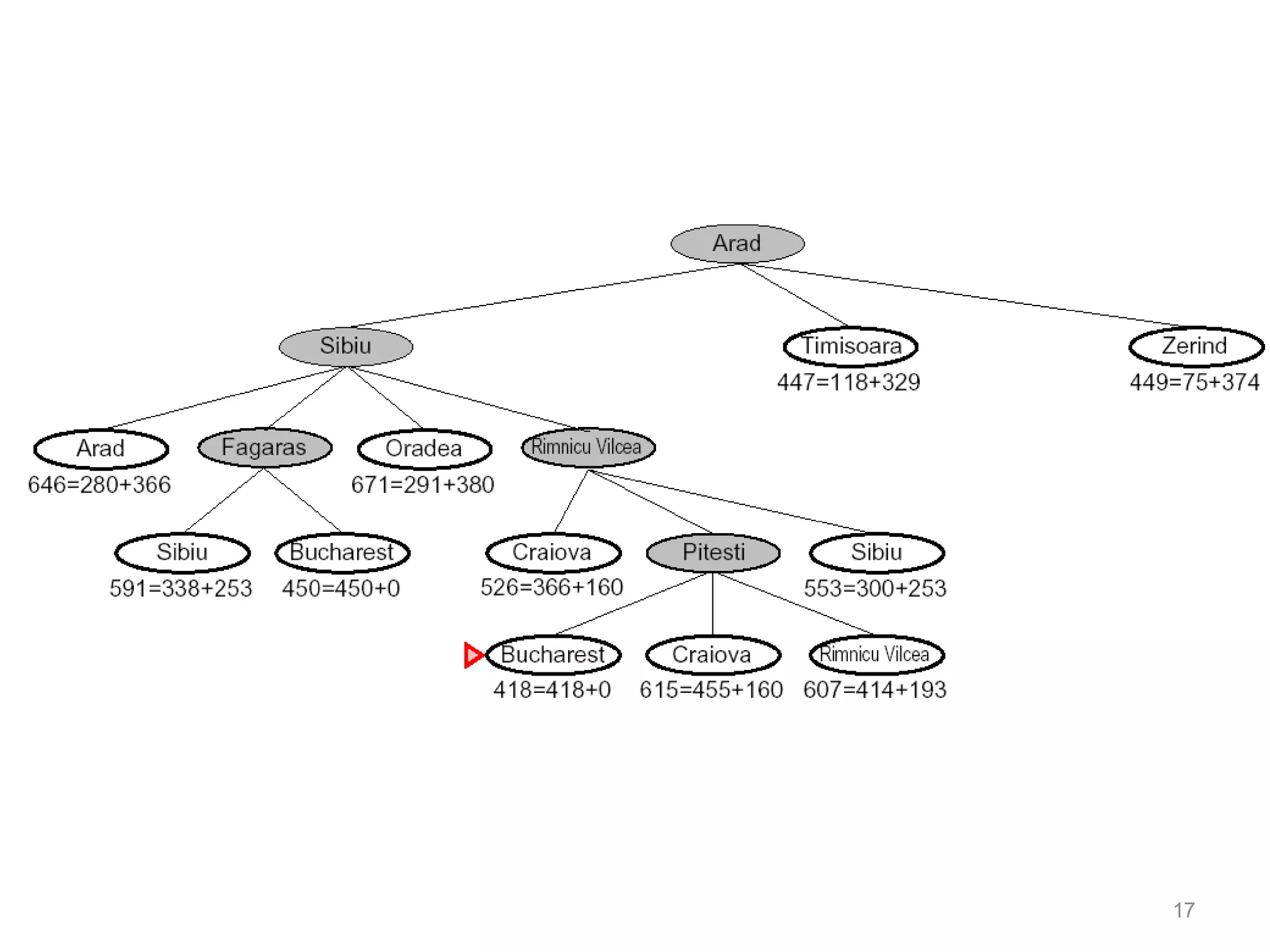
• Evaluation function f(n) = g(n) + h(n)
• g(n) = cost so far to reach n
• h(n) = estimated cost from n to goal
• f(n) = estimated total cost of path through n to
goal
12
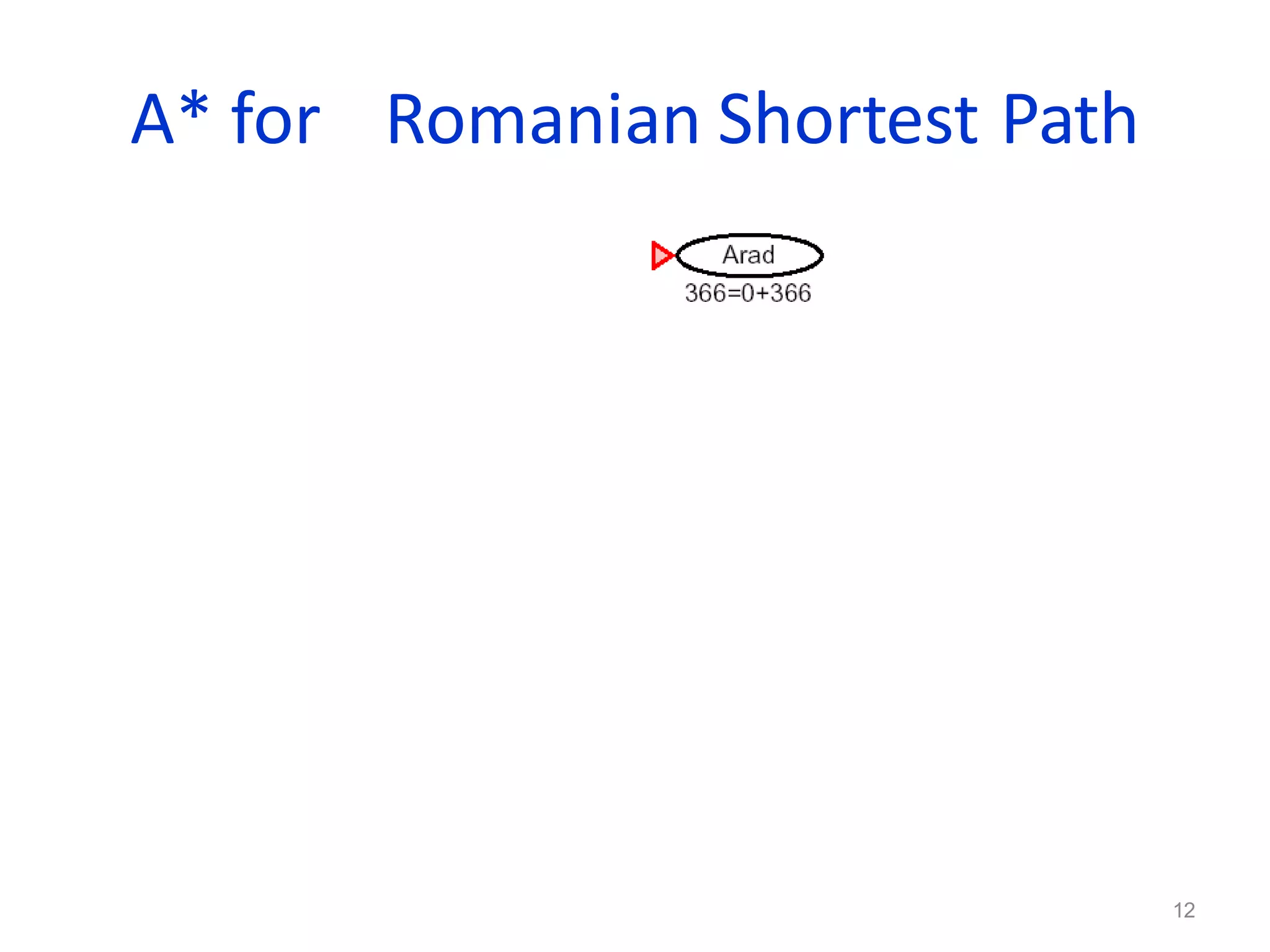
A* for Romanian Shortest Path
13
14
15
16
17
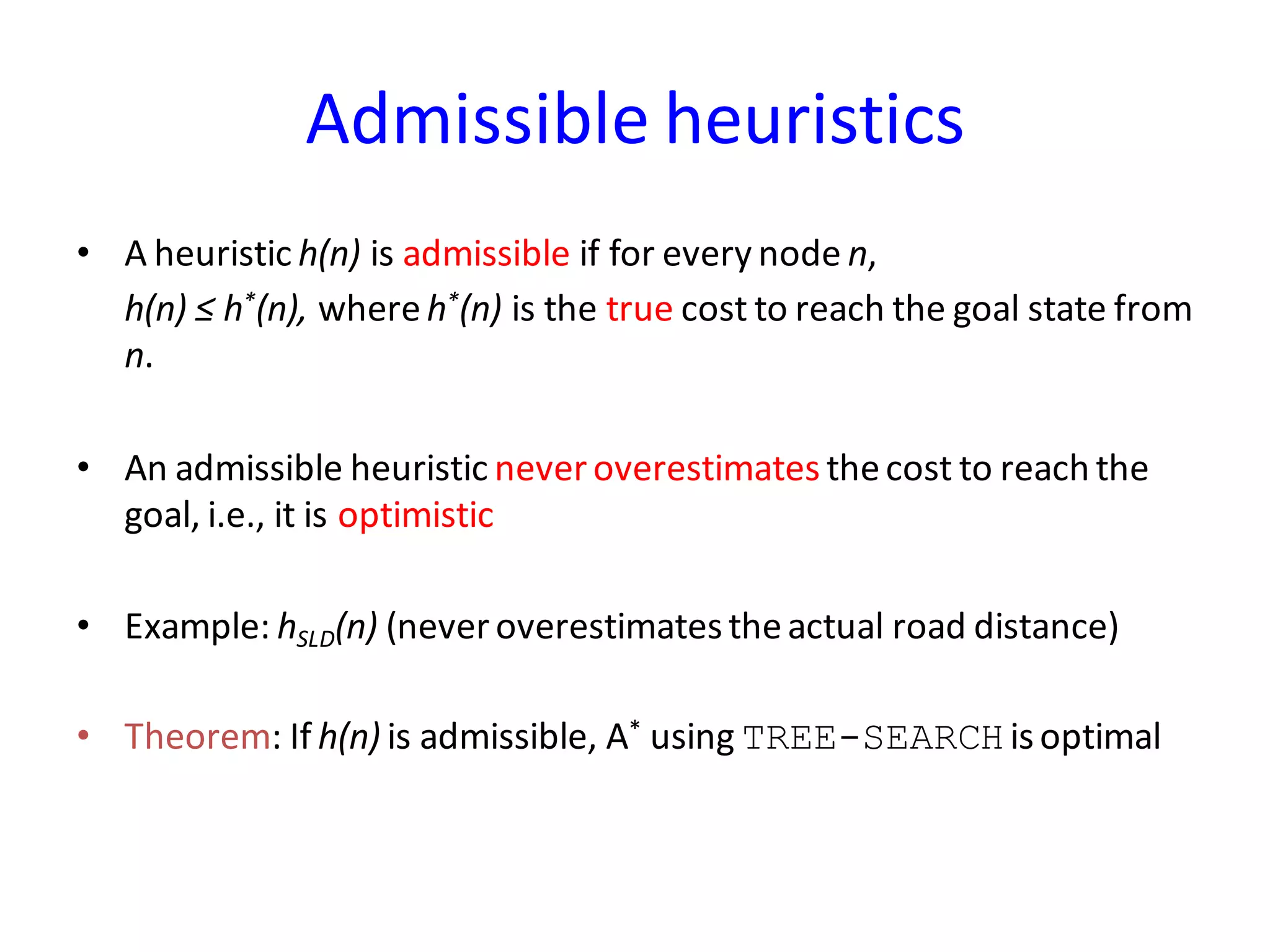
Admissible heuristics
• A heuristic h(n) is admissible if for every node n,
h(n) ≤ h*(n), whereh*(n) is the true cost to reach the goal state from
n.
• An admissible heuristic neveroverestimates thecost to reach the
goal, i.e., it is optimistic
• Example: hSLD(n) (never overestimatestheactual road distance)
• Theorem: If h(n) is admissible, A* using TREE-SEARCH isoptimal
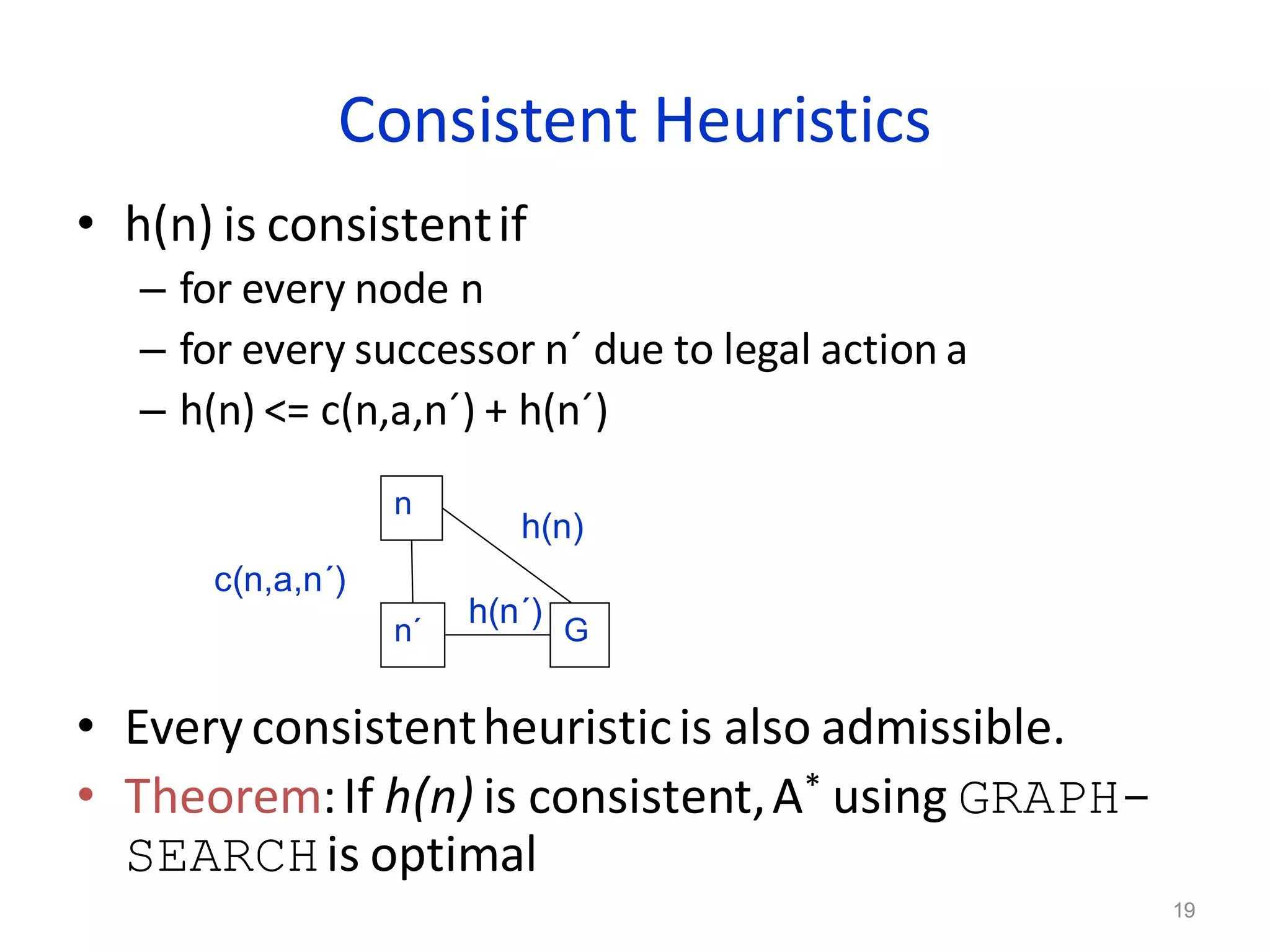
Consistent Heuristics
• h(n) is consistentif
– for every node n
– for every successor n´ due to legal action a
– h(n) <= c(n,a,n´) + h(n´)
• Every consistentheuristicis also admissible.
• Theorem:If h(n) is consistent,A* using GRAPH-
SEARCHis optimal
19
n
n´ G
c(n,a,n´)
h(n´)
h(n)
Properties of A*
• Complete?
Yes (unless there are infinitely many nodes with f ≤ f(G) )
• Time? Exponential
• Space? Keeps all nodes in memory
• Optimal?
Yes (depending upon search algo and heuristic property)
http://www.youtube.com/watch?v=huJEgJ82360
Admissible heuristics
E.g., for the 8-puzzle:
• h1(n) = number of misplaced tiles
• h2(n) = total Manhattan distance
(i.e., no. of squares from desired location of each tile)
• h1(S) = ?
• h2(S) = ?
Admissible heuristics
E.g., for the 8-puzzle:
• h1(n) = number of misplaced tiles
• h2(n) = total Manhattan distance
(i.e., no. of squares from desired location of each tile)
• h1(S) = ? 8
• h2(S) = ? 3+1+2+2+2+3+3+2 = 18
Dominance
• If h2(n) ≥ h1(n) for all n (both admissible)
then h2 dominates h1
• h2 is better for search
• Typicalsearch costs (average number of node expanded):
• d=12 IDS = 3,644,035 nodes
A*(h1) = 227 nodes
A*(h2) = 73 nodes
• d=24 IDS = too many nodes
A*(h1) = 39,135 nodes
A*(h2) = 1,641 nodes
Relaxed problems
• A problem with fewer restrictions on the actions is called a
relaxed problem
• The cost of an optimal solution to a relaxed problem is an
admissible heuristic for the original problem
• If the rules of the 8-puzzle are relaxed so that a tile can move
anywhere, then h1(n) gives the shortest solution
• If the rules are relaxed so that a tile can move to any adjacent
square, then h2(n) gives the shortest solution
Memory Problem?
• Iterative deepening A*
– Similar to ID search
Non-optimal variations
• Use more informative, but inadmissible
heuristics
• Weighted A*
– f(n) = g(n)+ w.h(n) where w>1
– Typically w=5.
– Solution quality bounded by w for admissible h
Sizes of Problem Spaces
• 8 Puzzle: 105 .01 seconds
• 23 Rubik’s Cube: 106 .2 seconds
• 15 Puzzle: 1013 6 days
• 33 Rubik’s Cube: 1019 68,000 years
• 24 Puzzle: 1025 12 billion years
Brute-Force SearchTime (10 million
nodes/second)
Problem Nodes
Performance of IDA* on 15 Puzzle
• Random 15 puzzle instances were first solved
optimally using IDA* with Manhattan distance
heuristic (Korf, 1985).
• Optimal solution lengths average 53 moves.
• 400 million nodes generated on average.
• Average solution time is about 50 seconds on
current machines.
Limitation of Manhattan Distance
• To solve a 24-Puzzle instance, IDA* with
Manhattan distance would take about 65,000
years on average.
• Assumes that each tile moves independently
• In fact, tiles interfere with each other.
• Accounting for these interactions is the key to
more accurate heuristic functions.
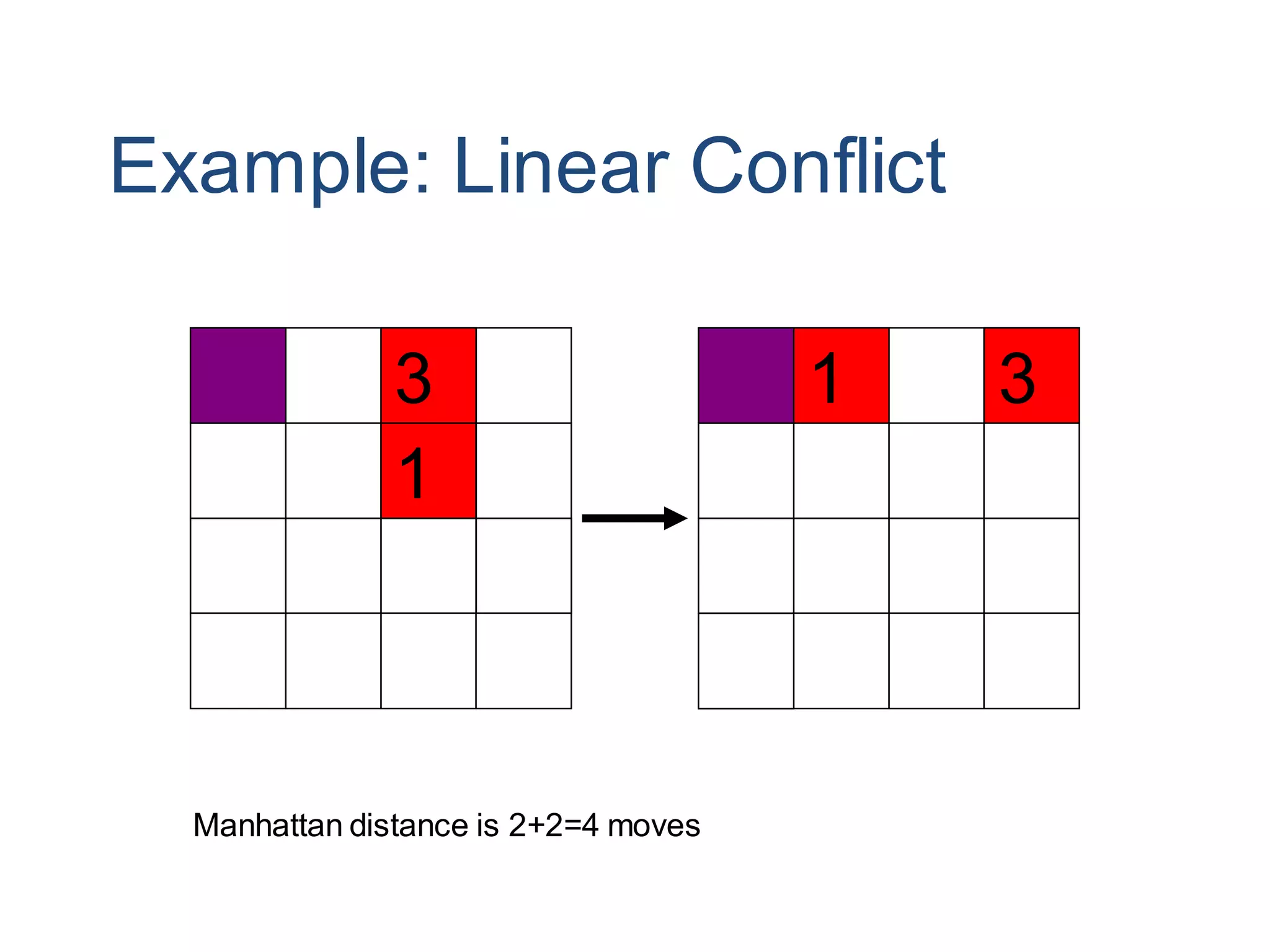
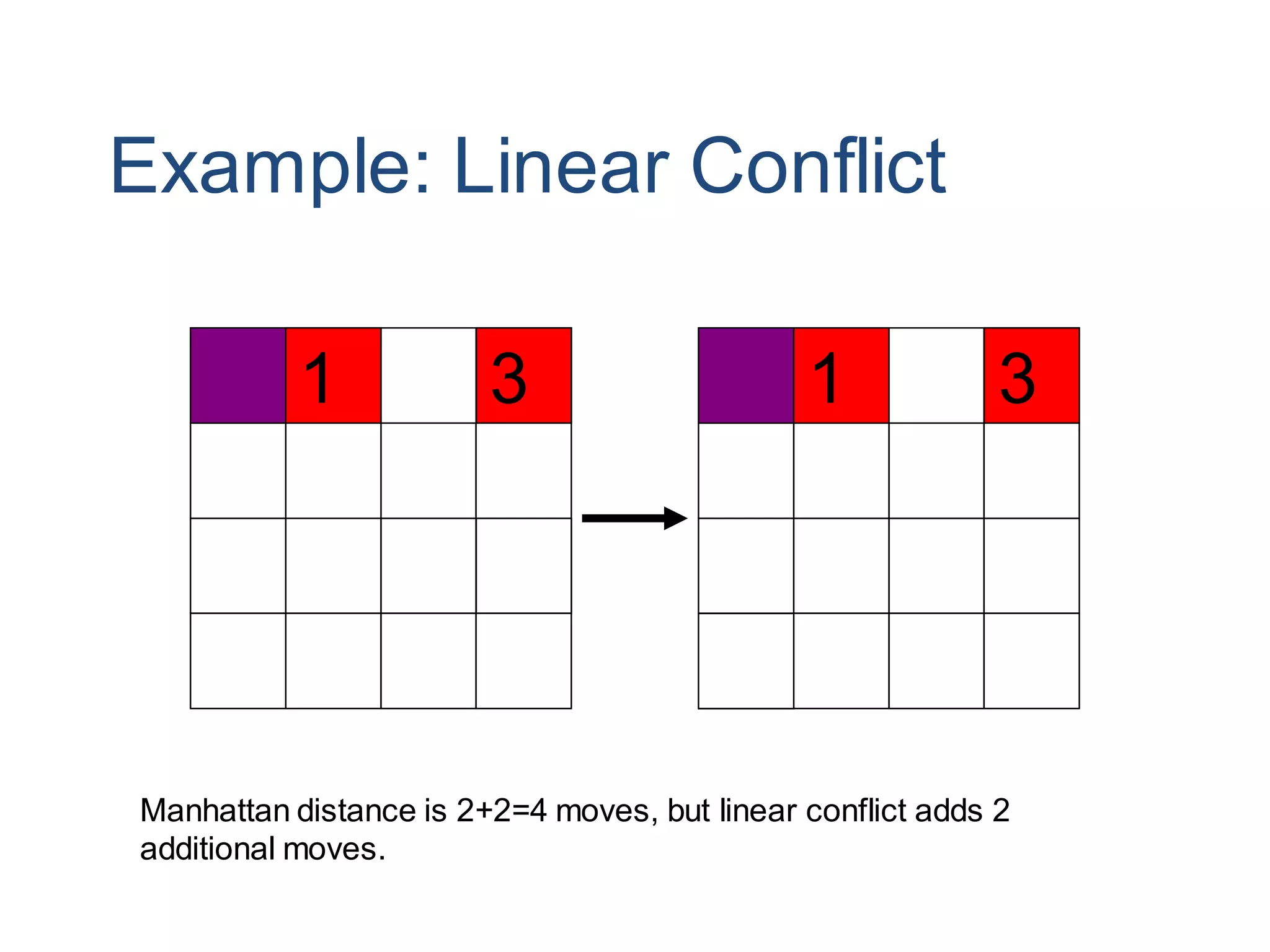
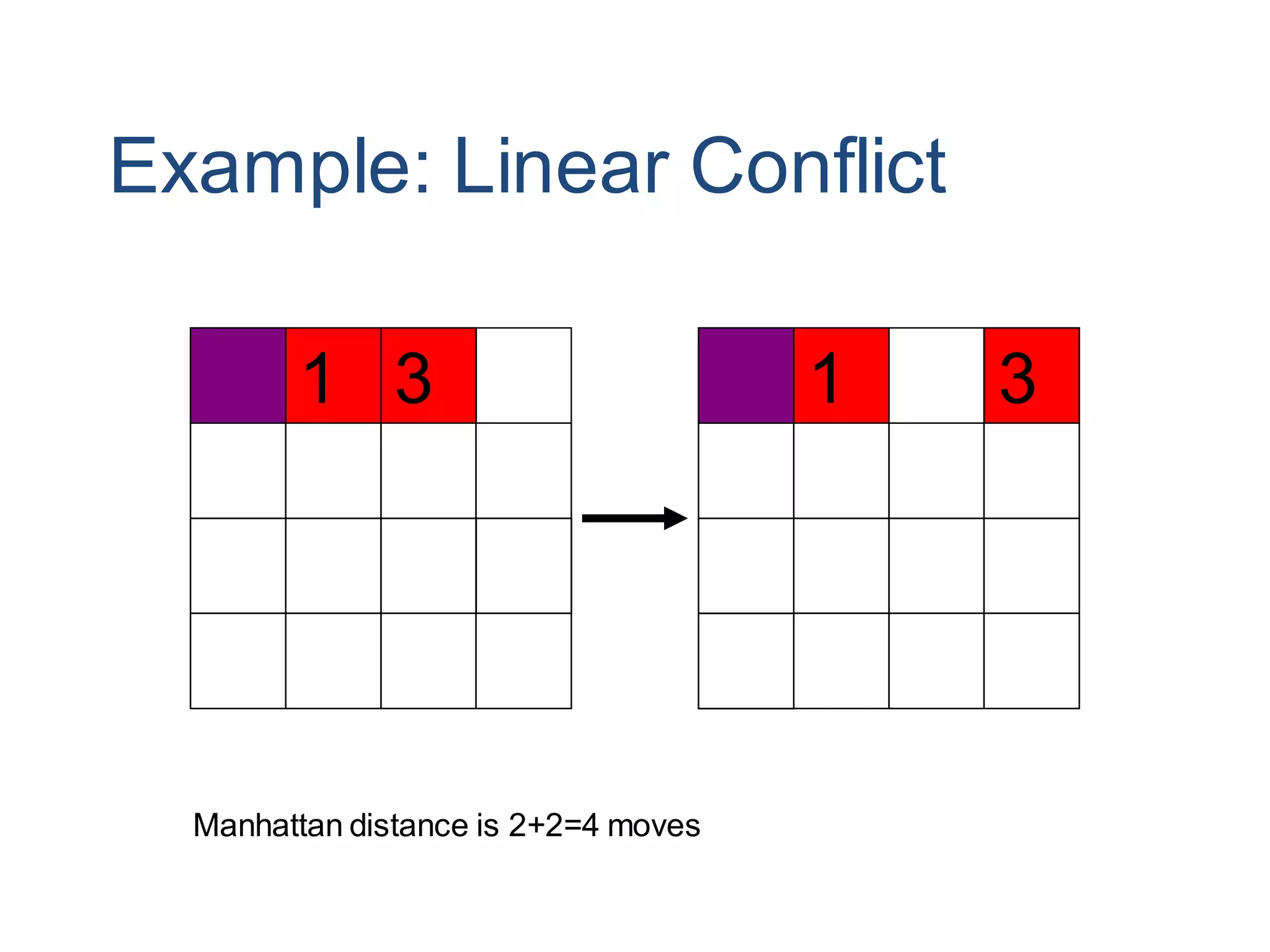
Example: Linear Conflict
1 3
3 1
Manhattan distance is 2+2=4 moves
Example: Linear Conflict
1 3
3 1
Manhattan distance is 2+2=4 moves
Example: Linear Conflict
1 3
3
1
Manhattan distance is 2+2=4 moves
Example: Linear Conflict
1 3
3
1
Manhattan distance is 2+2=4 moves
Example: Linear Conflict
1 3
3
1
Manhattan distance is 2+2=4 moves
Example: Linear Conflict
1 3
3
1
Manhattan distance is 2+2=4 moves
Example: Linear Conflict
1 3
3
1
Manhattan distance is 2+2=4 moves, but linear conflict adds 2
additional moves.
Linear Conflict Heuristic
• Hansson, Mayer, and Yung, 1991
• Given two tiles in their goal row, but reversed
in position, additional vertical moves can be
added to Manhattan distance.
• Still not accurate enough to solve 24-Puzzle
• We can generalize this idea further.
More Complex Tile Interactions
3
7
11
12 13 14 15
14 7
3
15 12
11 13
M.d. is 19 moves, but 31 moves are
needed.
M.d. is 20 moves, but 28 moves are
needed
3
7
11
12 13 14 15
7 13
12
15 3
11 14
M.d. is 17 moves, but 27 moves are
needed
3
7
11
12 13 14 15
12 11
7 14
13 3
15
Pattern Database Heuristics
• Culberson and Schaeffer, 1996
• A pattern database is a complete set of such
positions, with associated number of moves.
• e.g. a 7-tile pattern database for the Fifteen
Puzzle contains 519 million entries.
Heuristics from Pattern Databases
1 2 3
4 5 6 7
8 9 10 11
12 13 14 15
5 10 14 7
8 3 6 1
15 12 9
2 11 4 13
31 moves is a lower bound on the total number of moves needed to solve
this particular state.
Combining Multiple Databases
1 2 3
4 5 6 7
8 9 10 11
12 13 14 15
5 10 14 7
8 3 6 1
15 12 9
2 11 4 13
Overall heuristic is maximum of 31 moves
31 moves needed to solve red tiles
22 moves need to solve blue tiles
Additive Pattern Databases
• Culberson and Schaeffer counted all moves
needed to correctly position the pattern tiles.
• In contrast, we count only moves of the
pattern tiles, ignoring non-pattern moves.
• If no tile belongs to more than one pattern,
then we can add their heuristic values.
• Manhattan distance is a special case of this,
where each pattern contains a single tile.
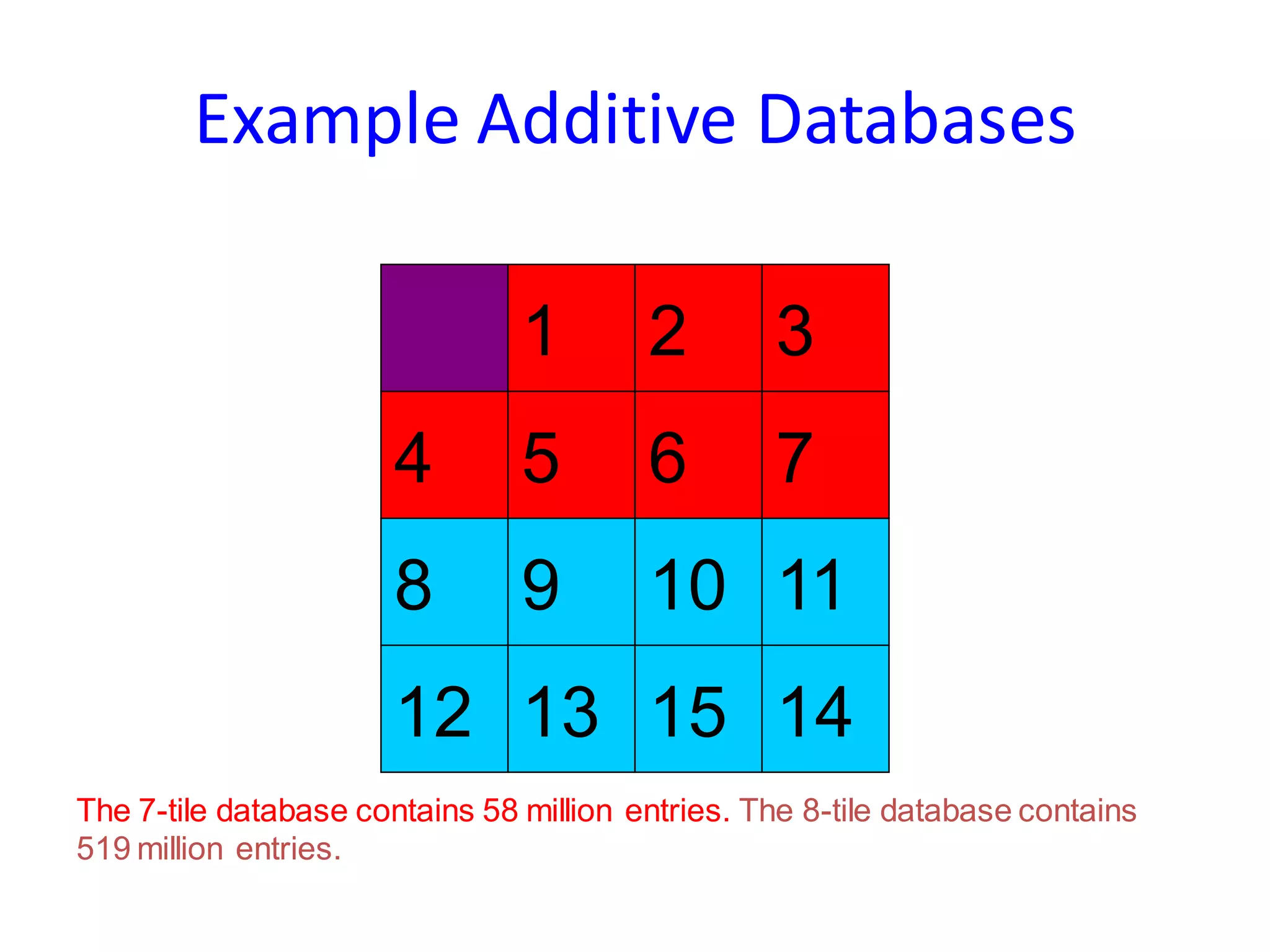
Example Additive Databases
1 2 3
4 5 6 7
8 9 10 11
12 13 15 14
The 7-tile database contains 58 million entries. The 8-tile database contains
519 million entries.
Computing the Heuristic
1 2 3
4 5 6 7
8 9 10 11
12 13 14 15
5 10 14 7
8 3 6 1
15 12 9
2 11 4 13
Overall heuristic is sum, or 20+25=45 moves
20 moves needed to solve red tiles
25 moves needed to solve blue tiles
Performance on 15 Puzzle
• IDA* with a heuristic based on these additive
pattern databases can optimally solve random
15 puzzle instances in less than 29
milliseconds on average.
• This is about 1700 times faster than with
Manhattan distance on the same machine.
Assignment 1
• Flashlight Problem
• Do not use pattern database heuristics

Searching Informed Search.pdf

  • 1.
    Informed search algorithms Chapter3 (Based on Slides by Stuart Russell, Richard Korf and UW-AI faculty)
  • 2.
    2 Informed (Heuristic) Search Idea:be smart about what paths to try.
  • 3.
    3 Blind Search vs.Informed Search • What’s the difference? • How do we formally specify this? A node is selected for expansion based on an evaluation function that estimates cost to goal.
  • 4.
    4 General Tree SearchParadigm function tree-search(root-node) fringe  successors(root-node) while ( notempty(fringe) ) {node  remove-first(fringe) state  state(node) if goal-test(state) return solution(node) fringe  insert-all(successors(node),fringe) } return failure end tree-search
  • 5.
    5 General Graph SearchParadigm function tree-search(root-node) fringe  successors(root-node) explored  empty while ( notempty(fringe) ) {node  remove-first(fringe) state  state(node) if goal-test(state) return solution(node) fringe  insert-all(successors(node),fringe, if node not in explored) explored  insert(node,explored) } return failure end tree-search
  • 6.
    6 Best-First Search • Usean evaluation function f(n) for node n. • Always choose the node from fringe that has the lowest f value. 3 5 1 4 6
  • 7.
    Best-first search • Asearch strategy is defined by picking the order of node expansion • Idea: use an evaluation function f(n) for each node – estimate of "desirability“ Expand most desirable unexpanded node • Implementation: Order the nodes in fringe in decreasing order of desirability • Special cases: – greedy best-first search – A* search
  • 8.
    Romania with stepcosts in km
  • 9.
    Greedy best-first search •Evaluation function f(n) = h(n) (heuristic) = estimate of cost from n to goal • e.g., hSLD(n) = straight-line distance from n to Bucharest • Greedy best-first search expands the node that appears to be closest to goal
  • 10.
    Properties of greedybest-first search • Complete? • No – can get stuck in loops, e.g., Iasi  Neamt  Iasi  Neamt  • Time? • O(bm),but a good heuristic can givedramatic improvement • Space? • O(bm) -- keeps all nodes in memory • Optimal? • No
  • 11.
    A* search • Idea:avoid expanding paths that are already expensive • Evaluation function f(n) = g(n) + h(n) • g(n) = cost so far to reach n • h(n) = estimated cost from n to goal • f(n) = estimated total cost of path through n to goal
  • 12.
    12 A* for RomanianShortest Path
  • 13.
  • 14.
  • 15.
  • 16.
  • 17.
  • 18.
    Admissible heuristics • Aheuristic h(n) is admissible if for every node n, h(n) ≤ h*(n), whereh*(n) is the true cost to reach the goal state from n. • An admissible heuristic neveroverestimates thecost to reach the goal, i.e., it is optimistic • Example: hSLD(n) (never overestimatestheactual road distance) • Theorem: If h(n) is admissible, A* using TREE-SEARCH isoptimal
  • 19.
    Consistent Heuristics • h(n)is consistentif – for every node n – for every successor n´ due to legal action a – h(n) <= c(n,a,n´) + h(n´) • Every consistentheuristicis also admissible. • Theorem:If h(n) is consistent,A* using GRAPH- SEARCHis optimal 19 n n´ G c(n,a,n´) h(n´) h(n)
  • 20.
    Properties of A* •Complete? Yes (unless there are infinitely many nodes with f ≤ f(G) ) • Time? Exponential • Space? Keeps all nodes in memory • Optimal? Yes (depending upon search algo and heuristic property) http://www.youtube.com/watch?v=huJEgJ82360
  • 21.
    Admissible heuristics E.g., forthe 8-puzzle: • h1(n) = number of misplaced tiles • h2(n) = total Manhattan distance (i.e., no. of squares from desired location of each tile) • h1(S) = ? • h2(S) = ?
  • 22.
    Admissible heuristics E.g., forthe 8-puzzle: • h1(n) = number of misplaced tiles • h2(n) = total Manhattan distance (i.e., no. of squares from desired location of each tile) • h1(S) = ? 8 • h2(S) = ? 3+1+2+2+2+3+3+2 = 18
  • 23.
    Dominance • If h2(n)≥ h1(n) for all n (both admissible) then h2 dominates h1 • h2 is better for search • Typicalsearch costs (average number of node expanded): • d=12 IDS = 3,644,035 nodes A*(h1) = 227 nodes A*(h2) = 73 nodes • d=24 IDS = too many nodes A*(h1) = 39,135 nodes A*(h2) = 1,641 nodes
  • 24.
    Relaxed problems • Aproblem with fewer restrictions on the actions is called a relaxed problem • The cost of an optimal solution to a relaxed problem is an admissible heuristic for the original problem • If the rules of the 8-puzzle are relaxed so that a tile can move anywhere, then h1(n) gives the shortest solution • If the rules are relaxed so that a tile can move to any adjacent square, then h2(n) gives the shortest solution
  • 25.
    Memory Problem? • Iterativedeepening A* – Similar to ID search
  • 26.
    Non-optimal variations • Usemore informative, but inadmissible heuristics • Weighted A* – f(n) = g(n)+ w.h(n) where w>1 – Typically w=5. – Solution quality bounded by w for admissible h
  • 27.
    Sizes of ProblemSpaces • 8 Puzzle: 105 .01 seconds • 23 Rubik’s Cube: 106 .2 seconds • 15 Puzzle: 1013 6 days • 33 Rubik’s Cube: 1019 68,000 years • 24 Puzzle: 1025 12 billion years Brute-Force SearchTime (10 million nodes/second) Problem Nodes
  • 28.
    Performance of IDA*on 15 Puzzle • Random 15 puzzle instances were first solved optimally using IDA* with Manhattan distance heuristic (Korf, 1985). • Optimal solution lengths average 53 moves. • 400 million nodes generated on average. • Average solution time is about 50 seconds on current machines.
  • 29.
    Limitation of ManhattanDistance • To solve a 24-Puzzle instance, IDA* with Manhattan distance would take about 65,000 years on average. • Assumes that each tile moves independently • In fact, tiles interfere with each other. • Accounting for these interactions is the key to more accurate heuristic functions.
  • 30.
    Example: Linear Conflict 13 3 1 Manhattan distance is 2+2=4 moves
  • 31.
    Example: Linear Conflict 13 3 1 Manhattan distance is 2+2=4 moves
  • 32.
    Example: Linear Conflict 13 3 1 Manhattan distance is 2+2=4 moves
  • 33.
    Example: Linear Conflict 13 3 1 Manhattan distance is 2+2=4 moves
  • 34.
    Example: Linear Conflict 13 3 1 Manhattan distance is 2+2=4 moves
  • 35.
    Example: Linear Conflict 13 3 1 Manhattan distance is 2+2=4 moves
  • 36.
    Example: Linear Conflict 13 3 1 Manhattan distance is 2+2=4 moves, but linear conflict adds 2 additional moves.
  • 37.
    Linear Conflict Heuristic •Hansson, Mayer, and Yung, 1991 • Given two tiles in their goal row, but reversed in position, additional vertical moves can be added to Manhattan distance. • Still not accurate enough to solve 24-Puzzle • We can generalize this idea further.
  • 38.
    More Complex TileInteractions 3 7 11 12 13 14 15 14 7 3 15 12 11 13 M.d. is 19 moves, but 31 moves are needed. M.d. is 20 moves, but 28 moves are needed 3 7 11 12 13 14 15 7 13 12 15 3 11 14 M.d. is 17 moves, but 27 moves are needed 3 7 11 12 13 14 15 12 11 7 14 13 3 15
  • 39.
    Pattern Database Heuristics •Culberson and Schaeffer, 1996 • A pattern database is a complete set of such positions, with associated number of moves. • e.g. a 7-tile pattern database for the Fifteen Puzzle contains 519 million entries.
  • 40.
    Heuristics from PatternDatabases 1 2 3 4 5 6 7 8 9 10 11 12 13 14 15 5 10 14 7 8 3 6 1 15 12 9 2 11 4 13 31 moves is a lower bound on the total number of moves needed to solve this particular state.
  • 41.
    Combining Multiple Databases 12 3 4 5 6 7 8 9 10 11 12 13 14 15 5 10 14 7 8 3 6 1 15 12 9 2 11 4 13 Overall heuristic is maximum of 31 moves 31 moves needed to solve red tiles 22 moves need to solve blue tiles
  • 42.
    Additive Pattern Databases •Culberson and Schaeffer counted all moves needed to correctly position the pattern tiles. • In contrast, we count only moves of the pattern tiles, ignoring non-pattern moves. • If no tile belongs to more than one pattern, then we can add their heuristic values. • Manhattan distance is a special case of this, where each pattern contains a single tile.
  • 43.
    Example Additive Databases 12 3 4 5 6 7 8 9 10 11 12 13 15 14 The 7-tile database contains 58 million entries. The 8-tile database contains 519 million entries.
  • 44.
    Computing the Heuristic 12 3 4 5 6 7 8 9 10 11 12 13 14 15 5 10 14 7 8 3 6 1 15 12 9 2 11 4 13 Overall heuristic is sum, or 20+25=45 moves 20 moves needed to solve red tiles 25 moves needed to solve blue tiles
  • 45.
    Performance on 15Puzzle • IDA* with a heuristic based on these additive pattern databases can optimally solve random 15 puzzle instances in less than 29 milliseconds on average. • This is about 1700 times faster than with Manhattan distance on the same machine.
  • 46.
    Assignment 1 • FlashlightProblem • Do not use pattern database heuristics