Determining the
Dependent and
Independent Variables
and Finding the
Domain and Range of a
Function
ACTIVITY 1: THE VARIABLES
Directions: Determine the quantities that change (or
the variables) in each of the following situation. Item
number 1 is done as an example.
1. Rosario is making souvenirs for a friend’s wedding.
The number of invited people to attend the wedding
determines the number of souvenirs she must make.
The variables are:
the number of invited people
the number of souvenirs
ACTIVITY 1: THE VARIABLES
Directions: Determine the quantities that
change (or the variables) in each of the following
situation. Item number 1 is done as an example.
2. George is selling brownies
online. The more brownies he sells,
the more money he earns. The
variables are:
ACTIVITY 1: THE VARIABLES
Directions: Determine the quantities that change (or
the variables) in each of the following situation. Item
number 1 is done as an example.
3. A bakery in Cabadbaran City sells
different types of bread. The more
bread the customers buy, the more
sacks of flour they will use. The
variables are:
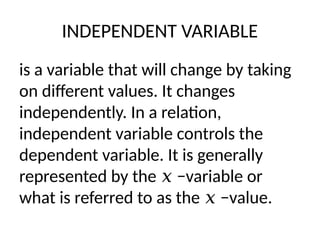
INDEPENDENT VARIABLE
is a variable that will change by taking
on different values. It changes
independently. In a relation,
independent variable controls the
dependent variable. It is generally
represented by the −variable or
𝑥
what is referred to as the −value.
𝑥
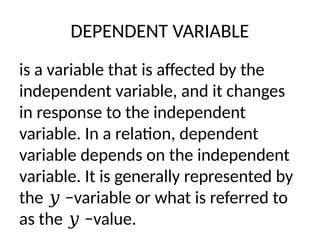
DEPENDENT VARIABLE
is a variable that is affected by the
independent variable, and it changes
in response to the independent
variable. In a relation, dependent
variable depends on the independent
variable. It is generally represented by
the −variable or what is referred to
𝑦
as the −value.
𝑦
In the scenario, which must
happen first before the other
occurs? Which variable controls
the other, and which variable
depends on the other?
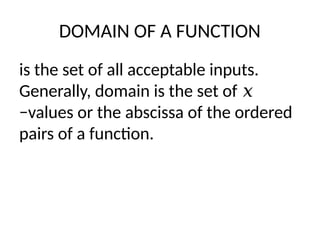
DOMAIN OF A FUNCTION
is the set of all acceptable inputs.
Generally, domain is the set of 𝑥
−values or the abscissa of the ordered
pairs of a function.
DOMAIN OF A FUNCTION
When represented as ordered pairs is
the set of the first coordinates or it is
the set of all values that can be used
for the independent variable. In the
function y=2/x
The domain is the set of all nonzero
real numbers since 2/x is undefined for
x=0.
RANGE OF A FUNCTION
is the set of resulting outputs.
Generally, range is the set of −values
𝑦
or the ordinate of the ordered pairs of
a function.
RANGE OF A FUNCTION
Is the set of second coordinates or the
set of all values of the dependent
variables.
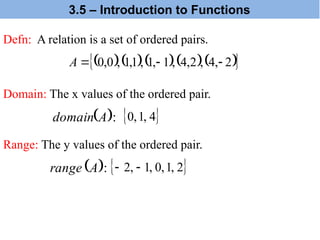
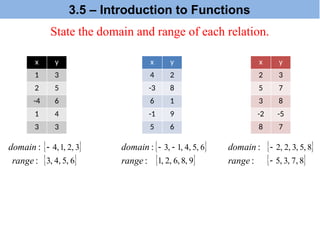
Defn: A relation is a set of ordered pairs.
     
 
2
,
4
,
2
,
4
,
1
,
1
,
1
,
1
,
0
,
0 


A
 :
A
range
 
4
,
1
,
0
 
2
,
1
,
0
,
1
,
2 

Domain: The x values of the ordered pair.
 :
A
domain
Range: The y values of the ordered pair.
3.5 – Introduction to Functions
:
range  
6
,
5
,
4
,
3
 
3
,
2
,
1
,
4

:
domain
x y
1 3
2 5
-4 6
1 4
3 3
x y
4 2
-3 8
6 1
-1 9
5 6
x y
2 3
5 7
3 8
-2 -5
8 7
:
range  
9
,
8
,
6
,
2
,
1
 
6
,
5
,
4
,
1
,
3 

:
domain
:
range  
8
,
7
,
3
,
5

 
8
,
5
,
3
,
2
,
2

:
domain
State the domain and range of each relation.
3.5 – Introduction to Functions
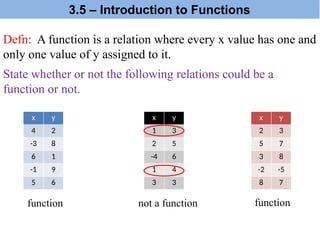
Defn: A function is a relation where every x value has one and
only one value of y assigned to it.
x y
1 3
2 5
-4 6
1 4
3 3
x y
4 2
-3 8
6 1
-1 9
5 6
x y
2 3
5 7
3 8
-2 -5
8 7
function not a function function
State whether or not the following relations could be a
function or not.
3.5 – Introduction to Functions
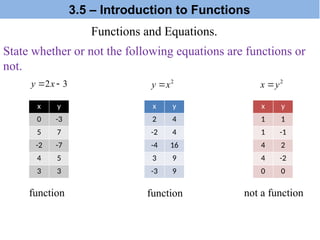
Functions and Equations.
3
2 
 x
y
x y
0 -3
5 7
-2 -7
4 5
3 3
x y
2 4
-2 4
-4 16
3 9
-3 9
x y
1 1
1 -1
4 2
4 -2
0 0
2
x
y  2
y
x 
function function not a function
State whether or not the following equations are functions or
not.
3.5 – Introduction to Functions
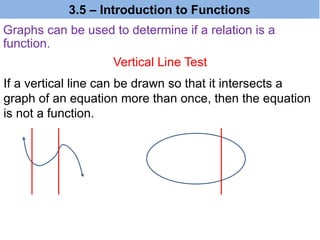
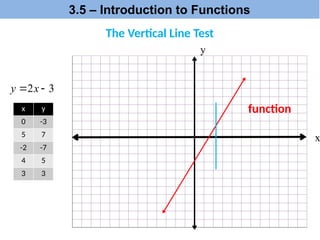
Vertical Line Test
Graphs can be used to determine if a relation is a
function.
If a vertical line can be drawn so that it intersects a
graph of an equation more than once, then the equation
is not a function.
3.5 – Introduction to Functions
x
y
The Vertical Line Test
3
2 
 x
y
x y
0 -3
5 7
-2 -7
4 5
3 3
function
3.5 – Introduction to Functions
x
y
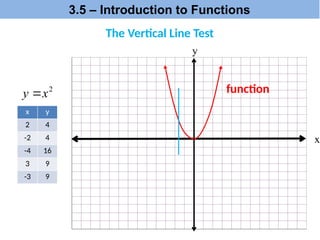
2
x
y 
x y
2 4
-2 4
-4 16
3 9
-3 9
The Vertical Line Test
function
3.5 – Introduction to Functions
x
y
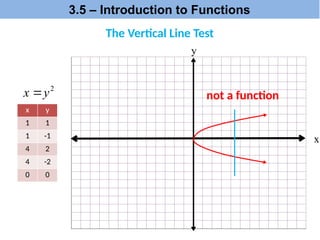
2
y
x 
x y
1 1
1 -1
4 2
4 -2
0 0
The Vertical Line Test
not a function
3.5 – Introduction to Functions
Find the domain and
range of the function
graphed to the right.
Use interval
notation.
x
y
Domain:
Domain
Range:
Range
[–3, 4]
[–4, 2]
Domain and Range from Graphs
3.5 – Introduction to Functions
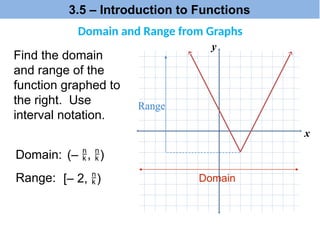
Find the domain
and range of the
function graphed to
the right. Use
interval notation.
x
y
Domain:
Domain
Range:
Range
(– , )
[– 2, )
Domain and Range from Graphs
3.5 – Introduction to Functions
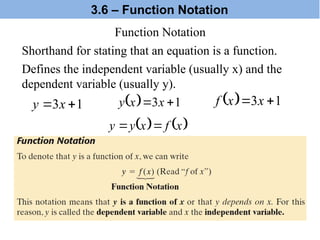
Function Notation
  1
3 
 x
x
f
  1
3 
 x
x
y
   
x
f
x
y
y 

Shorthand for stating that an equation is a function.
1
3 
 x
y
Defines the independent variable (usually x) and the
dependent variable (usually y).
3.6 – Function Notation
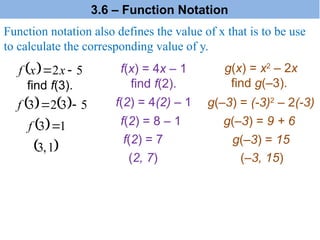
  5
2 
 x
x
f
Function notation also defines the value of x that is to be use
to calculate the corresponding value of y.
    5
3
2
3 

f
  1
3 
f
 
1
,
3
f(x) = 4x – 1
find f(2).
f(2) = 4(2) – 1
f(2) = 8 – 1
f(2) = 7
(2, 7)
g(x) = x2
– 2x
find g(–3).
g(–3) = (-3)2
– 2(-3)
g(–3) = 9 + 6
g(–3) = 15
(–3, 15)
find f(3).
3.6 – Function Notation
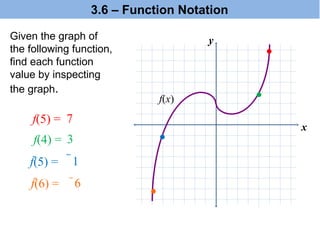
Given the graph of
the following function,
find each function
value by inspecting
the graph.
f(5) = 7
x
y
f(x)
f(4) = 3
f(5) = 1
f(6) = 6
●
●
●
●
3.6 – Function Notation

1_Relations and Functions grade eight.pptx

  • 1.
    Determining the Dependent and IndependentVariables and Finding the Domain and Range of a Function
  • 2.
    ACTIVITY 1: THEVARIABLES Directions: Determine the quantities that change (or the variables) in each of the following situation. Item number 1 is done as an example. 1. Rosario is making souvenirs for a friend’s wedding. The number of invited people to attend the wedding determines the number of souvenirs she must make. The variables are: the number of invited people the number of souvenirs
  • 3.
    ACTIVITY 1: THEVARIABLES Directions: Determine the quantities that change (or the variables) in each of the following situation. Item number 1 is done as an example. 2. George is selling brownies online. The more brownies he sells, the more money he earns. The variables are:
  • 4.
    ACTIVITY 1: THEVARIABLES Directions: Determine the quantities that change (or the variables) in each of the following situation. Item number 1 is done as an example. 3. A bakery in Cabadbaran City sells different types of bread. The more bread the customers buy, the more sacks of flour they will use. The variables are:
  • 5.
    INDEPENDENT VARIABLE is avariable that will change by taking on different values. It changes independently. In a relation, independent variable controls the dependent variable. It is generally represented by the −variable or 𝑥 what is referred to as the −value. 𝑥
  • 6.
    DEPENDENT VARIABLE is avariable that is affected by the independent variable, and it changes in response to the independent variable. In a relation, dependent variable depends on the independent variable. It is generally represented by the −variable or what is referred to 𝑦 as the −value. 𝑦
  • 7.
    In the scenario,which must happen first before the other occurs? Which variable controls the other, and which variable depends on the other?
  • 8.
    DOMAIN OF AFUNCTION is the set of all acceptable inputs. Generally, domain is the set of 𝑥 −values or the abscissa of the ordered pairs of a function.
  • 9.
    DOMAIN OF AFUNCTION When represented as ordered pairs is the set of the first coordinates or it is the set of all values that can be used for the independent variable. In the function y=2/x The domain is the set of all nonzero real numbers since 2/x is undefined for x=0.
  • 10.
    RANGE OF AFUNCTION is the set of resulting outputs. Generally, range is the set of −values 𝑦 or the ordinate of the ordered pairs of a function.
  • 11.
    RANGE OF AFUNCTION Is the set of second coordinates or the set of all values of the dependent variables.
  • 12.
    Defn: A relationis a set of ordered pairs.         2 , 4 , 2 , 4 , 1 , 1 , 1 , 1 , 0 , 0    A  : A range   4 , 1 , 0   2 , 1 , 0 , 1 , 2   Domain: The x values of the ordered pair.  : A domain Range: The y values of the ordered pair. 3.5 – Introduction to Functions
  • 13.
    : range   6 , 5 , 4 , 3  3 , 2 , 1 , 4  : domain x y 1 3 2 5 -4 6 1 4 3 3 x y 4 2 -3 8 6 1 -1 9 5 6 x y 2 3 5 7 3 8 -2 -5 8 7 : range   9 , 8 , 6 , 2 , 1   6 , 5 , 4 , 1 , 3   : domain : range   8 , 7 , 3 , 5    8 , 5 , 3 , 2 , 2  : domain State the domain and range of each relation. 3.5 – Introduction to Functions
  • 14.
    Defn: A functionis a relation where every x value has one and only one value of y assigned to it. x y 1 3 2 5 -4 6 1 4 3 3 x y 4 2 -3 8 6 1 -1 9 5 6 x y 2 3 5 7 3 8 -2 -5 8 7 function not a function function State whether or not the following relations could be a function or not. 3.5 – Introduction to Functions
  • 15.
    Functions and Equations. 3 2  x y x y 0 -3 5 7 -2 -7 4 5 3 3 x y 2 4 -2 4 -4 16 3 9 -3 9 x y 1 1 1 -1 4 2 4 -2 0 0 2 x y  2 y x  function function not a function State whether or not the following equations are functions or not. 3.5 – Introduction to Functions
  • 16.
    Vertical Line Test Graphscan be used to determine if a relation is a function. If a vertical line can be drawn so that it intersects a graph of an equation more than once, then the equation is not a function. 3.5 – Introduction to Functions
  • 17.
    x y The Vertical LineTest 3 2   x y x y 0 -3 5 7 -2 -7 4 5 3 3 function 3.5 – Introduction to Functions
  • 18.
    x y 2 x y  x y 24 -2 4 -4 16 3 9 -3 9 The Vertical Line Test function 3.5 – Introduction to Functions
  • 19.
    x y 2 y x  x y 11 1 -1 4 2 4 -2 0 0 The Vertical Line Test not a function 3.5 – Introduction to Functions
  • 20.
    Find the domainand range of the function graphed to the right. Use interval notation. x y Domain: Domain Range: Range [–3, 4] [–4, 2] Domain and Range from Graphs 3.5 – Introduction to Functions
  • 21.
    Find the domain andrange of the function graphed to the right. Use interval notation. x y Domain: Domain Range: Range (– , ) [– 2, ) Domain and Range from Graphs 3.5 – Introduction to Functions
  • 22.
    Function Notation  1 3   x x f   1 3   x x y     x f x y y   Shorthand for stating that an equation is a function. 1 3   x y Defines the independent variable (usually x) and the dependent variable (usually y). 3.6 – Function Notation
  • 23.
      5 2  x x f Function notation also defines the value of x that is to be use to calculate the corresponding value of y.     5 3 2 3   f   1 3  f   1 , 3 f(x) = 4x – 1 find f(2). f(2) = 4(2) – 1 f(2) = 8 – 1 f(2) = 7 (2, 7) g(x) = x2 – 2x find g(–3). g(–3) = (-3)2 – 2(-3) g(–3) = 9 + 6 g(–3) = 15 (–3, 15) find f(3). 3.6 – Function Notation
  • 24.
    Given the graphof the following function, find each function value by inspecting the graph. f(5) = 7 x y f(x) f(4) = 3 f(5) = 1 f(6) = 6 ● ● ● ● 3.6 – Function Notation
  • 25.

Editor's Notes

  • #4 Reminder: Brace yourself with the knowledge of how to determine the different variables as you will be identifying which one can change by its own and which one would be affected by the change of the other.
  • #5 In your previous activity, the two variables in the scenario are “the number invited people” and “the number of souvenier”. How do we know which variable is independent and which variable is dependent?
  • #7 Answ: know the invited people first before doing souvenier Ind= the number of invited people Dep= the number of souvenier
  • #10 A common misconception is we can use any numbers for the inputs (or domain) of a function. That is very wrong. In fact, we must inspect the function and determine any limitations on the domain.
  • #11 A common misconception is we can use any numbers for the inputs (or domain) of a function. That is very wrong. In fact, we must inspect the function and determine any limitations on the domain.