TYBCom C Div
Course: Fundamentals Organizational Behavior
Unit 3
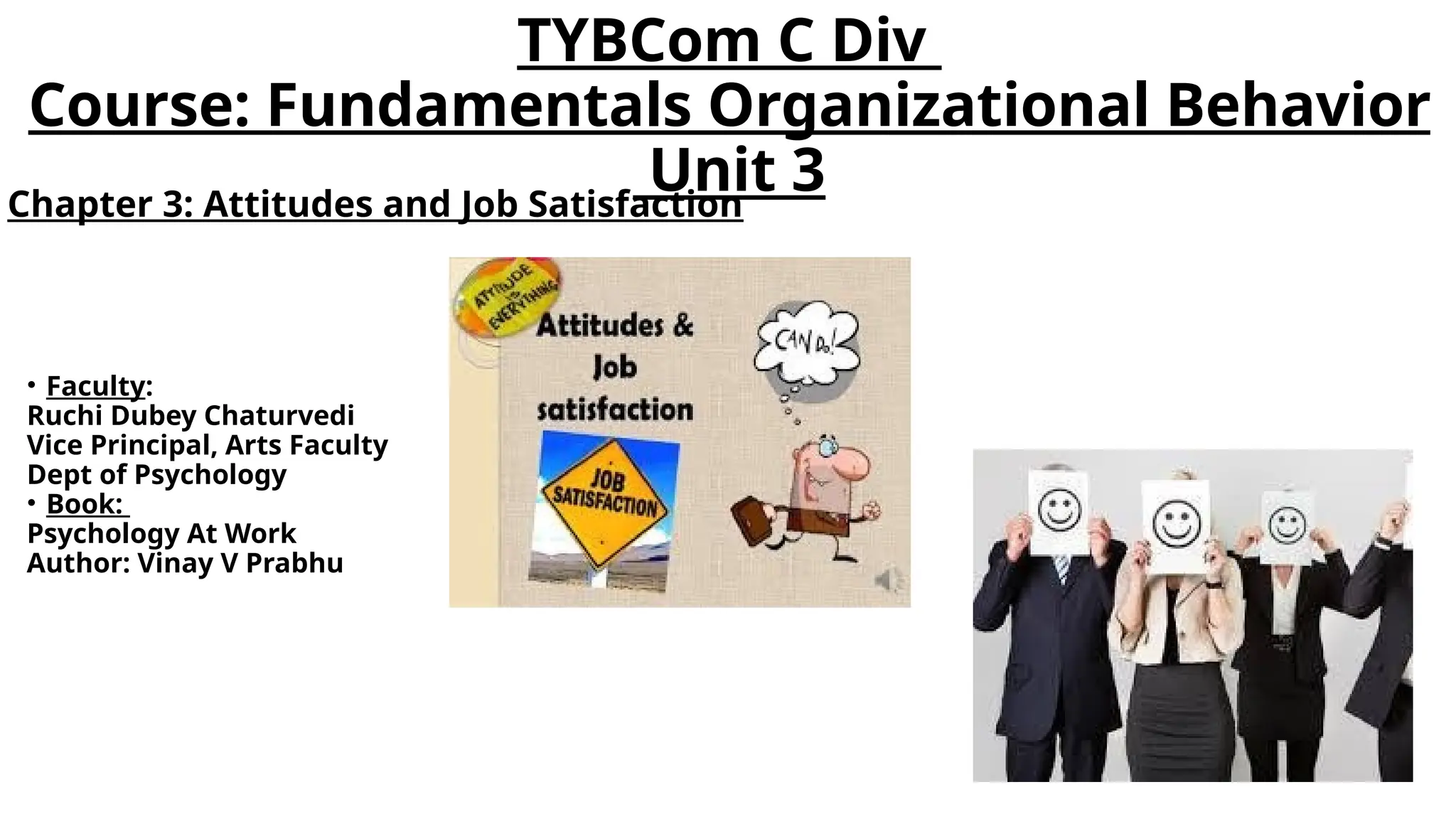
Chapter 3: Attitudes and Job Satisfaction
• Faculty:
Ruchi Dubey Chaturvedi
Vice Principal, Arts Faculty
Dept of Psychology
• Book:
Psychology At Work
Author: Vinay V Prabhu
Sub-Topics
Attitudes and Job Satisfaction
1.Components of Attitudes
2.Measurement of Job Satisfaction
3.Determinants of Job Satisfaction
4. Impact of Job Satisfaction
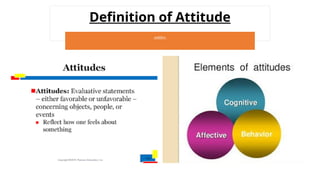
Definition of Attitude
Components of Attitudes:
1.Cognitive: how we think about someone/something; our
Belief or opinion. Eg. Employee saying his job is boring
2. Affective: emotional aspect; how we feel (our liking or
disliking) about someone or something. Eg. An employee
saying that he hates his job
3. Behavioral: intention to behave in a certain way toward
someone or something. E.g. Employees sys he wants to change his
job
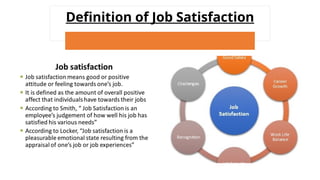
Definition of Job Satisfaction
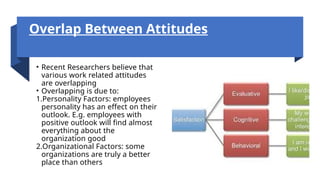
Overlap Between Attitudes
• Recent Researchers believe that
various work related attitudes
are overlapping
• Overlapping is due to:
1.Personality Factors: employees
personality has an effect on their
outlook. E.g. employees with
positive outlook will find almost
everything about the
organization good
2.Organizational Factors: some
organizations are truly a better
place than others
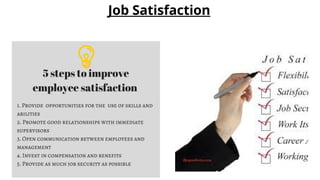
Job Satisfaction
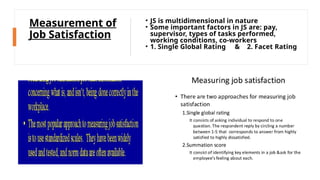
Measurement of
Job Satisfaction
• JS is multidimensional in nature
• Some important factors in JS are: pay,
supervisor, types of tasks performed,
working conditions, co-workers
• 1. Single Global Rating & 2. Facet Rating
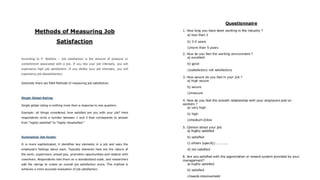
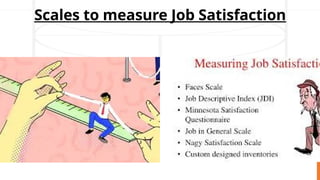
Scales to measure Job Satisfaction
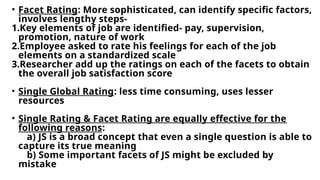
• Facet Rating: More sophisticated, can identify specific factors,
involves lengthy steps-
1.Key elements of job are identified- pay, supervision,
promotion, nature of work
2.Employee asked to rate his feelings for each of the job
elements on a standardized scale
3.Researcher add up the ratings on each of the facets to obtain
the overall job satisfaction score
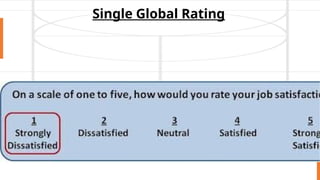
• Single Global Rating: less time consuming, uses lesser
resources
• Single Rating & Facet Rating are equally effective for the
following reasons:
a) JS is a broad concept that even a single question is able to
capture its true meaning
b) Some important facets of JS might be excluded by
mistake
Single Global Rating
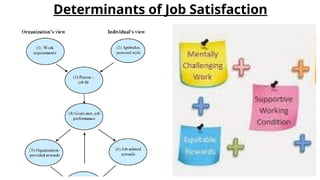
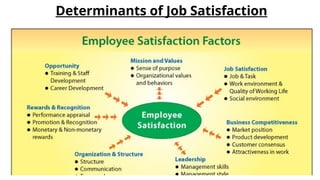
Determinants of Job Satisfaction
Major
Determinants of
Job Satisfaction
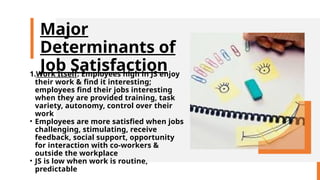
1.Work Itself: Employees high in JS enjoy
their work & find it interesting;
employees find their jobs interesting
when they are provided training, task
variety, autonomy, control over their
work
• Employees are more satisfied when jobs
challenging, stimulating, receive
feedback, social support, opportunity
for interaction with co-workers &
outside the workplace
• JS is low when work is routine,
predictable
Major Determinants of Job Satisfaction
2. Pay:
• For poor people, pay has strong impact on JS & Happiness
• Impact of Pay reduces & almost disappears as a person rises
in status; money may be a good motivator but it does not
guarantee either JS or Happiness
3. Personality:
• Happy, positive people have high JS
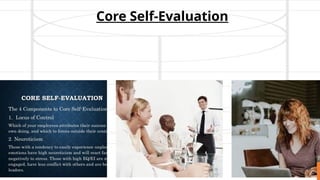
• Positive Core self-evaluation (capability, competent, worthy)-
employees who have positive Core self-evaluation consider
their jobs to be challenging & fulfilling
• Negative Core self-evaluation: employees who have negative
Core self-evaluation lack ambition, give-up easily when faced
with a difficult task, tend to get stuck in routine & boring jobs
Core Self-Evaluation
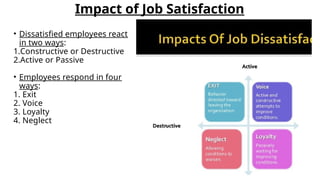
Impact of Job Satisfaction
• Dissatisfied employees react
in two ways:
1.Constructive or Destructive
2.Active or Passive
• Employees respond in four
ways:
1. Exit
2. Voice
3. Loyalty
4. Neglect
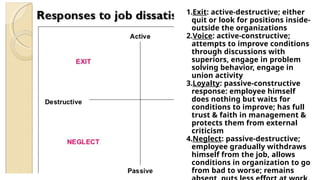
1.Exit: active-destructive; either
quit or look for positions inside-
outside the organizations
2.Voice: active-constructive;
attempts to improve conditions
through discussions with
superiors, engage in problem
solving behavior, engage in
union activity
3.Loyalty: passive-constructive
response: employee himself
does nothing but waits for
conditions to improve; has full
trust & faith in management &
protects them from external
criticism
4.Neglect: passive-destructive;
employee gradually withdraws
himself from the job, allows
conditions in organization to go
from bad to worse; remains
Job Satisfaction & Job Performance
• Earlier belief- happy workers are productive workers
• Managers: concentrated on improving work conditions &
make work environment happy
• Current understanding: happy workers are productive
workers is myth & illusion; its actually reverse- productive
workers are happy workers; Reasons are:
1.When one does good job, one gets intrinsically motivated
2.Higher productivity results in greater economic, sociological
& psychological rewards in the form of pay raise, greater
recognition, promotion etc. This increases JS
• Enough research for both viewpoints
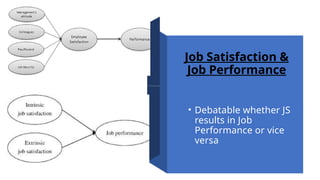
Job Satisfaction &
Job Performance
• Debatable whether JS
results in Job
Performance or vice
versa
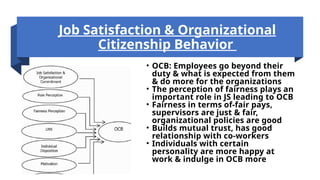
Job Satisfaction & Organizational
Citizenship Behavior
• OCB: Employees go beyond their
duty & what is expected from them
& do more for the organizations
• The perception of fairness plays an
important role in JS leading to OCB
• Fairness in terms of-fair pays,
supervisors are just & fair,
organizational policies are good
• Builds mutual trust, has good
relationship with co-workers
• Individuals with certain
personality are more happy at
work & indulge in OCB more
Job Satisfaction & Customer Satisfaction
• High JS leads to increased
customer satisfaction &
loyalty
• Satisfied employees- friendly,
energetic, responsive, as they
tend to stay in the same
organization for longer
durations, makes customers
satisfied
• Dissatisfied employees: rude,
abusive, make unreasonable
demands, negatively effect
customers
Steps to enhance Job Satisfaction
• Train employees
• Reward deserving
employees
• Create positive work
environment
• Conduct regular
employee
satisfaction surveys
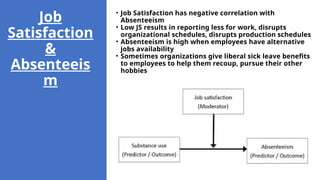
Job
Satisfaction
&
Absenteeis
m
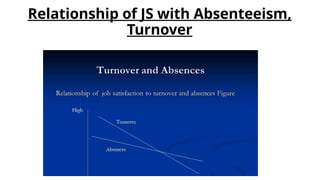
• Job Satisfaction has negative correlation with
Absenteeism
• Low JS results in reporting less for work, disrupts
organizational schedules, disrupts production schedules
• Absenteeism is high when employees have alternative
jobs availability
• Sometimes organizations give liberal sick leave benefits
to employees to help them recoup, pursue their other
hobbies
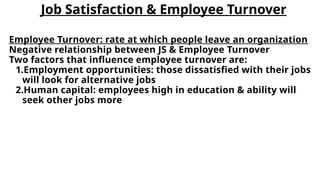
Job Satisfaction & Employee Turnover
Employee Turnover: rate at which people leave an organization
Negative relationship between JS & Employee Turnover
Two factors that influence employee turnover are:
1.Employment opportunities: those dissatisfied with their jobs
will look for alternative jobs
2.Human capital: employees high in education & ability will
seek other jobs more
Relationship of JS with Absenteeism,
Turnover
Job
Satisfactio
n &
Workplace
Deviance
Dissatisfied employees indulge in
Employee withdrawal behaviors:
1.Report late for work
2.Damage company property
3.Surf on internet during working
hours
4.Hostile towards co-workers
5.Indulge in different forms of thefts in
organization
6.Susceptible to substance abuse
(drugs)
7.Tries to gain revenge against
organization
Reasons for Deviant Behavior &
Dissatisfaction
1.Feeling that they are being exploited by organization
2.Feeling they are overworked & get less compensation
3.Frustration on account of cold & interpersonal treatment
given by the organization
4.Supervisor illtreating employees
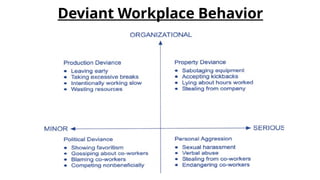
Deviant Workplace Behavior
Psyc Talks
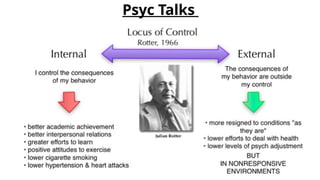
Locus of Control
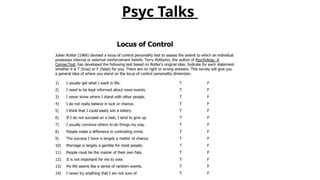
Psyc Talks
End of Unit 3

Sem V Unit III TYBCom Attitudes & JS.pptx.pptx.pptx

  • 1.
    TYBCom C Div Course:Fundamentals Organizational Behavior Unit 3 Chapter 3: Attitudes and Job Satisfaction • Faculty: Ruchi Dubey Chaturvedi Vice Principal, Arts Faculty Dept of Psychology • Book: Psychology At Work Author: Vinay V Prabhu
  • 2.
    Sub-Topics Attitudes and JobSatisfaction 1.Components of Attitudes 2.Measurement of Job Satisfaction 3.Determinants of Job Satisfaction 4. Impact of Job Satisfaction
  • 3.
    Definition of Attitude Componentsof Attitudes: 1.Cognitive: how we think about someone/something; our Belief or opinion. Eg. Employee saying his job is boring 2. Affective: emotional aspect; how we feel (our liking or disliking) about someone or something. Eg. An employee saying that he hates his job 3. Behavioral: intention to behave in a certain way toward someone or something. E.g. Employees sys he wants to change his job
  • 4.
    Definition of JobSatisfaction
  • 5.
    Overlap Between Attitudes •Recent Researchers believe that various work related attitudes are overlapping • Overlapping is due to: 1.Personality Factors: employees personality has an effect on their outlook. E.g. employees with positive outlook will find almost everything about the organization good 2.Organizational Factors: some organizations are truly a better place than others
  • 6.
  • 7.
    Measurement of Job Satisfaction •JS is multidimensional in nature • Some important factors in JS are: pay, supervisor, types of tasks performed, working conditions, co-workers • 1. Single Global Rating & 2. Facet Rating
  • 9.
    Scales to measureJob Satisfaction
  • 10.
    • Facet Rating:More sophisticated, can identify specific factors, involves lengthy steps- 1.Key elements of job are identified- pay, supervision, promotion, nature of work 2.Employee asked to rate his feelings for each of the job elements on a standardized scale 3.Researcher add up the ratings on each of the facets to obtain the overall job satisfaction score • Single Global Rating: less time consuming, uses lesser resources • Single Rating & Facet Rating are equally effective for the following reasons: a) JS is a broad concept that even a single question is able to capture its true meaning b) Some important facets of JS might be excluded by mistake
  • 11.
  • 12.
    Determinants of JobSatisfaction
  • 13.
    Determinants of JobSatisfaction
  • 14.
    Major Determinants of Job Satisfaction 1.WorkItself: Employees high in JS enjoy their work & find it interesting; employees find their jobs interesting when they are provided training, task variety, autonomy, control over their work • Employees are more satisfied when jobs challenging, stimulating, receive feedback, social support, opportunity for interaction with co-workers & outside the workplace • JS is low when work is routine, predictable
  • 15.
    Major Determinants ofJob Satisfaction 2. Pay: • For poor people, pay has strong impact on JS & Happiness • Impact of Pay reduces & almost disappears as a person rises in status; money may be a good motivator but it does not guarantee either JS or Happiness 3. Personality: • Happy, positive people have high JS • Positive Core self-evaluation (capability, competent, worthy)- employees who have positive Core self-evaluation consider their jobs to be challenging & fulfilling • Negative Core self-evaluation: employees who have negative Core self-evaluation lack ambition, give-up easily when faced with a difficult task, tend to get stuck in routine & boring jobs
  • 16.
  • 17.
    Impact of JobSatisfaction • Dissatisfied employees react in two ways: 1.Constructive or Destructive 2.Active or Passive • Employees respond in four ways: 1. Exit 2. Voice 3. Loyalty 4. Neglect
  • 18.
    1.Exit: active-destructive; either quitor look for positions inside- outside the organizations 2.Voice: active-constructive; attempts to improve conditions through discussions with superiors, engage in problem solving behavior, engage in union activity 3.Loyalty: passive-constructive response: employee himself does nothing but waits for conditions to improve; has full trust & faith in management & protects them from external criticism 4.Neglect: passive-destructive; employee gradually withdraws himself from the job, allows conditions in organization to go from bad to worse; remains
  • 19.
    Job Satisfaction &Job Performance • Earlier belief- happy workers are productive workers • Managers: concentrated on improving work conditions & make work environment happy • Current understanding: happy workers are productive workers is myth & illusion; its actually reverse- productive workers are happy workers; Reasons are: 1.When one does good job, one gets intrinsically motivated 2.Higher productivity results in greater economic, sociological & psychological rewards in the form of pay raise, greater recognition, promotion etc. This increases JS • Enough research for both viewpoints
  • 20.
    Job Satisfaction & JobPerformance • Debatable whether JS results in Job Performance or vice versa
  • 21.
    Job Satisfaction &Organizational Citizenship Behavior • OCB: Employees go beyond their duty & what is expected from them & do more for the organizations • The perception of fairness plays an important role in JS leading to OCB • Fairness in terms of-fair pays, supervisors are just & fair, organizational policies are good • Builds mutual trust, has good relationship with co-workers • Individuals with certain personality are more happy at work & indulge in OCB more
  • 22.
    Job Satisfaction &Customer Satisfaction • High JS leads to increased customer satisfaction & loyalty • Satisfied employees- friendly, energetic, responsive, as they tend to stay in the same organization for longer durations, makes customers satisfied • Dissatisfied employees: rude, abusive, make unreasonable demands, negatively effect customers
  • 23.
    Steps to enhanceJob Satisfaction • Train employees • Reward deserving employees • Create positive work environment • Conduct regular employee satisfaction surveys
  • 24.
    Job Satisfaction & Absenteeis m • Job Satisfactionhas negative correlation with Absenteeism • Low JS results in reporting less for work, disrupts organizational schedules, disrupts production schedules • Absenteeism is high when employees have alternative jobs availability • Sometimes organizations give liberal sick leave benefits to employees to help them recoup, pursue their other hobbies
  • 25.
    Job Satisfaction &Employee Turnover Employee Turnover: rate at which people leave an organization Negative relationship between JS & Employee Turnover Two factors that influence employee turnover are: 1.Employment opportunities: those dissatisfied with their jobs will look for alternative jobs 2.Human capital: employees high in education & ability will seek other jobs more
  • 26.
    Relationship of JSwith Absenteeism, Turnover
  • 27.
    Job Satisfactio n & Workplace Deviance Dissatisfied employeesindulge in Employee withdrawal behaviors: 1.Report late for work 2.Damage company property 3.Surf on internet during working hours 4.Hostile towards co-workers 5.Indulge in different forms of thefts in organization 6.Susceptible to substance abuse (drugs) 7.Tries to gain revenge against organization
  • 28.
    Reasons for DeviantBehavior & Dissatisfaction 1.Feeling that they are being exploited by organization 2.Feeling they are overworked & get less compensation 3.Frustration on account of cold & interpersonal treatment given by the organization 4.Supervisor illtreating employees
  • 29.
  • 30.
  • 31.
  • 32.
  • 33.