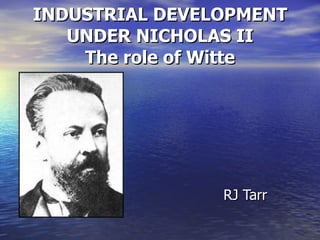
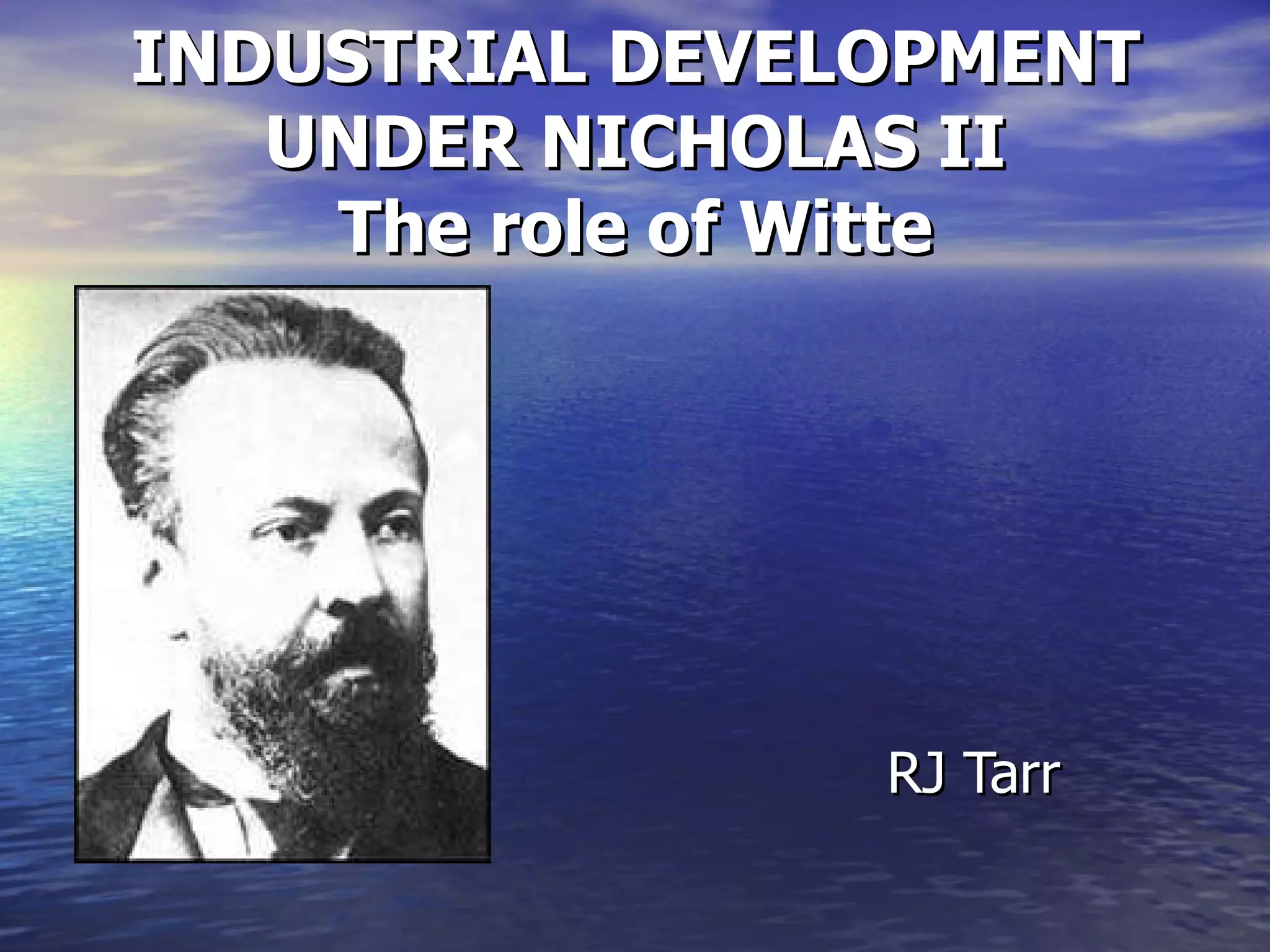
INDUSTRIAL DEVELOPMENT UNDER NICHOLAS II The role of Witte RJ Tarr
(a) Raising Money - The Gold Standard
Policies / Positive Assessment   Immediately upon taking office Witte raised a massive amount of capital – he secured a  loan  from the French government, raised  taxes ,  tariffs  and  interest rates Put Russia on the  Gold Standard  in 1897. This tripled foreign currency investment during his period in power (because it could now be exchanged for Gold, investors were more confident in the currency). Gold Standard meant currency was valued according to the Gold reserves in the country’s banks
Reservations   This meant a higher national debt – 20% of budget was just on servicing the debt (i.e. paying the interest off) by 1900. Light industry and agriculture were pretty much ignored.
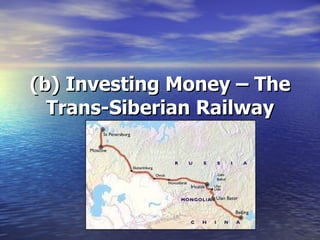
(b) Investing Money – The Trans-Siberian Railway
Policies / Positive Assessment   He then started investing in capital projects – in particular,  railways , which offered military as well as economic advantages and therefore gained the support of the Tsar. The  Trans-Siberian Railway  was the showpiece, stretching 9600 miles from Moscow to Vladivostok.
Reservations   Its value was more symbolic than anything else – it was only single track and some sections were still incomplete in 1914.  An unfortunate consequence was that it encouraged Nicholas II to believe he could defeat Japan in the 1904-5 war.
Overall Assessment
Policies / Positive Assessment He was aware that the long-term benefits of industrialisation was preceded by short-term social dislocation and political tension; so he aimed to leapfrog over this stage and “ Save Russia by rapid and forceful industrialisation ”  Massive growth 1893-1900  All this in the face of the suspicion and hostility of the conservative establishment (Milyutin had faced the same problem).
Reservations   Growth was from a very low base. Even if developments taken at face value, this does not mean that Tsarism would have adapted politically to the economic changes. 4/5 of population in 1914 still peasants.

Tsar Nicholas II and Industry

  • 1.
    INDUSTRIAL DEVELOPMENT UNDERNICHOLAS II The role of Witte RJ Tarr
  • 2.
    (a) Raising Money- The Gold Standard
  • 3.
    Policies / PositiveAssessment Immediately upon taking office Witte raised a massive amount of capital – he secured a loan from the French government, raised taxes , tariffs and interest rates Put Russia on the Gold Standard in 1897. This tripled foreign currency investment during his period in power (because it could now be exchanged for Gold, investors were more confident in the currency). Gold Standard meant currency was valued according to the Gold reserves in the country’s banks
  • 4.
    Reservations This meant a higher national debt – 20% of budget was just on servicing the debt (i.e. paying the interest off) by 1900. Light industry and agriculture were pretty much ignored.
  • 5.
    (b) Investing Money– The Trans-Siberian Railway
  • 6.
    Policies / PositiveAssessment He then started investing in capital projects – in particular, railways , which offered military as well as economic advantages and therefore gained the support of the Tsar. The Trans-Siberian Railway was the showpiece, stretching 9600 miles from Moscow to Vladivostok.
  • 7.
    Reservations Its value was more symbolic than anything else – it was only single track and some sections were still incomplete in 1914. An unfortunate consequence was that it encouraged Nicholas II to believe he could defeat Japan in the 1904-5 war.
  • 8.
  • 9.
    Policies / PositiveAssessment He was aware that the long-term benefits of industrialisation was preceded by short-term social dislocation and political tension; so he aimed to leapfrog over this stage and “ Save Russia by rapid and forceful industrialisation ” Massive growth 1893-1900 All this in the face of the suspicion and hostility of the conservative establishment (Milyutin had faced the same problem).
  • 10.
    Reservations Growth was from a very low base. Even if developments taken at face value, this does not mean that Tsarism would have adapted politically to the economic changes. 4/5 of population in 1914 still peasants.