Christie Fidura Senior Product Marketing Manager for Terminology Solutions Avoiding the Content Conveyor Belt Trap: Enabling Interdepartmental Collaboration
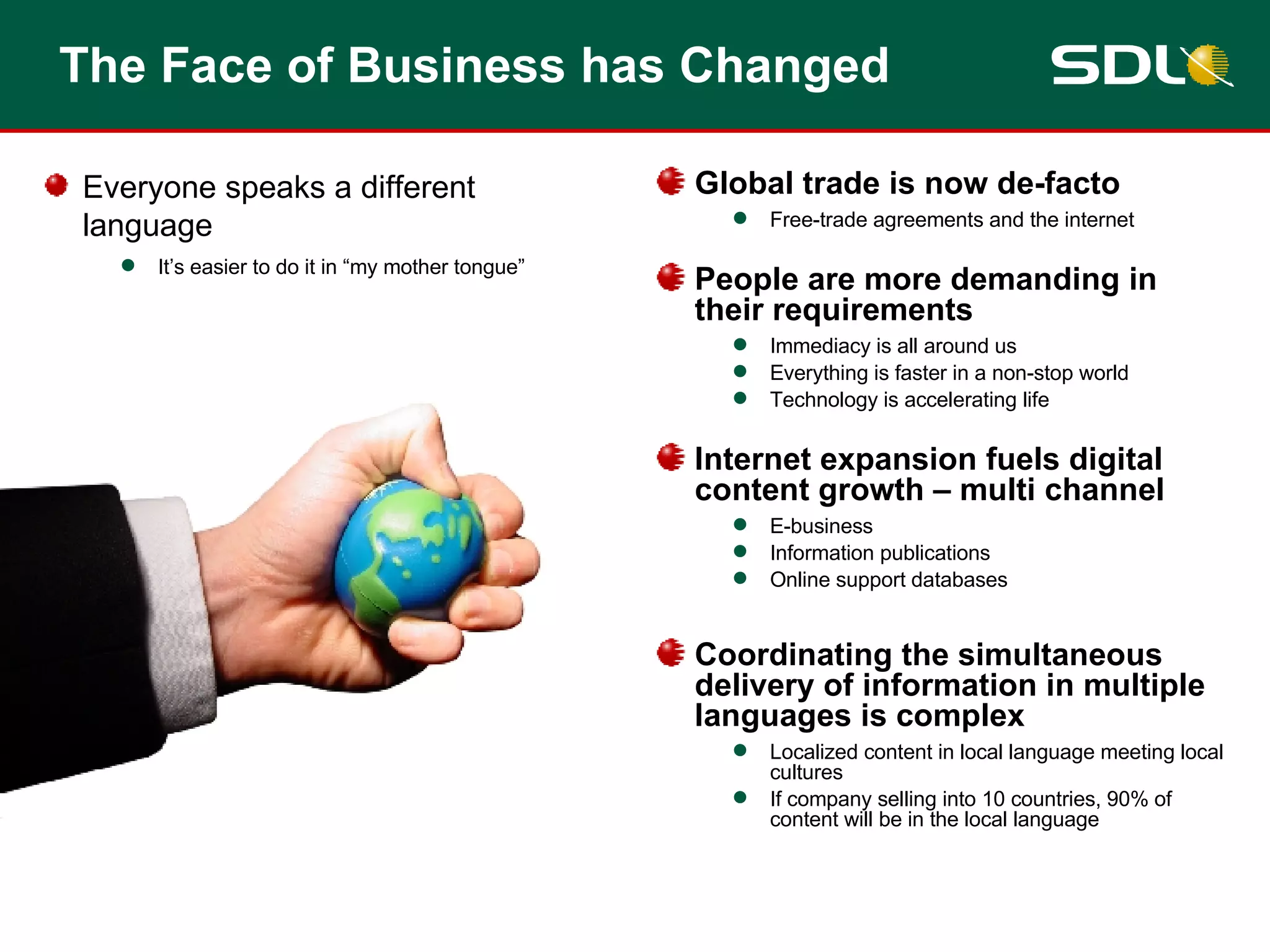
The Face of Business has Changed Global trade is now de-facto Free-trade agreements and the internet People are more demanding in their requirements Immediacy is all around us Everything is faster in a non-stop world Technology is accelerating life Internet expansion fuels digital content growth – multi channel E-business Information publications Online support databases Coordinating the simultaneous delivery of information in multiple languages is complex Localized content in local language meeting local cultures If company selling into 10 countries, 90% of content will be in the local language Everyone speaks a different language It’s easier to do it in “my mother tongue”
How many of you… Are invited to development meetings?  Invite yourself to development meetings? Bribe developers for information? “ Borrow” functional specs off the printer? Are repeatedly asked for part/product/feature names clarifications from other departments? Get caught up in intra-departmental wars over corporate style and terminology? Have a 300-page style guide to follow? Worry about the state of other documents produced by your company?
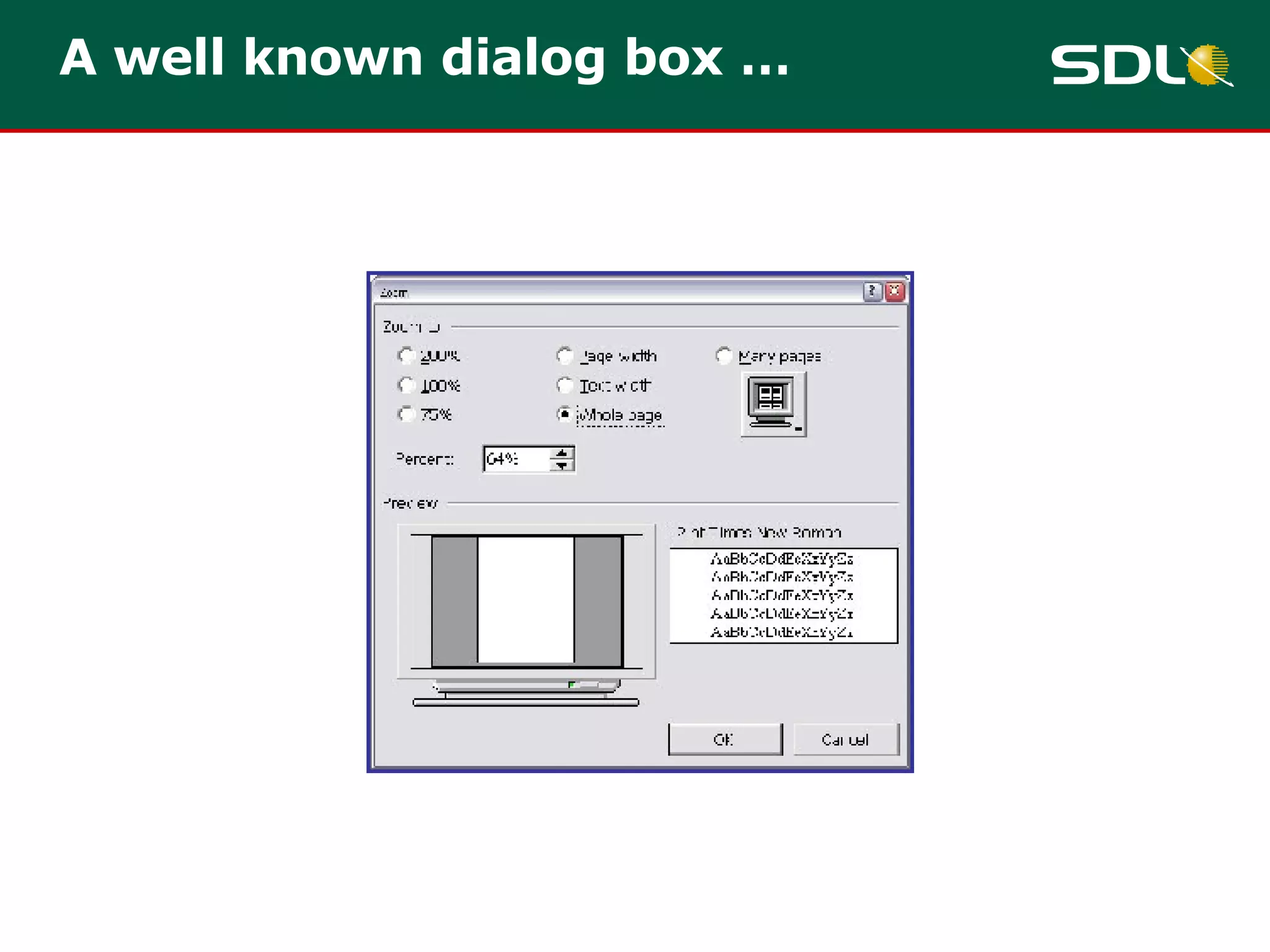
A well known dialog box …
“ Use the [Alt]+[P] {…} to …” hotkey hot key shortcut key keyboard shortcut access key accelerator key keyboard accelerator
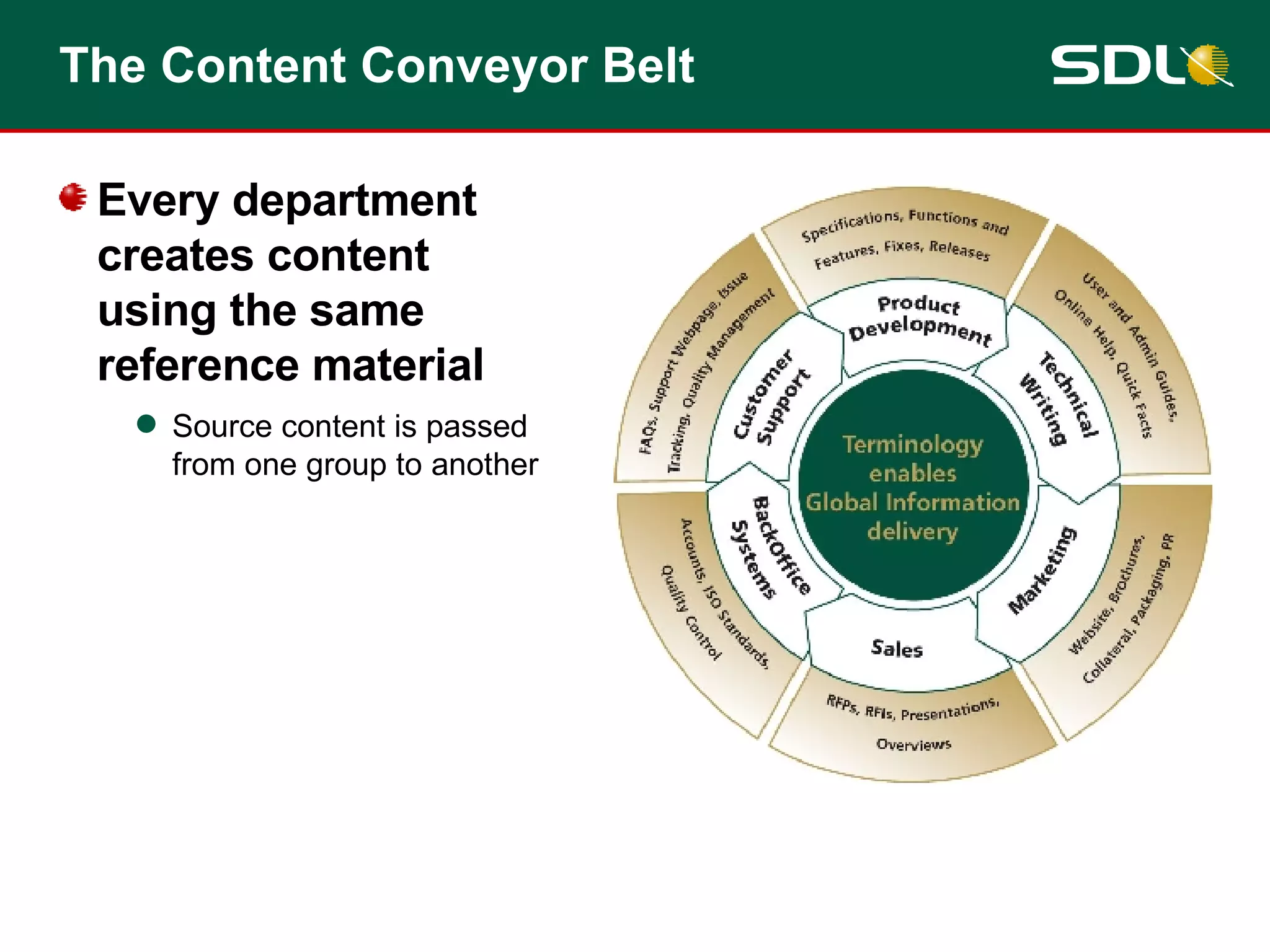
The Content Conveyor Belt Every department creates content using the same reference material Source content is passed from one group to another
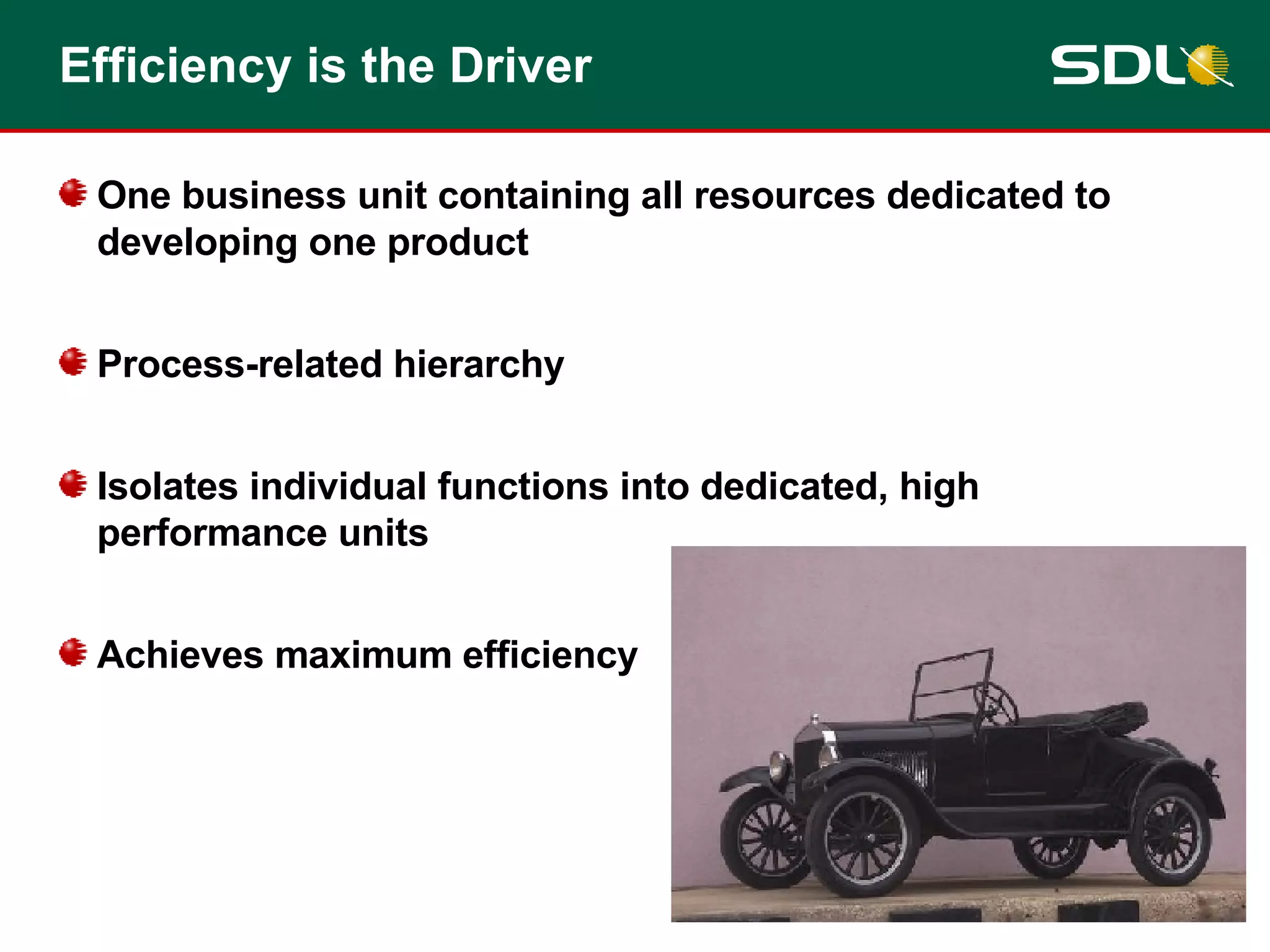
Efficiency is the Driver One business unit containing all resources dedicated to developing one product Process-related hierarchy Isolates individual functions into dedicated, high performance units Achieves maximum efficiency
It’s Efficient, but… Each group uses the content in a different way Different formats Different delivery channels Different tone of voice Content which was produced for internal reference only is not ready for external consumption Content is vulnerable to modification Inconsistencies at the source affect all subsequent documents Chaos  can result when globalization enters the picture…
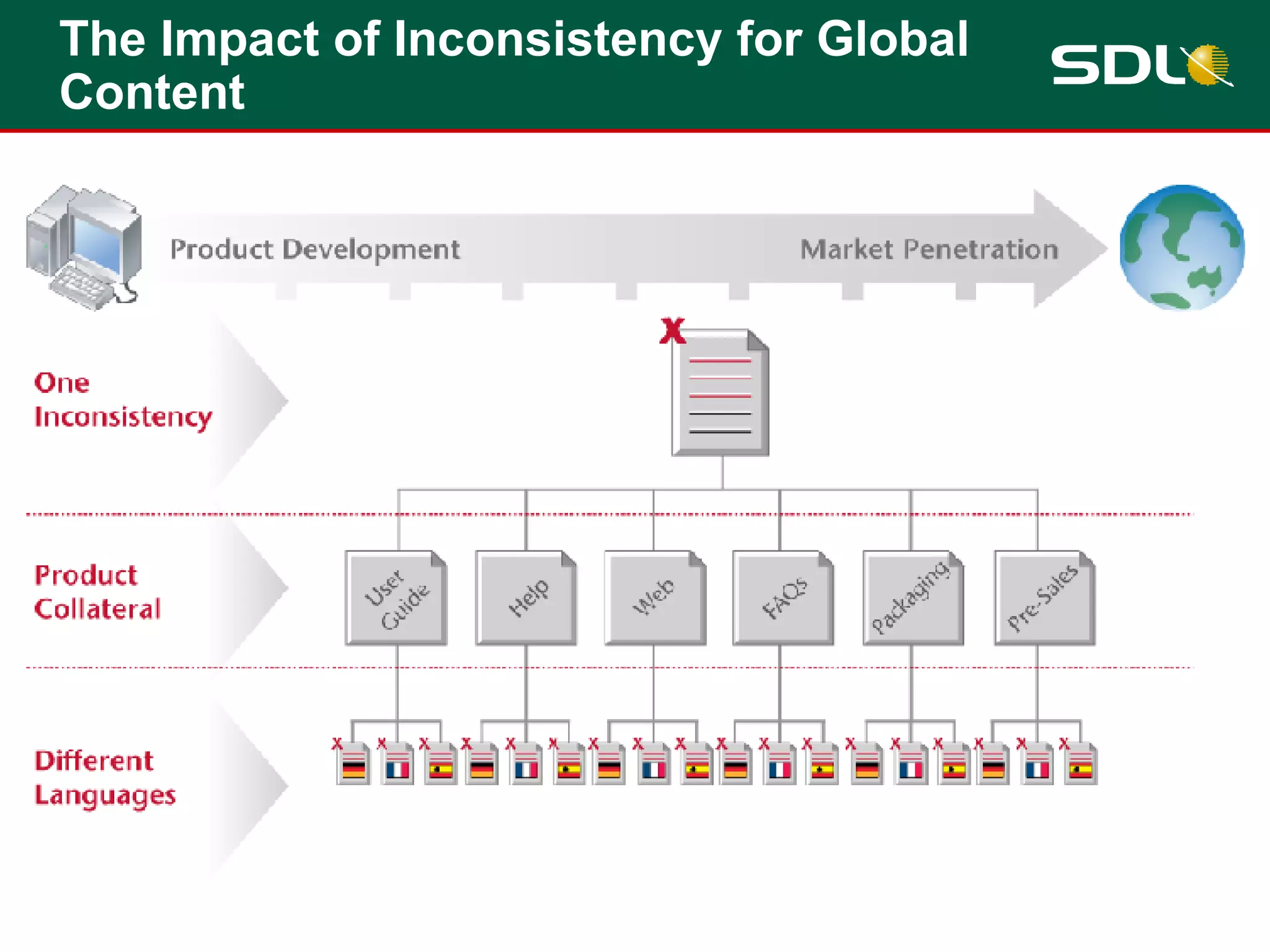
The Impact of Inconsistency for Global Content
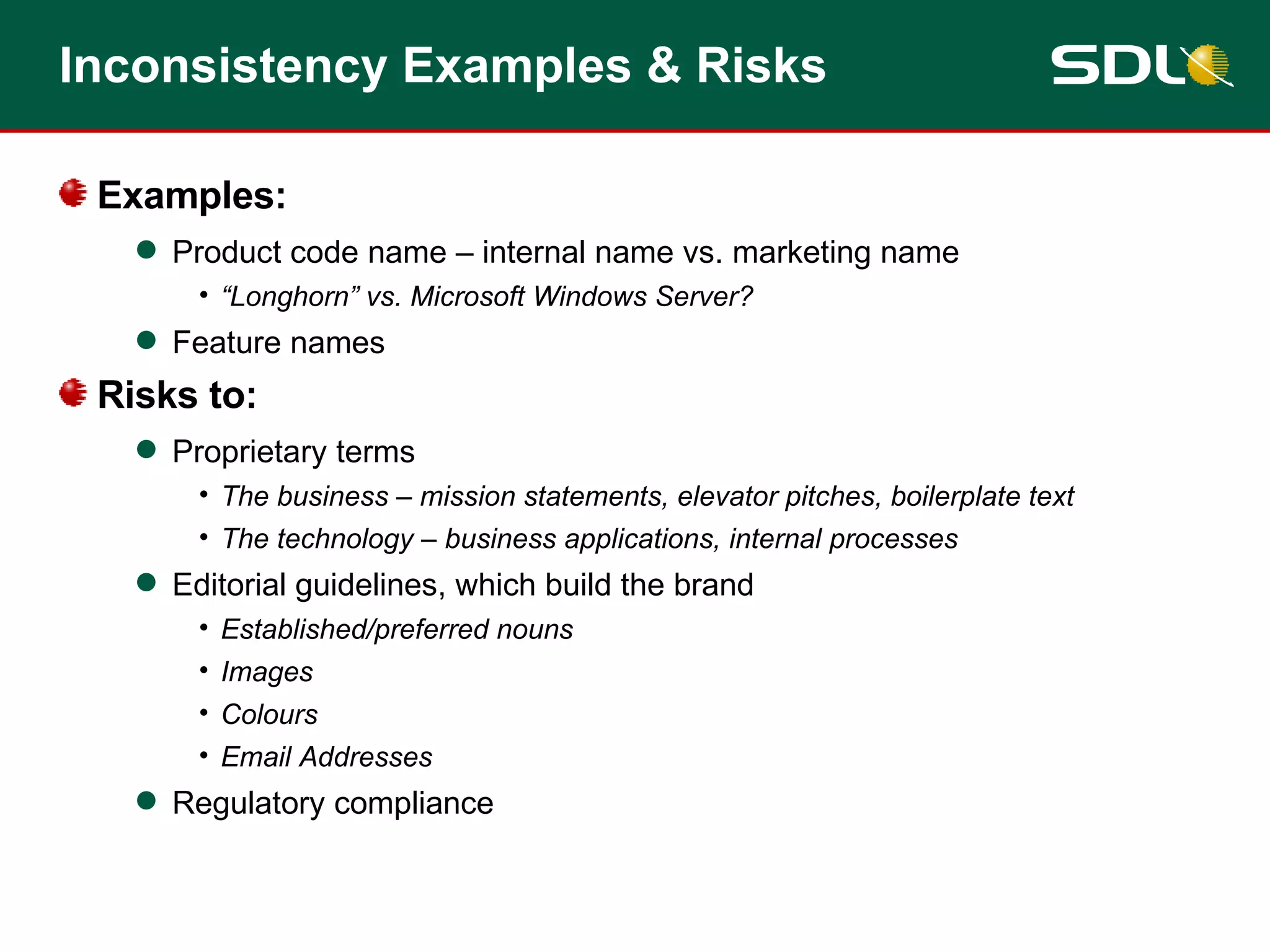
Examples: Product code name – internal name vs. marketing name “Longhorn” vs. Microsoft Windows Server? Feature names Risks to: Proprietary terms The business – mission statements, elevator pitches, boilerplate text The technology – business applications, internal processes Editorial guidelines, which build the brand Established/preferred nouns Images Colours Email Addresses Regulatory compliance Inconsistency Examples & Risks
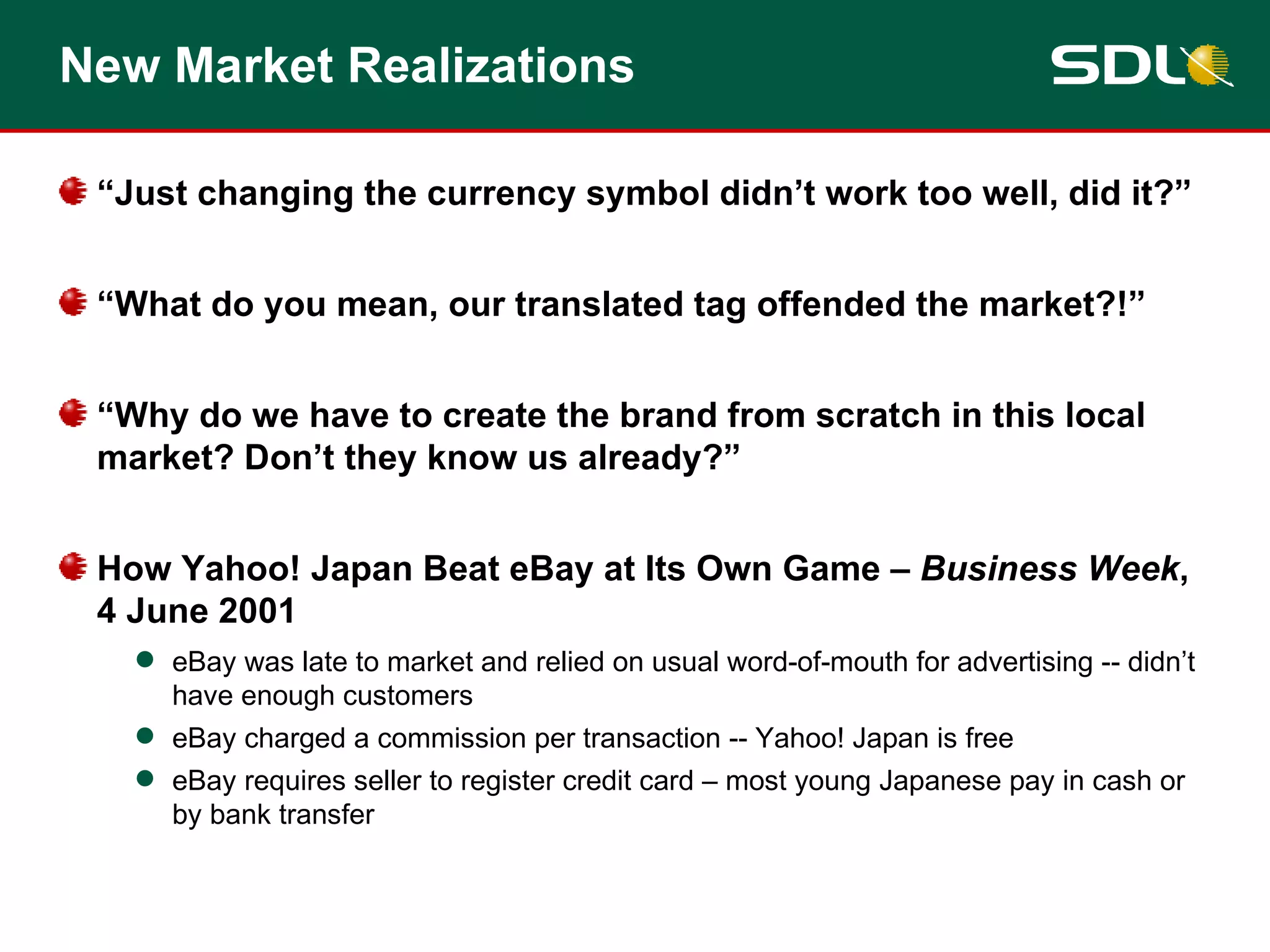
New Market Realizations “ Just changing the currency symbol didn’t work too well, did it?” “ What do you mean, our translated tag offended the market?!” “ Why do we have to create the brand from scratch in this local market? Don’t they know us already?” How Yahoo! Japan Beat eBay at Its Own Game –  Business Week , 4 June 2001 eBay was late to market and relied on usual word-of-mouth for advertising -- didn’t have enough customers eBay charged a commission per transaction -- Yahoo! Japan is free eBay requires seller to register credit card – most young Japanese pay in cash or by bank transfer
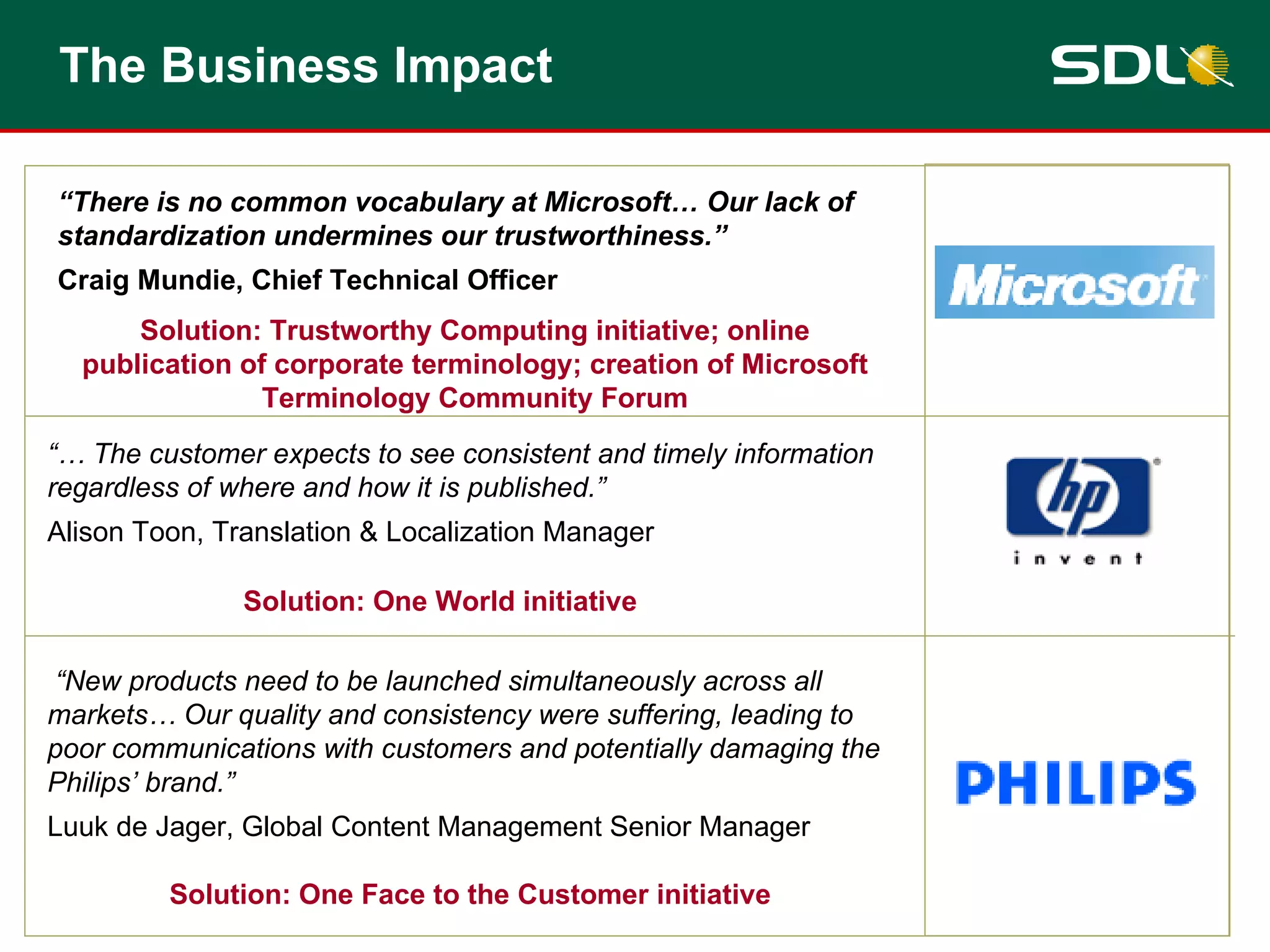
The Business Impact “ There is no common vocabulary at Microsoft… Our lack of standardization undermines our trustworthiness.”  Craig Mundie, Chief Technical Officer “…  The customer expects to see consistent and timely information regardless of where and how it is published.”   Alison Toon, Translation & Localization Manager “ New products need to be launched simultaneously across all markets… Our quality and consistency were suffering, leading to poor communications with customers and potentially damaging the Philips’ brand.”   Luuk de Jager, Global Content Management Senior Manager Solution: Trustworthy Computing initiative; online publication of corporate terminology; creation of Microsoft Terminology Community Forum Solution: One World initiative Solution: One Face to the Customer initiative
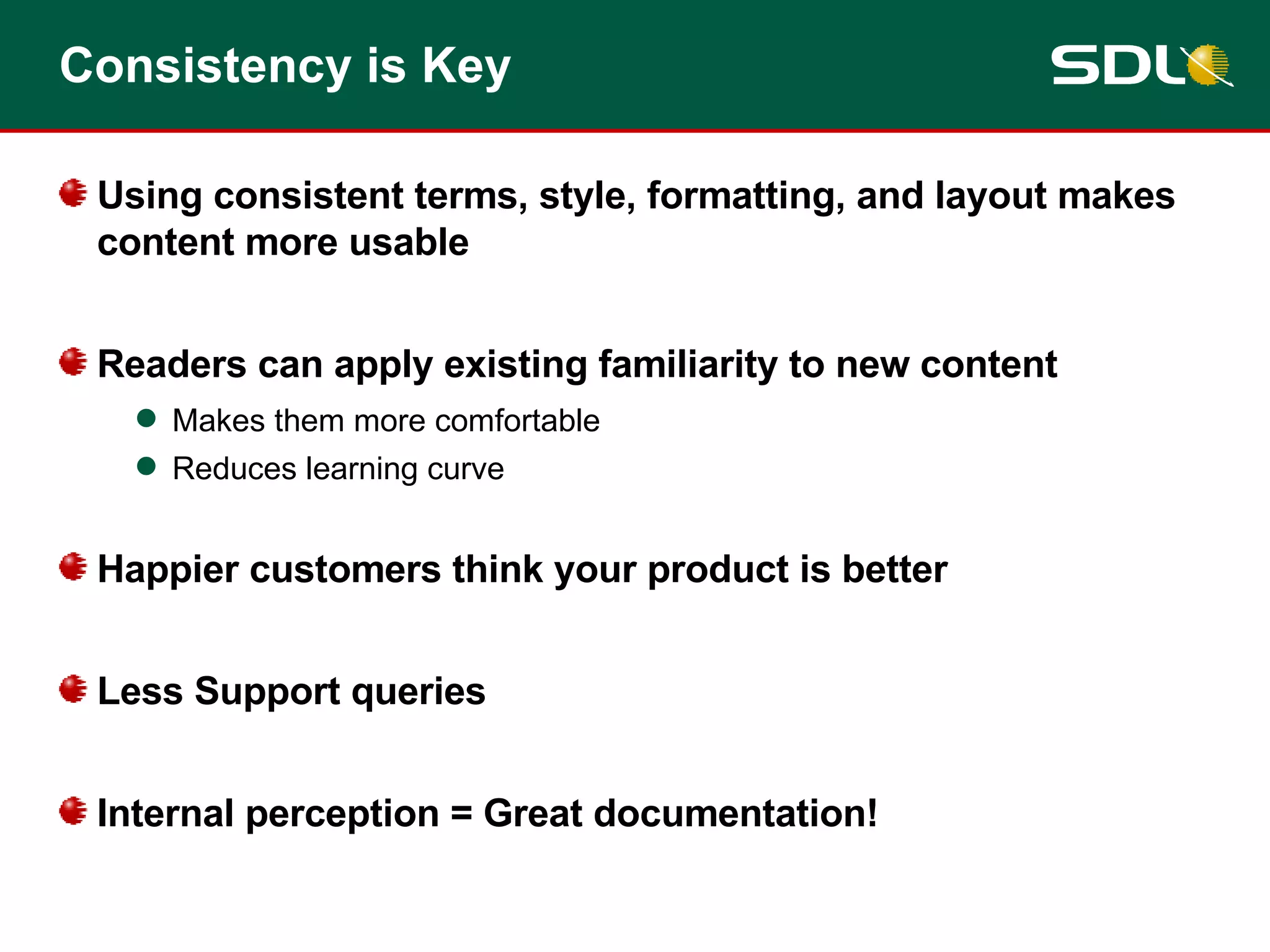
Consistency is Key Using consistent terms, style, formatting, and layout makes content more usable Readers can apply existing familiarity to new content Makes them more comfortable Reduces learning curve Happier customers think your product is better Less Support queries Internal perception = Great documentation!
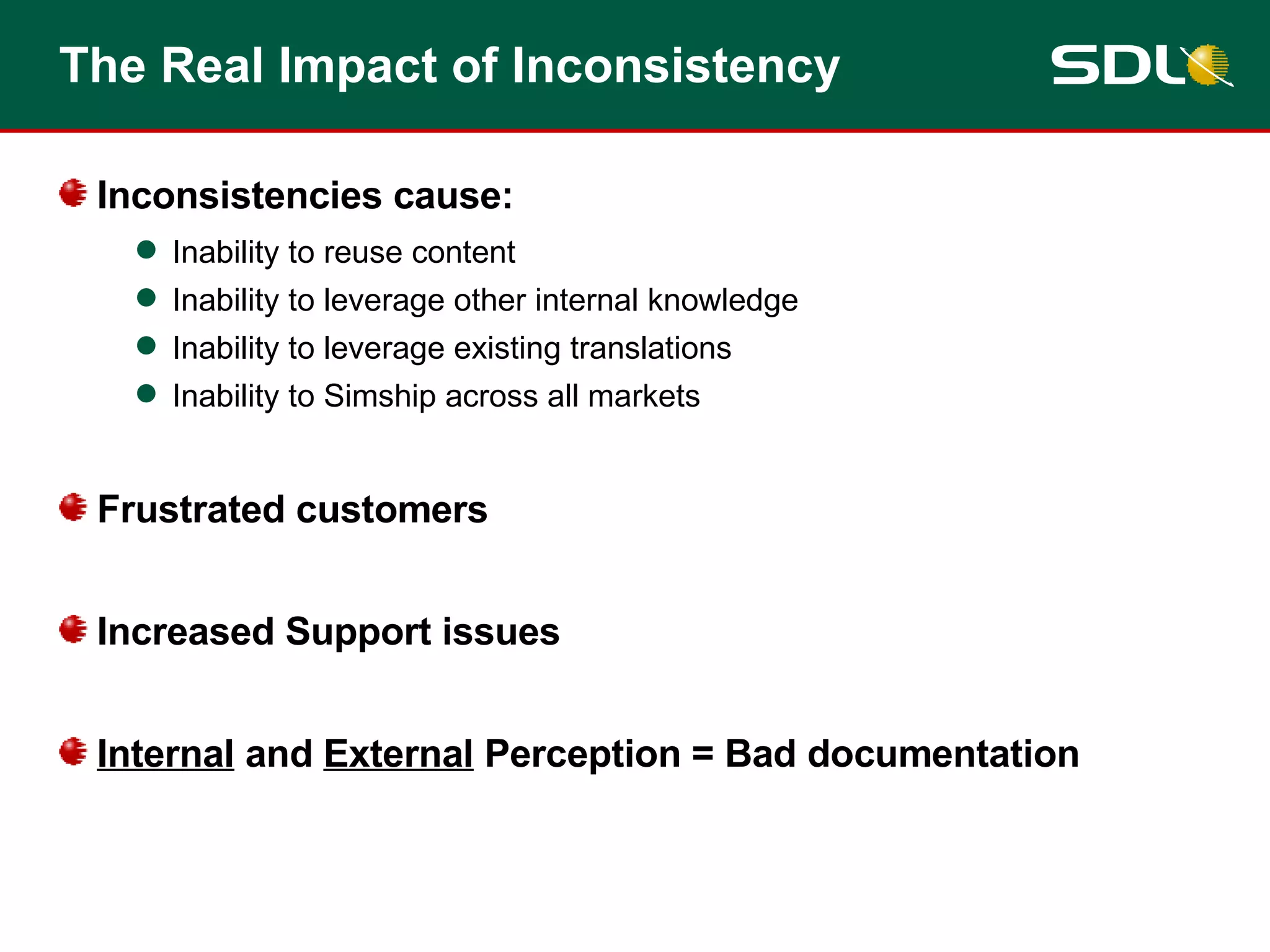
The Real Impact of Inconsistency Inconsistencies cause: Inability to reuse content Inability to leverage other internal knowledge Inability to leverage existing translations Inability to Simship across all markets Frustrated customers Increased Support issues Internal  and  External  Perception = Bad documentation
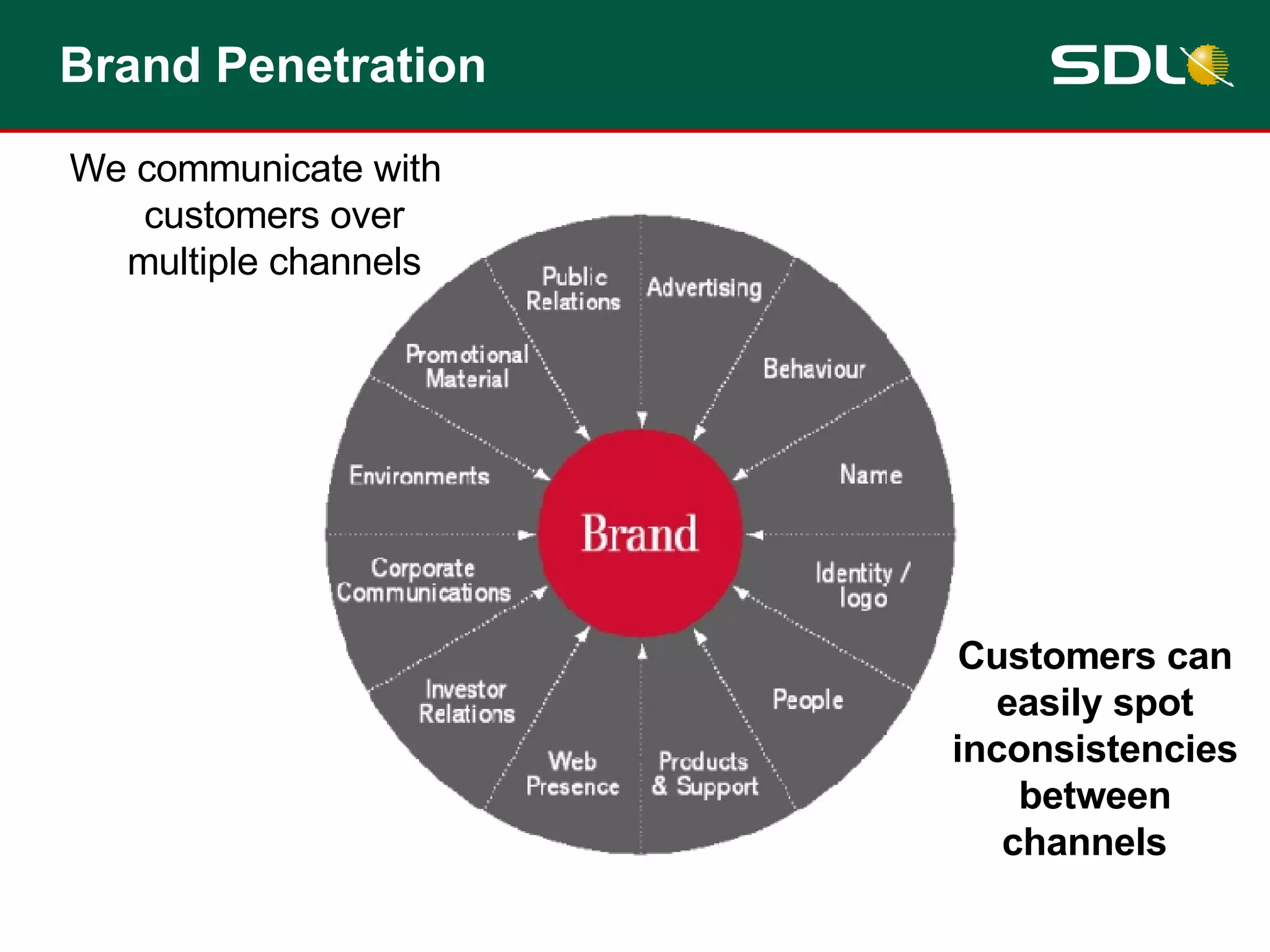
Brand Penetration We communicate with customers over multiple channels Customers can easily spot inconsistencies between channels
The Result of Inconsistency? Ineffective communications Inaccurate messaging Lack of cultural/local knowledge Brand perceived negatively Product/service/offering fails
Today’s Solutions for Managing Consistency Current best practice methods Content Management Systems (automated) Style guidelines manuals and websites (automated) Training (human) Ad hoc review (human) But consider… Increasing logistical difficulty of managing a global web presence Multiple CMS and other repositories Multiple editors, languages and locations worldwide Utilizing the power of local knowledge Empowerment with enforcement A framework, not a strait jacket
Centralization = Communication
Today’s Communication Challenges Increasing delivery channels Too much work to deliver/track Increases risk of errors Decreases content effectiveness Increasing content volumes Does ‘write once, reuse many times’ ever work? Higher translation costs Time-to-market pressures Production cycles are shortening Squeezes development & localization effort Source issues Don’t have access to all content sources required – no transparency Dependency on subject matter experts – busy and/or located elsewhere
Today’s Communication Challenges Content ownership Lost after publication Leaves content vulnerable Pressure to: Improve customer satisfaction Improve quality and consistency Accelerate time-to-market Do more with less resource Business silos of content creation Geographically separated resources No ability to share information or leverage other work
Content Creation Challenges Business silos of content creation Resources are separated General lack of ownership across the organization Terminology and content Pressure to do more with less Change is difficult No budget No visibility Process is lengthy Style guides are not integrated into business workflow Interrupts work
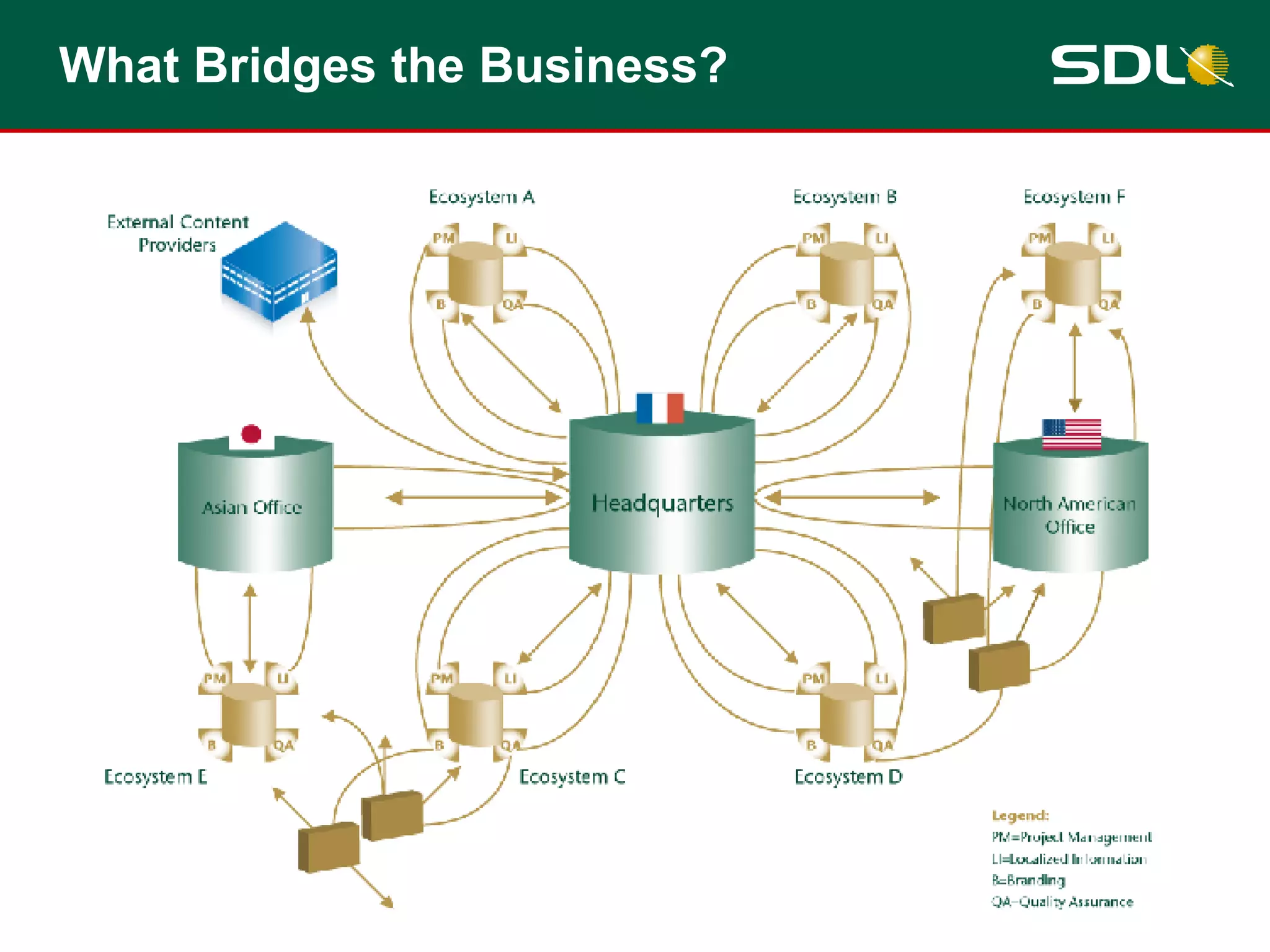
What Bridges the Business?
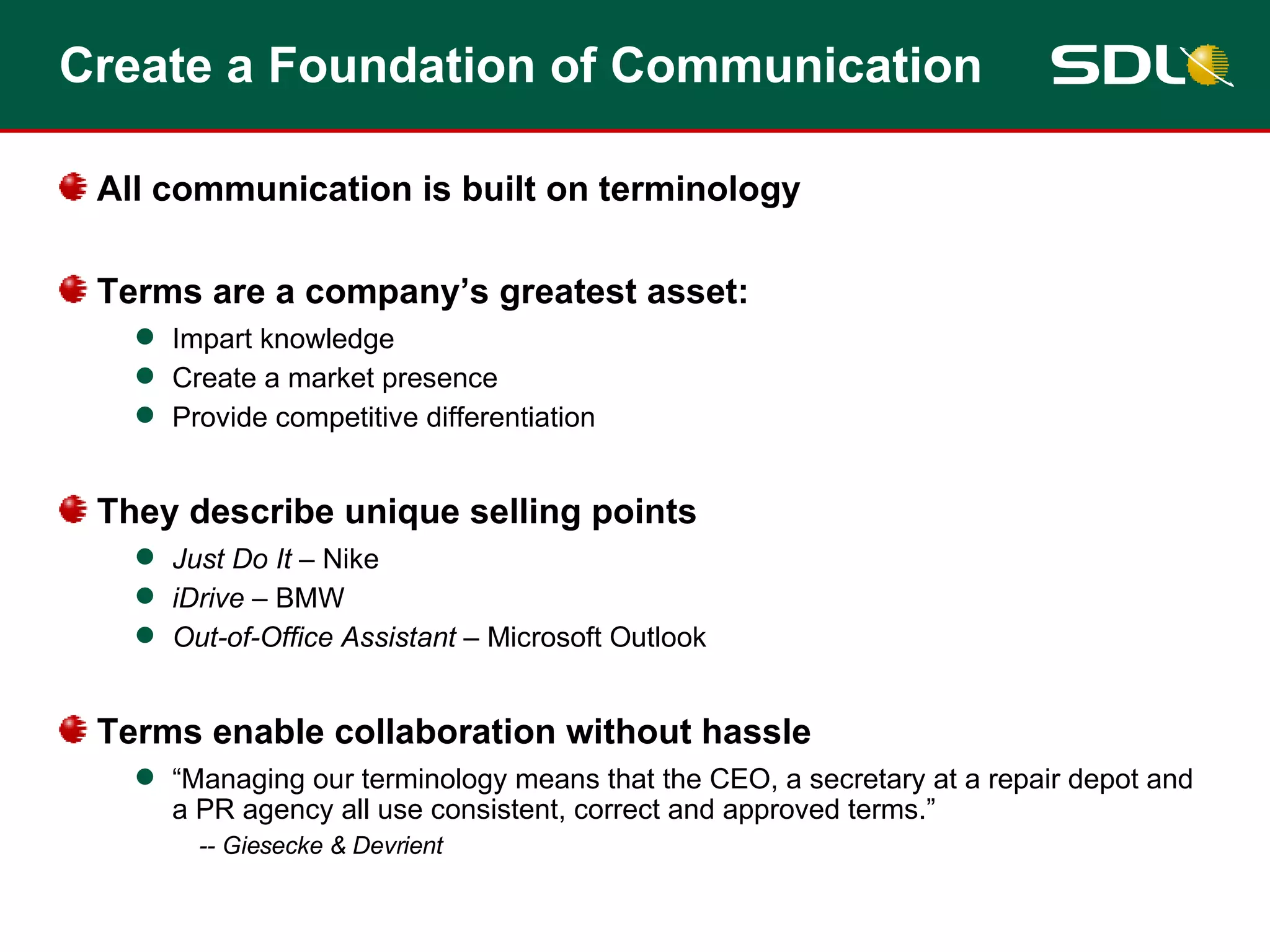
Create a Foundation of Communication All communication is built on terminology Terms are a company’s greatest asset: Impart knowledge  Create a market presence Provide competitive differentiation They describe unique selling points Just Do It  – Nike iDrive  – BMW Out-of-Office Assistant  – Microsoft Outlook Terms enable collaboration without hassle “ Managing our terminology means that the CEO, a secretary at a repair depot and a PR agency all use consistent, correct and approved terms.” -- Giesecke & Devrient
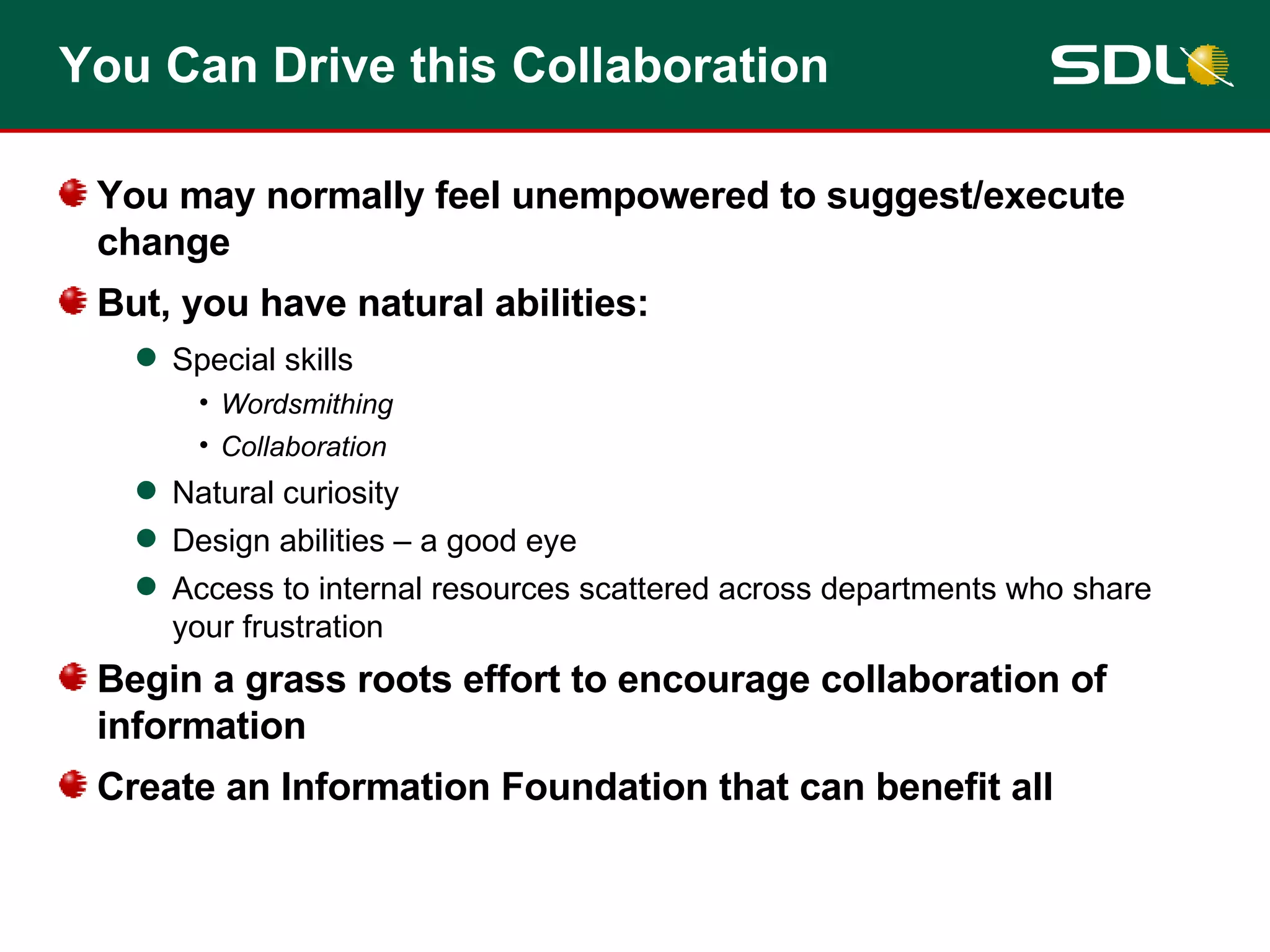
You Can Drive this Collaboration You may normally feel unempowered to suggest/execute change But, you have natural abilities: Special skills Wordsmithing Collaboration  Natural curiosity Design abilities – a good eye Access to internal resources scattered across departments who share your frustration Begin a grass roots effort to encourage collaboration of information Create an Information Foundation that can benefit all
A Case Study
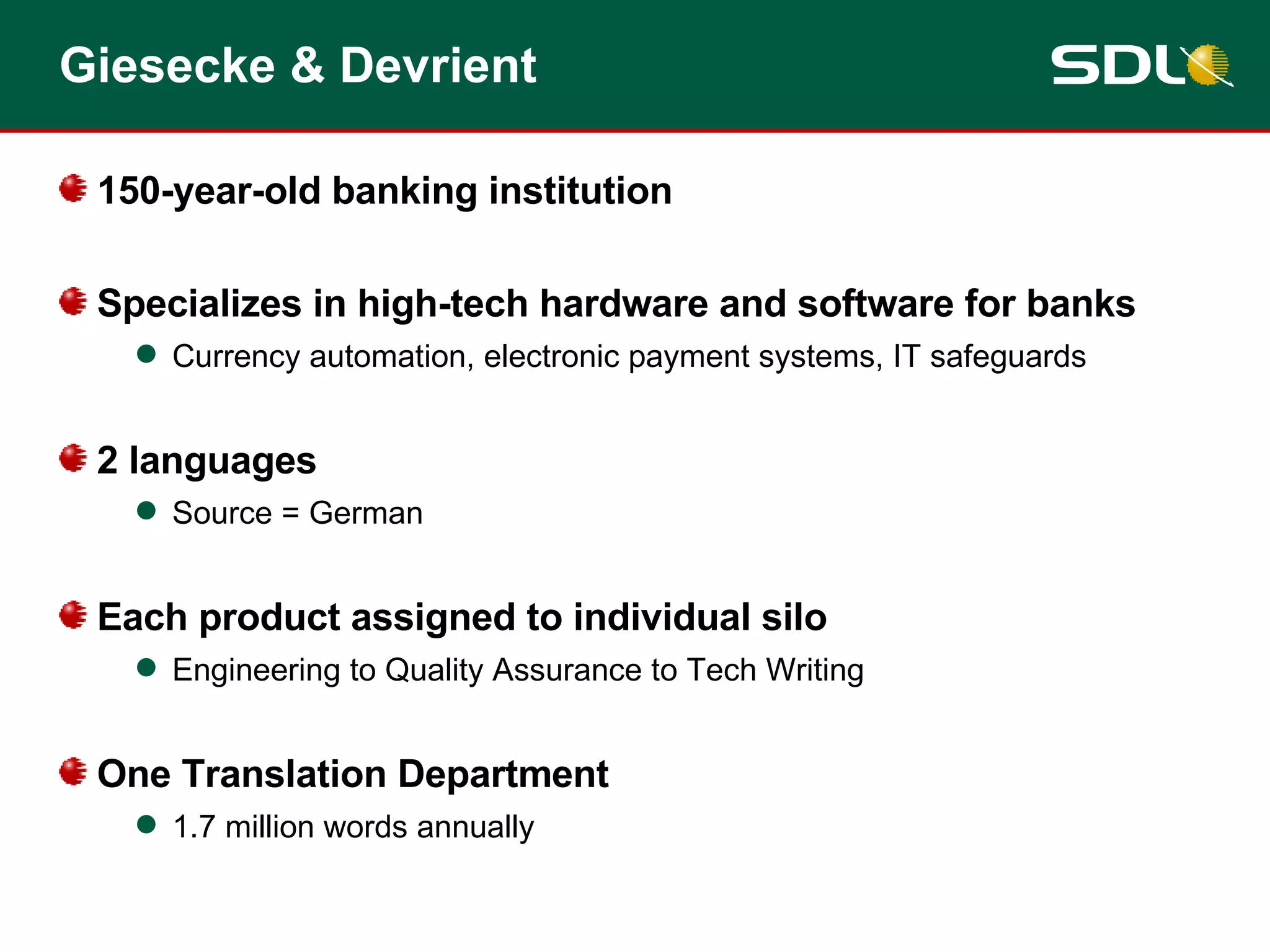
Giesecke & Devrient 150-year-old banking institution Specializes in high-tech hardware and software for banks Currency automation, electronic payment systems, IT safeguards 2 languages Source = German Each product assigned to individual silo Engineering to Quality Assurance to Tech Writing One Translation Department 1.7 million words annually
The Problem “Each time we started working on a new document, we found a new name for something or a different way to describe it than before.” References: 8 Word/Excel lists  Spare parts database Inconsistencies in these references Project delivery dates (and sanity) were suffering
The Solution Centralized the documentation teams Each writer was assigned to his own core competency to maintain expertise Incorporated Translation department into this group Internal collaboration achieved Centralized corporate terminology into a singular system Accessible to everyone in the organization Enabled quantification for how much each term costs for translation Standardized on a term management system where all term info and translations can reside Pushes correct term to translator during translation process Streamlines workflow
The Benefits “ We no longer have to continually double-check terminology. 30 seconds per term in a 300-page manual with 2 or 3 questions per page can add up to another day’s work.” Inter-departmental collaboration enabled Engineering began consulting the term system for new feature names Use of corporate-approved naming conventions 4,000+ movable parts – saved time and effort Cleansed German source language – increased customer satisfaction Unified style and language – increased customer satisfaction Combining multiple word lists – decreased overall number of terms Eliminated duplicate and unapproved terms 20,000+ terms today “ It helped us collaborate across a wider variety of topics and fields within the company.”
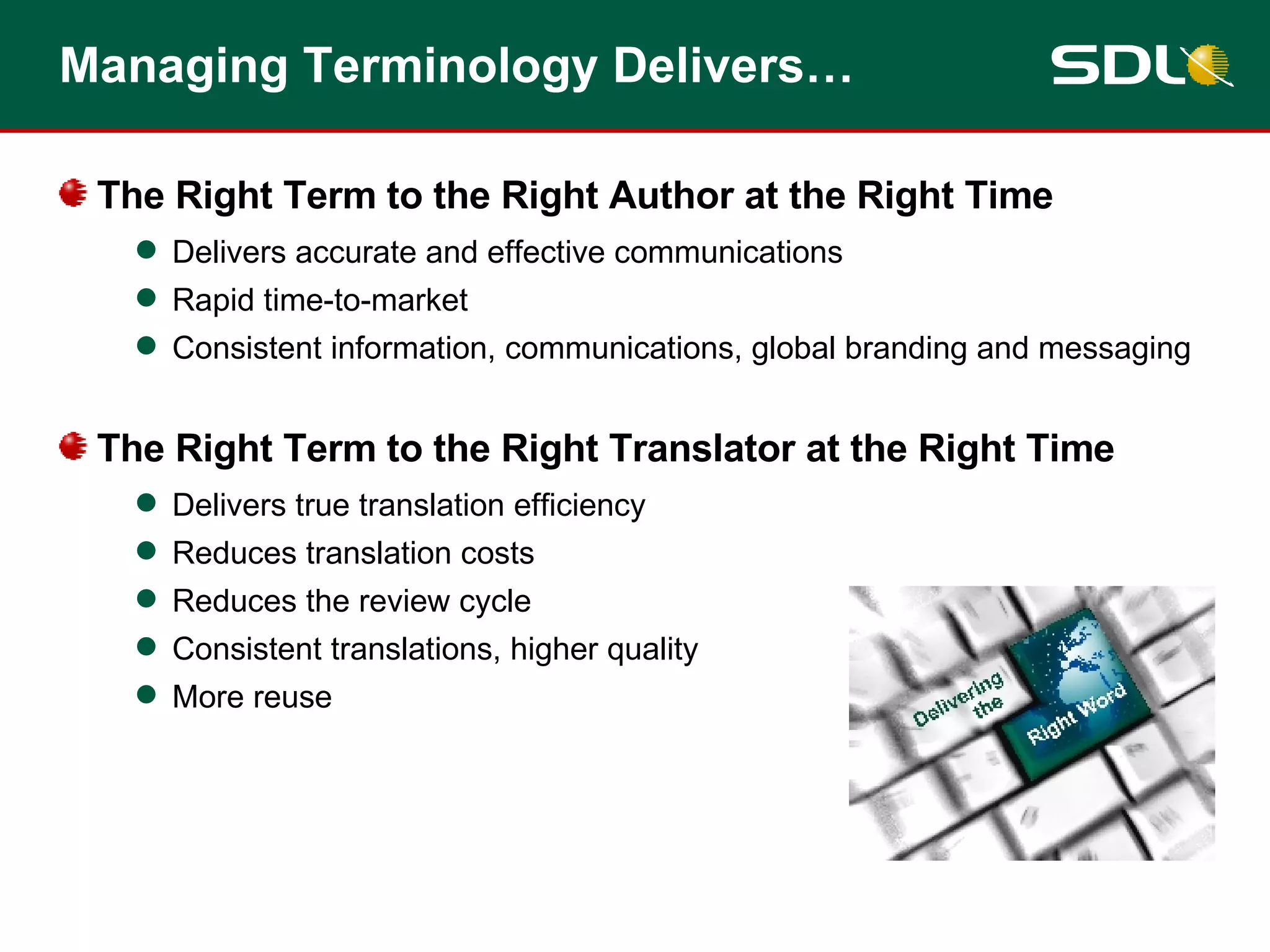
Managing Terminology Delivers… The Right Term to the Right Author at the Right Time Delivers accurate and effective communications Rapid time-to-market Consistent information, communications, global branding and messaging The Right Term to the Right Translator at the Right Time Delivers true translation efficiency Reduces translation costs Reduces the review cycle Consistent translations, higher quality More reuse
Thank you Christie Fidura [email_address] Copyright © 2007 SDL PLC. All rights reserved. SDL and the SDL Logo are trademarks or registered trademarks of SDL PLC or its affiliates in the U.S. and other countries.  Other names may be trademarks of their respective owners. This document is provided for informational purposes only and is not intended as advertising.  All warranties relating to the information in this document, either express or implied, are disclaimed to the maximum extent allowed by law.  The information in this document is subject to change without notice.

19 Oct07 Avoiding The Content Conveyor Belt Trap Enabling Interdepartmental Collaboration

  • 1.
  • 2.
    Christie Fidura SeniorProduct Marketing Manager for Terminology Solutions Avoiding the Content Conveyor Belt Trap: Enabling Interdepartmental Collaboration
  • 3.
    The Face ofBusiness has Changed Global trade is now de-facto Free-trade agreements and the internet People are more demanding in their requirements Immediacy is all around us Everything is faster in a non-stop world Technology is accelerating life Internet expansion fuels digital content growth – multi channel E-business Information publications Online support databases Coordinating the simultaneous delivery of information in multiple languages is complex Localized content in local language meeting local cultures If company selling into 10 countries, 90% of content will be in the local language Everyone speaks a different language It’s easier to do it in “my mother tongue”
  • 4.
    How many ofyou… Are invited to development meetings? Invite yourself to development meetings? Bribe developers for information? “ Borrow” functional specs off the printer? Are repeatedly asked for part/product/feature names clarifications from other departments? Get caught up in intra-departmental wars over corporate style and terminology? Have a 300-page style guide to follow? Worry about the state of other documents produced by your company?
  • 5.
    A well knowndialog box …
  • 6.
    “ Use the[Alt]+[P] {…} to …” hotkey hot key shortcut key keyboard shortcut access key accelerator key keyboard accelerator
  • 7.
    The Content ConveyorBelt Every department creates content using the same reference material Source content is passed from one group to another
  • 8.
    Efficiency is theDriver One business unit containing all resources dedicated to developing one product Process-related hierarchy Isolates individual functions into dedicated, high performance units Achieves maximum efficiency
  • 9.
    It’s Efficient, but…Each group uses the content in a different way Different formats Different delivery channels Different tone of voice Content which was produced for internal reference only is not ready for external consumption Content is vulnerable to modification Inconsistencies at the source affect all subsequent documents Chaos can result when globalization enters the picture…
  • 10.
    The Impact ofInconsistency for Global Content
  • 11.
    Examples: Product codename – internal name vs. marketing name “Longhorn” vs. Microsoft Windows Server? Feature names Risks to: Proprietary terms The business – mission statements, elevator pitches, boilerplate text The technology – business applications, internal processes Editorial guidelines, which build the brand Established/preferred nouns Images Colours Email Addresses Regulatory compliance Inconsistency Examples & Risks
  • 12.
    New Market Realizations“ Just changing the currency symbol didn’t work too well, did it?” “ What do you mean, our translated tag offended the market?!” “ Why do we have to create the brand from scratch in this local market? Don’t they know us already?” How Yahoo! Japan Beat eBay at Its Own Game – Business Week , 4 June 2001 eBay was late to market and relied on usual word-of-mouth for advertising -- didn’t have enough customers eBay charged a commission per transaction -- Yahoo! Japan is free eBay requires seller to register credit card – most young Japanese pay in cash or by bank transfer
  • 13.
    The Business Impact“ There is no common vocabulary at Microsoft… Our lack of standardization undermines our trustworthiness.” Craig Mundie, Chief Technical Officer “… The customer expects to see consistent and timely information regardless of where and how it is published.” Alison Toon, Translation & Localization Manager “ New products need to be launched simultaneously across all markets… Our quality and consistency were suffering, leading to poor communications with customers and potentially damaging the Philips’ brand.” Luuk de Jager, Global Content Management Senior Manager Solution: Trustworthy Computing initiative; online publication of corporate terminology; creation of Microsoft Terminology Community Forum Solution: One World initiative Solution: One Face to the Customer initiative
  • 14.
    Consistency is KeyUsing consistent terms, style, formatting, and layout makes content more usable Readers can apply existing familiarity to new content Makes them more comfortable Reduces learning curve Happier customers think your product is better Less Support queries Internal perception = Great documentation!
  • 15.
    The Real Impactof Inconsistency Inconsistencies cause: Inability to reuse content Inability to leverage other internal knowledge Inability to leverage existing translations Inability to Simship across all markets Frustrated customers Increased Support issues Internal and External Perception = Bad documentation
  • 16.
    Brand Penetration Wecommunicate with customers over multiple channels Customers can easily spot inconsistencies between channels
  • 17.
    The Result ofInconsistency? Ineffective communications Inaccurate messaging Lack of cultural/local knowledge Brand perceived negatively Product/service/offering fails
  • 18.
    Today’s Solutions forManaging Consistency Current best practice methods Content Management Systems (automated) Style guidelines manuals and websites (automated) Training (human) Ad hoc review (human) But consider… Increasing logistical difficulty of managing a global web presence Multiple CMS and other repositories Multiple editors, languages and locations worldwide Utilizing the power of local knowledge Empowerment with enforcement A framework, not a strait jacket
  • 19.
  • 20.
    Today’s Communication ChallengesIncreasing delivery channels Too much work to deliver/track Increases risk of errors Decreases content effectiveness Increasing content volumes Does ‘write once, reuse many times’ ever work? Higher translation costs Time-to-market pressures Production cycles are shortening Squeezes development & localization effort Source issues Don’t have access to all content sources required – no transparency Dependency on subject matter experts – busy and/or located elsewhere
  • 21.
    Today’s Communication ChallengesContent ownership Lost after publication Leaves content vulnerable Pressure to: Improve customer satisfaction Improve quality and consistency Accelerate time-to-market Do more with less resource Business silos of content creation Geographically separated resources No ability to share information or leverage other work
  • 22.
    Content Creation ChallengesBusiness silos of content creation Resources are separated General lack of ownership across the organization Terminology and content Pressure to do more with less Change is difficult No budget No visibility Process is lengthy Style guides are not integrated into business workflow Interrupts work
  • 23.
  • 24.
    Create a Foundationof Communication All communication is built on terminology Terms are a company’s greatest asset: Impart knowledge Create a market presence Provide competitive differentiation They describe unique selling points Just Do It – Nike iDrive – BMW Out-of-Office Assistant – Microsoft Outlook Terms enable collaboration without hassle “ Managing our terminology means that the CEO, a secretary at a repair depot and a PR agency all use consistent, correct and approved terms.” -- Giesecke & Devrient
  • 25.
    You Can Drivethis Collaboration You may normally feel unempowered to suggest/execute change But, you have natural abilities: Special skills Wordsmithing Collaboration Natural curiosity Design abilities – a good eye Access to internal resources scattered across departments who share your frustration Begin a grass roots effort to encourage collaboration of information Create an Information Foundation that can benefit all
  • 26.
  • 27.
    Giesecke & Devrient150-year-old banking institution Specializes in high-tech hardware and software for banks Currency automation, electronic payment systems, IT safeguards 2 languages Source = German Each product assigned to individual silo Engineering to Quality Assurance to Tech Writing One Translation Department 1.7 million words annually
  • 28.
    The Problem “Eachtime we started working on a new document, we found a new name for something or a different way to describe it than before.” References: 8 Word/Excel lists Spare parts database Inconsistencies in these references Project delivery dates (and sanity) were suffering
  • 29.
    The Solution Centralizedthe documentation teams Each writer was assigned to his own core competency to maintain expertise Incorporated Translation department into this group Internal collaboration achieved Centralized corporate terminology into a singular system Accessible to everyone in the organization Enabled quantification for how much each term costs for translation Standardized on a term management system where all term info and translations can reside Pushes correct term to translator during translation process Streamlines workflow
  • 30.
    The Benefits “We no longer have to continually double-check terminology. 30 seconds per term in a 300-page manual with 2 or 3 questions per page can add up to another day’s work.” Inter-departmental collaboration enabled Engineering began consulting the term system for new feature names Use of corporate-approved naming conventions 4,000+ movable parts – saved time and effort Cleansed German source language – increased customer satisfaction Unified style and language – increased customer satisfaction Combining multiple word lists – decreased overall number of terms Eliminated duplicate and unapproved terms 20,000+ terms today “ It helped us collaborate across a wider variety of topics and fields within the company.”
  • 31.
    Managing Terminology Delivers…The Right Term to the Right Author at the Right Time Delivers accurate and effective communications Rapid time-to-market Consistent information, communications, global branding and messaging The Right Term to the Right Translator at the Right Time Delivers true translation efficiency Reduces translation costs Reduces the review cycle Consistent translations, higher quality More reuse
  • 32.
    Thank you ChristieFidura [email_address] Copyright © 2007 SDL PLC. All rights reserved. SDL and the SDL Logo are trademarks or registered trademarks of SDL PLC or its affiliates in the U.S. and other countries.  Other names may be trademarks of their respective owners. This document is provided for informational purposes only and is not intended as advertising.  All warranties relating to the information in this document, either express or implied, are disclaimed to the maximum extent allowed by law.  The information in this document is subject to change without notice.