mu
A slow speed or medium speed
Diesel engine is a
high pressure propulsion plant
with internal combustion.
s
In a V-engine the cylinders are placed in an oblique (or bevel)
position, unlike the in-line engine, where the cylinders are
placed “in line”.
V-engine
In-line
engine
S
s
The cylinder is filled
with air.
S
During the
compression stroke
the air in the cylinder
is compressed.
The atomizer (1)
sprays the fuel into
the cylinder.
The nozzle
divides the fuel into
small particles.
1
S
atomizer
Tip of the atomizer
(nozzle).
During the
power stroke the
fuel is injected and
burnt.
This actuates the
piston (1) and
connecting rod (2).
1
2
The piston makes a
reciprocating motion.
Piston
The piston pin (1)
and the
crank pin (2)
are connected to
each other
by the
connecting rod (3).
S
1
2
3
The crank (1)
is connected to
the crankshaft (2).
S
1
2
S
The crank
changes the
reciprocating motion
of the piston into a
rotary motion
of the crank shaft .
Gearwheels
to drive the
camshaft (1)
are driven by chains (2)
(“chaindrive”).
S
1
2
camshaft
The campeak (1)
is fixed to the
camshaft (2).
S
2
1
The push rod (1)
may be used as a
distance piece
between campeak (2)
and rocker arm (3).
s
1
2
3
S
The exhaust valve (1)
is actuated (opened)
by the
rocking lever (2)
(rocker arm).
1 1
2
S
The exhaust valve (1)
is actuated (closed)
by the
exhaust valve spring (2).
12
S
The scavenging air
manifold (1)
and
scavenging ports (2)
supply the
scavenging air
to remove the
exhaust gases.
1
2
S
SCAVENGING SYSTEMS
CROSS
SCAVENGING
LOOP
SCAVENGING
UNIFLOW
SCAVENGING
S
The cylinder liner (1)
and cylinder jacket (2)
form the cylinder wall.
1
2
Cooling the cylinder:
A coolant (fresh water)
is injected between
liner and jacket
to cool the cylinder.
s
Cooling the cylinder:
s
Cooling the piston:
The advantages of oil as
a coolant are:
. it reduces noise;
. it purifies;
. it forms a seal;
. it lubricates;
. it is anti-corrosive;
. it has a higher resistance
to heat.
The piston is cooled by oil.
SO
The piston rings (1)
form a seal around the
cylinder and
carry away the heat.
1
Piston rings
SS
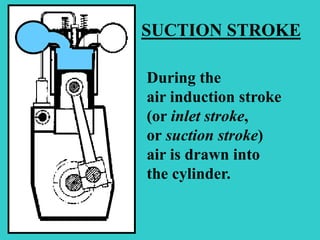
SUCTION STROKE
During the
air induction stroke
(or inlet stroke,
or suction stroke)
air is drawn into
the cylinder.
SS
COMPRESSION
STROKE
During the
compression stroke
the air in the cylinder
is compressed.
SS
POWER STROKE.
During the
power stroke
fuel is injected
and burnt.
SS
EXHAUST STROKE
During the
exhaust stroke
the exhaust gases are
driven out of
the cylinder by
the piston.
C P.C. van Kluijven
SHIPPING AND TRANSPORT COLLEGE ROTTERDAM

19 diesel engines