GUN DYNAMICS
The 3 Round Burst:
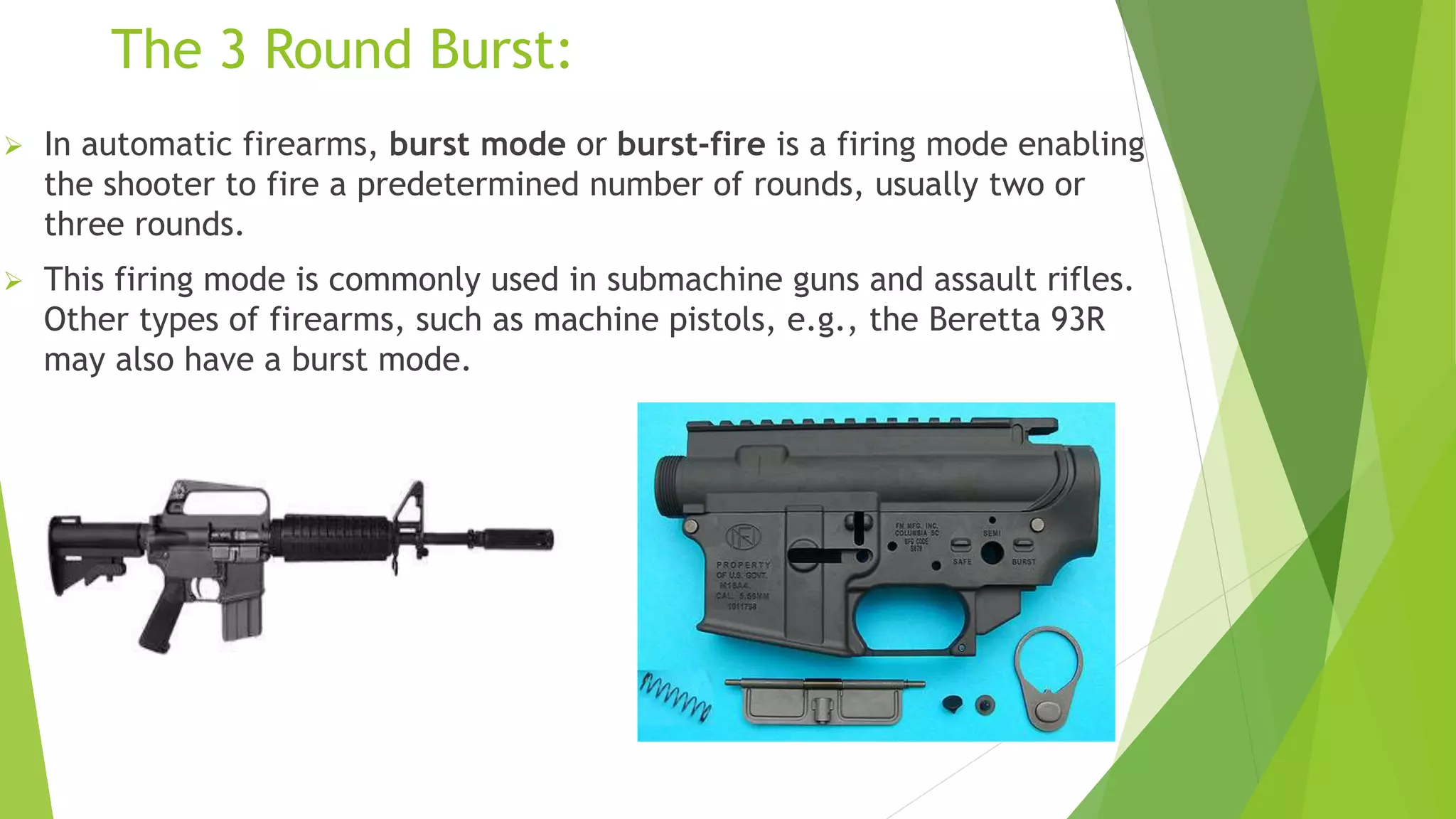
 In automatic firearms, burst mode or burst-fire is a firing mode enabling
the shooter to fire a predetermined number of rounds, usually two or
three rounds.
 This firing mode is commonly used in submachine guns and assault rifles.
Other types of firearms, such as machine pistols, e.g., the Beretta 93R
may also have a burst mode.
How Does it Work?
 The 3 round burst has a simple mechanism that involves the use of a
cam and a rachet mechanism.
 A ratchet is a mechanical device that allows continuous linear or
rotary motion in only one direction while preventing motion in the
opposite direction.
 The cylinder rotates with the concept of Ratchet and Pawl
Mechanism.
 As the trigger moves backwards, a pawl attached to the trigger
pushes on a ratchet to rotate the cylinder. This positions the
next breech chamber in front of the gun barrel.
 Another pawl lodges in a small depression on the cylinder. This
stops the cylinder in a particular position so it is perfectly lined
up with the barrel.
Cylinder Rotation Mechanism:
GATLING GUN
1862 & 1865 MODEL
PARTS OF 1862 MODEL
WORKING
 The Gatling gun consists of an assembly of six barrels, a carrier,
lock-cylinder and cog wheel all fixed to a central shaft so that
they rotate together when a pinion wheel is turned by a hand
crank on the right rear side of the gun. The lock-cylinder is
bored to hold six locks that are free to move within the lock
cylinder. Each lock contains a spring-loaded firing hammer,
which has a tenon extending up through a slot in the lock
cylinder and which rests against a ring cut with an inclined
plane (yellow in diagram).
 As the assembly is rotated the carrier picks up a loaded
cartridge-chamber from the hopper. Then, as the assembly
approaches the top-most point (the 12 o'clock position) the
tenon on the firing pin is pushed back by the inclined plane,
thereby compressing the firing spring.
 The solid bulkhead (red) at the rear of the lock cylinder is made strong
enough to absorb the recoil from each shot. A steel plug or wedge (green) is
fitted into this bulkhead so that when the lock approaches the 12 o'clock
position, the rounded rear of a lock rides up on the wedge, and the lock
moves forwards. As it does so, it pushes the loaded cartridge-cylinder hard
up against the rear of the barrel to make an (almost) gas-tight seal.
 The hammer is released, and it moves forward to strike the percussion cap
(or in the second model, to crush the rim of the rim-fire cartridge) and the
round is fired.
 As the assembly continues to rotate, the lock moves off the plug and is
withdrawn by a spring. A second inclined plane is cut into the ring to pull the
hammer back to disengage it from the rear of the cartridge-chamber. This
leaves the fired cartridge-cylinder free to fall from the carrier to the ground.
In case it sticks, a pair of arms, or comb, are attached on the left side of the
frame to force it out of the carrier.
SPRING OPERATED MAGAZINES
AK-47 AMT Hardballer 1911 Mossberg
Patriot/4×4 rifle
magazine
MAGAZINE:
A magazine is an ammunition storage and feeding device within or attached
to a repeating firearm. Magazines can be removable (detachable) or integral
(internal/fixed) to the firearm. The magazine functions by moving the
cartridges stored within it into a position where they may be loaded into the
barrel chamber by the action of the firearm. The detachable magazine is
often colloquially referred to as a clip, although this is technically
inaccurate.
Magazines come in many shapes and sizes, from tubular magazines on lever-
action riflesthat hold only a few rounds, to detachable box and drum
magazines for automatic rifles and machine guns that can hold more than
one hundred rounds. Various jurisdictions ban what they define as "high-
capacity magazines".
Magazine Spring:
A compression spring with oval or rectangular shaped coils placed inside of the
magazine or charger of a firearm. A magazine springs function is to push up the
bullets or rounds to be placed into the chamber.
Magazine springs are typical for most guns but certain types of
firearms require different lengths, forces, and amount of coils. Take
a rifle and a hand gun for example. Certain rifles have longer
magazines or chargers than a usual hand gun. This means that the
magazine spring in the rifle will be longer than that of a hand gun and
will probably have some other dimensional differences in design.
Other differences may apply on different firearms depending on how
the magazine spring will be positioned and how much rate and travel
it will need.
BUMP FIRE STOCK
 Bump fire is the act of using the recoil of a semi-automatic firearm or
revolver to fire shots in rapid succession at the cost of accuracy of
individual shots.
 Bump fire stocks are gunstocks that are specially designed to make bump
firing easier, which assist semi-automatic firearms with somewhat
mimicking the firing motion of fully automatic weapons but does not
make the firearm automatic.
How Does it work?
1
2
3
4
 Bump stocks assist rapid fire by "throwing" the trigger against
one's finger (as opposed to one's finger pulling on the trigger) thus
allowing the firearm's recoil to actuate the trigger.
 Bump fire stocks can be placed on a few common weapon
platforms such as the AR or AK families. They can achieve rates of
fire between 400 and 500 rounds per minute depending on the
gun.
THANKYOU
BY: SHREYASH BOMPILWAR 206451
SHUBHAM SABHU 206460
SHREEJIT NAGORI 206452
SHIVAM TRIPATHY 206448
SHRADDHEY MATTE 206449

Gun dynamics

  • 1.
  • 2.
    The 3 RoundBurst:  In automatic firearms, burst mode or burst-fire is a firing mode enabling the shooter to fire a predetermined number of rounds, usually two or three rounds.  This firing mode is commonly used in submachine guns and assault rifles. Other types of firearms, such as machine pistols, e.g., the Beretta 93R may also have a burst mode.
  • 3.
    How Does itWork?  The 3 round burst has a simple mechanism that involves the use of a cam and a rachet mechanism.  A ratchet is a mechanical device that allows continuous linear or rotary motion in only one direction while preventing motion in the opposite direction.
  • 6.
     The cylinderrotates with the concept of Ratchet and Pawl Mechanism.  As the trigger moves backwards, a pawl attached to the trigger pushes on a ratchet to rotate the cylinder. This positions the next breech chamber in front of the gun barrel.  Another pawl lodges in a small depression on the cylinder. This stops the cylinder in a particular position so it is perfectly lined up with the barrel. Cylinder Rotation Mechanism:
  • 8.
  • 9.
  • 10.
    WORKING  The Gatlinggun consists of an assembly of six barrels, a carrier, lock-cylinder and cog wheel all fixed to a central shaft so that they rotate together when a pinion wheel is turned by a hand crank on the right rear side of the gun. The lock-cylinder is bored to hold six locks that are free to move within the lock cylinder. Each lock contains a spring-loaded firing hammer, which has a tenon extending up through a slot in the lock cylinder and which rests against a ring cut with an inclined plane (yellow in diagram).  As the assembly is rotated the carrier picks up a loaded cartridge-chamber from the hopper. Then, as the assembly approaches the top-most point (the 12 o'clock position) the tenon on the firing pin is pushed back by the inclined plane, thereby compressing the firing spring.
  • 11.
     The solidbulkhead (red) at the rear of the lock cylinder is made strong enough to absorb the recoil from each shot. A steel plug or wedge (green) is fitted into this bulkhead so that when the lock approaches the 12 o'clock position, the rounded rear of a lock rides up on the wedge, and the lock moves forwards. As it does so, it pushes the loaded cartridge-cylinder hard up against the rear of the barrel to make an (almost) gas-tight seal.  The hammer is released, and it moves forward to strike the percussion cap (or in the second model, to crush the rim of the rim-fire cartridge) and the round is fired.  As the assembly continues to rotate, the lock moves off the plug and is withdrawn by a spring. A second inclined plane is cut into the ring to pull the hammer back to disengage it from the rear of the cartridge-chamber. This leaves the fired cartridge-cylinder free to fall from the carrier to the ground. In case it sticks, a pair of arms, or comb, are attached on the left side of the frame to force it out of the carrier.
  • 13.
    SPRING OPERATED MAGAZINES AK-47AMT Hardballer 1911 Mossberg Patriot/4×4 rifle magazine
  • 14.
    MAGAZINE: A magazine isan ammunition storage and feeding device within or attached to a repeating firearm. Magazines can be removable (detachable) or integral (internal/fixed) to the firearm. The magazine functions by moving the cartridges stored within it into a position where they may be loaded into the barrel chamber by the action of the firearm. The detachable magazine is often colloquially referred to as a clip, although this is technically inaccurate. Magazines come in many shapes and sizes, from tubular magazines on lever- action riflesthat hold only a few rounds, to detachable box and drum magazines for automatic rifles and machine guns that can hold more than one hundred rounds. Various jurisdictions ban what they define as "high- capacity magazines".
  • 15.
    Magazine Spring: A compressionspring with oval or rectangular shaped coils placed inside of the magazine or charger of a firearm. A magazine springs function is to push up the bullets or rounds to be placed into the chamber. Magazine springs are typical for most guns but certain types of firearms require different lengths, forces, and amount of coils. Take a rifle and a hand gun for example. Certain rifles have longer magazines or chargers than a usual hand gun. This means that the magazine spring in the rifle will be longer than that of a hand gun and will probably have some other dimensional differences in design. Other differences may apply on different firearms depending on how the magazine spring will be positioned and how much rate and travel it will need.
  • 16.
    BUMP FIRE STOCK Bump fire is the act of using the recoil of a semi-automatic firearm or revolver to fire shots in rapid succession at the cost of accuracy of individual shots.  Bump fire stocks are gunstocks that are specially designed to make bump firing easier, which assist semi-automatic firearms with somewhat mimicking the firing motion of fully automatic weapons but does not make the firearm automatic.
  • 17.
    How Does itwork? 1 2 3 4
  • 18.
     Bump stocksassist rapid fire by "throwing" the trigger against one's finger (as opposed to one's finger pulling on the trigger) thus allowing the firearm's recoil to actuate the trigger.  Bump fire stocks can be placed on a few common weapon platforms such as the AR or AK families. They can achieve rates of fire between 400 and 500 rounds per minute depending on the gun.
  • 20.
    THANKYOU BY: SHREYASH BOMPILWAR206451 SHUBHAM SABHU 206460 SHREEJIT NAGORI 206452 SHIVAM TRIPATHY 206448 SHRADDHEY MATTE 206449