180 rules and Continuity editing

By: Destinee and Reginald
180 degree rule
•

•

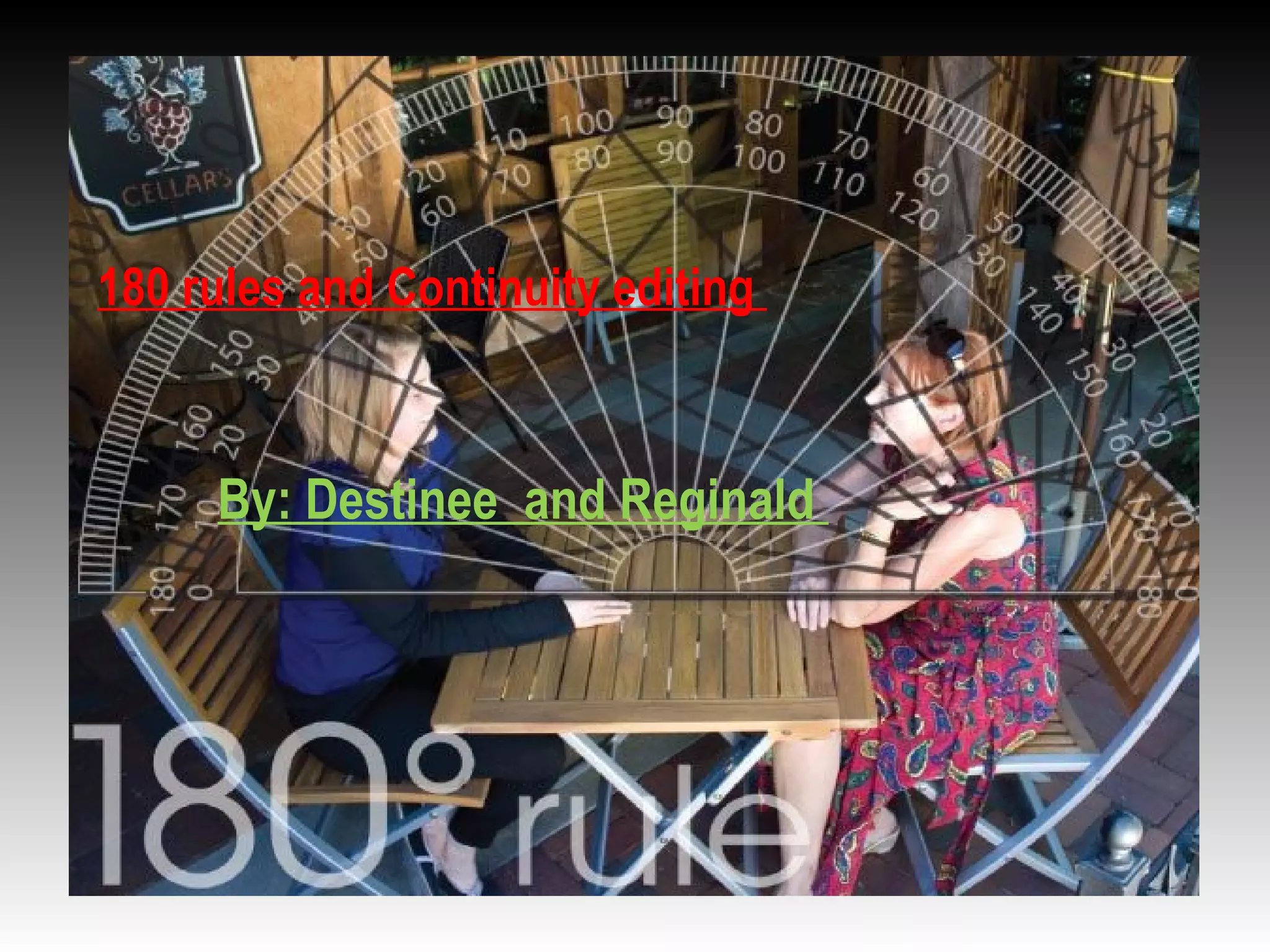
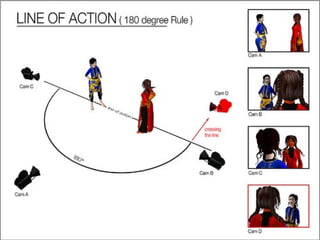
The rule states the camera(s) should remain the Same side of an imaginary
line. The line Is drawn perpendicular to the camera’s viewpoint in the
establishing shot of the film.
The rule enforces continuity of the film
Never break the rule.
•

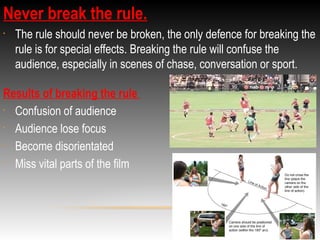
The rule should never be broken, the only defence for breaking the
rule is for special effects. Breaking the rule will confuse the
audience, especially in scenes of chase, conversation or sport.

Results of breaking the rule
•
Confusion of audience
•
Audience lose focus
•
Become disorientated
•
Miss vital parts of the film
CONTIUITY EDITING
•

•

Continuity editing is the predominant style of film editing and video editing in the postproduction process of filmmaking of narrative films and television programs. The purpose of
continuity editing is to smooth over the inherent discontinuity of the editing process and to
establish a logical coherence between shots.
In most films, logical coherence is achieved by cutting to continuity, which emphasizes
smooth transition of time and space.
Common techniques of continuity editing
Continuity editing can be divided into two categories: temporal continuity and spatial

continuity.
An ellipsis: is an apparent break in natural time continuity as it is implied in the
film's story
Diegetic sound: is that which is to have actually occurred within the story during the action
being viewed. It is sound that comes from within the narrative world of a film (including off-screen
sound). Continuous diegetic sound helps to smooth temporally questionable cuts by overlapping
the shots

Match on action: technique can preserve temporal continuity where there is a uniform,
unrepeated physical motion or change within a passage. A match on action is when some action
occurring before the temporally questionable cut is picked up where the cut left it by the shot
immediately following. For example, a shot of someone tossing a ball can be edited to show two
different views, while maintaining temporal continuity by being sure that the second shot shows
the arm of the subject in the same stage of its motion as it was left when cutting from the first
shot.
•

•

The establishing shot is one that provides a view of all the space in
which the action is occurring. Its theory is that it is difficult for a viewer to
become disoriented when all the story space is presented before him. The
establishing shot can be used at any time as a re-establishing shot. This
might be necessary when a complex sequence of cuts may have served to
disorient the viewer.
One way of preventing viewer disorientation in editing is to adhere to the 180
degree rule.

180 rules and continuity editing

  • 1.
    180 rules andContinuity editing By: Destinee and Reginald
  • 2.
    180 degree rule • • Therule states the camera(s) should remain the Same side of an imaginary line. The line Is drawn perpendicular to the camera’s viewpoint in the establishing shot of the film. The rule enforces continuity of the film
  • 4.
    Never break therule. • The rule should never be broken, the only defence for breaking the rule is for special effects. Breaking the rule will confuse the audience, especially in scenes of chase, conversation or sport. Results of breaking the rule • Confusion of audience • Audience lose focus • Become disorientated • Miss vital parts of the film
  • 5.
    CONTIUITY EDITING • • Continuity editingis the predominant style of film editing and video editing in the postproduction process of filmmaking of narrative films and television programs. The purpose of continuity editing is to smooth over the inherent discontinuity of the editing process and to establish a logical coherence between shots. In most films, logical coherence is achieved by cutting to continuity, which emphasizes smooth transition of time and space.
  • 6.
    Common techniques ofcontinuity editing Continuity editing can be divided into two categories: temporal continuity and spatial continuity. An ellipsis: is an apparent break in natural time continuity as it is implied in the film's story Diegetic sound: is that which is to have actually occurred within the story during the action being viewed. It is sound that comes from within the narrative world of a film (including off-screen sound). Continuous diegetic sound helps to smooth temporally questionable cuts by overlapping the shots Match on action: technique can preserve temporal continuity where there is a uniform, unrepeated physical motion or change within a passage. A match on action is when some action occurring before the temporally questionable cut is picked up where the cut left it by the shot immediately following. For example, a shot of someone tossing a ball can be edited to show two different views, while maintaining temporal continuity by being sure that the second shot shows the arm of the subject in the same stage of its motion as it was left when cutting from the first shot.
  • 7.
    • • The establishing shotis one that provides a view of all the space in which the action is occurring. Its theory is that it is difficult for a viewer to become disoriented when all the story space is presented before him. The establishing shot can be used at any time as a re-establishing shot. This might be necessary when a complex sequence of cuts may have served to disorient the viewer. One way of preventing viewer disorientation in editing is to adhere to the 180 degree rule.