17th Century
(1625 – 1700)
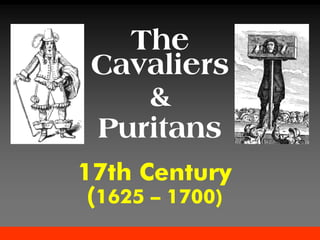
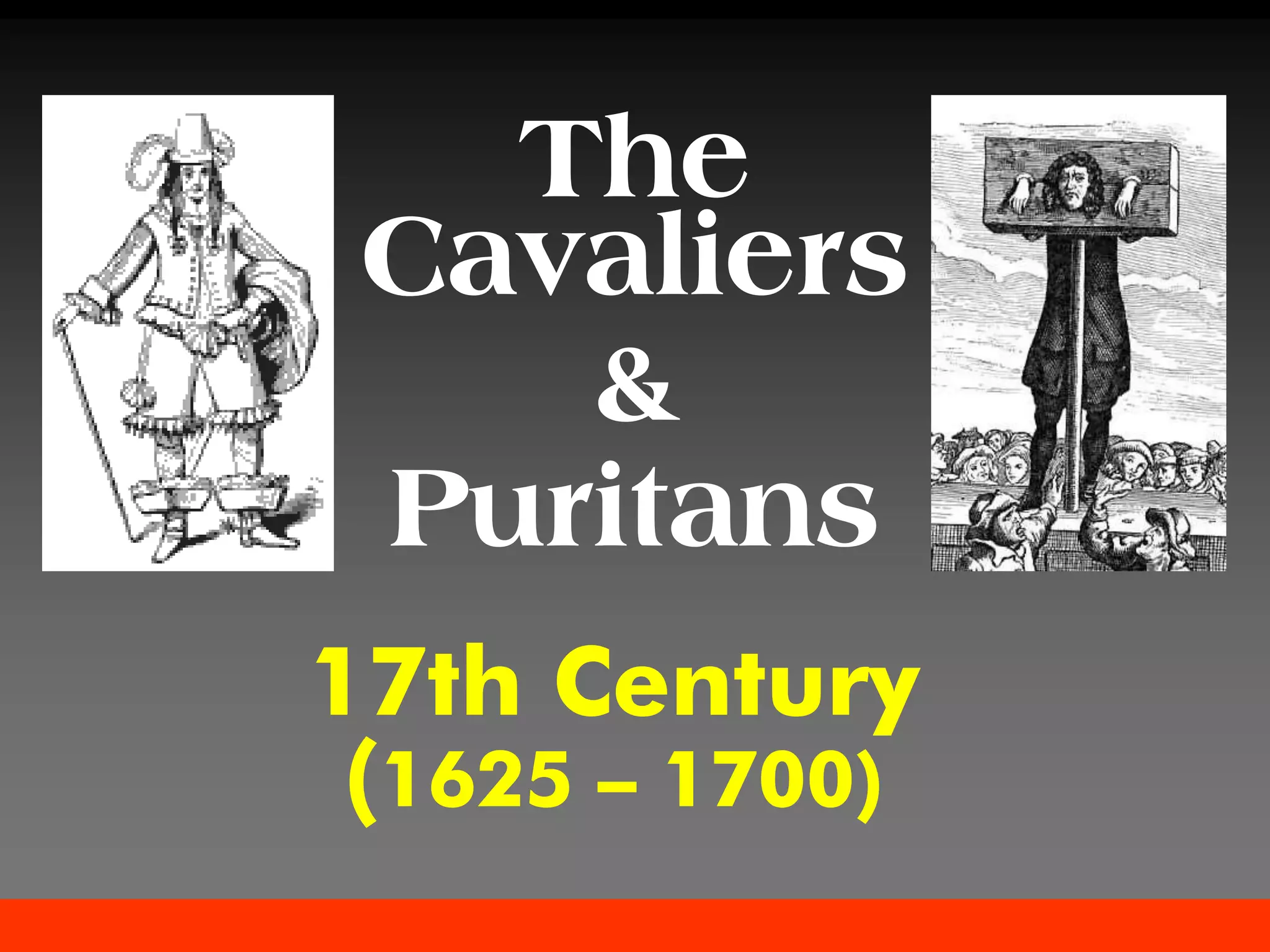
The
Cavaliers
&
Puritans
Turmoil
Religious & Political
Queen Elizabeth dies 1603
King James 1603-1625
King Charles 1625-1649
Oliver Cromwell 1642 - 1660
King Charles II 1660 - 1685
“GLORIOUS REVOLUTION”
The Controversy
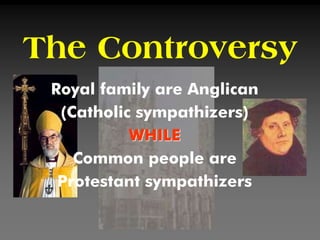
Royal family are Anglican
(Catholic sympathizers)
WHILE
Common people are
Protestant sympathizers
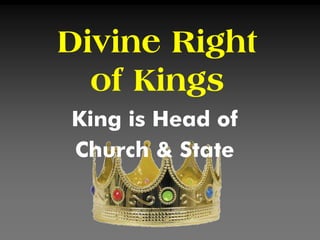
Divine Right
of Kings
King is Head of
Church & State
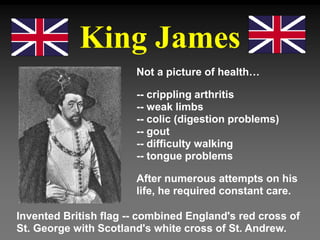
King James
Not a picture of health…
-- crippling arthritis
-- weak limbs
-- colic (digestion problems)
-- gout
-- difficulty walking
-- tongue problems
After numerous attempts on his
life, he required constant care.
Invented British flag -- combined England's red cross of
St. George with Scotland's white cross of St. Andrew.
Religious
Non-Conformity
Puritans/Separatists
Congregationists/Presbyterians
Church government styles
congregation vs. bishop
liturgical vs. non-liturgical
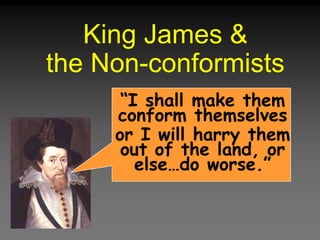
King James &
the Non-conformists
“I shall make them
conform themselves
or I will harry them
out of the land, or
else…do worse.”
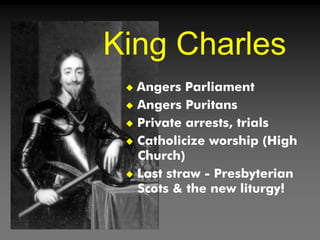
 Angers Parliament
 Angers Puritans
 Private arrests, trials
 Catholicize worship (High
Church)
 Last straw - Presbyterian
Scots & the new liturgy!
King Charles
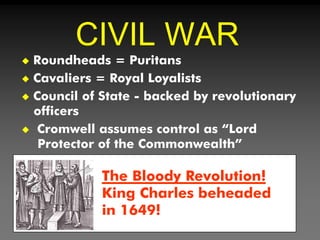
CIVIL WAR
 Roundheads = Puritans
 Cavaliers = Royal Loyalists
 Council of State - backed by revolutionary
officers
 Cromwell assumes control as “Lord
Protector of the Commonwealth”
The Bloody Revolution!
King Charles beheaded
in 1649!
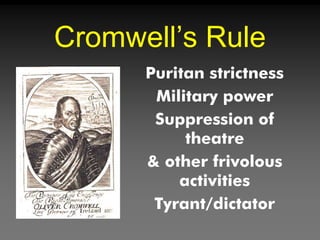
Cromwell’s Rule
Puritan strictness
Military power
Suppression of
theatre
& other frivolous
activities
Tyrant/dictator
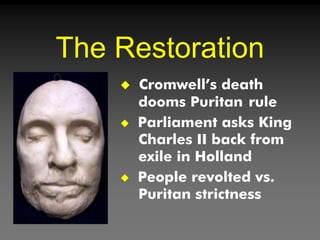
The Restoration
 Cromwell’s death
dooms Puritan rule
 Parliament asks King
Charles II back from
exile in Holland
 People revolted vs.
Puritan strictness
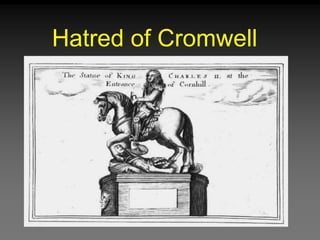
Hatred of Cromwell
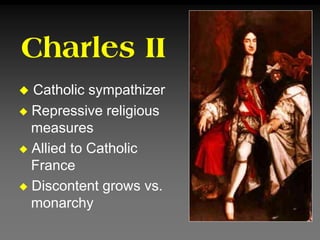
Charles II
 Catholic sympathizer
 Repressive religious
measures
 Allied to Catholic
France
 Discontent grows vs.
monarchy
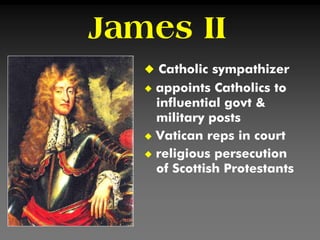
James II
 Catholic sympathizer
 appoints Catholics to
influential govt &
military posts
 Vatican reps in court
 religious persecution
of Scottish Protestants
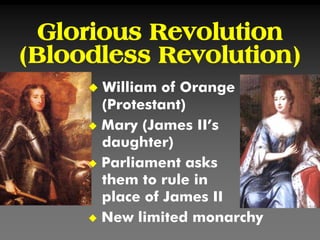
Glorious Revolution
(Bloodless Revolution)
 William of Orange
(Protestant)
 Mary (James II’s
daughter)
 Parliament asks
them to rule in
place of James II
 New limited monarchy
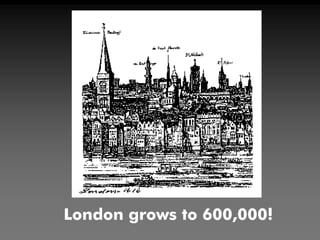
London grows to 600,000!
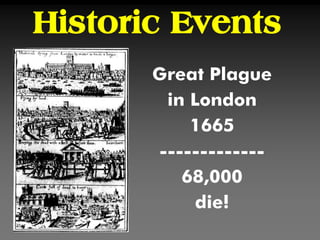
Historic Events
Great Plague
in London
1665
-------------
68,000
die!
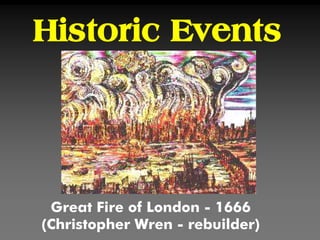
Historic Events
Great Fire of London - 1666
(Christopher Wren - rebuilder)
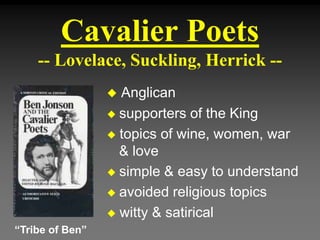
Cavalier Poets
-- Lovelace, Suckling, Herrick --
 Anglican
 supporters of the King
 topics of wine, women, war
& love
 simple & easy to understand
 avoided religious topics
 witty & satirical
“Tribe of Ben”
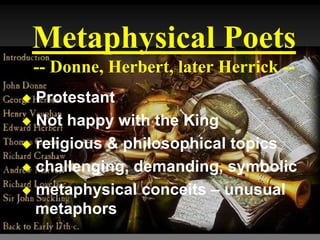
Metaphysical Poets
-- Donne, Herbert, later Herrick --
 Protestant
 Not happy with the King
 religious & philosophical topics
 challenging, demanding, symbolic
 metaphysical conceits – unusual
metaphors
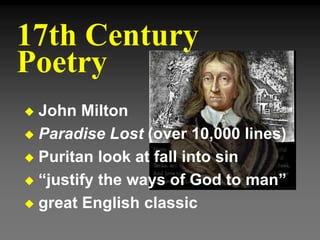
 John Milton
 Paradise Lost (over 10,000 lines)
 Puritan look at fall into sin
 “justify the ways of God to man”
 great English classic
17th Century
Poetry
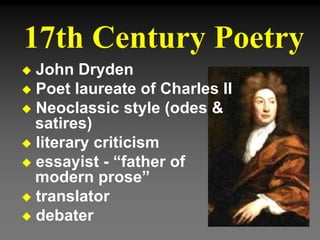
17th Century Poetry
 John Dryden
 Poet laureate of Charles II
 Neoclassic style (odes &
satires)
 literary criticism
 essayist - “father of
modern prose”
 translator
 debater
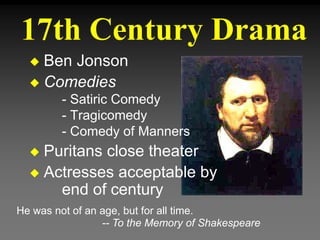
17th Century Drama
He was not of an age, but for all time.
-- To the Memory of Shakespeare
 Ben Jonson
 Comedies
- Satiric Comedy
- Tragicomedy
- Comedy of Manners
 Puritans close theater
 Actresses acceptable by
end of century
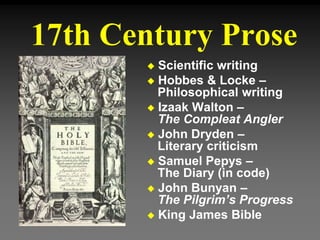
17th Century Prose
 Scientific writing
 Hobbes & Locke –
Philosophical writing
 Izaak Walton –
The Compleat Angler
 John Dryden –
Literary criticism
 Samuel Pepys –
The Diary (in code)
 John Bunyan –
The Pilgrim’s Progress
 King James Bible
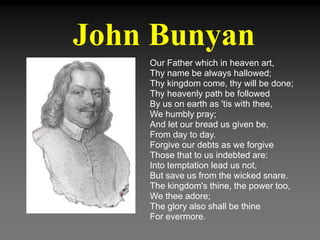
John Bunyan
Our Father which in heaven art,
Thy name be always hallowed;
Thy kingdom come, thy will be done;
Thy heavenly path be followed
By us on earth as 'tis with thee,
We humbly pray;
And let our bread us given be,
From day to day.
Forgive our debts as we forgive
Those that to us indebted are:
Into temptation lead us not,
But save us from the wicked snare.
The kingdom's thine, the power too,
We thee adore;
The glory also shall be thine
For evermore.
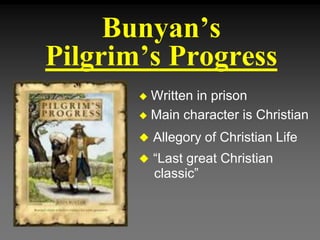
Bunyan’s
Pilgrim’s Progress
 Written in prison
 Main character is Christian
 Allegory of Christian Life
 “Last great Christian
classic”
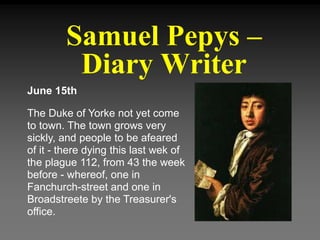
Samuel Pepys –
Diary Writer
June 15th
The Duke of Yorke not yet come
to town. The town grows very
sickly, and people to be afeared
of it - there dying this last wek of
the plague 112, from 43 the week
before - whereof, one in
Fanchurch-street and one in
Broadstreete by the Treasurer's
office.
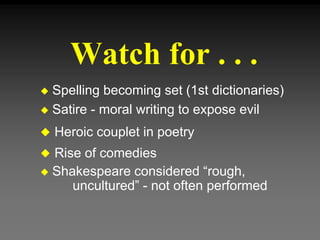
Watch for . . .
 Spelling becoming set (1st dictionaries)
 Satire - moral writing to expose evil
 Heroic couplet in poetry
 Rise of comedies
 Shakespeare considered “rough,
uncultured” - not often performed

17th Century - Cavaliers & Puritans.ppt

  • 1.
    17th Century (1625 –1700) The Cavaliers & Puritans
  • 2.
    Turmoil Religious & Political QueenElizabeth dies 1603 King James 1603-1625 King Charles 1625-1649 Oliver Cromwell 1642 - 1660 King Charles II 1660 - 1685 “GLORIOUS REVOLUTION”
  • 3.
    The Controversy Royal familyare Anglican (Catholic sympathizers) WHILE Common people are Protestant sympathizers
  • 4.
    Divine Right of Kings Kingis Head of Church & State
  • 5.
    King James Not apicture of health… -- crippling arthritis -- weak limbs -- colic (digestion problems) -- gout -- difficulty walking -- tongue problems After numerous attempts on his life, he required constant care. Invented British flag -- combined England's red cross of St. George with Scotland's white cross of St. Andrew.
  • 6.
  • 7.
    King James & theNon-conformists “I shall make them conform themselves or I will harry them out of the land, or else…do worse.”
  • 8.
     Angers Parliament Angers Puritans  Private arrests, trials  Catholicize worship (High Church)  Last straw - Presbyterian Scots & the new liturgy! King Charles
  • 9.
    CIVIL WAR  Roundheads= Puritans  Cavaliers = Royal Loyalists  Council of State - backed by revolutionary officers  Cromwell assumes control as “Lord Protector of the Commonwealth” The Bloody Revolution! King Charles beheaded in 1649!
  • 10.
    Cromwell’s Rule Puritan strictness Militarypower Suppression of theatre & other frivolous activities Tyrant/dictator
  • 11.
    The Restoration  Cromwell’sdeath dooms Puritan rule  Parliament asks King Charles II back from exile in Holland  People revolted vs. Puritan strictness
  • 12.
  • 13.
    Charles II  Catholicsympathizer  Repressive religious measures  Allied to Catholic France  Discontent grows vs. monarchy
  • 14.
    James II  Catholicsympathizer  appoints Catholics to influential govt & military posts  Vatican reps in court  religious persecution of Scottish Protestants
  • 15.
    Glorious Revolution (Bloodless Revolution) William of Orange (Protestant)  Mary (James II’s daughter)  Parliament asks them to rule in place of James II  New limited monarchy
  • 16.
  • 17.
    Historic Events Great Plague inLondon 1665 ------------- 68,000 die!
  • 18.
    Historic Events Great Fireof London - 1666 (Christopher Wren - rebuilder)
  • 19.
    Cavalier Poets -- Lovelace,Suckling, Herrick --  Anglican  supporters of the King  topics of wine, women, war & love  simple & easy to understand  avoided religious topics  witty & satirical “Tribe of Ben”
  • 20.
    Metaphysical Poets -- Donne,Herbert, later Herrick --  Protestant  Not happy with the King  religious & philosophical topics  challenging, demanding, symbolic  metaphysical conceits – unusual metaphors
  • 21.
     John Milton Paradise Lost (over 10,000 lines)  Puritan look at fall into sin  “justify the ways of God to man”  great English classic 17th Century Poetry
  • 22.
    17th Century Poetry John Dryden  Poet laureate of Charles II  Neoclassic style (odes & satires)  literary criticism  essayist - “father of modern prose”  translator  debater
  • 23.
    17th Century Drama Hewas not of an age, but for all time. -- To the Memory of Shakespeare  Ben Jonson  Comedies - Satiric Comedy - Tragicomedy - Comedy of Manners  Puritans close theater  Actresses acceptable by end of century
  • 24.
    17th Century Prose Scientific writing  Hobbes & Locke – Philosophical writing  Izaak Walton – The Compleat Angler  John Dryden – Literary criticism  Samuel Pepys – The Diary (in code)  John Bunyan – The Pilgrim’s Progress  King James Bible
  • 25.
    John Bunyan Our Fatherwhich in heaven art, Thy name be always hallowed; Thy kingdom come, thy will be done; Thy heavenly path be followed By us on earth as 'tis with thee, We humbly pray; And let our bread us given be, From day to day. Forgive our debts as we forgive Those that to us indebted are: Into temptation lead us not, But save us from the wicked snare. The kingdom's thine, the power too, We thee adore; The glory also shall be thine For evermore.
  • 26.
    Bunyan’s Pilgrim’s Progress  Writtenin prison  Main character is Christian  Allegory of Christian Life  “Last great Christian classic”
  • 27.
    Samuel Pepys – DiaryWriter June 15th The Duke of Yorke not yet come to town. The town grows very sickly, and people to be afeared of it - there dying this last wek of the plague 112, from 43 the week before - whereof, one in Fanchurch-street and one in Broadstreete by the Treasurer's office.
  • 28.
    Watch for .. .  Spelling becoming set (1st dictionaries)  Satire - moral writing to expose evil  Heroic couplet in poetry  Rise of comedies  Shakespeare considered “rough, uncultured” - not often performed