TCP/IP Protocol Suite
1
Chapter 4
Objectives
Upon completion you will be able to:
IP Addresses:
Classful Addressing
• Understand IPv4 addresses and classes
• Identify the class of an IP address
• Find the network address given an IP address
• Understand masks and how to use them
• Understand subnets and supernets
TCP/IP Protocol Suite
2
4.1 INTRODUCTION
4.1 INTRODUCTION
The identifier used in the IP layer of the TCP/IP protocol suite to identify
each device connected to the Internet is called the Internet address or IP
address. An IP address is a 32-bit address that uniquely and universally
defines the connection of a host or a router to the Internet. IP addresses
are unique. They are unique in the sense that each address defines one,
and only one, connection to the Internet. Two devices on the Internet can
never have the same address.
The topics discussed in this section include:
Address Space
Notation
TCP/IP Protocol Suite
3
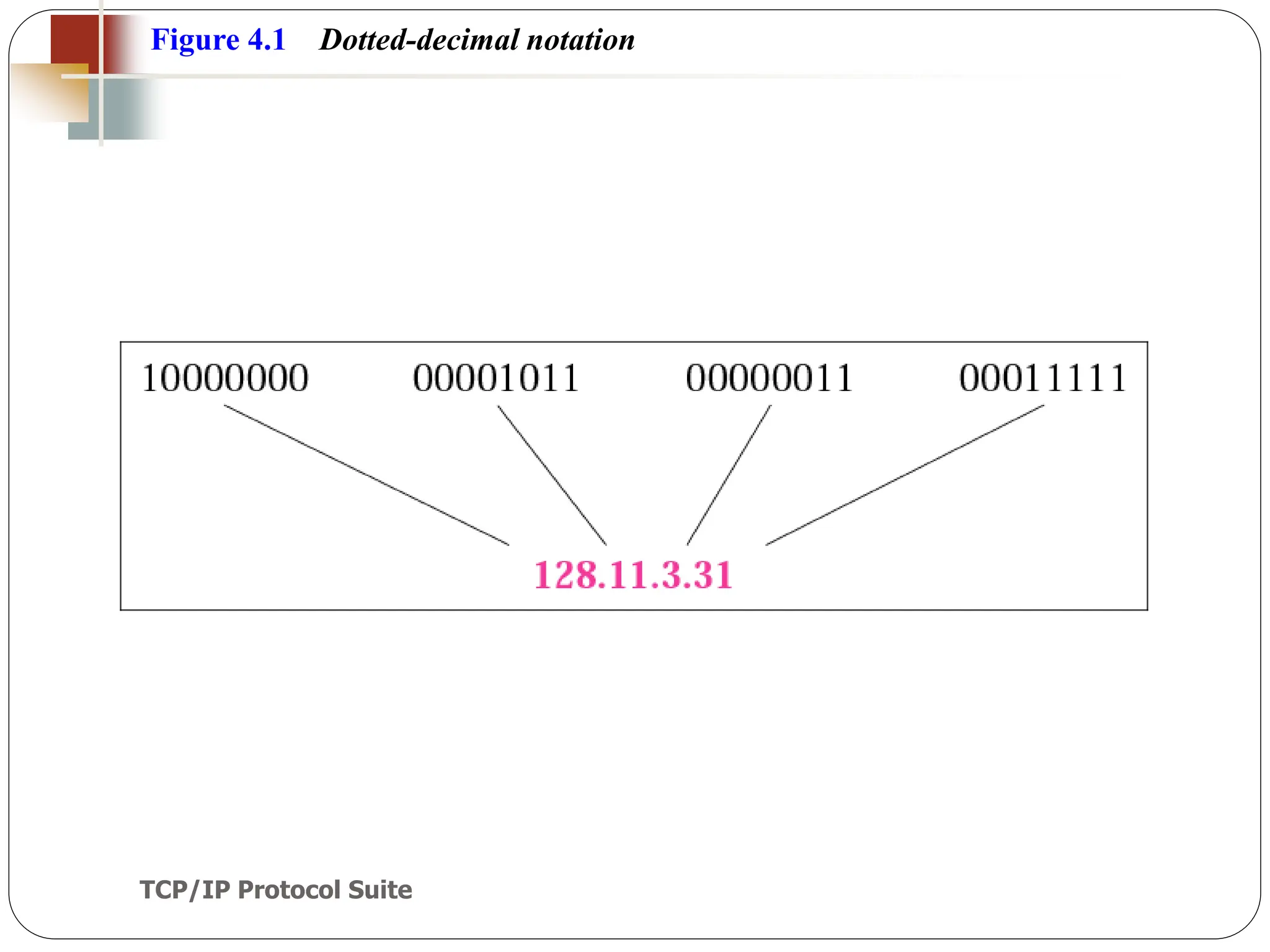
An IP address is a 32-bit address.
Note:
TCP/IP Protocol Suite
4
The IP addresses are unique.
Note:
TCP/IP Protocol Suite
5
The address space of IPv4 is
232 or 4,294,967,296.
Note:
TCP/IP Protocol Suite
6
Figure 4.1 Dotted-decimal notation
TCP/IP Protocol Suite
7
The binary, decimal, and hexadecimal
number systems are reviewed in
Appendix B.
Note:
TCP/IP Protocol Suite
8
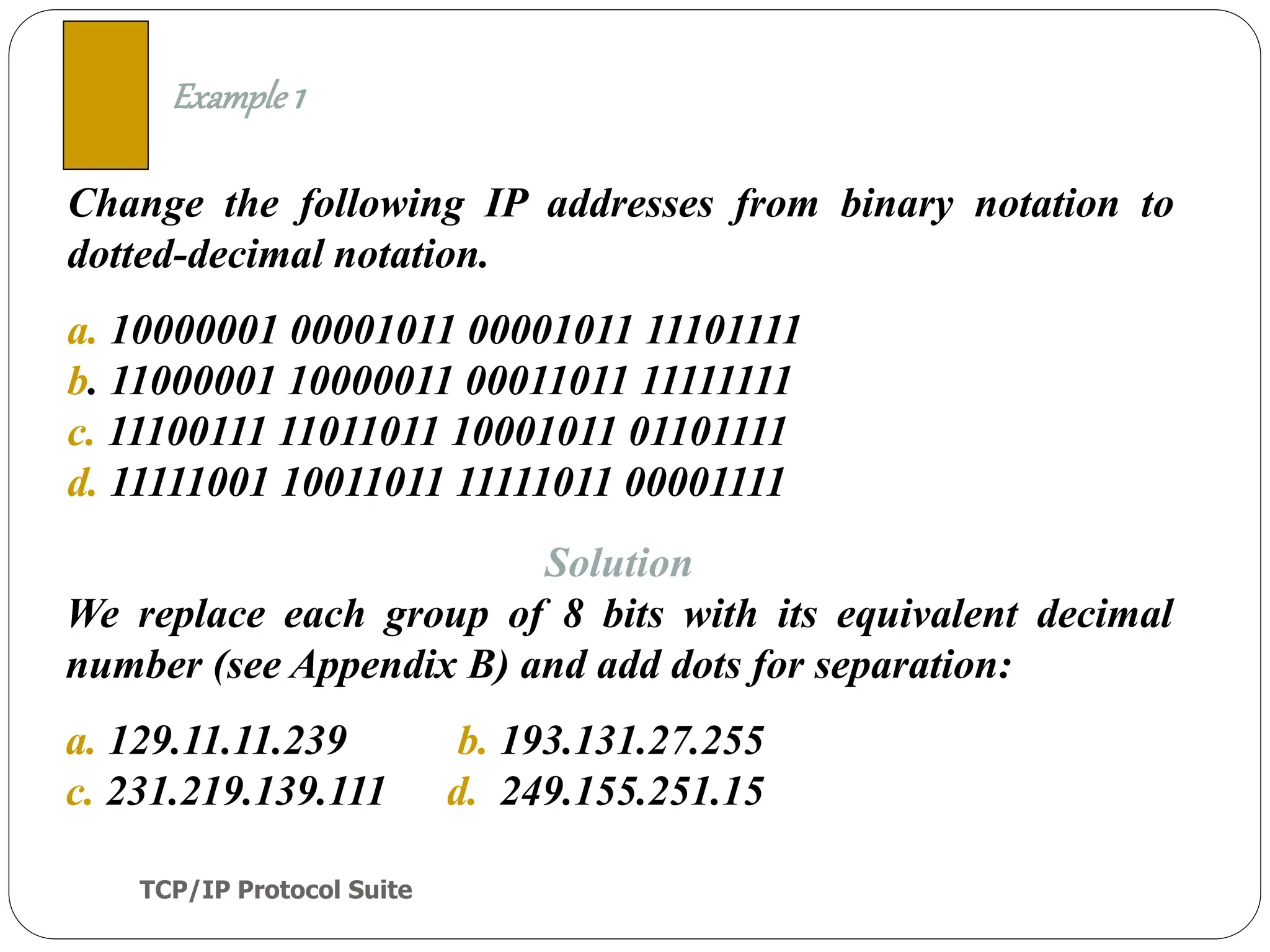
Change the following IP addresses from binary notation to
dotted-decimal notation.
a. 10000001 00001011 00001011 11101111
b. 11000001 10000011 00011011 11111111
c. 11100111 11011011 10001011 01101111
d. 11111001 10011011 11111011 00001111
Example 1
Solution
We replace each group of 8 bits with its equivalent decimal
number (see Appendix B) and add dots for separation:
a. 129.11.11.239 b. 193.131.27.255
c. 231.219.139.111 d. 249.155.251.15
TCP/IP Protocol Suite
9
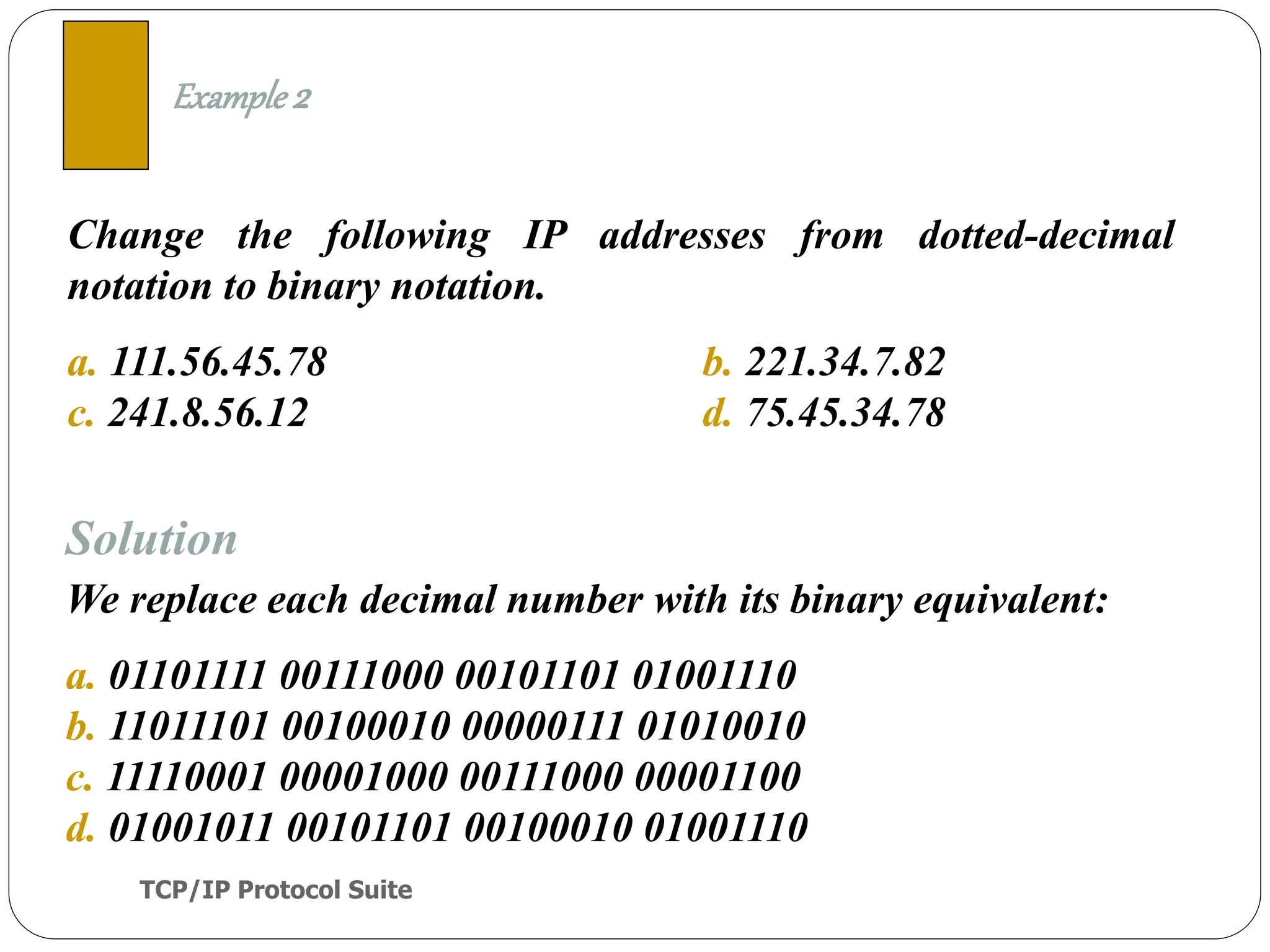
Change the following IP addresses from dotted-decimal
notation to binary notation.
a. 111.56.45.78 b. 221.34.7.82
c. 241.8.56.12 d. 75.45.34.78
Example 2
Solution
We replace each decimal number with its binary equivalent:
a. 01101111 00111000 00101101 01001110
b. 11011101 00100010 00000111 01010010
c. 11110001 00001000 00111000 00001100
d. 01001011 00101101 00100010 01001110
TCP/IP Protocol Suite
10
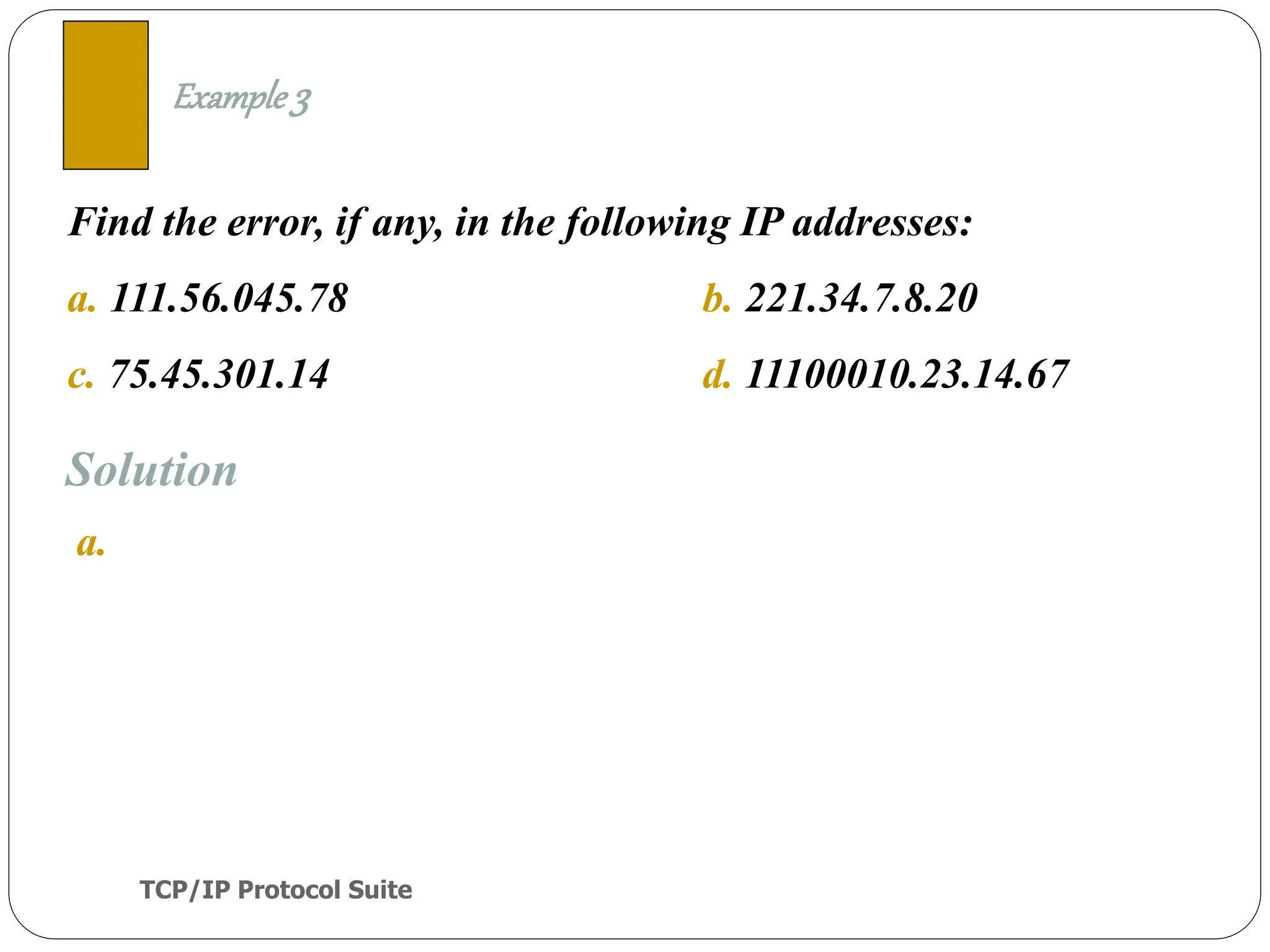
Find the error, if any, in the following IP addresses:
a. 111.56.045.78 b. 221.34.7.8.20
c. 75.45.301.14 d. 11100010.23.14.67
Example 3
Solution
a.
TCP/IP Protocol Suite
11
4.2 CLASSFUL ADDRESSING
IP addresses, when started a few decades ago, used the concept of
classes. This architecture is called classful addressing. In the mid-1990s,
a new architecture, called classless addressing, was introduced and will
eventually supersede the original architecture. However, part of the
Internet is still using classful addressing, but the migration is very fast.
The topics discussed in this section include:
Recognizing Classes
Netid and Hostid
Classes and Blocks
Network Addresses
Sufficient Information
Mask
CIDR Notation
Address Depletion
TCP/IP Protocol Suite
12
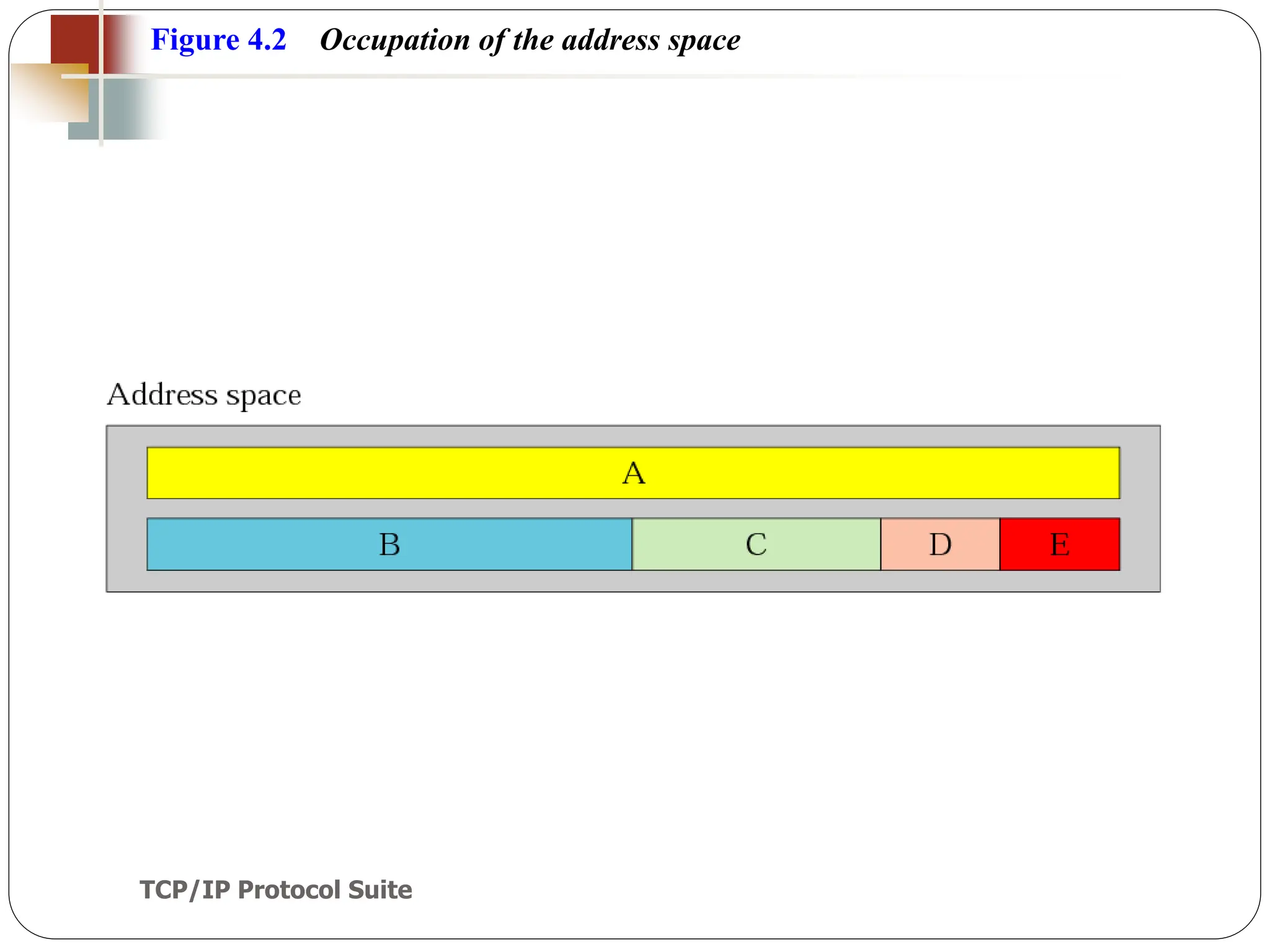
Figure 4.2 Occupation of the address space
TCP/IP Protocol Suite
13
Table 4.1 Addresses per class
TCP/IP Protocol Suite
14
Figure 4.3 Finding the class in binary notation
TCP/IP Protocol Suite
15
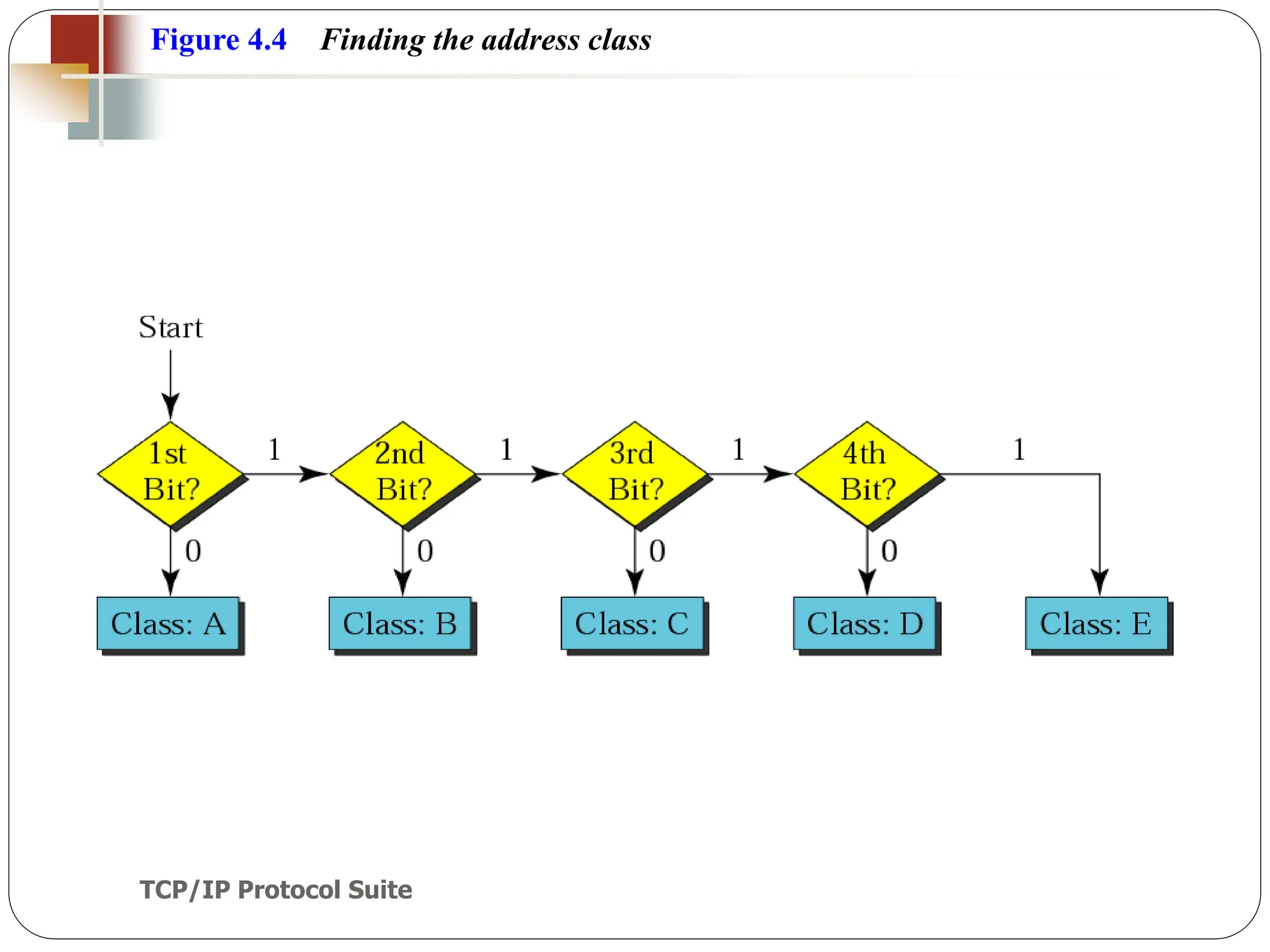
Figure 4.4 Finding the address class
TCP/IP Protocol Suite
16
How can we prove that we have 2,147,483,648 addresses in
class A?
Example 5
Solution
In class A, only 1 bit defines the class. The remaining 31 bits
are available for the address. With 31 bits, we can have 231
or 2,147,483,648 addresses.
TCP/IP Protocol Suite
17
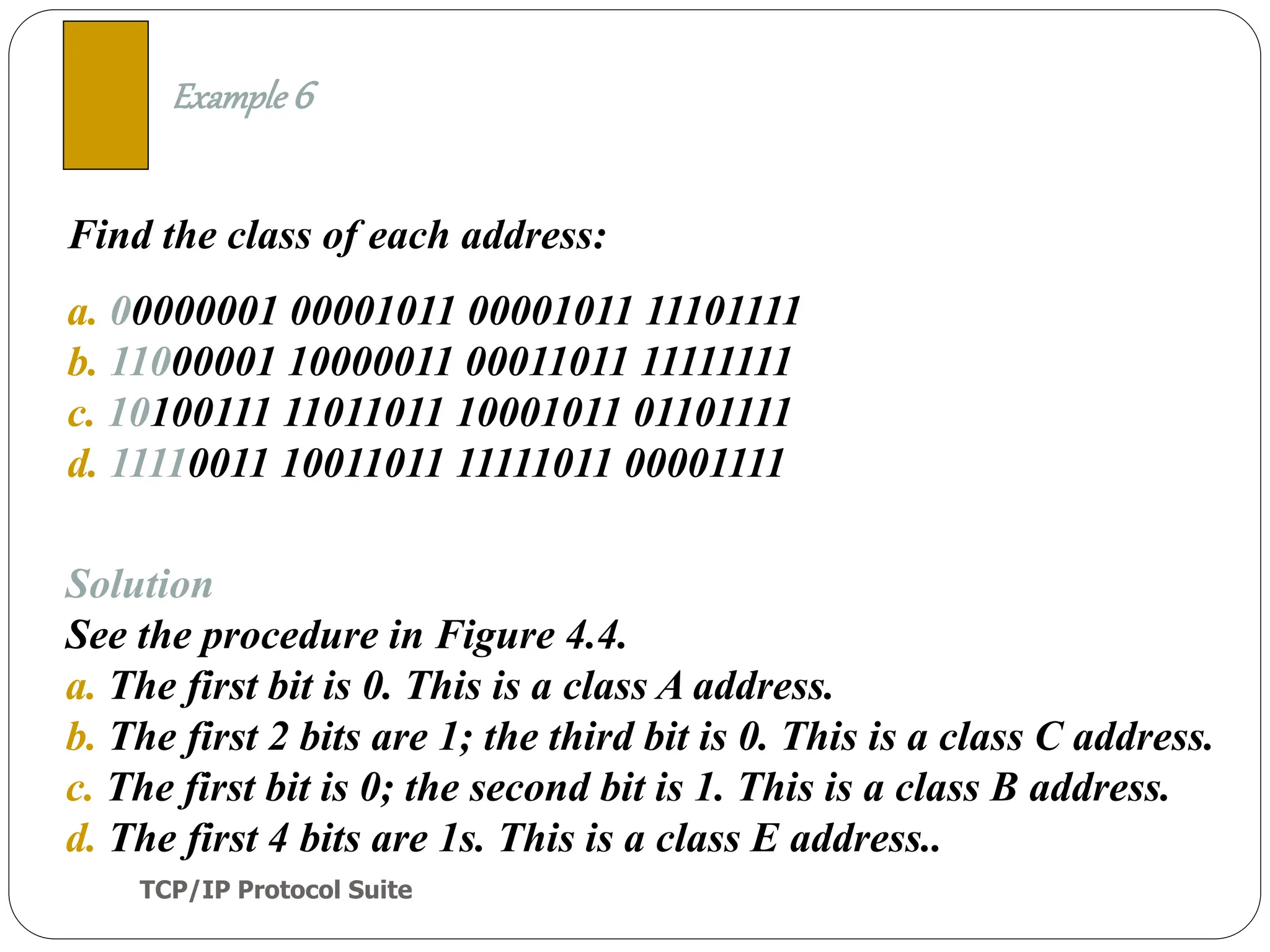
Find the class of each address:
a. 00000001 00001011 00001011 11101111
b. 11000001 10000011 00011011 11111111
c. 10100111 11011011 10001011 01101111
d. 11110011 10011011 11111011 00001111
Example 6
Solution
See the procedure in Figure 4.4.
a. The first bit is 0. This is a class A address.
b. The first 2 bits are 1; the third bit is 0. This is a class C address.
c. The first bit is 0; the second bit is 1. This is a class B address.
d. The first 4 bits are 1s. This is a class E address..
TCP/IP Protocol Suite
18
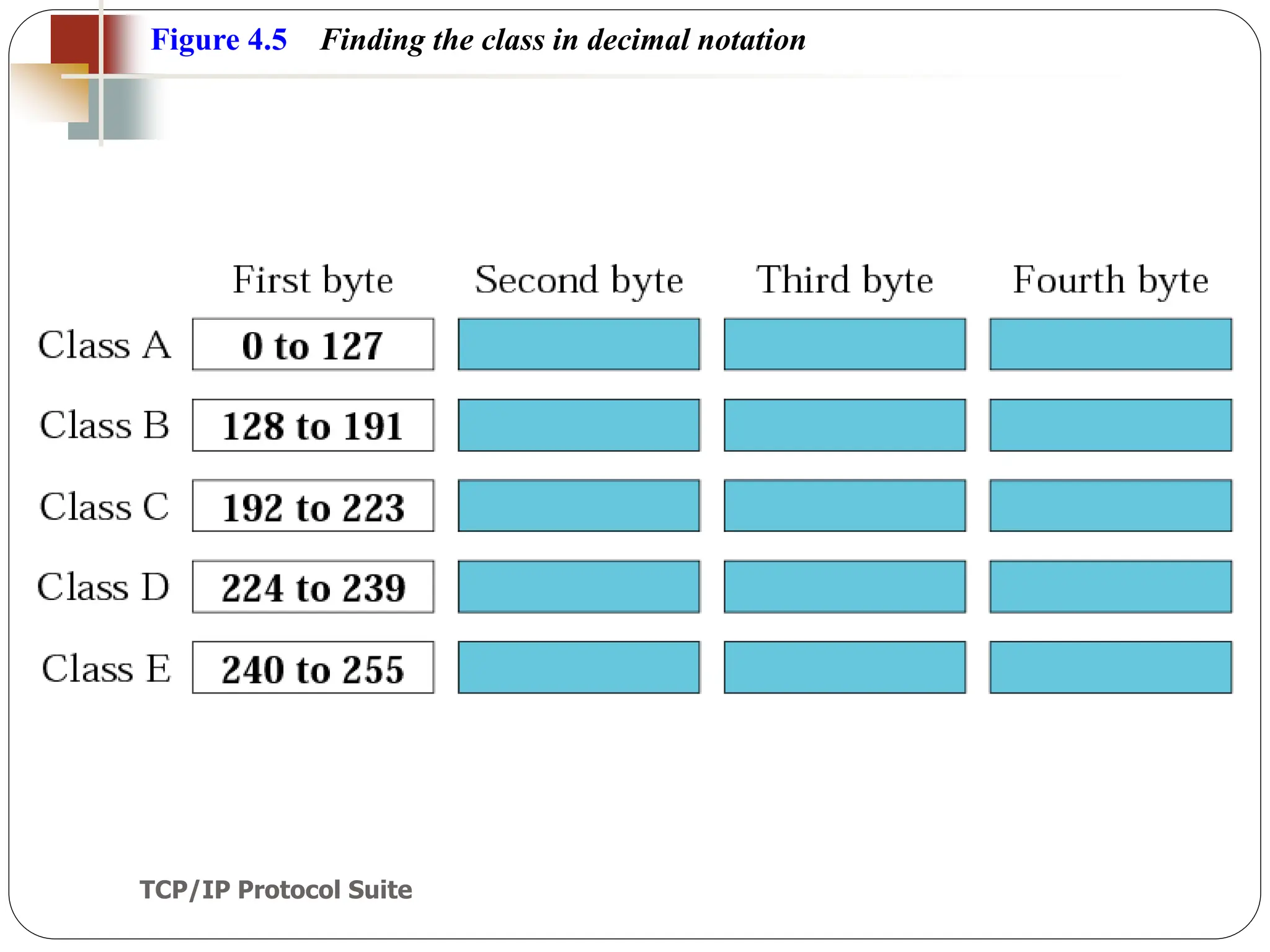
Figure 4.5 Finding the class in decimal notation
TCP/IP Protocol Suite
19
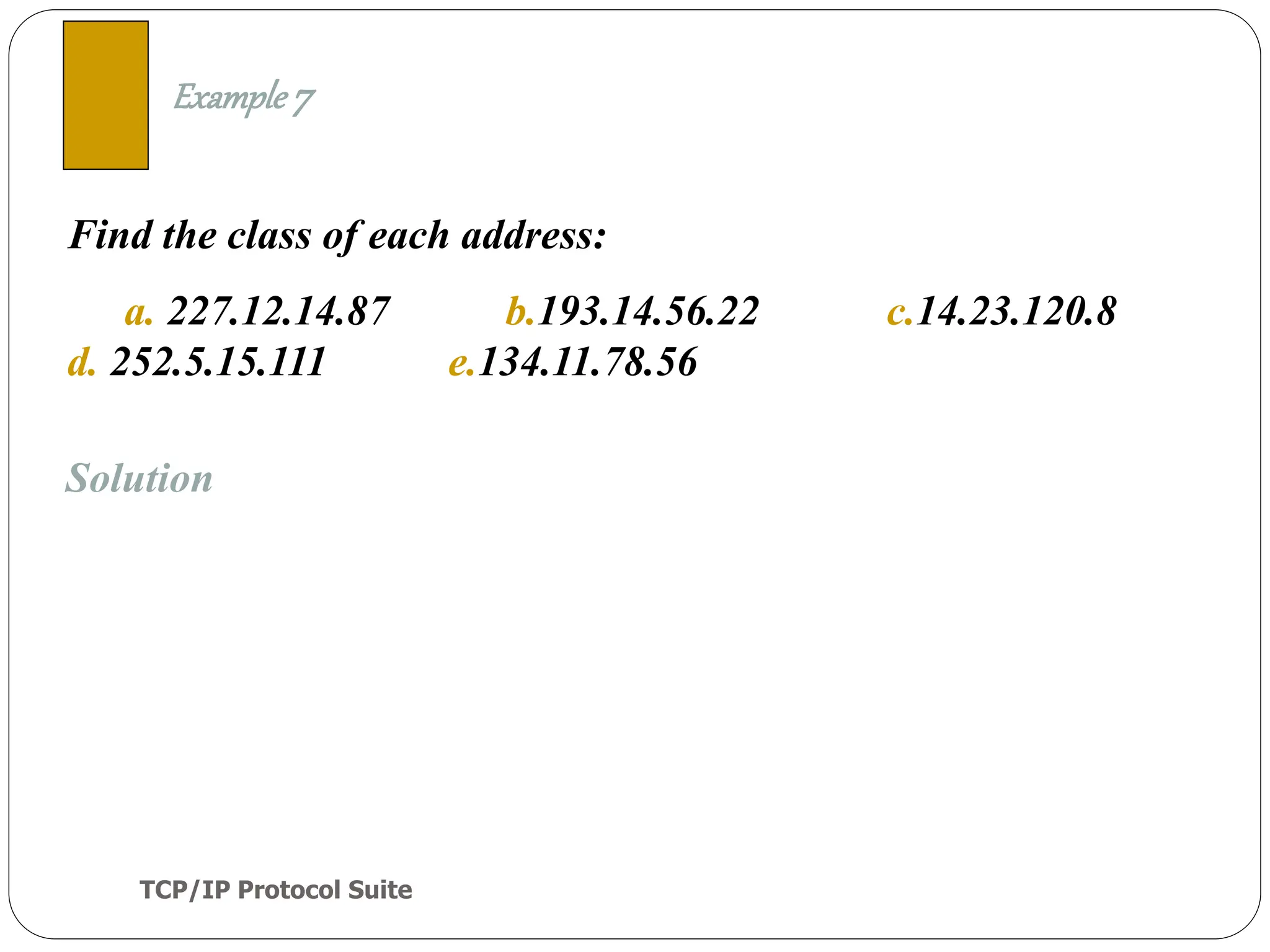
Find the class of each address:
a. 227.12.14.87 b.193.14.56.22 c.14.23.120.8
d. 252.5.15.111 e.134.11.78.56
Example 7
Solution
TCP/IP Protocol Suite
20
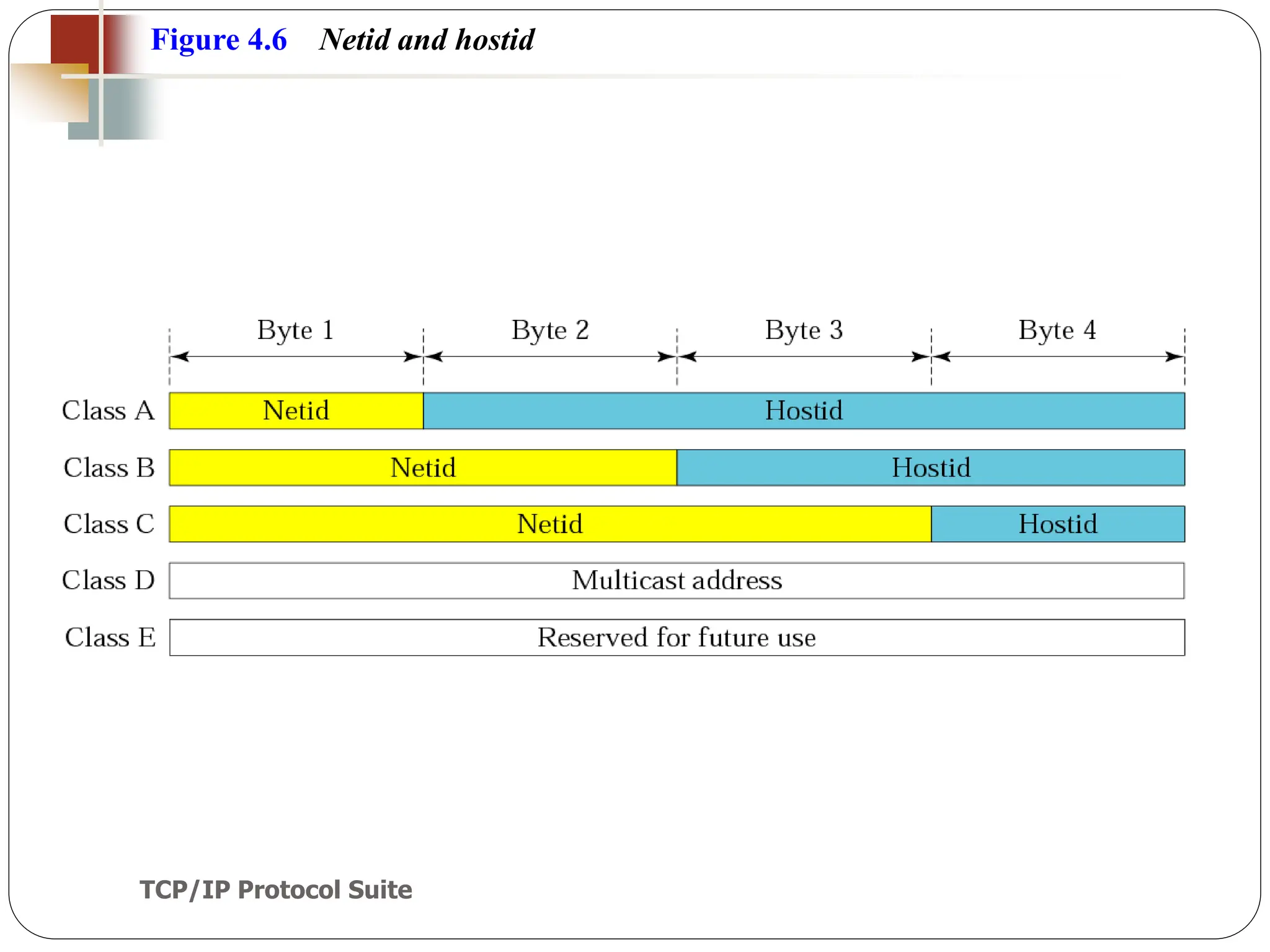
Figure 4.6 Netid and hostid
TCP/IP Protocol Suite
21
Millions of class A addresses are
wasted.
Note:
TCP/IP Protocol Suite
22
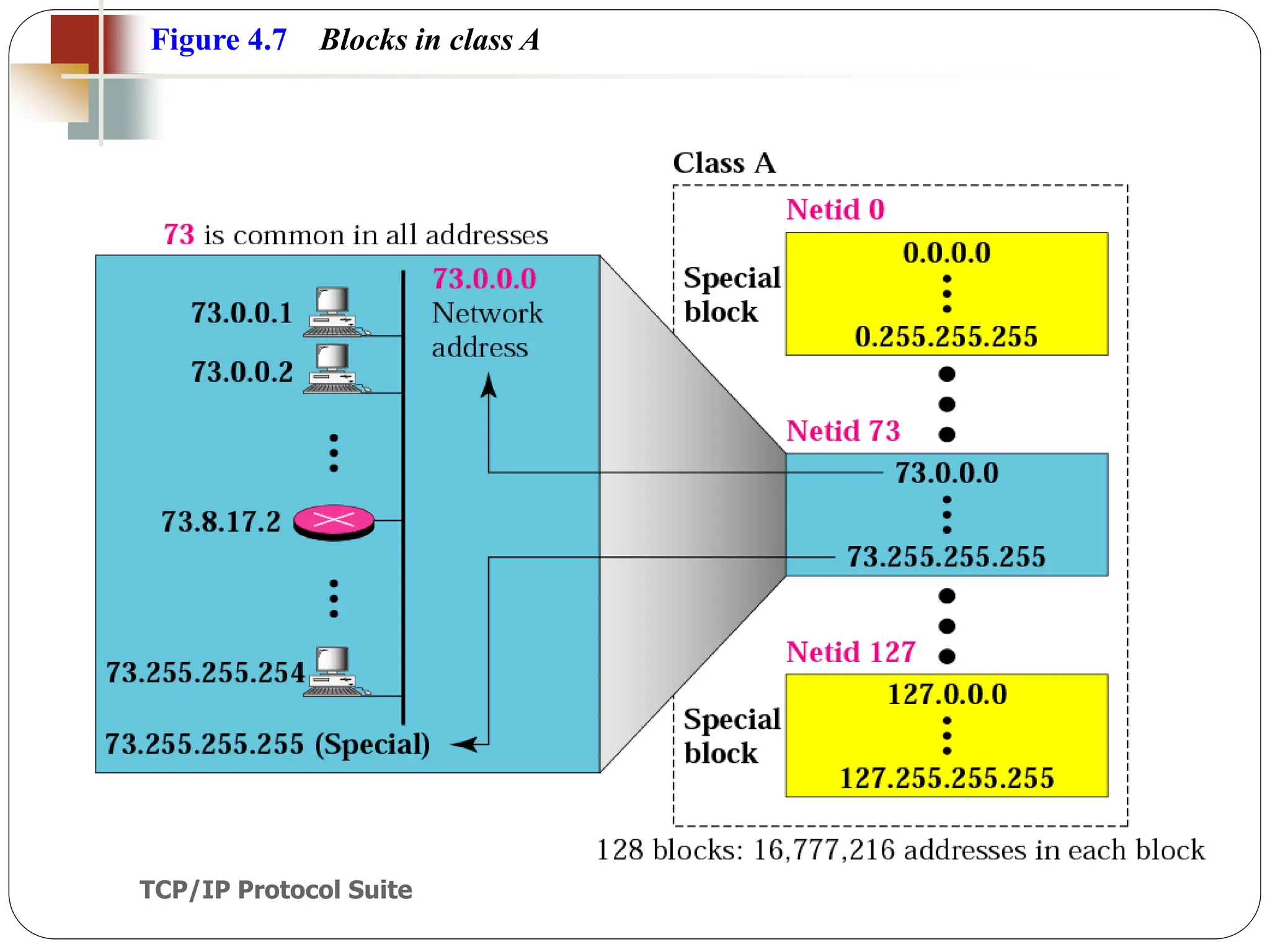
Figure 4.7 Blocks in class A
TCP/IP Protocol Suite
23
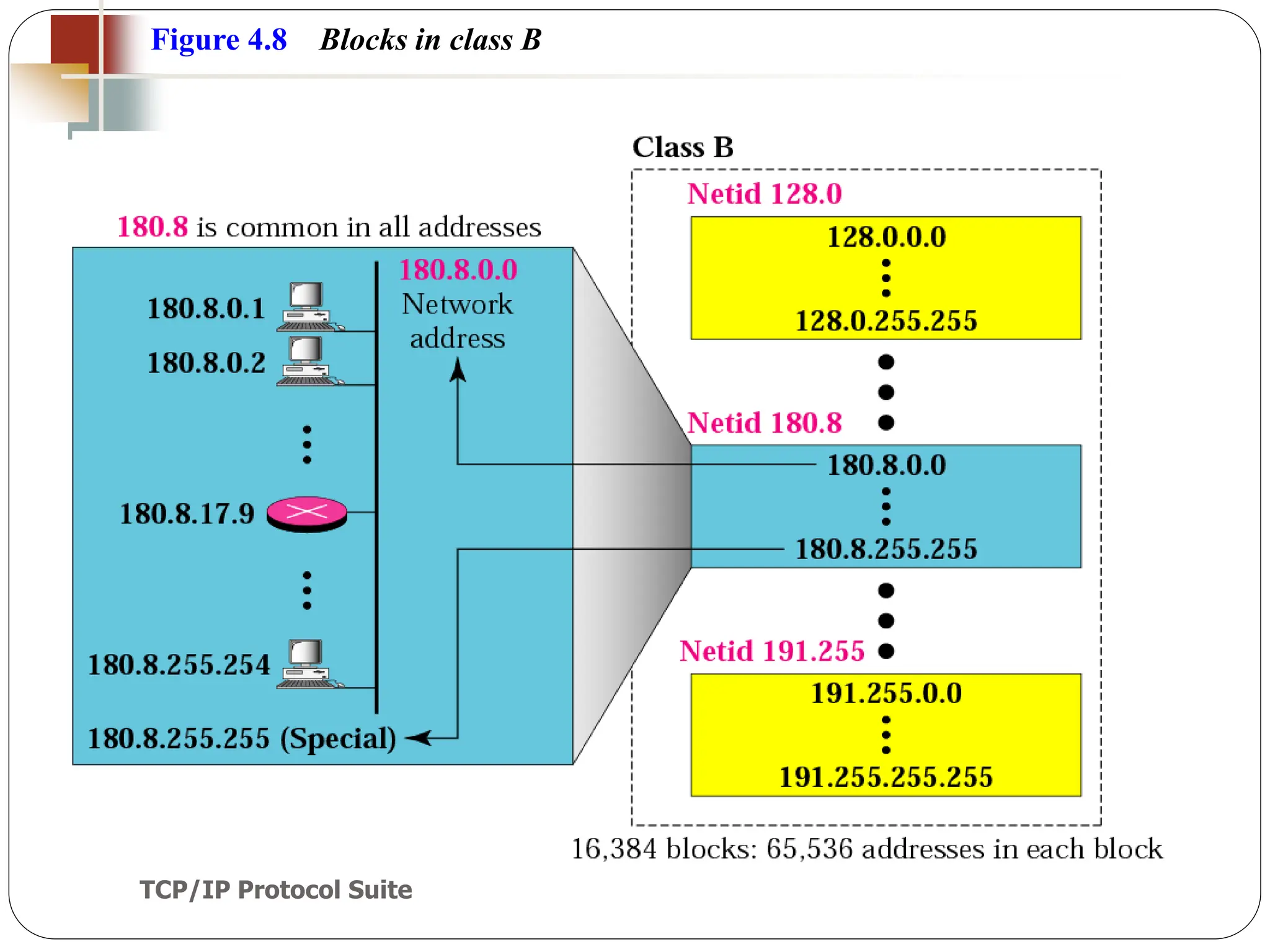
Figure 4.8 Blocks in class B
TCP/IP Protocol Suite
24
Many class B addresses are wasted.
Note:
TCP/IP Protocol Suite
25
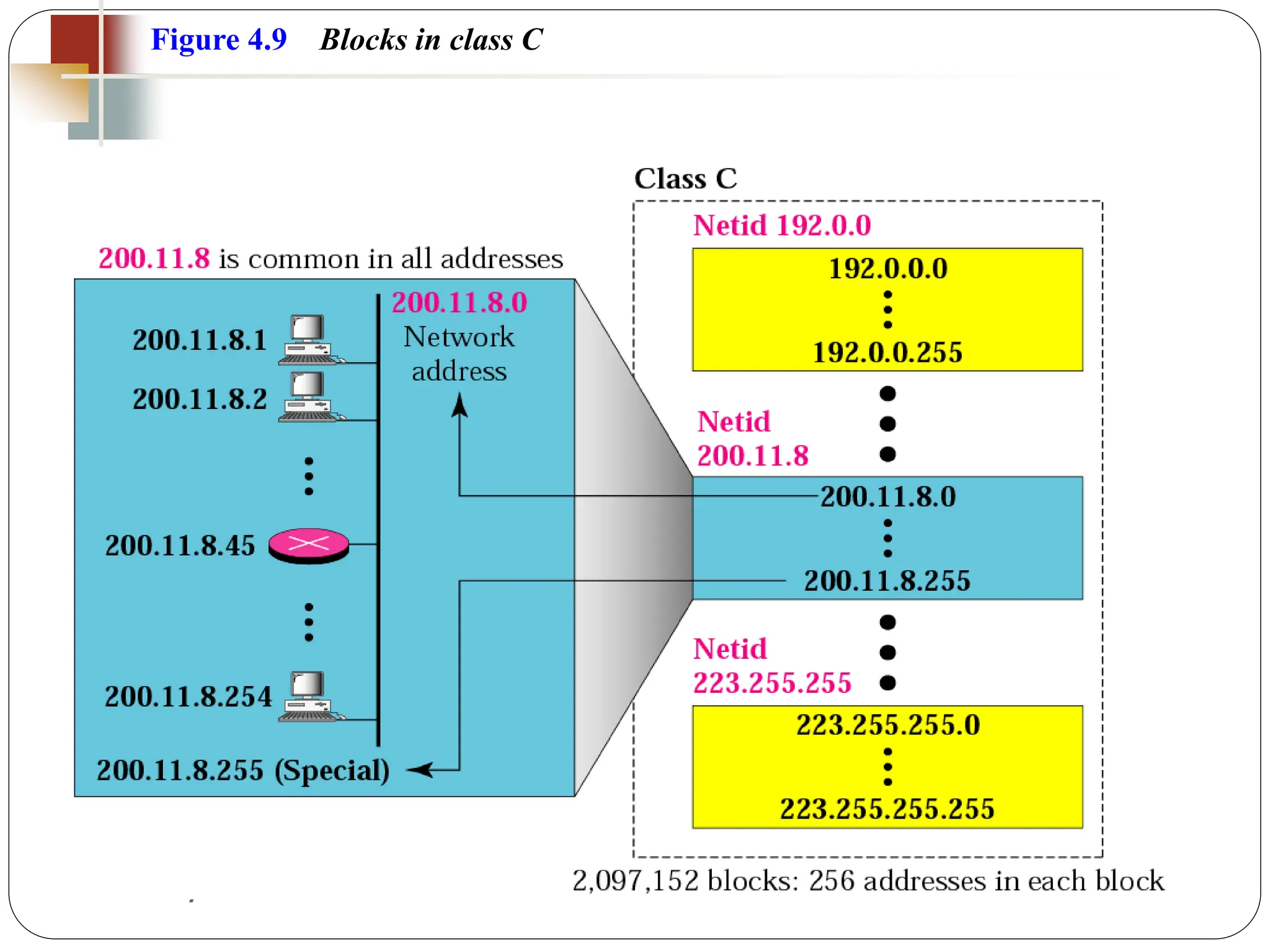
Figure 4.9 Blocks in class C
TCP/IP Protocol Suite
26
The number of addresses in class C is
smaller than the needs of most
organizations.
Note:
TCP/IP Protocol Suite
27
Class D addresses are used for
multicasting; there is only one block in
this class.
Note:
TCP/IP Protocol Suite
28
Class E addresses are reserved for
future purposes; most of the block is
wasted.
Note:
TCP/IP Protocol Suite
29
In classful addressing, the network
address (the first address in the block)
is the one that is assigned to the
organization. The range of addresses
can automatically be inferred from the
network address.
Note:
TCP/IP Protocol Suite
30
Given the network address 17.0.0.0, find the class, the block,
and the range of the addresses.
Example 9
Solution
TCP/IP Protocol Suite
31
Given the network address 132.21.0.0, find the class, the block,
and the range of the addresses.
Example 10
Solution
TCP/IP Protocol Suite
32
Given the network address 220.34.76.0, find the class, the
block, and the range of the addresses.
Example 11
Solution
TCP/IP Protocol Suite
33
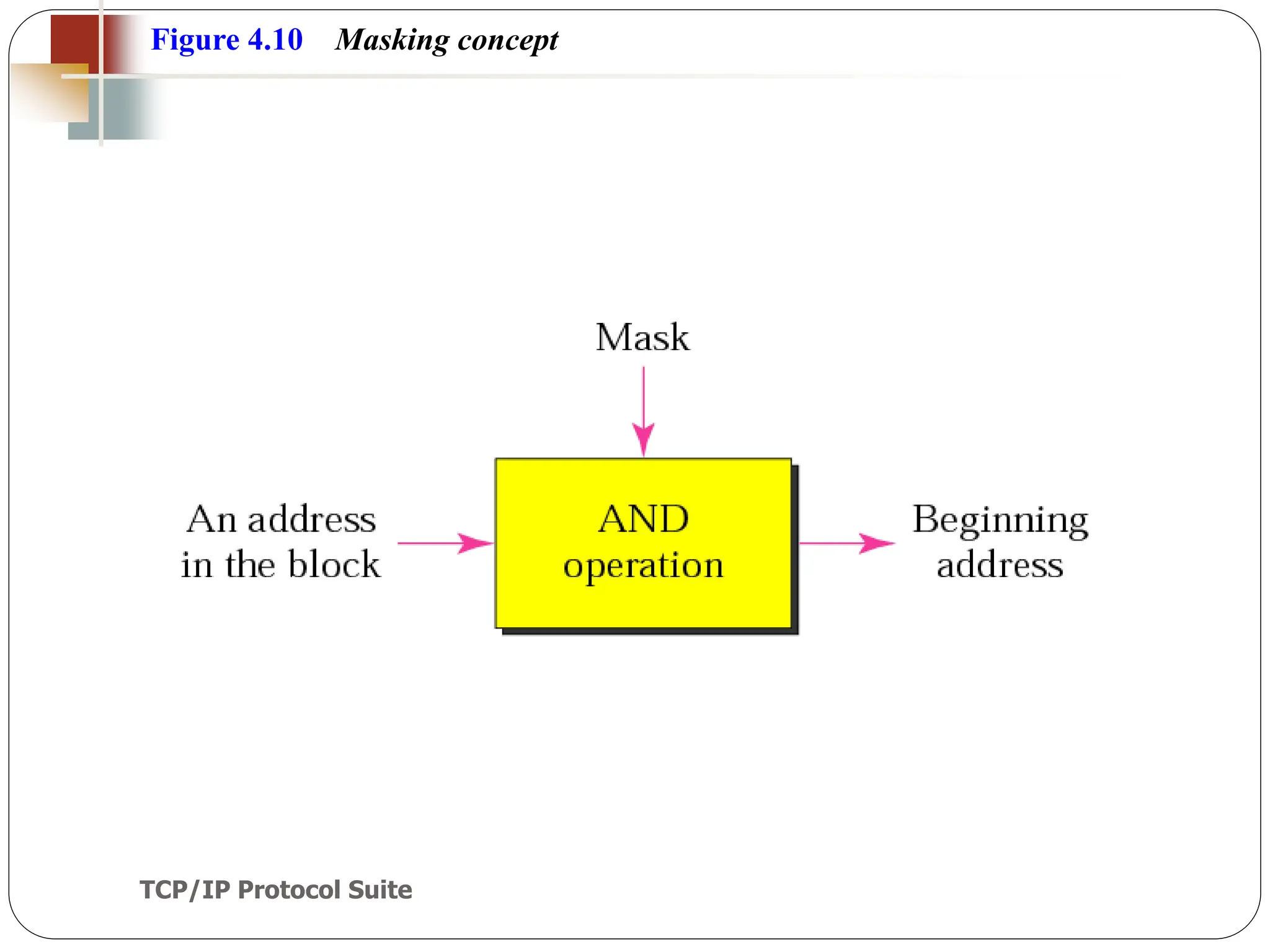
Figure 4.10 Masking concept
TCP/IP Protocol Suite
34
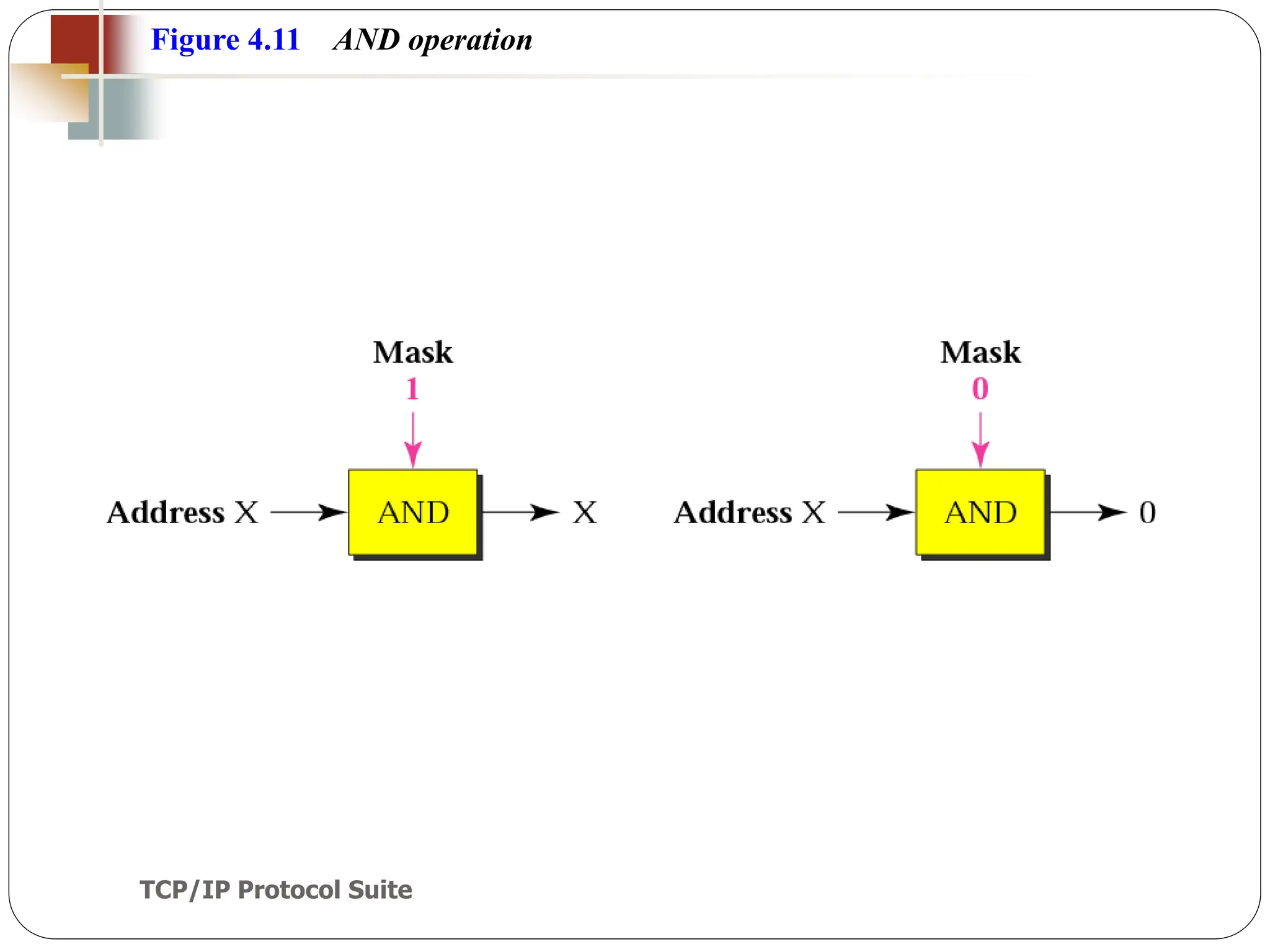
Figure 4.11 AND operation
TCP/IP Protocol Suite
35
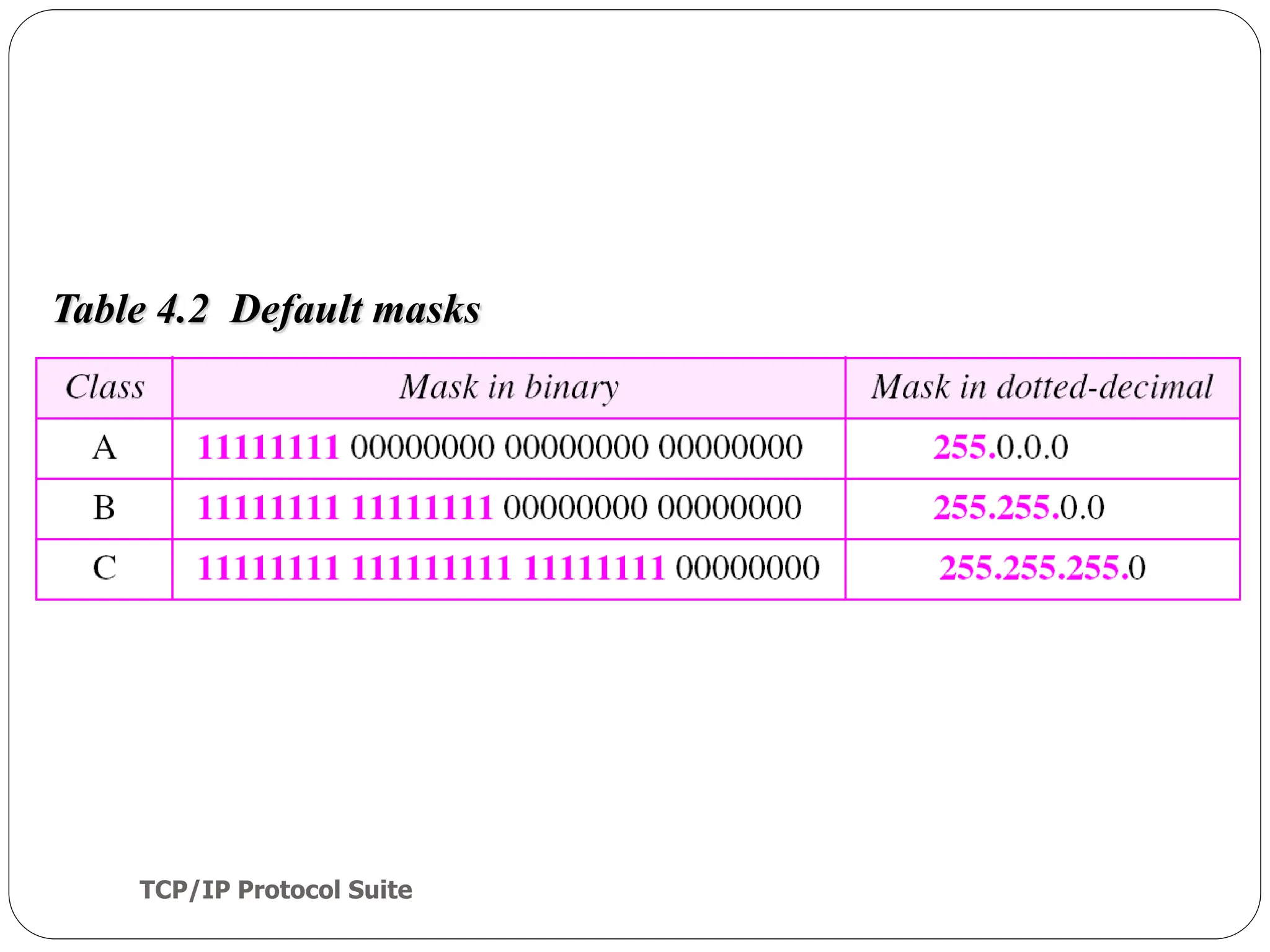
Table 4.2 Default masks
TCP/IP Protocol Suite
36
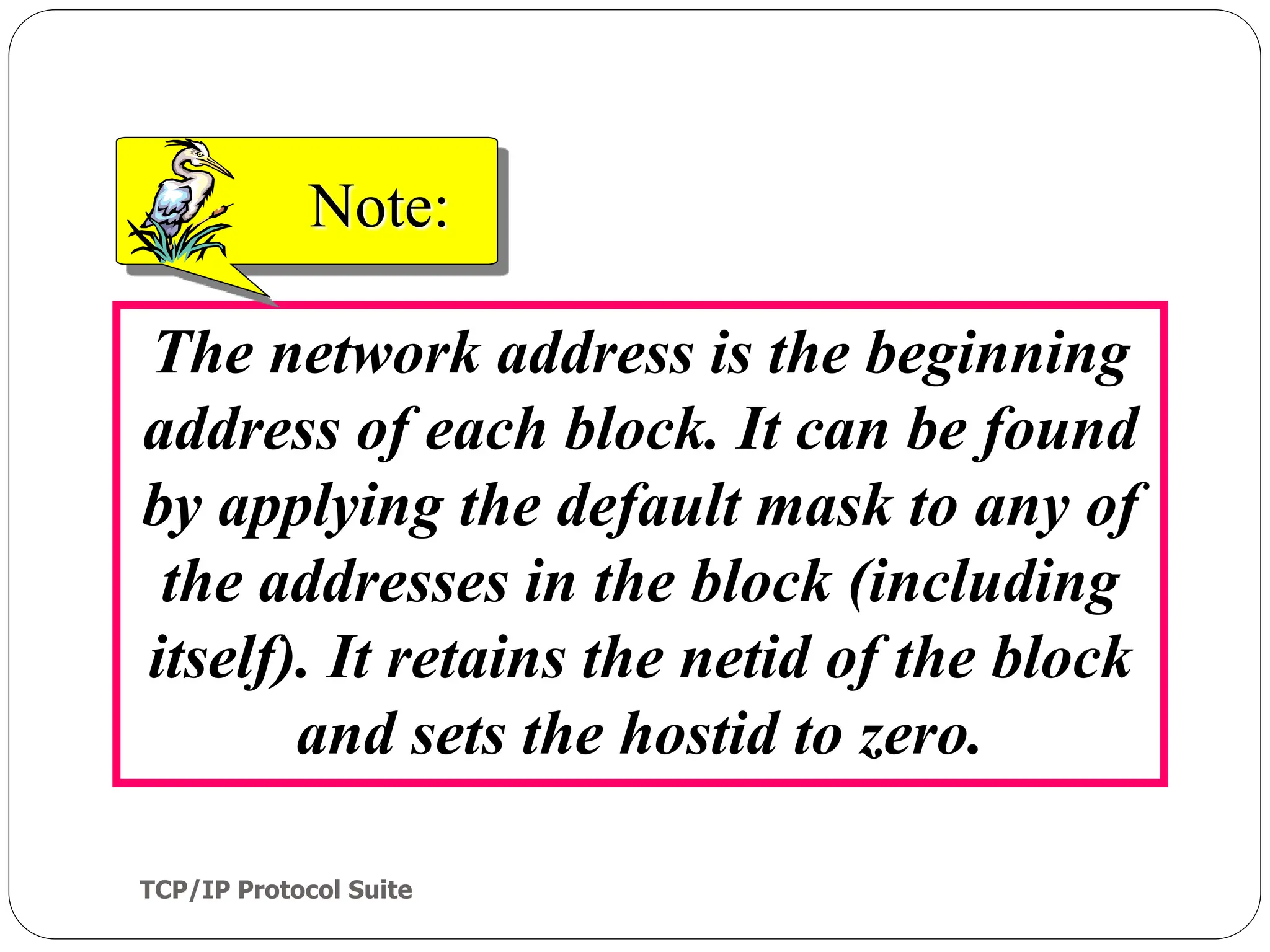
The network address is the beginning
address of each block. It can be found
by applying the default mask to any of
the addresses in the block (including
itself). It retains the netid of the block
and sets the hostid to zero.
Note:
TCP/IP Protocol Suite
37
Given the address 23.56.7.91, find the beginning address
(network address).
Example 12
Solution
.
TCP/IP Protocol Suite
38
Given the address 132.6.17.85, find the beginning address
(network address).
Example 13
Solution
.
TCP/IP Protocol Suite
39
Given the address 201.180.56.5, find the beginning address
(network address).
Example 14
Solution
TCP/IP Protocol Suite
40
Note that we must not apply the
default mask of one class to an address
belonging to another class.
Note:
TCP/IP Protocol Suite
41
4.3 OTHER ISSUES
In this section, we discuss some other issues that are related to
addressing in general and classful addressing in particular.
The topics discussed in this section include:
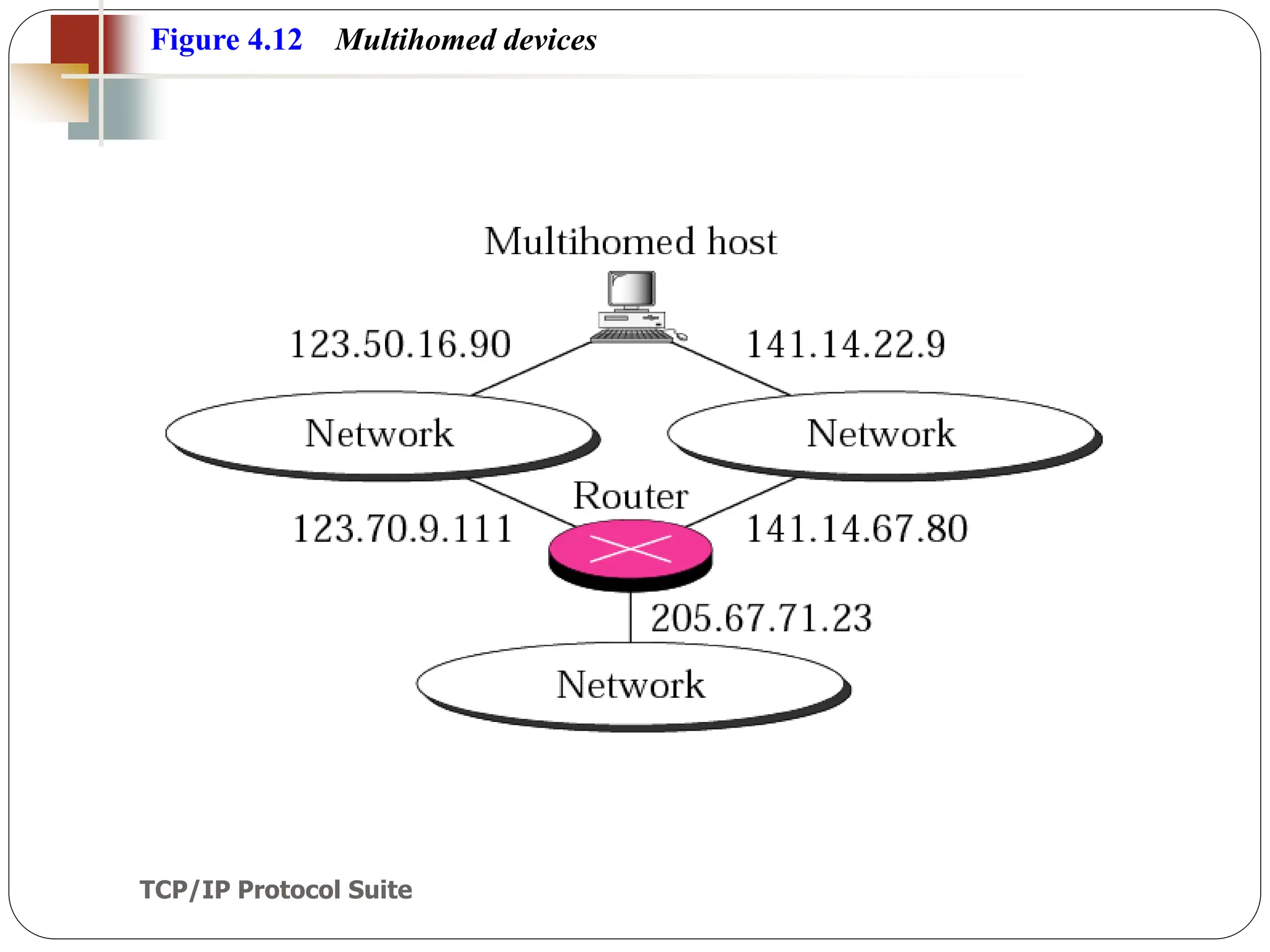
Multihomed Devices
Location, Not Names
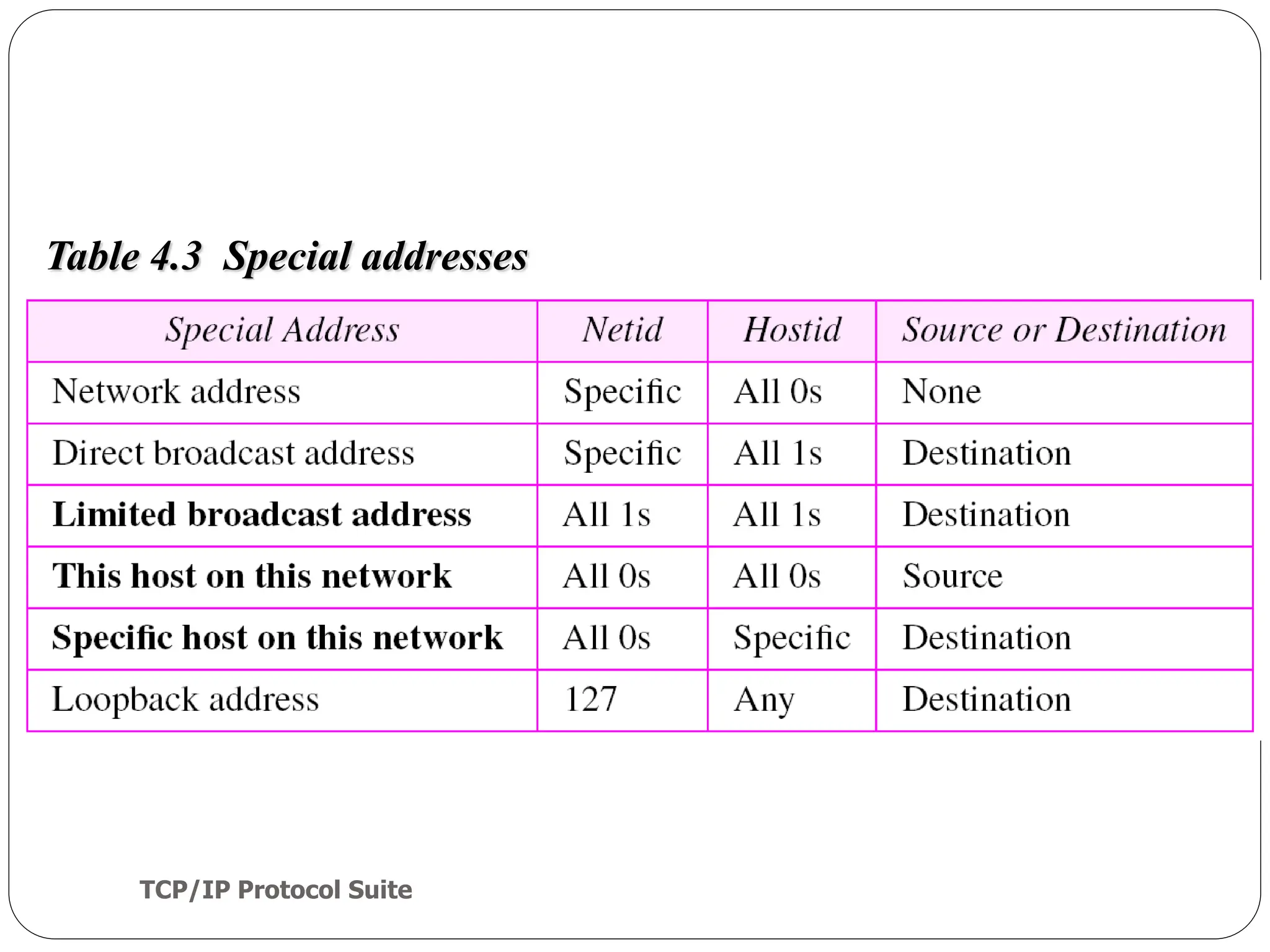
Special Addresses
Private Addresses
Unicast, Multicast, and Broadcast Addresses
TCP/IP Protocol Suite
42
Figure 4.12 Multihomed devices
TCP/IP Protocol Suite
43
Table 4.3 Special addresses
TCP/IP Protocol Suite
44
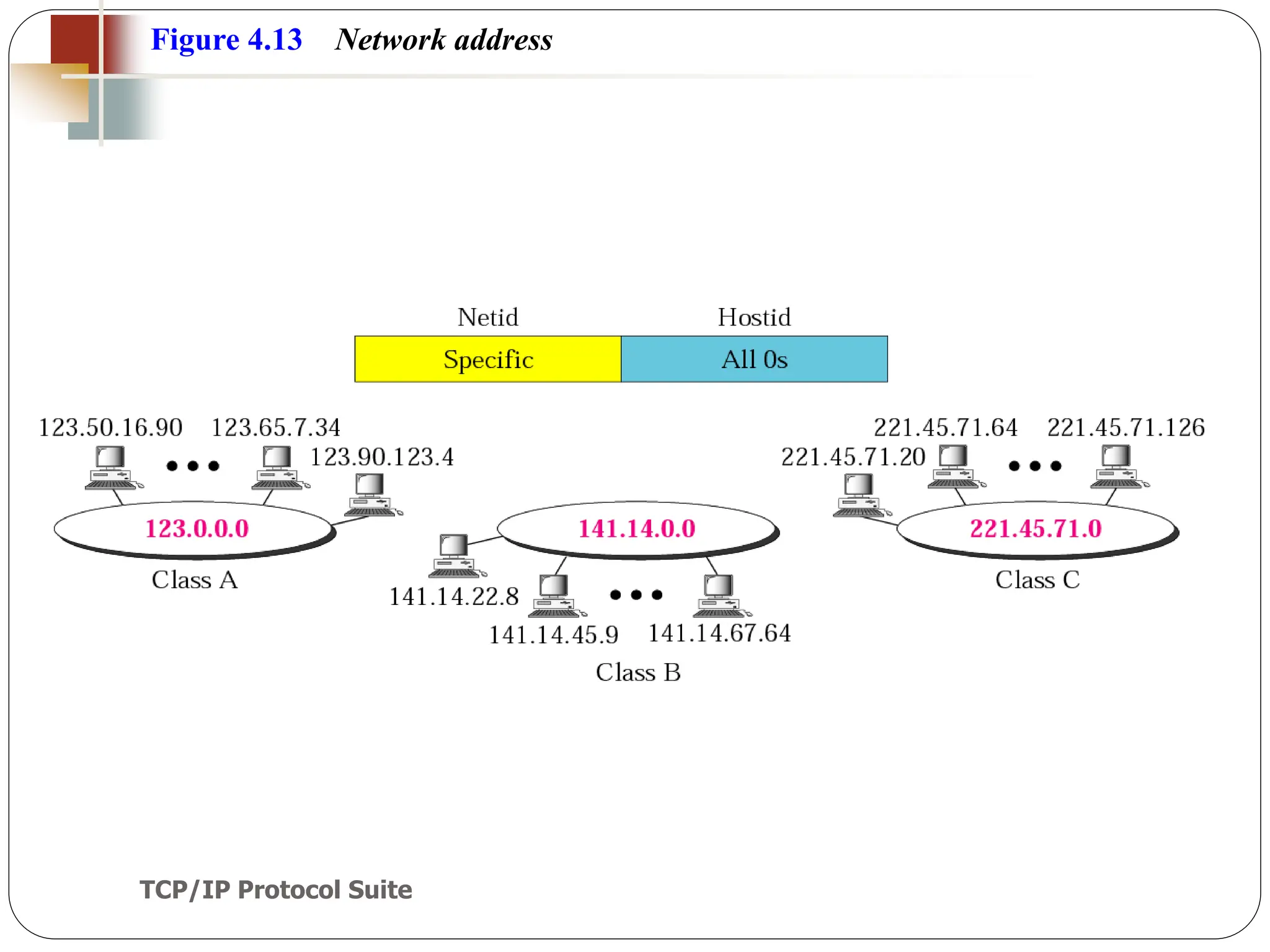
Figure 4.13 Network address
TCP/IP Protocol Suite
45
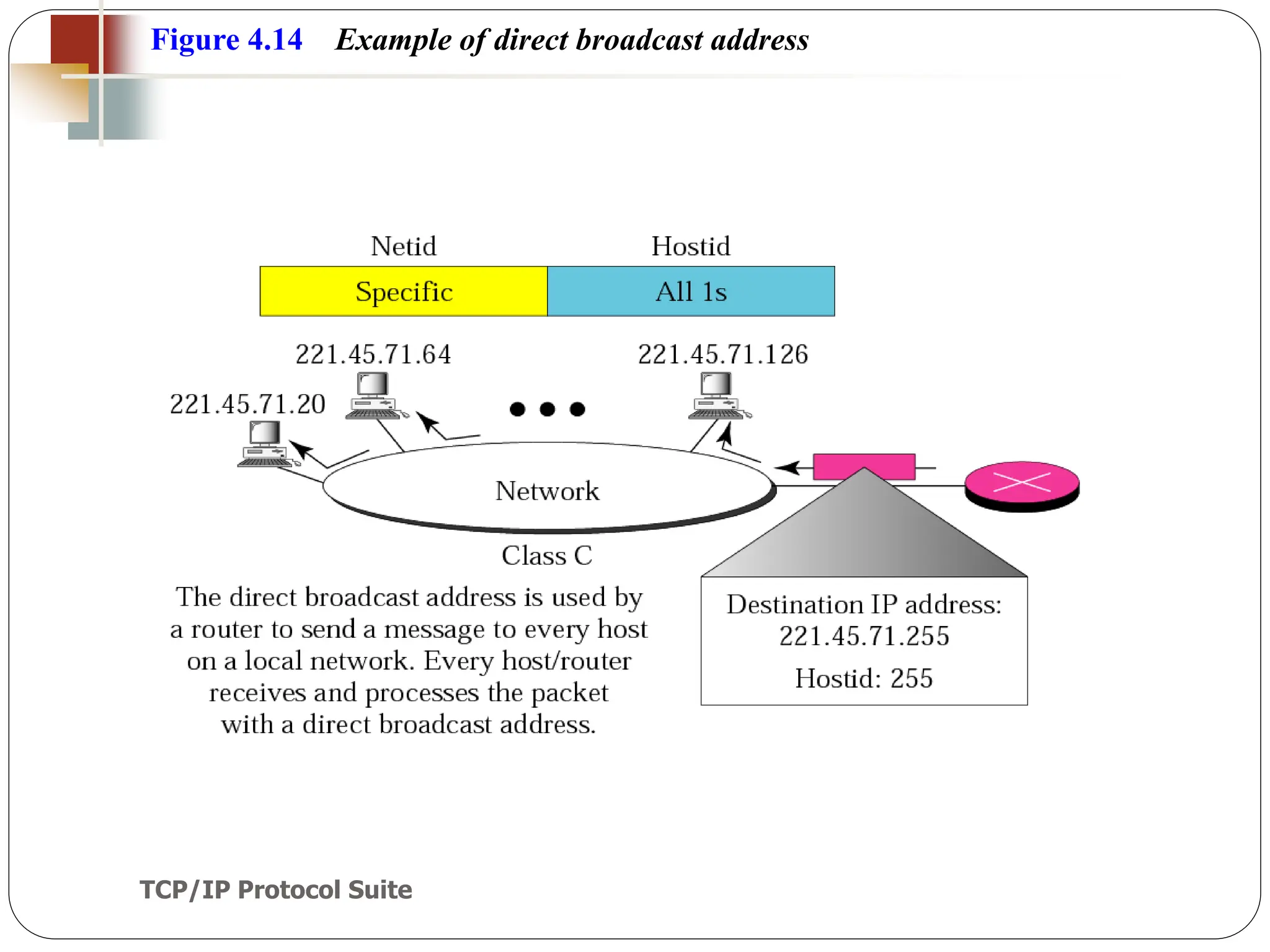
Figure 4.14 Example of direct broadcast address
TCP/IP Protocol Suite
46
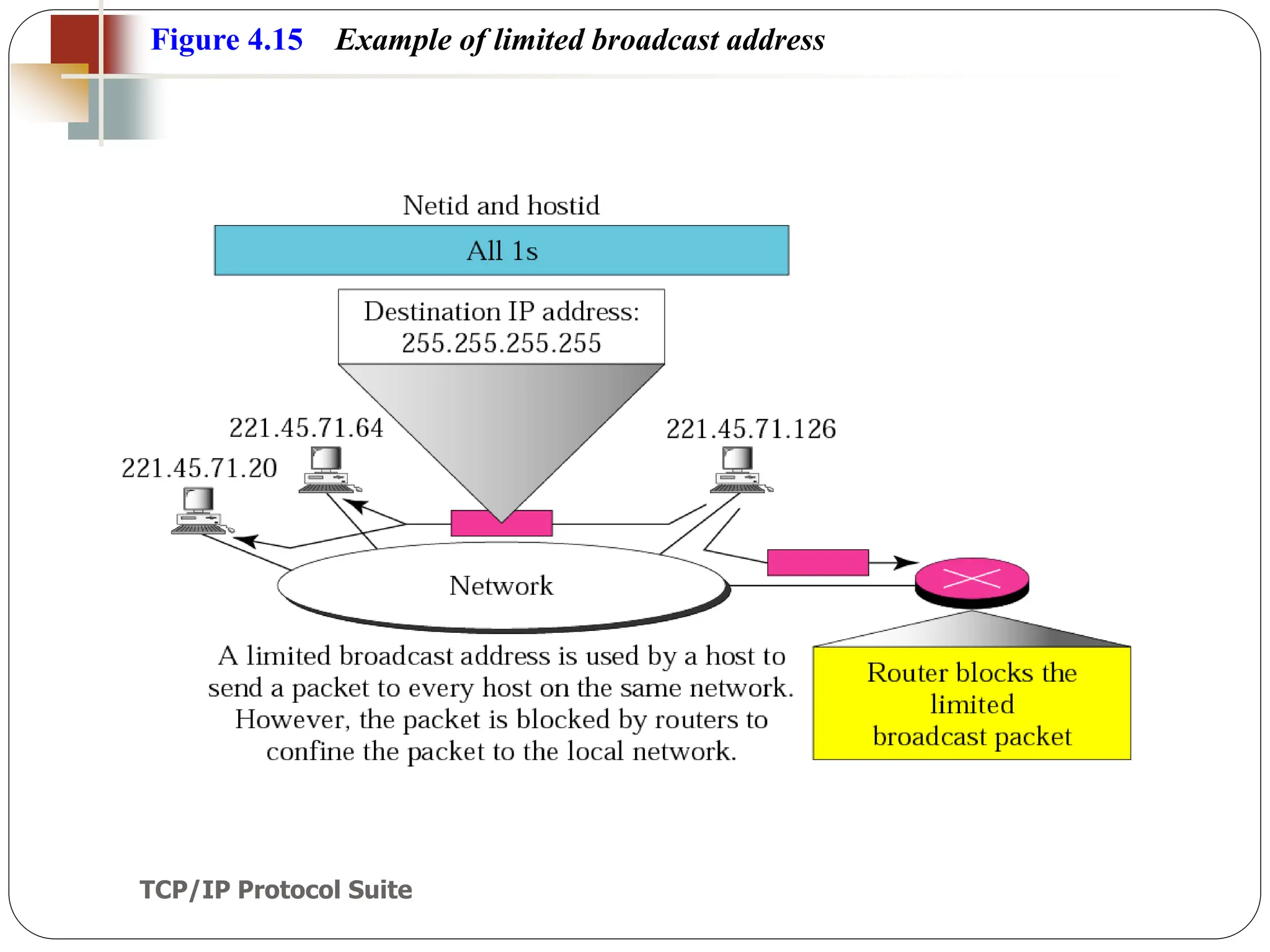
Figure 4.15 Example of limited broadcast address
TCP/IP Protocol Suite
47
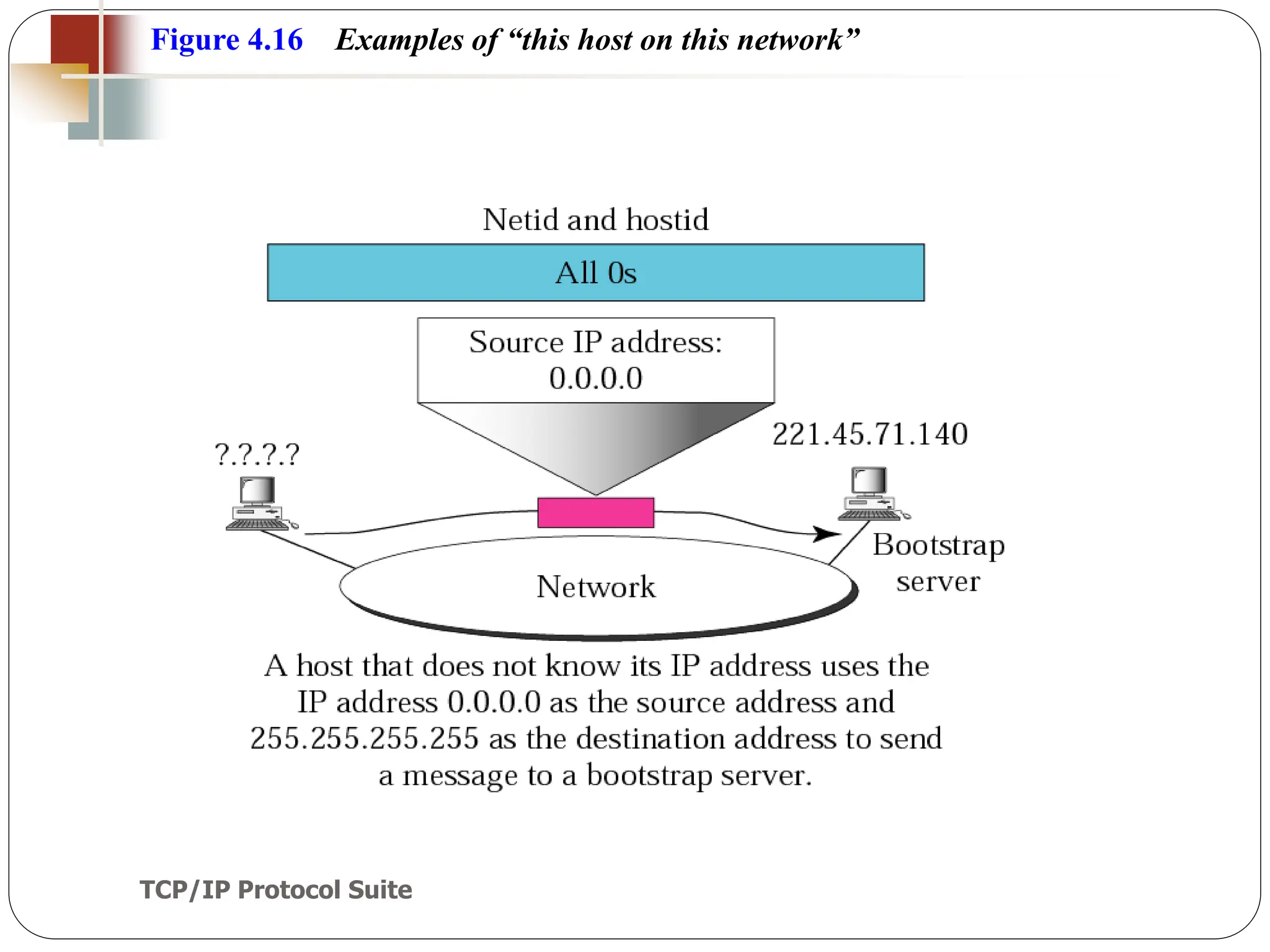
Figure 4.16 Examples of “this host on this network”
TCP/IP Protocol Suite
48
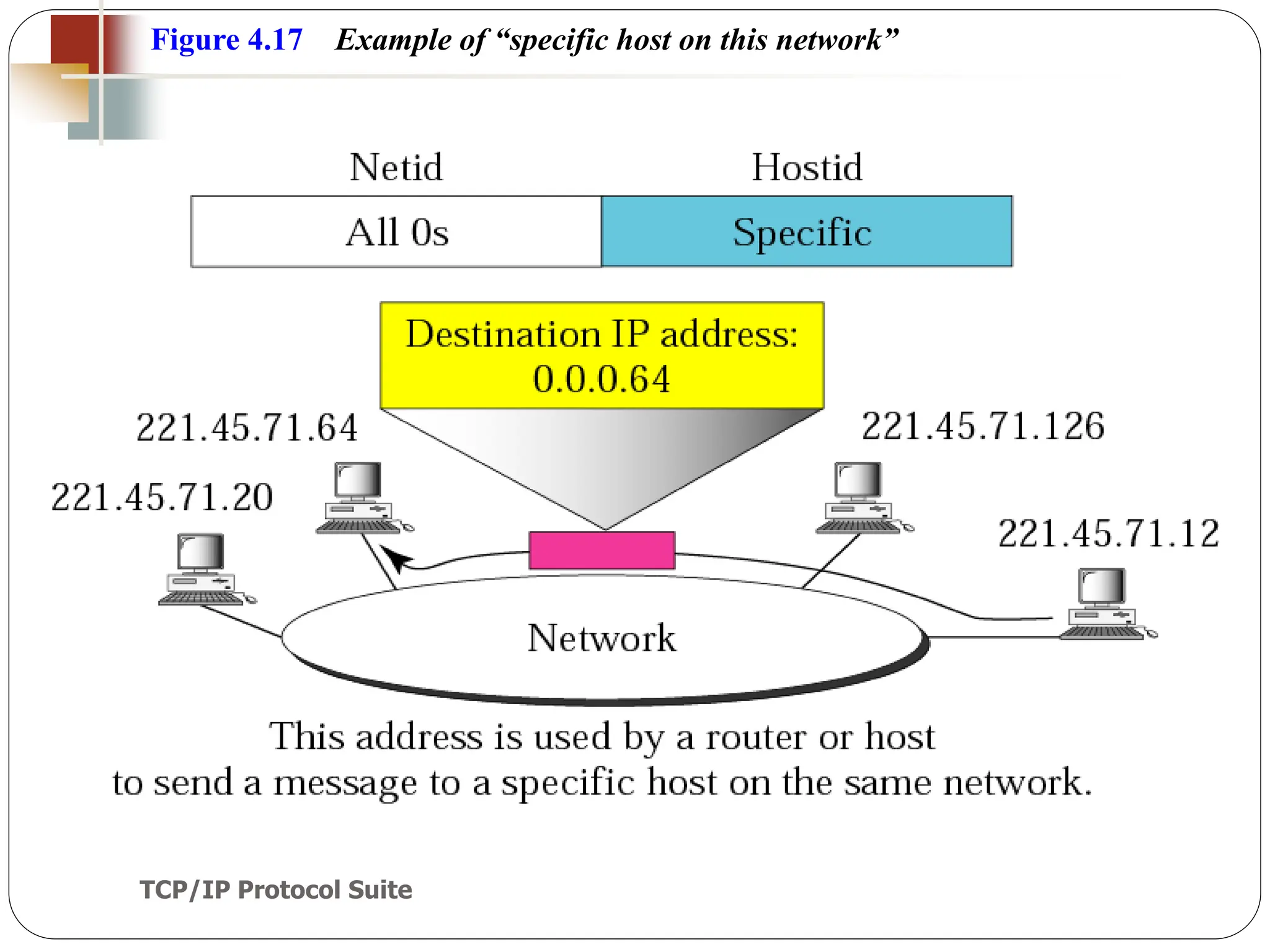
Figure 4.17 Example of “specific host on this network”
TCP/IP Protocol Suite
49
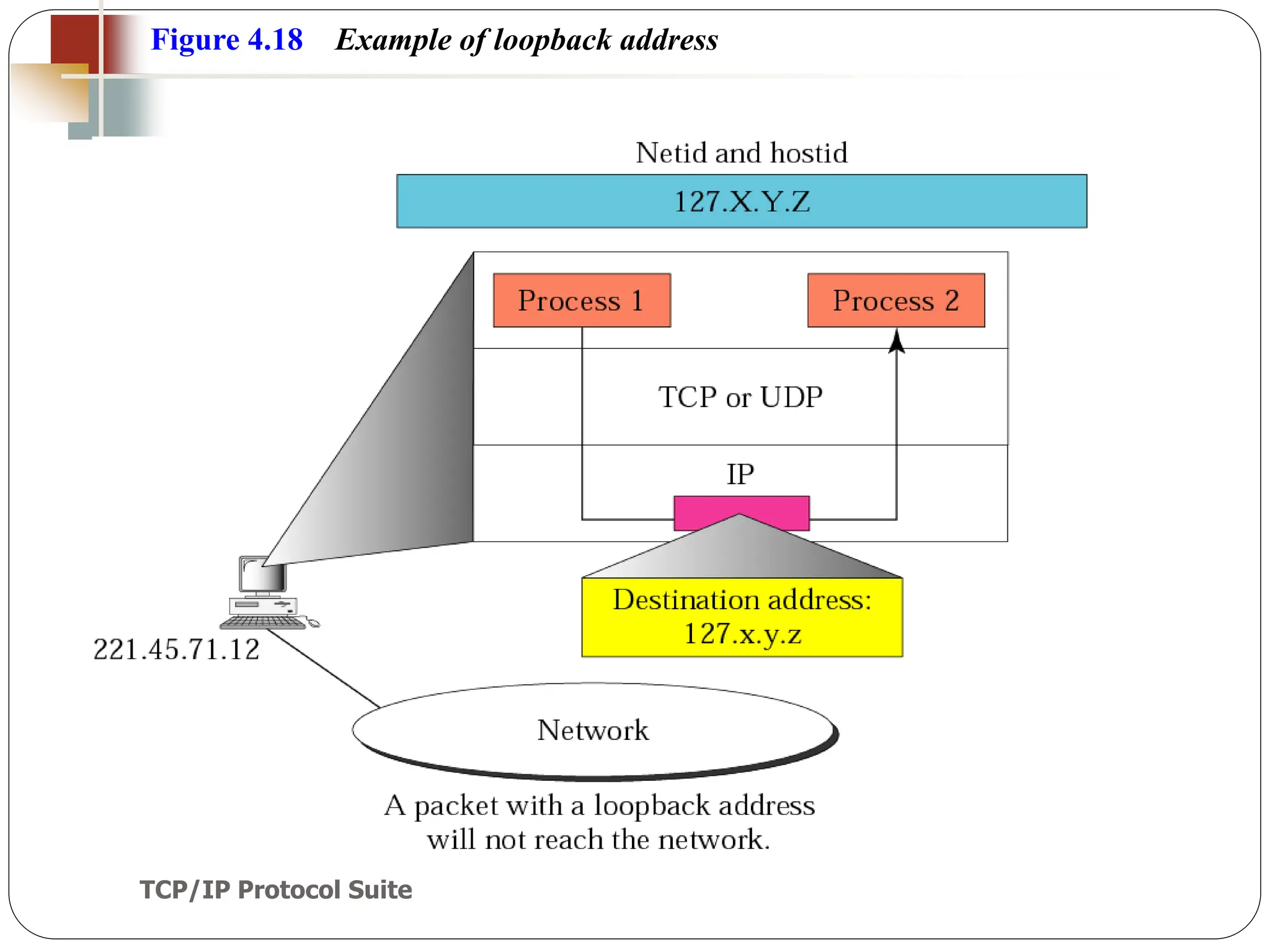
Figure 4.18 Example of loopback address
TCP/IP Protocol Suite
50
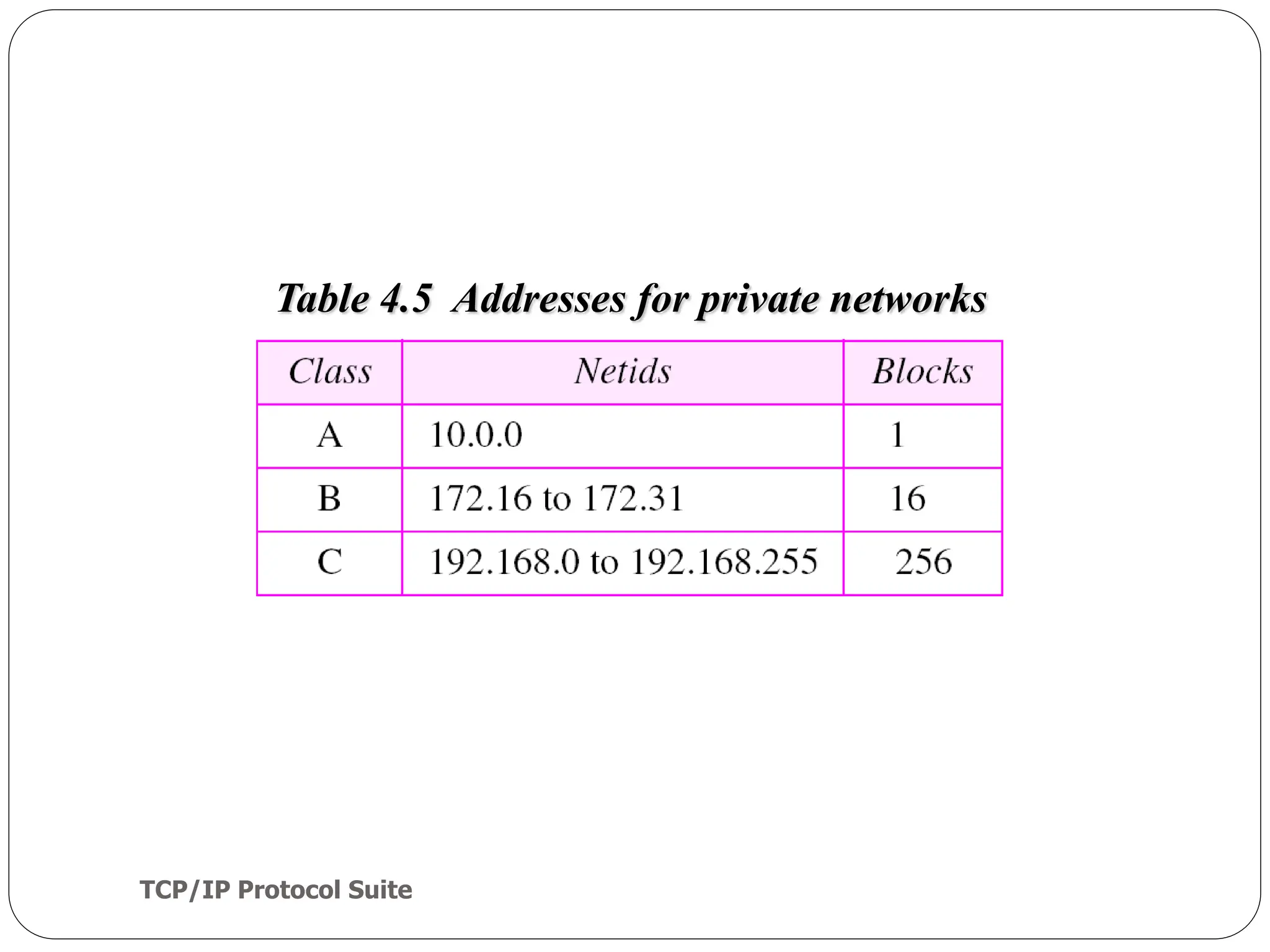
Table 4.5 Addresses for private networks
TCP/IP Protocol Suite
51
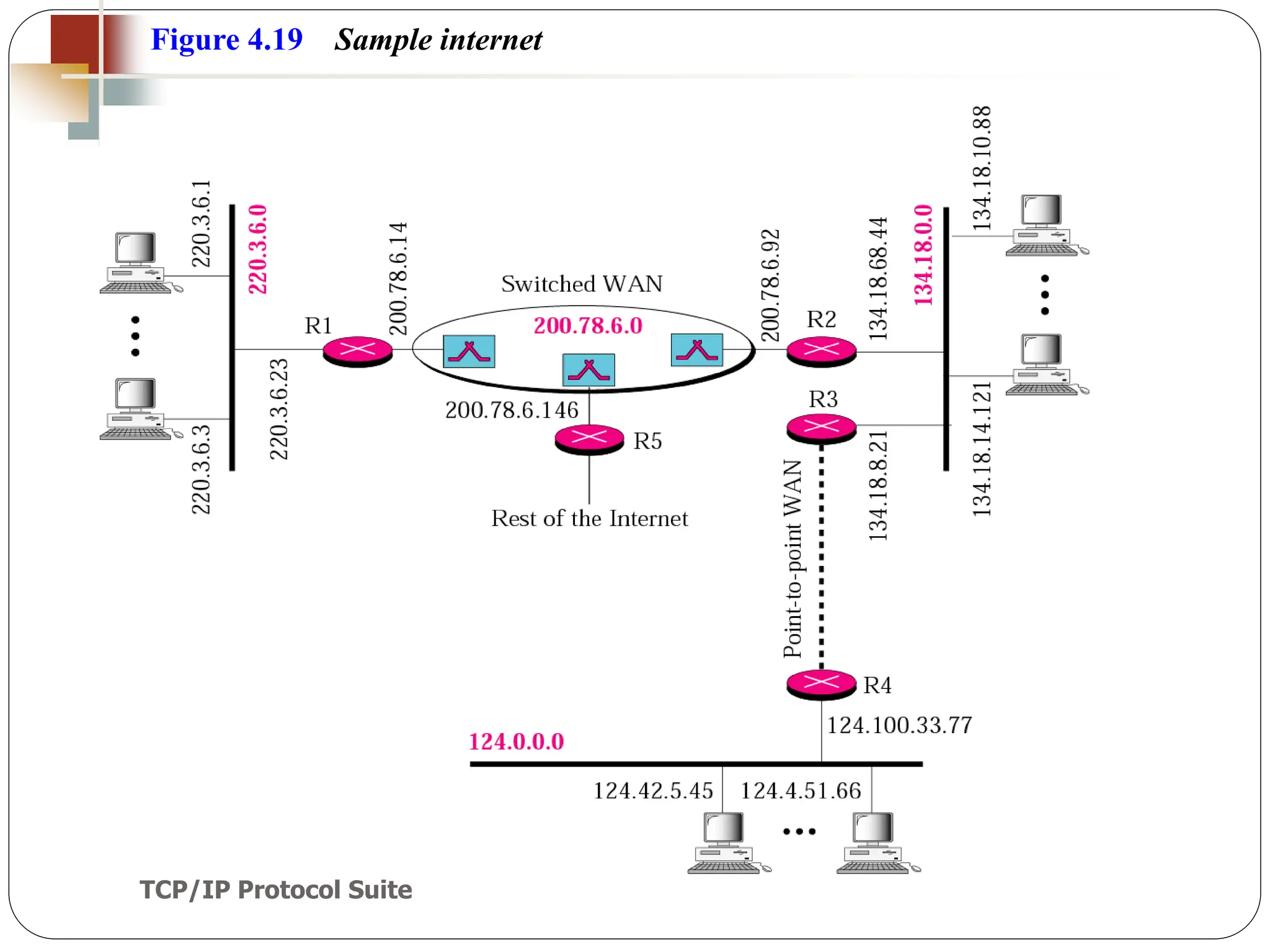
Figure 4.19 Sample internet
TCP/IP Protocol Suite
52
4.4 SUBNETTING AND
SUPERNETTING
In the previous sections we discussed the problems associated with
classful addressing. Specifically, the network addresses available for
assignment to organizations are close to depletion. This is coupled with
the ever-increasing demand for addresses from organizations that want
connection to the Internet. In this section we briefly discuss two
solutions: subnetting and supernetting.
The topics discussed in this section include:
Subnetting
Supernetting
Supernet Mask
Obsolescence
TCP/IP Protocol Suite
53
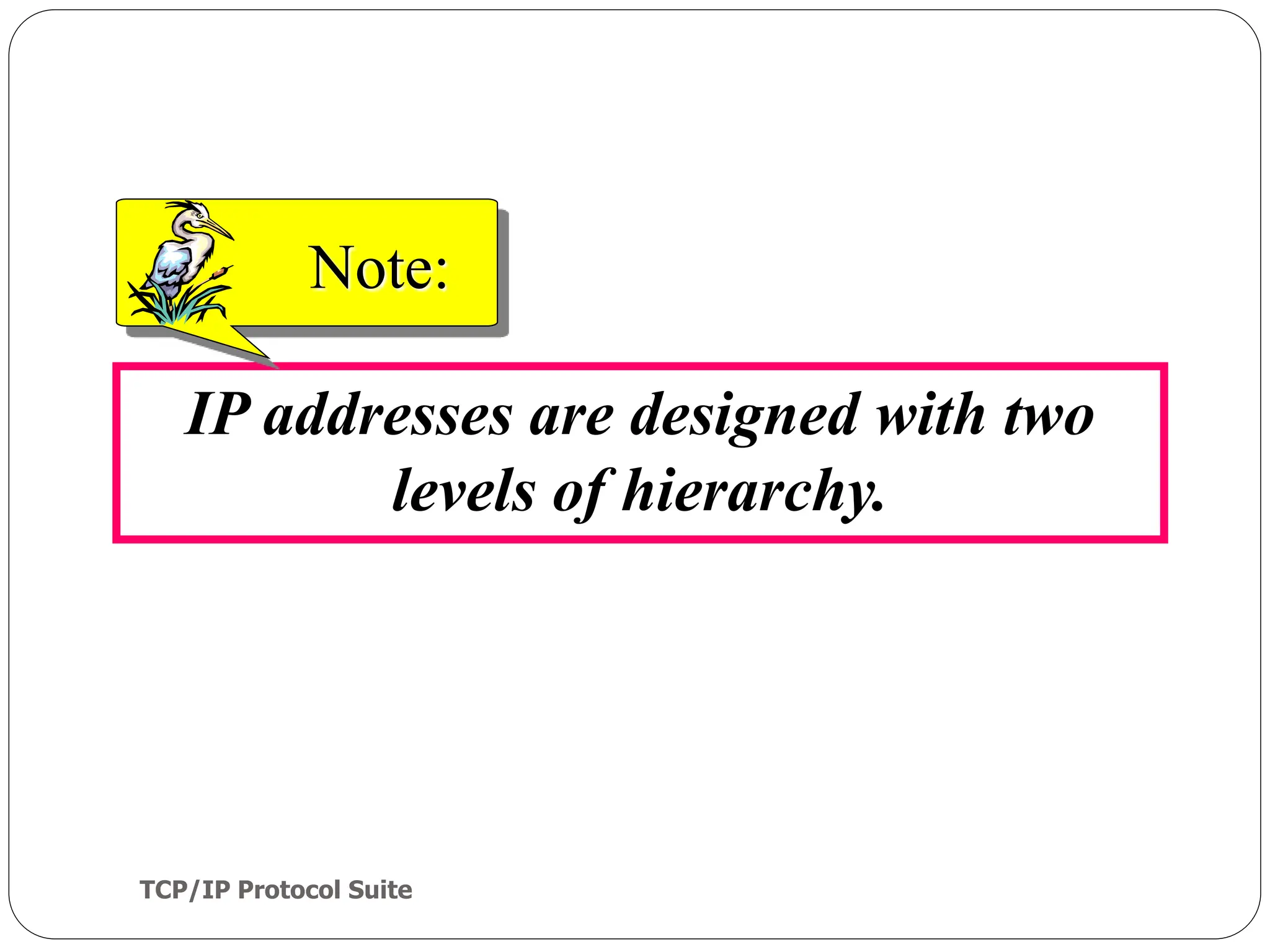
IP addresses are designed with two
levels of hierarchy.
Note:
TCP/IP Protocol Suite
54
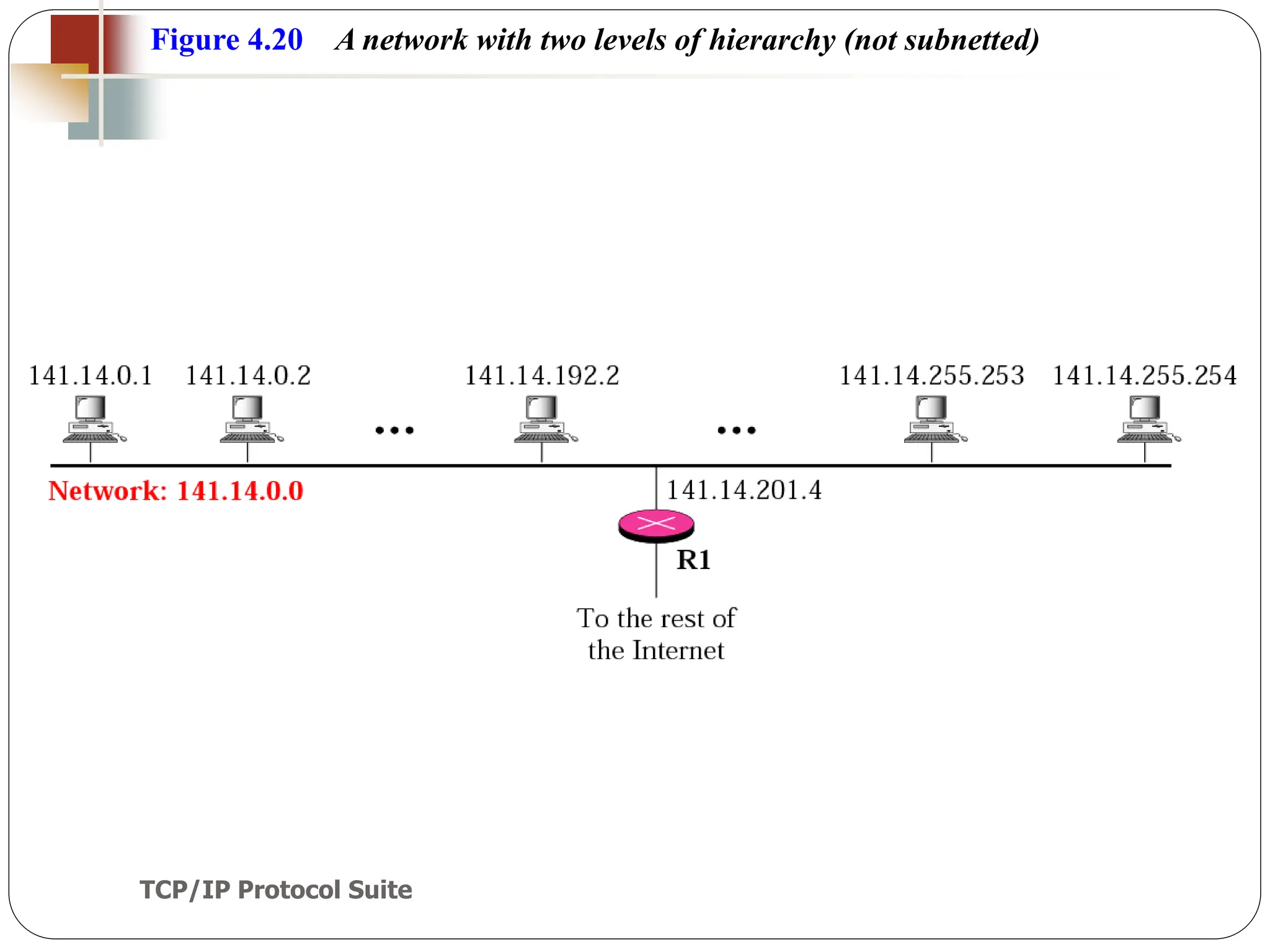
Figure 4.20 A network with two levels of hierarchy (not subnetted)
TCP/IP Protocol Suite
55
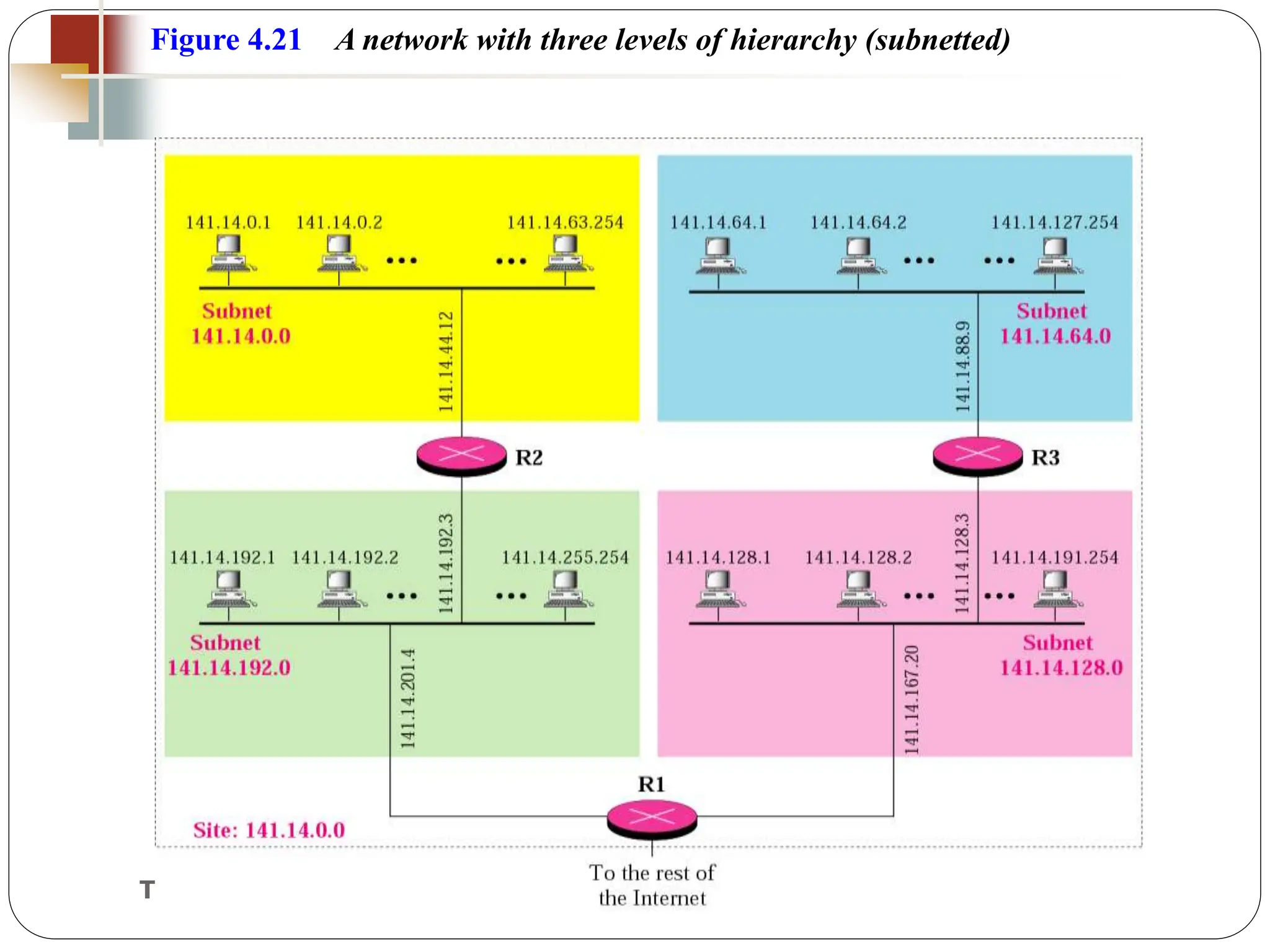
Figure 4.21 A network with three levels of hierarchy (subnetted)
TCP/IP Protocol Suite
56
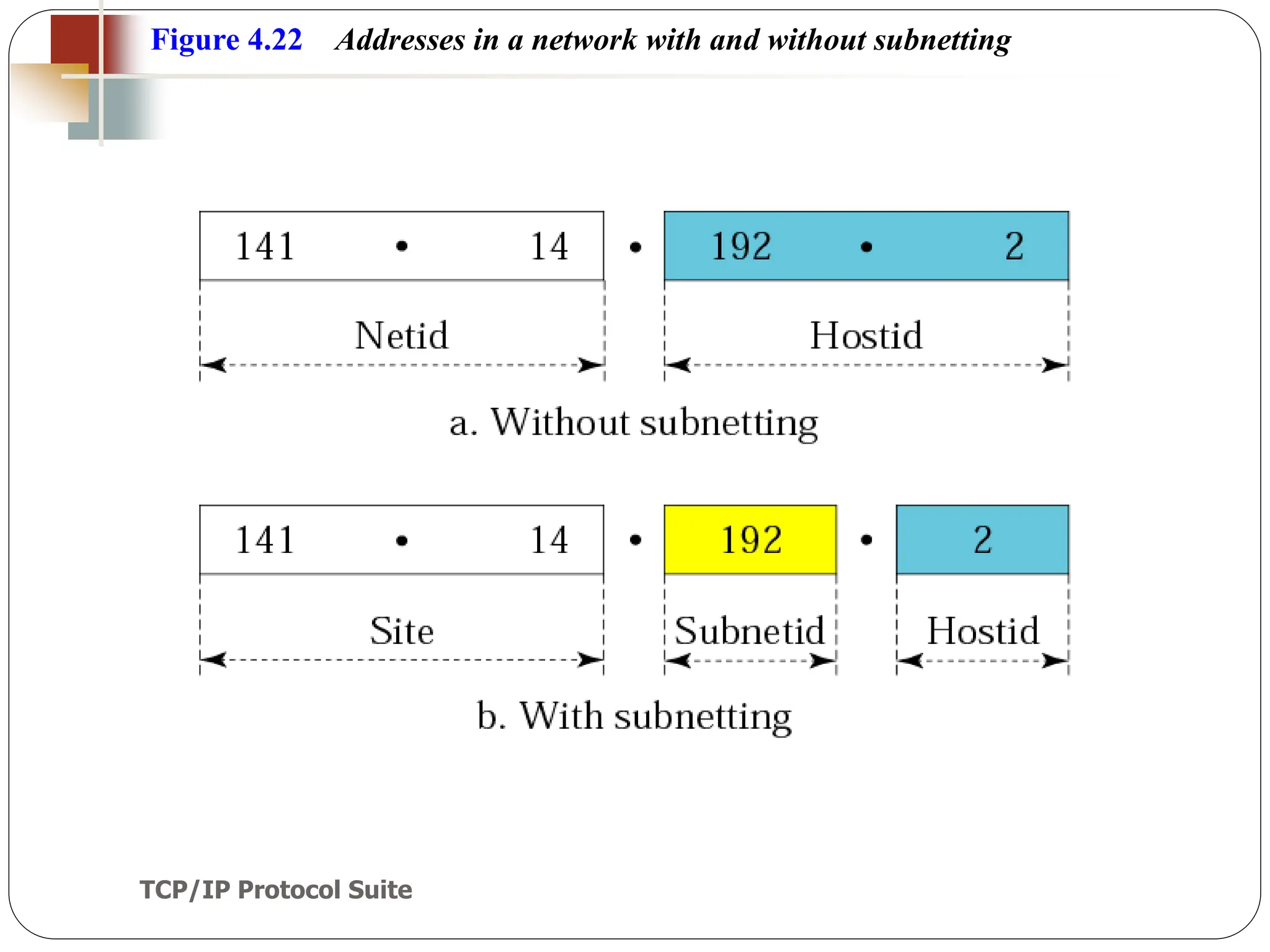
Figure 4.22 Addresses in a network with and without subnetting
TCP/IP Protocol Suite
57
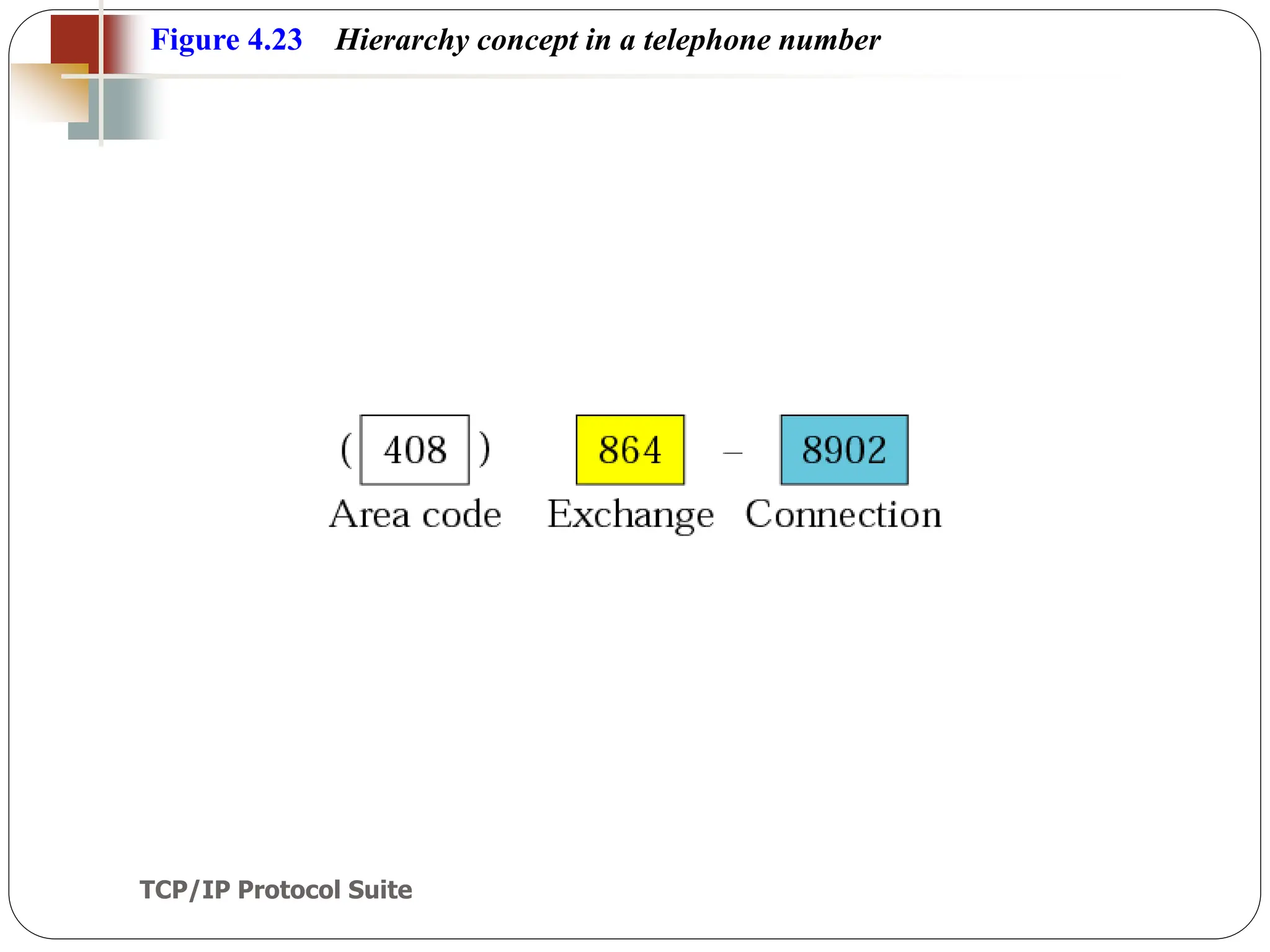
Figure 4.23 Hierarchy concept in a telephone number
TCP/IP Protocol Suite
58
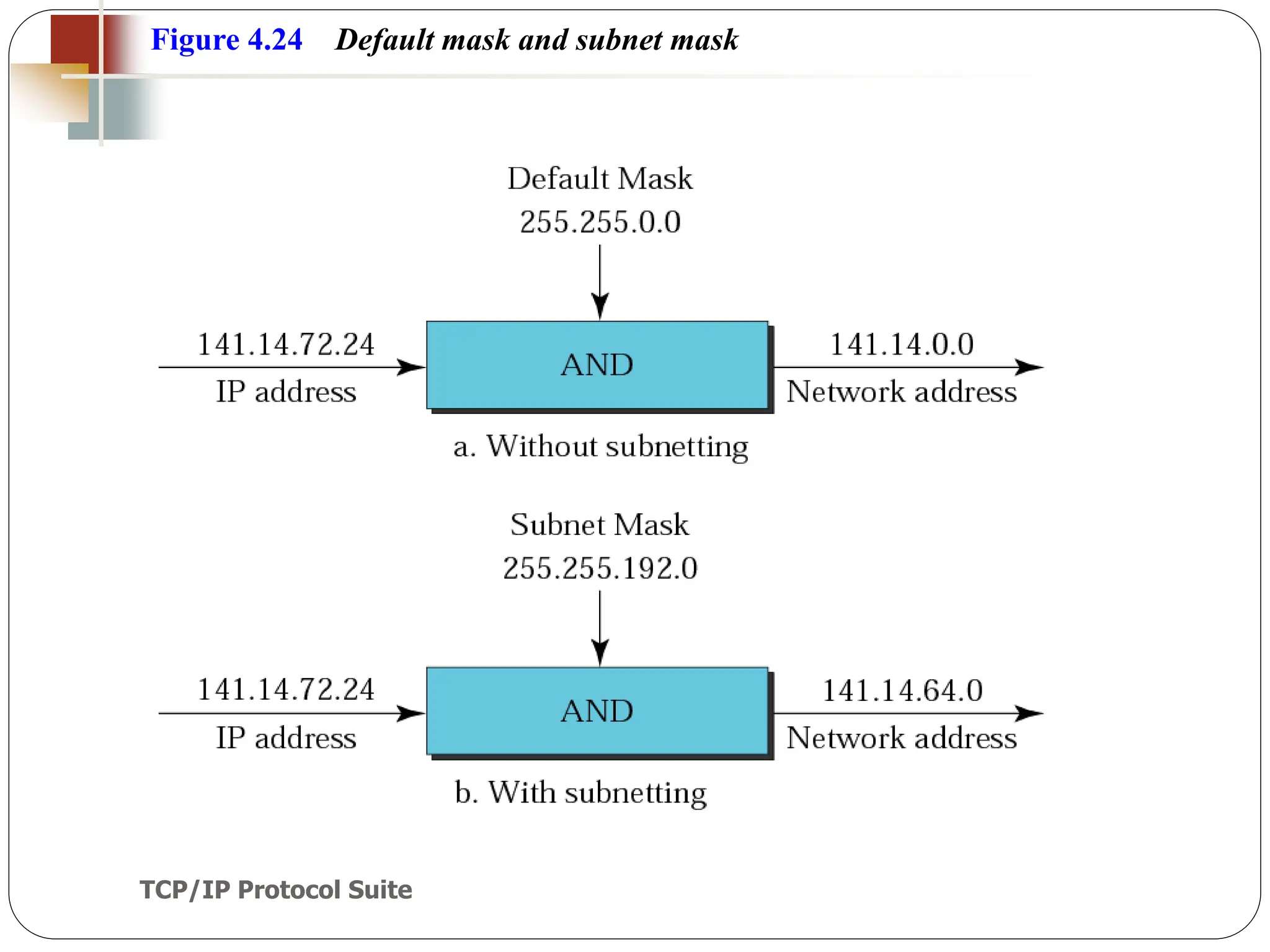
Figure 4.24 Default mask and subnet mask
TCP/IP Protocol Suite
59
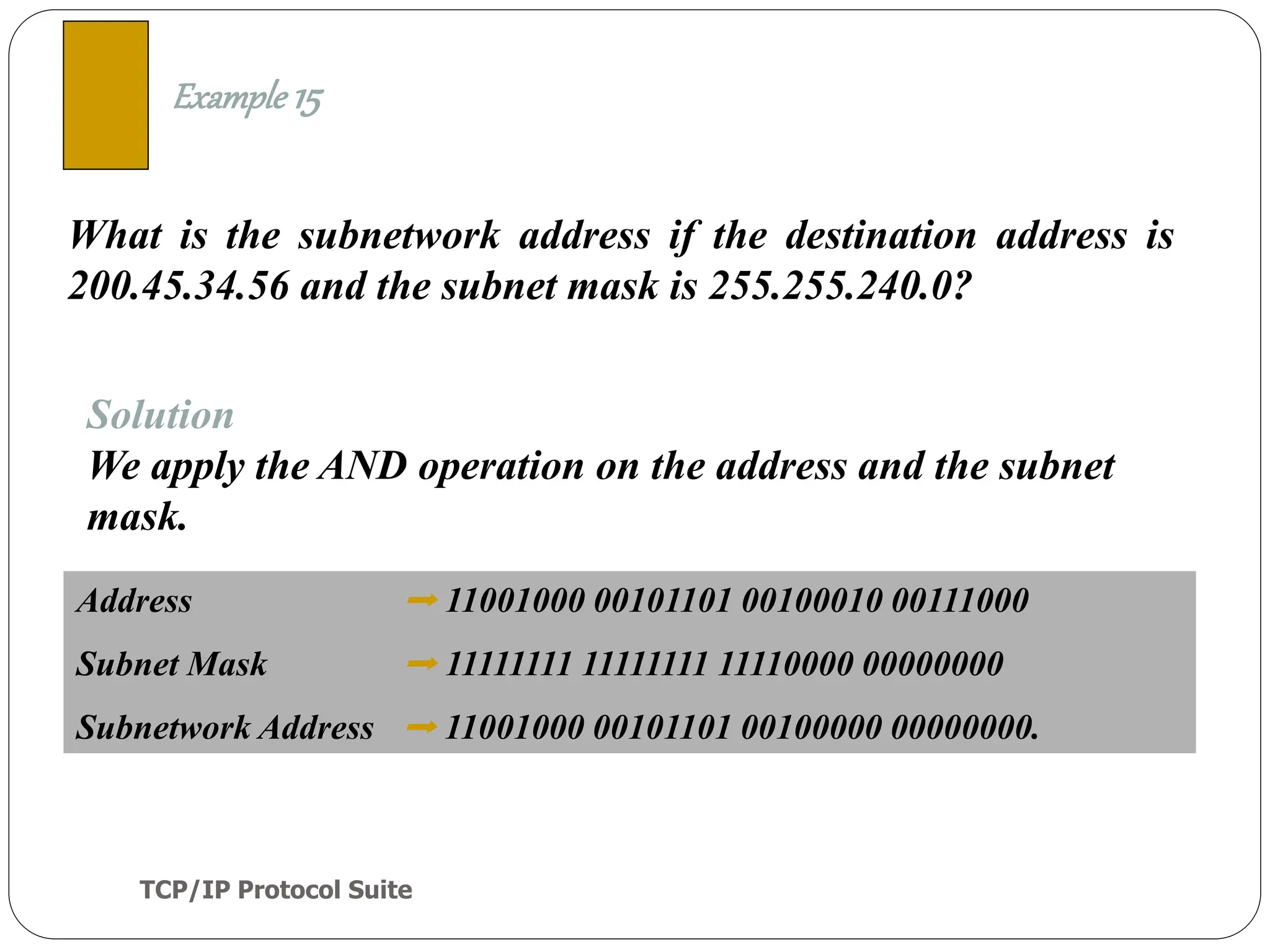
What is the subnetwork address if the destination address is
200.45.34.56 and the subnet mask is 255.255.240.0?
Example 15
Solution
We apply the AND operation on the address and the subnet
mask.
Address ➡ 11001000 00101101 00100010 00111000
Subnet Mask ➡ 11111111 11111111 11110000 00000000
Subnetwork Address ➡ 11001000 00101101 00100000 00000000.
TCP/IP Protocol Suite
60
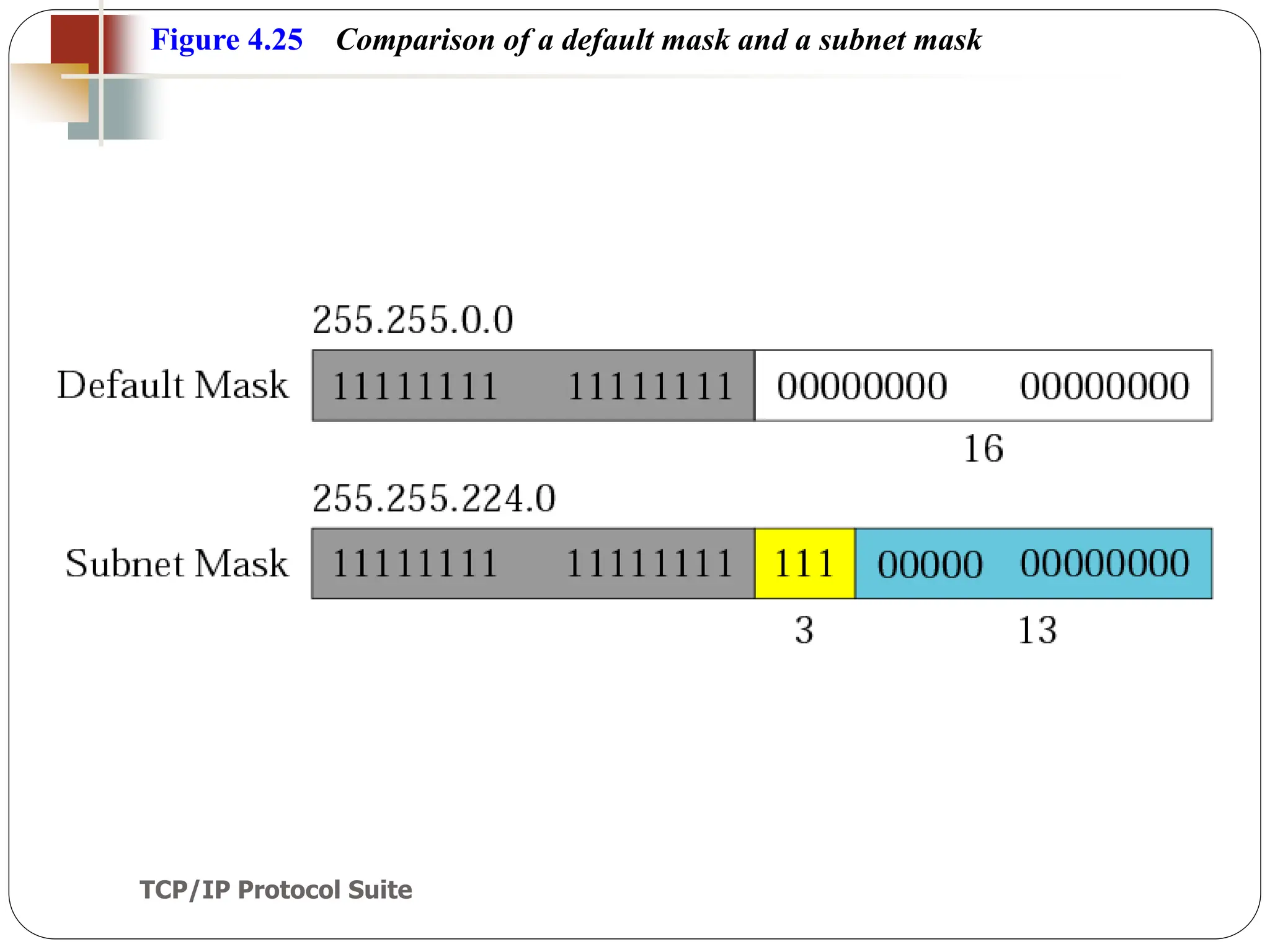
Figure 4.25 Comparison of a default mask and a subnet mask
TCP/IP Protocol Suite
61
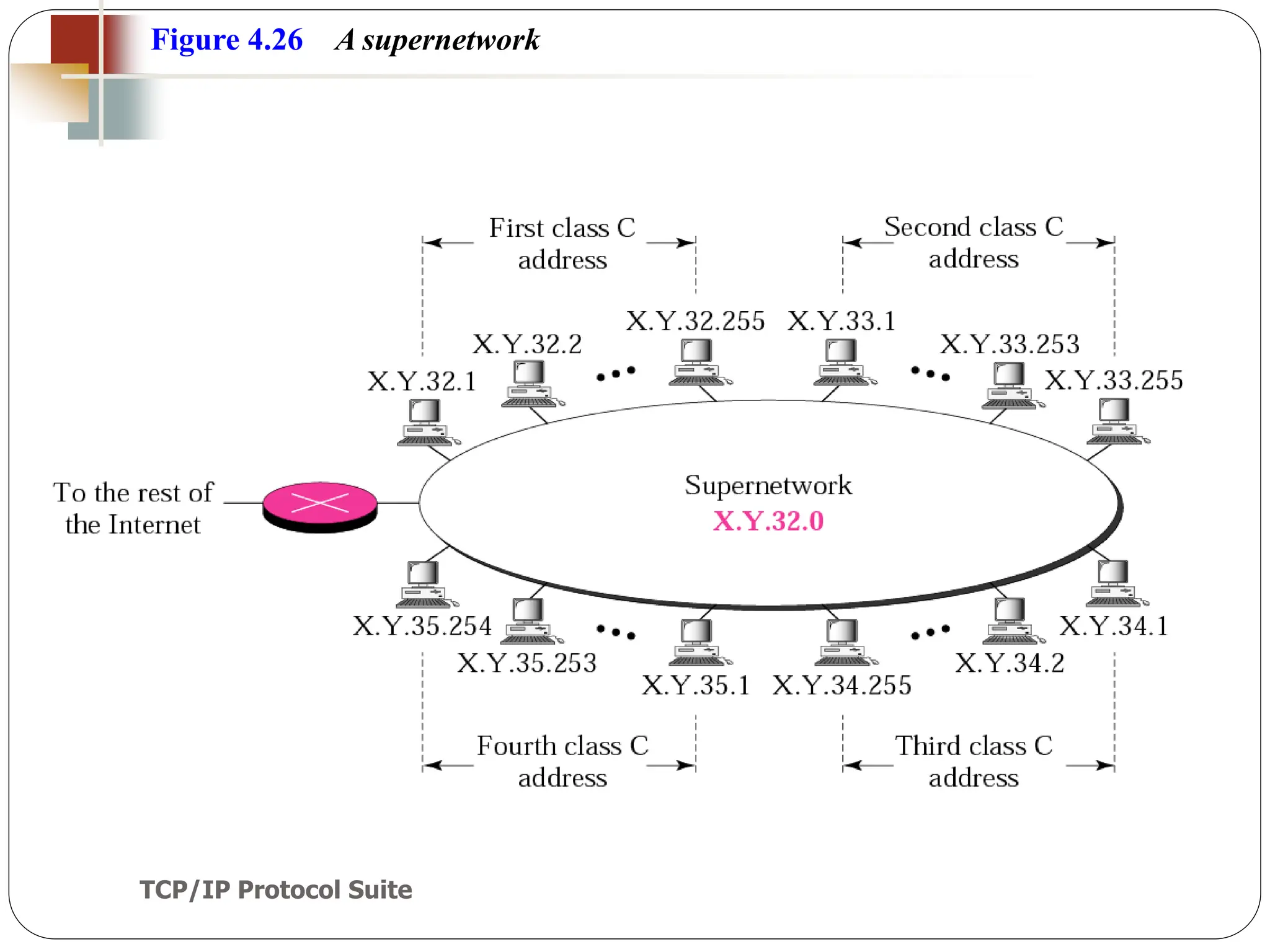
Figure 4.26 A supernetwork
TCP/IP Protocol Suite
62
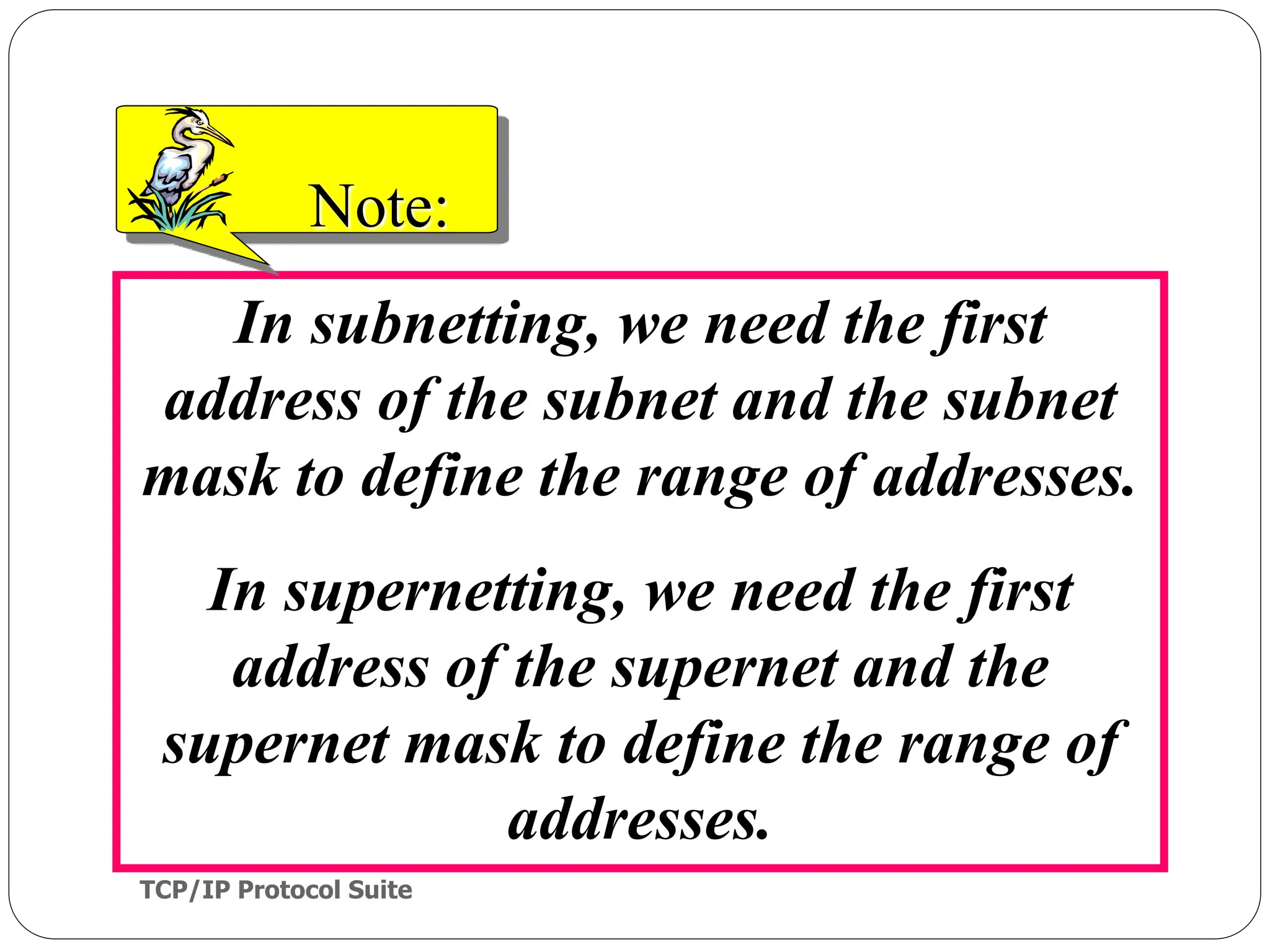
In subnetting, we need the first
address of the subnet and the subnet
mask to define the range of addresses.
In supernetting, we need the first
address of the supernet and the
supernet mask to define the range of
addresses.
Note:
TCP/IP Protocol Suite
63
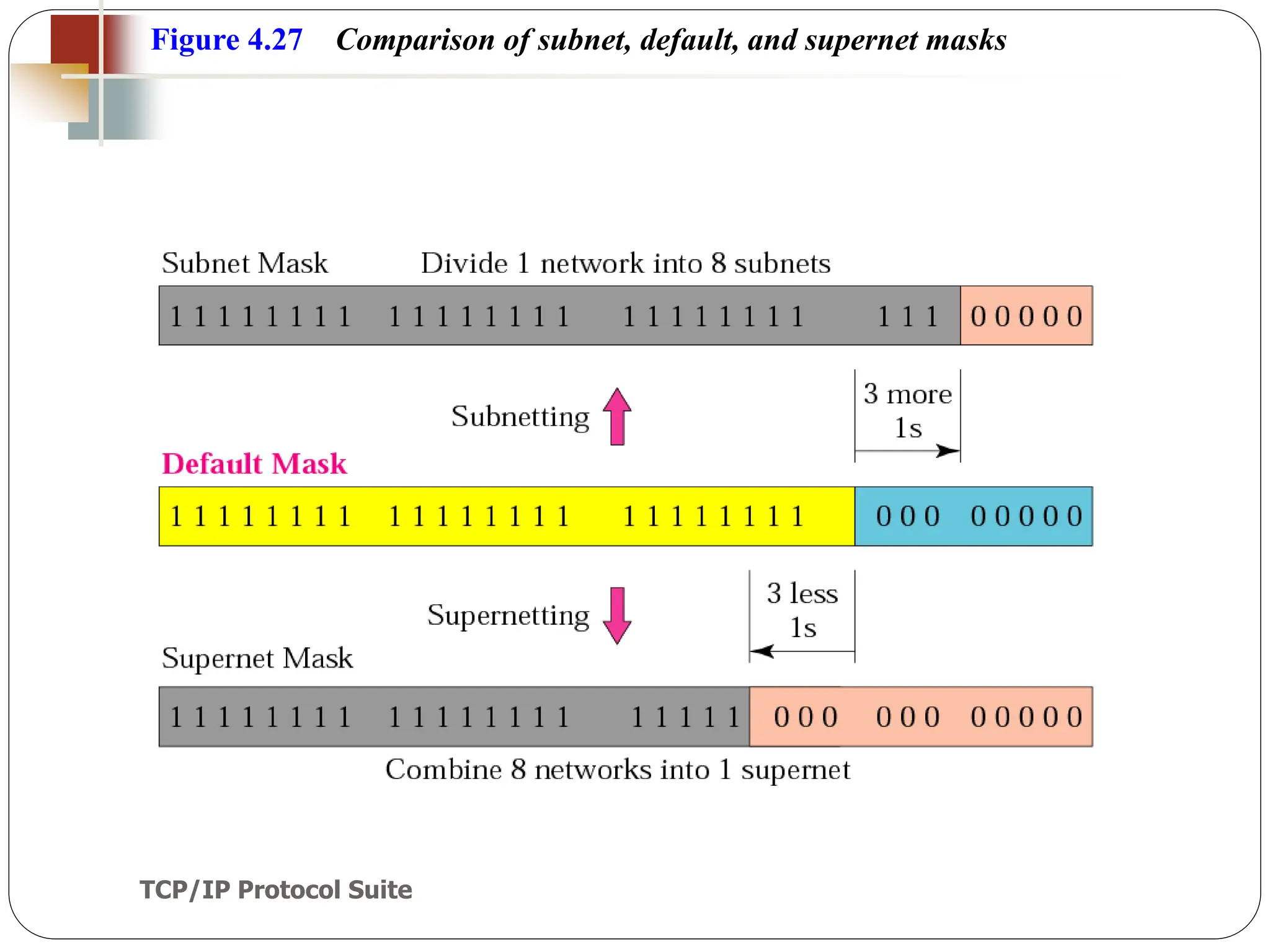
Figure 4.27 Comparison of subnet, default, and supernet masks
TCP/IP Protocol Suite
64
The idea of subnetting and
supernetting of classful addresses is
almost obsolete.
Note:
TCP/IP Protocol Suite
65
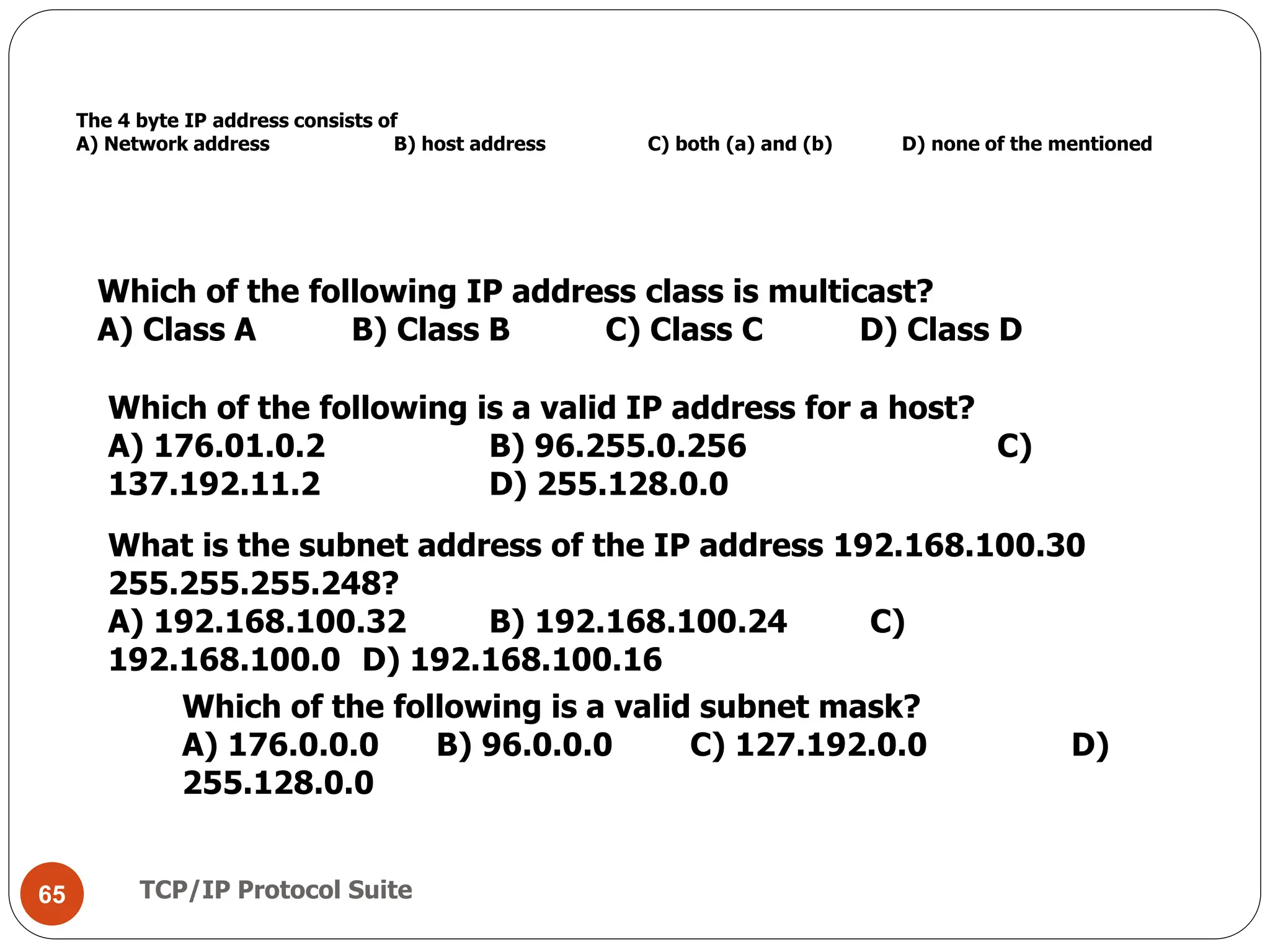
The 4 byte IP address consists of
A) Network address B) host address C) both (a) and (b) D) none of the mentioned
Which of the following IP address class is multicast?
A) Class A B) Class B C) Class C D) Class D
Which of the following is a valid IP address for a host?
A) 176.01.0.2 B) 96.255.0.256 C)
137.192.11.2 D) 255.128.0.0
What is the subnet address of the IP address 192.168.100.30
255.255.255.248?
A) 192.168.100.32 B) 192.168.100.24 C)
192.168.100.0 D) 192.168.100.16
Which of the following is a valid subnet mask?
A) 176.0.0.0 B) 96.0.0.0 C) 127.192.0.0 D)
255.128.0.0

17433_ip-addressing-subnetting-supernetting.ppt

  • 1.
    TCP/IP Protocol Suite 1 Chapter4 Objectives Upon completion you will be able to: IP Addresses: Classful Addressing • Understand IPv4 addresses and classes • Identify the class of an IP address • Find the network address given an IP address • Understand masks and how to use them • Understand subnets and supernets
  • 2.
    TCP/IP Protocol Suite 2 4.1INTRODUCTION 4.1 INTRODUCTION The identifier used in the IP layer of the TCP/IP protocol suite to identify each device connected to the Internet is called the Internet address or IP address. An IP address is a 32-bit address that uniquely and universally defines the connection of a host or a router to the Internet. IP addresses are unique. They are unique in the sense that each address defines one, and only one, connection to the Internet. Two devices on the Internet can never have the same address. The topics discussed in this section include: Address Space Notation
  • 3.
    TCP/IP Protocol Suite 3 AnIP address is a 32-bit address. Note:
  • 4.
    TCP/IP Protocol Suite 4 TheIP addresses are unique. Note:
  • 5.
    TCP/IP Protocol Suite 5 Theaddress space of IPv4 is 232 or 4,294,967,296. Note:
  • 6.
    TCP/IP Protocol Suite 6 Figure4.1 Dotted-decimal notation
  • 7.
    TCP/IP Protocol Suite 7 Thebinary, decimal, and hexadecimal number systems are reviewed in Appendix B. Note:
  • 8.
    TCP/IP Protocol Suite 8 Changethe following IP addresses from binary notation to dotted-decimal notation. a. 10000001 00001011 00001011 11101111 b. 11000001 10000011 00011011 11111111 c. 11100111 11011011 10001011 01101111 d. 11111001 10011011 11111011 00001111 Example 1 Solution We replace each group of 8 bits with its equivalent decimal number (see Appendix B) and add dots for separation: a. 129.11.11.239 b. 193.131.27.255 c. 231.219.139.111 d. 249.155.251.15
  • 9.
    TCP/IP Protocol Suite 9 Changethe following IP addresses from dotted-decimal notation to binary notation. a. 111.56.45.78 b. 221.34.7.82 c. 241.8.56.12 d. 75.45.34.78 Example 2 Solution We replace each decimal number with its binary equivalent: a. 01101111 00111000 00101101 01001110 b. 11011101 00100010 00000111 01010010 c. 11110001 00001000 00111000 00001100 d. 01001011 00101101 00100010 01001110
  • 10.
    TCP/IP Protocol Suite 10 Findthe error, if any, in the following IP addresses: a. 111.56.045.78 b. 221.34.7.8.20 c. 75.45.301.14 d. 11100010.23.14.67 Example 3 Solution a.
  • 11.
    TCP/IP Protocol Suite 11 4.2CLASSFUL ADDRESSING IP addresses, when started a few decades ago, used the concept of classes. This architecture is called classful addressing. In the mid-1990s, a new architecture, called classless addressing, was introduced and will eventually supersede the original architecture. However, part of the Internet is still using classful addressing, but the migration is very fast. The topics discussed in this section include: Recognizing Classes Netid and Hostid Classes and Blocks Network Addresses Sufficient Information Mask CIDR Notation Address Depletion
  • 12.
    TCP/IP Protocol Suite 12 Figure4.2 Occupation of the address space
  • 13.
    TCP/IP Protocol Suite 13 Table4.1 Addresses per class
  • 14.
    TCP/IP Protocol Suite 14 Figure4.3 Finding the class in binary notation
  • 15.
    TCP/IP Protocol Suite 15 Figure4.4 Finding the address class
  • 16.
    TCP/IP Protocol Suite 16 Howcan we prove that we have 2,147,483,648 addresses in class A? Example 5 Solution In class A, only 1 bit defines the class. The remaining 31 bits are available for the address. With 31 bits, we can have 231 or 2,147,483,648 addresses.
  • 17.
    TCP/IP Protocol Suite 17 Findthe class of each address: a. 00000001 00001011 00001011 11101111 b. 11000001 10000011 00011011 11111111 c. 10100111 11011011 10001011 01101111 d. 11110011 10011011 11111011 00001111 Example 6 Solution See the procedure in Figure 4.4. a. The first bit is 0. This is a class A address. b. The first 2 bits are 1; the third bit is 0. This is a class C address. c. The first bit is 0; the second bit is 1. This is a class B address. d. The first 4 bits are 1s. This is a class E address..
  • 18.
    TCP/IP Protocol Suite 18 Figure4.5 Finding the class in decimal notation
  • 19.
    TCP/IP Protocol Suite 19 Findthe class of each address: a. 227.12.14.87 b.193.14.56.22 c.14.23.120.8 d. 252.5.15.111 e.134.11.78.56 Example 7 Solution
  • 20.
    TCP/IP Protocol Suite 20 Figure4.6 Netid and hostid
  • 21.
    TCP/IP Protocol Suite 21 Millionsof class A addresses are wasted. Note:
  • 22.
    TCP/IP Protocol Suite 22 Figure4.7 Blocks in class A
  • 23.
    TCP/IP Protocol Suite 23 Figure4.8 Blocks in class B
  • 24.
    TCP/IP Protocol Suite 24 Manyclass B addresses are wasted. Note:
  • 25.
    TCP/IP Protocol Suite 25 Figure4.9 Blocks in class C
  • 26.
    TCP/IP Protocol Suite 26 Thenumber of addresses in class C is smaller than the needs of most organizations. Note:
  • 27.
    TCP/IP Protocol Suite 27 ClassD addresses are used for multicasting; there is only one block in this class. Note:
  • 28.
    TCP/IP Protocol Suite 28 ClassE addresses are reserved for future purposes; most of the block is wasted. Note:
  • 29.
    TCP/IP Protocol Suite 29 Inclassful addressing, the network address (the first address in the block) is the one that is assigned to the organization. The range of addresses can automatically be inferred from the network address. Note:
  • 30.
    TCP/IP Protocol Suite 30 Giventhe network address 17.0.0.0, find the class, the block, and the range of the addresses. Example 9 Solution
  • 31.
    TCP/IP Protocol Suite 31 Giventhe network address 132.21.0.0, find the class, the block, and the range of the addresses. Example 10 Solution
  • 32.
    TCP/IP Protocol Suite 32 Giventhe network address 220.34.76.0, find the class, the block, and the range of the addresses. Example 11 Solution
  • 33.
    TCP/IP Protocol Suite 33 Figure4.10 Masking concept
  • 34.
  • 35.
  • 36.
    TCP/IP Protocol Suite 36 Thenetwork address is the beginning address of each block. It can be found by applying the default mask to any of the addresses in the block (including itself). It retains the netid of the block and sets the hostid to zero. Note:
  • 37.
    TCP/IP Protocol Suite 37 Giventhe address 23.56.7.91, find the beginning address (network address). Example 12 Solution .
  • 38.
    TCP/IP Protocol Suite 38 Giventhe address 132.6.17.85, find the beginning address (network address). Example 13 Solution .
  • 39.
    TCP/IP Protocol Suite 39 Giventhe address 201.180.56.5, find the beginning address (network address). Example 14 Solution
  • 40.
    TCP/IP Protocol Suite 40 Notethat we must not apply the default mask of one class to an address belonging to another class. Note:
  • 41.
    TCP/IP Protocol Suite 41 4.3OTHER ISSUES In this section, we discuss some other issues that are related to addressing in general and classful addressing in particular. The topics discussed in this section include: Multihomed Devices Location, Not Names Special Addresses Private Addresses Unicast, Multicast, and Broadcast Addresses
  • 42.
    TCP/IP Protocol Suite 42 Figure4.12 Multihomed devices
  • 43.
    TCP/IP Protocol Suite 43 Table4.3 Special addresses
  • 44.
    TCP/IP Protocol Suite 44 Figure4.13 Network address
  • 45.
    TCP/IP Protocol Suite 45 Figure4.14 Example of direct broadcast address
  • 46.
    TCP/IP Protocol Suite 46 Figure4.15 Example of limited broadcast address
  • 47.
    TCP/IP Protocol Suite 47 Figure4.16 Examples of “this host on this network”
  • 48.
    TCP/IP Protocol Suite 48 Figure4.17 Example of “specific host on this network”
  • 49.
    TCP/IP Protocol Suite 49 Figure4.18 Example of loopback address
  • 50.
    TCP/IP Protocol Suite 50 Table4.5 Addresses for private networks
  • 51.
    TCP/IP Protocol Suite 51 Figure4.19 Sample internet
  • 52.
    TCP/IP Protocol Suite 52 4.4SUBNETTING AND SUPERNETTING In the previous sections we discussed the problems associated with classful addressing. Specifically, the network addresses available for assignment to organizations are close to depletion. This is coupled with the ever-increasing demand for addresses from organizations that want connection to the Internet. In this section we briefly discuss two solutions: subnetting and supernetting. The topics discussed in this section include: Subnetting Supernetting Supernet Mask Obsolescence
  • 53.
    TCP/IP Protocol Suite 53 IPaddresses are designed with two levels of hierarchy. Note:
  • 54.
    TCP/IP Protocol Suite 54 Figure4.20 A network with two levels of hierarchy (not subnetted)
  • 55.
    TCP/IP Protocol Suite 55 Figure4.21 A network with three levels of hierarchy (subnetted)
  • 56.
    TCP/IP Protocol Suite 56 Figure4.22 Addresses in a network with and without subnetting
  • 57.
    TCP/IP Protocol Suite 57 Figure4.23 Hierarchy concept in a telephone number
  • 58.
    TCP/IP Protocol Suite 58 Figure4.24 Default mask and subnet mask
  • 59.
    TCP/IP Protocol Suite 59 Whatis the subnetwork address if the destination address is 200.45.34.56 and the subnet mask is 255.255.240.0? Example 15 Solution We apply the AND operation on the address and the subnet mask. Address ➡ 11001000 00101101 00100010 00111000 Subnet Mask ➡ 11111111 11111111 11110000 00000000 Subnetwork Address ➡ 11001000 00101101 00100000 00000000.
  • 60.
    TCP/IP Protocol Suite 60 Figure4.25 Comparison of a default mask and a subnet mask
  • 61.
  • 62.
    TCP/IP Protocol Suite 62 Insubnetting, we need the first address of the subnet and the subnet mask to define the range of addresses. In supernetting, we need the first address of the supernet and the supernet mask to define the range of addresses. Note:
  • 63.
    TCP/IP Protocol Suite 63 Figure4.27 Comparison of subnet, default, and supernet masks
  • 64.
    TCP/IP Protocol Suite 64 Theidea of subnetting and supernetting of classful addresses is almost obsolete. Note:
  • 65.
    TCP/IP Protocol Suite 65 The4 byte IP address consists of A) Network address B) host address C) both (a) and (b) D) none of the mentioned Which of the following IP address class is multicast? A) Class A B) Class B C) Class C D) Class D Which of the following is a valid IP address for a host? A) 176.01.0.2 B) 96.255.0.256 C) 137.192.11.2 D) 255.128.0.0 What is the subnet address of the IP address 192.168.100.30 255.255.255.248? A) 192.168.100.32 B) 192.168.100.24 C) 192.168.100.0 D) 192.168.100.16 Which of the following is a valid subnet mask? A) 176.0.0.0 B) 96.0.0.0 C) 127.192.0.0 D) 255.128.0.0