Khanna SS et al. Convalescent plasma therapy for coronavirus in critically ill patients.
57
Journal of Advanced Medical and Dental Sciences Research |Vol. 8|Issue 4| April 2020
Journal of Advanced Medical and Dental Sciences Research
@Society of Scientific Research and Studies
Journal home page: www.jamdsr.com doi: 10.21276/jamdsr Index Copernicus value = 82.06
Review Article
Convalescent Plasma Therapy for Coronavirus in Critically ill Patients
Shilpa Sunil Khanna1
, Mohd Abdul Qayyum2
, Rashmi Banjare Patley3
, Abhishek Patley4
, Dhananjay Rathod5
,
Rishabh Shah6
, Rahul Vinay Chandra Tiwari7
1
M.D.S, Department of Oral and Maxillofacial Surgery, Senior Lecturer, Sri Ramakrishna Dental College and
Hospital, Coimbatore, Tamil Nadu;
2
Dental Surgeon, Pro Dent Advanced Dental Care, Hyderabad, Telangana;
3
BDS, Dental surgeon, District Hospital, Mungeli, Chhattisgarh;
4
PG FELLOW, Department of Oral and Maxillofacial Surgery, New Horizon Dental College and Research
Institute, Bilaspur, Chhattisgarh;
5
Assistant professor, Department of Orthodontics, Hazaribagh college of Dental Sciences, Hazaribagh,
Jharkhand;
6
Senior Lecturer , Department of Oral & Maxillofacial Surgery, K. M. Shah Dental College & Hospital,
Sumandeep Vidyapeeth, Pipariya, Waghodia, Vadodara, Gujarat;
7
FOGS, MDS, Consultant Oral & Maxillofacial Surgeon, CLOVE Dental & OMNI Hospitals, Visakhapatnam,
Andhra Pradesh, India
ABSTRACT:
Severe Acute Respiratory Syndrome Coronavirus 2 (SARS-CoV-2), the cause of coronavirus disease (COVID-19), has
spurred a global health crisis. To date, there are no proven options for prophylaxis for those who have been exposed to
SARS-CoV-2, nor therapy for those who develop COVID-19. Immune (i.e. “convalescent”) plasma refers to plasma that is
collected from individuals, following resolution of infection and development of antibodies. Passive antibody administration
through transfusion of convalescent plasma may offer the only short-term strategy to confer immediate immunity to
susceptible individuals. Convalescent plasma has also been used in the COVID-19 pandemic; limited data from China
suggest clinical benefit, including radiological resolution, reduction in viral loads and improved survival. Globally, blood
centers have robust infrastructure to undertake collections and construct inventories of convalescent plasma to meet the
growing demand. Nonetheless, there are nuanced challenges, both regulatory and logistical, spanning donor eligibility, donor
recruitment, collections and transfusion itself.
Keywords Coronavirus, Convalescent plasma therapy, neutralizing antibodies.
Received: 23 March, 2020 Accepted: 3 April, 2020
Corresponding author: Dr. Shilpa Sunil Khanna, M.D.S, Department of Oral and Maxillofacial Surgery,
Senior Lecturer, Sri Ramakrishna Dental College and Hospital, Coimbatore, Tamil Nadu, India
This article may be cited as: Khanna SS, Qayyum MA, Patley RB, Patley A, Rathod D, Shah R, Tiwari RVC.
Convalescent Plasma Therapy for Coronavirus in Critically ill Patients. J Adv Med Dent Scie Res 2020;8(4):57-
60.
INTRODUCTION
Convalescent blood product therapy has been
introduced since early 1900s to treat emerging
infectious disease based on the evidence that
polyclonal neutralizing antibodies can reduce duration
of viremia. Recent large outbreaks of viral diseases
for whom effective antivirals or vaccines are still
lacking has revamped the interest in convalescent
plasma as life-saving treatments. Recent viruses with
pandemic potential include flaviviruses (e.g. West
Nile virus, dengue virus, Zika virus), chikungunya
virus, influenza viruses A, e.g. H1N1, H5N1, Ebola
virus, and respiratory beta coronaviruses (SARS-CoV,
MERS-CoV, and SARS-CoV2). Transfusion of
convalescent blood products (CBP), especially
convalescent plasma (CP), are useful against
emerging infectious agents if the latter induces
neutralizing antibodies.1
(e) ISSN Online: 2321-9599; (p) ISSN Print: 2348-6805
Khanna SS et al. Convalescent plasma therapy for coronavirus in critically ill patients.
58
Journal of Advanced Medical and Dental Sciences Research |Vol. 8|Issue 4| April 2020
Since December 2019, a pneumonia associated with
severe acute respiratory syndrome coronavirus 2
(SARS-CoV-2), named as coronavirus disease 2019
(COVID-19) by World Health Organization (WHO),
emerged in Wuhan, China.2
The epidemic spread
rapidly worldwide within 3 months and was
characterized as a pandemic by WHO on March 11,
2020. As of April 16th, 2020, a total of 20,83,913
confirmed cases and 1,34,658 deaths had been
reported worldwide and the count is still up as each
day passes on. Currently, there are no approved
specific antiviral agents targeting the novel virus,
while some drugs are still under investigation,
including Remdesivir and Lopinavir/Ritonavir.3
Moreover, the corticosteroid treatment for COVID-19
lung injury remains controversial, due to delayed
clearance of viral infection and complications.4
Since
the effective vaccine and specific antiviral medicines
are unavailable, it is an urgent need to look for an
alternative strategy for COVID-19 treatment,
especially among severe patients.5
A meta-analysis from 32 studies of SARS coronavirus
infection and severe influenza showed a statistically
significant reduction in the pooled odds of mortality
following CP therapy, compared with placebo or no
therapy (odds ratio, 0.25; 95% confidence interval,
0.14–0.45).6
However, the CP therapy was unable to
significantly improve the survival in the Ebola virus
disease, probably due to the absence of data of
neutralizing antibody titration for stratified analysis.7
Since the virological and clinical characteristics share
similarity among SARS, Middle East Respiratory
Syndrome (MERS), and COVID-19,8
CP therapy
might be a promising treatment option for COVID-19
rescue.9
Patients who have recovered from COVID-19
with a high neutralizing antibody titer may be a
valuable donor source of CP.5
Ideally in plasma therapy, the donors will donate
plasma by plasmapheresis, but where that is not
possible, whole blood can also be collected, with
plasma separation in the blood establishment. Plasma
obtained by plasmapheresis should be split before
freezing into 2-3 separate units (e.g. 3x200 ml). Final
products should be specifically labeled as COVID-19
Convalescent Plasma/Blood and stored in a dedicated
location. Any serious adverse reactions in the donor
should be notified to the competent authority without
delay. It is strongly recommended that defined SARS-
CoV-2 neutralizing antibody titers be measured in the
donated plasma. It is suggested that neutralizing
antibody titers should optimally be greater than 1:320,
but lower thresholds might also be effective. Clinical
symptoms and laboratory parameters– according to
the disease progression scale by WHO (Table 1)
should be noted especially during transfusion, after 5
days and after discharge from the hospital.10
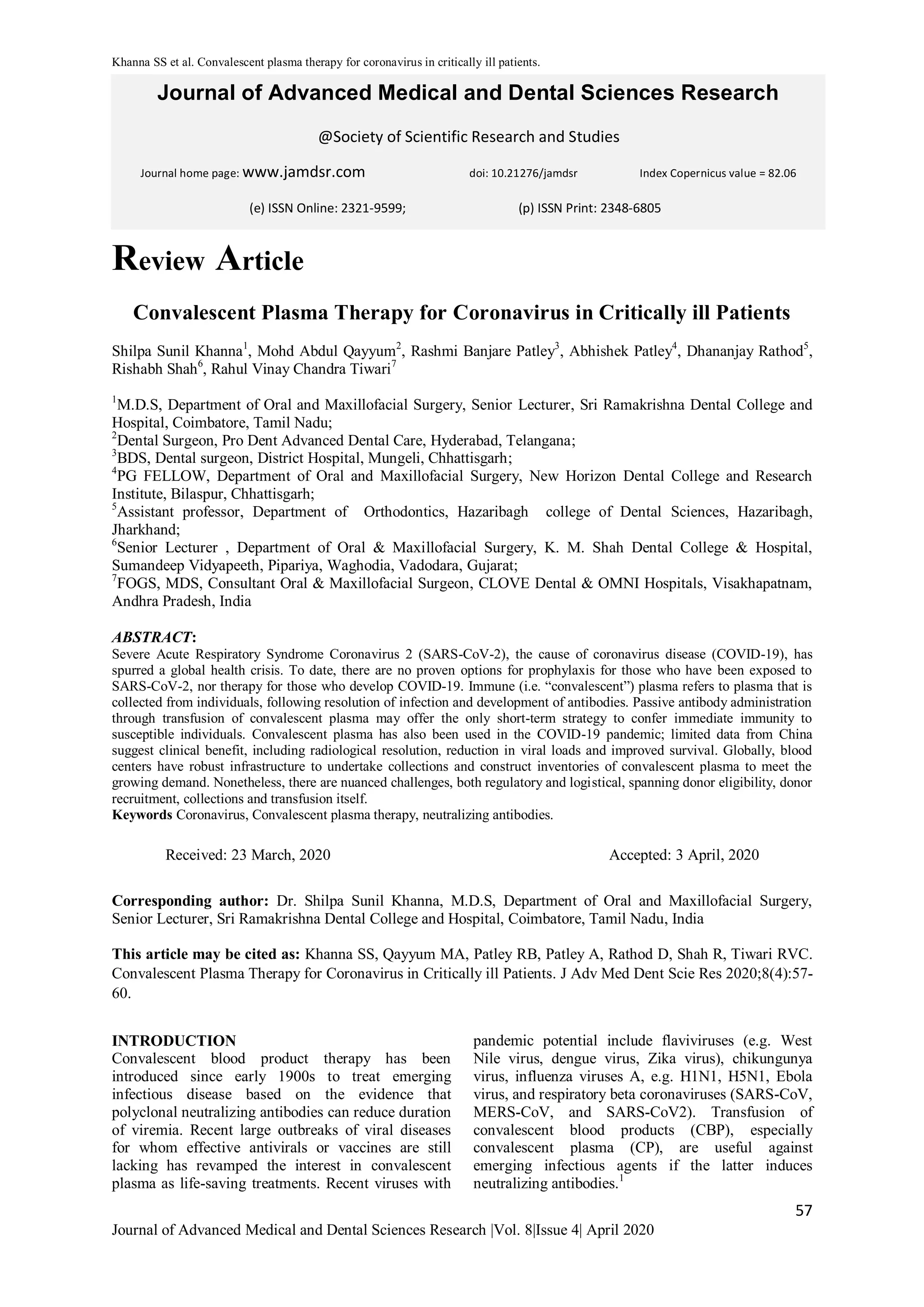
Table 1: WHO Progression scale
OMS progression
scale
Descriptor Score
Uninfected Uninfected, No Viral RNA detected 0
Ambulatory Asymptomatic, Viral RNA detected 1
Ambulatory Symptomatic, Independent 2
Ambulatory Symptomatic Assistance needed 3
Hospitalized: Mild
disease
Hospitalized; no oxygen therapy 4
Hospitalized: Mild
disease
Hospitalized; Oxygen by mask or nasal prongs 5
Hospitalized: Severe
disease
Hospitalized; Oxygen by NIV or High flow 6
Hospitalized: Severe
disease
Intubation and Mechanical Ventilation 7
Hospitalized: Severe
disease
Mechanical Ventilation (conditional use of vasopressors like
norepinephrine)
8
Hospitalized: Severe
disease
Mechanical Ventilation+ vasopressors or Dialysis or ECMO 9
Death Dead 10
NIV-Non-Invasive Ventilation, ECMO-Extracorporeal membrane oxygenation
Khanna SS et al. Convalescent plasma therapy for coronavirus in critically ill patients.
59
Journal of Advanced Medical and Dental Sciences Research |Vol. 8|Issue 4| April 2020
DISCUSSION
Severe pneumonia caused by human coronavirus was
characterized by rapid viral replication, massive
inflammatory cell infiltration, and elevated
proinflammatory cytokines or even cytokine storm in
alveoli of lungs, resulting in acute pulmonary injury
and acute respiratory distress syndrome (ARDS).11
Recent studies on COVID-19 demonstrated that the
lymphocyte counts in the peripheral blood were
remarkably decreased and the levels of cytokines in
the plasma from patients requiring intensive care unit
(ICU) support, including IL-6, IL-10, TNF-ɑ, and
granulocyte-macrophage colony-stimulating factor,
were significantly higher than in those who did not
require ICU conditions.12
CP, obtained from
recovered COVID-19 patients who had established
humoral immunity against the virus, contains a large
quantity of neutralizing antibodies capable of
neutralizing SARS-CoV-2 and eradicating the
pathogen from blood circulation and pulmonary
tissues.13
The key factors associated with CP therapy is the
neutralizing antibody titer as well as efficacy. A small
sample study in MERS-CoV infection showed that the
neutralizing antibody titer should exceed 1:80 to
achieve effective CP therapy.14
To find eligible
donors who have high levels of neutralizing antibody
is a prerequisite. Cao et al. showed that the level of
specific neutralizing antibody to SARS-CoV
decreased gradually 4 months after the disease
process, reaching undetectable levels in 25.6% (IgG)
and 16.1% (neutralizing antibodies) of patients at 36
months after disease status.15
A study from the
MERS-CoV−infected patients and the exposed
healthcare workers showed that the prevalence of
MERS-CoV IgG sero-reactivity was very low (2.7%),
and the antibodies titer decreased rapidly within 3
months.16
These studies suggested that the
neutralizing antibodies represented short lasting
humoral immune response, and plasma from recently
recovered patients should be more effective.5
Studies have shown that viral loads are highly
correlated with disease severity and progression.17
Fatal outcome of human influenza A(H5N1) has been
associated with high viral load and
hypercytokinemia.18
Apart from antiviral treatment,
virus specific neutralizing antibody, which could
accelerate virus clearance and prevent entry into target
cells, serves as the main mechanism for the restriction
and clearance of the viruses by the host.19
Notably, a small retrospective case-comparison study
(19 vs 21 patients) showed a case fatality rate
reduction after convalescent plasma treatment of 23%
(95% CI: 6%-42%, p=0,049)16. Each patient received
200 to 400 ml of plasma. Also, a case series including
80 treated patients reported an overall mortality rate
of 12,5% in severe deteriorating SARS-CoV -
infected patients while the overall SARS-related
mortality rate in Hong-Kong was 17% during the
SARS epidemic in 2003.20
The mean volume of
plasma infused was 279 + 127 ml (range 160-640 ml).
Interestingly, a subgroup analysis found that those
treated with a PCR positive but seronegative for
SARS-CoV-1 has a significantly better outcome (i.e.
discharge by day 22 vs after day 22 or death) than
those who were seropositive at the time of plasma
infusion (61% vs 21%, p<0.001). Similarly, those
receiving convalescent plasma before (versus after) 14
days after onset of symptoms were found to have a
better outcome. In multivariate analysis, the time of
convalescent plasma was reported to stay
significant.21
In a convalescent plasma trial for Ebola disease we
contributed to in 2015, no serious adverse events were
reported in 99 patients (minor adverse events were
observed 8% of patients, mostly an increase in
temperature (5%) and/or itching or skin rash (4%)).
Notably, 2 case reports of possible transfusion-related
acute lung injury (TRALI) following convalescent
plasma have been reported in a patient with Ebola
disease19 and patient with MERS-CoV20. In both
cases, transfused plasma were found free of anti-HLA
or anti-HNA Ab. 21
Peak in viral load in SARS patients has been reported
to coincide with the first appearance of an Ab
response. In vitro, higher concentration of Ab
collected from SARS-CoV(1) -infected patients (i.e.
non-convalescent) facilitated SARS-CoV(1) infection
and induced higher levels of virus-induced
apoptosis.22
Importantly, this phenomenon occurred
via anti-spike (S) Ab that mediated ADE, but not via
anti-nucleocapsid (N) Ab21,28. A possibly relevant
observation is that temporal changes in S-specific and
N-specific neutralizing Ab responses may differ
significantly in patients who have either recovered
from or succumbed to SARS-CoV(1) infection. In
comparison to patients who subsequently died,
recovered patients had a delayed but sustained
increase in (serum) neutralizing Ab titers with an
increasing contribution of anti N Ab (not observed in
patients that subsequently died). Increasing Ab
affinity is most probably occurring as well. Lastly,
long-term persistence of robust Ab (and cytotoxic T
cell responses) has been reported in patients infected
with SARS CoV-1. Interestingly, very recent data in
COVID-19 patients indicates seroconversion
occurring after 6-12 days, but not followed by rapid
decline in viral load. This later finding is compatible
with a suboptimal endogenous early Ab response with
regard to SARS-CoV-2 replication.21
CONCLUSION
COVID-19 requires urgent development of successful
curative treatment modalities. Convalescent plasma
may be one of them. Making such plasma available
and rigorous clinical evaluation of such an approach is
a priority in a number of jurisdictions.
Khanna SS et al. Convalescent plasma therapy for coronavirus in critically ill patients.
60
Journal of Advanced Medical and Dental Sciences Research |Vol. 8|Issue 4| April 2020
REFERENCES
1. Focosi D. Convalescent plasma therapy for Covid-19:
State of the art. Apr 2020, www.preprints.org.
doi:10.20944/preprints202004.0097.v.
2. P. Zhou et al., A pneumonia outbreak associated with a
new coronavirus of probable bat origin. Nature
2020;579:270–273.
3. M. Wang et al., Remdesivir and chloroquine effectively
inhibit the recently emerged novel coronavirus (2019-
nCoV) in vitro. Cell Res. 2020;30:269–271.
4. C. D. Russell, J. E. Millar, J. K. Baillie, Clinical
evidence does not support corticosteroid treatment for
2019-nCoV lung injury. Lancet 2020;395:473–475.
5. Kai Duan. Effectiveness of convalescent plasma therapy
in severe COVID-19 patients. PNAS Apr 2020,1-7.
www.pnas.org/cgi/doi/10.1073/pnas.2004168117.
6. J. Mair-Jenkins et al. Convalescent Plasma Study
Group, The effectiveness of convalescent plasma and
hyperimmune immunoglobulin for the treatment of
severe acute respiratory infections of viral etiology: A
systematic review and exploratory meta-analysis. J.
Infect. Dis. 2015;211:80-90.
7. J. van Griensven et al.; Ebola-Tx Consortium.
Evaluation of convalescent plasma for Ebola virus
disease in Guinea. N. Engl. J. Med. 2016;374:33-42.
8. P. I. Lee, P. R. Hsueh, Emerging threats from zoonotic
coronaviruses-from SARS and MERS to 2019-nCoV. J.
Microbiol. Immunol. Infect., in press.
9. L. Chen, J. Xiong, L. Bao, Y. Shi, Convalescent plasma
as a potential therapy for COVID-19. Lancet Infect. Dis.
2020;20:398–400.
10. An EU programme of COVID-19 convalescent plasma
collection and transfusion. European commission
directorate-general for health and food safety. Version
1.0 April 4 2020.
11. R. Channappanvar, S. Perlman. Pathogenic human
coronavirus infections: Causes and consequences of
cytokine storm and immunopathology. Semin.
Immunopathol. 2017;39:529–539.
12. C. Huang et al., Clinical features of patients infected
with 2019 novel coronavirus in Wuhan, China. Lancet
395, 497–506 (2020).
13. G. Marano et al., Convalescent plasma: New evidence
for an old therapeutic tool? Blood Transfus. 14, 152–
157 (2016).
14. J. H. Ko et al., Challenges of convalescent plasma
infusion therapy in Middle East respiratory coronavirus
infection: A single centre experience. Antivir. Ther. 23,
617– 622 (2018).
15. W. C. Cao, W. Liu, P. H. Zhang, F. Zhang, J. H.
Richardus, Disappearance of antibodies to SARS-
associated coronavirus after recovery. N. Engl. J.
Med.357, 1162– 1163 (2007)
16. Y. M. Arabi et al., Feasibility of using convalescent
plasma immunotherapy for MERSCoV infection, Saudi
Arabia. Emerg. Infect. Dis. 22, 1554–1561 (2016).
17. Ng KT, Oong XY, Lim SH, et al. Viral load and
sequence analysis reveal the symptom severity,
diversity, and transmission clusters of rhinovirus
infections. Clin Infect Dis.2018;67(2):261-268.
18. De Jong MD, Simmons CP, Thanh TT et al. Fatal
outcome of human influenza A(H5N1) is associated
with high viral load and hypercytokinemia. Nat Med.
2006;12(10):1203-1207.
19. Shen C, Chen J, Li R et al. A multi mechanistic
antibody targeting the receptor binding site potently
cross-protects against influenza B viruses. Sci Transl
Med.2017;9(412): eaam5752.
20. Cheng Y, Wong R, Soo YO, et al. Use of convalescent
plasma therapy in SARS patients in Hong Kong. Eur J
Clin Microbiol Infect Dis. 2005;24:44-46.
21. Pierre Tiberghien. Collecting and evaluating
convalescent plasma for COVID-19 treatment: why and
how. doi: 10.1111/vox.12926
22. Wang SF, Tseng SP, Yen CH et al. Antibody-dependent
SARS coronavirus infection is mediated by antibodies
against spike proteins. Biochem Biophys Res Commun.
2014;451:20814.

167th publication jamdsr- 7th name

  • 1.
    Khanna SS etal. Convalescent plasma therapy for coronavirus in critically ill patients. 57 Journal of Advanced Medical and Dental Sciences Research |Vol. 8|Issue 4| April 2020 Journal of Advanced Medical and Dental Sciences Research @Society of Scientific Research and Studies Journal home page: www.jamdsr.com doi: 10.21276/jamdsr Index Copernicus value = 82.06 Review Article Convalescent Plasma Therapy for Coronavirus in Critically ill Patients Shilpa Sunil Khanna1 , Mohd Abdul Qayyum2 , Rashmi Banjare Patley3 , Abhishek Patley4 , Dhananjay Rathod5 , Rishabh Shah6 , Rahul Vinay Chandra Tiwari7 1 M.D.S, Department of Oral and Maxillofacial Surgery, Senior Lecturer, Sri Ramakrishna Dental College and Hospital, Coimbatore, Tamil Nadu; 2 Dental Surgeon, Pro Dent Advanced Dental Care, Hyderabad, Telangana; 3 BDS, Dental surgeon, District Hospital, Mungeli, Chhattisgarh; 4 PG FELLOW, Department of Oral and Maxillofacial Surgery, New Horizon Dental College and Research Institute, Bilaspur, Chhattisgarh; 5 Assistant professor, Department of Orthodontics, Hazaribagh college of Dental Sciences, Hazaribagh, Jharkhand; 6 Senior Lecturer , Department of Oral & Maxillofacial Surgery, K. M. Shah Dental College & Hospital, Sumandeep Vidyapeeth, Pipariya, Waghodia, Vadodara, Gujarat; 7 FOGS, MDS, Consultant Oral & Maxillofacial Surgeon, CLOVE Dental & OMNI Hospitals, Visakhapatnam, Andhra Pradesh, India ABSTRACT: Severe Acute Respiratory Syndrome Coronavirus 2 (SARS-CoV-2), the cause of coronavirus disease (COVID-19), has spurred a global health crisis. To date, there are no proven options for prophylaxis for those who have been exposed to SARS-CoV-2, nor therapy for those who develop COVID-19. Immune (i.e. “convalescent”) plasma refers to plasma that is collected from individuals, following resolution of infection and development of antibodies. Passive antibody administration through transfusion of convalescent plasma may offer the only short-term strategy to confer immediate immunity to susceptible individuals. Convalescent plasma has also been used in the COVID-19 pandemic; limited data from China suggest clinical benefit, including radiological resolution, reduction in viral loads and improved survival. Globally, blood centers have robust infrastructure to undertake collections and construct inventories of convalescent plasma to meet the growing demand. Nonetheless, there are nuanced challenges, both regulatory and logistical, spanning donor eligibility, donor recruitment, collections and transfusion itself. Keywords Coronavirus, Convalescent plasma therapy, neutralizing antibodies. Received: 23 March, 2020 Accepted: 3 April, 2020 Corresponding author: Dr. Shilpa Sunil Khanna, M.D.S, Department of Oral and Maxillofacial Surgery, Senior Lecturer, Sri Ramakrishna Dental College and Hospital, Coimbatore, Tamil Nadu, India This article may be cited as: Khanna SS, Qayyum MA, Patley RB, Patley A, Rathod D, Shah R, Tiwari RVC. Convalescent Plasma Therapy for Coronavirus in Critically ill Patients. J Adv Med Dent Scie Res 2020;8(4):57- 60. INTRODUCTION Convalescent blood product therapy has been introduced since early 1900s to treat emerging infectious disease based on the evidence that polyclonal neutralizing antibodies can reduce duration of viremia. Recent large outbreaks of viral diseases for whom effective antivirals or vaccines are still lacking has revamped the interest in convalescent plasma as life-saving treatments. Recent viruses with pandemic potential include flaviviruses (e.g. West Nile virus, dengue virus, Zika virus), chikungunya virus, influenza viruses A, e.g. H1N1, H5N1, Ebola virus, and respiratory beta coronaviruses (SARS-CoV, MERS-CoV, and SARS-CoV2). Transfusion of convalescent blood products (CBP), especially convalescent plasma (CP), are useful against emerging infectious agents if the latter induces neutralizing antibodies.1 (e) ISSN Online: 2321-9599; (p) ISSN Print: 2348-6805
  • 2.
    Khanna SS etal. Convalescent plasma therapy for coronavirus in critically ill patients. 58 Journal of Advanced Medical and Dental Sciences Research |Vol. 8|Issue 4| April 2020 Since December 2019, a pneumonia associated with severe acute respiratory syndrome coronavirus 2 (SARS-CoV-2), named as coronavirus disease 2019 (COVID-19) by World Health Organization (WHO), emerged in Wuhan, China.2 The epidemic spread rapidly worldwide within 3 months and was characterized as a pandemic by WHO on March 11, 2020. As of April 16th, 2020, a total of 20,83,913 confirmed cases and 1,34,658 deaths had been reported worldwide and the count is still up as each day passes on. Currently, there are no approved specific antiviral agents targeting the novel virus, while some drugs are still under investigation, including Remdesivir and Lopinavir/Ritonavir.3 Moreover, the corticosteroid treatment for COVID-19 lung injury remains controversial, due to delayed clearance of viral infection and complications.4 Since the effective vaccine and specific antiviral medicines are unavailable, it is an urgent need to look for an alternative strategy for COVID-19 treatment, especially among severe patients.5 A meta-analysis from 32 studies of SARS coronavirus infection and severe influenza showed a statistically significant reduction in the pooled odds of mortality following CP therapy, compared with placebo or no therapy (odds ratio, 0.25; 95% confidence interval, 0.14–0.45).6 However, the CP therapy was unable to significantly improve the survival in the Ebola virus disease, probably due to the absence of data of neutralizing antibody titration for stratified analysis.7 Since the virological and clinical characteristics share similarity among SARS, Middle East Respiratory Syndrome (MERS), and COVID-19,8 CP therapy might be a promising treatment option for COVID-19 rescue.9 Patients who have recovered from COVID-19 with a high neutralizing antibody titer may be a valuable donor source of CP.5 Ideally in plasma therapy, the donors will donate plasma by plasmapheresis, but where that is not possible, whole blood can also be collected, with plasma separation in the blood establishment. Plasma obtained by plasmapheresis should be split before freezing into 2-3 separate units (e.g. 3x200 ml). Final products should be specifically labeled as COVID-19 Convalescent Plasma/Blood and stored in a dedicated location. Any serious adverse reactions in the donor should be notified to the competent authority without delay. It is strongly recommended that defined SARS- CoV-2 neutralizing antibody titers be measured in the donated plasma. It is suggested that neutralizing antibody titers should optimally be greater than 1:320, but lower thresholds might also be effective. Clinical symptoms and laboratory parameters– according to the disease progression scale by WHO (Table 1) should be noted especially during transfusion, after 5 days and after discharge from the hospital.10 Table 1: WHO Progression scale OMS progression scale Descriptor Score Uninfected Uninfected, No Viral RNA detected 0 Ambulatory Asymptomatic, Viral RNA detected 1 Ambulatory Symptomatic, Independent 2 Ambulatory Symptomatic Assistance needed 3 Hospitalized: Mild disease Hospitalized; no oxygen therapy 4 Hospitalized: Mild disease Hospitalized; Oxygen by mask or nasal prongs 5 Hospitalized: Severe disease Hospitalized; Oxygen by NIV or High flow 6 Hospitalized: Severe disease Intubation and Mechanical Ventilation 7 Hospitalized: Severe disease Mechanical Ventilation (conditional use of vasopressors like norepinephrine) 8 Hospitalized: Severe disease Mechanical Ventilation+ vasopressors or Dialysis or ECMO 9 Death Dead 10 NIV-Non-Invasive Ventilation, ECMO-Extracorporeal membrane oxygenation
  • 3.
    Khanna SS etal. Convalescent plasma therapy for coronavirus in critically ill patients. 59 Journal of Advanced Medical and Dental Sciences Research |Vol. 8|Issue 4| April 2020 DISCUSSION Severe pneumonia caused by human coronavirus was characterized by rapid viral replication, massive inflammatory cell infiltration, and elevated proinflammatory cytokines or even cytokine storm in alveoli of lungs, resulting in acute pulmonary injury and acute respiratory distress syndrome (ARDS).11 Recent studies on COVID-19 demonstrated that the lymphocyte counts in the peripheral blood were remarkably decreased and the levels of cytokines in the plasma from patients requiring intensive care unit (ICU) support, including IL-6, IL-10, TNF-ɑ, and granulocyte-macrophage colony-stimulating factor, were significantly higher than in those who did not require ICU conditions.12 CP, obtained from recovered COVID-19 patients who had established humoral immunity against the virus, contains a large quantity of neutralizing antibodies capable of neutralizing SARS-CoV-2 and eradicating the pathogen from blood circulation and pulmonary tissues.13 The key factors associated with CP therapy is the neutralizing antibody titer as well as efficacy. A small sample study in MERS-CoV infection showed that the neutralizing antibody titer should exceed 1:80 to achieve effective CP therapy.14 To find eligible donors who have high levels of neutralizing antibody is a prerequisite. Cao et al. showed that the level of specific neutralizing antibody to SARS-CoV decreased gradually 4 months after the disease process, reaching undetectable levels in 25.6% (IgG) and 16.1% (neutralizing antibodies) of patients at 36 months after disease status.15 A study from the MERS-CoV−infected patients and the exposed healthcare workers showed that the prevalence of MERS-CoV IgG sero-reactivity was very low (2.7%), and the antibodies titer decreased rapidly within 3 months.16 These studies suggested that the neutralizing antibodies represented short lasting humoral immune response, and plasma from recently recovered patients should be more effective.5 Studies have shown that viral loads are highly correlated with disease severity and progression.17 Fatal outcome of human influenza A(H5N1) has been associated with high viral load and hypercytokinemia.18 Apart from antiviral treatment, virus specific neutralizing antibody, which could accelerate virus clearance and prevent entry into target cells, serves as the main mechanism for the restriction and clearance of the viruses by the host.19 Notably, a small retrospective case-comparison study (19 vs 21 patients) showed a case fatality rate reduction after convalescent plasma treatment of 23% (95% CI: 6%-42%, p=0,049)16. Each patient received 200 to 400 ml of plasma. Also, a case series including 80 treated patients reported an overall mortality rate of 12,5% in severe deteriorating SARS-CoV - infected patients while the overall SARS-related mortality rate in Hong-Kong was 17% during the SARS epidemic in 2003.20 The mean volume of plasma infused was 279 + 127 ml (range 160-640 ml). Interestingly, a subgroup analysis found that those treated with a PCR positive but seronegative for SARS-CoV-1 has a significantly better outcome (i.e. discharge by day 22 vs after day 22 or death) than those who were seropositive at the time of plasma infusion (61% vs 21%, p<0.001). Similarly, those receiving convalescent plasma before (versus after) 14 days after onset of symptoms were found to have a better outcome. In multivariate analysis, the time of convalescent plasma was reported to stay significant.21 In a convalescent plasma trial for Ebola disease we contributed to in 2015, no serious adverse events were reported in 99 patients (minor adverse events were observed 8% of patients, mostly an increase in temperature (5%) and/or itching or skin rash (4%)). Notably, 2 case reports of possible transfusion-related acute lung injury (TRALI) following convalescent plasma have been reported in a patient with Ebola disease19 and patient with MERS-CoV20. In both cases, transfused plasma were found free of anti-HLA or anti-HNA Ab. 21 Peak in viral load in SARS patients has been reported to coincide with the first appearance of an Ab response. In vitro, higher concentration of Ab collected from SARS-CoV(1) -infected patients (i.e. non-convalescent) facilitated SARS-CoV(1) infection and induced higher levels of virus-induced apoptosis.22 Importantly, this phenomenon occurred via anti-spike (S) Ab that mediated ADE, but not via anti-nucleocapsid (N) Ab21,28. A possibly relevant observation is that temporal changes in S-specific and N-specific neutralizing Ab responses may differ significantly in patients who have either recovered from or succumbed to SARS-CoV(1) infection. In comparison to patients who subsequently died, recovered patients had a delayed but sustained increase in (serum) neutralizing Ab titers with an increasing contribution of anti N Ab (not observed in patients that subsequently died). Increasing Ab affinity is most probably occurring as well. Lastly, long-term persistence of robust Ab (and cytotoxic T cell responses) has been reported in patients infected with SARS CoV-1. Interestingly, very recent data in COVID-19 patients indicates seroconversion occurring after 6-12 days, but not followed by rapid decline in viral load. This later finding is compatible with a suboptimal endogenous early Ab response with regard to SARS-CoV-2 replication.21 CONCLUSION COVID-19 requires urgent development of successful curative treatment modalities. Convalescent plasma may be one of them. Making such plasma available and rigorous clinical evaluation of such an approach is a priority in a number of jurisdictions.
  • 4.
    Khanna SS etal. Convalescent plasma therapy for coronavirus in critically ill patients. 60 Journal of Advanced Medical and Dental Sciences Research |Vol. 8|Issue 4| April 2020 REFERENCES 1. Focosi D. Convalescent plasma therapy for Covid-19: State of the art. Apr 2020, www.preprints.org. doi:10.20944/preprints202004.0097.v. 2. P. Zhou et al., A pneumonia outbreak associated with a new coronavirus of probable bat origin. Nature 2020;579:270–273. 3. M. Wang et al., Remdesivir and chloroquine effectively inhibit the recently emerged novel coronavirus (2019- nCoV) in vitro. Cell Res. 2020;30:269–271. 4. C. D. Russell, J. E. Millar, J. K. Baillie, Clinical evidence does not support corticosteroid treatment for 2019-nCoV lung injury. Lancet 2020;395:473–475. 5. Kai Duan. Effectiveness of convalescent plasma therapy in severe COVID-19 patients. PNAS Apr 2020,1-7. www.pnas.org/cgi/doi/10.1073/pnas.2004168117. 6. J. Mair-Jenkins et al. Convalescent Plasma Study Group, The effectiveness of convalescent plasma and hyperimmune immunoglobulin for the treatment of severe acute respiratory infections of viral etiology: A systematic review and exploratory meta-analysis. J. Infect. Dis. 2015;211:80-90. 7. J. van Griensven et al.; Ebola-Tx Consortium. Evaluation of convalescent plasma for Ebola virus disease in Guinea. N. Engl. J. Med. 2016;374:33-42. 8. P. I. Lee, P. R. Hsueh, Emerging threats from zoonotic coronaviruses-from SARS and MERS to 2019-nCoV. J. Microbiol. Immunol. Infect., in press. 9. L. Chen, J. Xiong, L. Bao, Y. Shi, Convalescent plasma as a potential therapy for COVID-19. Lancet Infect. Dis. 2020;20:398–400. 10. An EU programme of COVID-19 convalescent plasma collection and transfusion. European commission directorate-general for health and food safety. Version 1.0 April 4 2020. 11. R. Channappanvar, S. Perlman. Pathogenic human coronavirus infections: Causes and consequences of cytokine storm and immunopathology. Semin. Immunopathol. 2017;39:529–539. 12. C. Huang et al., Clinical features of patients infected with 2019 novel coronavirus in Wuhan, China. Lancet 395, 497–506 (2020). 13. G. Marano et al., Convalescent plasma: New evidence for an old therapeutic tool? Blood Transfus. 14, 152– 157 (2016). 14. J. H. Ko et al., Challenges of convalescent plasma infusion therapy in Middle East respiratory coronavirus infection: A single centre experience. Antivir. Ther. 23, 617– 622 (2018). 15. W. C. Cao, W. Liu, P. H. Zhang, F. Zhang, J. H. Richardus, Disappearance of antibodies to SARS- associated coronavirus after recovery. N. Engl. J. Med.357, 1162– 1163 (2007) 16. Y. M. Arabi et al., Feasibility of using convalescent plasma immunotherapy for MERSCoV infection, Saudi Arabia. Emerg. Infect. Dis. 22, 1554–1561 (2016). 17. Ng KT, Oong XY, Lim SH, et al. Viral load and sequence analysis reveal the symptom severity, diversity, and transmission clusters of rhinovirus infections. Clin Infect Dis.2018;67(2):261-268. 18. De Jong MD, Simmons CP, Thanh TT et al. Fatal outcome of human influenza A(H5N1) is associated with high viral load and hypercytokinemia. Nat Med. 2006;12(10):1203-1207. 19. Shen C, Chen J, Li R et al. A multi mechanistic antibody targeting the receptor binding site potently cross-protects against influenza B viruses. Sci Transl Med.2017;9(412): eaam5752. 20. Cheng Y, Wong R, Soo YO, et al. Use of convalescent plasma therapy in SARS patients in Hong Kong. Eur J Clin Microbiol Infect Dis. 2005;24:44-46. 21. Pierre Tiberghien. Collecting and evaluating convalescent plasma for COVID-19 treatment: why and how. doi: 10.1111/vox.12926 22. Wang SF, Tseng SP, Yen CH et al. Antibody-dependent SARS coronavirus infection is mediated by antibodies against spike proteins. Biochem Biophys Res Commun. 2014;451:20814.