Get Homework Done
Homeworkping.com
Homework Help
https://www.homeworkping.com/
Research Paper help
https://www.homeworkping.com/
Online Tutoring
https://www.homeworkping.com/
click here for freelancing tutoring sites
TRIBHUVAN UNIVERSITY
INSTITUTE OF ENGINEERING
PULCHOWK CAMPUS
A
Thesis Proposal
On
2
Developing Ring Road as Open Space: Strategic Planning for Post-Earthquake Temporary
Shelter in Kathmandu Valley
By:
Ram Prasad Neupane
(068/MSD/364)
SUBMITTED TO
THE DEPARTMENT OF CIVIL ENGINEERING
IN PARTIAL FULFILLMENT OF THE REQUIREMENT FOR THE
DEGREE OF MASTER OF SCIENCE IN DISASTAR RISK MANAGEMENT
LALITPUR, NEPAL
June 2, 2013
i
Contents
Chapter I.......................................................................................................................................... 1
Introduction..................................................................................................................................... 1
1.1 Background ........................................................................................................................... 1
1.1.1 Earthquake Disaster in Nepal and Kathmandu .............................................................. 1
1.1.2 Temporary Shelters........................................................................................................ 1
1.2 Objectives.............................................................................................................................. 2
1.4 Rationale of the Study........................................................................................................... 3
Chapter II ........................................................................................................................................ 3
Literature Review............................................................................................................................ 3
2.1 National Studies in Post Earthquake Temporary Shelter...................................................... 3
2.2 International Studies in Post Earthquake Temporary Shelter ............................................... 3
Chapter III....................................................................................................................................... 6
Methodology................................................................................................................................... 6
Chapter IV....................................................................................................................................... 8
Work Schedule and Budged Required............................................................................................ 8
4.1 Work Schedule...................................................................................................................... 8
4.2 Budget ................................................................................................................................... 8
Chapter V ........................................................................................................................................ 9
Expected Output.............................................................................................................................. 9
References..................................................................................................................................... 10
1
Chapter I
Introduction
1.1 Background
1.1.1 Earthquake Disaster in Nepal and Kathmandu
An earthquake is the shaking of the earth caused by a number of phenomena including tectonic
ground motions, volcanism, landslides, rock bursts, and human made explosions.Of these various
causes, tectonic-related earthquakes are the largest and most important.Earthquakes are one of
nature's greatest hazards to life on this planet; throughout historic time they have caused the
destruction of countless cities and villages on nearly every continent.An important distinction of
the earthquake problem is that the hazard to life is associated almost entirely with man-made
structures.
According to Earthquake Risk Reduction, Response and Preparedness Project (2009), Nepal
occupies an ironic eleventh position in the list of the countries around the globe vulnerable to
earthquake. It has the history of being rocked by a large earthquake every seventy to hundred
years like those of the years of 1833 and 1934 and a moderate one after every 50 years like that
of the year 1988. Seismologists have been predicting of yet another large an earthquake like that
of 1934 any time in the future. If it so happens, it is likely to result innumerable deaths as well as
a colossal loss of property.Kathmandu is the capital and the largest city of Nepal.Kathmandu as
compared to the other cities within the country is more vulnerable to earthquake, with increasing
and unplanned urbanization and the mushrooming of high rises. It is among 21 cities around the
world in seismic zones, and the risk for the city is increasing every year. Joint study carried out
by the Nepal government and the Japan Inter-national Cooperation Agency (JICA) in 2008
concluded that at least 40,000 people will be killed, another 100,000 injured and dozens of
utilities damaged if a quake equal to the one that struck in 1993, which was of magnitude 7.7 on
the Richter scale, strikes the Valley. “There could be more human casualties and infrastructure
damage if any big disaster hits as the population of the Valley has seen a sharp rise. (JICA
report-2008, UN OCHA)
According to UN- OCHA, an earthquake could displace more than 1.8 million people, kill over
100,000 and injure a further 300,000. Sixty percent of buildings could be destroyed.Providing
shelter for the estimated 1.8 million people displaced would demand a tremendous amount of
open space, so the International Organization for Migration (IOM) and the Ministry of Home
Affairs have mapped all public spaces in and around Kathmandu that could be used for
temporary shelters.
1.1.2 Temporary Shelters
Shelter is a major problem following any disaster. The temporary shelter conditions, created for
earthquake victims, aim at overcoming the negative post-disaster conditions and protecting the
victims from external effects.Reconstruction following major earthquakes proceeds slowly, and
2
emergency shelters distributed immediately post-quake are unlikely to last until homes have been
restored. In the meantime, providing temporary housing for victims presents a number of
challenges and can draw resources away from other activities. With sound pre-impact strategic
planning for temporary housing, however, earthquake-affected populations can be more
adequately housed during the reconstruction process and can begin rebuilding their lives even
before moving into permanent homes.
Earthquake Risk Assessment and Shelter Response Planning for Kathmandu, Nepal (together
with Maputo, Mozambique) within the program Risk Mapping for Shelter Response is a joint
project of UN Habitat which is being supported by UNDP/BCPR, IFRC and Prevention
Consortium and is being implemented by the National Society for Earthquake Technology –
Nepal (NSET) as a technical consultant. The program is under the Global Emergency Shelter
Cluster in the UN/IASC context; and also a component of the Global Risk Identification
Programme (GRIP) of the UNDP/BCPR. The goal of the programme is to improve capacity to
predict and address post-disaster shelter recovery needs and shelter planning.
The government has identified 83 open spaces across the three districts of the Valley—
Kathmandu, Lalitpur and Bhaktapur—as evacuation and temporary rescue sites to relocate
victims, build temporary hospitals and store logistics in case of a disaster.
The government has decided not to develop any kind of infrastructure on these spaces and keep
them as they are. The open spaces are mostly football grounds across the Valley—Tundikhel, the
track adjacent to the Ring Road, school and college compounds, premises of the Tribhuvan
University at Kirtipur, the Pulchowk Engineering Campus, the Nepal Agriculture Research
Centre in Khumaltar, UN Park, Ratna Park, premises of Tara Hotel, Gokarna, Shanka Park and
Tribhuvan Park, among others.
Considering the the Ring Road improvement project, to be completed by 2015,27 Km long Ring
Road will be 62 m wide including its right of way. Leaving 11 m middle portion of Ring Road
for vehicular movement, total of 1,377,000 sq m could be utilized for temporary shelterfrom the
Ring Road. .
1.2 Objectives
The main objective of this proposal is to consider the ring road as temporary shelterin afterthe
earthquake disaster in Kathmandu and Lalitpur City. Specific objectives are:
 To quantify total area and capacity of Ring Road that can be utilized for temporary
shelter,
 To calculate capacity of open spaces which are already identified,
 To identifying the access of possible evacuation routes and the total population that can
be rescue in temporary shelter,
 To determine the design requirements of temporary shelters and tentative cost of shelter
unit.
3
1.4 Rationale of the Study
The Shelters to support on-site activities after the occurrence of a disaster is a
Critical issue. Immediately it need to either to carry on temporary shelter or to health
camp after any rescue activities. As UN OCHA, there will be more than 1.8 Million
people homeless in Kathmandu if any big disaster hits as the population of the Valley has
seen a sharp rise.
So, this study will try to address clear vision and strategic plan that how to use the Ring
Road space for temporary shelter and what it will be the capacity for shelter. Also it will
give tentative required space as well cost for temporary shelter as such big disasters
occurred in Kathmandu valley.
Chapter II
Literature Review
2.1 National Studies in Post Earthquake Temporary Shelter
In Nepal, there are many organizations working in the field of earthquake disaster. National
Society for Earthquake Technology-Nepal (NSET), Disaster Preparedness Network (DPNet-
Nepal), GeoHazards International, International Organisation for Migration (IOM) the leading
ones (Nepal Disaster Report 2009
Under the overall leadership of Ministry of Home Affairs (MoHA) the International
Organization for Migration (IOM) as lead of the Camp Coordination and Camp Management
(CCCM) cluster, undertook a study to identify open spaces within Kathmandu which could be
used for humanitarian purposes in the event an earthquake occurred. These identified sites are
yet to be assigned a humanitarian purpose following the disaster event. (MoHA)
The Sphere Project, led by the Red Cross / Red Crescent Society with a range of Humanitarian
Non- Government Organizations (NGOs), developed a Humanitarian Charter and a set of
minimum standards in disaster response. Given the large numbers of expected IDPs and scarcity
of vacant land in close proximity to Kathmandu it may not be possible to establish camps which
contain all the facilities ideally located within a camp site.
2.2 International Studies in Post Earthquake Temporary Shelter
Omar et.al (2009) presented the computational implementation of a newly developed multi-
objective optimization model to support decision-makers in emergency management agencies in
optimizing large-scale temporary housing arrangements. The model is capable of simultaneously
minimizing (1) post-disaster social and economic disruptions suffered by displaced families; (2)
temporary housing vulnerabilities to post-disaster hazards; (3) adverse environmental impacts on
host communities; and (4) public expenditures on temporary housing. The model is implemented
in four main phases and it incorporates four optimization modules to enable optimizing each of
the aforementioned important objectives. A large-scale temporary housing application example
4
is presented to demonstrate the unique capabilities of the model and illustrate the performed
computations in each of the implementation phases.
Bolin and Stanford (2007) examined the issues associated with the temporary sheltering and
housing of victims after natural disasters in the United States. Specific topics addressed include
differential access to shelter and housing aid according to social class, ethnicity and related
demographic factors; the relationship between post-disaster shelter and housing and long-term
recovery; the role of social support networks in the sheltering of victims; and the implications of
the research for the provision of shelter and housing aid after disasters.
According to Johnson (2007), temporary housing programmes suffer from excessively high cost,
late delivery, poor location, improper unit designs and other inherent issues. These issues can be
attributed in part to a prevalence of ad hoc tactical planning, rather than pre-disaster strategic
planning, for reconstruction undertaken by governments and non-governmental organizations
(NGOs) in the chaotic post-disaster environment. An analysis of the process and outcomes from
six case studies of temporary housing programmes after disasters in Turkey and Colombia in
1999, Japan in 1995, Greece in 1986, Mexico in 1985, and Italy in 1976 yields information about
the extent to which strategic planning is employed in temporary housing programmes, as well as
common issues in temporary housing. Based on an understanding of these common issues,
Johnson proposes a framework for strategic planning for temporary housing that identifies
organizational designs and available resources for temporary housing before the disaster, but
allows modifications to fit the specific post-disaster situation.
Johnson 2006 researched to recognize exactly what problems exist with temporary housing in the
long term (that is after 5 years) and to identify, using the systems approach, the origin of these
problems within the project process for temporary housing. Using the Logical Framework
Approach to highlight the projects’outcomes, the investigation focuses on the case study of the
temporary housing programme for the 1999 earthquakes in Turkey and on four temporary
housing projects in Düzce, one disaster-affected town. The research found that unwanted effects
can be reduced through proper facilities management, reuse of the units, and by the initial
application of unit designs that are easy to dismantle. Incorporating plans upfront, thus dealing
with these problems by anticipation, can minimize negative impacts.
According to Davidson et.al (2006), the key to performance in low-cost housing projects in
developing countries lies in community participation. They proposed that this premise
(extensively discussed in the theory and emphasized in grant applications) is not clearly reflected
in the realities of reconstruction practice. In fact, there are many ways in which
users/beneficiaries can participate in post-disaster reconstruction projects but not all types of
participation ensure the best deployment of their capabilities.The systems approach shows that
there is a continuum of possibilities for participation; at one extreme, users are involved in the
projects only as the labor force, whereas at the other, they play an active role in decision-making
and project management.Four case studies of post-disaster housing reconstruction projects (one
each in Colombia and in El Salvador, and two in Turkey) illustrate this continuum. A
comparative analysis of the organizational designs of these projects highlights the different ways
5
in which users can be and were involved. They showed the impact of the different approaches to
the “where”, the “when” and the “how”, regarding incorporating the users into the organizational
and technical design processes. They showed that the participation of users in up-front decision-
making (within the project design and planning phases, including the capacity to make
meaningful choices among a series of options offered to them) leads to positive results in terms
of building process and outcomes. However, despite often-good intentions, this level of
participation is rarely obtained and the capabilities of the users are often significantly wasted.
6
Chapter III
Methodology
The methodology is divided into two parts:
Part one consists of estimating causalities due to earthquake hazards e.g. total deaths, homeless
etc considering different magnitude of earthquake. For this method as adopted inJICA report on
the study on earthquake disaster mitigation in the Kathmandu valley, Kingdom of Nepal will be
utilized.
Second part consist of assessment of shelter management and non food items. For this
methodology mentioned in Humanitarian Charter Minimum Standards in Humanitarian
Response developed by the Sphere Project will be followed.The Sphere Project and its
Handbook are well known for introducing considerations of quality and accountability to
humanitarian response.The minimum standards for shelter, settlement and non-food items are a
practical expression of the shared beliefs and commitments of humanitarian agencies and the
common principles, rights and duties governing humanitarian action that are set out in the
Humanitarian Charter.
The process includes
 Literature review
 Collection of secondary data on population , average household size, types of houses,
proximity from Ring Road etc.
 Field visit, Observation and data verification
Proposed estimation
a) Probable Numbers of Building Damages and destroyed,
b) Probable numbers of casualties/injured population,
c) Probable numbers of death population,
d) Probable numbers of homeless/ shelter needed population/families;
 Identifying the evacuation access route to link ring road from inner and outer side of the
ring road
 .
 Estimation of total space that can be utilized from Ring Road area for establishing
temporary shelter
 Zoning of different spaces and identification of areas for rescue and transfer
 Identification of link roads connecting already identified open spaces
 Recommendation of strategies and action plans for developing Ring Road as temporary
shelter place as per Humanitarian Charter Minimum Standards in Humanitarian
Response.
7
8
Chapter IV
Work Schedule and Budged Required
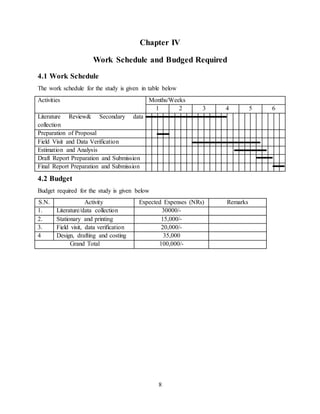
4.1 Work Schedule
The work schedule for the study is given in table below
Activities Months/Weeks
1 2 3 4 5 6
Literature Review& Secondary data
collection
Preparation of Proposal
Field Visit and Data Verification
Estimation and Analysis
Draft Report Preparation and Submission
Final Report Preparation and Submission
4.2 Budget
Budget required for the study is given below
S.N. Activity Expected Expenses (NRs) Remarks
1. Literature/data collection 30000/-
2. Stationary and printing 15,000/-
3. Field visit, data verification 20,000/-
4 Design, drafting and costing 35,000
Grand Total 100,000/-
9
Chapter V
Expected Output
This study will identify
 Total casualties, homeless population that can occur in different scenarios of earthquake
in Kathmandu and Lalitpur city,
 Identify total space required for temporary shelter.
 Recommendation for Strategies and action plans will be generated for developing Ring
Road as temporary shelter, evacuation route to pre-identified space with ring road and
tentative size and cost of temporary shelter.
10
References
Bolin R. and Stanford L. (2007): Shelter, Housing and Recovery: A Comparison of U.S.
Disasters; Disasters Volume 15, Issue 1, pages 24–34, March 1991
Davidson C. H., Johnson C., LizarraldeG.,Dikmen N., and Sliwinski A. (2006): Truths and
myths about community participation in post-disaster housing projects
Earthquake Risk Reduction, Response and Preparedness Project (2009):Final Review Report on
Existing Government and Municipal Policies on Earthquake Risk Reduction, Response and
Preparedness, Ministry of Physical Planning and Works, Prepared by Nepal Center for Disaster
Management
JICA (2002): The study on earthquake disaster mitigation in the Kathmandu Valley, Kingdom of
Nepal, Nippon Koei Co., Ltd., Oyo Corporation
Johnson C (2006): Impacts of prefabricated temporary housing after disasters: 1999 earthquakes
in Turkey, IF Research Group, Faculté de l’aménagement, Université de Montréal, C.P. 6128
Succ. Centre-Ville, Montreal, Que., Canada H3C 3J7
Johnson C (2007): Strategic planning for post-disaster temporary housing; Disasters Volume
31, Issue 4, pages 435–458
Nepal Center for Disaster Management (2009): Existing Government and Municipal Policies on
Earthquake Risk Reduction, Response and Preparedness; Earthquake Risk Reduction, Response
and Preparedness Project, Ministry of Physical Planning and Works
Omar E., Khaled E., and Amr E.: Optimizing Large-Scale Temporary Housing Arrangements
after Natural Disasters, DOI: 10.1061/(ASCE)0887-3801(2009)23:2(110)
The Sphere Project (2011): The Humanitarian Charter and Minimum Standards in Humanitarian
Response, Practical Action Publishing, Schumacher Centre for Technology and Development,
Bourton on Dunsmore, Rugby, CV23 9QZ, United Kingdom

146250662 draft-thesis-proposal-ff

  • 1.
    Get Homework Done Homeworkping.com HomeworkHelp https://www.homeworkping.com/ Research Paper help https://www.homeworkping.com/ Online Tutoring https://www.homeworkping.com/ click here for freelancing tutoring sites TRIBHUVAN UNIVERSITY INSTITUTE OF ENGINEERING PULCHOWK CAMPUS A Thesis Proposal On
  • 2.
    2 Developing Ring Roadas Open Space: Strategic Planning for Post-Earthquake Temporary Shelter in Kathmandu Valley By: Ram Prasad Neupane (068/MSD/364) SUBMITTED TO THE DEPARTMENT OF CIVIL ENGINEERING IN PARTIAL FULFILLMENT OF THE REQUIREMENT FOR THE DEGREE OF MASTER OF SCIENCE IN DISASTAR RISK MANAGEMENT LALITPUR, NEPAL June 2, 2013
  • 3.
    i Contents Chapter I.......................................................................................................................................... 1 Introduction.....................................................................................................................................1 1.1 Background ........................................................................................................................... 1 1.1.1 Earthquake Disaster in Nepal and Kathmandu .............................................................. 1 1.1.2 Temporary Shelters........................................................................................................ 1 1.2 Objectives.............................................................................................................................. 2 1.4 Rationale of the Study........................................................................................................... 3 Chapter II ........................................................................................................................................ 3 Literature Review............................................................................................................................ 3 2.1 National Studies in Post Earthquake Temporary Shelter...................................................... 3 2.2 International Studies in Post Earthquake Temporary Shelter ............................................... 3 Chapter III....................................................................................................................................... 6 Methodology................................................................................................................................... 6 Chapter IV....................................................................................................................................... 8 Work Schedule and Budged Required............................................................................................ 8 4.1 Work Schedule...................................................................................................................... 8 4.2 Budget ................................................................................................................................... 8 Chapter V ........................................................................................................................................ 9 Expected Output.............................................................................................................................. 9 References..................................................................................................................................... 10
  • 4.
    1 Chapter I Introduction 1.1 Background 1.1.1Earthquake Disaster in Nepal and Kathmandu An earthquake is the shaking of the earth caused by a number of phenomena including tectonic ground motions, volcanism, landslides, rock bursts, and human made explosions.Of these various causes, tectonic-related earthquakes are the largest and most important.Earthquakes are one of nature's greatest hazards to life on this planet; throughout historic time they have caused the destruction of countless cities and villages on nearly every continent.An important distinction of the earthquake problem is that the hazard to life is associated almost entirely with man-made structures. According to Earthquake Risk Reduction, Response and Preparedness Project (2009), Nepal occupies an ironic eleventh position in the list of the countries around the globe vulnerable to earthquake. It has the history of being rocked by a large earthquake every seventy to hundred years like those of the years of 1833 and 1934 and a moderate one after every 50 years like that of the year 1988. Seismologists have been predicting of yet another large an earthquake like that of 1934 any time in the future. If it so happens, it is likely to result innumerable deaths as well as a colossal loss of property.Kathmandu is the capital and the largest city of Nepal.Kathmandu as compared to the other cities within the country is more vulnerable to earthquake, with increasing and unplanned urbanization and the mushrooming of high rises. It is among 21 cities around the world in seismic zones, and the risk for the city is increasing every year. Joint study carried out by the Nepal government and the Japan Inter-national Cooperation Agency (JICA) in 2008 concluded that at least 40,000 people will be killed, another 100,000 injured and dozens of utilities damaged if a quake equal to the one that struck in 1993, which was of magnitude 7.7 on the Richter scale, strikes the Valley. “There could be more human casualties and infrastructure damage if any big disaster hits as the population of the Valley has seen a sharp rise. (JICA report-2008, UN OCHA) According to UN- OCHA, an earthquake could displace more than 1.8 million people, kill over 100,000 and injure a further 300,000. Sixty percent of buildings could be destroyed.Providing shelter for the estimated 1.8 million people displaced would demand a tremendous amount of open space, so the International Organization for Migration (IOM) and the Ministry of Home Affairs have mapped all public spaces in and around Kathmandu that could be used for temporary shelters. 1.1.2 Temporary Shelters Shelter is a major problem following any disaster. The temporary shelter conditions, created for earthquake victims, aim at overcoming the negative post-disaster conditions and protecting the victims from external effects.Reconstruction following major earthquakes proceeds slowly, and
  • 5.
    2 emergency shelters distributedimmediately post-quake are unlikely to last until homes have been restored. In the meantime, providing temporary housing for victims presents a number of challenges and can draw resources away from other activities. With sound pre-impact strategic planning for temporary housing, however, earthquake-affected populations can be more adequately housed during the reconstruction process and can begin rebuilding their lives even before moving into permanent homes. Earthquake Risk Assessment and Shelter Response Planning for Kathmandu, Nepal (together with Maputo, Mozambique) within the program Risk Mapping for Shelter Response is a joint project of UN Habitat which is being supported by UNDP/BCPR, IFRC and Prevention Consortium and is being implemented by the National Society for Earthquake Technology – Nepal (NSET) as a technical consultant. The program is under the Global Emergency Shelter Cluster in the UN/IASC context; and also a component of the Global Risk Identification Programme (GRIP) of the UNDP/BCPR. The goal of the programme is to improve capacity to predict and address post-disaster shelter recovery needs and shelter planning. The government has identified 83 open spaces across the three districts of the Valley— Kathmandu, Lalitpur and Bhaktapur—as evacuation and temporary rescue sites to relocate victims, build temporary hospitals and store logistics in case of a disaster. The government has decided not to develop any kind of infrastructure on these spaces and keep them as they are. The open spaces are mostly football grounds across the Valley—Tundikhel, the track adjacent to the Ring Road, school and college compounds, premises of the Tribhuvan University at Kirtipur, the Pulchowk Engineering Campus, the Nepal Agriculture Research Centre in Khumaltar, UN Park, Ratna Park, premises of Tara Hotel, Gokarna, Shanka Park and Tribhuvan Park, among others. Considering the the Ring Road improvement project, to be completed by 2015,27 Km long Ring Road will be 62 m wide including its right of way. Leaving 11 m middle portion of Ring Road for vehicular movement, total of 1,377,000 sq m could be utilized for temporary shelterfrom the Ring Road. . 1.2 Objectives The main objective of this proposal is to consider the ring road as temporary shelterin afterthe earthquake disaster in Kathmandu and Lalitpur City. Specific objectives are:  To quantify total area and capacity of Ring Road that can be utilized for temporary shelter,  To calculate capacity of open spaces which are already identified,  To identifying the access of possible evacuation routes and the total population that can be rescue in temporary shelter,  To determine the design requirements of temporary shelters and tentative cost of shelter unit.
  • 6.
    3 1.4 Rationale ofthe Study The Shelters to support on-site activities after the occurrence of a disaster is a Critical issue. Immediately it need to either to carry on temporary shelter or to health camp after any rescue activities. As UN OCHA, there will be more than 1.8 Million people homeless in Kathmandu if any big disaster hits as the population of the Valley has seen a sharp rise. So, this study will try to address clear vision and strategic plan that how to use the Ring Road space for temporary shelter and what it will be the capacity for shelter. Also it will give tentative required space as well cost for temporary shelter as such big disasters occurred in Kathmandu valley. Chapter II Literature Review 2.1 National Studies in Post Earthquake Temporary Shelter In Nepal, there are many organizations working in the field of earthquake disaster. National Society for Earthquake Technology-Nepal (NSET), Disaster Preparedness Network (DPNet- Nepal), GeoHazards International, International Organisation for Migration (IOM) the leading ones (Nepal Disaster Report 2009 Under the overall leadership of Ministry of Home Affairs (MoHA) the International Organization for Migration (IOM) as lead of the Camp Coordination and Camp Management (CCCM) cluster, undertook a study to identify open spaces within Kathmandu which could be used for humanitarian purposes in the event an earthquake occurred. These identified sites are yet to be assigned a humanitarian purpose following the disaster event. (MoHA) The Sphere Project, led by the Red Cross / Red Crescent Society with a range of Humanitarian Non- Government Organizations (NGOs), developed a Humanitarian Charter and a set of minimum standards in disaster response. Given the large numbers of expected IDPs and scarcity of vacant land in close proximity to Kathmandu it may not be possible to establish camps which contain all the facilities ideally located within a camp site. 2.2 International Studies in Post Earthquake Temporary Shelter Omar et.al (2009) presented the computational implementation of a newly developed multi- objective optimization model to support decision-makers in emergency management agencies in optimizing large-scale temporary housing arrangements. The model is capable of simultaneously minimizing (1) post-disaster social and economic disruptions suffered by displaced families; (2) temporary housing vulnerabilities to post-disaster hazards; (3) adverse environmental impacts on host communities; and (4) public expenditures on temporary housing. The model is implemented in four main phases and it incorporates four optimization modules to enable optimizing each of the aforementioned important objectives. A large-scale temporary housing application example
  • 7.
    4 is presented todemonstrate the unique capabilities of the model and illustrate the performed computations in each of the implementation phases. Bolin and Stanford (2007) examined the issues associated with the temporary sheltering and housing of victims after natural disasters in the United States. Specific topics addressed include differential access to shelter and housing aid according to social class, ethnicity and related demographic factors; the relationship between post-disaster shelter and housing and long-term recovery; the role of social support networks in the sheltering of victims; and the implications of the research for the provision of shelter and housing aid after disasters. According to Johnson (2007), temporary housing programmes suffer from excessively high cost, late delivery, poor location, improper unit designs and other inherent issues. These issues can be attributed in part to a prevalence of ad hoc tactical planning, rather than pre-disaster strategic planning, for reconstruction undertaken by governments and non-governmental organizations (NGOs) in the chaotic post-disaster environment. An analysis of the process and outcomes from six case studies of temporary housing programmes after disasters in Turkey and Colombia in 1999, Japan in 1995, Greece in 1986, Mexico in 1985, and Italy in 1976 yields information about the extent to which strategic planning is employed in temporary housing programmes, as well as common issues in temporary housing. Based on an understanding of these common issues, Johnson proposes a framework for strategic planning for temporary housing that identifies organizational designs and available resources for temporary housing before the disaster, but allows modifications to fit the specific post-disaster situation. Johnson 2006 researched to recognize exactly what problems exist with temporary housing in the long term (that is after 5 years) and to identify, using the systems approach, the origin of these problems within the project process for temporary housing. Using the Logical Framework Approach to highlight the projects’outcomes, the investigation focuses on the case study of the temporary housing programme for the 1999 earthquakes in Turkey and on four temporary housing projects in Düzce, one disaster-affected town. The research found that unwanted effects can be reduced through proper facilities management, reuse of the units, and by the initial application of unit designs that are easy to dismantle. Incorporating plans upfront, thus dealing with these problems by anticipation, can minimize negative impacts. According to Davidson et.al (2006), the key to performance in low-cost housing projects in developing countries lies in community participation. They proposed that this premise (extensively discussed in the theory and emphasized in grant applications) is not clearly reflected in the realities of reconstruction practice. In fact, there are many ways in which users/beneficiaries can participate in post-disaster reconstruction projects but not all types of participation ensure the best deployment of their capabilities.The systems approach shows that there is a continuum of possibilities for participation; at one extreme, users are involved in the projects only as the labor force, whereas at the other, they play an active role in decision-making and project management.Four case studies of post-disaster housing reconstruction projects (one each in Colombia and in El Salvador, and two in Turkey) illustrate this continuum. A comparative analysis of the organizational designs of these projects highlights the different ways
  • 8.
    5 in which userscan be and were involved. They showed the impact of the different approaches to the “where”, the “when” and the “how”, regarding incorporating the users into the organizational and technical design processes. They showed that the participation of users in up-front decision- making (within the project design and planning phases, including the capacity to make meaningful choices among a series of options offered to them) leads to positive results in terms of building process and outcomes. However, despite often-good intentions, this level of participation is rarely obtained and the capabilities of the users are often significantly wasted.
  • 9.
    6 Chapter III Methodology The methodologyis divided into two parts: Part one consists of estimating causalities due to earthquake hazards e.g. total deaths, homeless etc considering different magnitude of earthquake. For this method as adopted inJICA report on the study on earthquake disaster mitigation in the Kathmandu valley, Kingdom of Nepal will be utilized. Second part consist of assessment of shelter management and non food items. For this methodology mentioned in Humanitarian Charter Minimum Standards in Humanitarian Response developed by the Sphere Project will be followed.The Sphere Project and its Handbook are well known for introducing considerations of quality and accountability to humanitarian response.The minimum standards for shelter, settlement and non-food items are a practical expression of the shared beliefs and commitments of humanitarian agencies and the common principles, rights and duties governing humanitarian action that are set out in the Humanitarian Charter. The process includes  Literature review  Collection of secondary data on population , average household size, types of houses, proximity from Ring Road etc.  Field visit, Observation and data verification Proposed estimation a) Probable Numbers of Building Damages and destroyed, b) Probable numbers of casualties/injured population, c) Probable numbers of death population, d) Probable numbers of homeless/ shelter needed population/families;  Identifying the evacuation access route to link ring road from inner and outer side of the ring road  .  Estimation of total space that can be utilized from Ring Road area for establishing temporary shelter  Zoning of different spaces and identification of areas for rescue and transfer  Identification of link roads connecting already identified open spaces  Recommendation of strategies and action plans for developing Ring Road as temporary shelter place as per Humanitarian Charter Minimum Standards in Humanitarian Response.
  • 10.
  • 11.
    8 Chapter IV Work Scheduleand Budged Required 4.1 Work Schedule The work schedule for the study is given in table below Activities Months/Weeks 1 2 3 4 5 6 Literature Review& Secondary data collection Preparation of Proposal Field Visit and Data Verification Estimation and Analysis Draft Report Preparation and Submission Final Report Preparation and Submission 4.2 Budget Budget required for the study is given below S.N. Activity Expected Expenses (NRs) Remarks 1. Literature/data collection 30000/- 2. Stationary and printing 15,000/- 3. Field visit, data verification 20,000/- 4 Design, drafting and costing 35,000 Grand Total 100,000/-
  • 12.
    9 Chapter V Expected Output Thisstudy will identify  Total casualties, homeless population that can occur in different scenarios of earthquake in Kathmandu and Lalitpur city,  Identify total space required for temporary shelter.  Recommendation for Strategies and action plans will be generated for developing Ring Road as temporary shelter, evacuation route to pre-identified space with ring road and tentative size and cost of temporary shelter.
  • 13.
    10 References Bolin R. andStanford L. (2007): Shelter, Housing and Recovery: A Comparison of U.S. Disasters; Disasters Volume 15, Issue 1, pages 24–34, March 1991 Davidson C. H., Johnson C., LizarraldeG.,Dikmen N., and Sliwinski A. (2006): Truths and myths about community participation in post-disaster housing projects Earthquake Risk Reduction, Response and Preparedness Project (2009):Final Review Report on Existing Government and Municipal Policies on Earthquake Risk Reduction, Response and Preparedness, Ministry of Physical Planning and Works, Prepared by Nepal Center for Disaster Management JICA (2002): The study on earthquake disaster mitigation in the Kathmandu Valley, Kingdom of Nepal, Nippon Koei Co., Ltd., Oyo Corporation Johnson C (2006): Impacts of prefabricated temporary housing after disasters: 1999 earthquakes in Turkey, IF Research Group, Faculté de l’aménagement, Université de Montréal, C.P. 6128 Succ. Centre-Ville, Montreal, Que., Canada H3C 3J7 Johnson C (2007): Strategic planning for post-disaster temporary housing; Disasters Volume 31, Issue 4, pages 435–458 Nepal Center for Disaster Management (2009): Existing Government and Municipal Policies on Earthquake Risk Reduction, Response and Preparedness; Earthquake Risk Reduction, Response and Preparedness Project, Ministry of Physical Planning and Works Omar E., Khaled E., and Amr E.: Optimizing Large-Scale Temporary Housing Arrangements after Natural Disasters, DOI: 10.1061/(ASCE)0887-3801(2009)23:2(110) The Sphere Project (2011): The Humanitarian Charter and Minimum Standards in Humanitarian Response, Practical Action Publishing, Schumacher Centre for Technology and Development, Bourton on Dunsmore, Rugby, CV23 9QZ, United Kingdom