4tTH INTERNATIONAL RICE CONGRESS, 27OCTOBER TO 11SSTT NNOOVVEEMMBBEERR,, BBAANNKKOOKK 
FARMER EVALUATION OF THE SYSTEM OF RICE INTENSIFICATION (SRI) AND 
CONVENTIONAL RICE CULTIVATION METHODS IN BENIN 
Pascal Gbenou 1, Noukpo Agossou 2, Marjolein Visser 3, 
1.Ecological farmer and farm school leader at Kakanitchoé. BP 21 Adjohoun, Benin (gbenoup@gmail.com); 2 . Department of Geography, University of Calavi, Benin 
(anoukpo@yahoo.fr) ; 3. Department of Ecology, University Libre of Brussels, Belgium (marjolein.visser@ulb.ac.be) 
Opening remarks 
The System of Rice Intensification (SRI), which represents a paradigm change for 
agriculture, is an agro-ecological innovation promoted in more than 50 countries. 
Developed in Madagascar in 1984, this method is used in Asia (China, India, 
Vietnam, Cambodia, Indonesia, etc.), increasing yields by 20-50% and sometimes 
100% and even more. A group of rice producers in the south of Benin were very 
interested to test SRI for themselves as they heard about the good agronomic 
results as well as the controversy questioning the good results fueled by the 
research community. 
Methods 
Over a period of 4 years (between August 2009 and June 2012), 90 farmers from 
different areas of the country implemented 6 different trials (with a total of 44 plots) 
which compared the SRI system with the conventional system. Different aspects 
were evaluated: yield, labor demand, weeding with the cono-weeder, fertilization 
with compost, and age of the transplanted seedlings. This was done in two agro-ecological 
zones: the low lands (with high natural soil fertility, which is renewed 
through yearly floods between July and October), and the uplands (with poor soil 
fertility that requires fertilization). 
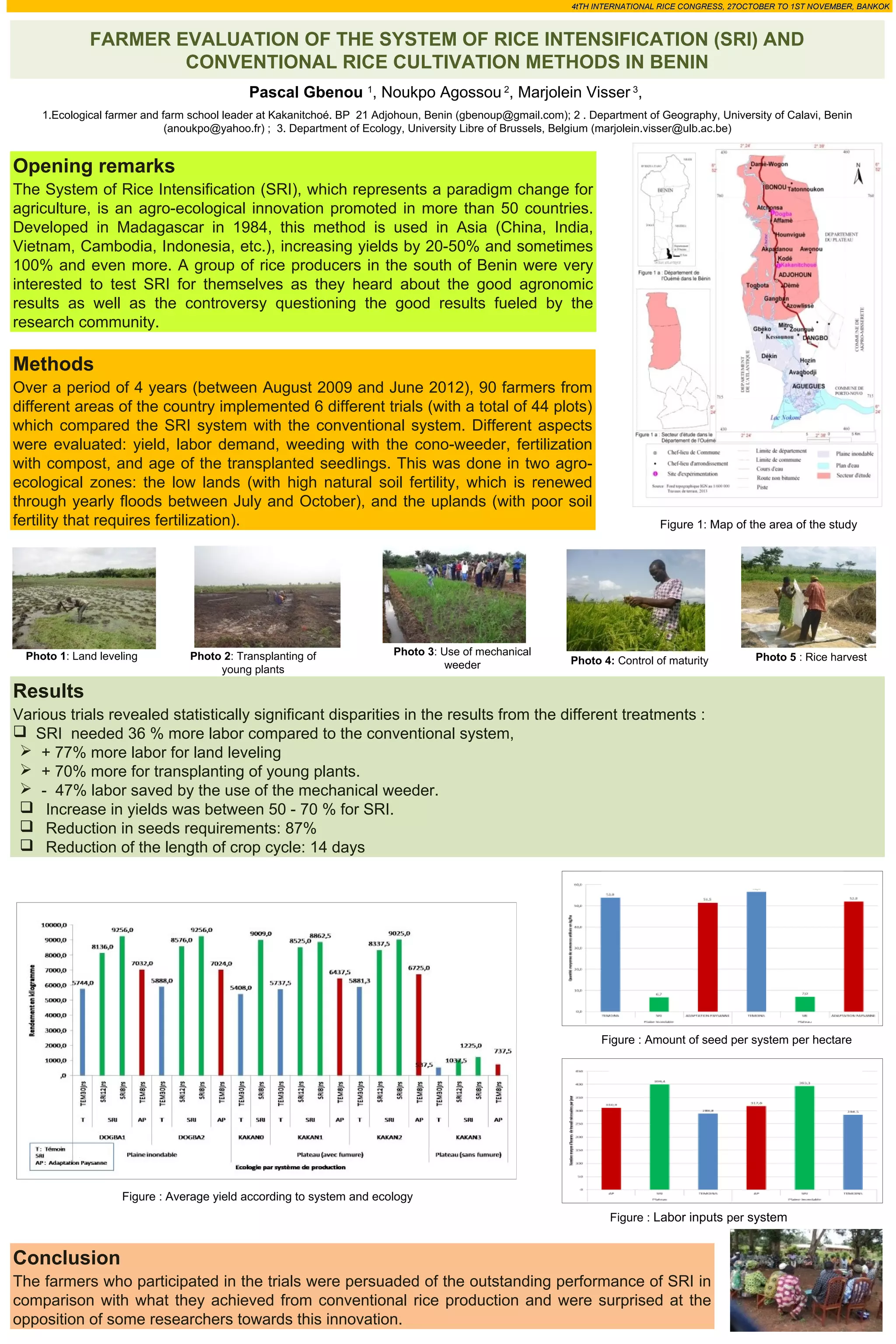
Figure 1: Map of the area of the study 
Photo 1: Land leveling Photo 2: Transplanting of 
Photo 3: Use of mechanical 
young plants 
weeder Photo 4: Control of maturity Photo 5 : Rice harvest 
Results 
Various trials revealed statistically significant disparities in the results from the different treatments : 
 SRI needed 36 % more labor compared to the conventional system, 
 + 77% more labor for land leveling 
 + 70% more for transplanting of young plants. 
 - 47% labor saved by the use of the mechanical weeder. 
 Increase in yields was between 50 - 70 % for SRI. 
 Reduction in seeds requirements: 87% 
 Reduction of the length of crop cycle: 14 days 
Figure : Average yield according to system and ecology 
Figure : Amount of seed per system per hectare 
Figure : Labor inputs per system 
Conclusion 
The farmers who participated in the trials were persuaded of the outstanding performance of SRI in 
comparison with what they achieved from conventional rice production and were surprised at the 
opposition of some researchers towards this innovation.

1433 - Farmer Evaluation of the SRI and Conventional Rice Cultivation Methods in Benin

  • 1.
    4tTH INTERNATIONAL RICECONGRESS, 27OCTOBER TO 11SSTT NNOOVVEEMMBBEERR,, BBAANNKKOOKK FARMER EVALUATION OF THE SYSTEM OF RICE INTENSIFICATION (SRI) AND CONVENTIONAL RICE CULTIVATION METHODS IN BENIN Pascal Gbenou 1, Noukpo Agossou 2, Marjolein Visser 3, 1.Ecological farmer and farm school leader at Kakanitchoé. BP 21 Adjohoun, Benin (gbenoup@gmail.com); 2 . Department of Geography, University of Calavi, Benin (anoukpo@yahoo.fr) ; 3. Department of Ecology, University Libre of Brussels, Belgium (marjolein.visser@ulb.ac.be) Opening remarks The System of Rice Intensification (SRI), which represents a paradigm change for agriculture, is an agro-ecological innovation promoted in more than 50 countries. Developed in Madagascar in 1984, this method is used in Asia (China, India, Vietnam, Cambodia, Indonesia, etc.), increasing yields by 20-50% and sometimes 100% and even more. A group of rice producers in the south of Benin were very interested to test SRI for themselves as they heard about the good agronomic results as well as the controversy questioning the good results fueled by the research community. Methods Over a period of 4 years (between August 2009 and June 2012), 90 farmers from different areas of the country implemented 6 different trials (with a total of 44 plots) which compared the SRI system with the conventional system. Different aspects were evaluated: yield, labor demand, weeding with the cono-weeder, fertilization with compost, and age of the transplanted seedlings. This was done in two agro-ecological zones: the low lands (with high natural soil fertility, which is renewed through yearly floods between July and October), and the uplands (with poor soil fertility that requires fertilization). Figure 1: Map of the area of the study Photo 1: Land leveling Photo 2: Transplanting of Photo 3: Use of mechanical young plants weeder Photo 4: Control of maturity Photo 5 : Rice harvest Results Various trials revealed statistically significant disparities in the results from the different treatments :  SRI needed 36 % more labor compared to the conventional system,  + 77% more labor for land leveling  + 70% more for transplanting of young plants.  - 47% labor saved by the use of the mechanical weeder.  Increase in yields was between 50 - 70 % for SRI.  Reduction in seeds requirements: 87%  Reduction of the length of crop cycle: 14 days Figure : Average yield according to system and ecology Figure : Amount of seed per system per hectare Figure : Labor inputs per system Conclusion The farmers who participated in the trials were persuaded of the outstanding performance of SRI in comparison with what they achieved from conventional rice production and were surprised at the opposition of some researchers towards this innovation.