Photo 
© 
javarman 
-­‐ 
fotolia 
File 
1
File 
1
Discovering Scrum
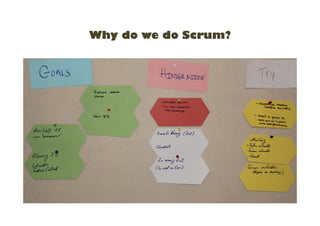
Why do we do Scrum?
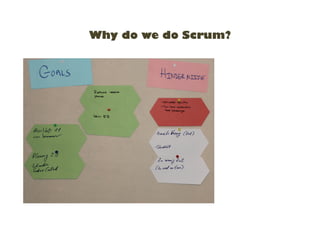
Why do we do Scrum?
Why do we do Scrum?
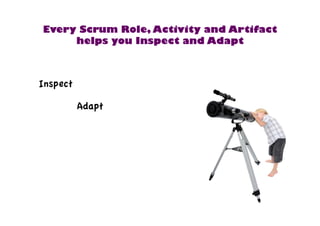
Every Scrum Role, Activity and Artifact 
Inspect 
helps you Inspect and Adapt 
Adapt
Photo 
courtesy 
of 
Iain 
Farrell@flickr
Photo 
courtesy 
of 
Iain 
Farrell@flickr
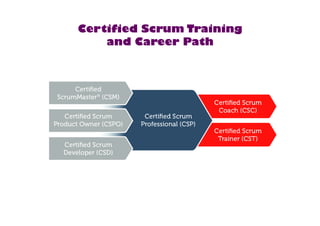
Certified Scrum Training 
and Career Path
@peterstev 
peter@saat-­‐network.ch
@peterstev 
peter@saat-­‐network.ch
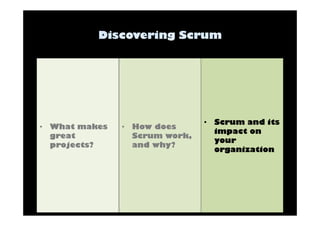
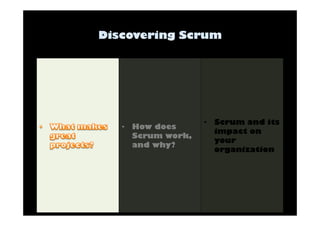
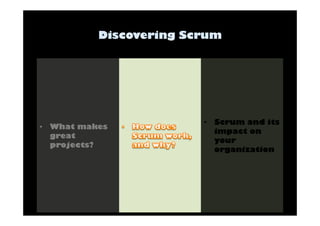
• What makes 
great 
projects? 
• How does 
Scrum work, 
and why? 
• Scrum and its 
impact on 
your 
organization
… 
while 
experiencing 
Scrum 
Photo 
© 
leonardo 
viD 
-­‐ 
fotolia
• How does 
Scrum work, 
and why? 
• Scrum and its 
impact on 
your 
organization
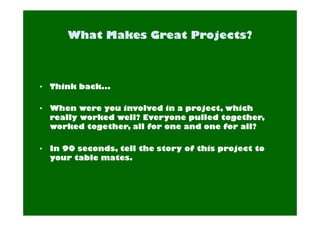
• Think back... 
• When were you involved in a project, which 
really worked well? Everyone pulled together, 
worked together, all for one and one for all? 
• In 90 seconds, tell the story of this project to 
your table mates.
• Note the person who told the “best” story, the 
one which should be a role model moving 
forward. 
• Now switch tables so your are with as many new 
people as possible.
• What are the stories we’d most like to emulate? 
• Find the best story (from either the first or 
second round) and put your hand on that 
persons shoulder. 
• Keep it there, until we find the top 3 stories.
Would the top 3 storytellers please 
share their stories to everyone.
Photo 
© 
leonardo 
viD 
-­‐ 
fotolia
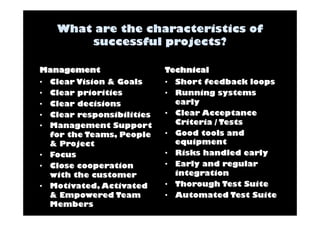
Management
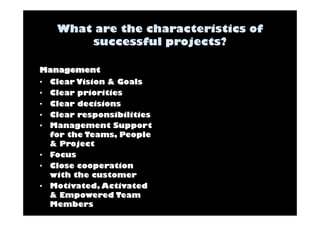
Management 
• Clear Vision & Goals 
• Clear priorities 
• Clear decisions 
• Clear responsibilities 
• Management Support 
for the Teams, People 
& Project 
• Focus 
• Close cooperation 
with the customer 
• Motivated, Activated 
& Empowered Team 
Members
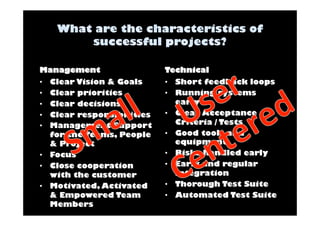
Management 
• Clear Vision & Goals 
• Clear priorities 
• Clear decisions 
• Clear responsibilities 
• Management Support 
for the Teams, People 
& Project 
• Focus 
• Close cooperation 
with the customer 
• Motivated, Activated 
& Empowered Team 
Members 
Technical 
• Short feedback loops 
• Running systems 
early 
• Clear Acceptance 
Criteria / Tests 
• Good tools and 
equipment 
• Risks handled early 
• Early and regular 
integration 
• Thorough Test Suite 
• Automated Test Suite
Management 
• Clear Vision & Goals 
• Clear priorities 
• Clear decisions 
• Clear responsibilities 
• Management Support 
for the Teams, People 
& Project 
• Focus 
• Close cooperation 
with the customer 
• Motivated, Activated 
& Empowered Team 
Members 
Technical 
• Short feedback loops 
• Running systems 
early 
• Clear Acceptance 
Criteria / Tests 
• Good tools and 
equipment 
• Risks handled early 
• Early and regular 
integration 
• Thorough Test Suite 
• Automated Test Suite
• What makes 
great 
projects? 
• Scrum and its 
impact on 
your 
organization
Photo: 
(CC) 
joeshlabotnik@flickr
Photo: 
Peter 
Stevens
t 
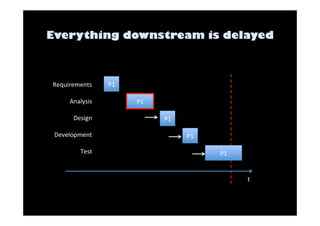
P1 
P1 
P1 
P1 
Requirements 
P1 
Analysis 
Design 
Development 
Test 
Deadline
t 
P1 
P1 
P1 
P1 
Requirements 
P1 
Analysis 
Design 
Development 
Test
t 
P1 
P1 
P1 
P1 
Requirements 
P1 
Analysis 
Design 
Development 
Test
t 
P1 
P1 
P1 
P1 
Requirements 
P1 
Analysis 
Design 
Development 
Test
t 
P1 
P1 
P1 
P1 
Requirements 
P1 
Analysis 
Design 
Development 
Test
P0 
P0 
P0 
P0 
t 
P1 
P1 
P1 
P1 
Requirements 
P1 
Analysis 
Design 
Development 
Test
P0 
P0 
P0 
P0 
t 
P1 
P1 
P1 
P1 
Requirements 
P1 
Analysis 
Design 
Development 
Test 
P2 
P2 
P2 
P2 
P2
P0 
P0 
P0 
P0 
t 
P1 
P1 
P1 
P1 
Requirements 
P1 
Analysis 
Design 
Development 
Test 
P2 
P2 
P2 
P2 
P2 
P3 
P3 
P3 
P3
P0 
P0 
P0 
P0 
t 
P5 
P6 
P1 
P1 
P1 
P1 
Requirements 
P1 
Analysis 
Design 
Development 
Test 
P2 
P2 
P2 
P2 
P2 
P3 
P3 
P3 
P3 
P4 
P4 
P4 
P5
P0 
P0 
P0 
P0 
t 
P5 
P6 
P1 
P1 
P1 
P1 
Requirements 
P1 
Analysis 
Design 
Development 
Test 
P2 
P2 
P2 
P2 
P2 
P3 
P3 
P3 
P3 
P4 
P4 
P4 
P5 
P1
P0 
P0 
P0 
P0 
t 
P1 
Requirements 
P1 
Analysis 
Design 
Development 
Test 
P2 
P5 
P6 
P2 
P2 
P2 
P2 
P3 
P3 
P3 
P3 
P4 
P4 
P4 
P5 
P1 
P1 
P1 
P1
P0 
P0 
P0 
P0 
t 
P1 
P1 
P1 
P1 
Requirements 
P1 
Analysis 
Design 
Development 
Test 
P2 
P2 
P2 
P2 
P2 
P3 
P3 
P3 
P3 
P4 
P4 
P4 
P5 
P5 
P6 
P1 
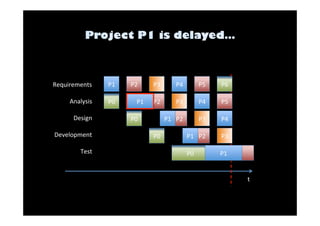
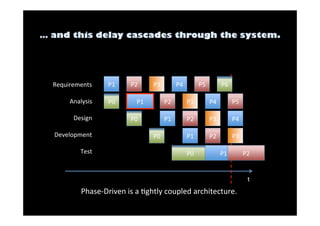
Phase-­‐Driven 
is 
a 
Dghtly 
coupled 
architecture.
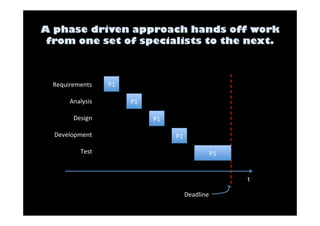
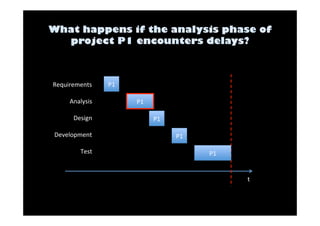
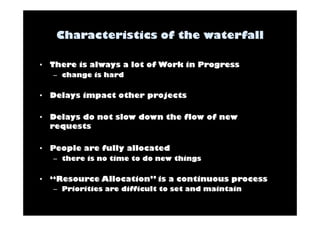
• There is always a lot of Work in Progress 
– change is hard 
• Delays impact other projects 
• Delays do not slow down the flow of new 
requests 
• People are fully allocated 
– there is no time to do new things 
• “Resource Allocation” is a continuous process 
– Priorities are difficult to set and maintain
P5 
R-­‐A-­‐D-­‐D-­‐T 
Team 
P1 
R-­‐A-­‐D-­‐D-­‐T 
PotenDal 
Release 
P1 
R-­‐A-­‐D-­‐D-­‐T 
PotenDal 
Release 
P1 
R-­‐A-­‐D-­‐D-­‐T 
Actual 
Release 
P4 
R-­‐A-­‐D-­‐D-­‐T 
Actual 
Release
P1 
R-­‐A-­‐D-­‐D-­‐T 
P1 
R-­‐A-­‐D-­‐D-­‐T 
P1 
R-­‐A-­‐D-­‐D-­‐T 
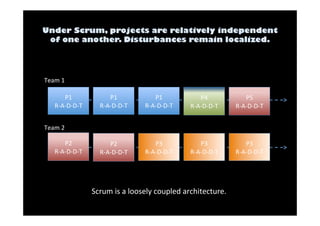
P2 
R-­‐A-­‐D-­‐D-­‐T 
P2 
R-­‐A-­‐D-­‐D-­‐T 
P3 
R-­‐A-­‐D-­‐D-­‐T 
P3 
R-­‐A-­‐D-­‐D-­‐T 
P3 
R-­‐A-­‐D-­‐D-­‐T 
P4 
R-­‐A-­‐D-­‐D-­‐T 
P5 
R-­‐A-­‐D-­‐D-­‐T 
Team 
1 
Team 
2 
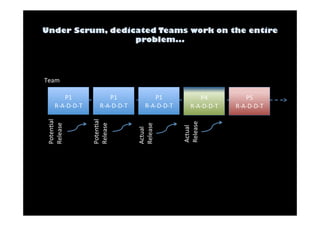
Scrum 
is 
a 
loosely 
coupled 
architecture.
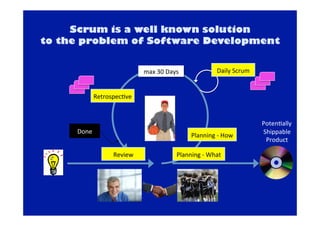
max 
30 
Days 
Done 
PotenDally 
Shippable 
Product 
RetrospecDve 
Daily 
Scrum 
Planning 
-­‐ 
How 
Review 
Planning 
-­‐ 
What
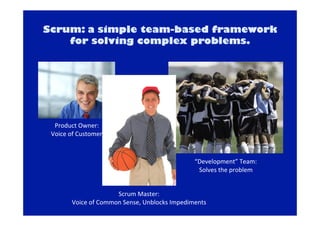
Product 
Owner: 
Voice 
of 
Customer 
Scrum 
Master: 
“Development” 
Team: 
Solves 
the 
problem 
Voice 
of 
Common 
Sense, 
Unblocks 
Impediments
• What makes 
great 
projects? 
• How does 
Scrum work, 
and why?
Photo: 
Courtesy 
of 
Roman 
Keller
Photo 
© 
Big 
Stock 
Photo
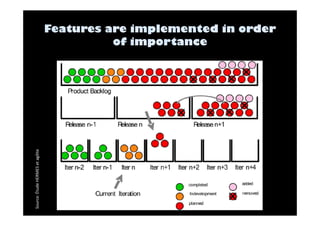
au début du projet, d’une vision du produit décrivant clairement et de manière compréhensible 
l’objectif final, tout en laissant consciemment un espace suffisant pour la navigation. Au cours du pro-cessus 
de développement, cet espace sera complété avec les exigences apportant la meilleure plus-value. 
La collecte des exigences et la fixation des priorités correspondantes ne s’effectuent donc pas 
au début seulement (up-front), mais en continu, par l’intégration précoce du client et d’autres experts 
du domaine. Ainsi, des découvertes importantes peuvent encore être prises en compte même très 
tard dans le projet. De telles constatations apportent souvent la meilleure plus-value et sont importan-tes 
pour la réussite du projet. 
Figure 5: Backlog de produit: catalogue des exigences avec itérations 
Source: 
Étude 
HERMES 
et 
agilite
7 
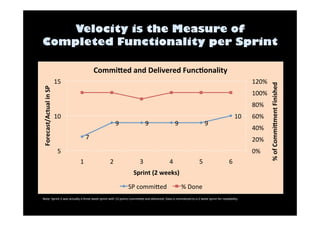
Commi(ed 
and 
Delivered 
FuncAonality 
9 
9 
9 
9 
10 
120% 
100% 
80% 
60% 
40% 
20% 
0% 
15 
10 
5 
1 
2 
3 
4 
5 
6 
% 
of 
Commi(ment 
Finished 
Forecast/Actual 
in 
SP 
Sprint 
(2 
weeks) 
SP 
commifed 
% 
Done 
Note: 
Sprint 
2 
was 
actually 
a 
three 
week 
sprint 
with 
13 
points 
commifed 
and 
delivered. 
Data 
is 
normalized 
to 
a 
2 
week 
sprint 
for 
readability.
52 
45 
36 
28 
19 
10 
15 
10 
0 
5 
60 
50 
40 
30 
20 
10 
0 
Start 
1 
2 
3 
4 
5 
6 
Velocity 
FuncAonality 
Remaining 
"Backlog" 
Delivered 
FuncAonality 
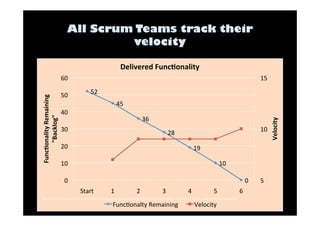
Note: 
Sprint 
2 
was 
actually 
a 
three 
week 
sprint 
with 
13 
points 
commifed 
and 
delivered. 
Data 
is 
normalized 
to 
a 
2 
week 
sprint 
for 
readability. 
FuncDonalty 
Remaining 
Velocity
120 
100 
80 
60 
40 
20 
0 
Start 
1 
2 
3 
4 
5 
6 
7 
8 
9 
10 
11 
12 
Scope 
EsAmated 
CompleAon 
Note: 
Sprint 
2 
was 
actually 
a 
three 
week 
sprint 
with 
13 
points 
commifed 
and 
delivered. 
Data 
is 
normalized 
to 
a 
2 
week 
sprint 
for 
readability. 
Full 
Project 
Reduced 
Project
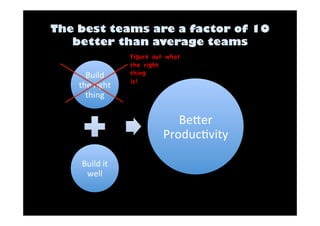
Build 
the 
right 
thing 
Build 
it 
well 
Figure out what 
the right 
thing 
is! 
Befer 
ProducDvity
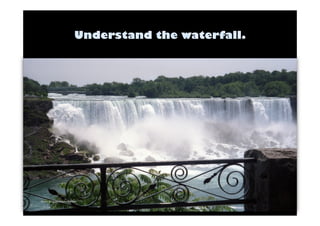
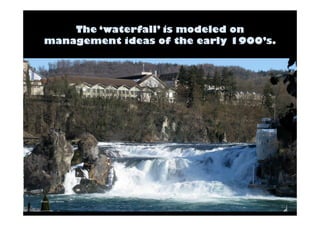
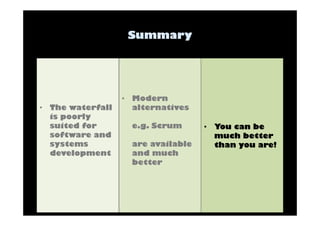
• The waterfall 
is poorly 
suited for 
software and 
systems 
development 
• Modern 
alternatives 
e.g. Scrum 
are available 
and much 
better 
• You can be 
much better 
than you are!
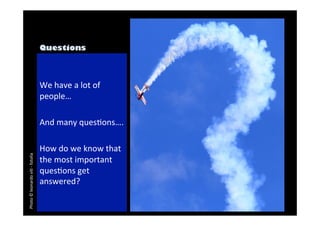
We 
have 
a 
lot 
of 
people… 
And 
many 
quesDons…. 
How 
do 
we 
know 
that 
the 
most 
important 
quesDons 
get 
answered? 
Photo 
© 
leonardo 
viD 
-­‐ 
fotolia
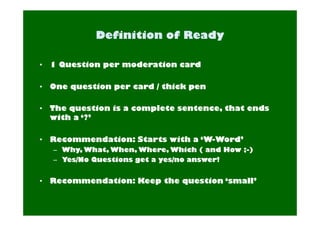
• 1 Question per moderation card 
• One question per card / thick pen 
• The question is a complete sentence, that ends 
with a ‘?’ 
• Recommendation: Starts with a ‘W-Word’ 
– Why, What, When, Where, Which ( and How ;-) 
– Yes/No Questions get a yes/no answer! 
• Recommendation: Keep the question ‘small’
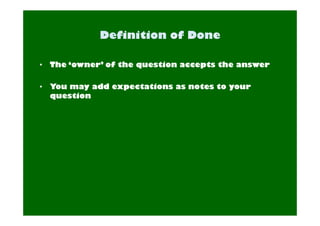
• The ‘owner’ of the question accepts the answer 
• You may add expectations as notes to your 
question
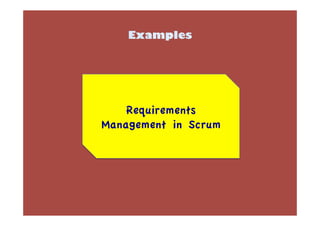
Requirements 
Management in Scrum
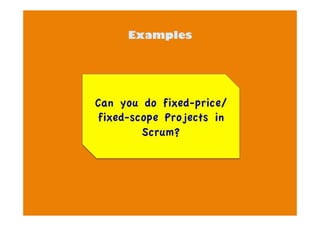
Can you do fixed-price/ 
fixed-scope Projects in 
Scrum?
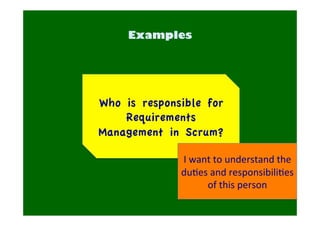
Who is responsible for 
Requirements 
Management in Scrum? 
I 
want 
to 
understand 
the 
duDes 
and 
responsibiliDes 
of 
this 
person
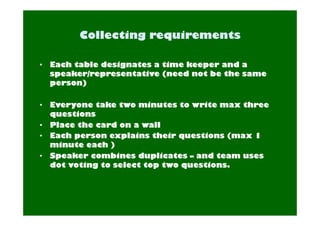
• Each table designates a time keeper and a 
speaker/representative (need not be the same 
person) 
• Everyone take two minutes to write max three 
questions 
• Place the card on a wall 
• Each person explains their questions (max 1 
minute each ) 
• Speaker combines duplicates – and team uses 
dot voting to select top two questions.
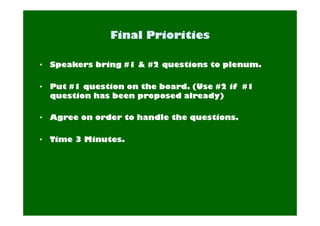
• Speakers bring #1 & #2 questions to plenum. 
• Put #1 question on the board. (Use #2 if #1 
question has been proposed already) 
• Agree on order to handle the questions. 
• Time 3 Minutes.
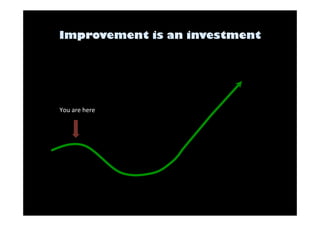
You 
are 
here
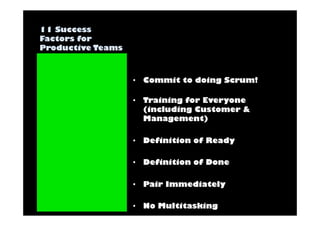
• Commit to doing Scrum! 
• Training for Everyone 
(including Customer & 
Management) 
• Definition of Ready 
• Definition of Done 
• Pair Immediately 
• No Multitasking
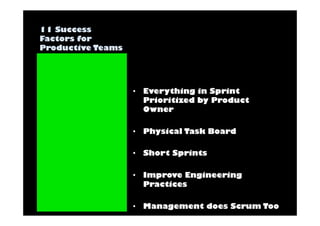
• Everything in Sprint 
Prioritized by Product 
Owner 
• Physical Task Board 
• Short Sprints 
• Improve Engineering 
Practices 
• Management does Scrum Too
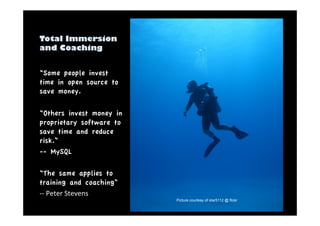
“Some people invest 
time in open source to 
save money. 
“Others invest money in 
proprietary software to 
save time and reduce 
risk.” 
-- MySQL 
“The same applies to 
training and coaching” 
-­‐-­‐ 
Peter 
Stevens 
Picture courtesy of star5112 @ flickr
Peter 
Stevens 
@peterstev 
peter@saat-­‐network.ch 
Training 
CerDfied 
Scrum 
Master 
Roma 
16.10 
Milano 
25.11 
For 
Training 
Coaching 
or 
TransisDons 
Contact 
Elena 
Bassa 
elena.b@beflowing.com 
Photo 
: 
© 
Julián 
RovagnaD 
– 
Fotolia
• © 2006-2013 Peter Stevens 
• Redistribution permitted under 
Attribution-NonCommercial-ShareAlike 2.5 
Generic 
(CC BY-NC-SA 2.5) 
• Some image material © Fotolia or BigStockPhoto 
and their respective photographers – used 
under license

141015 Discovering Scrum at Scrum Roma

  • 1.
    Photo © javarman -­‐ fotolia File 1
  • 2.
  • 3.
  • 4.
    Why do wedo Scrum?
  • 5.
    Why do wedo Scrum?
  • 6.
    Why do wedo Scrum?
  • 7.
    Every Scrum Role,Activity and Artifact Inspect helps you Inspect and Adapt Adapt
  • 8.
    Photo courtesy of Iain Farrell@flickr
  • 10.
    Photo courtesy of Iain Farrell@flickr
  • 11.
    Certified Scrum Training and Career Path
  • 12.
  • 13.
  • 14.
    • What makes great projects? • How does Scrum work, and why? • Scrum and its impact on your organization
  • 15.
    … while experiencing Scrum Photo © leonardo viD -­‐ fotolia
  • 16.
    • How does Scrum work, and why? • Scrum and its impact on your organization
  • 17.
    • Think back... • When were you involved in a project, which really worked well? Everyone pulled together, worked together, all for one and one for all? • In 90 seconds, tell the story of this project to your table mates.
  • 18.
    • Note theperson who told the “best” story, the one which should be a role model moving forward. • Now switch tables so your are with as many new people as possible.
  • 20.
    • What arethe stories we’d most like to emulate? • Find the best story (from either the first or second round) and put your hand on that persons shoulder. • Keep it there, until we find the top 3 stories.
  • 21.
    Would the top3 storytellers please share their stories to everyone.
  • 23.
    Photo © leonardo viD -­‐ fotolia
  • 24.
  • 25.
    Management • ClearVision & Goals • Clear priorities • Clear decisions • Clear responsibilities • Management Support for the Teams, People & Project • Focus • Close cooperation with the customer • Motivated, Activated & Empowered Team Members
  • 26.
    Management • ClearVision & Goals • Clear priorities • Clear decisions • Clear responsibilities • Management Support for the Teams, People & Project • Focus • Close cooperation with the customer • Motivated, Activated & Empowered Team Members Technical • Short feedback loops • Running systems early • Clear Acceptance Criteria / Tests • Good tools and equipment • Risks handled early • Early and regular integration • Thorough Test Suite • Automated Test Suite
  • 27.
    Management • ClearVision & Goals • Clear priorities • Clear decisions • Clear responsibilities • Management Support for the Teams, People & Project • Focus • Close cooperation with the customer • Motivated, Activated & Empowered Team Members Technical • Short feedback loops • Running systems early • Clear Acceptance Criteria / Tests • Good tools and equipment • Risks handled early • Early and regular integration • Thorough Test Suite • Automated Test Suite
  • 28.
    • What makes great projects? • Scrum and its impact on your organization
  • 29.
  • 30.
  • 33.
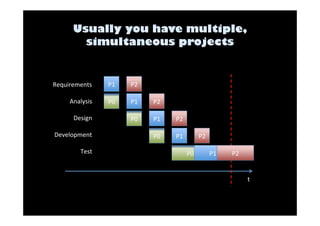
    t P1 P1 P1 P1 Requirements P1 Analysis Design Development Test Deadline
  • 34.
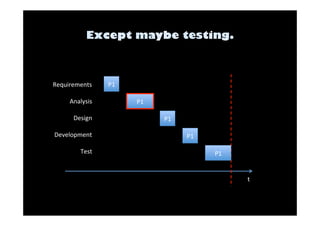
    t P1 P1 P1 P1 Requirements P1 Analysis Design Development Test
  • 35.
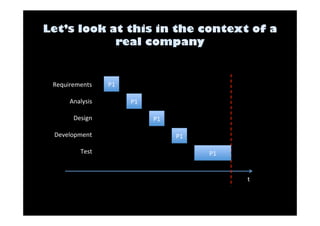
    t P1 P1 P1 P1 Requirements P1 Analysis Design Development Test
  • 36.
    t P1 P1 P1 P1 Requirements P1 Analysis Design Development Test
  • 37.
    t P1 P1 P1 P1 Requirements P1 Analysis Design Development Test
  • 38.
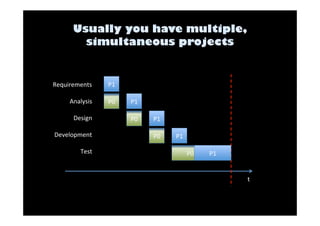
    P0 P0 P0 P0 t P1 P1 P1 P1 Requirements P1 Analysis Design Development Test
  • 39.
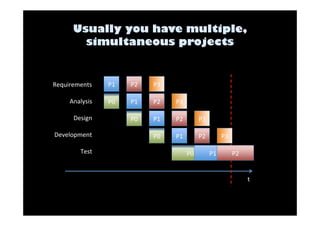
    P0 P0 P0 P0 t P1 P1 P1 P1 Requirements P1 Analysis Design Development Test P2 P2 P2 P2 P2
  • 40.
    P0 P0 P0 P0 t P1 P1 P1 P1 Requirements P1 Analysis Design Development Test P2 P2 P2 P2 P2 P3 P3 P3 P3
  • 41.
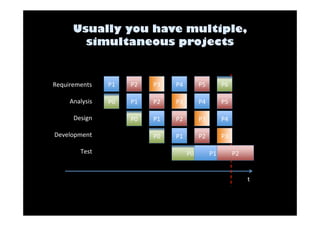
    P0 P0 P0 P0 t P5 P6 P1 P1 P1 P1 Requirements P1 Analysis Design Development Test P2 P2 P2 P2 P2 P3 P3 P3 P3 P4 P4 P4 P5
  • 42.
    P0 P0 P0 P0 t P5 P6 P1 P1 P1 P1 Requirements P1 Analysis Design Development Test P2 P2 P2 P2 P2 P3 P3 P3 P3 P4 P4 P4 P5 P1
  • 43.
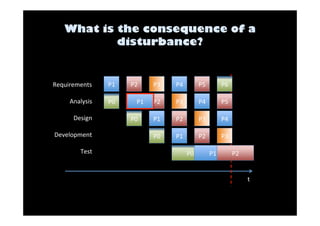
    P0 P0 P0 P0 t P1 Requirements P1 Analysis Design Development Test P2 P5 P6 P2 P2 P2 P2 P3 P3 P3 P3 P4 P4 P4 P5 P1 P1 P1 P1
  • 44.
    P0 P0 P0 P0 t P1 P1 P1 P1 Requirements P1 Analysis Design Development Test P2 P2 P2 P2 P2 P3 P3 P3 P3 P4 P4 P4 P5 P5 P6 P1 Phase-­‐Driven is a Dghtly coupled architecture.
  • 45.
    • There isalways a lot of Work in Progress – change is hard • Delays impact other projects • Delays do not slow down the flow of new requests • People are fully allocated – there is no time to do new things • “Resource Allocation” is a continuous process – Priorities are difficult to set and maintain
  • 46.
    P5 R-­‐A-­‐D-­‐D-­‐T Team P1 R-­‐A-­‐D-­‐D-­‐T PotenDal Release P1 R-­‐A-­‐D-­‐D-­‐T PotenDal Release P1 R-­‐A-­‐D-­‐D-­‐T Actual Release P4 R-­‐A-­‐D-­‐D-­‐T Actual Release
  • 47.
    P1 R-­‐A-­‐D-­‐D-­‐T P1 R-­‐A-­‐D-­‐D-­‐T P1 R-­‐A-­‐D-­‐D-­‐T P2 R-­‐A-­‐D-­‐D-­‐T P2 R-­‐A-­‐D-­‐D-­‐T P3 R-­‐A-­‐D-­‐D-­‐T P3 R-­‐A-­‐D-­‐D-­‐T P3 R-­‐A-­‐D-­‐D-­‐T P4 R-­‐A-­‐D-­‐D-­‐T P5 R-­‐A-­‐D-­‐D-­‐T Team 1 Team 2 Scrum is a loosely coupled architecture.
  • 48.
    max 30 Days Done PotenDally Shippable Product RetrospecDve Daily Scrum Planning -­‐ How Review Planning -­‐ What
  • 49.
    Product Owner: Voice of Customer Scrum Master: “Development” Team: Solves the problem Voice of Common Sense, Unblocks Impediments
  • 50.
    • What makes great projects? • How does Scrum work, and why?
  • 51.
    Photo: Courtesy of Roman Keller
  • 52.
    Photo © Big Stock Photo
  • 54.
    au début duprojet, d’une vision du produit décrivant clairement et de manière compréhensible l’objectif final, tout en laissant consciemment un espace suffisant pour la navigation. Au cours du pro-cessus de développement, cet espace sera complété avec les exigences apportant la meilleure plus-value. La collecte des exigences et la fixation des priorités correspondantes ne s’effectuent donc pas au début seulement (up-front), mais en continu, par l’intégration précoce du client et d’autres experts du domaine. Ainsi, des découvertes importantes peuvent encore être prises en compte même très tard dans le projet. De telles constatations apportent souvent la meilleure plus-value et sont importan-tes pour la réussite du projet. Figure 5: Backlog de produit: catalogue des exigences avec itérations Source: Étude HERMES et agilite
  • 56.
    7 Commi(ed and Delivered FuncAonality 9 9 9 9 10 120% 100% 80% 60% 40% 20% 0% 15 10 5 1 2 3 4 5 6 % of Commi(ment Finished Forecast/Actual in SP Sprint (2 weeks) SP commifed % Done Note: Sprint 2 was actually a three week sprint with 13 points commifed and delivered. Data is normalized to a 2 week sprint for readability.
  • 57.
    52 45 36 28 19 10 15 10 0 5 60 50 40 30 20 10 0 Start 1 2 3 4 5 6 Velocity FuncAonality Remaining "Backlog" Delivered FuncAonality Note: Sprint 2 was actually a three week sprint with 13 points commifed and delivered. Data is normalized to a 2 week sprint for readability. FuncDonalty Remaining Velocity
  • 58.
    120 100 80 60 40 20 0 Start 1 2 3 4 5 6 7 8 9 10 11 12 Scope EsAmated CompleAon Note: Sprint 2 was actually a three week sprint with 13 points commifed and delivered. Data is normalized to a 2 week sprint for readability. Full Project Reduced Project
  • 59.
    Build the right thing Build it well Figure out what the right thing is! Befer ProducDvity
  • 61.
    • The waterfall is poorly suited for software and systems development • Modern alternatives e.g. Scrum are available and much better • You can be much better than you are!
  • 62.
    We have a lot of people… And many quesDons…. How do we know that the most important quesDons get answered? Photo © leonardo viD -­‐ fotolia
  • 63.
    • 1 Questionper moderation card • One question per card / thick pen • The question is a complete sentence, that ends with a ‘?’ • Recommendation: Starts with a ‘W-Word’ – Why, What, When, Where, Which ( and How ;-) – Yes/No Questions get a yes/no answer! • Recommendation: Keep the question ‘small’
  • 64.
    • The ‘owner’of the question accepts the answer • You may add expectations as notes to your question
  • 65.
  • 66.
    Can you dofixed-price/ fixed-scope Projects in Scrum?
  • 67.
    Who is responsiblefor Requirements Management in Scrum? I want to understand the duDes and responsibiliDes of this person
  • 68.
    • Each tabledesignates a time keeper and a speaker/representative (need not be the same person) • Everyone take two minutes to write max three questions • Place the card on a wall • Each person explains their questions (max 1 minute each ) • Speaker combines duplicates – and team uses dot voting to select top two questions.
  • 69.
    • Speakers bring#1 & #2 questions to plenum. • Put #1 question on the board. (Use #2 if #1 question has been proposed already) • Agree on order to handle the questions. • Time 3 Minutes.
  • 71.
  • 72.
    • Commit todoing Scrum! • Training for Everyone (including Customer & Management) • Definition of Ready • Definition of Done • Pair Immediately • No Multitasking
  • 73.
    • Everything inSprint Prioritized by Product Owner • Physical Task Board • Short Sprints • Improve Engineering Practices • Management does Scrum Too
  • 74.
    “Some people invest time in open source to save money. “Others invest money in proprietary software to save time and reduce risk.” -- MySQL “The same applies to training and coaching” -­‐-­‐ Peter Stevens Picture courtesy of star5112 @ flickr
  • 75.
    Peter Stevens @peterstev peter@saat-­‐network.ch Training CerDfied Scrum Master Roma 16.10 Milano 25.11 For Training Coaching or TransisDons Contact Elena Bassa elena.b@beflowing.com Photo : © Julián RovagnaD – Fotolia
  • 76.
    • © 2006-2013Peter Stevens • Redistribution permitted under Attribution-NonCommercial-ShareAlike 2.5 Generic (CC BY-NC-SA 2.5) • Some image material © Fotolia or BigStockPhoto and their respective photographers – used under license