By
Asst. Prof. Desai Y.N.
Ismailsaheb Mulla Law College,
Satara
 Theft
 Extortion
 Robbery
 Decoity
 Criminal Misappropriation of Property
 Criminal Breach Of Trust
 Cheating
 Mischief.
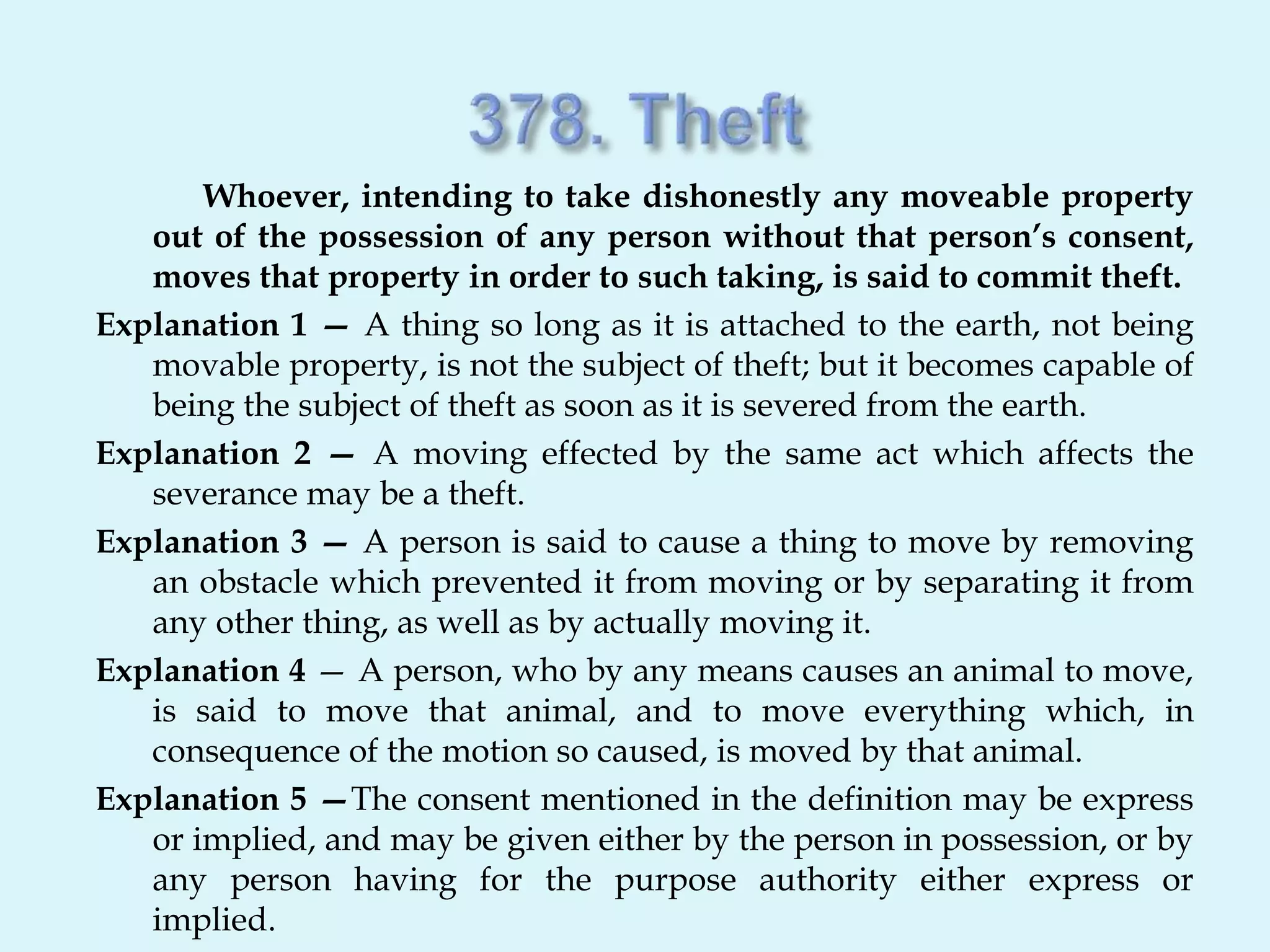
Whoever, intending to take dishonestly any moveable property
out of the possession of any person without that person’s consent,
moves that property in order to such taking, is said to commit theft.
Explanation 1 — A thing so long as it is attached to the earth, not being
movable property, is not the subject of theft; but it becomes capable of
being the subject of theft as soon as it is severed from the earth.
Explanation 2 — A moving effected by the same act which affects the
severance may be a theft.
Explanation 3 — A person is said to cause a thing to move by removing
an obstacle which prevented it from moving or by separating it from
any other thing, as well as by actually moving it.
Explanation 4 — A person, who by any means causes an animal to move,
is said to move that animal, and to move everything which, in
consequence of the motion so caused, is moved by that animal.
Explanation 5 —The consent mentioned in the definition may be express
or implied, and may be given either by the person in possession, or by
any person having for the purpose authority either express or
implied.
1. take dishonestly
2. any moveable property
3. out of the possession of any person
4. without that person’s consent
5. moves that property in order to such taking
Whoever commits theft shall be punished
with imprisonment of either description for a
term which may extend to three years, or with
fine, or with both.
 380. Theft in dwelling house, etc.—
 381. Theft by clerk or servant of property in
possession of master —
 382. Theft after preparation made for causing
death, hurt or restraint in order to the
committing of the theft —
Whoever intentionally puts any person
in fear of any injury to that person, or to
any other, and thereby dishonestly
induces the person so put in fear to
deliver to any person any property or
valuable security, or anything signed or
sealed which maybe converted into a
valuable security, commits "extortion".
1. Intention
2. puts any person in fear of any injury - to
that person or
to any other
3. Thereby, dishonestly induces the person so put
in fear
4. to deliver to any person
 any property or
 valuable security, or
 anything signed or sealed which maybe
converted into a valuable security
Whoever commits extortion
shall be punished with
imprisonment of either
description for a term which
may extend to three years, or
with fine, or with both.
 385. Putting person in fear of injury in order to
com
 386. Extortion by putting a person in fear of death
or grievous hurt to —commit extortion —
 387. Putting person in fear of death or of grievous
hurt, in order to commit extortion
 388. Extortion by threat of accusation of an offence
punishable with death or imprisonment for life,
etc.—
 389. Putting person in fear of accusation of offence,
in order to commit extortion —
390. Robbery —
In all robbery there is either
theft
or
extortion.
Theft is "robbery" if, in order to the
committing of the theft, or in committing the
theft, or in carving away or attempting to carry
away property obtained by the theft, the
offender, for that end, voluntarily causes or
attempts to cause to any person death or hurt
or wrongful restraint, or fear of instant death or
of instant hurt, or of instant wrongful restraint.
1. a) in order to the committing of the theft,
b)or in committing the theft, or
c) in carving away or
d)attempting to carry away property obtained by
the theft
2. offender, voluntarily causes or attempts to cause
3. Any person
death or
hurt or
wrongful restraint, or
fear of instant death or of instant hurt, or
of instant wrongful restraint.
Extortion is "robbery" if the offender, at
the time of committing the extortion, is in the
presence of the person put in fear, and commits the
extortion by putting that person in fear of instant
death, of instant hurt, or of instant wrongful
restraint to that person or to some other person,
and, by so putting in fear, induces the person so
put in fear then and there to deliver up the thing
extorted.
Explanation —The offender is said to be present
if he is sufficiently near to put the other person in
fear of instant death, of instant hurt, or of instant
wrongful restraint.
1. the offender, at the time of committing the extortion
2. is in the presence of the person put in fear
3. commits the extortion by putting that person in fear of
-instant death,
-of instant hurt, or
-of instant wrongful restraint
-to that person or
-to some other person,
4. by so putting in fear,
5. induces the person so put in fear then and there
-to deliver up the thing extorted
Whoever commits robbery
shall be punished with rigorous
imprisonment for a term which may
extend to ten years, and shall also
be liable to fine; and, if the robbery
be committed on the highway
between sunset and sunrise, the
imprisonment may be extended to
fourteen years.
When five or more persons conjointly
commit or attempt to commit a robbery, or
where the whole number of persons conjointly
committing or attempting to commit a robbery,
and persons present and aiding such
commission or attempt, amount to five or
more, every person so committing, attempting
or aiding, is said to commit "dacoity".
 five or more persons conjointly
commit or
attempt to commit a robbery
 where the whole number of persons conjointly
 committing or
 attempting to commit a robbery, and
 persons present and aiding such commission or
attempt,
 amount to five or more,
 every person so committing, attempting or aiding
Whoever commits dacoity shall be
punished with imprisonment for life, or with
rigorous imprisonment for a term which may
extend to ten years, and shall also be liable to
fine.
 396. Dacoity with murder —
If any one of five or more persons, who
are conjointly committing dacoity, commits
murder in so committing dacoity, every one of
those persons shall be punished with death, or
imprisonment for life, or rigorous imprisonment
for a term which may extend to ten years, and
shall also be liable to fine.
 393. Attempt to commit robbery —
Whoever attempts to commit robbery shall be punished
with rigorous imprisonment for a term which may extend to
seven years, and shall also be liable to fine.
 394. Voluntarily causing hurt in committing robbery —
 397. Robbery, or dacoity, with attempt to cause death or
grievous hurt —
 398. Attempt to commit robbery or dacoity when armed
with deadly weapon
 399. Making preparation to commit dacoity —
 400. Punishment for belonging to gang of dacoits —
 401. Punishment for belonging to gang of thieves —
 402. Assembling for purpose of committing dacoity —
403. Dishonest misappropriation of property —
Whoever dishonestly misappropriates or converts to his own use any
movable property, shall be punished with imprisonment of either
description for a term which may extend to two years, or with fine, or
with both.
Explanation I —A dishonest misappropriation for a time only is a
misappropriation with the meaning of this section.
Explanation 2 — A person who finds property not in the possession of any
other person, and takes such property for the purpose of protecting if for,
or of restoring it to, the owner does not take or misappropriate it
dishonestly, and is not guilty of an offence; but he is guilty of the offence
above defined, if he appropriates it to his own use, when he knows or has
the means of discovering the owner, or before he has used reasonable
means to discover and give notice to the owner and has kept the property
a reasonable time to enable the owner to claim it. What are reasonable
means or what is a reasonable time in such a case, is a question of fact. It
is not necessary that the finder should know who is the owner of the
property, or that any particular person is the owner of it; it is sufficient if,
at the time of appropriating it, he does not believe it to be his own
property, or in good faith believe that the real owner cannot be found.
 dishonestly misappropriates
 converts to his own use
 movable property
 404. Dishonest misappropriation of property
possessed by deceased person at the time of
his death —
405. Criminal breach of trust —
Whoever, being in any manner entrusted
with property, or with any dominion over
property, dishonestly misappropriates or
converts to his own use that property, or
dishonestly uses or disposes of that property in
violation of any direction of law prescribing the
mode in which such trust is to be discharged,
or of any legal contract, express or implied,
which he has made touching the discharge of
such trust, or willfully suffers any other person
so to do, commits "criminal breach of trust".
Explanation 1 —A person, being an employer of an establishment whether
exempted under section 17 of the Employees’ Provident Funds and
Miscellaneous Provisions Act, 1952 (19 of 1952), or not who deducts the
employee’s contribution from the wages payable to the employee for
credit to a Provident Fund or Family Pension Fund established by any
law for the time being in force, shall be deemed to have been entrusted
with the amount of the contribution so deducted by him and if he makes
default in the payment of such contribution to the said Fund in violation
of the said law, shall be deemed to have dishonestly used the amount of
the said contribution in violation of a direction of law as aforesaid.
Explanation 2 — A person, being an employer, who deducts the employees’
contribution from the wages payable to the employee for credit to the
Employees’ State Insurance Fund held and administered by the
Employees’ State Insurance Corporation established under the
Employees’ State Insurance Act, 1948 (34 of 1948), shall be deemed to
have been entrusted with the amount of the contribution so deducted by
him and if he makes default in the payment of such contribution to the
said Fund in violation of the said Act, shall be deemed to have
dishonestly used the amount of the said contribution in violation of a
direction of law as aforesaid.
 Whoever, being in any manner entrusted with
property, or with any dominion over property
 dishonestly misappropriates or converts to his
own use that property
 dishonestly uses or disposes of that property in
violation of any direction of law prescribing the
mode in which such trust is to be discharged
 of any legal contract, express or implied, which
he has made touching the discharge of such
trust
 willfully suffers any other person so to do
Whoever commits criminal
breach of trust shall be punished
with imprisonment of either
description for a term which
may extend to three years, or
with fine, or with both.
 407. Criminal breach of trust by carrier, etc.—
 408. Criminal breach of trust by clerk or
servant —
 409. Criminal breach of trust by public
servant, or by banker, merchant or agent.—
Whoever, by deceiving any person,
fraudulently or dishonestly induces the person so
deceived to deliver any property to any person, or
to consent that any person shall retain any
property, or intentionally induces the person so
deceived to do or omit to do anything which he
would not do or omit if he were not so deceived,
and which act or omission causes or is likely to
cause damage or harm to that person in body,
mind, reputation or property, is said to "cheat".
Explanation— A dishonest concealment of facts is a
deception within the meaning of this section.
 deceiving any person
 fraudulently or dishonestly induces the person
 to deliver any property to any person/
 to consent that any person shall retain any property
• intentionally induces the person
- to do or omit to do anything which he would
not do or omit if he were not so deceived
• which act or omission causes or is likely to cause
damage or harm to that person in body, mind,
reputation or property
Whoever cheats shall be punished with
imprisonment of either description for a term
which may extend to one year, or with fine, or
with both.
A person is said to "cheat by personation" if he
cheats by pretending to be some other person, or
by knowingly substituting one person for another,
or representing that he or any other person is a
person other than he or such other person really is.
Explanation —The offence is committed
whether the individual personated is a real or
imaginary person.
419. Punishment for cheating by personation —
Whoever cheats by personation shall be
punished with imprisonment of either description
for a term which may extend to three years, or
with fine, or with both .
Whoever with intent to cause, or knowing that he is
likely to cause, wrongful loss or damage to the public
or to any person, causes the destruction of any
property, or any such change in any property or in the
situation thereof as destroys or diminishes its value or
utility, or affects it injuriously, commits "mischief".
Explanation 1—It is not essential to the offence of
mischief that the offender should intend to cause loss
or damage to the owner of the property injured or
destroyed. It is sufficient if he intends to cause, or
knows that he is likely to cause, wrongful loss or
damage to any person by injuring any property,
whether it belongs to that person or not.
Explanation 2—Mischief may be committed by an act
affecting property belonging to the person who
commits the act, or to that person and others jointly.
 Intention to cause, or knowing that he is likely
to cause
 wrongful loss or damage to the public or to any
person
 causes the destruction of any property
 any such change in any property or in the
situation thereof
 destroys or
 diminishes its value or
 utility, or
 affects it injuriously
Whoever commits mischief shall be
punished with imprisonment of either
description for a term which may extend to
three months, or with fine, or with both.
427. Mischief causing damage to the amount of fifty rupees —
428. Mischief by killing or maiming animal of the value of ten rupees .—
429. Mischief by killing or maiming cattle, etc., of any value or any animal of the
value of fifty rupees —
430. Mischief by injury to works of irrigation or by wrongfully diverting water—
431. Mischief by injury to public road, bridge, river or channel —
432. Mischief by causing inundation or obstruction to public drainage attended with
damage —
433. Mischief by destroying, moving or rendering less useful a light-house or sea-
mark.—
434. Mischief by destroying or moving, etc., a land-mark fixed by public authority —
435. Mischief by fire or explosive substance with intent to cause damage to amount
of one hundred or (in case of agricultural produce) ten rupees —
436. Mischief by fire or explosive substance with intent to destroy house, etc.—
437. Mischief with intent to destroy or make unsafe a decked vessel or one of twenty
tons burden —
438. Punishment for the mischief described in section 437 committed by fire or
explosive substance —
439. Punishment for intentionally running vessel on ground or ashore with intent to
commit theft, etc.—
440. Mischief committed after preparation made for causing death or hurt.—
Thank
You

OFFENCES AGAINST PROPERTY

  • 1.
    By Asst. Prof. DesaiY.N. Ismailsaheb Mulla Law College, Satara
  • 2.
     Theft  Extortion Robbery  Decoity  Criminal Misappropriation of Property  Criminal Breach Of Trust  Cheating  Mischief.
  • 3.
    Whoever, intending totake dishonestly any moveable property out of the possession of any person without that person’s consent, moves that property in order to such taking, is said to commit theft. Explanation 1 — A thing so long as it is attached to the earth, not being movable property, is not the subject of theft; but it becomes capable of being the subject of theft as soon as it is severed from the earth. Explanation 2 — A moving effected by the same act which affects the severance may be a theft. Explanation 3 — A person is said to cause a thing to move by removing an obstacle which prevented it from moving or by separating it from any other thing, as well as by actually moving it. Explanation 4 — A person, who by any means causes an animal to move, is said to move that animal, and to move everything which, in consequence of the motion so caused, is moved by that animal. Explanation 5 —The consent mentioned in the definition may be express or implied, and may be given either by the person in possession, or by any person having for the purpose authority either express or implied.
  • 4.
    1. take dishonestly 2.any moveable property 3. out of the possession of any person 4. without that person’s consent 5. moves that property in order to such taking
  • 5.
    Whoever commits theftshall be punished with imprisonment of either description for a term which may extend to three years, or with fine, or with both.
  • 6.
     380. Theftin dwelling house, etc.—  381. Theft by clerk or servant of property in possession of master —  382. Theft after preparation made for causing death, hurt or restraint in order to the committing of the theft —
  • 7.
    Whoever intentionally putsany person in fear of any injury to that person, or to any other, and thereby dishonestly induces the person so put in fear to deliver to any person any property or valuable security, or anything signed or sealed which maybe converted into a valuable security, commits "extortion".
  • 8.
    1. Intention 2. putsany person in fear of any injury - to that person or to any other 3. Thereby, dishonestly induces the person so put in fear 4. to deliver to any person  any property or  valuable security, or  anything signed or sealed which maybe converted into a valuable security
  • 9.
    Whoever commits extortion shallbe punished with imprisonment of either description for a term which may extend to three years, or with fine, or with both.
  • 10.
     385. Puttingperson in fear of injury in order to com  386. Extortion by putting a person in fear of death or grievous hurt to —commit extortion —  387. Putting person in fear of death or of grievous hurt, in order to commit extortion  388. Extortion by threat of accusation of an offence punishable with death or imprisonment for life, etc.—  389. Putting person in fear of accusation of offence, in order to commit extortion —
  • 11.
    390. Robbery — Inall robbery there is either theft or extortion.
  • 12.
    Theft is "robbery"if, in order to the committing of the theft, or in committing the theft, or in carving away or attempting to carry away property obtained by the theft, the offender, for that end, voluntarily causes or attempts to cause to any person death or hurt or wrongful restraint, or fear of instant death or of instant hurt, or of instant wrongful restraint.
  • 13.
    1. a) inorder to the committing of the theft, b)or in committing the theft, or c) in carving away or d)attempting to carry away property obtained by the theft 2. offender, voluntarily causes or attempts to cause 3. Any person death or hurt or wrongful restraint, or fear of instant death or of instant hurt, or of instant wrongful restraint.
  • 14.
    Extortion is "robbery"if the offender, at the time of committing the extortion, is in the presence of the person put in fear, and commits the extortion by putting that person in fear of instant death, of instant hurt, or of instant wrongful restraint to that person or to some other person, and, by so putting in fear, induces the person so put in fear then and there to deliver up the thing extorted. Explanation —The offender is said to be present if he is sufficiently near to put the other person in fear of instant death, of instant hurt, or of instant wrongful restraint.
  • 15.
    1. the offender,at the time of committing the extortion 2. is in the presence of the person put in fear 3. commits the extortion by putting that person in fear of -instant death, -of instant hurt, or -of instant wrongful restraint -to that person or -to some other person, 4. by so putting in fear, 5. induces the person so put in fear then and there -to deliver up the thing extorted
  • 16.
    Whoever commits robbery shallbe punished with rigorous imprisonment for a term which may extend to ten years, and shall also be liable to fine; and, if the robbery be committed on the highway between sunset and sunrise, the imprisonment may be extended to fourteen years.
  • 17.
    When five ormore persons conjointly commit or attempt to commit a robbery, or where the whole number of persons conjointly committing or attempting to commit a robbery, and persons present and aiding such commission or attempt, amount to five or more, every person so committing, attempting or aiding, is said to commit "dacoity".
  • 18.
     five ormore persons conjointly commit or attempt to commit a robbery  where the whole number of persons conjointly  committing or  attempting to commit a robbery, and  persons present and aiding such commission or attempt,  amount to five or more,  every person so committing, attempting or aiding
  • 19.
    Whoever commits dacoityshall be punished with imprisonment for life, or with rigorous imprisonment for a term which may extend to ten years, and shall also be liable to fine.  396. Dacoity with murder — If any one of five or more persons, who are conjointly committing dacoity, commits murder in so committing dacoity, every one of those persons shall be punished with death, or imprisonment for life, or rigorous imprisonment for a term which may extend to ten years, and shall also be liable to fine.
  • 20.
     393. Attemptto commit robbery — Whoever attempts to commit robbery shall be punished with rigorous imprisonment for a term which may extend to seven years, and shall also be liable to fine.  394. Voluntarily causing hurt in committing robbery —  397. Robbery, or dacoity, with attempt to cause death or grievous hurt —  398. Attempt to commit robbery or dacoity when armed with deadly weapon  399. Making preparation to commit dacoity —  400. Punishment for belonging to gang of dacoits —  401. Punishment for belonging to gang of thieves —  402. Assembling for purpose of committing dacoity —
  • 21.
    403. Dishonest misappropriationof property — Whoever dishonestly misappropriates or converts to his own use any movable property, shall be punished with imprisonment of either description for a term which may extend to two years, or with fine, or with both. Explanation I —A dishonest misappropriation for a time only is a misappropriation with the meaning of this section. Explanation 2 — A person who finds property not in the possession of any other person, and takes such property for the purpose of protecting if for, or of restoring it to, the owner does not take or misappropriate it dishonestly, and is not guilty of an offence; but he is guilty of the offence above defined, if he appropriates it to his own use, when he knows or has the means of discovering the owner, or before he has used reasonable means to discover and give notice to the owner and has kept the property a reasonable time to enable the owner to claim it. What are reasonable means or what is a reasonable time in such a case, is a question of fact. It is not necessary that the finder should know who is the owner of the property, or that any particular person is the owner of it; it is sufficient if, at the time of appropriating it, he does not believe it to be his own property, or in good faith believe that the real owner cannot be found.
  • 22.
     dishonestly misappropriates converts to his own use  movable property
  • 23.
     404. Dishonestmisappropriation of property possessed by deceased person at the time of his death —
  • 24.
    405. Criminal breachof trust — Whoever, being in any manner entrusted with property, or with any dominion over property, dishonestly misappropriates or converts to his own use that property, or dishonestly uses or disposes of that property in violation of any direction of law prescribing the mode in which such trust is to be discharged, or of any legal contract, express or implied, which he has made touching the discharge of such trust, or willfully suffers any other person so to do, commits "criminal breach of trust".
  • 25.
    Explanation 1 —Aperson, being an employer of an establishment whether exempted under section 17 of the Employees’ Provident Funds and Miscellaneous Provisions Act, 1952 (19 of 1952), or not who deducts the employee’s contribution from the wages payable to the employee for credit to a Provident Fund or Family Pension Fund established by any law for the time being in force, shall be deemed to have been entrusted with the amount of the contribution so deducted by him and if he makes default in the payment of such contribution to the said Fund in violation of the said law, shall be deemed to have dishonestly used the amount of the said contribution in violation of a direction of law as aforesaid. Explanation 2 — A person, being an employer, who deducts the employees’ contribution from the wages payable to the employee for credit to the Employees’ State Insurance Fund held and administered by the Employees’ State Insurance Corporation established under the Employees’ State Insurance Act, 1948 (34 of 1948), shall be deemed to have been entrusted with the amount of the contribution so deducted by him and if he makes default in the payment of such contribution to the said Fund in violation of the said Act, shall be deemed to have dishonestly used the amount of the said contribution in violation of a direction of law as aforesaid.
  • 26.
     Whoever, beingin any manner entrusted with property, or with any dominion over property  dishonestly misappropriates or converts to his own use that property  dishonestly uses or disposes of that property in violation of any direction of law prescribing the mode in which such trust is to be discharged  of any legal contract, express or implied, which he has made touching the discharge of such trust  willfully suffers any other person so to do
  • 27.
    Whoever commits criminal breachof trust shall be punished with imprisonment of either description for a term which may extend to three years, or with fine, or with both.
  • 28.
     407. Criminalbreach of trust by carrier, etc.—  408. Criminal breach of trust by clerk or servant —  409. Criminal breach of trust by public servant, or by banker, merchant or agent.—
  • 29.
    Whoever, by deceivingany person, fraudulently or dishonestly induces the person so deceived to deliver any property to any person, or to consent that any person shall retain any property, or intentionally induces the person so deceived to do or omit to do anything which he would not do or omit if he were not so deceived, and which act or omission causes or is likely to cause damage or harm to that person in body, mind, reputation or property, is said to "cheat". Explanation— A dishonest concealment of facts is a deception within the meaning of this section.
  • 30.
     deceiving anyperson  fraudulently or dishonestly induces the person  to deliver any property to any person/  to consent that any person shall retain any property • intentionally induces the person - to do or omit to do anything which he would not do or omit if he were not so deceived • which act or omission causes or is likely to cause damage or harm to that person in body, mind, reputation or property
  • 31.
    Whoever cheats shallbe punished with imprisonment of either description for a term which may extend to one year, or with fine, or with both.
  • 32.
    A person issaid to "cheat by personation" if he cheats by pretending to be some other person, or by knowingly substituting one person for another, or representing that he or any other person is a person other than he or such other person really is. Explanation —The offence is committed whether the individual personated is a real or imaginary person. 419. Punishment for cheating by personation — Whoever cheats by personation shall be punished with imprisonment of either description for a term which may extend to three years, or with fine, or with both .
  • 33.
    Whoever with intentto cause, or knowing that he is likely to cause, wrongful loss or damage to the public or to any person, causes the destruction of any property, or any such change in any property or in the situation thereof as destroys or diminishes its value or utility, or affects it injuriously, commits "mischief". Explanation 1—It is not essential to the offence of mischief that the offender should intend to cause loss or damage to the owner of the property injured or destroyed. It is sufficient if he intends to cause, or knows that he is likely to cause, wrongful loss or damage to any person by injuring any property, whether it belongs to that person or not. Explanation 2—Mischief may be committed by an act affecting property belonging to the person who commits the act, or to that person and others jointly.
  • 34.
     Intention tocause, or knowing that he is likely to cause  wrongful loss or damage to the public or to any person  causes the destruction of any property  any such change in any property or in the situation thereof  destroys or  diminishes its value or  utility, or  affects it injuriously
  • 35.
    Whoever commits mischiefshall be punished with imprisonment of either description for a term which may extend to three months, or with fine, or with both.
  • 36.
    427. Mischief causingdamage to the amount of fifty rupees — 428. Mischief by killing or maiming animal of the value of ten rupees .— 429. Mischief by killing or maiming cattle, etc., of any value or any animal of the value of fifty rupees — 430. Mischief by injury to works of irrigation or by wrongfully diverting water— 431. Mischief by injury to public road, bridge, river or channel — 432. Mischief by causing inundation or obstruction to public drainage attended with damage — 433. Mischief by destroying, moving or rendering less useful a light-house or sea- mark.— 434. Mischief by destroying or moving, etc., a land-mark fixed by public authority — 435. Mischief by fire or explosive substance with intent to cause damage to amount of one hundred or (in case of agricultural produce) ten rupees — 436. Mischief by fire or explosive substance with intent to destroy house, etc.— 437. Mischief with intent to destroy or make unsafe a decked vessel or one of twenty tons burden — 438. Punishment for the mischief described in section 437 committed by fire or explosive substance — 439. Punishment for intentionally running vessel on ground or ashore with intent to commit theft, etc.— 440. Mischief committed after preparation made for causing death or hurt.—
  • 37.