Made by Aliah
1
Criminal Law notes – Joint Liability; Common Intention
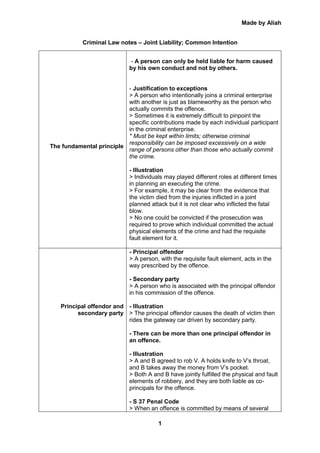
The fundamental principle
- A person can only be held liable for harm caused
by his own conduct and not by others.
- Justification to exceptions
> A person who intentionally joins a criminal enterprise
with another is just as blameworthy as the person who
actually commits the offence.
> Sometimes it is extremely difficult to pinpoint the
specific contributions made by each individual participant
in the criminal enterprise.
* Must be kept within limits; otherwise criminal
responsibility can be imposed excessively on a wide
range of persons other than those who actually commit
the crime.
- Illustration
> Individuals may played different roles at different times
in planning an executing the crime.
> For example, it may be clear from the evidence that
the victim died from the injuries inflicted in a joint
planned attack but it is not clear who inflicted the fatal
blow.
> No one could be convicted if the prosecution was
required to prove which individual committed the actual
physical elements of the crime and had the requisite
fault element for it.
Principal offendor and
secondary party
- Principal offendor
> A person, with the requisite fault element, acts in the
way prescribed by the offence.
- Secondary party
> A person who is associated with the principal offendor
in his commission of the offence.
- Illustration
> The principal offendor causes the death of victim then
rides the gateway car driven by secondary party.
- There can be more than one principal offendor in
an offence.
- Illustration
> A and B agreed to rob V. A holds knife to V’s throat,
and B takes away the money from V’s pocket.
> Both A and B have jointly fulfilled the physical and fault
elements of robbery, and they are both liable as co-
principals for the offence.
- S 37 Penal Code
> When an offence is committed by means of several
Made by Aliah
2
acts, whoever intentionally co-operates in the
commission of that offence by doing any one of those
acts, either singly or jointly with any other person,
commits that offence.
- Illustration
> A and B agreed to murder Z by giving small dose of
poison at different times.
> Z dies.
> Here, A and B intentionally co-operate in the
commission of murder, and as each of them does an act
by which the death is caused, they are both guilty of the
offence, though their acts are separate.
I. Common Intention
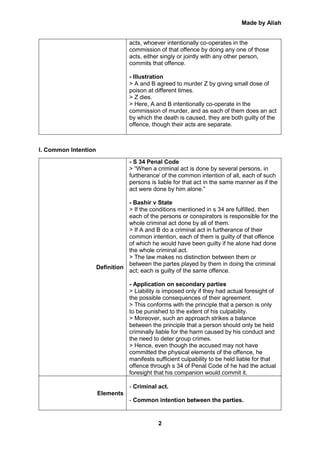
Definition
- S 34 Penal Code
> “When a criminal act is done by several persons, in
furtherancei
of the common intention of all, each of such
persons is liable for that act in the same manner as if the
act were done by him alone.”
- Bashir v State
> If the conditions mentioned in s 34 are fulfilled, then
each of the persons or conspirators is responsible for the
whole criminal act done by all of them.
> If A and B do a criminal act in furtherance of their
common intention, each of them is guilty of that offence
of which he would have been guilty if he alone had done
the whole criminal act.
> The law makes no distinction between them or
between the partes played by them in doing the criminal
act; each is guilty of the same offence.
- Application on secondary parties
> Liability is imposed only if they had actual foresight of
the possible consequences of their agreement.
> This conforms with the principle that a person is only
to be punished to the extent of his culpability.
> Moreover, such an approach strikes a balance
between the principle that a person should only be held
criminally liable for the harm caused by his conduct and
the need to deter group crimes.
> Hence, even though the accused may not have
committed the physical elements of the offence, he
manifests sufficient culpability to be held liable for that
offence through s 34 of Penal Code of he had the actual
foresight that his companion would commit it.
Elements
- Criminal act.
- Common intention between the parties.
Made by Aliah
3
- Participation in the doing of the act.
- Act done in furtherance of the common intention of
the parties.
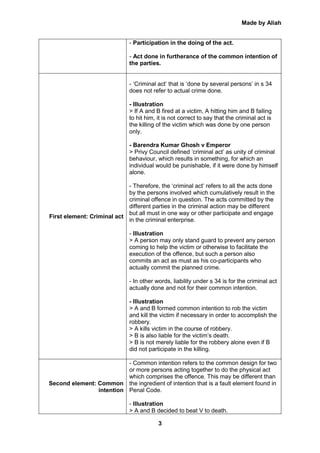
First element: Criminal act
- ‘Criminal act’ that is ‘done by several persons’ in s 34
does not refer to actual crime done.
- Illustration
> If A and B fired at a victim, A hitting him and B failing
to hit him, it is not correct to say that the criminal act is
the killing of the victim which was done by one person
only.
- Barendra Kumar Ghosh v Emperor
> Privy Council defined ‘criminal act’ as unity of criminal
behaviour, which results in something, for which an
individual would be punishable, if it were done by himself
alone.
- Therefore, the ‘criminal act’ refers to all the acts done
by the persons involved which cumulatively result in the
criminal offence in question. The acts committed by the
different parties in the criminal action may be different
but all must in one way or other participate and engage
in the criminal enterprise.
- Illustration
> A person may only stand guard to prevent any person
coming to help the victim or otherwise to facilitate the
execution of the offence, but such a person also
commits an act as must as his co-participants who
actually commit the planned crime.
- In other words, liability under s 34 is for the criminal act
actually done and not for their common intention.
- Illustration
> A and B formed common intention to rob the victim
and kill the victim if necessary in order to accomplish the
robbery.
> A kills victim in the course of robbery.
> B is also liable for the victim’s death.
> B is not merely liable for the robbery alone even if B
did not participate in the killing.
Second element: Common
intention
- Common intention refers to the common design for two
or more persons acting together to do the physical act
which comprises the offence. This may be different than
the ingredient of intention that is a fault element found in
Penal Code.
- Illustration
> A and B decided to beat V to death.
Made by Aliah
4
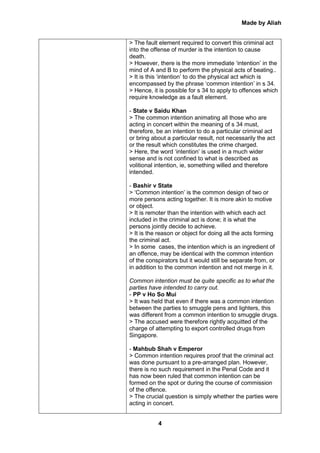
> The fault element required to convert this criminal act
into the offense of murder is the intention to cause
death.
> However, there is the more immediate ‘intention’ in the
mind of A and B to perform the physical acts of beating..
> It is this ‘intention’ to do the physical act which is
encompassed by the phrase ‘common intention’ in s 34.
> Hence, it is possible for s 34 to apply to offences which
require knowledge as a fault element.
- State v Saidu Khan
> The common intention animating all those who are
acting in concert within the meaning of s 34 must,
therefore, be an intention to do a particular criminal act
or bring about a particular result, not necessarily the act
or the result which constitutes the crime charged.
> Here, the word ‘intention’ is used in a much wider
sense and is not confined to what is described as
volitional intention, ie, something willed and therefore
intended.
- Bashir v State
> ‘Common intention’ is the common design of two or
more persons acting together. It is more akin to motive
or object.
> It is remoter than the intention with which each act
included in the criminal act is done; it is what the
persons jointly decide to achieve.
> It is the reason or object for doing all the acts forming
the criminal act.
> In some cases, the intention which is an ingredient of
an offence, may be identical with the common intention
of the conspirators but it would still be separate from, or
in addition to the common intention and not merge in it.
Common intention must be quite specific as to what the
parties have intended to carry out.
- PP v Ho So Mui
> It was held that even if there was a common intention
between the parties to smuggle pens and lighters, this
was different from a common intention to smuggle drugs.
> The accused were therefore rightly acquitted of the
charge of attempting to export controlled drugs from
Singapore.
- Mahbub Shah v Emperor
> Common intention requires proof that the criminal act
was done pursuant to a pre-arranged plan. However,
there is no such requirement in the Penal Code and it
has now been ruled that common intention can be
formed on the spot or during the course of commission
of the offence.
> The crucial question is simply whether the parties were
acting in concert.
Made by Aliah
5
- Bashir v State
> ‘Common intention’ that was held to imply a ‘pre-
arranged plan’ does not mean either that there should be
a discussion and agreement.
- Asogan Ramesh s/o Ramachandren v PP
> The court held that three appellants had developed a
common intention on the spot to assault the deceased
for what he said to them, and also this murder was
committed in furtherance of this common intention.
> Hence, in assessing the common intention of the
parties, it must be borne in mind that this can evolve as
the plot unfolds.
- Illustration
> A and B agree to kidnap and rape a woman, V.
> At the outset, there is no plan to kill.
> However, the plan can evolve to a stage where it can
fairly said that A and B formed a common intention to kill
V.
Third element: Participation
- Initially, physical presence is required, but not
anymore.
- For the principals, their physical presence is required.
For secondary parties, their physical presence is not
required as long as they have participated to a sufficient
degree such that he or she is deemed to be as
blameworthy as the principal offendor.
- The reason for not requiring physical presence in order
to show participation is that modern technological
advances permit assistance to be given from afar.
- Sabarudin bin Non v PP, Gopal Sri Ram JCA
> “Presence in every case is not necessary for s 34 to
apply. S 34 should be interpreted having regard to
modern technological advances. The early decisions that
held presence to be essential for s 34 were handed
down at a time when modes of communication were not
as advanced as today. It would, in our judgement, be a
perversion of justice if we are required to cling on to an
interpretation of the section made at a time when
science was at very early stage of development.”
- Lee Chez Kee v PP
> What s 34 requires is proof of participation, which can
be at ‘the specific criminal act committed by the principal
offendor which gives rise to the offence charged’, or ‘in
some other criminal act that is done in furtherance of the
common intention of all the offenders’.
Made by Aliah
6
Fourth element: Act done in
furtherance of the common
intention.
Three categories of acts
- Ratanlal and Dhirajlal’s Law of Crimes
> Act which is directly intended in between all the
confederates.
> Act which the circumstances of the case leave no
doubt to conclude that though the act was not directly
intended in between them but was taken by all of them
as included in the common intention.
> Act which any of the confederatesii
commits in order to
avoid or remove any obstruction or resistance put up in
the way of the proper execution of the common intention.
(i) Collateraliii
offence ‘consistent with’ common intention
- The parties are only required to have the common
intention to do a particular criminal act which ultimately
leads to an offence being committed in furtherance of
that common intention.
- Wong Mimi v PP
> If A and B form a common intention to cause injury to
C with a knife and A holds C while B stabs C deliberately
in the region of the heart and the stab wound is sufficient
in the ordinary course of nature to cause death, B is
clearly guilty of murder.
> Applying s 34 it is also clear that B’s act in stabbing C
is in furtherance of the common intention to cause injury
to C with a knife because B’s act is clearly consistent
with the carrying out of that common intention and as
their ’criminal act’, ie that unity of criminal behaviour,
resulted in the criminal offense of murder punishable
under s 302. A is also guilty of murder.
- Under this wide approach, the only requirement is that
the actual offence for which all the participants are to be
held liable, must be ‘consistent’ with the common
intention of the parties.
(iii) Collateral offence ‘intended’ by secondary party
- A person is required to have the intention to commit the
collateral offence in common with the person or persons
who actually committed it. Unless this is proved, he or
she cannot be liable for the collateral offence even
though it was committed in order to accomplish some
other objective shared in common.
- R v Vincent Banka
> The court held there must exist a common intention to
commit the crime actually committed, and it is not
sufficient that there should merely be a common
intention to ‘behave criminally’.
> The two accused in that case set out to commit
robbery and in the process muder was committed.
> The evidence was inconclusive as to which of them
inflicted the fatal wound or who carried the knife.
> It was held that there must be a common intention
Made by Aliah
7
between the robbers not merely to commit robbery but, if
necessary, to kill the deceased.
> Since there was no express agreement between them
that a knife should be carried or that the victim should be
stabbed, the court convicted them of robbery and
acquitted them of murder.
> The effect of this approach is that the prosecution is
required to prove that the secondary party possessed
the fault element for the actual offence charged.
- Daniel Vijay s/o Katherasan v PPP
> Pronounced on the law to be followed in ‘twin-crime’
situations.
> In the case, the three appellants, Daniel, Christopher
and Bala, were part of a plan to rob a cargo lorry driver
to the extend that he could not identify the assailants.
> The trio forced the cargo lorry to stop by the roadside
and when the driver alighted from the vehicle, he was
repeatedly hit on the road and other partys of the body
with the baseball bat by Bala.
> The lorry driver was found subsequently and
underwent emergency surgery on his head but died a
few days later.
> There was no question that Bala was liable for the
murder.
> Court of Appeal held that Daniel and Christopher could
not be held vicariously liable for the murder committed
by Bala via s 34 if they only had the common intention to
rob and merely knew that violence would be necessary
to overpower and incapacipate the victim.
> This was so even if the killing had, objectively
speaking, facilitated their common intention to commit
the robbery.
> The reason for the Court of Appeal’s decision was that
Daniel and Christopher might not necessarily have
agreed to carry out the robbery at alll costs, to the
extent, for example, of causing grievous hurt or killing
the victim.
> Court of Appeal said,
“A criminal act which is not commonly intended by all the
offenders is inconsistent with or, at least, outside the
scope of the offender’s common intention, and cannot be
regarded as having been done in furtherance of that
common intention.”
> The following example was given by the Court of
Appeal to clarify the difference between knowledge and
intention:
“If A and B have a common intention only to rob C but
not to physically harm C and A joins B in robbing C even
though he as subjective knowledge that B has a history
of using violence, it does not follow – assuming B does
indeed use violence against C in the course of carrying
out the robbery – that A had a common intention with B
to use violence against C. Even if A was aware that B
was carrying a knife with him when they set out together
Made by Aliah
8
to rob C, a court would be more likely to infer merely that
A had subjectively knowledge that B might likely use the
knife to hurt or kill C in the course of carrying out the
robbery, as opposed to inferring that A, by going along
with B to rob C in those cirumstances, spontaneously
formed a commin intention with B to rob and, if
necessary, to use the knife to hurt or kill C so as to carry
out the robbery.”
> In certain circumstances, the line between subjective
knowledge that a particular act might likely occur and a
common intention to do that particular act may be rather
thin. Depending on the circumstances of the case,
subjective knowledge may be evidence of the existence
of a particular intention.”
- Namasiyiam v PP
> This case shows that Malaysia seems to accept these
broader approaches.
(iii) Actual foresight by the secondary party
- State v Saidu Khan
> “When a number of persons act in pursuance of a
common design or purpose, each is responsible for the
doings of others provided what others actually do is
something which may have been in contemplation of all
at the time when the ‘common intention’ was entertained
by them.”
- A degree of injustice is present in this compromise
since a person may be convicted of an offence even if
he or she did not possess the fault element for it, but this
may be unavoidable in order to deter group crimes.
- How this applies is that the principal offendor is not
required to have the intention to kill. He or she is only
required to have the intention to cause a particular bodily
injury which in fact turns out to be ‘sufficient in the
ordinary course of nature to cause death’.
- Court of Appeal in Daniel Vijay holds the actual
foresight approach where a secondary offender should
only be held constructively liabl by the principal offendor
if he or she knows that the principal offendor intends to
inflict a deadly injury, injury which on an objective
assessment is ‘sufficient in the orinary course of nature
to cause death’.
- R v Powell
> Three men went to a drug dealer to buy drugs and the
drug dealer was shot dead.
> It could not be proved by the prosecution which of the
three men fired the shot which killed the drug dealer, but
it was argued that the two appellants before the court
should be found guilty of murder even if the third man
Made by Aliah
9
fired the shot because they knew that the third man was
armed with a gun and realised that he might use it to kill.
> Lord Hutton opined that ‘it is sufficient to found a
conviction for murder for a secondary party to have
realised that in the course of the joint enterprise the
primary party might kill with intent to do so or with intent
to cause grevious bodily harm.
> It held that participation in a joint criminal enterprise
with foresight of the collateral offence as a possible
incident of that enterprise should be sufficient to impose
criminal liability for that offense carried out by another
participant.
> Liability for the collateral crime is therefore imposed
even though it could be outside of the parties’ joint
enterprise because it was foreseen and the accused
willingly took the risk of it materialising.
> On the other hand, it has been argued by Hor that the
structure of the Penal Code demands that the scope of
liability be limited to collateral offences that can be
foreseen to further their joint enterprise and not if they
are committed for extraneous reasons.
i
Furtherance (.n) - The advancement of a scheme or interest.
ii
Confederates (.n) - A person one works with, especially in something secret or illegal; an accomplice.
iii
Collateral (.adj) - Additional but subordinate; secondary.

Criminal law notes - Joint liability; common intention

  • 1.
    Made by Aliah 1 CriminalLaw notes – Joint Liability; Common Intention The fundamental principle - A person can only be held liable for harm caused by his own conduct and not by others. - Justification to exceptions > A person who intentionally joins a criminal enterprise with another is just as blameworthy as the person who actually commits the offence. > Sometimes it is extremely difficult to pinpoint the specific contributions made by each individual participant in the criminal enterprise. * Must be kept within limits; otherwise criminal responsibility can be imposed excessively on a wide range of persons other than those who actually commit the crime. - Illustration > Individuals may played different roles at different times in planning an executing the crime. > For example, it may be clear from the evidence that the victim died from the injuries inflicted in a joint planned attack but it is not clear who inflicted the fatal blow. > No one could be convicted if the prosecution was required to prove which individual committed the actual physical elements of the crime and had the requisite fault element for it. Principal offendor and secondary party - Principal offendor > A person, with the requisite fault element, acts in the way prescribed by the offence. - Secondary party > A person who is associated with the principal offendor in his commission of the offence. - Illustration > The principal offendor causes the death of victim then rides the gateway car driven by secondary party. - There can be more than one principal offendor in an offence. - Illustration > A and B agreed to rob V. A holds knife to V’s throat, and B takes away the money from V’s pocket. > Both A and B have jointly fulfilled the physical and fault elements of robbery, and they are both liable as co- principals for the offence. - S 37 Penal Code > When an offence is committed by means of several
  • 2.
    Made by Aliah 2 acts,whoever intentionally co-operates in the commission of that offence by doing any one of those acts, either singly or jointly with any other person, commits that offence. - Illustration > A and B agreed to murder Z by giving small dose of poison at different times. > Z dies. > Here, A and B intentionally co-operate in the commission of murder, and as each of them does an act by which the death is caused, they are both guilty of the offence, though their acts are separate. I. Common Intention Definition - S 34 Penal Code > “When a criminal act is done by several persons, in furtherancei of the common intention of all, each of such persons is liable for that act in the same manner as if the act were done by him alone.” - Bashir v State > If the conditions mentioned in s 34 are fulfilled, then each of the persons or conspirators is responsible for the whole criminal act done by all of them. > If A and B do a criminal act in furtherance of their common intention, each of them is guilty of that offence of which he would have been guilty if he alone had done the whole criminal act. > The law makes no distinction between them or between the partes played by them in doing the criminal act; each is guilty of the same offence. - Application on secondary parties > Liability is imposed only if they had actual foresight of the possible consequences of their agreement. > This conforms with the principle that a person is only to be punished to the extent of his culpability. > Moreover, such an approach strikes a balance between the principle that a person should only be held criminally liable for the harm caused by his conduct and the need to deter group crimes. > Hence, even though the accused may not have committed the physical elements of the offence, he manifests sufficient culpability to be held liable for that offence through s 34 of Penal Code of he had the actual foresight that his companion would commit it. Elements - Criminal act. - Common intention between the parties.
  • 3.
    Made by Aliah 3 -Participation in the doing of the act. - Act done in furtherance of the common intention of the parties. First element: Criminal act - ‘Criminal act’ that is ‘done by several persons’ in s 34 does not refer to actual crime done. - Illustration > If A and B fired at a victim, A hitting him and B failing to hit him, it is not correct to say that the criminal act is the killing of the victim which was done by one person only. - Barendra Kumar Ghosh v Emperor > Privy Council defined ‘criminal act’ as unity of criminal behaviour, which results in something, for which an individual would be punishable, if it were done by himself alone. - Therefore, the ‘criminal act’ refers to all the acts done by the persons involved which cumulatively result in the criminal offence in question. The acts committed by the different parties in the criminal action may be different but all must in one way or other participate and engage in the criminal enterprise. - Illustration > A person may only stand guard to prevent any person coming to help the victim or otherwise to facilitate the execution of the offence, but such a person also commits an act as must as his co-participants who actually commit the planned crime. - In other words, liability under s 34 is for the criminal act actually done and not for their common intention. - Illustration > A and B formed common intention to rob the victim and kill the victim if necessary in order to accomplish the robbery. > A kills victim in the course of robbery. > B is also liable for the victim’s death. > B is not merely liable for the robbery alone even if B did not participate in the killing. Second element: Common intention - Common intention refers to the common design for two or more persons acting together to do the physical act which comprises the offence. This may be different than the ingredient of intention that is a fault element found in Penal Code. - Illustration > A and B decided to beat V to death.
  • 4.
    Made by Aliah 4 >The fault element required to convert this criminal act into the offense of murder is the intention to cause death. > However, there is the more immediate ‘intention’ in the mind of A and B to perform the physical acts of beating.. > It is this ‘intention’ to do the physical act which is encompassed by the phrase ‘common intention’ in s 34. > Hence, it is possible for s 34 to apply to offences which require knowledge as a fault element. - State v Saidu Khan > The common intention animating all those who are acting in concert within the meaning of s 34 must, therefore, be an intention to do a particular criminal act or bring about a particular result, not necessarily the act or the result which constitutes the crime charged. > Here, the word ‘intention’ is used in a much wider sense and is not confined to what is described as volitional intention, ie, something willed and therefore intended. - Bashir v State > ‘Common intention’ is the common design of two or more persons acting together. It is more akin to motive or object. > It is remoter than the intention with which each act included in the criminal act is done; it is what the persons jointly decide to achieve. > It is the reason or object for doing all the acts forming the criminal act. > In some cases, the intention which is an ingredient of an offence, may be identical with the common intention of the conspirators but it would still be separate from, or in addition to the common intention and not merge in it. Common intention must be quite specific as to what the parties have intended to carry out. - PP v Ho So Mui > It was held that even if there was a common intention between the parties to smuggle pens and lighters, this was different from a common intention to smuggle drugs. > The accused were therefore rightly acquitted of the charge of attempting to export controlled drugs from Singapore. - Mahbub Shah v Emperor > Common intention requires proof that the criminal act was done pursuant to a pre-arranged plan. However, there is no such requirement in the Penal Code and it has now been ruled that common intention can be formed on the spot or during the course of commission of the offence. > The crucial question is simply whether the parties were acting in concert.
  • 5.
    Made by Aliah 5 -Bashir v State > ‘Common intention’ that was held to imply a ‘pre- arranged plan’ does not mean either that there should be a discussion and agreement. - Asogan Ramesh s/o Ramachandren v PP > The court held that three appellants had developed a common intention on the spot to assault the deceased for what he said to them, and also this murder was committed in furtherance of this common intention. > Hence, in assessing the common intention of the parties, it must be borne in mind that this can evolve as the plot unfolds. - Illustration > A and B agree to kidnap and rape a woman, V. > At the outset, there is no plan to kill. > However, the plan can evolve to a stage where it can fairly said that A and B formed a common intention to kill V. Third element: Participation - Initially, physical presence is required, but not anymore. - For the principals, their physical presence is required. For secondary parties, their physical presence is not required as long as they have participated to a sufficient degree such that he or she is deemed to be as blameworthy as the principal offendor. - The reason for not requiring physical presence in order to show participation is that modern technological advances permit assistance to be given from afar. - Sabarudin bin Non v PP, Gopal Sri Ram JCA > “Presence in every case is not necessary for s 34 to apply. S 34 should be interpreted having regard to modern technological advances. The early decisions that held presence to be essential for s 34 were handed down at a time when modes of communication were not as advanced as today. It would, in our judgement, be a perversion of justice if we are required to cling on to an interpretation of the section made at a time when science was at very early stage of development.” - Lee Chez Kee v PP > What s 34 requires is proof of participation, which can be at ‘the specific criminal act committed by the principal offendor which gives rise to the offence charged’, or ‘in some other criminal act that is done in furtherance of the common intention of all the offenders’.
  • 6.
    Made by Aliah 6 Fourthelement: Act done in furtherance of the common intention. Three categories of acts - Ratanlal and Dhirajlal’s Law of Crimes > Act which is directly intended in between all the confederates. > Act which the circumstances of the case leave no doubt to conclude that though the act was not directly intended in between them but was taken by all of them as included in the common intention. > Act which any of the confederatesii commits in order to avoid or remove any obstruction or resistance put up in the way of the proper execution of the common intention. (i) Collateraliii offence ‘consistent with’ common intention - The parties are only required to have the common intention to do a particular criminal act which ultimately leads to an offence being committed in furtherance of that common intention. - Wong Mimi v PP > If A and B form a common intention to cause injury to C with a knife and A holds C while B stabs C deliberately in the region of the heart and the stab wound is sufficient in the ordinary course of nature to cause death, B is clearly guilty of murder. > Applying s 34 it is also clear that B’s act in stabbing C is in furtherance of the common intention to cause injury to C with a knife because B’s act is clearly consistent with the carrying out of that common intention and as their ’criminal act’, ie that unity of criminal behaviour, resulted in the criminal offense of murder punishable under s 302. A is also guilty of murder. - Under this wide approach, the only requirement is that the actual offence for which all the participants are to be held liable, must be ‘consistent’ with the common intention of the parties. (iii) Collateral offence ‘intended’ by secondary party - A person is required to have the intention to commit the collateral offence in common with the person or persons who actually committed it. Unless this is proved, he or she cannot be liable for the collateral offence even though it was committed in order to accomplish some other objective shared in common. - R v Vincent Banka > The court held there must exist a common intention to commit the crime actually committed, and it is not sufficient that there should merely be a common intention to ‘behave criminally’. > The two accused in that case set out to commit robbery and in the process muder was committed. > The evidence was inconclusive as to which of them inflicted the fatal wound or who carried the knife. > It was held that there must be a common intention
  • 7.
    Made by Aliah 7 betweenthe robbers not merely to commit robbery but, if necessary, to kill the deceased. > Since there was no express agreement between them that a knife should be carried or that the victim should be stabbed, the court convicted them of robbery and acquitted them of murder. > The effect of this approach is that the prosecution is required to prove that the secondary party possessed the fault element for the actual offence charged. - Daniel Vijay s/o Katherasan v PPP > Pronounced on the law to be followed in ‘twin-crime’ situations. > In the case, the three appellants, Daniel, Christopher and Bala, were part of a plan to rob a cargo lorry driver to the extend that he could not identify the assailants. > The trio forced the cargo lorry to stop by the roadside and when the driver alighted from the vehicle, he was repeatedly hit on the road and other partys of the body with the baseball bat by Bala. > The lorry driver was found subsequently and underwent emergency surgery on his head but died a few days later. > There was no question that Bala was liable for the murder. > Court of Appeal held that Daniel and Christopher could not be held vicariously liable for the murder committed by Bala via s 34 if they only had the common intention to rob and merely knew that violence would be necessary to overpower and incapacipate the victim. > This was so even if the killing had, objectively speaking, facilitated their common intention to commit the robbery. > The reason for the Court of Appeal’s decision was that Daniel and Christopher might not necessarily have agreed to carry out the robbery at alll costs, to the extent, for example, of causing grievous hurt or killing the victim. > Court of Appeal said, “A criminal act which is not commonly intended by all the offenders is inconsistent with or, at least, outside the scope of the offender’s common intention, and cannot be regarded as having been done in furtherance of that common intention.” > The following example was given by the Court of Appeal to clarify the difference between knowledge and intention: “If A and B have a common intention only to rob C but not to physically harm C and A joins B in robbing C even though he as subjective knowledge that B has a history of using violence, it does not follow – assuming B does indeed use violence against C in the course of carrying out the robbery – that A had a common intention with B to use violence against C. Even if A was aware that B was carrying a knife with him when they set out together
  • 8.
    Made by Aliah 8 torob C, a court would be more likely to infer merely that A had subjectively knowledge that B might likely use the knife to hurt or kill C in the course of carrying out the robbery, as opposed to inferring that A, by going along with B to rob C in those cirumstances, spontaneously formed a commin intention with B to rob and, if necessary, to use the knife to hurt or kill C so as to carry out the robbery.” > In certain circumstances, the line between subjective knowledge that a particular act might likely occur and a common intention to do that particular act may be rather thin. Depending on the circumstances of the case, subjective knowledge may be evidence of the existence of a particular intention.” - Namasiyiam v PP > This case shows that Malaysia seems to accept these broader approaches. (iii) Actual foresight by the secondary party - State v Saidu Khan > “When a number of persons act in pursuance of a common design or purpose, each is responsible for the doings of others provided what others actually do is something which may have been in contemplation of all at the time when the ‘common intention’ was entertained by them.” - A degree of injustice is present in this compromise since a person may be convicted of an offence even if he or she did not possess the fault element for it, but this may be unavoidable in order to deter group crimes. - How this applies is that the principal offendor is not required to have the intention to kill. He or she is only required to have the intention to cause a particular bodily injury which in fact turns out to be ‘sufficient in the ordinary course of nature to cause death’. - Court of Appeal in Daniel Vijay holds the actual foresight approach where a secondary offender should only be held constructively liabl by the principal offendor if he or she knows that the principal offendor intends to inflict a deadly injury, injury which on an objective assessment is ‘sufficient in the orinary course of nature to cause death’. - R v Powell > Three men went to a drug dealer to buy drugs and the drug dealer was shot dead. > It could not be proved by the prosecution which of the three men fired the shot which killed the drug dealer, but it was argued that the two appellants before the court should be found guilty of murder even if the third man
  • 9.
    Made by Aliah 9 firedthe shot because they knew that the third man was armed with a gun and realised that he might use it to kill. > Lord Hutton opined that ‘it is sufficient to found a conviction for murder for a secondary party to have realised that in the course of the joint enterprise the primary party might kill with intent to do so or with intent to cause grevious bodily harm. > It held that participation in a joint criminal enterprise with foresight of the collateral offence as a possible incident of that enterprise should be sufficient to impose criminal liability for that offense carried out by another participant. > Liability for the collateral crime is therefore imposed even though it could be outside of the parties’ joint enterprise because it was foreseen and the accused willingly took the risk of it materialising. > On the other hand, it has been argued by Hor that the structure of the Penal Code demands that the scope of liability be limited to collateral offences that can be foreseen to further their joint enterprise and not if they are committed for extraneous reasons. i Furtherance (.n) - The advancement of a scheme or interest. ii Confederates (.n) - A person one works with, especially in something secret or illegal; an accomplice. iii Collateral (.adj) - Additional but subordinate; secondary.