Find the next term of the
following lists.
1) 5, 10, 15, 20, 25, ___
2) 3, 6, 9, 12, 15, ___
3) 1, 3, 6, 10, 15, ___
4) 7, 12, 17, 22, 27, 32, ___
5) 2, 5, 10, 17, 26, ___
Chapter 1
Lesson 3
PROBLEM
SOLVING
By:
Crysali Therese R. Dayaganon
Chapter 3. Problem Solving
3.1 Inductive and Deductive Reasoning
3.2 Problem Solving
3.3 Recreational Problems
3.1 Inductive and Deductive
Reasoning
What is INDUCTIVE REASONING?
• A Type of reasoning that forms a conclusion
based on the examination of specific examples
• The conclusion formed is a conjecture, since it
may or may not be correct.
3.1 Inductive and Deductive
Reasoning
Inductive Reasoning
Inductive reasoning is the process of reaching a
general conclusion by examining specific examples.
3.1 Inductive and Deductive
Reasoning
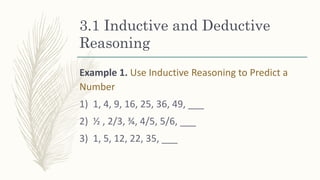
Example 1. Use Inductive Reasoning to Predict a
Number
1) 1, 4, 9, 16, 25, 36, 49, ___
2) ½ , 2/3, ¾, 4/5, 5/6, ___
3) 1, 5, 12, 22, 35, ___
3.1 Inductive and Deductive
Reasoning
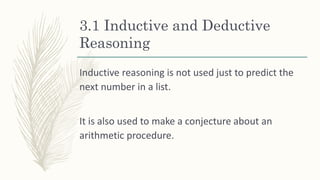
Inductive reasoning is not used just to predict the
next number in a list.
It is also used to make a conjecture about an
arithmetic procedure.
3.1 Inductive and Deductive
Reasoning
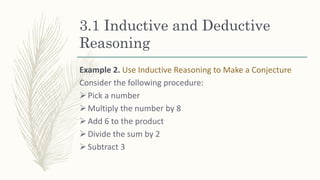
Example 2. Use Inductive Reasoning to Make a Conjecture
Consider the following procedure:
Pick a number
Multiply the number by 8
Add 6 to the product
Divide the sum by 2
Subtract 3
3.1 Inductive and Deductive
Reasoning
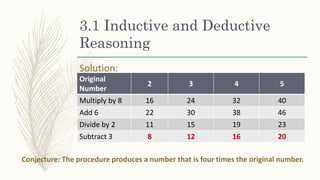
Solution:
Original
Number
2 3 4 5
Multiply by 8 16 24 32 40
Add 6 22 30 38 46
Divide by 2 11 15 19 23
Subtract 3 8 12 16 20
Conjecture: The procedure produces a number that is four times the original number.
3.1 Inductive and Deductive
Reasoning
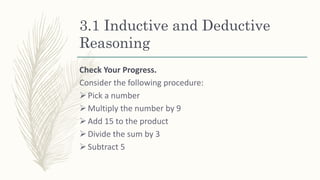
Check Your Progress.
Consider the following procedure:
Pick a number
Multiply the number by 9
Add 15 to the product
Divide the sum by 3
Subtract 5
3.1 Inductive and Deductive
Reasoning
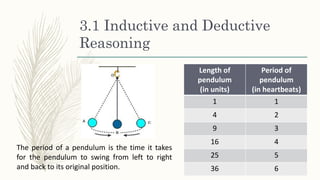
Scientists often use inductive reasoning.
Galileo Galilei used inductive reasoning to discover
that the time required for a pendulum to complete
one swing, called the period of the pendulum,
depends on the length of the pendulum.
3.1 Inductive and Deductive
Reasoning
Length of
pendulum
(in units)
Period of
pendulum
(in heartbeats)
1 1
4 2
9 3
16 4
25 5
36 6
The period of a pendulum is the time it takes
for the pendulum to swing from left to right
and back to its original position.
3.1 Inductive and Deductive
Reasoning
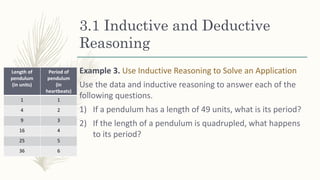
Example 3. Use Inductive Reasoning to Solve an Application
Use the data and inductive reasoning to answer each of the
following questions.
1) If a pendulum has a length of 49 units, what is its period?
2) If the length of a pendulum is quadrupled, what happens
to its period?
Length of
pendulum
(in units)
Period of
pendulum
(in
heartbeats)
1 1
4 2
9 3
16 4
25 5
36 6
3.1 Inductive and Deductive
Reasoning
Check your Progress
A tsunami is a sea wave produces by an underwater earthquake.
The height of the tsunami as it approaches land depends on the
velocity of the tsunami. Use the table at the left and inductive
reasoning to answer the ff.:
 What happens to the height of a tsunami when its velocity is
doubled?
 What should be the height of a tsunami if its velocity is 30 ft/s?
Velocity of
the tsunami
(in ft/s)
Height of
tsunami
(in ft)
6 4
9 9
12 16
15 25
18 36
21 49
24 64
3.1 Inductive and Deductive
Reasoning
Conclusions based on inductive reasoning may be
incorrect.
One can not be sure about a conjecture until a
general relationship has been proven.
3.1 Inductive and Deductive
Reasoning
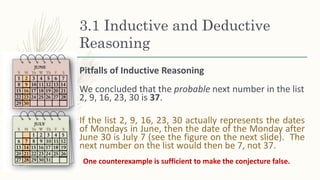
Pitfalls of Inductive Reasoning
We concluded that the probable next number in the list
2, 9, 16, 23, 30 is 37.
If the list 2, 9, 16, 23, 30 actually represents the dates
of Mondays in June, then the date of the Monday after
June 30 is July 7 (see the figure on the next slide). The
next number on the list would then be 7, not 37.
3.1 Inductive and Deductive
Reasoning
Pitfalls of Inductive Reasoning
We concluded that the probable next number in the list
2, 9, 16, 23, 30 is 37.
If the list 2, 9, 16, 23, 30 actually represents the dates
of Mondays in June, then the date of the Monday after
June 30 is July 7 (see the figure on the next slide). The
next number on the list would then be 7, not 37.
One counterexample is sufficient to make the conjecture false.
3.1 Inductive and Deductive
Reasoning
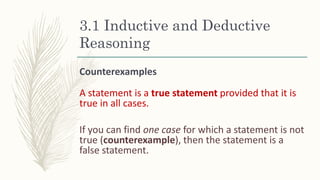
Counterexamples
A statement is a true statement provided that it is
true in all cases.
If you can find one case for which a statement is not
true (counterexample), then the statement is a
false statement.
3.1 Inductive and Deductive
Reasoning
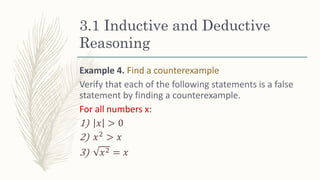
Example 4. Find a counterexample
Verify that each of the following statements is a false
statement by finding a counterexample.
For all numbers x:
1) 𝑥 > 0
2) 𝑥2
> 𝑥
3) 𝑥2 = 𝑥
3.1 Inductive and Deductive
Reasoning
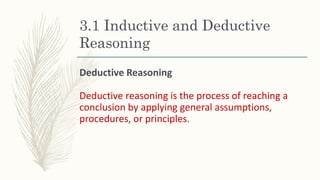
Deductive Reasoning
Deductive reasoning is the process of reaching a
conclusion by applying general assumptions,
procedures, or principles.
3.1 Inductive and Deductive
Reasoning
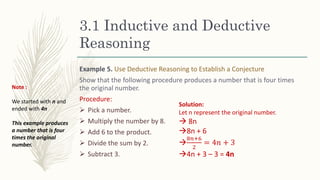
Example 5. Use Deductive Reasoning to Establish a Conjecture
Show that the following procedure produces a number that is four times
the original number.
Procedure:
 Pick a number.
 Multiply the number by 8.
 Add 6 to the product.
 Divide the sum by 2.
 Subtract 3.
Solution:
Let n represent the original number.
 8n
8n + 6

8𝑛+6
2
= 4𝑛 + 3
4n + 3 – 3 = 4n
Note :
We started with n and
ended with 4n
This example produces
a number that is four
times the original
number.
3.1 Inductive and Deductive
Reasoning
Inductive Reasoning vs. Deductive Reasoning
Example 6. Determine Types of Reasoning
Determine whether each of the following arguments is an example of inductive
reasoning or deductive reasoning.
1) During the past 10 years, a tree has produced plums every other year. Last
year the tree did not produce plums, so this year the tree will produce plums.
2) All home improvement cost more than the estimate. The contractor
estimated that my home improvement will cost Php150,000.00. Thus my
home improvement will cost more than Php 150,000.00.
3.1 Inductive and Deductive
Reasoning
References:
Aufmann, Richard N. et al. 2013. Mathematical
Excursions. Third Edition. USA: Brooks/Cole,
Cengage Learning.
Sirug, Winston S. 2018.Mathematics in the Modern
World. Manila: Mindshapers Co., Inc.

Ch1-L3.1-Inductive-and-Deductive-Reasoning.pptx

  • 1.
    Find the nextterm of the following lists. 1) 5, 10, 15, 20, 25, ___ 2) 3, 6, 9, 12, 15, ___ 3) 1, 3, 6, 10, 15, ___ 4) 7, 12, 17, 22, 27, 32, ___ 5) 2, 5, 10, 17, 26, ___
  • 2.
  • 3.
    Chapter 3. ProblemSolving 3.1 Inductive and Deductive Reasoning 3.2 Problem Solving 3.3 Recreational Problems
  • 4.
    3.1 Inductive andDeductive Reasoning What is INDUCTIVE REASONING? • A Type of reasoning that forms a conclusion based on the examination of specific examples • The conclusion formed is a conjecture, since it may or may not be correct.
  • 5.
    3.1 Inductive andDeductive Reasoning Inductive Reasoning Inductive reasoning is the process of reaching a general conclusion by examining specific examples.
  • 6.
    3.1 Inductive andDeductive Reasoning Example 1. Use Inductive Reasoning to Predict a Number 1) 1, 4, 9, 16, 25, 36, 49, ___ 2) ½ , 2/3, ¾, 4/5, 5/6, ___ 3) 1, 5, 12, 22, 35, ___
  • 7.
    3.1 Inductive andDeductive Reasoning Inductive reasoning is not used just to predict the next number in a list. It is also used to make a conjecture about an arithmetic procedure.
  • 8.
    3.1 Inductive andDeductive Reasoning Example 2. Use Inductive Reasoning to Make a Conjecture Consider the following procedure: Pick a number Multiply the number by 8 Add 6 to the product Divide the sum by 2 Subtract 3
  • 9.
    3.1 Inductive andDeductive Reasoning Solution: Original Number 2 3 4 5 Multiply by 8 16 24 32 40 Add 6 22 30 38 46 Divide by 2 11 15 19 23 Subtract 3 8 12 16 20 Conjecture: The procedure produces a number that is four times the original number.
  • 10.
    3.1 Inductive andDeductive Reasoning Check Your Progress. Consider the following procedure: Pick a number Multiply the number by 9 Add 15 to the product Divide the sum by 3 Subtract 5
  • 11.
    3.1 Inductive andDeductive Reasoning Scientists often use inductive reasoning. Galileo Galilei used inductive reasoning to discover that the time required for a pendulum to complete one swing, called the period of the pendulum, depends on the length of the pendulum.
  • 12.
    3.1 Inductive andDeductive Reasoning Length of pendulum (in units) Period of pendulum (in heartbeats) 1 1 4 2 9 3 16 4 25 5 36 6 The period of a pendulum is the time it takes for the pendulum to swing from left to right and back to its original position.
  • 13.
    3.1 Inductive andDeductive Reasoning Example 3. Use Inductive Reasoning to Solve an Application Use the data and inductive reasoning to answer each of the following questions. 1) If a pendulum has a length of 49 units, what is its period? 2) If the length of a pendulum is quadrupled, what happens to its period? Length of pendulum (in units) Period of pendulum (in heartbeats) 1 1 4 2 9 3 16 4 25 5 36 6
  • 14.
    3.1 Inductive andDeductive Reasoning Check your Progress A tsunami is a sea wave produces by an underwater earthquake. The height of the tsunami as it approaches land depends on the velocity of the tsunami. Use the table at the left and inductive reasoning to answer the ff.:  What happens to the height of a tsunami when its velocity is doubled?  What should be the height of a tsunami if its velocity is 30 ft/s? Velocity of the tsunami (in ft/s) Height of tsunami (in ft) 6 4 9 9 12 16 15 25 18 36 21 49 24 64
  • 15.
    3.1 Inductive andDeductive Reasoning Conclusions based on inductive reasoning may be incorrect. One can not be sure about a conjecture until a general relationship has been proven.
  • 16.
    3.1 Inductive andDeductive Reasoning Pitfalls of Inductive Reasoning We concluded that the probable next number in the list 2, 9, 16, 23, 30 is 37. If the list 2, 9, 16, 23, 30 actually represents the dates of Mondays in June, then the date of the Monday after June 30 is July 7 (see the figure on the next slide). The next number on the list would then be 7, not 37.
  • 17.
    3.1 Inductive andDeductive Reasoning Pitfalls of Inductive Reasoning We concluded that the probable next number in the list 2, 9, 16, 23, 30 is 37. If the list 2, 9, 16, 23, 30 actually represents the dates of Mondays in June, then the date of the Monday after June 30 is July 7 (see the figure on the next slide). The next number on the list would then be 7, not 37. One counterexample is sufficient to make the conjecture false.
  • 18.
    3.1 Inductive andDeductive Reasoning Counterexamples A statement is a true statement provided that it is true in all cases. If you can find one case for which a statement is not true (counterexample), then the statement is a false statement.
  • 19.
    3.1 Inductive andDeductive Reasoning Example 4. Find a counterexample Verify that each of the following statements is a false statement by finding a counterexample. For all numbers x: 1) 𝑥 > 0 2) 𝑥2 > 𝑥 3) 𝑥2 = 𝑥
  • 20.
    3.1 Inductive andDeductive Reasoning Deductive Reasoning Deductive reasoning is the process of reaching a conclusion by applying general assumptions, procedures, or principles.
  • 21.
    3.1 Inductive andDeductive Reasoning Example 5. Use Deductive Reasoning to Establish a Conjecture Show that the following procedure produces a number that is four times the original number. Procedure:  Pick a number.  Multiply the number by 8.  Add 6 to the product.  Divide the sum by 2.  Subtract 3. Solution: Let n represent the original number.  8n 8n + 6  8𝑛+6 2 = 4𝑛 + 3 4n + 3 – 3 = 4n Note : We started with n and ended with 4n This example produces a number that is four times the original number.
  • 22.
    3.1 Inductive andDeductive Reasoning Inductive Reasoning vs. Deductive Reasoning Example 6. Determine Types of Reasoning Determine whether each of the following arguments is an example of inductive reasoning or deductive reasoning. 1) During the past 10 years, a tree has produced plums every other year. Last year the tree did not produce plums, so this year the tree will produce plums. 2) All home improvement cost more than the estimate. The contractor estimated that my home improvement will cost Php150,000.00. Thus my home improvement will cost more than Php 150,000.00.
  • 23.
    3.1 Inductive andDeductive Reasoning References: Aufmann, Richard N. et al. 2013. Mathematical Excursions. Third Edition. USA: Brooks/Cole, Cengage Learning. Sirug, Winston S. 2018.Mathematics in the Modern World. Manila: Mindshapers Co., Inc.