UNIT I:
RISC AND CISC ARCHITECTURE
INTRODUCTION
Since 1950 there have been remarkably innovations happened in the
areas of computer organization and architecture.
The following are some of the major advances since the birth of the
computer:
 The family concept: Different Implementations for the Same Architecture
 Microprogrammed control unit: eases the task of designing and implementing the control
unit
 Cache memory: Enhanced Performance memory
 Pipelining: Fetching next instructions well in advance for execution
 Multiple processors: Parallelism
 Reduced instruction set computer (RISC) architecture:
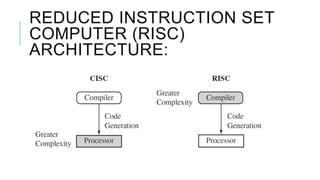
REDUCED INSTRUCTION SET
COMPUTER (RISC)
ARCHITECTURE:
RISC DESIGN PHILOSOPHY
The RISC philosophy is implemented with four major design rules:
1. Instructions
2. Pipelines
3. Registers
4. Load-store architecture

13 RISC and CISC architecture.pptx

  • 1.
    UNIT I: RISC ANDCISC ARCHITECTURE
  • 2.
    INTRODUCTION Since 1950 therehave been remarkably innovations happened in the areas of computer organization and architecture. The following are some of the major advances since the birth of the computer:  The family concept: Different Implementations for the Same Architecture  Microprogrammed control unit: eases the task of designing and implementing the control unit  Cache memory: Enhanced Performance memory  Pipelining: Fetching next instructions well in advance for execution  Multiple processors: Parallelism  Reduced instruction set computer (RISC) architecture:
  • 3.
  • 4.
    RISC DESIGN PHILOSOPHY TheRISC philosophy is implemented with four major design rules: 1. Instructions 2. Pipelines 3. Registers 4. Load-store architecture