Decreasing X-ray
exposure in CTO
procedures
Eliseo Vano
(JM Fernandez, RM Sanchez, JI Ten)
eliseov@med.ucm.es
Friday Sept 26, 12:25-12:50
1
San Carlos University Hospital. Medical Physics Service.
Radiology Department. Complutense University. Madrid.
Content
1. Level of patient exposure during CTO
procedures. Are dose values in your cath
lab, “acceptable” or are they “too high”?.
2. Staff radiation risk needs also be
considered.
3. International recommendations and
European regulation.
2
Patient and staff doses
• In some complex CTO procedures several
Grays (Gy) could be accumulated at the skin
of the patients with a risk of radiation injuries.
• If staff is not properly protected, some mGy per
procedure could be the dose at the lens of
the eyes for complex procedures and the risk of
radiation induced cataracts exists.
• The new annual occupational dose limit for the
lens of the eyes is 20 mSv (instead of 150 mSv).
3
A good management of patient and
staff radiation doses
• Maintain dose values as low as reasonably
achievable considering the clinical benefit of the
procedure (for patients and staff).
• Work under radiation dose limits (for
professionals) and use “Diagnostic Reference
Levels” (DRLs) for patients.
• Avoid radiation injuries and establish a clinical
follow-up for high dose procedures.
4
Managing patient
radiation doses
5
6
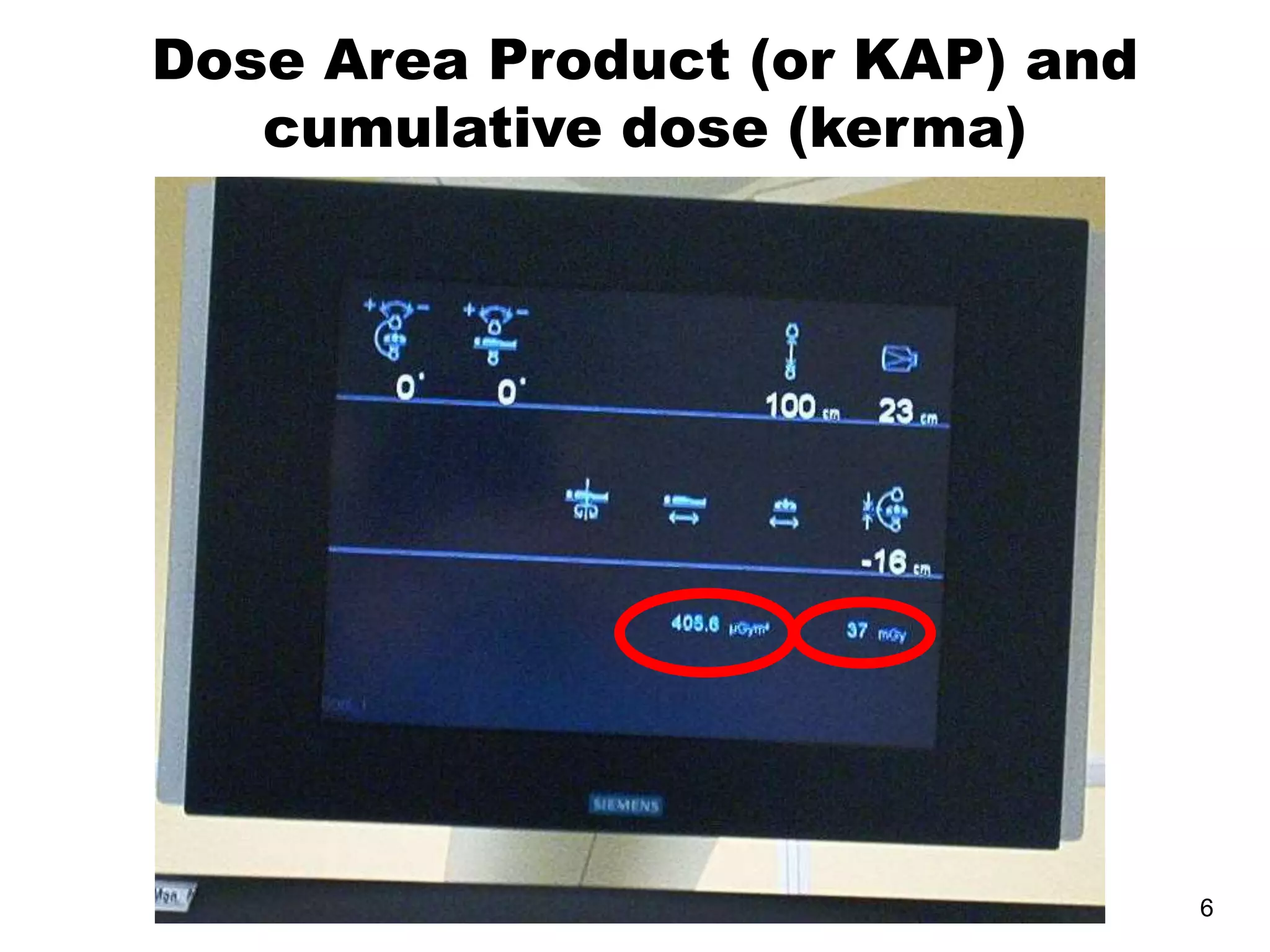
Dose Area Product (or KAP) and
cumulative dose (kerma)
7
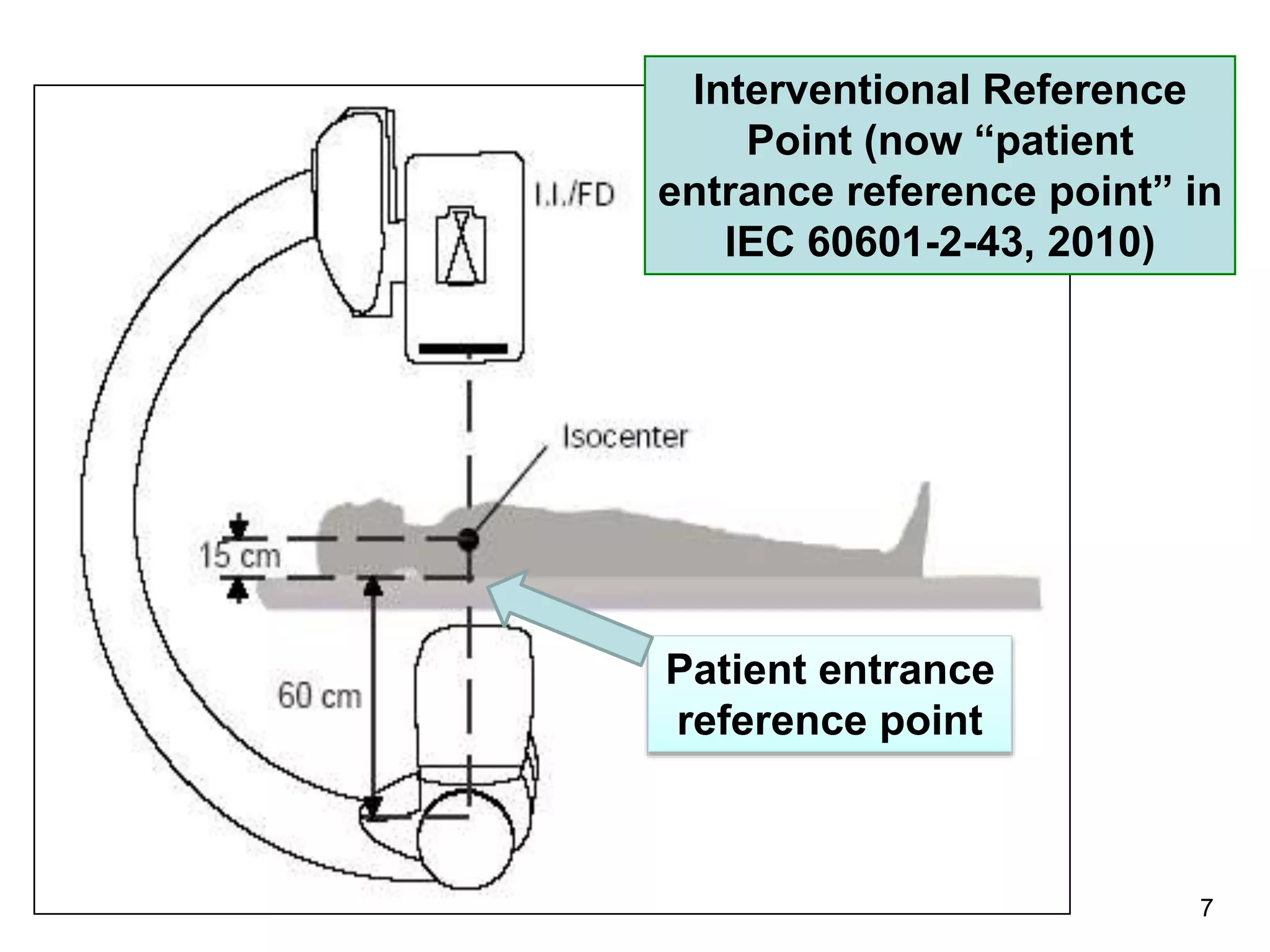
Interventional Reference
Point (now “patient
entrance reference point” in
IEC 60601-2-43, 2010)
7
Patient entrance
reference point
88
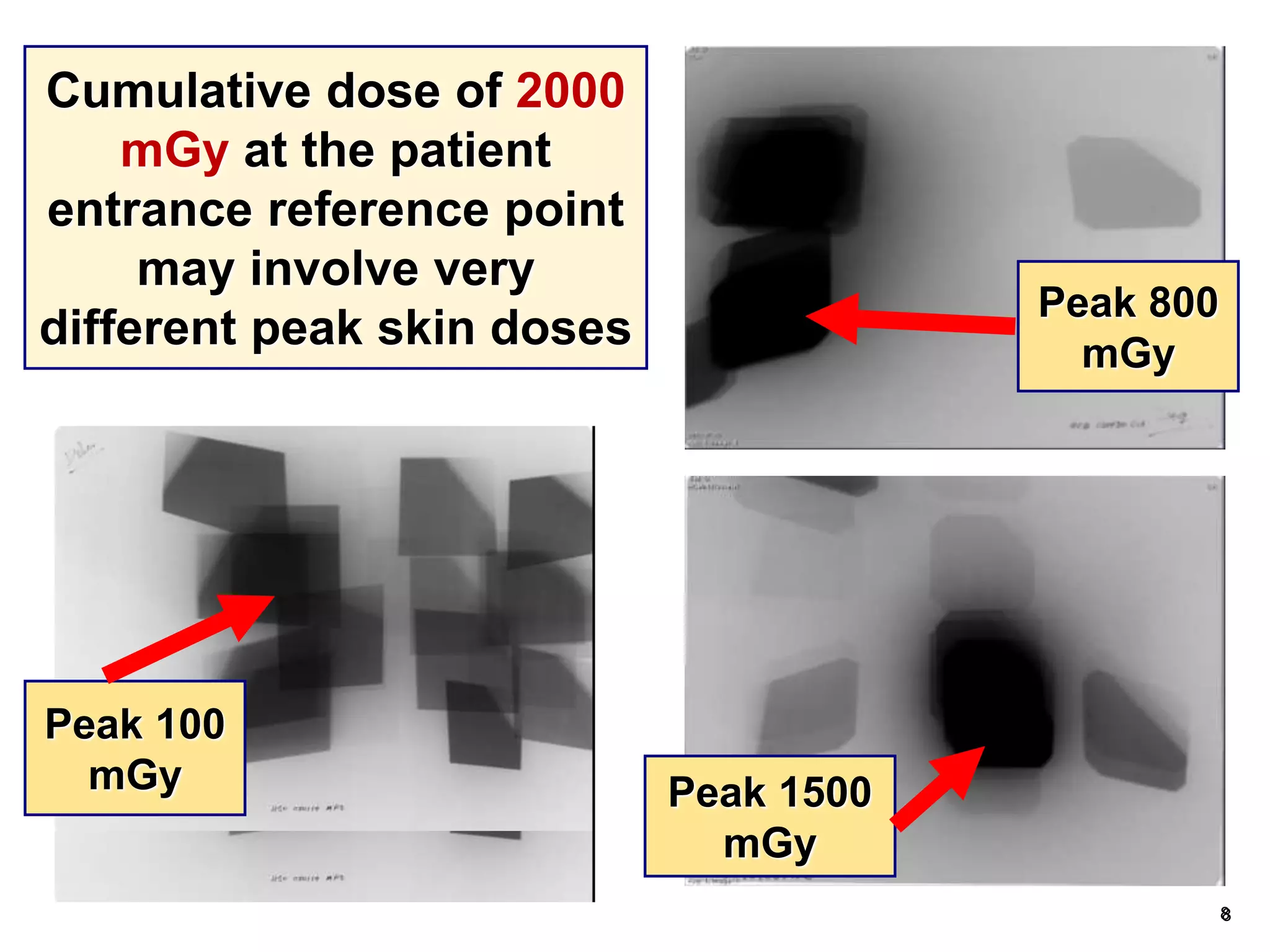
Cumulative dose of 2000
mGy at the patient
entrance reference point
may involve very
different peak skin doses
Peak 100
mGy Peak 1500
mGy
Peak 800
mGy
9
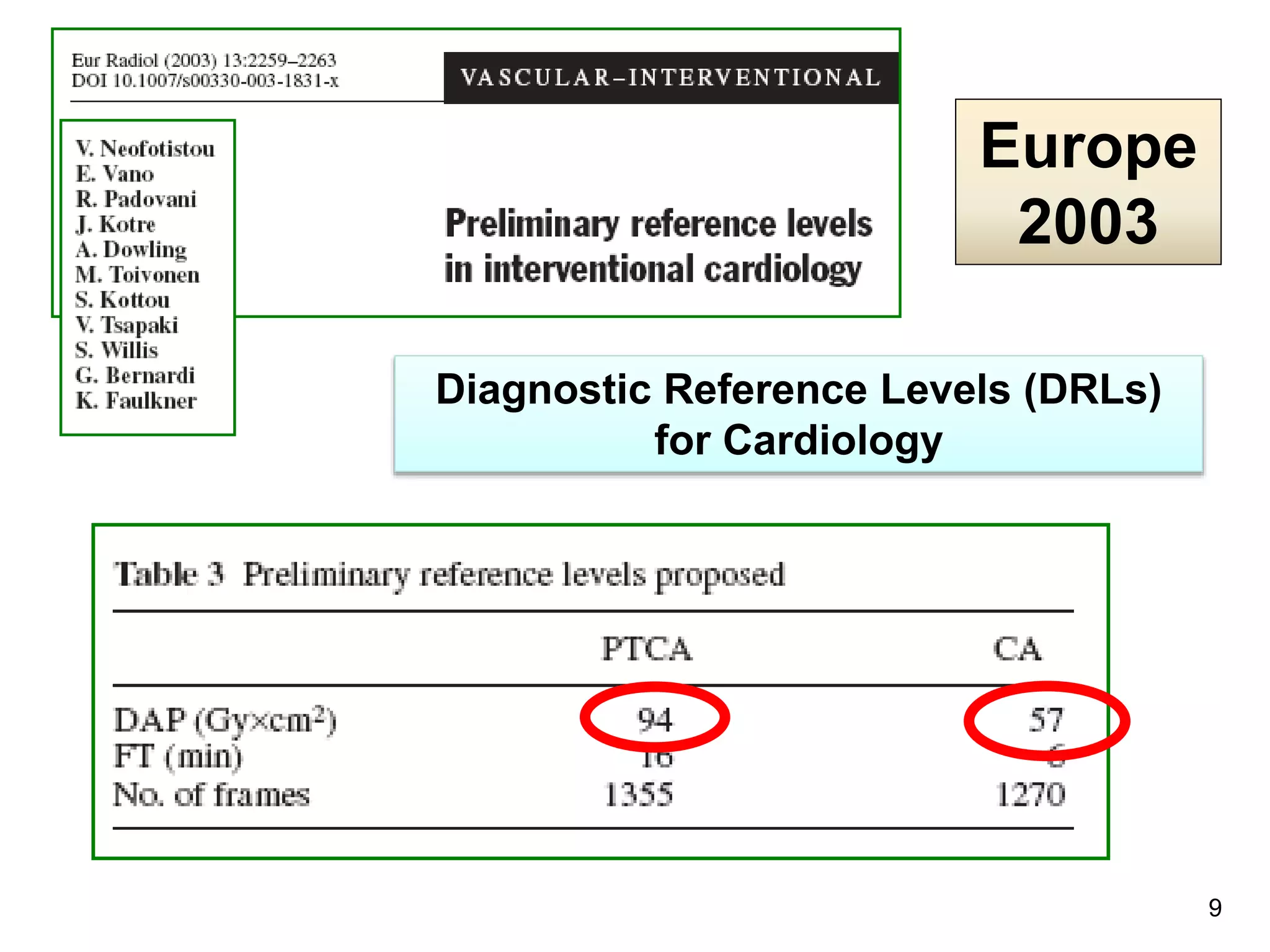
Europe
2003
Diagnostic Reference Levels (DRLs)
for Cardiology
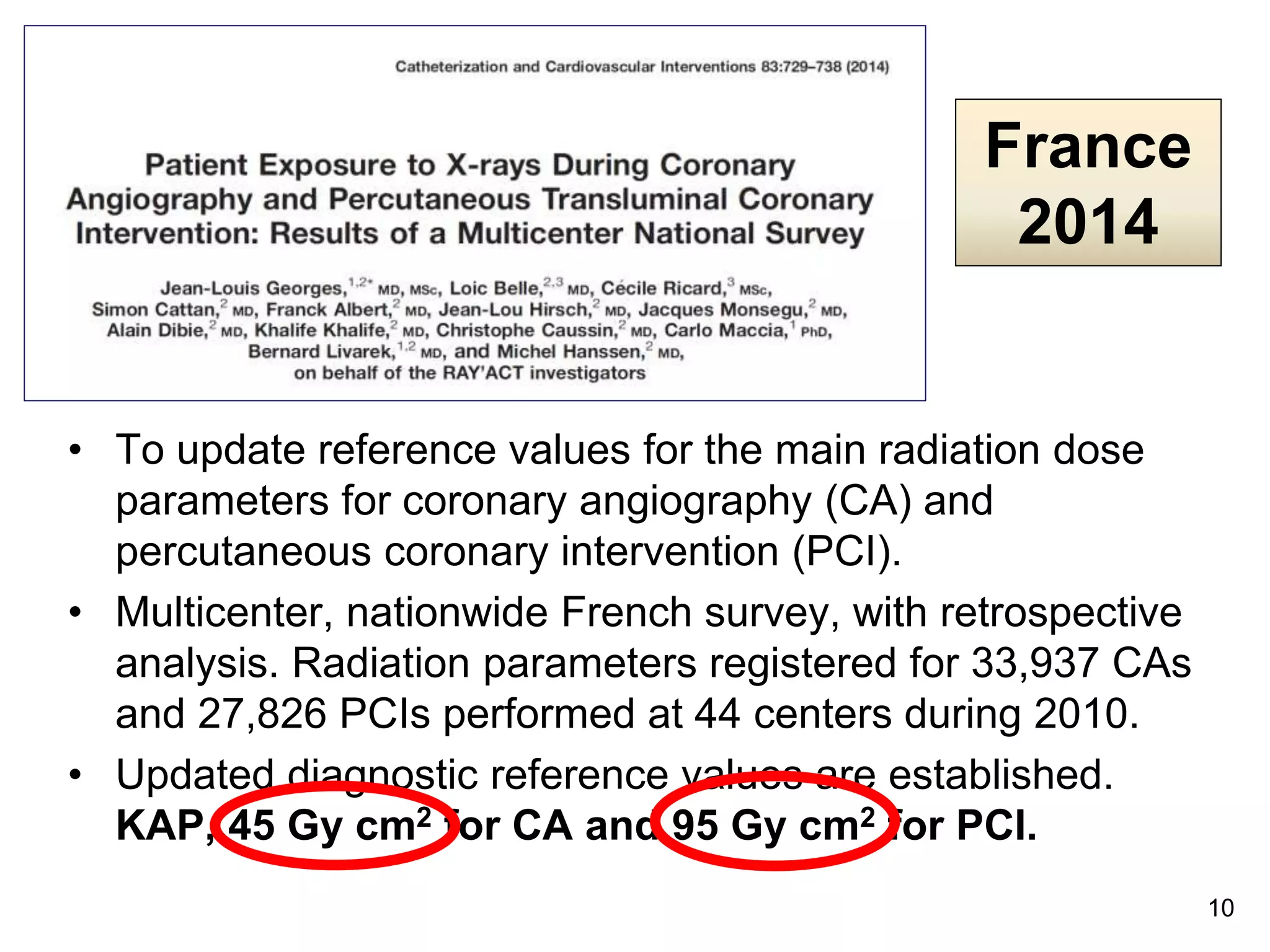
• To update reference values for the main radiation dose
parameters for coronary angiography (CA) and
percutaneous coronary intervention (PCI).
• Multicenter, nationwide French survey, with retrospective
analysis. Radiation parameters registered for 33,937 CAs
and 27,826 PCIs performed at 44 centers during 2010.
• Updated diagnostic reference values are established.
KAP, 45 Gy cm2 for CA and 95 Gy cm2 for PCI.
10
France
2014
11
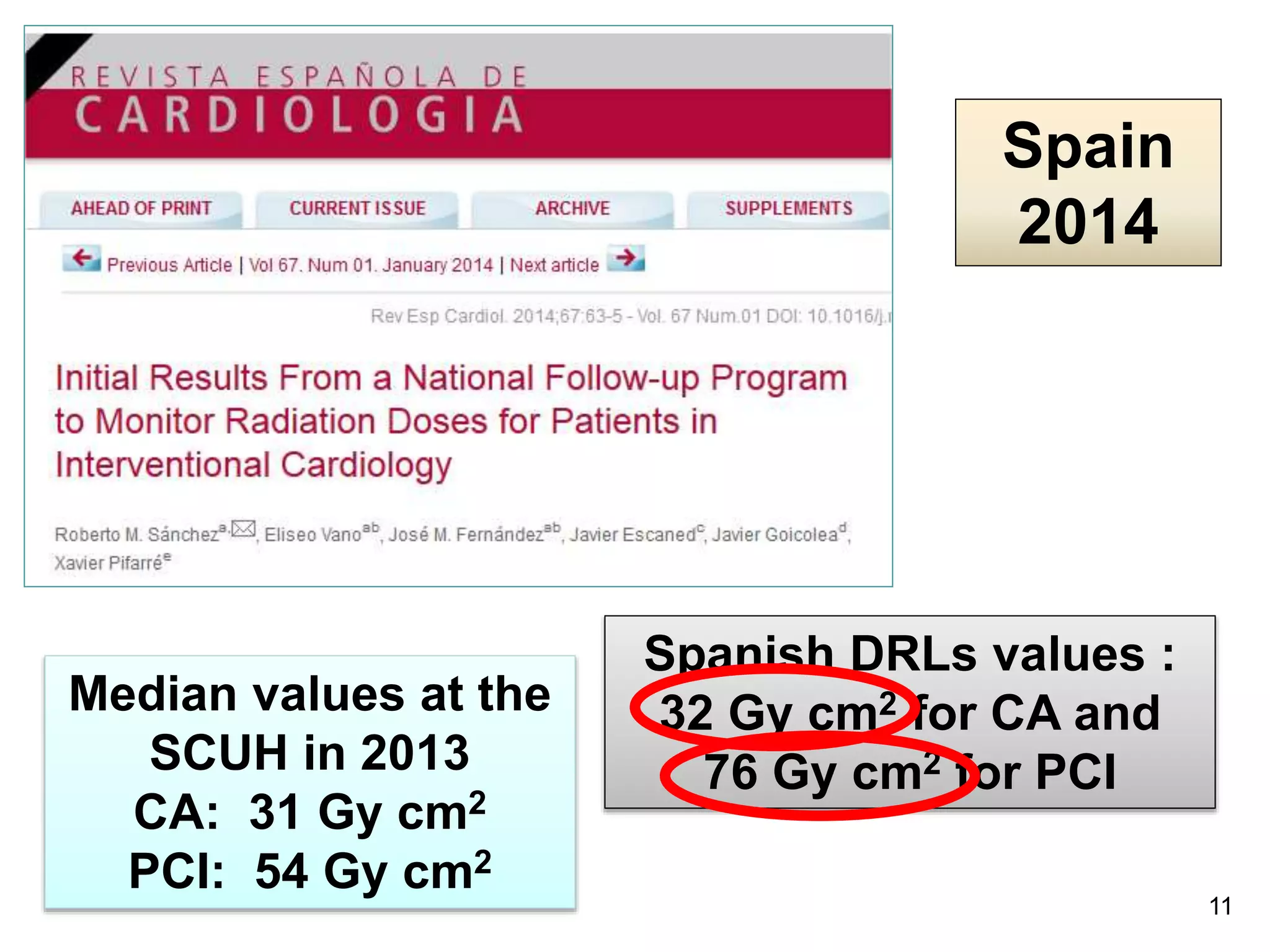
Spanish DRLs values :
32 Gy cm2 for CA and
76 Gy cm2 for PCI
Median values at the
SCUH in 2013
CA: 31 Gy cm2
PCI: 54 Gy cm2
Spain
2014
12
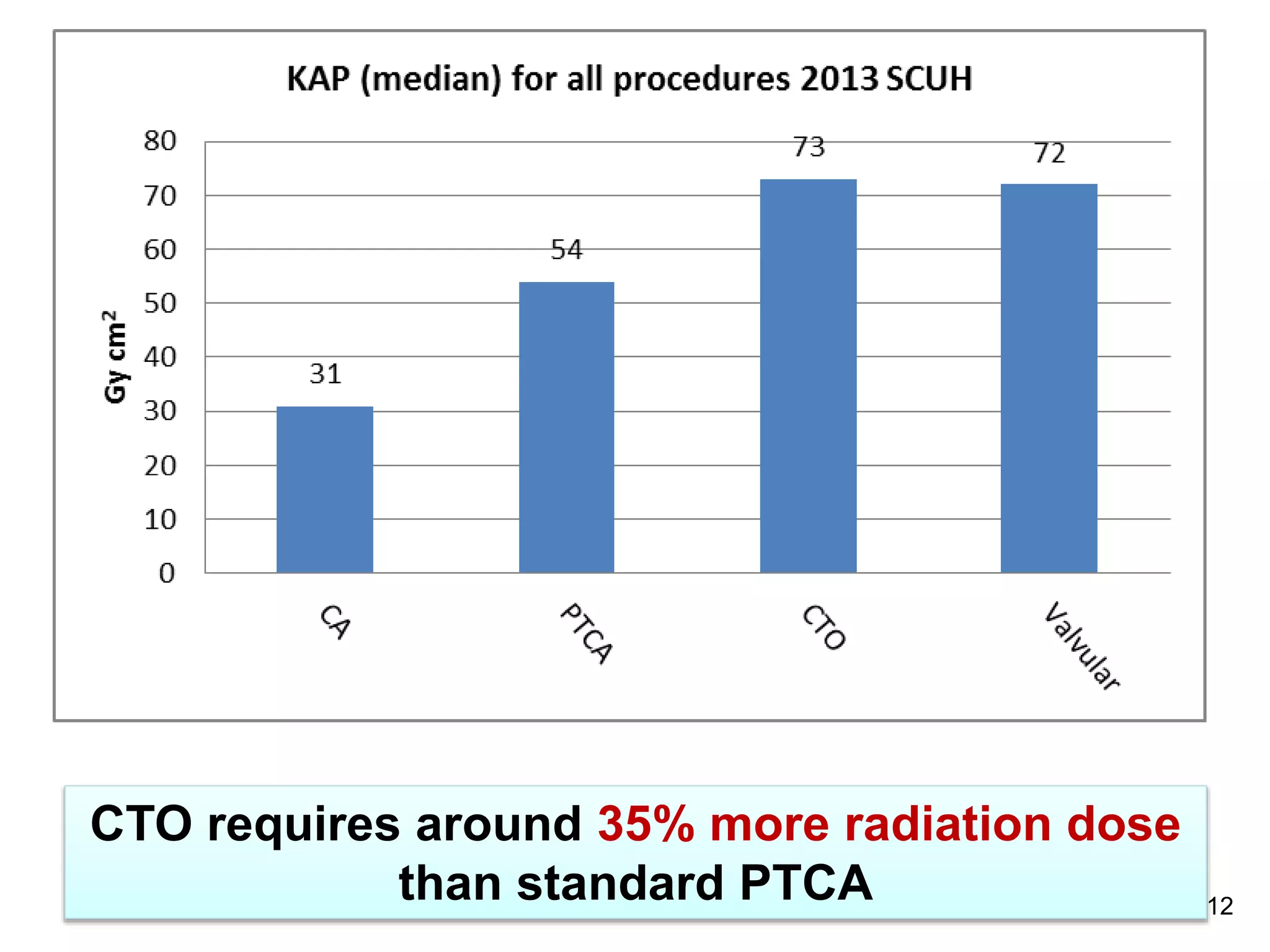
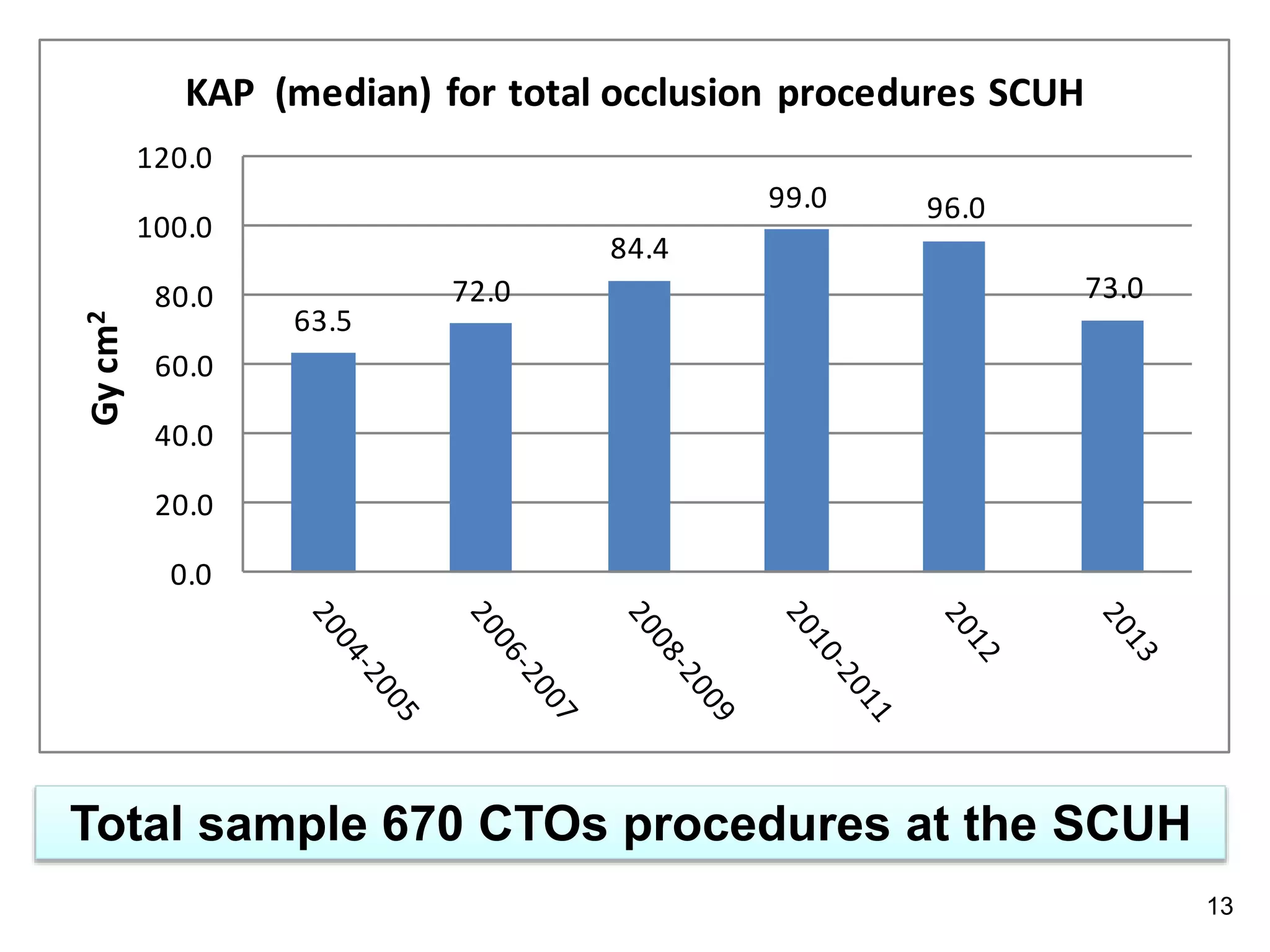
CTO requires around 35% more radiation dose
than standard PTCA
13
63.5
72.0
84.4
99.0 96.0
73.0
0.0
20.0
40.0
60.0
80.0
100.0
120.0
Gycm2 KAP (median) for total occlusion procedures SCUH
Total sample 670 CTOs procedures at the SCUH
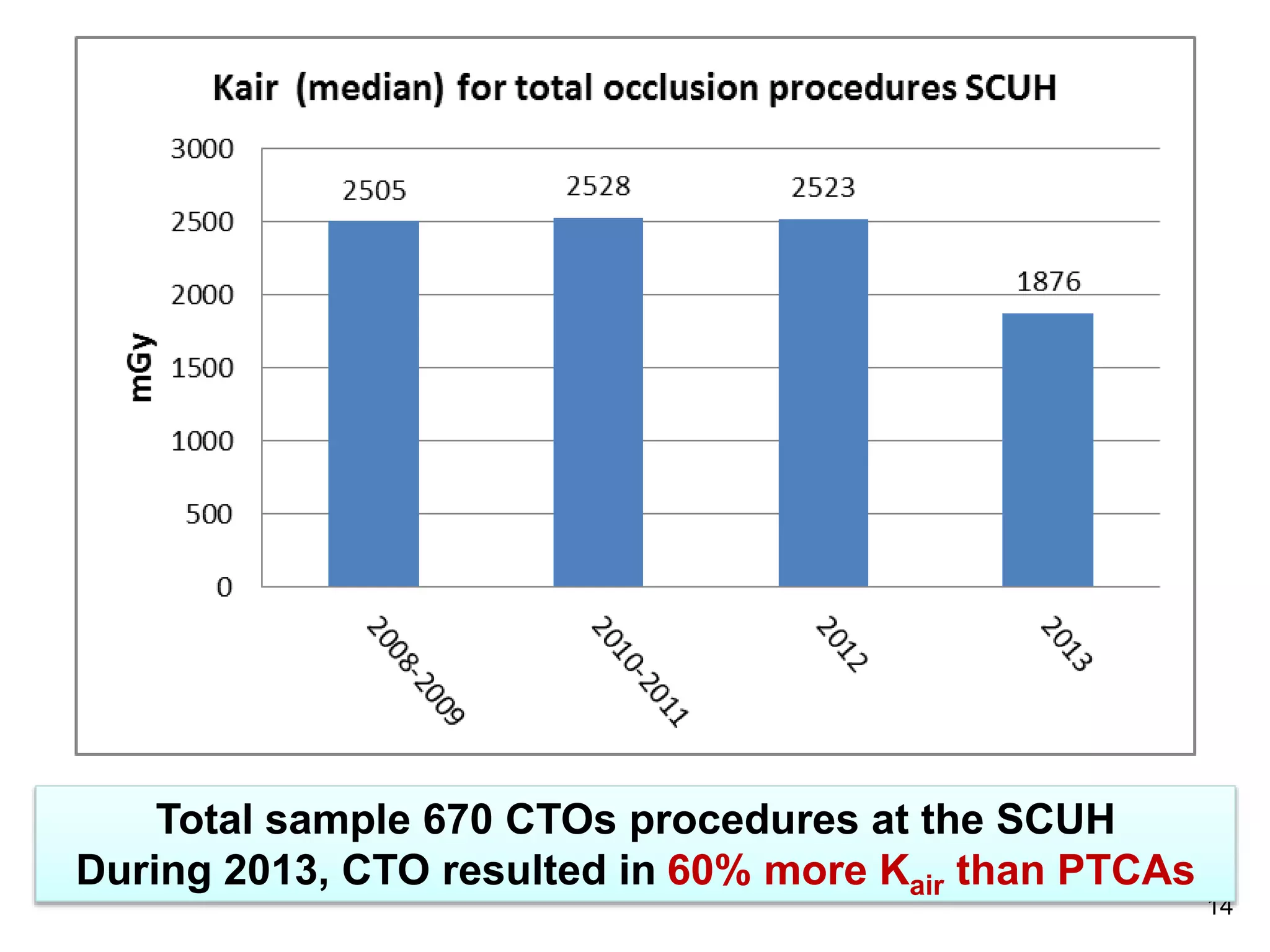
14
Total sample 670 CTOs procedures at the SCUH
During 2013, CTO resulted in 60% more Kair than PTCAs
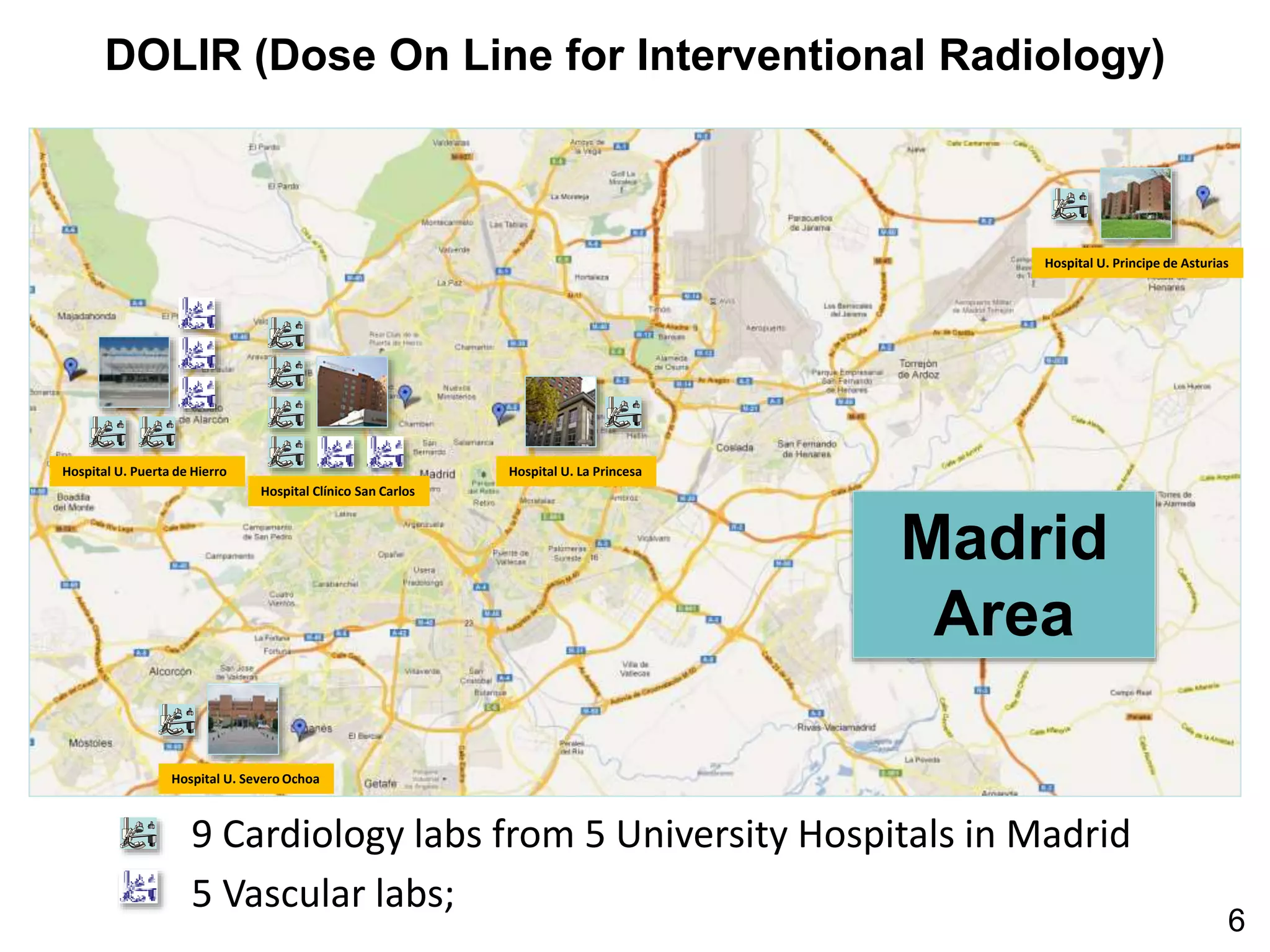
DOLIR (Dose On Line for Interventional Radiology)
5 Vascular labs;
9 Cardiology labs from 5 University Hospitals in Madrid
Hospital Clínico San Carlos
Hospital U. La PrincesaHospital U. Puerta de Hierro
Hospital U. Severo Ochoa
Hospital U. Principe de Asturias
6
Madrid
Area
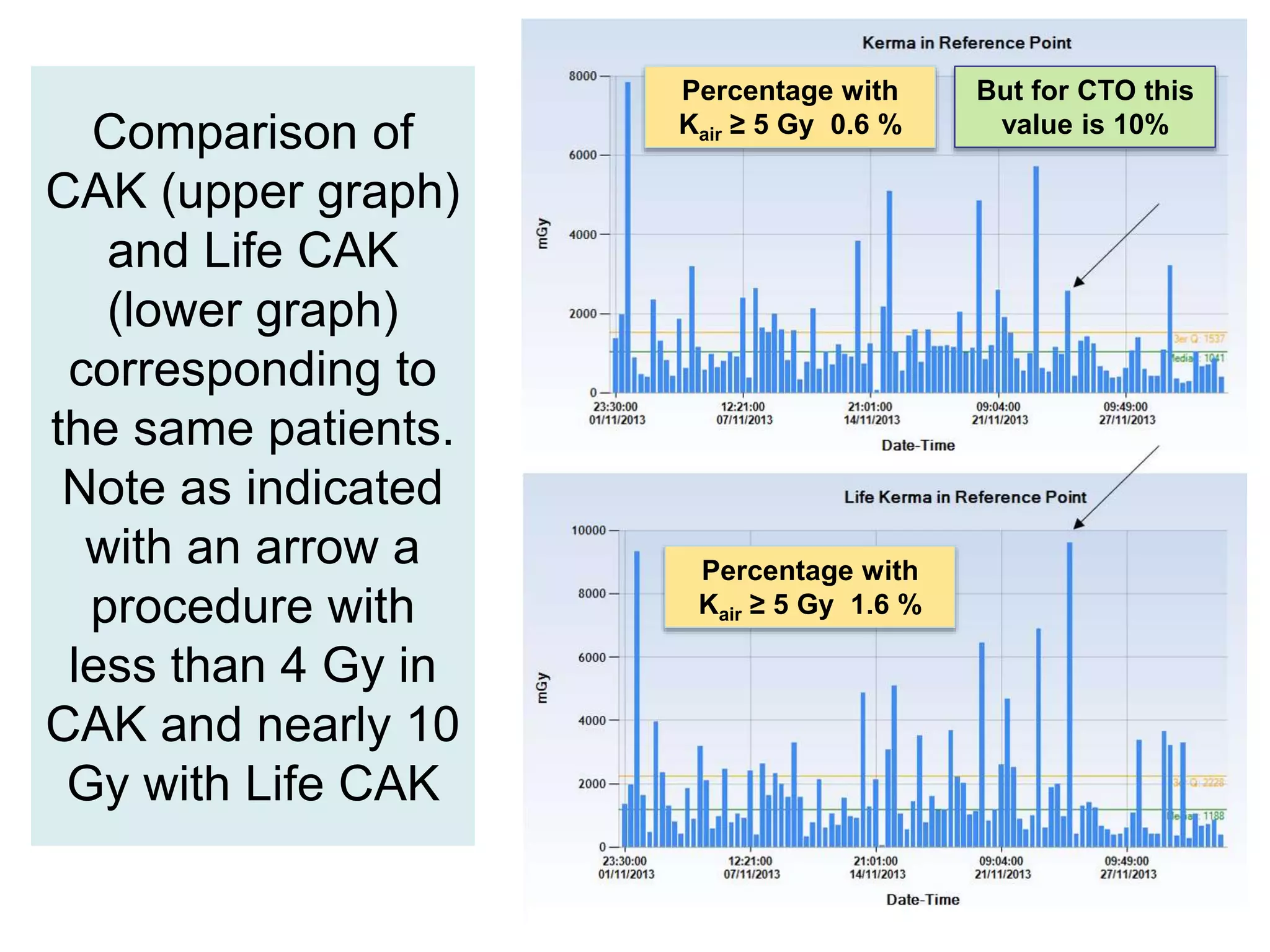
Comparison of
CAK (upper graph)
and Life CAK
(lower graph)
corresponding to
the same patients.
Note as indicated
with an arrow a
procedure with
less than 4 Gy in
CAK and nearly 10
Gy with Life CAK
Percentage with
Kair ≥ 5 Gy 0.6 %
Percentage with
Kair ≥ 5 Gy 1.6 %
But for CTO this
value is 10%
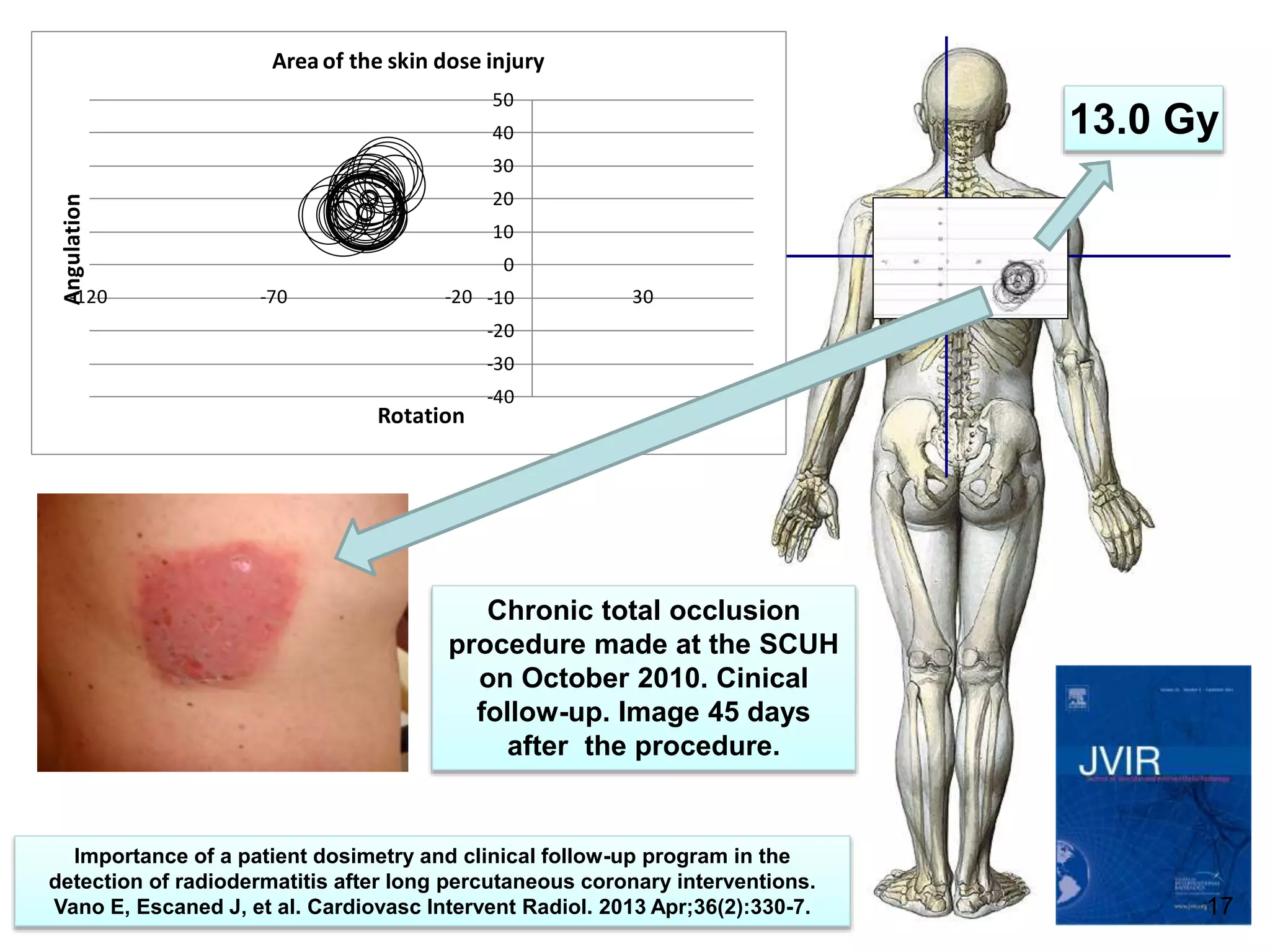
13.0 Gy
-40
-30
-20
-10
0
10
20
30
40
50
-120 -70 -20 30
Angulation
Rotation
Area of the skin dose injury
Chronic total occlusion
procedure made at the SCUH
on October 2010. Cinical
follow-up. Image 45 days
after the procedure.
Importance of a patient dosimetry and clinical follow-up program in the
detection of radiodermatitis after long percutaneous coronary interventions.
Vano E, Escaned J, et al. Cardiovasc Intervent Radiol. 2013 Apr;36(2):330-7. 17
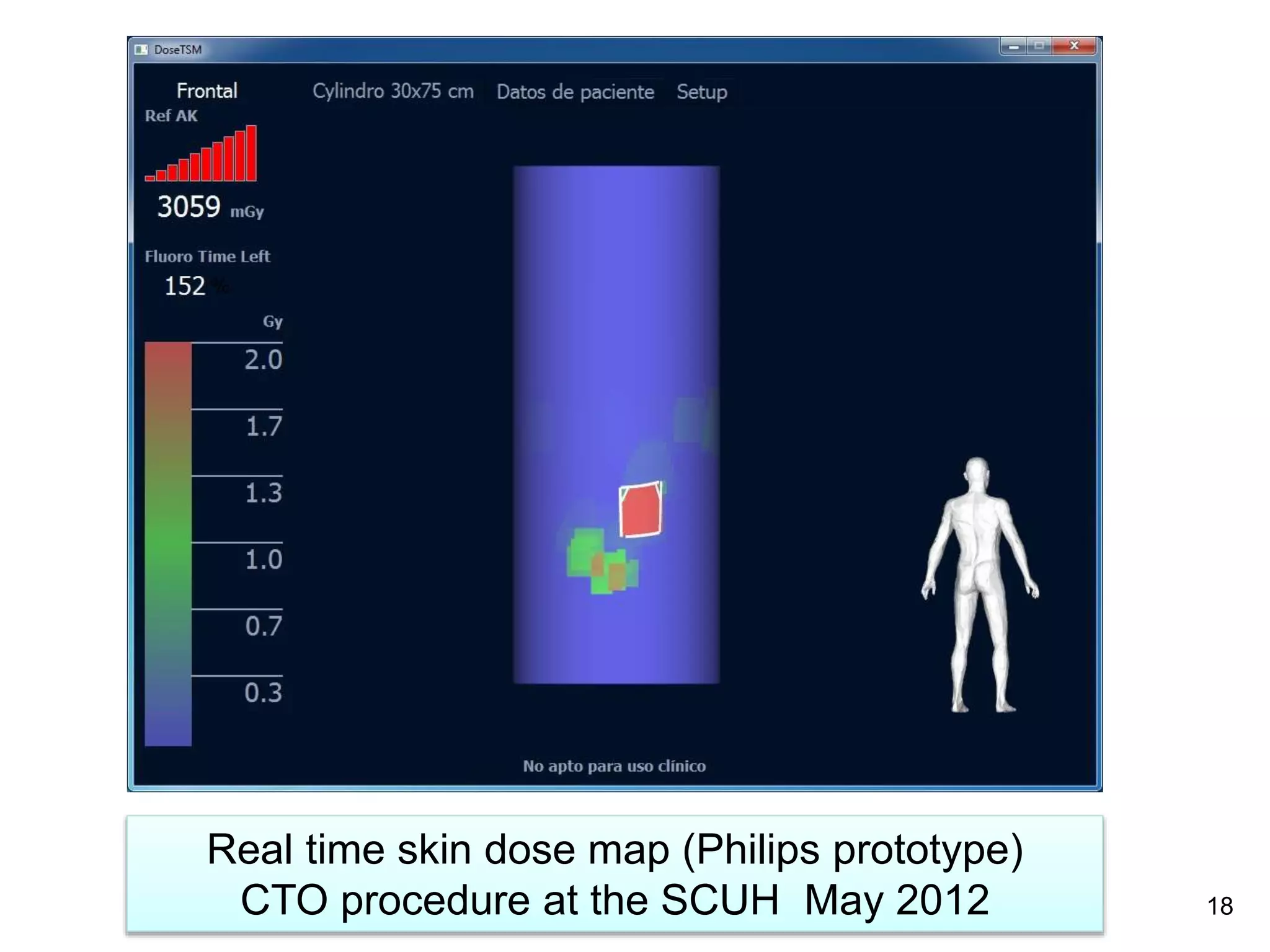
Real time skin dose map (Philips prototype)
CTO procedure at the SCUH May 2012 18
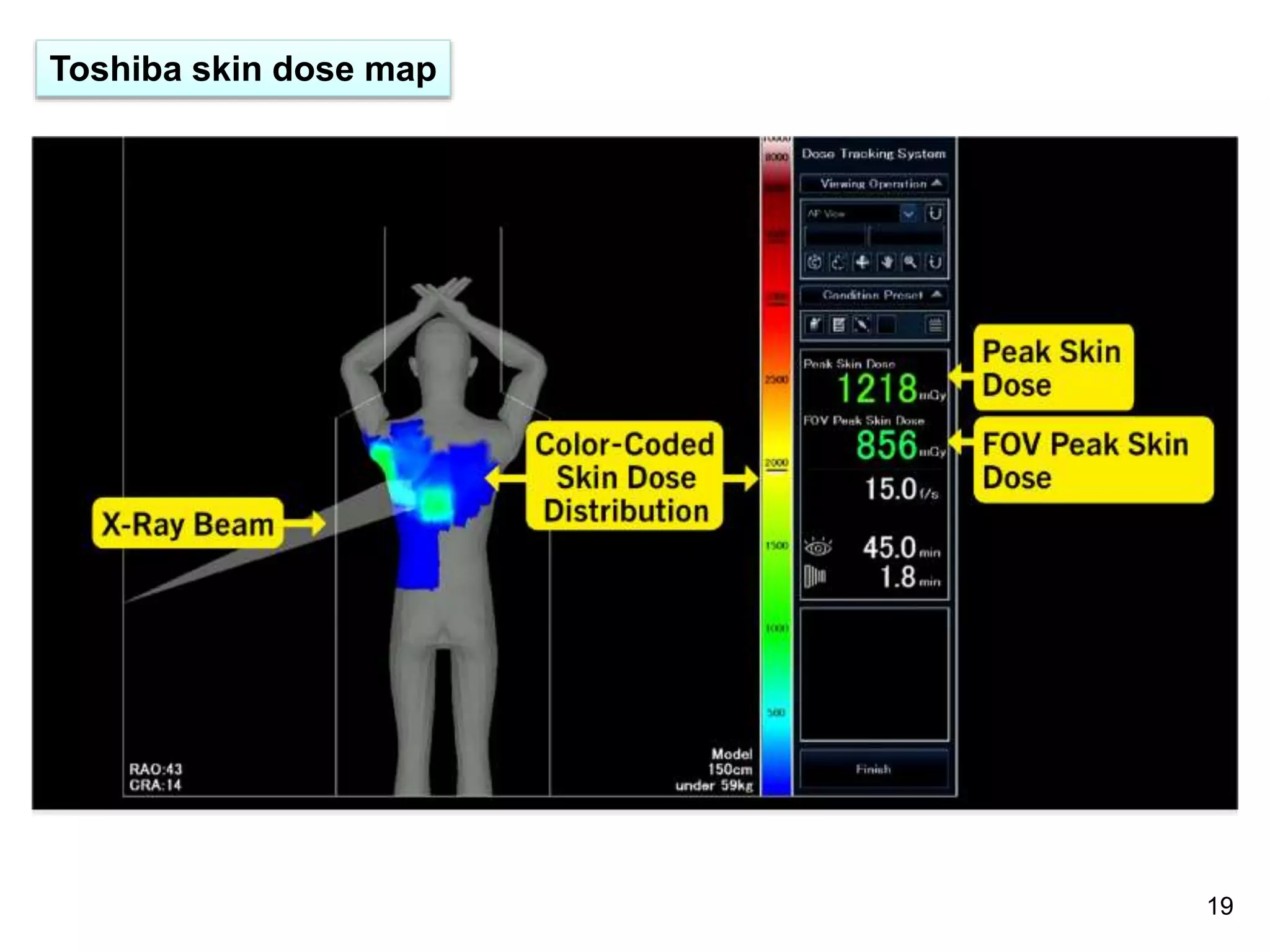
Toshiba skin dose map
19
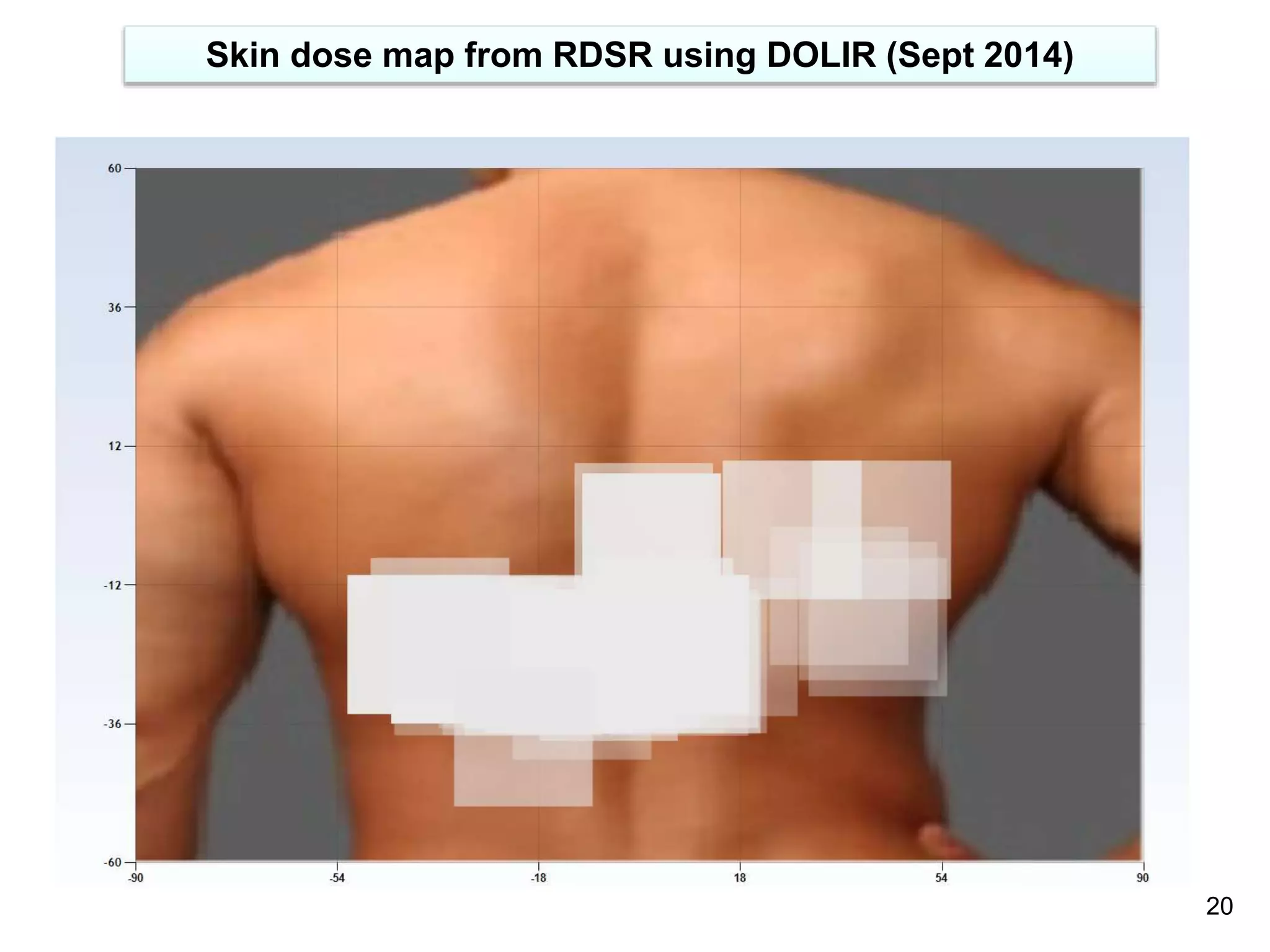
20
Skin dose map from RDSR using DOLIR (Sept 2014)
Radiation risk for staff
New threshold for lens opacities
and new occupational dose limit
for professionals
21
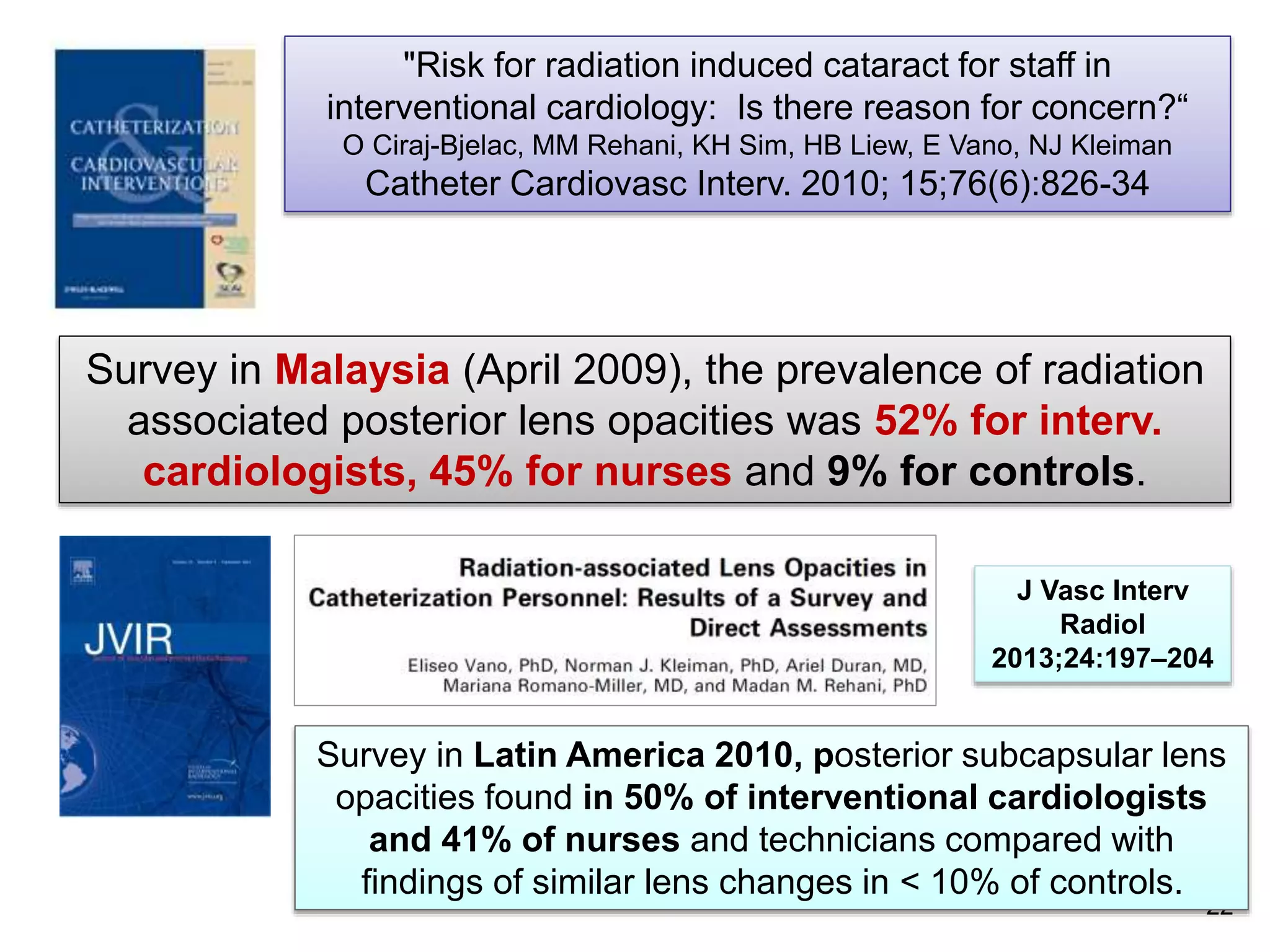
"Risk for radiation induced cataract for staff in
interventional cardiology: Is there reason for concern?“
O Ciraj-Bjelac, MM Rehani, KH Sim, HB Liew, E Vano, NJ Kleiman
Catheter Cardiovasc Interv. 2010; 15;76(6):826-34
Survey in Malaysia (April 2009), the prevalence of radiation
associated posterior lens opacities was 52% for interv.
cardiologists, 45% for nurses and 9% for controls.
22
Survey in Latin America 2010, posterior subcapsular lens
opacities found in 50% of interventional cardiologists
and 41% of nurses and technicians compared with
findings of similar lens changes in < 10% of controls.
J Vasc Interv
Radiol
2013;24:197–204
23
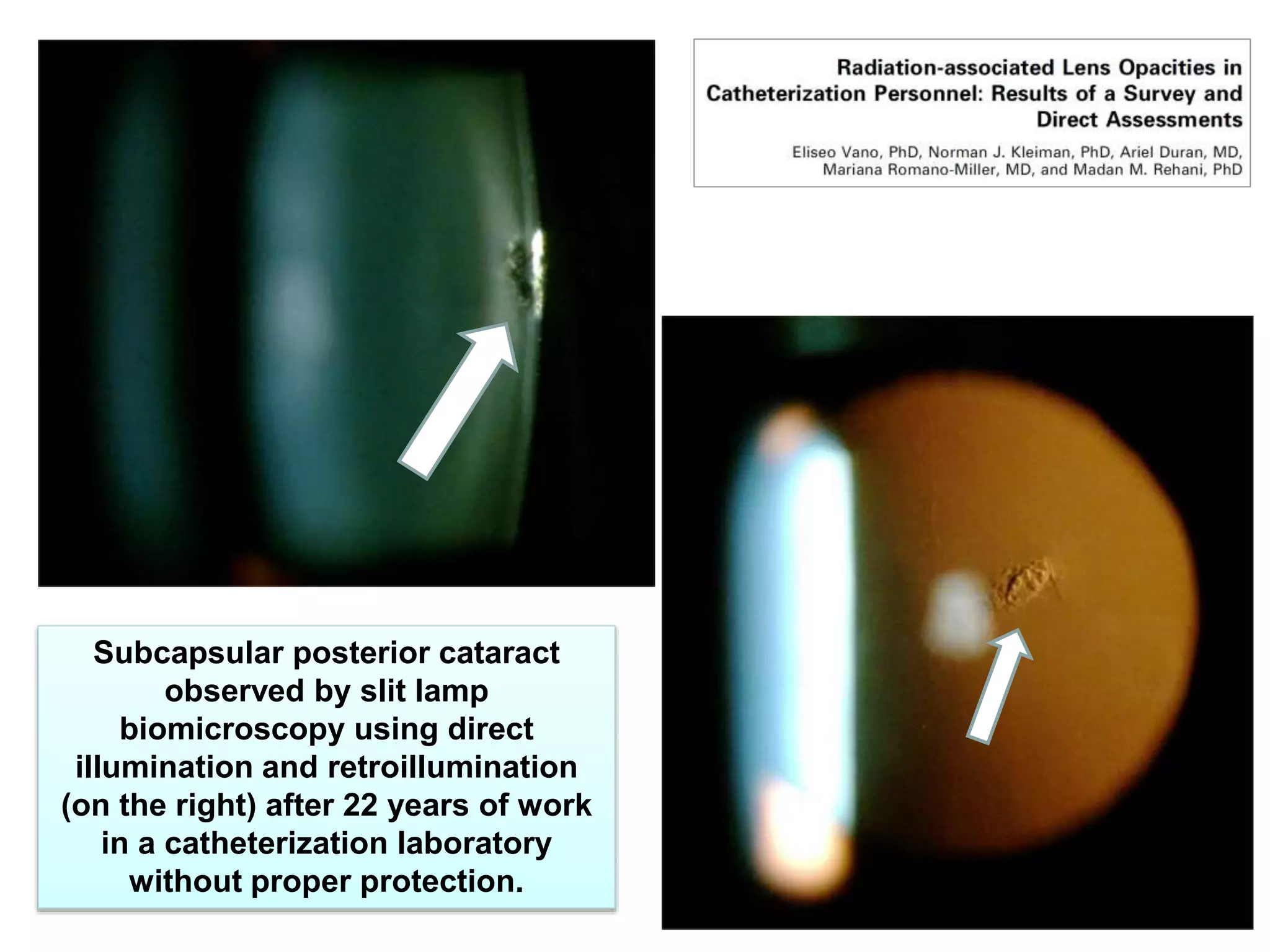
Subcapsular posterior cataract
observed by slit lamp
biomicroscopy using direct
illumination and retroillumination
(on the right) after 22 years of work
in a catheterization laboratory
without proper protection.
24
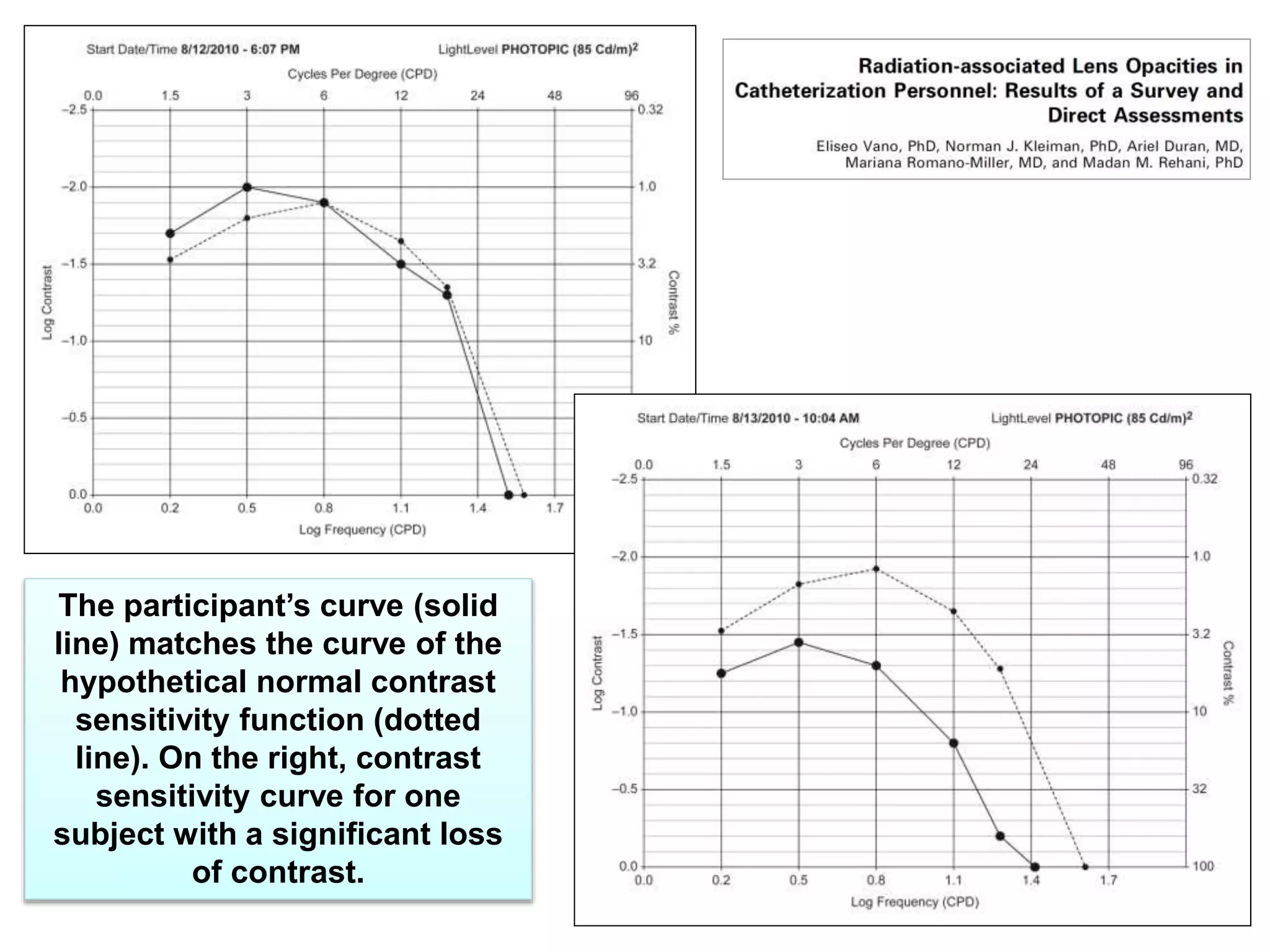
The participant’s curve (solid
line) matches the curve of the
hypothetical normal contrast
sensitivity function (dotted
line). On the right, contrast
sensitivity curve for one
subject with a significant loss
of contrast.
25
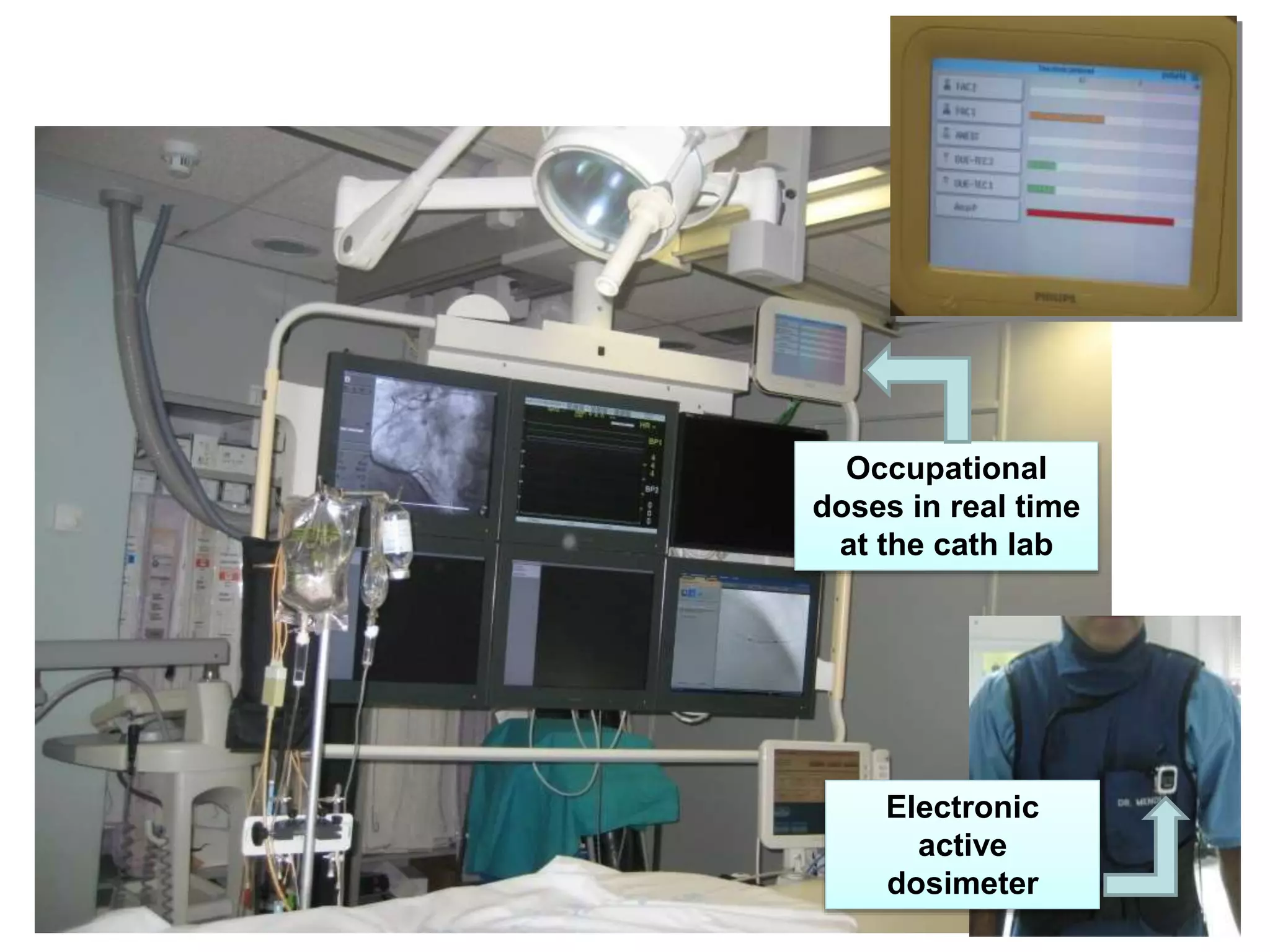
Occupational
doses in real time
at the cath lab
Electronic
active
dosimeter
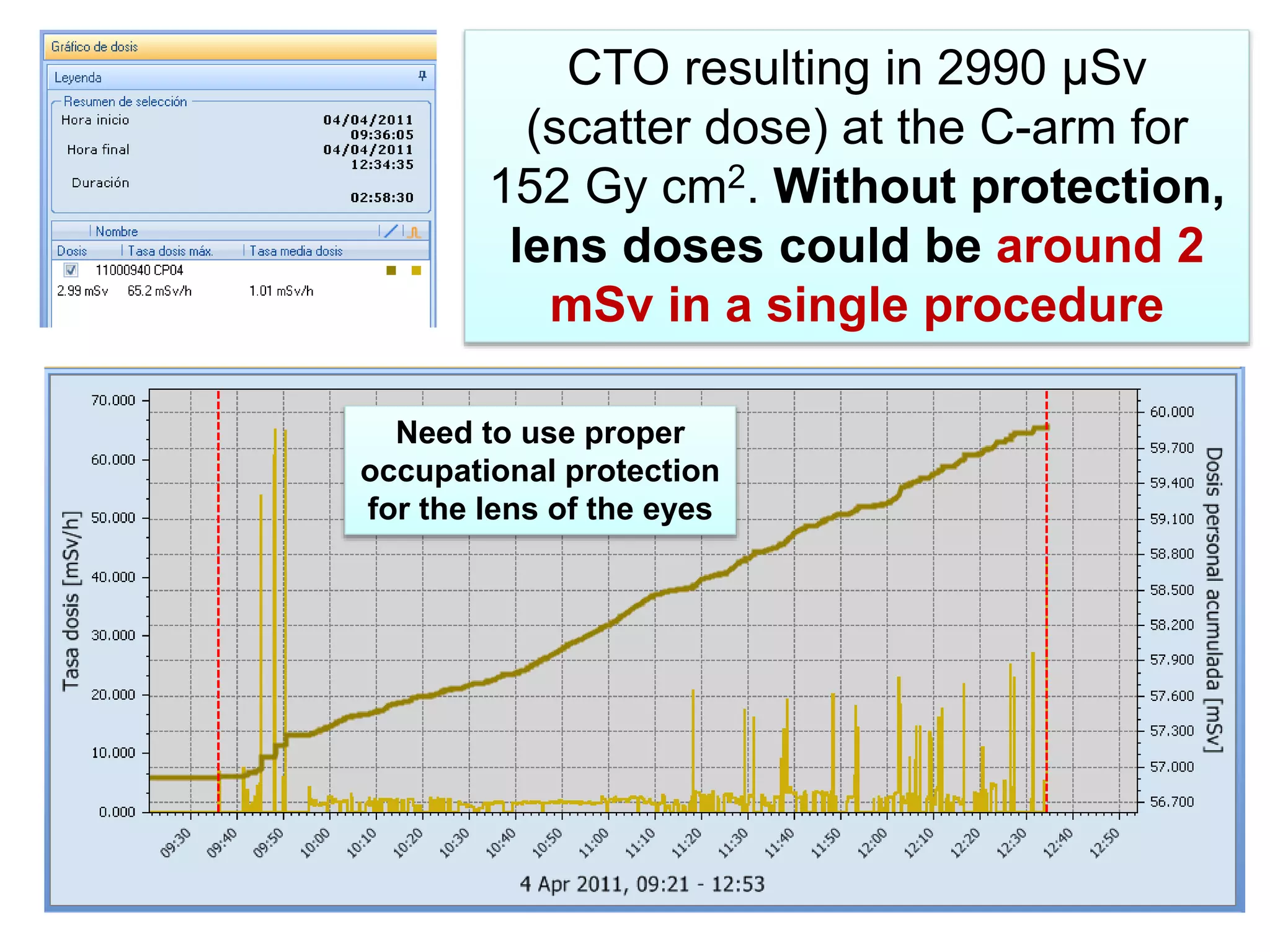
CTO resulting in 2990 μSv
(scatter dose) at the C-arm for
152 Gy cm2. Without protection,
lens doses could be around 2
mSv in a single procedure
Need to use proper
occupational protection
for the lens of the eyes
27
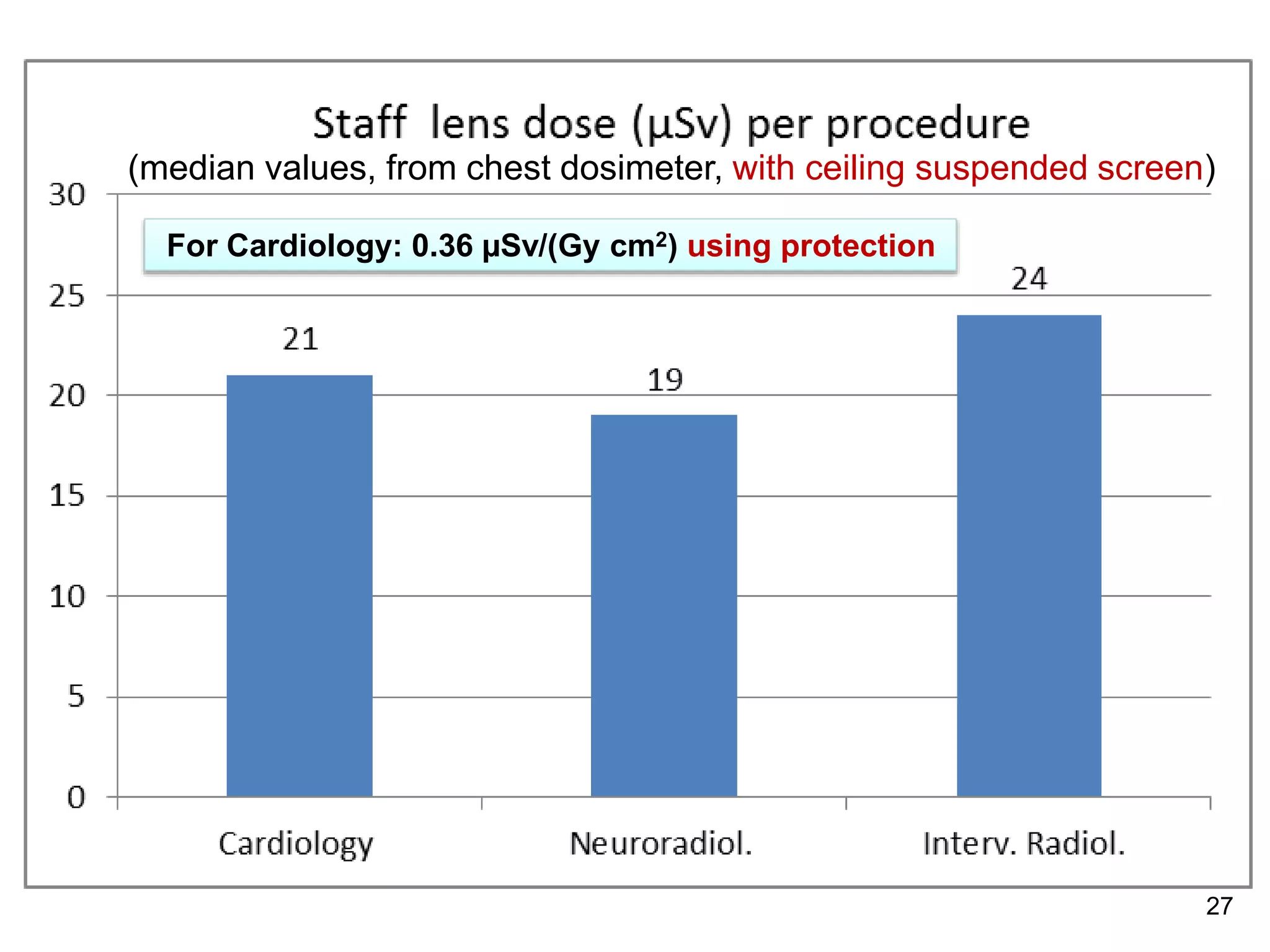
(median values, from chest dosimeter, with ceiling suspended screen)
For Cardiology: 0.36 µSv/(Gy cm2) using protection
International
Recommendations and
European Regulation
28
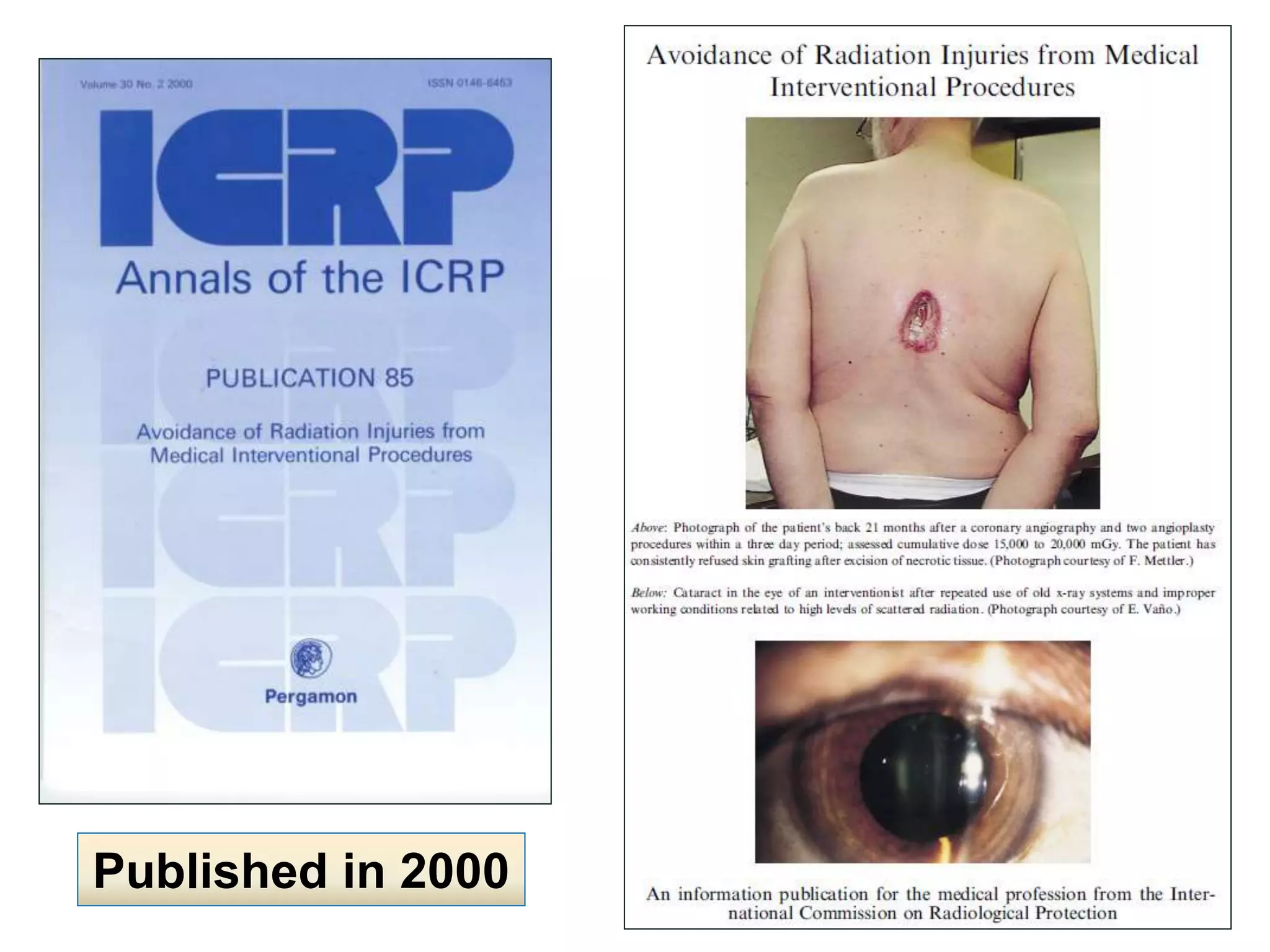
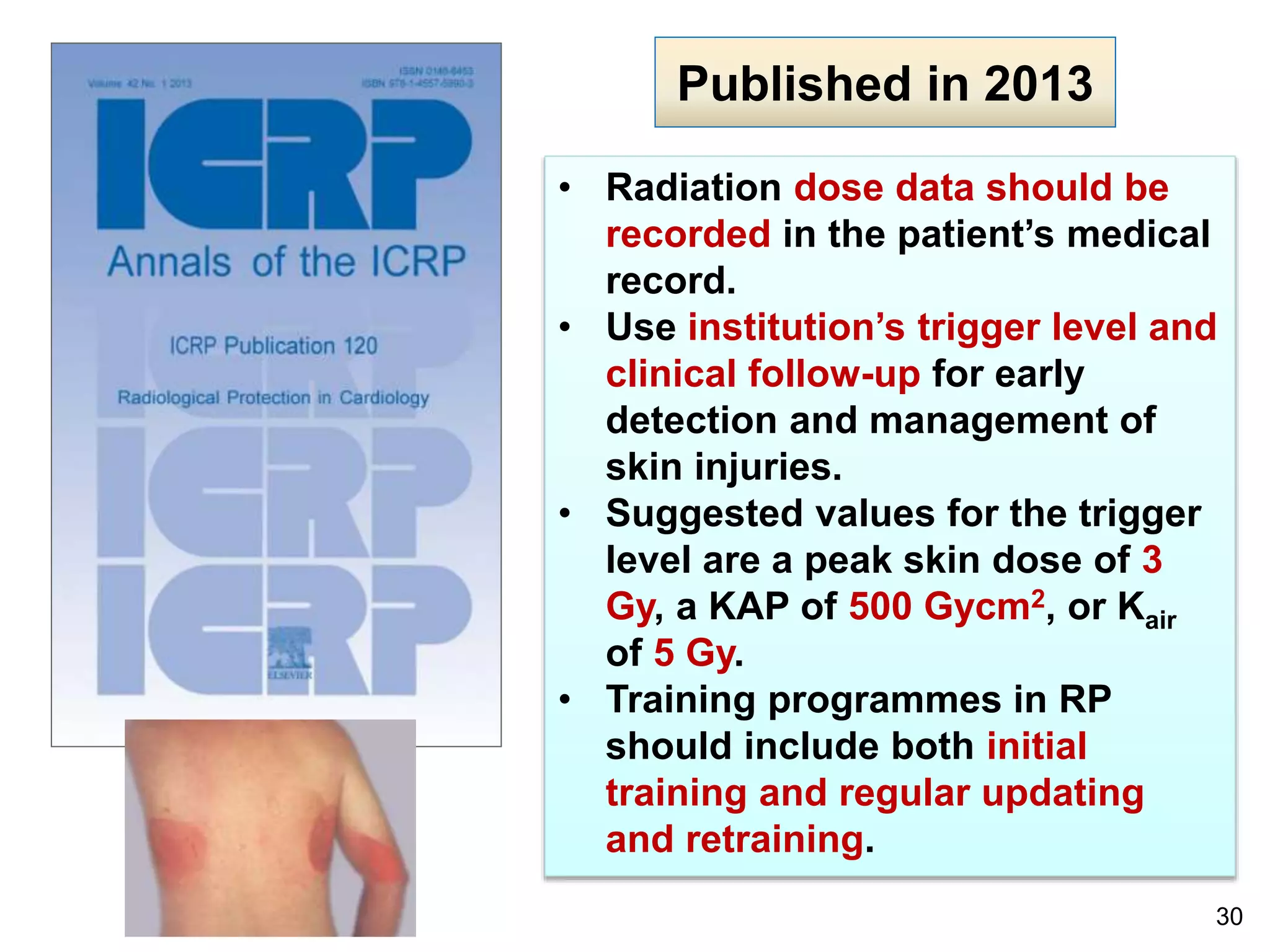
Published in 2000
29
30
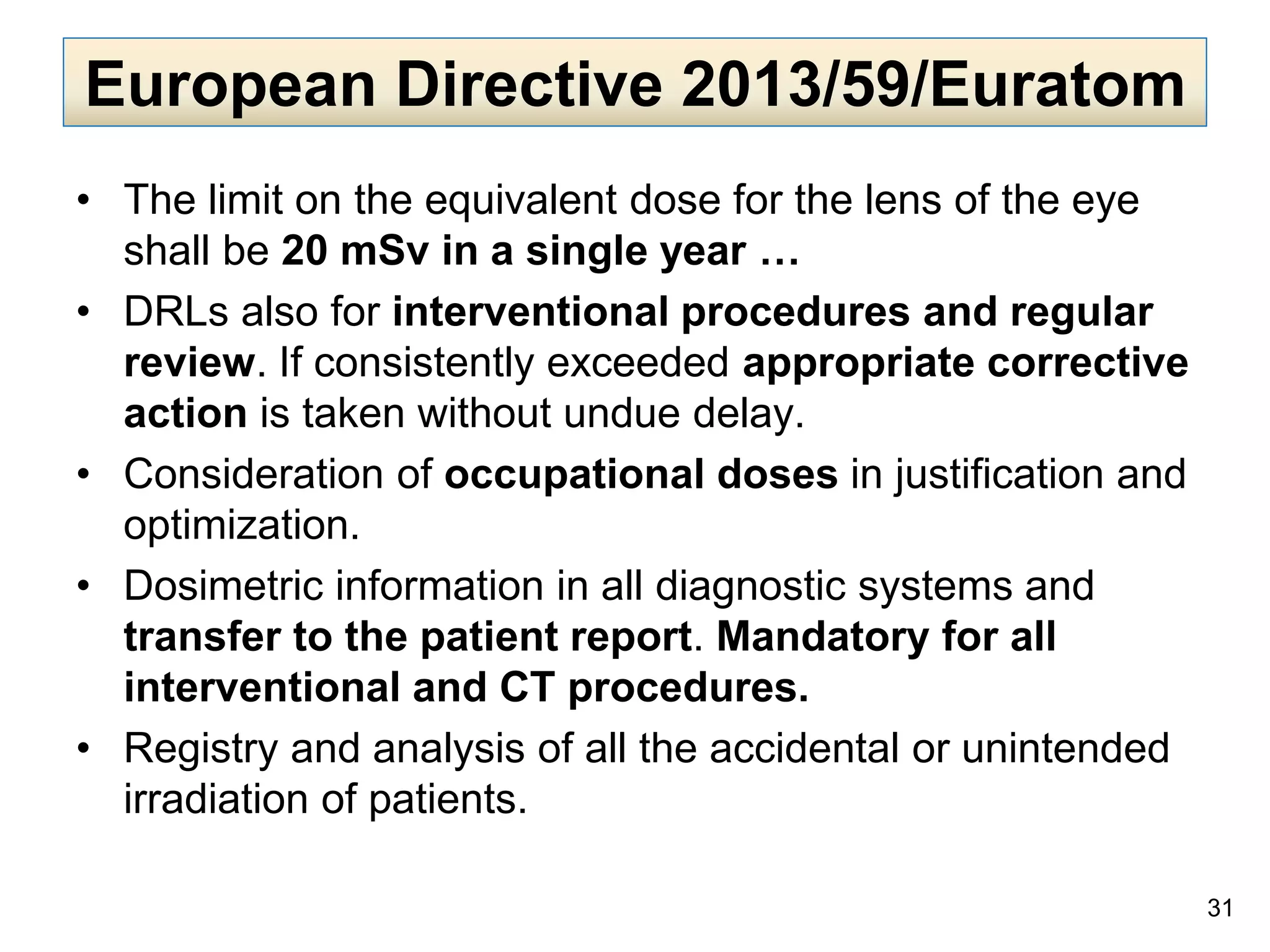
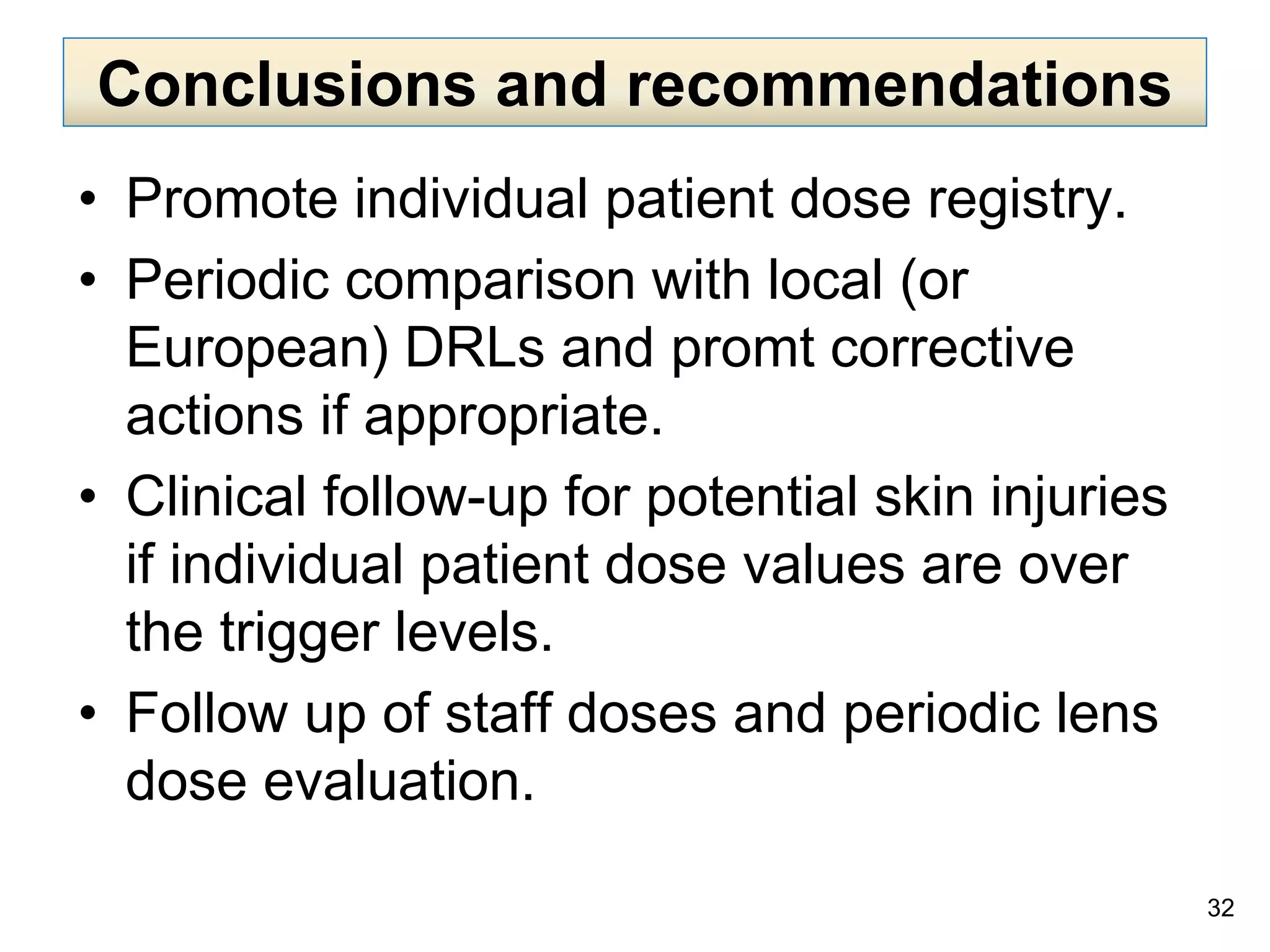
Published in 2013
• Radiation dose data should be
recorded in the patient’s medical
record.
• Use institution’s trigger level and
clinical follow-up for early
detection and management of
skin injuries.
• Suggested values for the trigger
level are a peak skin dose of 3
Gy, a KAP of 500 Gycm2, or Kair
of 5 Gy.
• Training programmes in RP
should include both initial
training and regular updating
and retraining.
European Directive 2013/59/Euratom
• The limit on the equivalent dose for the lens of the eye
shall be 20 mSv in a single year …
• DRLs also for interventional procedures and regular
review. If consistently exceeded appropriate corrective
action is taken without undue delay.
• Consideration of occupational doses in justification and
optimization.
• Dosimetric information in all diagnostic systems and
transfer to the patient report. Mandatory for all
interventional and CT procedures.
• Registry and analysis of all the accidental or unintended
irradiation of patients.
31
• Promote individual patient dose registry.
• Periodic comparison with local (or
European) DRLs and promt corrective
actions if appropriate.
• Clinical follow-up for potential skin injuries
if individual patient dose values are over
the trigger levels.
• Follow up of staff doses and periodic lens
dose evaluation.
32
Conclusions and recommendations

12:25 Vano - Decreasing X-ray exposure in CTO procedures

  • 1.
    Decreasing X-ray exposure inCTO procedures Eliseo Vano (JM Fernandez, RM Sanchez, JI Ten) eliseov@med.ucm.es Friday Sept 26, 12:25-12:50 1 San Carlos University Hospital. Medical Physics Service. Radiology Department. Complutense University. Madrid.
  • 2.
    Content 1. Level ofpatient exposure during CTO procedures. Are dose values in your cath lab, “acceptable” or are they “too high”?. 2. Staff radiation risk needs also be considered. 3. International recommendations and European regulation. 2
  • 3.
    Patient and staffdoses • In some complex CTO procedures several Grays (Gy) could be accumulated at the skin of the patients with a risk of radiation injuries. • If staff is not properly protected, some mGy per procedure could be the dose at the lens of the eyes for complex procedures and the risk of radiation induced cataracts exists. • The new annual occupational dose limit for the lens of the eyes is 20 mSv (instead of 150 mSv). 3
  • 4.
    A good managementof patient and staff radiation doses • Maintain dose values as low as reasonably achievable considering the clinical benefit of the procedure (for patients and staff). • Work under radiation dose limits (for professionals) and use “Diagnostic Reference Levels” (DRLs) for patients. • Avoid radiation injuries and establish a clinical follow-up for high dose procedures. 4
  • 5.
  • 6.
    6 Dose Area Product(or KAP) and cumulative dose (kerma)
  • 7.
    7 Interventional Reference Point (now“patient entrance reference point” in IEC 60601-2-43, 2010) 7 Patient entrance reference point
  • 8.
    88 Cumulative dose of2000 mGy at the patient entrance reference point may involve very different peak skin doses Peak 100 mGy Peak 1500 mGy Peak 800 mGy
  • 9.
  • 10.
    • To updatereference values for the main radiation dose parameters for coronary angiography (CA) and percutaneous coronary intervention (PCI). • Multicenter, nationwide French survey, with retrospective analysis. Radiation parameters registered for 33,937 CAs and 27,826 PCIs performed at 44 centers during 2010. • Updated diagnostic reference values are established. KAP, 45 Gy cm2 for CA and 95 Gy cm2 for PCI. 10 France 2014
  • 11.
    11 Spanish DRLs values: 32 Gy cm2 for CA and 76 Gy cm2 for PCI Median values at the SCUH in 2013 CA: 31 Gy cm2 PCI: 54 Gy cm2 Spain 2014
  • 12.
    12 CTO requires around35% more radiation dose than standard PTCA
  • 13.
    13 63.5 72.0 84.4 99.0 96.0 73.0 0.0 20.0 40.0 60.0 80.0 100.0 120.0 Gycm2 KAP(median) for total occlusion procedures SCUH Total sample 670 CTOs procedures at the SCUH
  • 14.
    14 Total sample 670CTOs procedures at the SCUH During 2013, CTO resulted in 60% more Kair than PTCAs
  • 15.
    DOLIR (Dose OnLine for Interventional Radiology) 5 Vascular labs; 9 Cardiology labs from 5 University Hospitals in Madrid Hospital Clínico San Carlos Hospital U. La PrincesaHospital U. Puerta de Hierro Hospital U. Severo Ochoa Hospital U. Principe de Asturias 6 Madrid Area
  • 16.
    Comparison of CAK (uppergraph) and Life CAK (lower graph) corresponding to the same patients. Note as indicated with an arrow a procedure with less than 4 Gy in CAK and nearly 10 Gy with Life CAK Percentage with Kair ≥ 5 Gy 0.6 % Percentage with Kair ≥ 5 Gy 1.6 % But for CTO this value is 10%
  • 17.
    13.0 Gy -40 -30 -20 -10 0 10 20 30 40 50 -120 -70-20 30 Angulation Rotation Area of the skin dose injury Chronic total occlusion procedure made at the SCUH on October 2010. Cinical follow-up. Image 45 days after the procedure. Importance of a patient dosimetry and clinical follow-up program in the detection of radiodermatitis after long percutaneous coronary interventions. Vano E, Escaned J, et al. Cardiovasc Intervent Radiol. 2013 Apr;36(2):330-7. 17
  • 18.
    Real time skindose map (Philips prototype) CTO procedure at the SCUH May 2012 18
  • 19.
  • 20.
    20 Skin dose mapfrom RDSR using DOLIR (Sept 2014)
  • 21.
    Radiation risk forstaff New threshold for lens opacities and new occupational dose limit for professionals 21
  • 22.
    "Risk for radiationinduced cataract for staff in interventional cardiology: Is there reason for concern?“ O Ciraj-Bjelac, MM Rehani, KH Sim, HB Liew, E Vano, NJ Kleiman Catheter Cardiovasc Interv. 2010; 15;76(6):826-34 Survey in Malaysia (April 2009), the prevalence of radiation associated posterior lens opacities was 52% for interv. cardiologists, 45% for nurses and 9% for controls. 22 Survey in Latin America 2010, posterior subcapsular lens opacities found in 50% of interventional cardiologists and 41% of nurses and technicians compared with findings of similar lens changes in < 10% of controls. J Vasc Interv Radiol 2013;24:197–204
  • 23.
    23 Subcapsular posterior cataract observedby slit lamp biomicroscopy using direct illumination and retroillumination (on the right) after 22 years of work in a catheterization laboratory without proper protection.
  • 24.
    24 The participant’s curve(solid line) matches the curve of the hypothetical normal contrast sensitivity function (dotted line). On the right, contrast sensitivity curve for one subject with a significant loss of contrast.
  • 25.
    25 Occupational doses in realtime at the cath lab Electronic active dosimeter
  • 26.
    CTO resulting in2990 μSv (scatter dose) at the C-arm for 152 Gy cm2. Without protection, lens doses could be around 2 mSv in a single procedure Need to use proper occupational protection for the lens of the eyes
  • 27.
    27 (median values, fromchest dosimeter, with ceiling suspended screen) For Cardiology: 0.36 µSv/(Gy cm2) using protection
  • 28.
  • 29.
  • 30.
    30 Published in 2013 •Radiation dose data should be recorded in the patient’s medical record. • Use institution’s trigger level and clinical follow-up for early detection and management of skin injuries. • Suggested values for the trigger level are a peak skin dose of 3 Gy, a KAP of 500 Gycm2, or Kair of 5 Gy. • Training programmes in RP should include both initial training and regular updating and retraining.
  • 31.
    European Directive 2013/59/Euratom •The limit on the equivalent dose for the lens of the eye shall be 20 mSv in a single year … • DRLs also for interventional procedures and regular review. If consistently exceeded appropriate corrective action is taken without undue delay. • Consideration of occupational doses in justification and optimization. • Dosimetric information in all diagnostic systems and transfer to the patient report. Mandatory for all interventional and CT procedures. • Registry and analysis of all the accidental or unintended irradiation of patients. 31
  • 32.
    • Promote individualpatient dose registry. • Periodic comparison with local (or European) DRLs and promt corrective actions if appropriate. • Clinical follow-up for potential skin injuries if individual patient dose values are over the trigger levels. • Follow up of staff doses and periodic lens dose evaluation. 32 Conclusions and recommendations