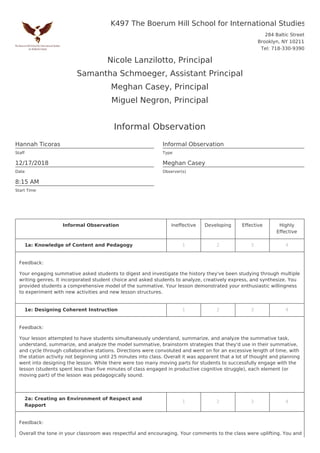
Hannah Ticoras
Staff
Informal Observation
Type
12/17/2018
Date
Meghan Casey
Observer(s)
8:15 AM
Start Time
Nicole Lanzilotto, Principal
Samantha Schmoeger, Assistant Principal
Meghan Casey, Principal
Miguel Negron, Principal
Informal Observation
Informal Observation Ineffective Developing Effective Highly
Effective
1a: Knowledge of Content and Pedagogy 1 2 3 4
Feedback:
Your engaging summative asked students to digest and investigate the history they've been studying through multiple
writing genres. It incorporated student choice and asked students to analyze, creatively express, and synthesize. You
provided students a comprehensive model of the summative. Your lesson demonstrated your enthusiastic willingness
to experiment with new activities and new lesson structures.
1e: Designing Coherent Instruction 1 2 3 4
Feedback:
Your lesson attempted to have students simultaneously understand, summarize, and analyze the summative task,
understand, summarize, and analyze the model summative, brainstorm strategies that they'd use in their summative,
and cycle through collaborative stations. Directions were convoluted and went on for an excessive length of time, with
the station activity not beginning until 25 minutes into class. Overall it was apparent that a lot of thought and planning
went into designing the lesson. While there were too many moving parts for students to successfully engage with the
lesson (students spent less than five minutes of class engaged in productive cognitive struggle), each element (or
moving part) of the lesson was pedagogically sound.
2a: Creating an Environment of Respect and
Rapport
1 2 3 4
Feedback:
Overall the tone in your classroom was respectful and encouraging. Your comments to the class were uplifting. You and
your co-teacher were both very responsive to student feelings and needs. You honored students' feelings while
K497 The Boerum Hill School for International Studies
284 Baltic Street
Brooklyn, NY 10211
Tel: 718-330-9390
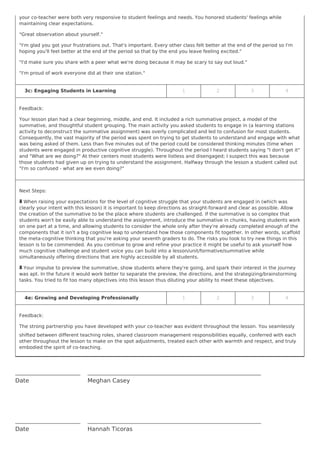
Date
Date
your co-teacher were both very responsive to student feelings and needs. You honored students' feelings while
maintaining clear expectations.
"Great observation about yourself."
"I'm glad you got your frustrations out. That's important. Every other class felt better at the end of the period so I'm
hoping you'll feel better at the end of the period so that by the end you leave feeling excited."
"I'd make sure you share with a peer what we're doing because it may be scary to say out loud."
"I'm proud of work everyone did at their one station."
3c: Engaging Students in Learning 1 2 3 4
Feedback:
Your lesson plan had a clear beginning, middle, and end. It included a rich summative project, a model of the
summative, and thoughtful student grouping. The main activity you asked students to engage in (a learning stations
activity to deconstruct the summative assignment) was overly complicated and led to confusion for most students.
Consequently, the vast majority of the period was spent on trying to get students to understand and engage with what
was being asked of them. Less than five minutes out of the period could be considered thinking minutes (time when
students were engaged in productive cognitive struggle). Throughout the period I heard students saying "I don't get it"
and "What are we doing?" At their centers most students were listless and disengaged; I suspect this was because
those students had given up on trying to understand the assignment. Halfway through the lesson a student called out
"I'm so confused - what are we even doing?"
Next Steps:
 When raising your expectations for the level of cognitive struggle that your students are engaged in (which was
clearly your intent with this lesson) it is important to keep directions as straight-forward and clear as possible. Allow
the creation of the summative to be the place where students are challenged. If the summative is so complex that
students won't be easily able to understand the assignment, introduce the summative in chunks, having students work
on one part at a time, and allowing students to consider the whole only after they're already completed enough of the
components that it isn't a big cognitive leap to understand how those components fit together. In other words, scaffold
the meta-cognitive thinking that you're asking your seventh graders to do. The risks you took to try new things in this
lesson is to be commended. As you continue to grow and refine your practice it might be useful to ask yourself how
much cognitive challenge and student voice you can build into a lesson/unit/formative/summative while
simultaneously offering directions that are highly accessible by all students.
 Your impulse to preview the summative, show students where they're going, and spark their interest in the journey
was apt. In the future it would work better to separate the preview, the directions, and the strategizing/brainstorming
tasks. You tried to fit too many objectives into this lesson thus diluting your ability to meet these objectives.
4e: Growing and Developing Professionally 1 2 3 4
Feedback:
The strong partnership you have developed with your co-teacher was evident throughout the lesson. You seamlessly
shifted between different teaching roles, shared classroom management responsibilities equally, conferred with each
other throughout the lesson to make on the spot adjustments, treated each other with warmth and respect, and truly
embodied the spirit of co-teaching.
Meghan Casey
Hannah Ticoras
12:17:18 informal observation

12:17:18 informal observation

  • 1.
    Hannah Ticoras Staff Informal Observation Type 12/17/2018 Date MeghanCasey Observer(s) 8:15 AM Start Time Nicole Lanzilotto, Principal Samantha Schmoeger, Assistant Principal Meghan Casey, Principal Miguel Negron, Principal Informal Observation Informal Observation Ineffective Developing Effective Highly Effective 1a: Knowledge of Content and Pedagogy 1 2 3 4 Feedback: Your engaging summative asked students to digest and investigate the history they've been studying through multiple writing genres. It incorporated student choice and asked students to analyze, creatively express, and synthesize. You provided students a comprehensive model of the summative. Your lesson demonstrated your enthusiastic willingness to experiment with new activities and new lesson structures. 1e: Designing Coherent Instruction 1 2 3 4 Feedback: Your lesson attempted to have students simultaneously understand, summarize, and analyze the summative task, understand, summarize, and analyze the model summative, brainstorm strategies that they'd use in their summative, and cycle through collaborative stations. Directions were convoluted and went on for an excessive length of time, with the station activity not beginning until 25 minutes into class. Overall it was apparent that a lot of thought and planning went into designing the lesson. While there were too many moving parts for students to successfully engage with the lesson (students spent less than five minutes of class engaged in productive cognitive struggle), each element (or moving part) of the lesson was pedagogically sound. 2a: Creating an Environment of Respect and Rapport 1 2 3 4 Feedback: Overall the tone in your classroom was respectful and encouraging. Your comments to the class were uplifting. You and your co-teacher were both very responsive to student feelings and needs. You honored students' feelings while K497 The Boerum Hill School for International Studies 284 Baltic Street Brooklyn, NY 10211 Tel: 718-330-9390
  • 2.
    Date Date your co-teacher wereboth very responsive to student feelings and needs. You honored students' feelings while maintaining clear expectations. "Great observation about yourself." "I'm glad you got your frustrations out. That's important. Every other class felt better at the end of the period so I'm hoping you'll feel better at the end of the period so that by the end you leave feeling excited." "I'd make sure you share with a peer what we're doing because it may be scary to say out loud." "I'm proud of work everyone did at their one station." 3c: Engaging Students in Learning 1 2 3 4 Feedback: Your lesson plan had a clear beginning, middle, and end. It included a rich summative project, a model of the summative, and thoughtful student grouping. The main activity you asked students to engage in (a learning stations activity to deconstruct the summative assignment) was overly complicated and led to confusion for most students. Consequently, the vast majority of the period was spent on trying to get students to understand and engage with what was being asked of them. Less than five minutes out of the period could be considered thinking minutes (time when students were engaged in productive cognitive struggle). Throughout the period I heard students saying "I don't get it" and "What are we doing?" At their centers most students were listless and disengaged; I suspect this was because those students had given up on trying to understand the assignment. Halfway through the lesson a student called out "I'm so confused - what are we even doing?" Next Steps:  When raising your expectations for the level of cognitive struggle that your students are engaged in (which was clearly your intent with this lesson) it is important to keep directions as straight-forward and clear as possible. Allow the creation of the summative to be the place where students are challenged. If the summative is so complex that students won't be easily able to understand the assignment, introduce the summative in chunks, having students work on one part at a time, and allowing students to consider the whole only after they're already completed enough of the components that it isn't a big cognitive leap to understand how those components fit together. In other words, scaffold the meta-cognitive thinking that you're asking your seventh graders to do. The risks you took to try new things in this lesson is to be commended. As you continue to grow and refine your practice it might be useful to ask yourself how much cognitive challenge and student voice you can build into a lesson/unit/formative/summative while simultaneously offering directions that are highly accessible by all students.  Your impulse to preview the summative, show students where they're going, and spark their interest in the journey was apt. In the future it would work better to separate the preview, the directions, and the strategizing/brainstorming tasks. You tried to fit too many objectives into this lesson thus diluting your ability to meet these objectives. 4e: Growing and Developing Professionally 1 2 3 4 Feedback: The strong partnership you have developed with your co-teacher was evident throughout the lesson. You seamlessly shifted between different teaching roles, shared classroom management responsibilities equally, conferred with each other throughout the lesson to make on the spot adjustments, treated each other with warmth and respect, and truly embodied the spirit of co-teaching. Meghan Casey Hannah Ticoras