



Attribution: University of Michigan Department of Dermatology, 2009

License: Unless otherwise noted, this material is made available under the terms of
the Creative Commons Attribution–Noncommercial–Share Alike 3.0 License:
http://creativecommons.org/licenses/by-nc-sa/3.0/

We have reviewed this material in accordance with U.S. Copyright Law and have tried to maximize your ability to use,
share, and adapt it. The citation key on the following slide provides information about how you may share and adapt this
material.

Copyright holders of content included in this material should contact open.michigan@umich.edu with any questions,
corrections, or clarification regarding the use of content.

For more information about how to cite these materials visit http://open.umich.edu/education/about/terms-of-use.

Any medical information in this material is intended to inform and educate and is not a tool for self-diagnosis or a
replacement for medical evaluation, advice, diagnosis or treatment by a healthcare professional. Please speak to your
physician if you have questions about your medical condition.

Viewer discretion is advised: Some medical content is graphic and may not be suitable for all viewers.
Citation Key
                          for more information see: http://open.umich.edu/wiki/CitationPolicy


Use + Share + Adapt
  { Content the copyright holder, author, or law permits you to use, share and adapt. }
               Public Domain – Government: Works that are produced by the U.S. Government. (17 USC § 105)
               Public Domain – Expired: Works that are no longer protected due to an expired copyright term.
               Public Domain – Self Dedicated: Works that a copyright holder has dedicated to the public domain.

               Creative Commons – Zero Waiver

               Creative Commons – Attribution License
               Creative Commons – Attribution Share Alike License
               Creative Commons – Attribution Noncommercial License
               Creative Commons – Attribution Noncommercial Share Alike License
               GNU – Free Documentation License

Make Your Own Assessment
  { Content Open.Michigan believes can be used, shared, and adapted because it is ineligible for copyright. }
               Public Domain – Ineligible: Works that are ineligible for copyright protection in the U.S. (17 USC § 102(b)) *laws in
               your jurisdiction may differ
   { Content Open.Michigan has used under a Fair Use determination. }
               Fair Use: Use of works that is determined to be Fair consistent with the U.S. Copyright Act. (17 USC § 107) *laws in
               your jurisdiction may differ
               Our determination DOES NOT mean that all uses of this 3rd-party content are Fair Uses and we DO NOT guarantee
               that your use of the content is Fair.
               To use this content you should do your own independent analysis to determine whether or not your use will be Fair.
Human Appearance
              Dermatology
            M2 – Dermatology Sequence


Fall 2008
 The area of dermatology that deals with
  appearance related issues (aka cosmetic
  dermatology )

 Drugs and procedures are used to
  improve the skin s appearance by making
  clinically detectable changes in skin
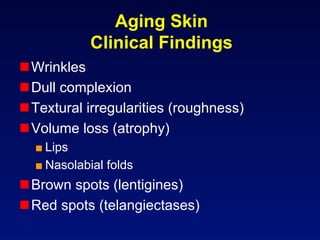
Aging Skin
            Clinical Findings
 Wrinkles
 Dull complexion
 Textural irregularities (roughness)
 Volume loss (atrophy)
  ■ Lips
  ■ Nasolabial folds
 Brown spots (lentigines)
 Red spots (telangiectases)
PROBLEM:

FOREHEAD WRINKLES

  I LOOK LIKE I M
    FROWNING
Dynamic wrinkles
 Due to repeated muscle contraction
 Most common sites
  ■ Glabella
  ■ Brow
  ■ Crow’s feet
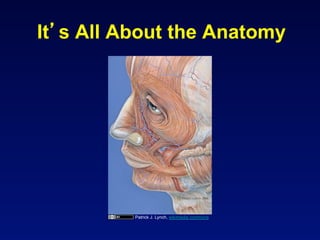
It s All About the Anatomy


          Patrick J. Lynch, wikimedia commons
Botulinum A exotoxin
                (Botox)
  Most popular cosmetic procedure in the U.S.
  Purified protein from Clostridium botulinum
  Reduces hyperkinetic lines associated with muscles of
   facial expression
  Typically used in the top 1/3 of the face
   ■  Glabella
   ■  Crow’s feet
   ■  Forehead
  Weakens overactive underlying muscle contraction
   causing flattening of facial skin and improved cosmesis
  3-4 months effect
Botox
       Mechanism of Action
 Heavy chain binds the toxin to the presynaptic
  cholinergic nerve terminal

 Light chain cleaves SNAP25 which prevents
  vesicles from fusing with the membrane and
  prevents acetylcholine release into the
  neuromuscular junction

 Collateral sprouting of new nerve terminals over
  time leads to restoration of function
Side Effects of Botox
  General
   ■    Ecchymosis
   ■    Pain
   ■    Headache
   ■    Eyelid ptosis
  Forehead
   ■  Brow ptosis
  Crow s feet
   ■    Diplopia
   ■    Ectropion
   ■    Drooping lateral lower eyelid
   ■    Asymmetric smile
Contraindications to Botulinum
             Toxin
 Myasthenia gravis
 Neuromuscular diseases
 Pregnancy category C
PROBLEM:

LINES AROUND THE
     MOUTH

   THIN LIPS
Soft Tissue Fillers
 2nd most popular cosmetic procedure in U.S.
 Restore facial fullness and volume
 Particularly useful in the lower face
  ■  Nasolabial folds
  ■  Lip augmentation
  ■  “Marionnette lines”
 Volume expansion of wrinkles
 Filler types
  ■  Intradermal fillers
  ■  Deep dermal/subcutaneous fillers
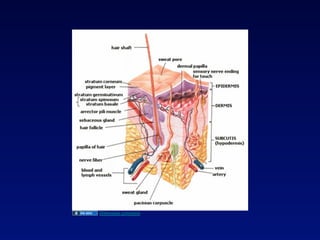
Wikimedia commons
Agents
 Temporary
  ■  Bovine collagen (Zyderm, Zyplast)
  ■  Porcine collagen (Evolence)
  ■  Human collagen (Cosmoderm, Cosmoplast)
  ■  Hyaluronic acid (Restylane, Perlane, Juvederm)
 Semi-permanent
  ■  Polymethlmethacrylate--PMMA (Artecoll)
  ■  Calcium hydroxylapatite (Radiesse)
 Permanent
  ■  Silicone
Hyaluronic Acid (HA) Fillers
 HA is a major component of the dermis
 Derived from bacteria or rooster combs
 NASHA=non animal stabilized HA
 Intradermal injection
 Does not require skin testing
 Duration of 4-5 months
 Cross-linked
  ■  Stabilizes HA as it degrades in the dermis
 NASHA shown to stimulate new collagen
  production in photodamaged human skin
Soft tissue filler
            Side effects
 Bruising
 Swelling
  Lumpiness
 Risk of necrosis or embolism when used in
  the glabellar or periorbital sites
PROBLEM:

SPIDER VEINS ON LEGS
Varicose veins
 Superficial and deep venous systems
 Seen in 40% of females
 Risk factors
  ■ Genetic predisposition
  ■ Pregnancy
  ■ Prolonged standing
  ■ Caucasians
Sclerotherapy
 Sclerosant is injected into varicose veins
 Does NOT work for large varicose veins
 Small vessel varicose veins of the legs
  ■  Telangiectatases
       Red
       <1mm diameter
  ■  Venules
       Blue
       <2mm
  ■  Reticular veins
       Blue
       2-4mm
Sclerosants
 Detergents
  ■ Disrupt vein cellular membrane
       Sodium tetradecyl sulfate (Sotradecol)
       Polidocanol
 Osmotic agents
  ■ Damage cell wall by shifting water balance
       Hypertonic sodium chloride (23.4%)
 Chemical irritants
  ■ Damage cell wall
Sclerotherapy
             Side Effects
 Pain and burning
 Bruising
 Edema (compression relieves this)
 Telangiectatic matting
 Hyperpigmentation
 Extravasation of sclerosant can lead to
  ulceration and necrosis
PROBLEM:

ACNE SCARRING

UNEVEN PIGMENT
Chemical Peels
 Agents
  ■  Alpha hydroxy acids (AHA)
  ■  Tricholoracetic acid (TCA)
  ■  Salicylic acid (SA)
  ■  Jessner’s solution (TCA+resorcinol+ SA+lactic acid)
  ■  Phenol based
 Indications
  ■  Acne/acne scarring
  ■  Photoaging
  ■  Dyspigmentation
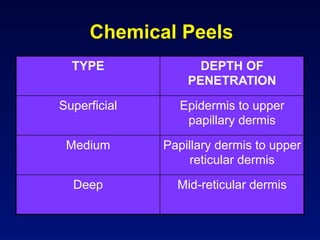
Chemical Peels
  TYPE              DEPTH OF
                  PENETRATION

Superficial      Epidermis to upper
                  papillary dermis

 Medium       Papillary dermis to upper
                   reticular dermis

  Deep          Mid-reticular dermis
Choosing a Chemical Peel
 SUPERFICIAL
 ■ Improved appearance
 ■ Acne
 MEDIUM DEPTH
 ■ Superficial wrinkles/pigmentary changes
 DEEP
 ■ Deep wrinkles
Chemical Peels
            Side Effects
 Persistent erythema
 Blisters
 Infection
 Dyspigmentation
 Herpes labialis
 Milia
 Scarring
 Cardiotoxicity (phenol peels only)
PROBLEM:

DULL COMPLEXION
Microdermabrasion
 For textural irregularities, aging skin
 Performed as a series of treatments
 Power source delivers aluminum oxide
  crystals to the skin surface
 Gentle abrasion of the epidermis
 Suction/vacuum returns the crystals to the
  machine with sloughed epidermal cells
Microdermabrasion
      Patient Expectations
 Practically no downtime
 Need for repeat treatment q2-4 weeks
 Some residual erythema
 Number of passes and
   aggressiveness of treatment will
  determine depth of abrasion
Medical Therapy of Aging Skin
 Topical retinoids
 Bleaching agents
 Sun protection
  ■ Avoidance
  ■ Sunscreens
 Cosmeceuticals
  ■ Peptides
  ■ Antioxidants
Patient selection
 Skin phototype
 Prior cosmetic procedures
 Medical history (cardiac, etc. ability to
  tolerate local anesthesia)
  ■ Cardiac
  ■ Medical devices
  ■ Autoimmune
  ■ Oral herpes simplex
 EXPECTATIONS
Additional Source Information
                       for more information see: http://open.umich.edu/wiki/CitationPolicy

Slide 8: Patrick J. Lynch, Wikimedia Commons, http://commons.wikimedia.org/wiki/File:Facial_muscles.jpg, CC:BY 2.5,
      http://creativecommons.org/licenses/by/2.5/deed.en
Slide 15: Wikimedia Commons, http://commons.wikimedia.org/wiki/File:Skin.jpg

12.17.08: Human Appearance Dermatology

  • 1.
    Attribution: University ofMichigan Department of Dermatology, 2009 License: Unless otherwise noted, this material is made available under the terms of the Creative Commons Attribution–Noncommercial–Share Alike 3.0 License: http://creativecommons.org/licenses/by-nc-sa/3.0/ We have reviewed this material in accordance with U.S. Copyright Law and have tried to maximize your ability to use, share, and adapt it. The citation key on the following slide provides information about how you may share and adapt this material. Copyright holders of content included in this material should contact open.michigan@umich.edu with any questions, corrections, or clarification regarding the use of content. For more information about how to cite these materials visit http://open.umich.edu/education/about/terms-of-use. Any medical information in this material is intended to inform and educate and is not a tool for self-diagnosis or a replacement for medical evaluation, advice, diagnosis or treatment by a healthcare professional. Please speak to your physician if you have questions about your medical condition. Viewer discretion is advised: Some medical content is graphic and may not be suitable for all viewers.
  • 2.
    Citation Key for more information see: http://open.umich.edu/wiki/CitationPolicy Use + Share + Adapt { Content the copyright holder, author, or law permits you to use, share and adapt. } Public Domain – Government: Works that are produced by the U.S. Government. (17 USC § 105) Public Domain – Expired: Works that are no longer protected due to an expired copyright term. Public Domain – Self Dedicated: Works that a copyright holder has dedicated to the public domain. Creative Commons – Zero Waiver Creative Commons – Attribution License Creative Commons – Attribution Share Alike License Creative Commons – Attribution Noncommercial License Creative Commons – Attribution Noncommercial Share Alike License GNU – Free Documentation License Make Your Own Assessment { Content Open.Michigan believes can be used, shared, and adapted because it is ineligible for copyright. } Public Domain – Ineligible: Works that are ineligible for copyright protection in the U.S. (17 USC § 102(b)) *laws in your jurisdiction may differ { Content Open.Michigan has used under a Fair Use determination. } Fair Use: Use of works that is determined to be Fair consistent with the U.S. Copyright Act. (17 USC § 107) *laws in your jurisdiction may differ Our determination DOES NOT mean that all uses of this 3rd-party content are Fair Uses and we DO NOT guarantee that your use of the content is Fair. To use this content you should do your own independent analysis to determine whether or not your use will be Fair.
  • 3.
    Human Appearance Dermatology M2 – Dermatology Sequence Fall 2008
  • 4.
     The area ofdermatology that deals with appearance related issues (aka cosmetic dermatology )  Drugs and procedures are used to improve the skin s appearance by making clinically detectable changes in skin
  • 5.
    Aging Skin Clinical Findings  Wrinkles  Dull complexion  Textural irregularities (roughness)  Volume loss (atrophy) ■ Lips ■ Nasolabial folds  Brown spots (lentigines)  Red spots (telangiectases)
  • 6.
    PROBLEM: FOREHEAD WRINKLES I LOOK LIKE I M FROWNING
  • 7.
    Dynamic wrinkles  Due torepeated muscle contraction  Most common sites ■ Glabella ■ Brow ■ Crow’s feet
  • 8.
    It s AllAbout the Anatomy Patrick J. Lynch, wikimedia commons
  • 9.
    Botulinum A exotoxin (Botox)   Most popular cosmetic procedure in the U.S.   Purified protein from Clostridium botulinum   Reduces hyperkinetic lines associated with muscles of facial expression   Typically used in the top 1/3 of the face ■  Glabella ■  Crow’s feet ■  Forehead   Weakens overactive underlying muscle contraction causing flattening of facial skin and improved cosmesis   3-4 months effect
  • 10.
    Botox Mechanism of Action  Heavy chain binds the toxin to the presynaptic cholinergic nerve terminal  Light chain cleaves SNAP25 which prevents vesicles from fusing with the membrane and prevents acetylcholine release into the neuromuscular junction  Collateral sprouting of new nerve terminals over time leads to restoration of function
  • 11.
    Side Effects ofBotox   General ■  Ecchymosis ■  Pain ■  Headache ■  Eyelid ptosis   Forehead ■  Brow ptosis   Crow s feet ■  Diplopia ■  Ectropion ■  Drooping lateral lower eyelid ■  Asymmetric smile
  • 12.
    Contraindications to Botulinum Toxin  Myasthenia gravis  Neuromuscular diseases  Pregnancy category C
  • 13.
  • 14.
    Soft Tissue Fillers  2ndmost popular cosmetic procedure in U.S.  Restore facial fullness and volume  Particularly useful in the lower face ■  Nasolabial folds ■  Lip augmentation ■  “Marionnette lines”  Volume expansion of wrinkles  Filler types ■  Intradermal fillers ■  Deep dermal/subcutaneous fillers
  • 15.
  • 16.
    Agents  Temporary ■ Bovine collagen (Zyderm, Zyplast) ■  Porcine collagen (Evolence) ■  Human collagen (Cosmoderm, Cosmoplast) ■  Hyaluronic acid (Restylane, Perlane, Juvederm)  Semi-permanent ■  Polymethlmethacrylate--PMMA (Artecoll) ■  Calcium hydroxylapatite (Radiesse)  Permanent ■  Silicone
  • 17.
    Hyaluronic Acid (HA)Fillers  HA is a major component of the dermis  Derived from bacteria or rooster combs  NASHA=non animal stabilized HA  Intradermal injection  Does not require skin testing  Duration of 4-5 months  Cross-linked ■  Stabilizes HA as it degrades in the dermis  NASHA shown to stimulate new collagen production in photodamaged human skin
  • 18.
    Soft tissue filler Side effects  Bruising  Swelling   Lumpiness  Risk of necrosis or embolism when used in the glabellar or periorbital sites
  • 19.
  • 20.
    Varicose veins  Superficial anddeep venous systems  Seen in 40% of females  Risk factors ■ Genetic predisposition ■ Pregnancy ■ Prolonged standing ■ Caucasians
  • 21.
    Sclerotherapy  Sclerosant is injectedinto varicose veins  Does NOT work for large varicose veins  Small vessel varicose veins of the legs ■  Telangiectatases   Red   <1mm diameter ■  Venules   Blue   <2mm ■  Reticular veins   Blue   2-4mm
  • 22.
    Sclerosants  Detergents ■ Disruptvein cellular membrane   Sodium tetradecyl sulfate (Sotradecol)   Polidocanol  Osmotic agents ■ Damage cell wall by shifting water balance   Hypertonic sodium chloride (23.4%)  Chemical irritants ■ Damage cell wall
  • 23.
    Sclerotherapy Side Effects  Pain and burning  Bruising  Edema (compression relieves this)  Telangiectatic matting  Hyperpigmentation  Extravasation of sclerosant can lead to ulceration and necrosis
  • 24.
  • 25.
    Chemical Peels  Agents ■  Alpha hydroxy acids (AHA) ■  Tricholoracetic acid (TCA) ■  Salicylic acid (SA) ■  Jessner’s solution (TCA+resorcinol+ SA+lactic acid) ■  Phenol based  Indications ■  Acne/acne scarring ■  Photoaging ■  Dyspigmentation
  • 26.
    Chemical Peels TYPE DEPTH OF PENETRATION Superficial Epidermis to upper papillary dermis Medium Papillary dermis to upper reticular dermis Deep Mid-reticular dermis
  • 27.
    Choosing a ChemicalPeel  SUPERFICIAL ■ Improved appearance ■ Acne  MEDIUM DEPTH ■ Superficial wrinkles/pigmentary changes  DEEP ■ Deep wrinkles
  • 28.
    Chemical Peels Side Effects  Persistent erythema  Blisters  Infection  Dyspigmentation  Herpes labialis  Milia  Scarring  Cardiotoxicity (phenol peels only)
  • 29.
  • 30.
    Microdermabrasion  For textural irregularities,aging skin  Performed as a series of treatments  Power source delivers aluminum oxide crystals to the skin surface  Gentle abrasion of the epidermis  Suction/vacuum returns the crystals to the machine with sloughed epidermal cells
  • 31.
    Microdermabrasion Patient Expectations  Practically no downtime  Need for repeat treatment q2-4 weeks  Some residual erythema  Number of passes and aggressiveness of treatment will determine depth of abrasion
  • 32.
    Medical Therapy ofAging Skin  Topical retinoids  Bleaching agents  Sun protection ■ Avoidance ■ Sunscreens  Cosmeceuticals ■ Peptides ■ Antioxidants
  • 33.
    Patient selection  Skin phototype  Priorcosmetic procedures  Medical history (cardiac, etc. ability to tolerate local anesthesia) ■ Cardiac ■ Medical devices ■ Autoimmune ■ Oral herpes simplex  EXPECTATIONS
  • 34.
    Additional Source Information for more information see: http://open.umich.edu/wiki/CitationPolicy Slide 8: Patrick J. Lynch, Wikimedia Commons, http://commons.wikimedia.org/wiki/File:Facial_muscles.jpg, CC:BY 2.5, http://creativecommons.org/licenses/by/2.5/deed.en Slide 15: Wikimedia Commons, http://commons.wikimedia.org/wiki/File:Skin.jpg