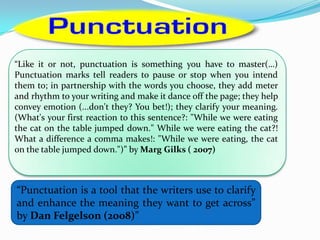
“Punctuation is a tool that the writers use to clarify
and enhance the meaning they want to get across”
by Dan Felgelson (2008)”
“Like it or not, punctuation is something you have to master(…)
Punctuation marks tell readers to pause or stop when you intend
them to; in partnership with the words you choose, they add meter
and rhythm to your writing and make it dance off the page; they help
convey emotion (...don't they? You bet!); they clarify your meaning.
(What's your first reaction to this sentence?: "While we were eating
the cat on the table jumped down." While we were eating the cat?!
What a difference a comma makes!: "While we were eating, the cat
on the table jumped down.")” by Marg Gilks ( 2007)
Punctuation
Is commonly accepted set of
symbols used in writing to
convey specific directions to
the reader
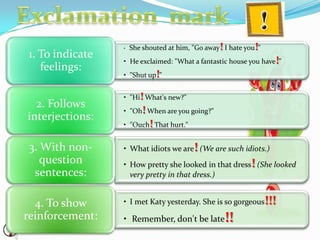
• She shouted at him, "Go away! I hate you!"
• He exclaimed: "What a fantastic house you have!"
• "Shut up!"
1. To indicate
feelings:
• "Hi! What's new?"
• "Oh! When are you going?"
• "Ouch! That hurt."
2. Follows
interjections:
• What idiots we are! (We are such idiots.)
• How pretty she looked in that dress! (She looked
very pretty in that dress.)
3. With non-
question
sentences:
• I met Katy yesterday. She is so gorgeous!!!
• Remember, don't be late!!
4. To show
reinforcement:
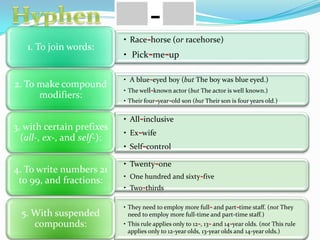
• Race-horse (or racehorse)
• Pick-me-up
1. To join words:
• A blue-eyed boy (but The boy was blue eyed.)
• The well-known actor (but The actor is well known.)
• Their four-year-old son (but Their son is four years old.)
2. To make compound
modifiers:
• All-inclusive
• Ex-wife
• Self-control
3. with certain prefixes
(all-, ex-, and self-):
• Twenty-one
• One hundred and sixty-five
• Two-thirds
4. To write numbers 21
to 99, and fractions:
• They need to employ more full- and part-time staff. (not They
need to employ more full-time and part-time staff.)
• This rule applies only to 12-, 13- and 14-year olds. (not This rule
applies only to 12-year olds, 13-year olds and 14-year olds.)
5. With suspended
compounds:
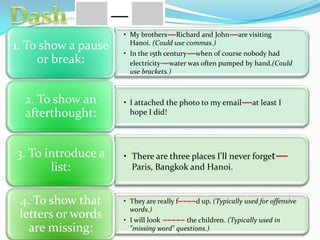
• My brothers—Richard and John—are visiting
Hanoi. (Could use commas.)
• In the 15th century—when of course nobody had
electricity—water was often pumped by hand.(Could
use brackets.)
1. To show a pause
or break:
• I attached the photo to my email—at least I
hope I did!
2. To show an
afterthought:
• There are three places I'll never forget—
Paris, Bangkok and Hanoi.
3. To introduce a
list:
• They are really f––––d up. (Typically used for offensive
words.)
• I will look ––––– the children. (Typically used in
"missing word" questions.)
4. To show that
letters or words
are missing:
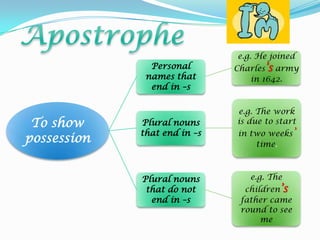
To show
possession
Personal
names that
end in –s
e.g. He joined
Charles’s army
in 1642.
Plural nouns
that end in –s
e.g. The work
is due to start
in two weeks’
time.
Plural nouns
that do not
end in –s
e.g. The
children’s
father came
round to see
me
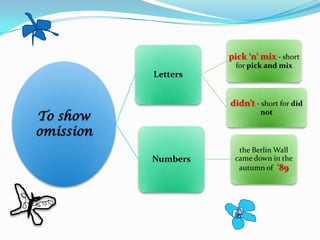
To show
omission
Letters
pick ‘n’ mix - short
for pick and mix
didn’t - short for did
not
Numbers
the Berlin Wall
came down in the
autumn of ’89
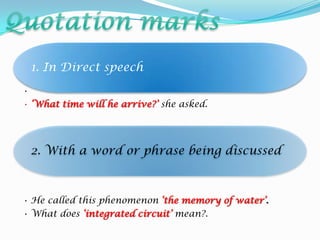
1. In Direct speech
•
• ‘What time will he arrive?’ she asked.
2. With a word or phrase being discussed
• He called this phenomenon ‘the memory of water’.
• What does ‘integrated circuit’ mean?.
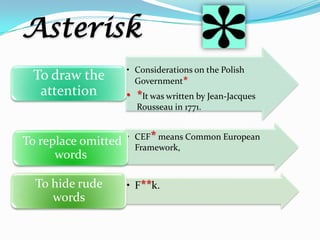
Asterisk
• Considerations on the Polish
Government*
• *It was written by Jean-Jacques
Rousseau in 1771.
To draw the
attention
• CEF* means Common European
Framework,
To replace omitted
words
• F**k.To hide rude
words
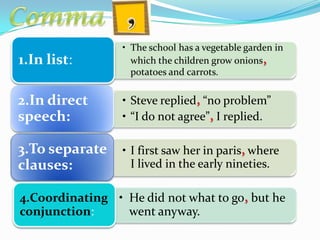
• The school has a vegetable garden in
which the children grow onions,
potatoes and carrots.
1.In list:
• Steve replied, “no problem”
• “I do not agree”, I replied.
2.In direct
speech:
• I first saw her in paris, where
I lived in the early nineties.
3.To separate
clauses:
• He did not what to go, but he
went anyway.
4.Coordinating
conjunction:
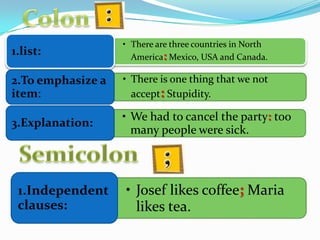
• There are three countries in North
America: Mexico, USA and Canada.
1.list:
• There is one thing that we not
accept: Stupidity.
2.To emphasize a
item:
• We had to cancel the party: too
many people were sick.
3.Explanation:
• Josef likes coffee; Maria
likes tea.
1.Independent
clauses:
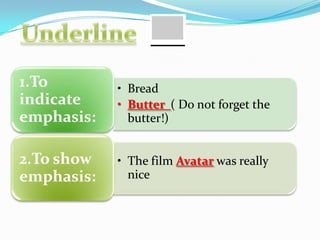
• Bread
• Butter ( Do not forget the
butter!)
1.To
indicate
emphasis:
• The film Avatar was really
nice
2.To show
emphasis:
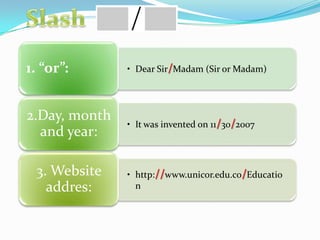
• Dear Sir/Madam (Sir or Madam)1. “or”:
• It was invented on 11/30/2007
2.Day, month
and year:
• http://www.unicor.edu.co/Educatio
n
3. Website
addres:
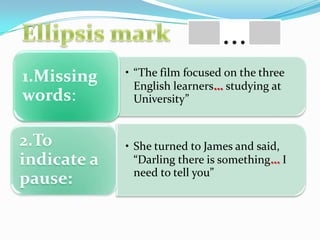
• “The film focused on the three
English learners… studying at
University”
1.Missing
words:
• She turned to James and said,
“Darling there is something… I
need to tell you”
2.To
indicate a
pause:
Thank you

12. punctuation

  • 2.
    “Punctuation is atool that the writers use to clarify and enhance the meaning they want to get across” by Dan Felgelson (2008)” “Like it or not, punctuation is something you have to master(…) Punctuation marks tell readers to pause or stop when you intend them to; in partnership with the words you choose, they add meter and rhythm to your writing and make it dance off the page; they help convey emotion (...don't they? You bet!); they clarify your meaning. (What's your first reaction to this sentence?: "While we were eating the cat on the table jumped down." While we were eating the cat?! What a difference a comma makes!: "While we were eating, the cat on the table jumped down.")” by Marg Gilks ( 2007)
  • 3.
    Punctuation Is commonly acceptedset of symbols used in writing to convey specific directions to the reader
  • 4.
    • She shoutedat him, "Go away! I hate you!" • He exclaimed: "What a fantastic house you have!" • "Shut up!" 1. To indicate feelings: • "Hi! What's new?" • "Oh! When are you going?" • "Ouch! That hurt." 2. Follows interjections: • What idiots we are! (We are such idiots.) • How pretty she looked in that dress! (She looked very pretty in that dress.) 3. With non- question sentences: • I met Katy yesterday. She is so gorgeous!!! • Remember, don't be late!! 4. To show reinforcement:
  • 5.
    • Race-horse (orracehorse) • Pick-me-up 1. To join words: • A blue-eyed boy (but The boy was blue eyed.) • The well-known actor (but The actor is well known.) • Their four-year-old son (but Their son is four years old.) 2. To make compound modifiers: • All-inclusive • Ex-wife • Self-control 3. with certain prefixes (all-, ex-, and self-): • Twenty-one • One hundred and sixty-five • Two-thirds 4. To write numbers 21 to 99, and fractions: • They need to employ more full- and part-time staff. (not They need to employ more full-time and part-time staff.) • This rule applies only to 12-, 13- and 14-year olds. (not This rule applies only to 12-year olds, 13-year olds and 14-year olds.) 5. With suspended compounds:
  • 6.
    • My brothers—Richardand John—are visiting Hanoi. (Could use commas.) • In the 15th century—when of course nobody had electricity—water was often pumped by hand.(Could use brackets.) 1. To show a pause or break: • I attached the photo to my email—at least I hope I did! 2. To show an afterthought: • There are three places I'll never forget— Paris, Bangkok and Hanoi. 3. To introduce a list: • They are really f––––d up. (Typically used for offensive words.) • I will look ––––– the children. (Typically used in "missing word" questions.) 4. To show that letters or words are missing:
  • 7.
    To show possession Personal names that endin –s e.g. He joined Charles’s army in 1642. Plural nouns that end in –s e.g. The work is due to start in two weeks’ time. Plural nouns that do not end in –s e.g. The children’s father came round to see me
  • 8.
    To show omission Letters pick ‘n’mix - short for pick and mix didn’t - short for did not Numbers the Berlin Wall came down in the autumn of ’89
  • 9.
    1. In Directspeech • • ‘What time will he arrive?’ she asked. 2. With a word or phrase being discussed • He called this phenomenon ‘the memory of water’. • What does ‘integrated circuit’ mean?.
  • 10.
    Asterisk • Considerations onthe Polish Government* • *It was written by Jean-Jacques Rousseau in 1771. To draw the attention • CEF* means Common European Framework, To replace omitted words • F**k.To hide rude words
  • 11.
    • The schoolhas a vegetable garden in which the children grow onions, potatoes and carrots. 1.In list: • Steve replied, “no problem” • “I do not agree”, I replied. 2.In direct speech: • I first saw her in paris, where I lived in the early nineties. 3.To separate clauses: • He did not what to go, but he went anyway. 4.Coordinating conjunction:
  • 12.
    • There arethree countries in North America: Mexico, USA and Canada. 1.list: • There is one thing that we not accept: Stupidity. 2.To emphasize a item: • We had to cancel the party: too many people were sick. 3.Explanation: • Josef likes coffee; Maria likes tea. 1.Independent clauses:
  • 13.
    • Bread • Butter( Do not forget the butter!) 1.To indicate emphasis: • The film Avatar was really nice 2.To show emphasis:
  • 14.
    • Dear Sir/Madam(Sir or Madam)1. “or”: • It was invented on 11/30/2007 2.Day, month and year: • http://www.unicor.edu.co/Educatio n 3. Website addres:
  • 15.
    • “The filmfocused on the three English learners… studying at University” 1.Missing words: • She turned to James and said, “Darling there is something… I need to tell you” 2.To indicate a pause:
  • 16.