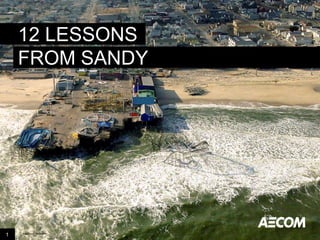
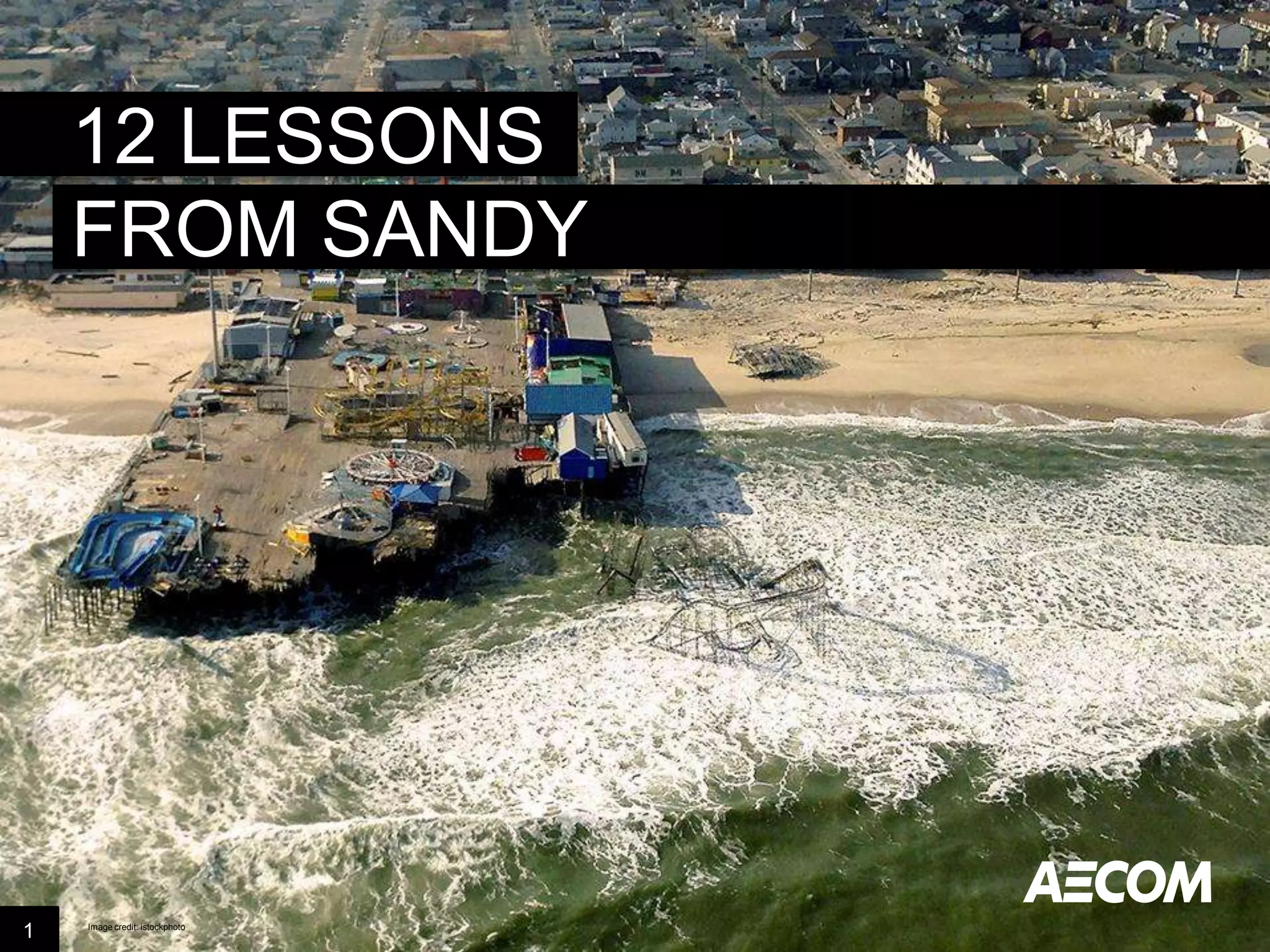
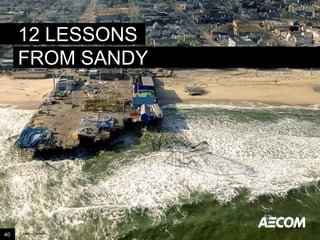
12 LESSONS
FROM SANDY

1

Image credit: istockphoto
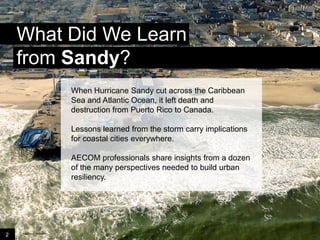
What Did We Learn
from Sandy?
When Hurricane Sandy cut across the
Caribbean Sea and Atlantic Ocean, it left death
and destruction from Puerto Rico to Canada.
Lessons learned from the storm carry
implications for coastal cities everywhere.
AECOM professionals share insights from a
dozen of the many perspectives needed to build
urban resiliency.

2

Image credit: istockphoto
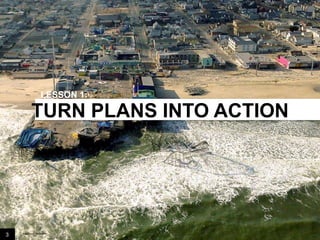
LESSON 1:

TURN PLANS INTO ACTION

3

Image credit: istockphoto
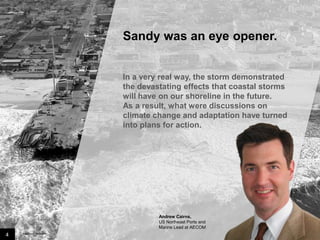
Sandy was an eye opener.

In a very real way, the storm demonstrated
the devastating effects that coastal storms
will have on our shoreline in the future.
As a result, what were discussions on
climate change and adaptation have turned
into plans for action.

Andrew Cairns,
US Northeast Ports and
Marine Lead at AECOM

4

Image credit: istockphoto
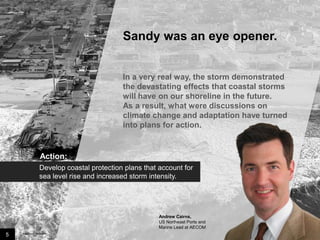
Sandy was an eye opener.

In a very real way, the storm demonstrated
the devastating effects that coastal storms
will have on our shoreline in the future.
As a result, what were discussions on
climate change and adaptation have turned
into plans for action.

Action:
Develop coastal protection plans that account for
sea level rise and increased storm intensity.

Andrew Cairns,
US Northeast Ports and
Marine Lead at AECOM

5

Image credit: istockphoto
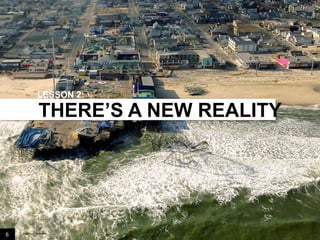
LESSON 2:

THERE’S A NEW REALITY

6

Image credit: istockphoto
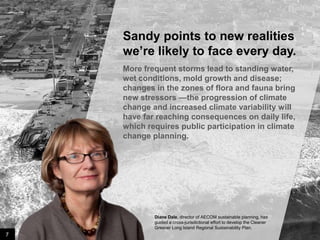
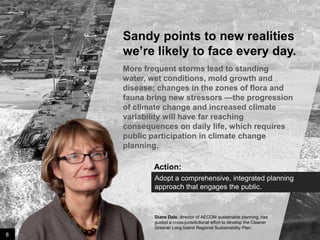
Sandy points to new realities
we’re likely to face every day.
More frequent storms lead to standing water,
wet conditions, mold growth and disease;
changes in the zones of flora and fauna bring
new stressors —the progression of climate
change and increased climate variability will
have far reaching consequences on daily life,
which requires public participation in climate
change planning.

Diane Dale, director of AECOM sustainable planning, has
guided a cross-jurisdictional effort to develop the Cleaner
Greener Long Island Regional Sustainability Plan.

7

Image credit: istockphoto
Sandy points to new realities
we’re likely to face every day.
More frequent storms lead to standing water,
wet conditions, mold growth and disease;
changes in the zones of flora and fauna bring
new stressors —the progression of climate
change and increased climate variability will
have far reaching consequences on daily life,
which requires public participation in climate
change planning.

Action:
Adopt a comprehensive, integrated planning
approach that engages the public.

Diane Dale, director of AECOM sustainable planning, has
guided a cross-jurisdictional effort to develop the Cleaner
Greener Long Island Regional Sustainability Plan.

8

Image credit: istockphoto
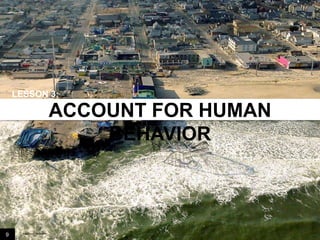
LESSON 3:

ACCOUNT FOR HUMAN BEHAVIOR

9

Image credit: istockphoto
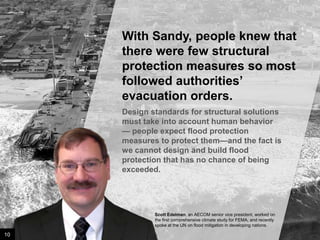
With Sandy, people knew that
there were few structural
protection measures so most
followed authorities’
evacuation orders.
Design standards for structural solutions
must take into account human behavior —
people expect flood protection measures
to protect them—and the fact is we cannot
design and build flood protection that has
no chance of being exceeded.

Scott Edelman, an AECOM senior vice president, worked on
the first comprehensive climate study for FEMA, and recently
spoke at the UN on flood mitigation in developing nations.

10

Image credit: istockphoto
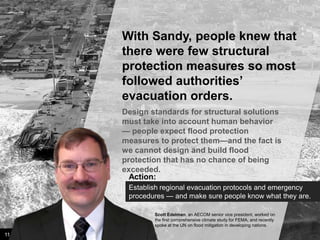
With Sandy, people knew that
there were few structural
protection measures so most
followed authorities’
evacuation orders.
Design standards for structural solutions
must take into account human behavior —
people expect flood protection measures
to protect them—and the fact is we cannot
design and build flood protection that has
no chance of being exceeded.
Action:
Establish regional evacuation protocols and emergency
procedures — and make sure people know what they are.
Scott Edelman, an AECOM senior vice president, worked on
the first comprehensive climate study for FEMA, and recently
spoke at the UN on flood mitigation in developing nations.

11

Image credit: istockphoto
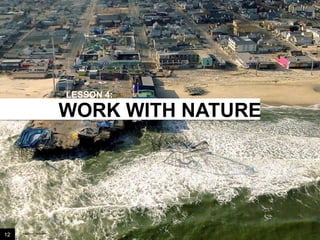
LESSON 4:

WORK WITH NATURE

12

Image credit: istockphoto
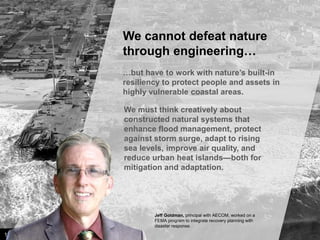
We cannot defeat nature
through engineering…
…but have to work with nature’s built-in
resiliency to protect people and assets in
highly vulnerable coastal areas.
We must think creatively about
constructed natural systems that
enhance flood management, protect
against storm surge, adapt to rising
sea levels, improve air quality, and
reduce urban heat islands—both for
mitigation and adaptation.

Jeff Goldman, principal with AECOM, worked on a
FEMA program to integrate recovery planning with
disaster response.

13

Image credit: istockphoto
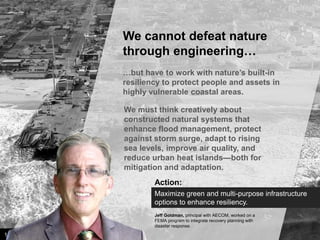
We cannot defeat nature
through engineering…
…but have to work with nature’s built-in
resiliency to protect people and assets in
highly vulnerable coastal areas.
We must think creatively about
constructed natural systems that
enhance flood management, protect
against storm surge, adapt to rising
sea levels, improve air quality, and
reduce urban heat islands—both for
mitigation and adaptation.
Action:
Maximize green and multi-purpose infrastructure
options to enhance resiliency.
Jeff Goldman, principal with AECOM, worked on a
FEMA program to integrate recovery planning with
disaster response.

14

Image credit: istockphoto
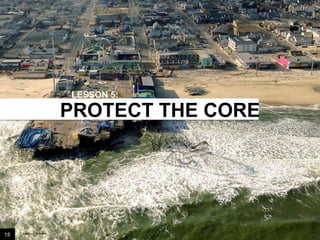
LESSON 5:

PROTECT THE CORE

15

Image credit: istockphoto
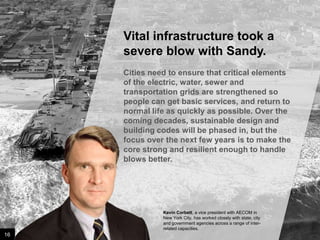
Vital infrastructure took a
severe blow with Sandy.
Cities need to ensure that critical elements
of the electric, water, sewer and
transportation grids are strengthened so
people can get basic services, and return to
normal life as quickly as possible. Over the
coming decades, sustainable design and
building codes will be phased in, but the
focus over the next few years is to make the
core strong and resilient enough to handle
blows better.

Kevin Corbett, a vice president with AECOM in
New York City, has worked closely with state, city
and government agencies across a range of interrelated capacities.

16

Image credit: istockphoto
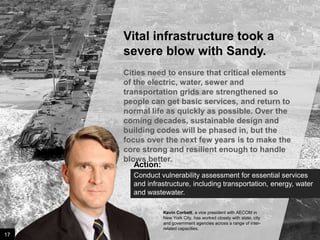
Vital infrastructure took a
severe blow with Sandy.
Cities need to ensure that critical elements
of the electric, water, sewer and
transportation grids are strengthened so
people can get basic services, and return to
normal life as quickly as possible. Over the
coming decades, sustainable design and
building codes will be phased in, but the
focus over the next few years is to make the
core strong and resilient enough to handle
blows better.
Action:
Conduct vulnerability assessment for essential services
and infrastructure, including transportation, energy, water
and wastewater.
Kevin Corbett, a vice president with AECOM in
New York City, has worked closely with state, city
and government agencies across a range of interrelated capacities.

17

Image credit: istockphoto
LESSON 6:

PREPARE TO RESPOND

18

Image credit: istockphoto
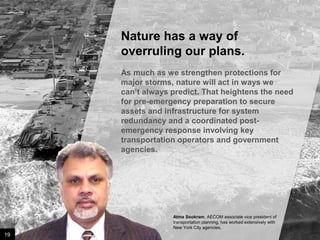
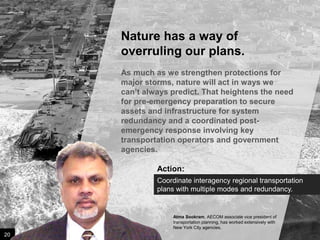
Nature has a way of
overruling our plans.
As much as we strengthen protections for
major storms, nature will act in ways we can’t
always predict. That heightens the need for
pre-emergency preparation to secure assets
and infrastructure for system redundancy and
a coordinated post-emergency response
involving key transportation operators and
government agencies.

Atma Sookram, AECOM associate vice president of
transportation planning, has worked extensively with
New York City agencies.

19

Image credit: istockphoto
Nature has a way of
overruling our plans.
As much as we strengthen protections for
major storms, nature will act in ways we can’t
always predict. That heightens the need for
pre-emergency preparation to secure assets
and infrastructure for system redundancy and
a coordinated post-emergency response
involving key transportation operators and
government agencies.

Action:
Coordinate interagency regional transportation
plans with multiple modes and redundancy.

Atma Sookram, AECOM associate vice president of
transportation planning, has worked extensively with
New York City agencies.

20

Image credit: istockphoto
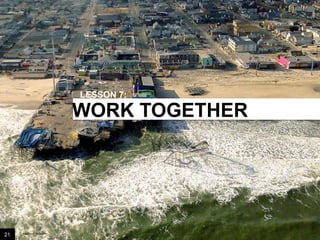
LESSON 7:

WORK TOGETHER

21

Image credit: istockphoto
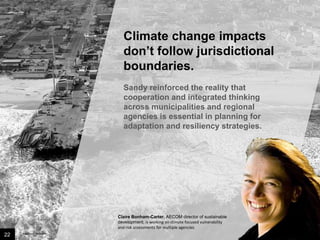
Climate change impacts
don’t follow jurisdictional
boundaries.
Sandy reinforced the reality that
cooperation and integrated thinking
across municipalities and regional
agencies is essential in planning for
adaptation and resiliency strategies.

Claire Bonham-Carter, AECOM director of sustainable
development, is working on climate focused vulnerability
and risk assessments for multiple agencies.

22

Image credit: istockphoto
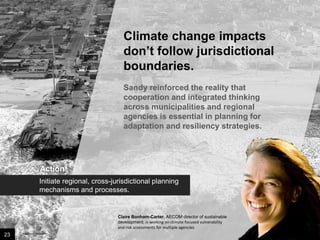
Climate change impacts
don’t follow jurisdictional
boundaries.
Sandy reinforced the reality that
cooperation and integrated thinking
across municipalities and regional
agencies is essential in planning for
adaptation and resiliency strategies.

Action:
Initiate regional, cross-jurisdictional planning
mechanisms and processes.

Claire Bonham-Carter, AECOM director of sustainable
development, is working on climate focused vulnerability
and risk assessments for multiple agencies.

23

Image credit: istockphoto
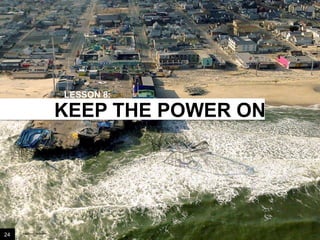
LESSON 8:

KEEP THE POWER ON

24

Image credit: istockphoto
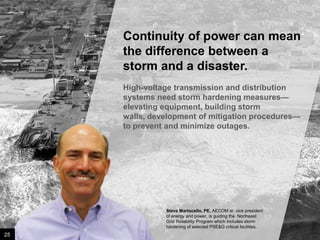
Continuity of power can mean
the difference between a
storm and a disaster.
High-voltage transmission and distribution
systems need storm hardening measures—
elevating equipment, building storm walls,
development of mitigation procedures—to
prevent and minimize outages.

Steve Martocello, PE, AECOM sr. vice president
of energy and power, is guiding the Northeast
Grid Reliability Program which includes storm
hardening of selected PSE&G critical facilities.

25

Image credit: istockphoto
Continuity of power can mean
the difference between a
storm and a disaster.
High-voltage transmission and distribution
systems need storm hardening measures—
elevating equipment, building storm walls,
development of mitigation procedures—to
prevent and minimize outages.

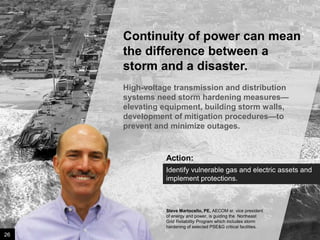
Action:
Identify vulnerable gas and electric assets and
implement protections.

Steve Martocello, PE, AECOM sr. vice president
of energy and power, is guiding the Northeast
Grid Reliability Program which includes storm
hardening of selected PSE&G critical facilities.

26

Image credit: istockphoto
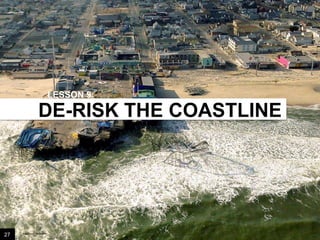
LESSON 9:

DE-RISK THE COASTLINE

27

Image credit: istockphoto
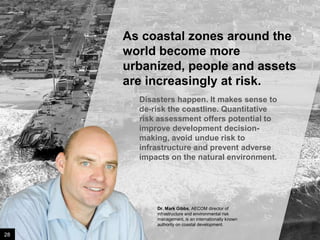
As coastal zones around the
world become more urbanized,
people and assets are
increasingly at risk.
Disasters happen. It makes sense to
de-risk the coastline. Quantitative
risk assessment offers potential to
improve development decisionmaking, avoid undue risk to
infrastructure and prevent adverse
impacts on the natural environment.

Dr. Mark Gibbs, AECOM director of
infrastructure and environmental risk
management, is an internationally known
authority on coastal development.

28

Image credit: istockphoto
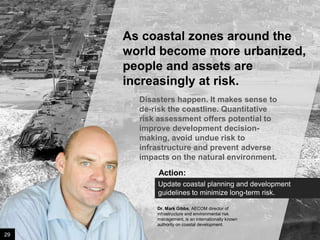
As coastal zones around the
world become more urbanized,
people and assets are
increasingly at risk.
Disasters happen. It makes sense to
de-risk the coastline. Quantitative
risk assessment offers potential to
improve development decisionmaking, avoid undue risk to
infrastructure and prevent adverse
impacts on the natural environment.
Action:
Update coastal planning and development
guidelines to minimize long-term risk.
Dr. Mark Gibbs, AECOM director of
infrastructure and environmental risk
management, is an internationally known
authority on coastal development.

29

Image credit: istockphoto
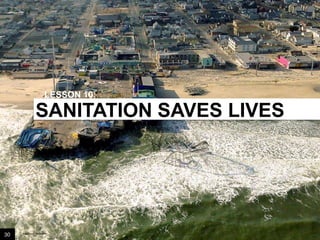
LESSON 10:

SANITATION SAVES LIVES

30

Image credit: istockphoto
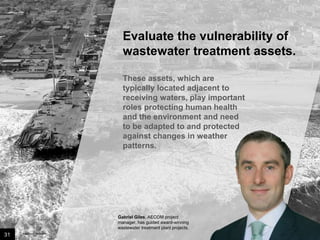
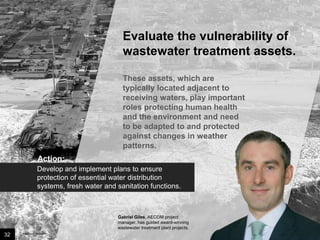
Evaluate the vulnerability of
wastewater treatment assets.
These assets, which are typically
located adjacent to receiving
waters, play important roles
protecting human health and the
environment and need to be
adapted to and protected against
changes in weather patterns.

Gabriel Giles, AECOM project manager,
has guided award-winning wastewater
treatment plant projects.

31

Image credit: istockphoto
Evaluate the vulnerability of
wastewater treatment assets.
These assets, which are typically
located adjacent to receiving
waters, play important roles
protecting human health and the
environment and need to be
adapted to and protected against
changes in weather patterns.
Action:
Develop and implement plans to ensure
protection of essential water distribution
systems, fresh water and sanitation functions.

Gabriel Giles, AECOM project manager,
has guided award-winning wastewater
treatment plant projects.

32

Image credit: istockphoto
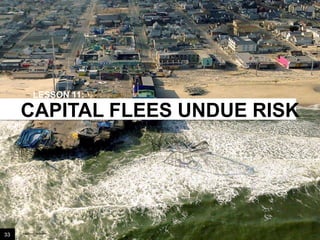
LESSON 11:

CAPITAL FLEES UNDUE RISK

33

Image credit: istockphoto
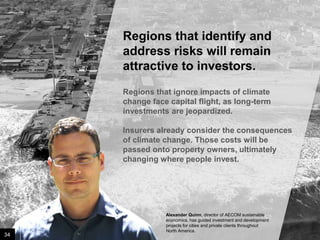
Regions that identify and
address risks will remain
attractive to investors.
Regions that ignore impacts of climate
change face capital flight, as long-term
investments are jeopardized.
Insurers already consider the consequences
of climate change. Those costs will be
passed onto property owners, ultimately
changing where people invest.

34

Image credit: istockphoto

Alexander Quinn, director of AECOM sustainable
economics, has guided investment and development
projects for cities and private clients throughout
North America.
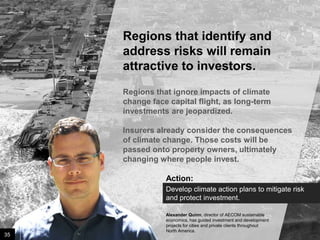
Regions that identify and
address risks will remain
attractive to investors.
Regions that ignore impacts of climate
change face capital flight, as long-term
investments are jeopardized.
Insurers already consider the consequences
of climate change. Those costs will be
passed onto property owners, ultimately
changing where people invest.
Action:
Develop climate action plans to mitigate risk
and protect investment.

35

Image credit: istockphoto

Alexander Quinn, director of AECOM sustainable
economics, has guided investment and development
projects for cities and private clients throughout
North America.
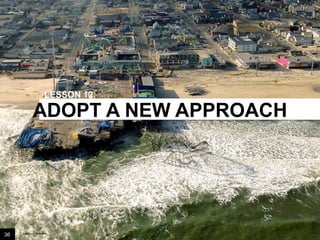
LESSON 12:

ADOPT A NEW APPROACH

36

Image credit: istockphoto
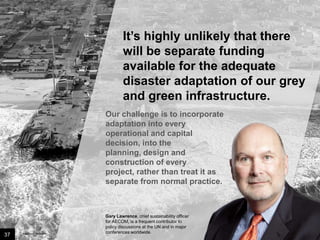
It’s highly unlikely that there
will be separate funding
available for the adequate
disaster adaptation of our grey
and green infrastructure.
Our challenge is to
incorporate adaptation into
every operational and capital
decision, into the planning,
design and construction of
every project, rather than
treat it as separate from
normal practice.

37

Image credit: istockphoto

Gary Lawrence, chief sustainability officer
for AECOM, is a frequent contributor to
policy discussions at the UN and in major
conferences worldwide.
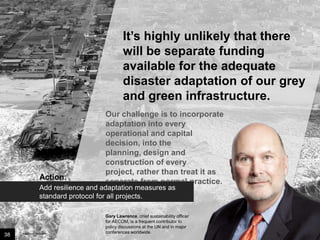
It’s highly unlikely that there
will be separate funding
available for the adequate
disaster adaptation of our grey
and green infrastructure.

Action:

Our challenge is to
incorporate adaptation into
every operational and capital
decision, into the planning,
design and construction of
every project, rather than
treat it as separate from
normal practice.

Add resilience and adaptation measures as
standard protocol for all projects.

38

Image credit: istockphoto

Gary Lawrence, chief sustainability officer
for AECOM, is a frequent contributor to
policy discussions at the UN and in major
conferences worldwide.
More information
and related work
Disaster Solutions
FEMA climate change report

Carbon Disclosure Project—2013 global cities report
“Ten ideas that can change the world”
Baltimore climate action plan

Assessing the climate change risk to SF Bay
Garnaut climate change review for Australia
“After Sandy: A ULI report”
(panelist Joe Brown, AECOM chief innovation officer)
Connected Cities blog: Michael Nolan on sea level rise
Environmental Leader: Gary Lawrence on “Finding the Balance
between ‘Green’ and ‘Gray’”
39

Image credit: istockphoto
12 LESSONS
FROM SANDY

40

Image credit: istockphoto

12 Lessons From Sandy

  • 1.
    12 LESSONS FROM SANDY 1 Imagecredit: istockphoto
  • 2.
    What Did WeLearn from Sandy? When Hurricane Sandy cut across the Caribbean Sea and Atlantic Ocean, it left death and destruction from Puerto Rico to Canada. Lessons learned from the storm carry implications for coastal cities everywhere. AECOM professionals share insights from a dozen of the many perspectives needed to build urban resiliency. 2 Image credit: istockphoto
  • 3.
    LESSON 1: TURN PLANSINTO ACTION 3 Image credit: istockphoto
  • 4.
    Sandy was aneye opener. In a very real way, the storm demonstrated the devastating effects that coastal storms will have on our shoreline in the future. As a result, what were discussions on climate change and adaptation have turned into plans for action. Andrew Cairns, US Northeast Ports and Marine Lead at AECOM 4 Image credit: istockphoto
  • 5.
    Sandy was aneye opener. In a very real way, the storm demonstrated the devastating effects that coastal storms will have on our shoreline in the future. As a result, what were discussions on climate change and adaptation have turned into plans for action. Action: Develop coastal protection plans that account for sea level rise and increased storm intensity. Andrew Cairns, US Northeast Ports and Marine Lead at AECOM 5 Image credit: istockphoto
  • 6.
    LESSON 2: THERE’S ANEW REALITY 6 Image credit: istockphoto
  • 7.
    Sandy points tonew realities we’re likely to face every day. More frequent storms lead to standing water, wet conditions, mold growth and disease; changes in the zones of flora and fauna bring new stressors —the progression of climate change and increased climate variability will have far reaching consequences on daily life, which requires public participation in climate change planning. Diane Dale, director of AECOM sustainable planning, has guided a cross-jurisdictional effort to develop the Cleaner Greener Long Island Regional Sustainability Plan. 7 Image credit: istockphoto
  • 8.
    Sandy points tonew realities we’re likely to face every day. More frequent storms lead to standing water, wet conditions, mold growth and disease; changes in the zones of flora and fauna bring new stressors —the progression of climate change and increased climate variability will have far reaching consequences on daily life, which requires public participation in climate change planning. Action: Adopt a comprehensive, integrated planning approach that engages the public. Diane Dale, director of AECOM sustainable planning, has guided a cross-jurisdictional effort to develop the Cleaner Greener Long Island Regional Sustainability Plan. 8 Image credit: istockphoto
  • 9.
    LESSON 3: ACCOUNT FORHUMAN BEHAVIOR 9 Image credit: istockphoto
  • 10.
    With Sandy, peopleknew that there were few structural protection measures so most followed authorities’ evacuation orders. Design standards for structural solutions must take into account human behavior — people expect flood protection measures to protect them—and the fact is we cannot design and build flood protection that has no chance of being exceeded. Scott Edelman, an AECOM senior vice president, worked on the first comprehensive climate study for FEMA, and recently spoke at the UN on flood mitigation in developing nations. 10 Image credit: istockphoto
  • 11.
    With Sandy, peopleknew that there were few structural protection measures so most followed authorities’ evacuation orders. Design standards for structural solutions must take into account human behavior — people expect flood protection measures to protect them—and the fact is we cannot design and build flood protection that has no chance of being exceeded. Action: Establish regional evacuation protocols and emergency procedures — and make sure people know what they are. Scott Edelman, an AECOM senior vice president, worked on the first comprehensive climate study for FEMA, and recently spoke at the UN on flood mitigation in developing nations. 11 Image credit: istockphoto
  • 12.
    LESSON 4: WORK WITHNATURE 12 Image credit: istockphoto
  • 13.
    We cannot defeatnature through engineering… …but have to work with nature’s built-in resiliency to protect people and assets in highly vulnerable coastal areas. We must think creatively about constructed natural systems that enhance flood management, protect against storm surge, adapt to rising sea levels, improve air quality, and reduce urban heat islands—both for mitigation and adaptation. Jeff Goldman, principal with AECOM, worked on a FEMA program to integrate recovery planning with disaster response. 13 Image credit: istockphoto
  • 14.
    We cannot defeatnature through engineering… …but have to work with nature’s built-in resiliency to protect people and assets in highly vulnerable coastal areas. We must think creatively about constructed natural systems that enhance flood management, protect against storm surge, adapt to rising sea levels, improve air quality, and reduce urban heat islands—both for mitigation and adaptation. Action: Maximize green and multi-purpose infrastructure options to enhance resiliency. Jeff Goldman, principal with AECOM, worked on a FEMA program to integrate recovery planning with disaster response. 14 Image credit: istockphoto
  • 15.
    LESSON 5: PROTECT THECORE 15 Image credit: istockphoto
  • 16.
    Vital infrastructure tooka severe blow with Sandy. Cities need to ensure that critical elements of the electric, water, sewer and transportation grids are strengthened so people can get basic services, and return to normal life as quickly as possible. Over the coming decades, sustainable design and building codes will be phased in, but the focus over the next few years is to make the core strong and resilient enough to handle blows better. Kevin Corbett, a vice president with AECOM in New York City, has worked closely with state, city and government agencies across a range of interrelated capacities. 16 Image credit: istockphoto
  • 17.
    Vital infrastructure tooka severe blow with Sandy. Cities need to ensure that critical elements of the electric, water, sewer and transportation grids are strengthened so people can get basic services, and return to normal life as quickly as possible. Over the coming decades, sustainable design and building codes will be phased in, but the focus over the next few years is to make the core strong and resilient enough to handle blows better. Action: Conduct vulnerability assessment for essential services and infrastructure, including transportation, energy, water and wastewater. Kevin Corbett, a vice president with AECOM in New York City, has worked closely with state, city and government agencies across a range of interrelated capacities. 17 Image credit: istockphoto
  • 18.
    LESSON 6: PREPARE TORESPOND 18 Image credit: istockphoto
  • 19.
    Nature has away of overruling our plans. As much as we strengthen protections for major storms, nature will act in ways we can’t always predict. That heightens the need for pre-emergency preparation to secure assets and infrastructure for system redundancy and a coordinated post-emergency response involving key transportation operators and government agencies. Atma Sookram, AECOM associate vice president of transportation planning, has worked extensively with New York City agencies. 19 Image credit: istockphoto
  • 20.
    Nature has away of overruling our plans. As much as we strengthen protections for major storms, nature will act in ways we can’t always predict. That heightens the need for pre-emergency preparation to secure assets and infrastructure for system redundancy and a coordinated post-emergency response involving key transportation operators and government agencies. Action: Coordinate interagency regional transportation plans with multiple modes and redundancy. Atma Sookram, AECOM associate vice president of transportation planning, has worked extensively with New York City agencies. 20 Image credit: istockphoto
  • 21.
  • 22.
    Climate change impacts don’tfollow jurisdictional boundaries. Sandy reinforced the reality that cooperation and integrated thinking across municipalities and regional agencies is essential in planning for adaptation and resiliency strategies. Claire Bonham-Carter, AECOM director of sustainable development, is working on climate focused vulnerability and risk assessments for multiple agencies. 22 Image credit: istockphoto
  • 23.
    Climate change impacts don’tfollow jurisdictional boundaries. Sandy reinforced the reality that cooperation and integrated thinking across municipalities and regional agencies is essential in planning for adaptation and resiliency strategies. Action: Initiate regional, cross-jurisdictional planning mechanisms and processes. Claire Bonham-Carter, AECOM director of sustainable development, is working on climate focused vulnerability and risk assessments for multiple agencies. 23 Image credit: istockphoto
  • 24.
    LESSON 8: KEEP THEPOWER ON 24 Image credit: istockphoto
  • 25.
    Continuity of powercan mean the difference between a storm and a disaster. High-voltage transmission and distribution systems need storm hardening measures— elevating equipment, building storm walls, development of mitigation procedures—to prevent and minimize outages. Steve Martocello, PE, AECOM sr. vice president of energy and power, is guiding the Northeast Grid Reliability Program which includes storm hardening of selected PSE&G critical facilities. 25 Image credit: istockphoto
  • 26.
    Continuity of powercan mean the difference between a storm and a disaster. High-voltage transmission and distribution systems need storm hardening measures— elevating equipment, building storm walls, development of mitigation procedures—to prevent and minimize outages. Action: Identify vulnerable gas and electric assets and implement protections. Steve Martocello, PE, AECOM sr. vice president of energy and power, is guiding the Northeast Grid Reliability Program which includes storm hardening of selected PSE&G critical facilities. 26 Image credit: istockphoto
  • 27.
    LESSON 9: DE-RISK THECOASTLINE 27 Image credit: istockphoto
  • 28.
    As coastal zonesaround the world become more urbanized, people and assets are increasingly at risk. Disasters happen. It makes sense to de-risk the coastline. Quantitative risk assessment offers potential to improve development decisionmaking, avoid undue risk to infrastructure and prevent adverse impacts on the natural environment. Dr. Mark Gibbs, AECOM director of infrastructure and environmental risk management, is an internationally known authority on coastal development. 28 Image credit: istockphoto
  • 29.
    As coastal zonesaround the world become more urbanized, people and assets are increasingly at risk. Disasters happen. It makes sense to de-risk the coastline. Quantitative risk assessment offers potential to improve development decisionmaking, avoid undue risk to infrastructure and prevent adverse impacts on the natural environment. Action: Update coastal planning and development guidelines to minimize long-term risk. Dr. Mark Gibbs, AECOM director of infrastructure and environmental risk management, is an internationally known authority on coastal development. 29 Image credit: istockphoto
  • 30.
    LESSON 10: SANITATION SAVESLIVES 30 Image credit: istockphoto
  • 31.
    Evaluate the vulnerabilityof wastewater treatment assets. These assets, which are typically located adjacent to receiving waters, play important roles protecting human health and the environment and need to be adapted to and protected against changes in weather patterns. Gabriel Giles, AECOM project manager, has guided award-winning wastewater treatment plant projects. 31 Image credit: istockphoto
  • 32.
    Evaluate the vulnerabilityof wastewater treatment assets. These assets, which are typically located adjacent to receiving waters, play important roles protecting human health and the environment and need to be adapted to and protected against changes in weather patterns. Action: Develop and implement plans to ensure protection of essential water distribution systems, fresh water and sanitation functions. Gabriel Giles, AECOM project manager, has guided award-winning wastewater treatment plant projects. 32 Image credit: istockphoto
  • 33.
    LESSON 11: CAPITAL FLEESUNDUE RISK 33 Image credit: istockphoto
  • 34.
    Regions that identifyand address risks will remain attractive to investors. Regions that ignore impacts of climate change face capital flight, as long-term investments are jeopardized. Insurers already consider the consequences of climate change. Those costs will be passed onto property owners, ultimately changing where people invest. 34 Image credit: istockphoto Alexander Quinn, director of AECOM sustainable economics, has guided investment and development projects for cities and private clients throughout North America.
  • 35.
    Regions that identifyand address risks will remain attractive to investors. Regions that ignore impacts of climate change face capital flight, as long-term investments are jeopardized. Insurers already consider the consequences of climate change. Those costs will be passed onto property owners, ultimately changing where people invest. Action: Develop climate action plans to mitigate risk and protect investment. 35 Image credit: istockphoto Alexander Quinn, director of AECOM sustainable economics, has guided investment and development projects for cities and private clients throughout North America.
  • 36.
    LESSON 12: ADOPT ANEW APPROACH 36 Image credit: istockphoto
  • 37.
    It’s highly unlikelythat there will be separate funding available for the adequate disaster adaptation of our grey and green infrastructure. Our challenge is to incorporate adaptation into every operational and capital decision, into the planning, design and construction of every project, rather than treat it as separate from normal practice. 37 Image credit: istockphoto Gary Lawrence, chief sustainability officer for AECOM, is a frequent contributor to policy discussions at the UN and in major conferences worldwide.
  • 38.
    It’s highly unlikelythat there will be separate funding available for the adequate disaster adaptation of our grey and green infrastructure. Action: Our challenge is to incorporate adaptation into every operational and capital decision, into the planning, design and construction of every project, rather than treat it as separate from normal practice. Add resilience and adaptation measures as standard protocol for all projects. 38 Image credit: istockphoto Gary Lawrence, chief sustainability officer for AECOM, is a frequent contributor to policy discussions at the UN and in major conferences worldwide.
  • 39.
    More information and relatedwork Disaster Solutions FEMA climate change report Carbon Disclosure Project—2013 global cities report “Ten ideas that can change the world” Baltimore climate action plan Assessing the climate change risk to SF Bay Garnaut climate change review for Australia “After Sandy: A ULI report” (panelist Joe Brown, AECOM chief innovation officer) Connected Cities blog: Michael Nolan on sea level rise Environmental Leader: Gary Lawrence on “Finding the Balance between ‘Green’ and ‘Gray’” 39 Image credit: istockphoto
  • 40.
    12 LESSONS FROM SANDY 40 Imagecredit: istockphoto