Samuel H. Sage
Atlantic States Legal Foundation, Inc. (ASLF)
                                    June 2012
About ASLF
 New York based not-for-profit, headquartered in the
  Near Westside area of Syracuse

 Established in 1982 to provide legal, technical, and
  organizational services to individuals and
  organizations dealing with environmental issues

 Has taken a lead role in the protection and restoration
  of Syracuse waterways and the CSO problem
The Impacts
 Economically draining for city

 Lower property value

 Aesthetical degradation

 High rates of crime and arson

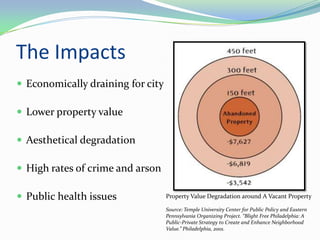
 Public health issues             Property Value Degradation around A Vacant Property

                                   Source: Temple University Center for Public Policy and Eastern
                                   Pennsylvania Organizing Project. “Blight Free Philadelphia: A
                                   Public-Private Strategy to Create and Enhance Neighborhood
                                   Value.” Philadelphia, 2001.
The Opportunities
  Stormwater retention

  Public amenities

  Urban infill development

  Urban forestry

  Urban agriculture

  Habitat creation and conservation
The Issue
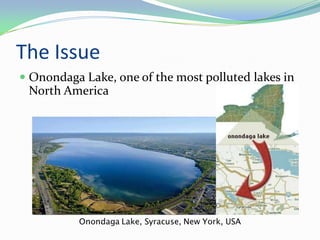
 Onondaga Lake, one of the most polluted lakes in
  North America
The Issue (cont.)
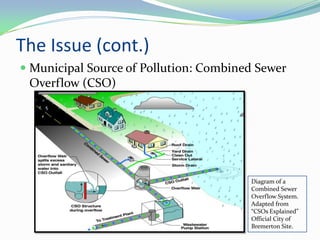
 Municipal Source of Pollution: Combined Sewer
 Overflow (CSO)


                                        Diagram of a
                                        Combined Sewer
                                        Overflow System.
                                        Adapted from
                                        “CSOs Explained”
                                        Official City of
                                        Bremerton Site.
The Process: ACJ
 ASLF and the NYS-DEC 1988 lawsuit against
 Onondaga County under the Clean Water Act

 METRO Consent Judgment


 Amended Consent Judgment (ACJ, January 1998)
    The key legal document
    Outlined two dozen projects for the County
    Extensive monitoring program
The Process:
          The 4th Stip to ACJ 2009
 The court order requires Onondaga County to use
 GRAY and GREEN infrastructure addressing CSOs

   Gray Infrastructure: Commitment to 88.7% annual
    volume capture in by 2013
   Green Infrastructure: Commitment to an additional
    6.3% annual volume capture in Green Infrastructure
    commencing immediately in 2009, resulting in 95%
    total annual volume capture by 2018
The Solution: Save the Rain (STR)
 A GI program created by the County
    Encompasses the storm water and GI initiatives
    Educates the public about issues and how they can use
     and benefit from GI

 Initiatives
    GI on public land
    Green Improvement Fund: GI on private land
    Rain Barrel Program
    Urban Forestry Program
    STR-Vacant Lot Program (VLP)
VLP Program Goals
 Reduce minimum of 9 million gallons of CSO by 2018
 with GI on publicly owned vacant lots

 Provide different forms of GREEN infrastructure
 projects for Save The Rain

 Simultaneously reclaim greenspace in a useful way and
 improve value of vacant lots to community

 Engage public in GI maintenance for Save The Rain
Syracuse Vacant Lot Inventory
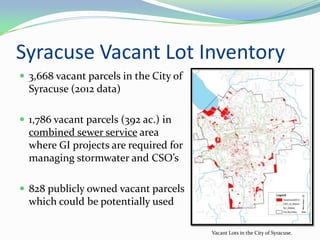
 3,668 vacant parcels in the City of
  Syracuse (2012 data)

 1,786 vacant parcels (392 ac.) in
  combined sewer service area
  where GI projects are required for
  managing stormwater and CSO’s

 828 publicly owned vacant parcels
  which could be potentially used

                                        Vacant Lots in the City of Syracuse.
Syracuse Vacant Lot Inventory
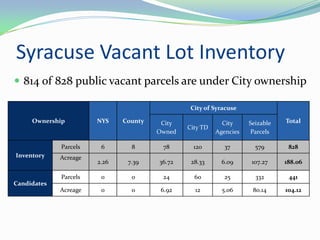
 814 of 828 public vacant parcels are under City ownership

                                                City of Syracuse

     Ownership         NYS    County    City               City     Seizable   Total
                                               City TD
                                       Owned             Agencies   Parcels

             Parcels    6       8       78       120        37        579       828
Inventory    Acreage
                       2.26    7.39    36.72    28.33      6.09      107.27    188.06

             Parcels    0       0       24       60         25        332       441
Candidates
             Acreage    0       0       6.92     12        5.06      80.14     104.12
VLP: A Joint Venture
 Between Onondaga County and City of
  Syracuse

 Initiated in 2011 by Onondaga County

 Funded by Onondaga County to built GI
  projects on City owned vacant lots

 Developed collaboratively to fit under both
  governments’ immediate planning goals

 Based on the agreement that defines the
  County’s and the City’s responsibilities in
  O&M of the VLP projects

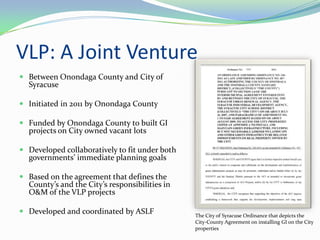
 Developed and coordinated by ASLF             The City of Syracuse Ordinance that depicts the
                                                City-County Agreement on installing GI on the City
                                                properties
VLP’s Reclamation Typologies
 Urban Orchard
 Community Garden (Ornamental or Vegetable)
 Urban Forest/Tree Planting

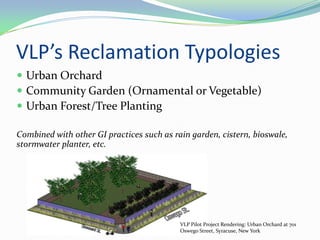
Combined with other GI practices such as rain garden, cistern, bioswale,
stormwater planter, etc.


                                           VLP Pilot Project Rendering: Urban Orchard at 701
                                           Oswego Street, Syracuse, New York
Community Involvement in VLP
 Outreach to general public and communities near project sites

 Coordination with community in planning & design process
  (community meetings, design workshops)

 Community participation in maintenance (organized to
  ensure the quality of performance)

 Green job training and job creation
VLP Projects: 2011
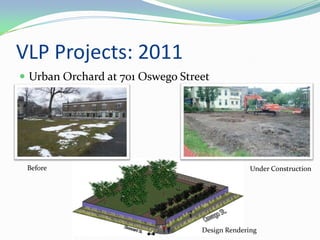
 Urban Orchard at 701 Oswego Street


 Before                                         Under Construction


                                  Design Rendering
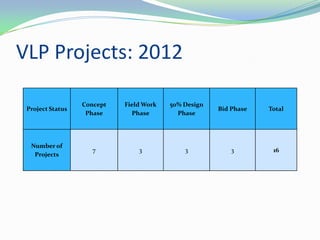
VLP Projects: 2012

                  Concept   Field Work   50% Design
 Project Status                                       Bid Phase   Total
                   Phase      Phase        Phase


  Number of
                     7          3            3            3        16
   Projects
Benefits of VLP
 Environmental Benefits
    Biodiversity
    Increase of tree canopy
    Carbon sequestration
    Reduction in pollution, heat island effects and CSO events


 Economic Benefits
    Increased property value and land desirability
    Lowers City’s maintenance costs
    Creation of new job and local business
Benefits of VLP
 Social & Public Health Benefits
   Revitalization of community
   Reduced crime rates
   Improved access to healthy foods from urban
    agricultural typologies
   Increased opportunities for outdoor physical exercise
   Facilitation of healthy behaviors is a factor in chronic
    disease incidence
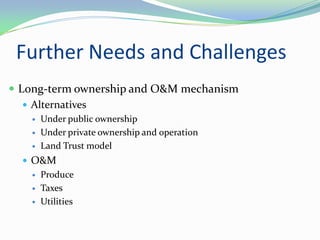
Further Needs and Challenges
 Long-term ownership and O&M mechanism
    Alternatives
      Under public ownership
      Under private ownership and operation
      Land Trust model
   O&M
      Produce
      Taxes
      Utilities
Further Needs and Challenges
 Public acceptance and involvement in projects
    Safety issues related to urban farming on abandoned
     land
    Lawn VS Native Garden
    Tree(s) VS Forest


 Long-term monitoring and compliance with legal
  requirements
For More Information
 Atlantic States Legal Foundation, Inc.
   658 West Onondaga Street, Syracuse, New York 13204
   315-475-1170. atlantic.states@aslf.org
   http://www.aslf.org/

 Onondaga County Save The Rain Program
  http://savetherain.us/
Greening vacant lots in syracuse final

Greening vacant lots in syracuse final

  • 1.
    Samuel H. Sage AtlanticStates Legal Foundation, Inc. (ASLF) June 2012
  • 2.
    About ASLF  NewYork based not-for-profit, headquartered in the Near Westside area of Syracuse  Established in 1982 to provide legal, technical, and organizational services to individuals and organizations dealing with environmental issues  Has taken a lead role in the protection and restoration of Syracuse waterways and the CSO problem
  • 4.
    The Impacts  Economicallydraining for city  Lower property value  Aesthetical degradation  High rates of crime and arson  Public health issues Property Value Degradation around A Vacant Property Source: Temple University Center for Public Policy and Eastern Pennsylvania Organizing Project. “Blight Free Philadelphia: A Public-Private Strategy to Create and Enhance Neighborhood Value.” Philadelphia, 2001.
  • 5.
    The Opportunities Stormwater retention  Public amenities  Urban infill development  Urban forestry  Urban agriculture  Habitat creation and conservation
  • 7.
    The Issue  OnondagaLake, one of the most polluted lakes in North America
  • 8.
    The Issue (cont.) Municipal Source of Pollution: Combined Sewer Overflow (CSO) Diagram of a Combined Sewer Overflow System. Adapted from “CSOs Explained” Official City of Bremerton Site.
  • 9.
    The Process: ACJ ASLF and the NYS-DEC 1988 lawsuit against Onondaga County under the Clean Water Act  METRO Consent Judgment  Amended Consent Judgment (ACJ, January 1998)  The key legal document  Outlined two dozen projects for the County  Extensive monitoring program
  • 10.
    The Process: The 4th Stip to ACJ 2009  The court order requires Onondaga County to use GRAY and GREEN infrastructure addressing CSOs  Gray Infrastructure: Commitment to 88.7% annual volume capture in by 2013  Green Infrastructure: Commitment to an additional 6.3% annual volume capture in Green Infrastructure commencing immediately in 2009, resulting in 95% total annual volume capture by 2018
  • 11.
    The Solution: Savethe Rain (STR)  A GI program created by the County  Encompasses the storm water and GI initiatives  Educates the public about issues and how they can use and benefit from GI  Initiatives  GI on public land  Green Improvement Fund: GI on private land  Rain Barrel Program  Urban Forestry Program  STR-Vacant Lot Program (VLP)
  • 13.
    VLP Program Goals Reduce minimum of 9 million gallons of CSO by 2018 with GI on publicly owned vacant lots  Provide different forms of GREEN infrastructure projects for Save The Rain  Simultaneously reclaim greenspace in a useful way and improve value of vacant lots to community  Engage public in GI maintenance for Save The Rain
  • 14.
    Syracuse Vacant LotInventory  3,668 vacant parcels in the City of Syracuse (2012 data)  1,786 vacant parcels (392 ac.) in combined sewer service area where GI projects are required for managing stormwater and CSO’s  828 publicly owned vacant parcels which could be potentially used Vacant Lots in the City of Syracuse.
  • 15.
    Syracuse Vacant LotInventory  814 of 828 public vacant parcels are under City ownership City of Syracuse Ownership NYS County City City Seizable Total City TD Owned Agencies Parcels Parcels 6 8 78 120 37 579 828 Inventory Acreage 2.26 7.39 36.72 28.33 6.09 107.27 188.06 Parcels 0 0 24 60 25 332 441 Candidates Acreage 0 0 6.92 12 5.06 80.14 104.12
  • 16.
    VLP: A JointVenture  Between Onondaga County and City of Syracuse  Initiated in 2011 by Onondaga County  Funded by Onondaga County to built GI projects on City owned vacant lots  Developed collaboratively to fit under both governments’ immediate planning goals  Based on the agreement that defines the County’s and the City’s responsibilities in O&M of the VLP projects  Developed and coordinated by ASLF The City of Syracuse Ordinance that depicts the City-County Agreement on installing GI on the City properties
  • 17.
    VLP’s Reclamation Typologies Urban Orchard  Community Garden (Ornamental or Vegetable)  Urban Forest/Tree Planting Combined with other GI practices such as rain garden, cistern, bioswale, stormwater planter, etc. VLP Pilot Project Rendering: Urban Orchard at 701 Oswego Street, Syracuse, New York
  • 18.
    Community Involvement inVLP  Outreach to general public and communities near project sites  Coordination with community in planning & design process (community meetings, design workshops)  Community participation in maintenance (organized to ensure the quality of performance)  Green job training and job creation
  • 19.
    VLP Projects: 2011 Urban Orchard at 701 Oswego Street Before Under Construction Design Rendering
  • 20.
    VLP Projects: 2012 Concept Field Work 50% Design Project Status Bid Phase Total Phase Phase Phase Number of 7 3 3 3 16 Projects
  • 22.
    Benefits of VLP Environmental Benefits  Biodiversity  Increase of tree canopy  Carbon sequestration  Reduction in pollution, heat island effects and CSO events  Economic Benefits  Increased property value and land desirability  Lowers City’s maintenance costs  Creation of new job and local business
  • 23.
    Benefits of VLP Social & Public Health Benefits  Revitalization of community  Reduced crime rates  Improved access to healthy foods from urban agricultural typologies  Increased opportunities for outdoor physical exercise  Facilitation of healthy behaviors is a factor in chronic disease incidence
  • 24.
    Further Needs andChallenges  Long-term ownership and O&M mechanism  Alternatives  Under public ownership  Under private ownership and operation  Land Trust model  O&M  Produce  Taxes  Utilities
  • 25.
    Further Needs andChallenges  Public acceptance and involvement in projects  Safety issues related to urban farming on abandoned land  Lawn VS Native Garden  Tree(s) VS Forest  Long-term monitoring and compliance with legal requirements
  • 26.
    For More Information Atlantic States Legal Foundation, Inc. 658 West Onondaga Street, Syracuse, New York 13204 315-475-1170. atlantic.states@aslf.org http://www.aslf.org/  Onondaga County Save The Rain Program http://savetherain.us/