Download to read offline
![RUBY METHODS
http://www.tutorialspoint.com/ruby/ruby_methods.htm Copyright © tutorialspoint.com
Ruby methods are very similar to functions in any other programming language. Ruby methods are used to bundle one
or more repeatable statements into a single unit.
Method names should begin with a lowercase letter. If you begin a method name with an uppercase letter, Ruby might
think that it is a constant and hence can parse the call incorrectly.
Methods should be defined before calling them otherwise Ruby will raise an exception for undefined method invoking.
Syntax:
def method_name [( [arg [= default]]...[, * arg [, &expr ]])]
expr..
end
So you can define a simple method as follows:
def method_name
expr..
end
You can represent a method that accepts parameters like this:
def method_name (var1, var2)
expr..
end
You can set default values for the parameters which will be used if method is called without passing required
parameters:
def method_name (var1=value1, var2=value2)
expr..
end
Whenever you call the simple method, you write only the method name as follows:
method_name
However, when you call a method with parameters, you write the method name along with the parameters, such as:
method_name 25, 30
The most important drawback to using methods with parameters is that you need to remember the number of parameters
whenever you call such methods. For example, if a method accepts three parameters and you pass only two, then Ruby
displays an error.
Example:
#!/usr/bin/ruby
def test(a1="Ruby", a2="Perl")
puts "The programming language is #{a1}"
puts "The programming language is #{a2}"
end
test "C", "C++"](https://image.slidesharecdn.com/11rubymethods-130204175536-phpapp02/85/11-ruby-methods-1-320.jpg)
![RUBY METHODS
http://www.tutorialspoint.com/ruby/ruby_methods.htm Copyright © tutorialspoint.com
Ruby methods are very similar to functions in any other programming language. Ruby methods are used to bundle one
or more repeatable statements into a single unit.
Method names should begin with a lowercase letter. If you begin a method name with an uppercase letter, Ruby might
think that it is a constant and hence can parse the call incorrectly.
Methods should be defined before calling them otherwise Ruby will raise an exception for undefined method invoking.
Syntax:
def method_name [( [arg [= default]]...[, * arg [, &expr ]])]
expr..
end
So you can define a simple method as follows:
def method_name
expr..
end
You can represent a method that accepts parameters like this:
def method_name (var1, var2)
expr..
end
You can set default values for the parameters which will be used if method is called without passing required
parameters:
def method_name (var1=value1, var2=value2)
expr..
end
Whenever you call the simple method, you write only the method name as follows:
method_name
However, when you call a method with parameters, you write the method name along with the parameters, such as:
method_name 25, 30
The most important drawback to using methods with parameters is that you need to remember the number of parameters
whenever you call such methods. For example, if a method accepts three parameters and you pass only two, then Ruby
displays an error.
Example:
#!/usr/bin/ruby
def test(a1="Ruby", a2="Perl")
puts "The programming language is #{a1}"
puts "The programming language is #{a2}"
end
test "C", "C++"](https://image.slidesharecdn.com/11rubymethods-130204175536-phpapp02/75/11-ruby-methods-1-2048.jpg)
![test
This will produce following result:
The programming language is C
The programming language is C++
The programming language is Ruby
The programming language is Perl
Return Values from Methods:
Every method in Ruby returns a value by default. This returned value will be the value of the last statement. For
example:
def test
i = 100
j = 10
k = 0
end
This method, when called, will return the last declared variable k.
Ruby return Statement:
The return statement in ruby is used to return one or more values from a Ruby Method.
Syntax:
return [expr[`,' expr...]]
If more than two expressions are given, the array contains these values will be the return value. If no expression given,
nil will be the return value.
Example:
return
OR
return 12
OR
return 1,2,3
Have a look at this example:
#!/usr/bin/ruby
def test
i = 100
j = 200
k = 300
return i, j, k
end
var = test
puts var
This will produce following result:
100](https://image.slidesharecdn.com/11rubymethods-130204175536-phpapp02/85/11-ruby-methods-2-320.jpg)
![200
300
Variable Number of Parameters:
Suppose that you declare a method that takes two parameters. Whenever you call this method, you need to pass two
parameters along with it.
However, Ruby allows you to declare methods that work with a variable number of parameters. Let us examine a
sample of this:
#!/usr/bin/ruby
def sample (*test)
puts "The number of parameters is #{test.length}"
for i in 0...test.length
puts "The parameters are #{test[i]}"
end
end
sample "Zara", "6", "F"
sample "Mac", "36", "M", "MCA"
In this code, you have declared a method sample that accepts one parameter test. However, this parameter is a variable
parameter. This means that this parameter can take in any number of variables. So above code will produce following
result:
The number of parameters is 3
The parameters are Zara
The parameters are 6
The parameters are F
The number of parameters is 4
The parameters are Mac
The parameters are 36
The parameters are M
The parameters are MCA
Class Methods:
When a method is defined outside of the class definition, the method is marked as private by default. On the other hand,
the methods defined in the class definition are marked as public by default. The default visibility and the private mark
of the methods can be changed by public or private of the Module.
Whenever you want to access a method of a class, you first need to instantiate the class. Then, using the object, you can
access any member of the class.
Ruby gives you a way to access a method without instantiating a class. Let us see how a class method is declared and
accessed:
class Accounts
def reading_charge
end
def Accounts.return_date
end
end
See how the method return_date is declared. It is declared with the class name followed by a period, which is followed
by the name of the method. You can access this class method directly as follows:
Accounts.return_date
To access this method, you need not create objects of the class Accounts.](https://image.slidesharecdn.com/11rubymethods-130204175536-phpapp02/85/11-ruby-methods-3-320.jpg)
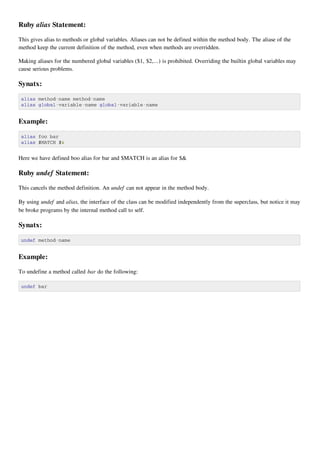

Ruby methods are used to bundle repeatable statements into a single unit. Method names should begin with a lowercase letter. Methods should be defined before calling them. Methods can accept parameters with default values. Variables can be returned from methods. The return statement is used to return values explicitly. Methods can take a variable number of parameters using *. Class methods can be accessed without instantiating an object. The alias statement creates an alias for a method or variable. The undef statement cancels a method definition.


