Bad smell in codes – Part 1
                  If it stinks change it.


Presented By:
Fuad Bin Omar               Rashed Kibria
fuad@code71.com             rashed@code71.com
www.code71.com              www.code71.com
Smells to be covered

    •Duplicated code
    •Long method
    •Long parameter list
    •Divergent change
    •Shotgun surgery
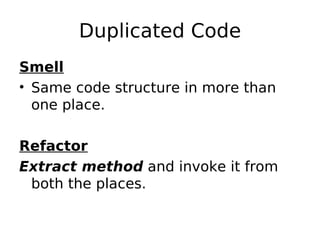
Duplicated Code
Smell
• Same code structure in more than
  one place.

Refactor
Extract method and invoke it from
 both the places.
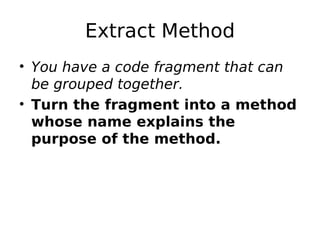
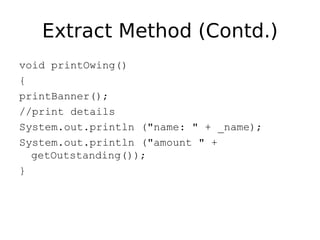
Extract Method
• You have a code fragment that can
  be grouped together.
• Turn the fragment into a method
  whose name explains the
  purpose of the method.
Extract Method (Contd.)
void printOwing()
{
printBanner();
//print details
System.out.println ("name: " + _name);
System.out.println ("amount " +
  getOutstanding());
}
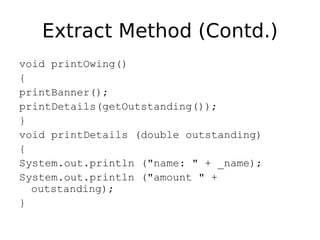
Extract Method (Contd.)
void printOwing()
{
printBanner();
printDetails(getOutstanding());
}
void printDetails (double outstanding)
{
System.out.println ("name: " + _name);
System.out.println ("amount " +
  outstanding);
}
Duplicated Code
Smell
• same expression in two sibling
  subclasses
Refactor
• Extract method in both classes.
• Pull up field.
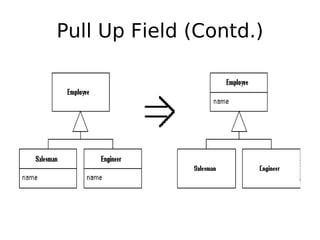
Pull Up Field
• Two subclasses have the same field.
• Move the field to the superclass.
Pull Up Field (Contd.)
Duplicated Code
Smell
• Code is similar but not the same
Refactor:
• Use Extract Method to
separate the similar bits from the
  different bits.
• Use Form Template Method.
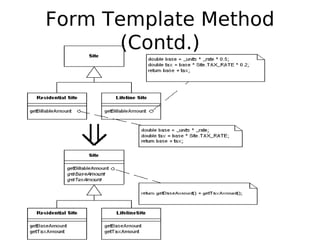
Form template method
• You have two methods in subclasses
  that perform similar steps in the same
  order, yet the steps are different.
• Get the steps into methods with
  the same signature, so that the
  original methods become the
  same. Then you can pull them up.
Form Template Method
       (Contd.)
Duplicated Code
Smell
• Methods do the same thing with a
  different algorithm
Refactor:
• Choose the clearer of the two
  algorithms Use
• Use Substitute Algorithm.
Substitute Algorithm
• You want to replace an algorithm
  with one that is clearer.
• Replace the body of the method
  with the new algorithm.
Substitute
         Algorithm(Contd.)
String foundPerson(String[] people)
{
for (int i = 0; i < people.length; i++)
{
if (people[i].equals ("Don")){ return "Don"; }
if (people[i].equals ("John")){ return "John"; }
if (people[i].equals ("Kent")){ return "Kent"; }
}
return "";
}
Substitute Algorithm
             (Contd.)
String foundPerson(String[] people)
{
List candidates = Arrays.asList(new String[] {"Don",
  "John", "Kent"});
for (int i=0; i<people.length; i++)
if (candidates.contains(people[i]))
return people[i]; return "";
}
Duplicated Code
Smell
• Duplicated code in two unrelated class.
Refactor:
• Use Extract Class in one class.
• Use the new component to the other.
• Decide where the method makes sense.
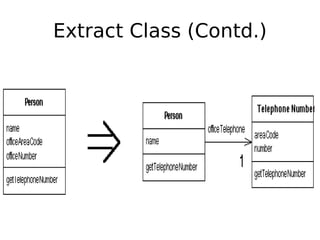
Extract Class
• You have one class doing work that
  should be done by two.
• Create a new class and move the
  relevant fields and methods from
  the old class into the new class.
Extract Class (Contd.)
Long method
• Object program having short
  methods live best and longest.
• Little methods are the most valuable.
• Longer methods are difficult to
  understand.
Long method
• Give methods a good name.
• Whenever you feel the need to comment
  something make it a method.
  – Group of lines
  – Even if it is a single line
  – Even if method call is longer than code itself.
  – Method length is not the key here.
  – What the method does and how it does it is
    important.
Long method
• Extract Method
Long method
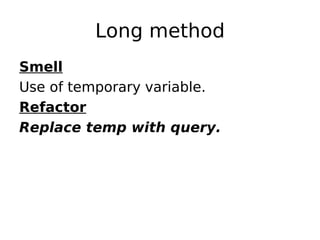
Smell
Use of temporary variable.
Refactor
Replace temp with query.
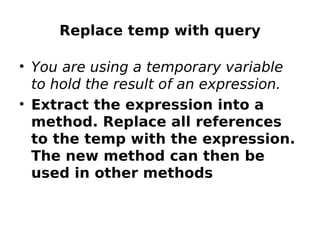
Replace temp with query

• You are using a temporary variable
  to hold the result of an expression.
• Extract the expression into a
  method. Replace all references
  to the temp with the expression.
  The new method can then be
  used in other methods
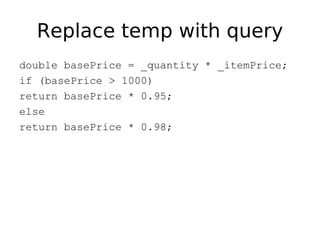
Replace temp with query
double basePrice = _quantity * _itemPrice;
if (basePrice > 1000)
return basePrice * 0.95;
else
return basePrice * 0.98;
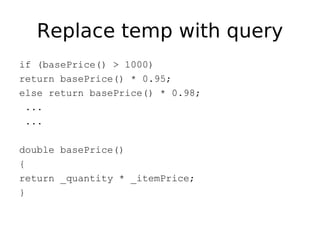
Replace temp with query
if (basePrice() > 1000)
return basePrice() * 0.95;
else return basePrice() * 0.98;
 ...
 ...

double basePrice()
{
return _quantity * _itemPrice;
}
Long method
Smell
Methods with long list of parameters.

Refactor
Introduce Parameter Object
Preserve Whole Object
Method with method Object
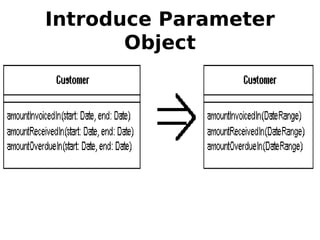
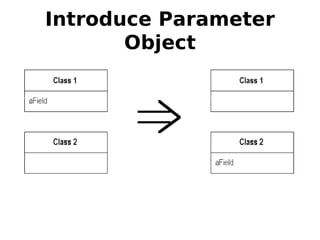
Introduce Parameter Object

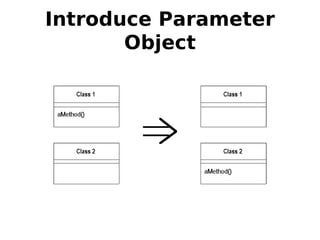
• You have a group of parameters that
  naturally go together.
• Replace them with an object.
Introduce Parameter
       Object
Preserve whole object
• You are getting several values from
  an object and passing these values
  as parameters in a method call.
• Send the whole object instead.
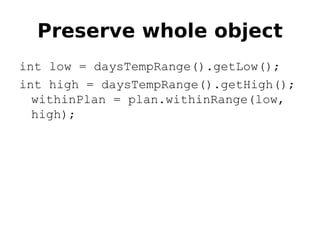
Preserve whole object
int low = daysTempRange().getLow();
int high = daysTempRange().getHigh();
  withinPlan = plan.withinRange(low,
  high);
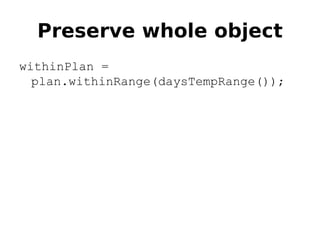
Preserve whole object
withinPlan =
  plan.withinRange(daysTempRange());
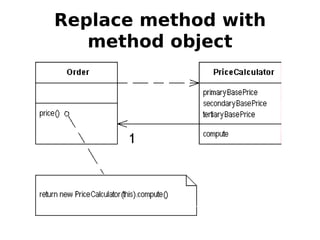
Replace method with
        method object
• You have a long method that uses local
  variables in such a way that you cannot
  apply Extract Method
• Turn the method into its own object
  so that all the local variables become
  fields on that object. You can then
  decompose the method into other
  methods on the same object.
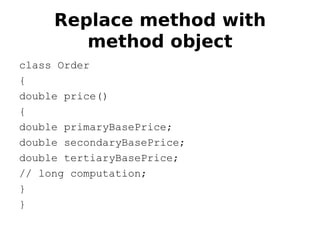
Replace method with
        method object
class Order
{
double price()
{
double primaryBasePrice;
double secondaryBasePrice;
double tertiaryBasePrice;
// long computation;
}
}
Replace method with
   method object
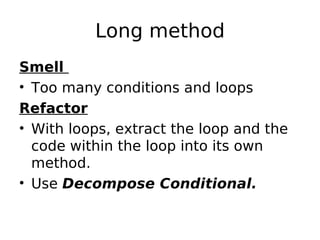
Long method
Smell
• Too many conditions and loops
Refactor
• With loops, extract the loop and the
  code within the loop into its own
  method.
• Use Decompose Conditional.
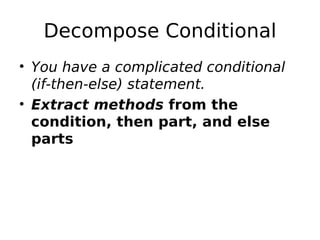
Decompose Conditional
• You have a complicated conditional
  (if-then-else) statement.
• Extract methods from the
  condition, then part, and else
  parts
Decompose Conditional
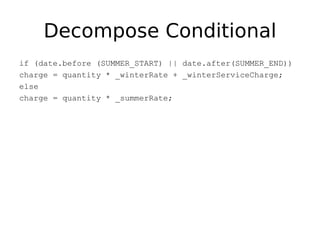
if (date.before (SUMMER_START) || date.after(SUMMER_END))
charge = quantity * _winterRate + _winterServiceCharge;
else
charge = quantity * _summerRate;
Decompose Conditional
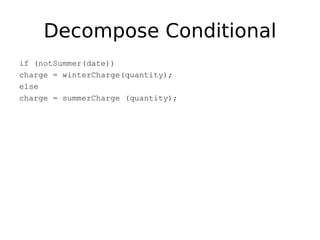
if (notSummer(date))
charge = winterCharge(quantity);
else
charge = summerCharge (quantity);
Long Parameter List
Smell
• A method call requires passing long list of
  parameters.


Refactor
• Use Replace Parameter with Method, Preserve
  whole object or Introduce Parameter Object.
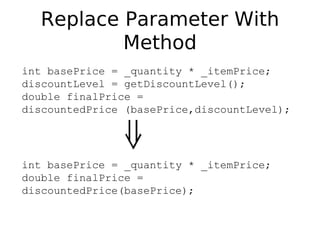
Replace Parameter With
          Method
int basePrice = _quantity * _itemPrice;
discountLevel = getDiscountLevel();
double finalPrice =
discountedPrice (basePrice,discountLevel);


int basePrice = _quantity * _itemPrice;
double finalPrice =
discountedPrice(basePrice);
Divergent Change
Smell
• One class is commonly changed in different ways for
  different reasons.


Refactor
• Use Extract class by identifying everything that changes
  for a particular cause and put them all together.
Shotgun Surgery
Smell
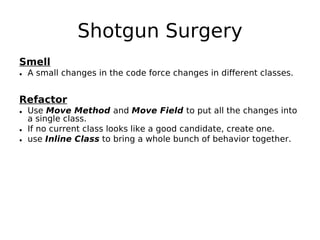
• A small changes in the code force changes in different classes.


Refactor
• Use Move Method and Move Field to put all the changes into
  a single class.
• If no current class looks like a good candidate, create one.
• use Inline Class to bring a whole bunch of behavior together.
Move Method

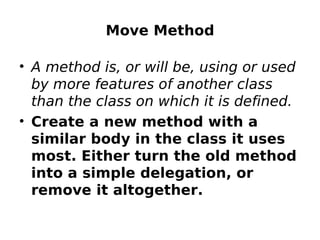
• A method is, or will be, using or used
  by more features of another class
  than the class on which it is defined.
• Create a new method with a
  similar body in the class it uses
  most. Either turn the old method
  into a simple delegation, or
  remove it altogether.
Introduce Parameter
       Object
Move Field

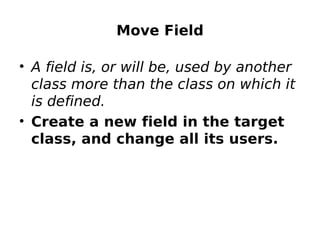
• A field is, or will be, used by another
  class more than the class on which it
  is defined.
• Create a new field in the target
  class, and change all its users.
Introduce Parameter
       Object
To be continued..
References

1. Refactoring: Improving the Design of Existing Code
   By
   Martin Fowler, Kent Beck, John Brant, William Opdyke, Don Roberts

2. www.refactoring.com

Bad Smell In Codes 1

  • 1.
    Bad smell incodes – Part 1 If it stinks change it. Presented By: Fuad Bin Omar Rashed Kibria fuad@code71.com rashed@code71.com www.code71.com www.code71.com
  • 2.
    Smells to becovered •Duplicated code •Long method •Long parameter list •Divergent change •Shotgun surgery
  • 3.
    Duplicated Code Smell • Samecode structure in more than one place. Refactor Extract method and invoke it from both the places.
  • 4.
    Extract Method • Youhave a code fragment that can be grouped together. • Turn the fragment into a method whose name explains the purpose of the method.
  • 5.
    Extract Method (Contd.) voidprintOwing() { printBanner(); //print details System.out.println ("name: " + _name); System.out.println ("amount " + getOutstanding()); }
  • 6.
    Extract Method (Contd.) voidprintOwing() { printBanner(); printDetails(getOutstanding()); } void printDetails (double outstanding) { System.out.println ("name: " + _name); System.out.println ("amount " + outstanding); }
  • 7.
    Duplicated Code Smell • sameexpression in two sibling subclasses Refactor • Extract method in both classes. • Pull up field.
  • 8.
    Pull Up Field •Two subclasses have the same field. • Move the field to the superclass.
  • 9.
    Pull Up Field(Contd.)
  • 10.
    Duplicated Code Smell • Codeis similar but not the same Refactor: • Use Extract Method to separate the similar bits from the different bits. • Use Form Template Method.
  • 11.
    Form template method •You have two methods in subclasses that perform similar steps in the same order, yet the steps are different. • Get the steps into methods with the same signature, so that the original methods become the same. Then you can pull them up.
  • 12.
  • 13.
    Duplicated Code Smell • Methodsdo the same thing with a different algorithm Refactor: • Choose the clearer of the two algorithms Use • Use Substitute Algorithm.
  • 14.
    Substitute Algorithm • Youwant to replace an algorithm with one that is clearer. • Replace the body of the method with the new algorithm.
  • 15.
    Substitute Algorithm(Contd.) String foundPerson(String[] people) { for (int i = 0; i < people.length; i++) { if (people[i].equals ("Don")){ return "Don"; } if (people[i].equals ("John")){ return "John"; } if (people[i].equals ("Kent")){ return "Kent"; } } return ""; }
  • 16.
    Substitute Algorithm (Contd.) String foundPerson(String[] people) { List candidates = Arrays.asList(new String[] {"Don", "John", "Kent"}); for (int i=0; i<people.length; i++) if (candidates.contains(people[i])) return people[i]; return ""; }
  • 17.
    Duplicated Code Smell • Duplicatedcode in two unrelated class. Refactor: • Use Extract Class in one class. • Use the new component to the other. • Decide where the method makes sense.
  • 18.
    Extract Class • Youhave one class doing work that should be done by two. • Create a new class and move the relevant fields and methods from the old class into the new class.
  • 19.
  • 20.
    Long method • Objectprogram having short methods live best and longest. • Little methods are the most valuable. • Longer methods are difficult to understand.
  • 21.
    Long method • Givemethods a good name. • Whenever you feel the need to comment something make it a method. – Group of lines – Even if it is a single line – Even if method call is longer than code itself. – Method length is not the key here. – What the method does and how it does it is important.
  • 22.
  • 23.
    Long method Smell Use oftemporary variable. Refactor Replace temp with query.
  • 24.
    Replace temp withquery • You are using a temporary variable to hold the result of an expression. • Extract the expression into a method. Replace all references to the temp with the expression. The new method can then be used in other methods
  • 25.
    Replace temp withquery double basePrice = _quantity * _itemPrice; if (basePrice > 1000) return basePrice * 0.95; else return basePrice * 0.98;
  • 26.
    Replace temp withquery if (basePrice() > 1000) return basePrice() * 0.95; else return basePrice() * 0.98; ... ... double basePrice() { return _quantity * _itemPrice; }
  • 27.
    Long method Smell Methods withlong list of parameters. Refactor Introduce Parameter Object Preserve Whole Object Method with method Object
  • 28.
    Introduce Parameter Object •You have a group of parameters that naturally go together. • Replace them with an object.
  • 29.
  • 30.
    Preserve whole object •You are getting several values from an object and passing these values as parameters in a method call. • Send the whole object instead.
  • 31.
    Preserve whole object intlow = daysTempRange().getLow(); int high = daysTempRange().getHigh(); withinPlan = plan.withinRange(low, high);
  • 32.
    Preserve whole object withinPlan= plan.withinRange(daysTempRange());
  • 33.
    Replace method with method object • You have a long method that uses local variables in such a way that you cannot apply Extract Method • Turn the method into its own object so that all the local variables become fields on that object. You can then decompose the method into other methods on the same object.
  • 34.
    Replace method with method object class Order { double price() { double primaryBasePrice; double secondaryBasePrice; double tertiaryBasePrice; // long computation; } }
  • 35.
    Replace method with method object
  • 36.
    Long method Smell • Toomany conditions and loops Refactor • With loops, extract the loop and the code within the loop into its own method. • Use Decompose Conditional.
  • 37.
    Decompose Conditional • Youhave a complicated conditional (if-then-else) statement. • Extract methods from the condition, then part, and else parts
  • 38.
    Decompose Conditional if (date.before(SUMMER_START) || date.after(SUMMER_END)) charge = quantity * _winterRate + _winterServiceCharge; else charge = quantity * _summerRate;
  • 39.
    Decompose Conditional if (notSummer(date)) charge= winterCharge(quantity); else charge = summerCharge (quantity);
  • 40.
    Long Parameter List Smell •A method call requires passing long list of parameters. Refactor • Use Replace Parameter with Method, Preserve whole object or Introduce Parameter Object.
  • 41.
    Replace Parameter With Method int basePrice = _quantity * _itemPrice; discountLevel = getDiscountLevel(); double finalPrice = discountedPrice (basePrice,discountLevel); int basePrice = _quantity * _itemPrice; double finalPrice = discountedPrice(basePrice);
  • 42.
    Divergent Change Smell • Oneclass is commonly changed in different ways for different reasons. Refactor • Use Extract class by identifying everything that changes for a particular cause and put them all together.
  • 43.
    Shotgun Surgery Smell • Asmall changes in the code force changes in different classes. Refactor • Use Move Method and Move Field to put all the changes into a single class. • If no current class looks like a good candidate, create one. • use Inline Class to bring a whole bunch of behavior together.
  • 44.
    Move Method • Amethod is, or will be, using or used by more features of another class than the class on which it is defined. • Create a new method with a similar body in the class it uses most. Either turn the old method into a simple delegation, or remove it altogether.
  • 45.
  • 46.
    Move Field • Afield is, or will be, used by another class more than the class on which it is defined. • Create a new field in the target class, and change all its users.
  • 47.
  • 48.
  • 49.
    References 1. Refactoring: Improvingthe Design of Existing Code By Martin Fowler, Kent Beck, John Brant, William Opdyke, Don Roberts 2. www.refactoring.com