March2015
Sciencewithahumanface
About ICRISAT: www.icrisat.org
ICRISAT’s scientific information: http://EXPLOREit.icrisat.org
Agricultural transformation in VDSA villages in Jharkhand
Abhay Kumar1
, RKP Singh2
, KM Singh1
, RC Bharati1
, Shiv Jee1
and BP Bhatt1
1
ICAR-Research Complex for Eastern Region, Patna; 2
International Crops Research Institute for the Semi-Arid Tropics, India
Introduction
•	In Jharkhand state, only 18% of area is cultivated, while 28% area is
under forest and 31% are fallow.
•	Mono-cropping mainly paddy still prevalent
•	Less developed irrigation system and poor rainwater management
limiting factor
•	In recent years, pulses, vegetables and maize are getting attention of
the farmers.
•	Use of critical inputs in farming- Seed, fertilizer, irrigation are still at
very low level. Therefore, crop productivity is also low in the region.
Objective
•	To examine the changes in cropping pattern in VDSA villages in
Bihar state
•	to examine the trend of input-use in farming and crop yield in the
study villages.
Data and methodology 	
•	Survey Area: Dubaliya, Hesapiri villages of Ranchi district and
Dumariya and Durgapur villages of Dumka district of Jharkhand
•	Survey year: 2010-11 to 2013-14
•	Sampling: Panel survey of 40 households from each village,
comprising 10 from each category viz.- labour, small, medium and
large category.
•	Total sample size: 160
Results
Change in Cropping pattern
•	Change in cropping pattern visible, but the changes mainly within
food grain crops
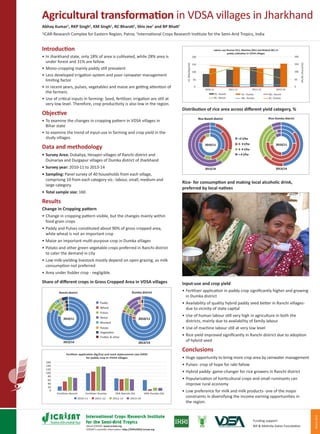
•	Paddy and Pulses constituted about 90% of gross cropped area,
while wheat is not an important crop
•	Maize an important multi-purpose crop in Dumka villages
•	Potato and other green vegetable crops preferred in Ranchi district
to cater the demand in city
•	Low milk-yielding livestock mostly depend on open grazing, as milk
consumption not preferred
•	Area under fodder crop - negligible.
Share of different crops in Gross Cropped Area in VDSA villages
Ranchi district
Paddy
Wheat
Pulses
Maize
Mustard
Potato
Vegetables
Fodder & other
2013/14
2010/11
Dumka district
2013/14
2010/11
0
20
40
60
80
100
120
140
160
FerƟlizer-Ranchi FerƟlizer-Dumka SRR-Ranchi (%) SRR-Dumka (%)
2010-11 2011-12 2012-13 2013-14
FerƟlizer applicaƟon (kg/ha) and eed replacement rate (SRR)s
pfor addy crop in VDSA villages
0
50
100
150
200
HL(Mandays/ha)
Labour use-Human (HL), Machine (ML) and Bullock (BL) in
paddy culƟvaƟon in VDSA villages
0
50
100
150
200
ML/BL(Hours/ha)
2010-11 2011-12 2012-13 2013-14
HL- Ranchi HL- Dumka ML- Ranchi
BL- Ranchi ML- Dumka BL- Dumka
Distribution of rice area across different yield category, %
Rice- for consumption and making local alcoholic drink,
preferred by local natives
Rice-Ranchi district
<2 t/ha
2- 3 t/ha
3- 4 t/ha
> 4 t/ha
2010/11
2013/14
Rice-Dumka district
2010/11
2013/14
VILLAGE DYNAMICS IN SOUTH ASIA
Funding support:
Bill & Melinda Gates Foundation
Input-use and crop yield
•	Fertilizer application in paddy crop significantly higher and growing
in Dumka district
•	Availability of quality hybrid paddy seed better in Ranchi villages-
due to vicinity of state capital
•	Use of human labour still very high in agriculture in both the
districts, mainly due to availability of family labour
•	Use of machine labour still at very low level
•	Rice yield improved significantly in Ranchi district due to adoption
of hybrid seed
Conclusions
•	Huge opportunity to bring more crop area by rainwater management
•	Pulses- crop of hope for rabi fallow
•	Hybrid paddy- game-changer for rice growers in Ranchi district
•	Popularization of horticultural crops and small ruminants can
improve rural economy
•	Low preference for milk and milk products- one of the major
constraints in diversifying the income earning opportunities in
the region.

Agricultural transformation in VDSA villages in Jharkhand

  • 1.
    March2015 Sciencewithahumanface About ICRISAT: www.icrisat.org ICRISAT’sscientific information: http://EXPLOREit.icrisat.org Agricultural transformation in VDSA villages in Jharkhand Abhay Kumar1 , RKP Singh2 , KM Singh1 , RC Bharati1 , Shiv Jee1 and BP Bhatt1 1 ICAR-Research Complex for Eastern Region, Patna; 2 International Crops Research Institute for the Semi-Arid Tropics, India Introduction • In Jharkhand state, only 18% of area is cultivated, while 28% area is under forest and 31% are fallow. • Mono-cropping mainly paddy still prevalent • Less developed irrigation system and poor rainwater management limiting factor • In recent years, pulses, vegetables and maize are getting attention of the farmers. • Use of critical inputs in farming- Seed, fertilizer, irrigation are still at very low level. Therefore, crop productivity is also low in the region. Objective • To examine the changes in cropping pattern in VDSA villages in Bihar state • to examine the trend of input-use in farming and crop yield in the study villages. Data and methodology • Survey Area: Dubaliya, Hesapiri villages of Ranchi district and Dumariya and Durgapur villages of Dumka district of Jharkhand • Survey year: 2010-11 to 2013-14 • Sampling: Panel survey of 40 households from each village, comprising 10 from each category viz.- labour, small, medium and large category. • Total sample size: 160 Results Change in Cropping pattern • Change in cropping pattern visible, but the changes mainly within food grain crops • Paddy and Pulses constituted about 90% of gross cropped area, while wheat is not an important crop • Maize an important multi-purpose crop in Dumka villages • Potato and other green vegetable crops preferred in Ranchi district to cater the demand in city • Low milk-yielding livestock mostly depend on open grazing, as milk consumption not preferred • Area under fodder crop - negligible. Share of different crops in Gross Cropped Area in VDSA villages Ranchi district Paddy Wheat Pulses Maize Mustard Potato Vegetables Fodder & other 2013/14 2010/11 Dumka district 2013/14 2010/11 0 20 40 60 80 100 120 140 160 FerƟlizer-Ranchi FerƟlizer-Dumka SRR-Ranchi (%) SRR-Dumka (%) 2010-11 2011-12 2012-13 2013-14 FerƟlizer applicaƟon (kg/ha) and eed replacement rate (SRR)s pfor addy crop in VDSA villages 0 50 100 150 200 HL(Mandays/ha) Labour use-Human (HL), Machine (ML) and Bullock (BL) in paddy culƟvaƟon in VDSA villages 0 50 100 150 200 ML/BL(Hours/ha) 2010-11 2011-12 2012-13 2013-14 HL- Ranchi HL- Dumka ML- Ranchi BL- Ranchi ML- Dumka BL- Dumka Distribution of rice area across different yield category, % Rice- for consumption and making local alcoholic drink, preferred by local natives Rice-Ranchi district <2 t/ha 2- 3 t/ha 3- 4 t/ha > 4 t/ha 2010/11 2013/14 Rice-Dumka district 2010/11 2013/14 VILLAGE DYNAMICS IN SOUTH ASIA Funding support: Bill & Melinda Gates Foundation Input-use and crop yield • Fertilizer application in paddy crop significantly higher and growing in Dumka district • Availability of quality hybrid paddy seed better in Ranchi villages- due to vicinity of state capital • Use of human labour still very high in agriculture in both the districts, mainly due to availability of family labour • Use of machine labour still at very low level • Rice yield improved significantly in Ranchi district due to adoption of hybrid seed Conclusions • Huge opportunity to bring more crop area by rainwater management • Pulses- crop of hope for rabi fallow • Hybrid paddy- game-changer for rice growers in Ranchi district • Popularization of horticultural crops and small ruminants can improve rural economy • Low preference for milk and milk products- one of the major constraints in diversifying the income earning opportunities in the region.