BIG IDEAS

Sustainable business models for
delivering ICT agro-advisories

T

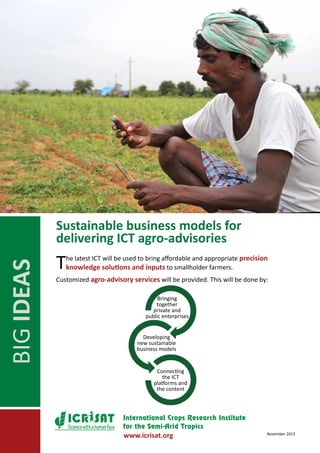
he latest ICT will be used to bring affordable and appropriate precision
knowledge solutions and inputs to smallholder farmers.

Customized agro-advisory services will be provided. This will be done by:
Bringing
together
private and
public enterprises
Developing
new sustainable
business models
Connecting
the ICT
platforms and
the content

Science with a human face

www.icrisat.org

November 2013
This will lead to:

	 Better access to markets and market

opportunities
	 Better management of risks
(e.g. of climate, onfarm challenges and
market changes)

	 Better on farm decision making

with timely and appropriate advice
and farm inputs (such as credit, seeds,
pesticides and fertilizers)

The problems that need addressing
Publicly funded agricultural extension systems played
a critical role during the green revolution leading
to sweeping efforts to transform farming methods.
However these systems are currently inadequate in
terms of infrastructure and human resources.
The need for such advisory services is still strong as
there are 500 million smallholder farms worldwide
and these farms produce about 80% of the food
consumed in Asia and sub-Saharan Africa. These
farmers are typically among the poorest people

and struggle with unproductive soils, poor access to
water, drought, little ability to invest, high risks and
more.
The advancement in ICT provides an opportunity to
provide agro-advisory services required and bridge
the technology divide for smallholder farmers.
ICT solutions are currently being implemented in
developing countries. However, there has been a
failure of financially sustainable business models.

The Approach
Setting up for sustainability is key for this initiative.
The approach will include:


Select crops and value chains to target
Identify and engage with private and public
partnerships


The private sector players will be recruited
on membership basis and the platform
will provide them a healthy competitive
environment to directly connect with the
end users.

The technology platforms and content
development
Existing proven platforms will be built into one
access point.
These platforms have been pilot tested by ICRISAT in
3 experimental hubs.


Farmer-field-crop record database
Experts database
Buy and sell virtual transaction platform
Credit and insurance options:

Features include:
-	

The platform supports tablet, smart phone and
computers.
The modules consist of a variety of information and
input delivery services. such as:


Soil health
Crop knowledge base
Improved farm management videos

Develop the business model
Connecting the ICT platforms that feed the
web and mobile devices with the content
relevant to farmers.
₋₋ Develop the integrated ICT platform
₋₋ Channel the information and
knowledge through the ICT platform
Promote the agro services with the
smallholder farmers through the private
and public partnerships.

-	

-	

Report generation such as market
intelligence and intelligent decision support
system for improving productivity and
profitability.
Delivery through voice messages in 16
categories including:
weather . market . crop information .
government schemes . nutrition . health
Local language capabilities

Involvement

Contact

Be an investor and catalyst to developing the
business model that can be implemented globally.

G Dileepkumar, Global Leader, Knowledge Sharing
and Innovation
E-mail: G.Dileepkumar@cgiar.org

Or support implementation in specific regions with
customized agro-services.
2

A concept note for

Ensuring nutritional security in rural India

11 ict scr

  • 1.
    BIG IDEAS Sustainable businessmodels for delivering ICT agro-advisories T he latest ICT will be used to bring affordable and appropriate precision knowledge solutions and inputs to smallholder farmers. Customized agro-advisory services will be provided. This will be done by: Bringing together private and public enterprises Developing new sustainable business models Connecting the ICT platforms and the content Science with a human face www.icrisat.org November 2013
  • 2.
    This will leadto:  Better access to markets and market opportunities  Better management of risks (e.g. of climate, onfarm challenges and market changes)  Better on farm decision making with timely and appropriate advice and farm inputs (such as credit, seeds, pesticides and fertilizers) The problems that need addressing Publicly funded agricultural extension systems played a critical role during the green revolution leading to sweeping efforts to transform farming methods. However these systems are currently inadequate in terms of infrastructure and human resources. The need for such advisory services is still strong as there are 500 million smallholder farms worldwide and these farms produce about 80% of the food consumed in Asia and sub-Saharan Africa. These farmers are typically among the poorest people and struggle with unproductive soils, poor access to water, drought, little ability to invest, high risks and more. The advancement in ICT provides an opportunity to provide agro-advisory services required and bridge the technology divide for smallholder farmers. ICT solutions are currently being implemented in developing countries. However, there has been a failure of financially sustainable business models. The Approach Setting up for sustainability is key for this initiative. The approach will include: Select crops and value chains to target Identify and engage with private and public partnerships The private sector players will be recruited on membership basis and the platform will provide them a healthy competitive environment to directly connect with the end users. The technology platforms and content development Existing proven platforms will be built into one access point. These platforms have been pilot tested by ICRISAT in 3 experimental hubs. Farmer-field-crop record database Experts database Buy and sell virtual transaction platform Credit and insurance options: Features include: - The platform supports tablet, smart phone and computers. The modules consist of a variety of information and input delivery services. such as: Soil health Crop knowledge base Improved farm management videos Develop the business model Connecting the ICT platforms that feed the web and mobile devices with the content relevant to farmers. ₋₋ Develop the integrated ICT platform ₋₋ Channel the information and knowledge through the ICT platform Promote the agro services with the smallholder farmers through the private and public partnerships. - - Report generation such as market intelligence and intelligent decision support system for improving productivity and profitability. Delivery through voice messages in 16 categories including: weather . market . crop information . government schemes . nutrition . health Local language capabilities Involvement Contact Be an investor and catalyst to developing the business model that can be implemented globally. G Dileepkumar, Global Leader, Knowledge Sharing and Innovation E-mail: G.Dileepkumar@cgiar.org Or support implementation in specific regions with customized agro-services. 2 A concept note for Ensuring nutritional security in rural India