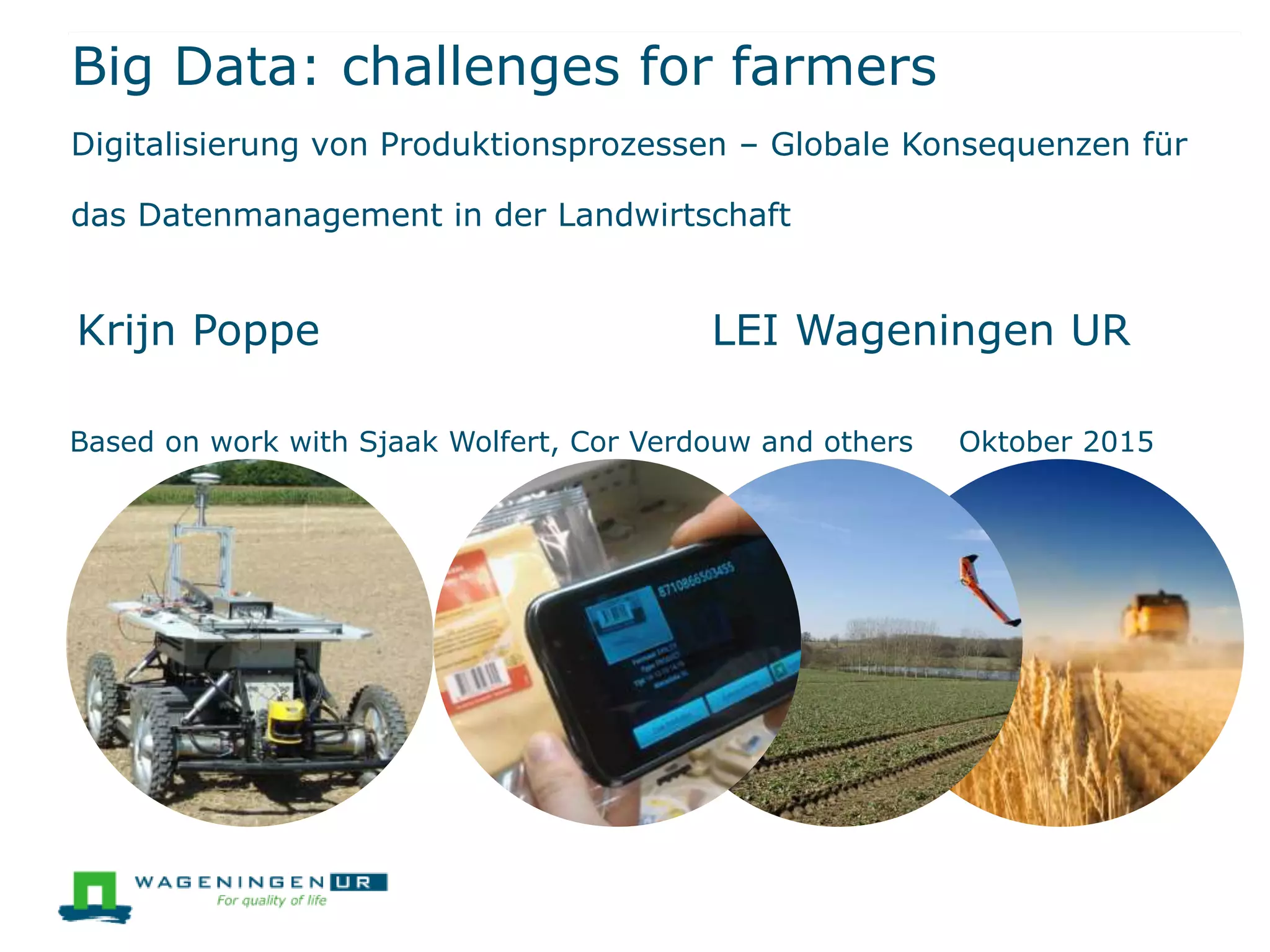
Big Data: challenges for farmers
Digitalisierung von Produktionsprozessen – Globale Konsequenzen für
das Datenmanagement in der Landwirtschaft
Krijn Poppe LEI Wageningen UR
Based on work with Sjaak Wolfert, Cor Verdouw and others Oktober 2015
Disruptive ICT Trends:
 Mobile/Cloud Computing – smart phones, wearables,
incl. sensors
 Internet of Things – everything gets connected in the
internet (virtualisation, M2M, autonomous devices)
 Location-based monitoring - satellite and remote sensing
technology, geo information, drones, etc.
 Social media - Facebook, Twitter, Wiki, etc.
Big Data - Web of Data, Linked Open Data
High Potential for unprecedented innovations!
everywhere
anything
anywhere
everybody
Which innovations and new business models are possible ?
Precision Farming/Advice Segment Cons. supportService ++
• Prescriptive farming
• Predictive maintenance
• Eco-systems of apps
• Regionally pooled big data
analysis for science and
advise (and risk mgt.)
• Personalized
advise by apps
• Online shops
• Integrated supply chains
• Feedback consumer-producer
• Measure, pay
sustainability
• Better T&T
• Paperless chain
• Store
replenishment
• Category
management
Sustainability HealthFood SafetyFood Security
LoyaltySMEs Cost priceGRIN Cope with retail
Transport
Input industries
Farmer Food processor Retail / consumerSoftware
Provider
Logistic
solution
providers
Transport+
Collaboration and Data Exchange is needed!
Data exchange by ABCDEFs
 Large organisations mostly have gone digital, with ERP
and other systems
 But between organisations (especially with SMEs) data
exchange and interoperability is still very poor
 While more data exchange for collaboration and business
process control in the chain is needed
● As data need to be combined to create value
● The better we exchange data, the less disruptive it is
for current business models and organisations
There is a need for ABCDEFs:
Agri-Business Collaboration & Data Exchange Facility
Proprietary/closed or open ABCDEFs?
Redefining Industry Boundaries (1/2)
(according to Porter and Heppelmann, Harvard Business Review, 2014)
6
3. Smart, connected product
+
+
+
2. Smart Product
1. Product
Redefining Industry Boundaries (2/2)
(according to Porter and Heppelmann, Harvard Business Review, 2014)
7
5. System of systems
farm
management
system
farm
equipment
system
weather
data
system
irrigation
system
seed
optimizing
system
field
sensors
irrigation
nodes
irrigation
application
seed
optimization
application
farm
performance
database
seed
database
weather data
application
weather
forecasts
weather
maps
rain, humidity,
temperature sensors
farm
equipment
system
planters
tillers
combine
harvesters
4. Product system
Is this
‘mono-equipment
system’ reality?
How to cope with
changes in industry
boundries?
How many
platforms should
users and
developers enter?
Agri-Food Supply
Chain Networks
are multi-
dimensional
• Markets allocate
products to different
destinations
• Chains are
supported by many
service providers
• Intensive data-
exchange with
governments
law & regulation
innovation
geographic
cluster
horizontal
fulfillment
Vertical
Farm Digital project
Sharing Data with AgriPlace:
Compliance Made Easy
https://www.agriplace.com
LESS ADMINISTRATIVE BURDEN
AND CREATING VALUE
Auditors
• More effective audit on farm
• More new clients
• Savings of >€100 per audit visit
Farmers and Growers
• Less time and irritation to collect data
• More digital management
• Savings of >€500 euro per grower
Retailers
• Quicker and more complete data
• Better risk management
• > €30 savings per farm request
Importers and Food processors
• Cost savings on data collection
• Increase data quality
• Savings > €10,000 per importer
Consumers
• Relation with growers
• Better understanding of labels
• More transparency
PROTOTYPE
AGRI-PLACE
FMS-manage-
ment software
GOV. open data
LEI Wageningen UR
Benchmark-data
The USA battleground: Monsanto (et al.)
11
PRESCRIPTIVE
FARMING
based on
VARIABLE RATE
APPLICATION
USA: Farmers Business Network
12
Farmers’ owned,
investment by Google
Ventures
Summer 2015:
FBN has aggregated data from 7
million acres of farm land across
17 states, and they’re growing
30% month over month. The
platform is currently
able to assess the performance
of 500 seeds and 16 different
crops.
Costs farmer $ 500 / year.
USA: Farm Mobile
13
“Farmers believe their trust has been violated”:
their data go to multinationals, that announce
big future income from big data, while they have
pay for everything.
Farmers collect
‘crop stories’
and decide where
they travel (and get a
few cents per item?)
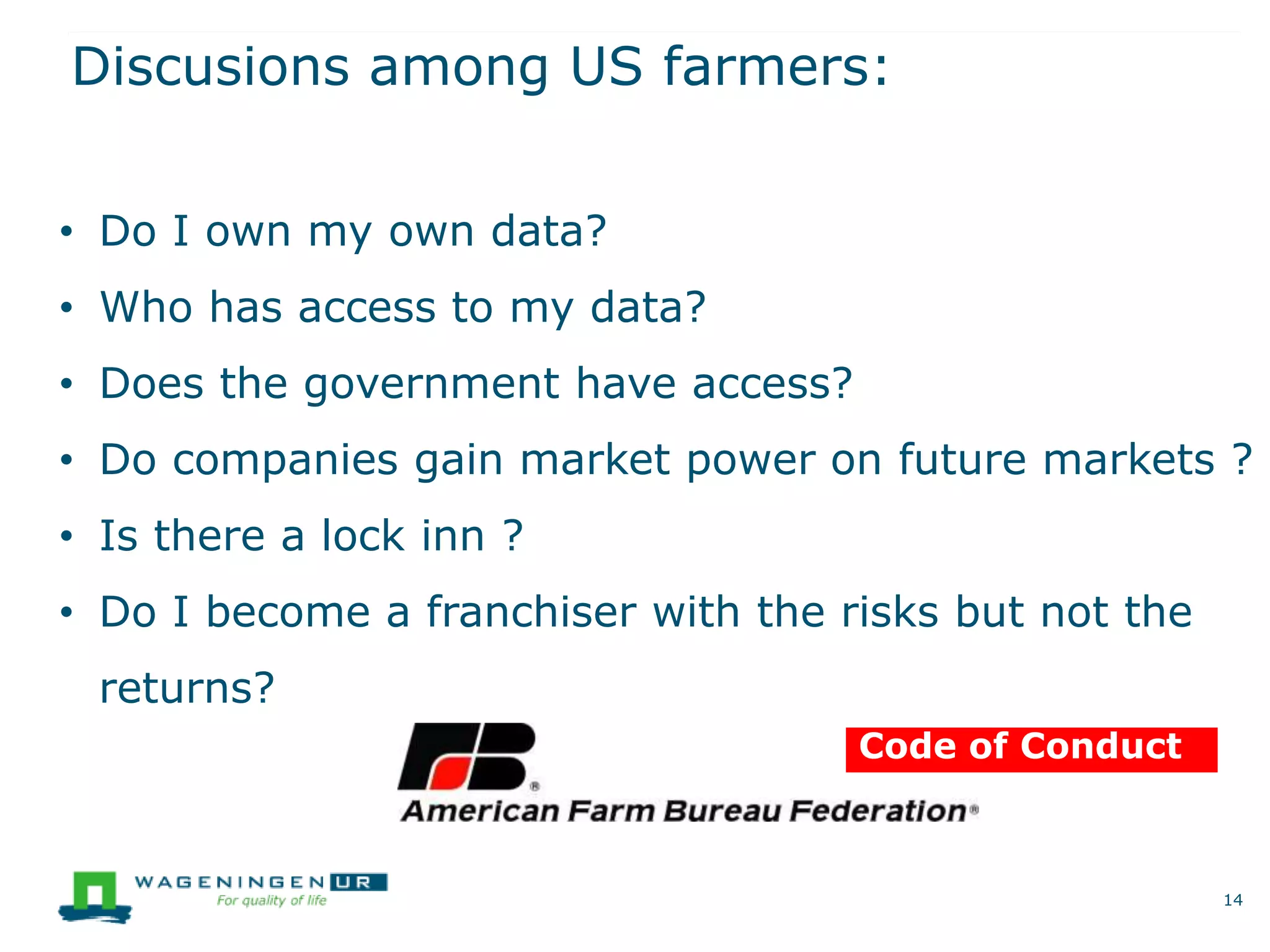
Discusions among US farmers:
14
Code of Conduct
• Do I own my own data?
• Who has access to my data?
• Does the government have access?
• Do companies gain market power on future markets ?
• Is there a lock inn ?
• Do I become a franchiser with the risks but not the
returns?
Towards the future:
15
• Farming becomes data based
• Data have mainly a value if they are combined
and aggregated
• Huge network effects can lead to monopolies
• That means that collaboration / cooperation is
needed and good governance is key.
• Is there a solution?
Is an eco-system of apps an alternative?
FARMER SCANS PESTICIDES PACKAGE IN THE FIELD
APP CONNECTS BASF FOR E-INSTRUCTION,
CROP AND SOIL SPECIFIC
APP ASK METEO FOR 24 hour WEATHER FORECAST
BASF SENDS INSTRUCTION TO SPRAYING MACHINE
ON WATER / PESTICIDE RATIO >> Machine adjusts
APP CHECKS ADVISE WITH GOV.AGENCY
FARMER CAN SHARE DATA WITH GOVERNMENT,
SGS-AUDITOR GLOBAL GAP AND PUBLIC
CAN I USE
MY CURRENT
SERVICE ?
CAN I USE
MY FMS ?
DOES IT
WORK WITH
BAYER /
DEERE
DOES IT
WORK WITH
BRC /
ISAcert
Can we link apps / services in a clever way ?
Leading to a market for services (apps and
data)?
Can this market be European (not MS), so
that development costs of services (apps and
data) are shared ?
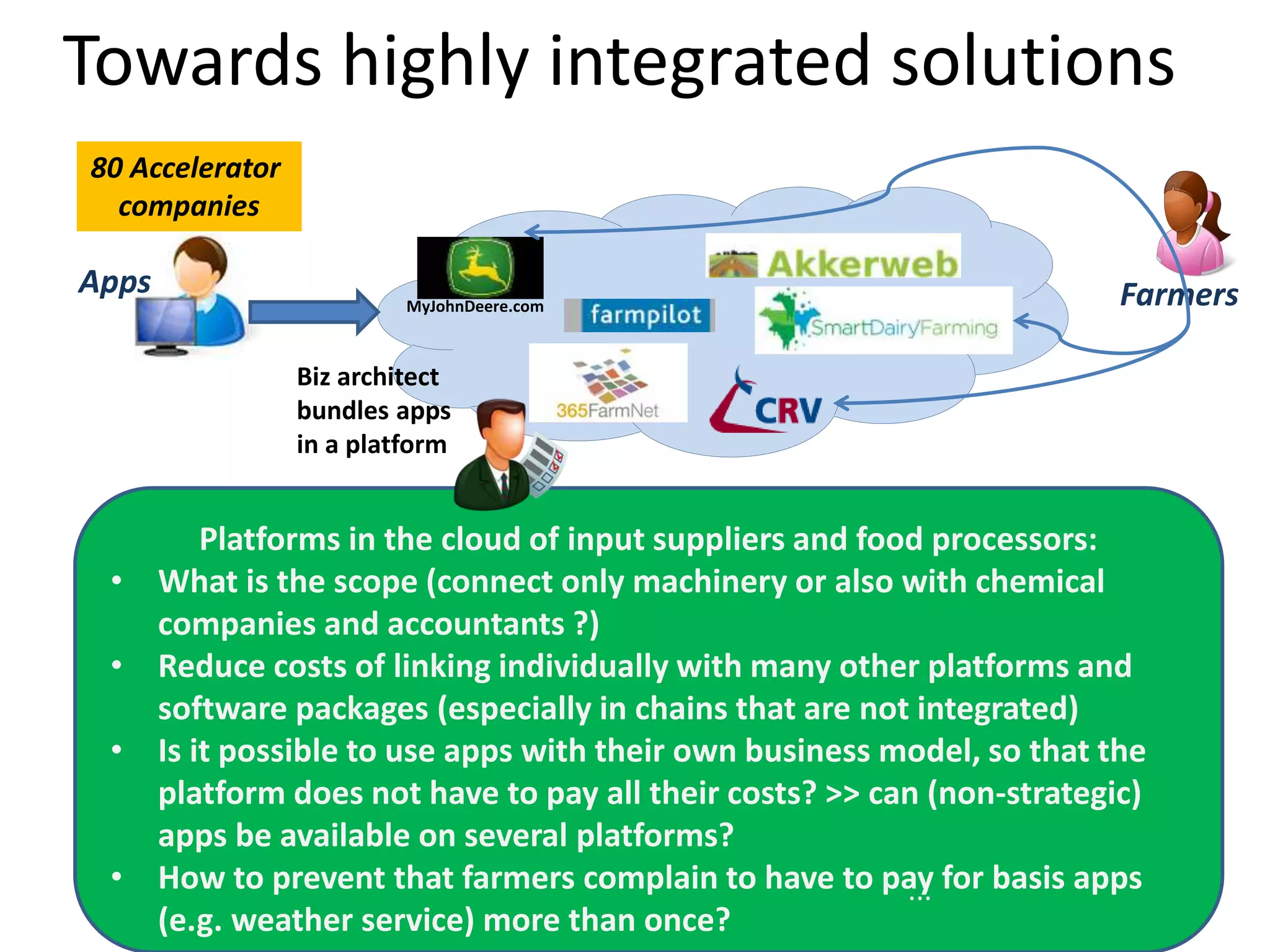
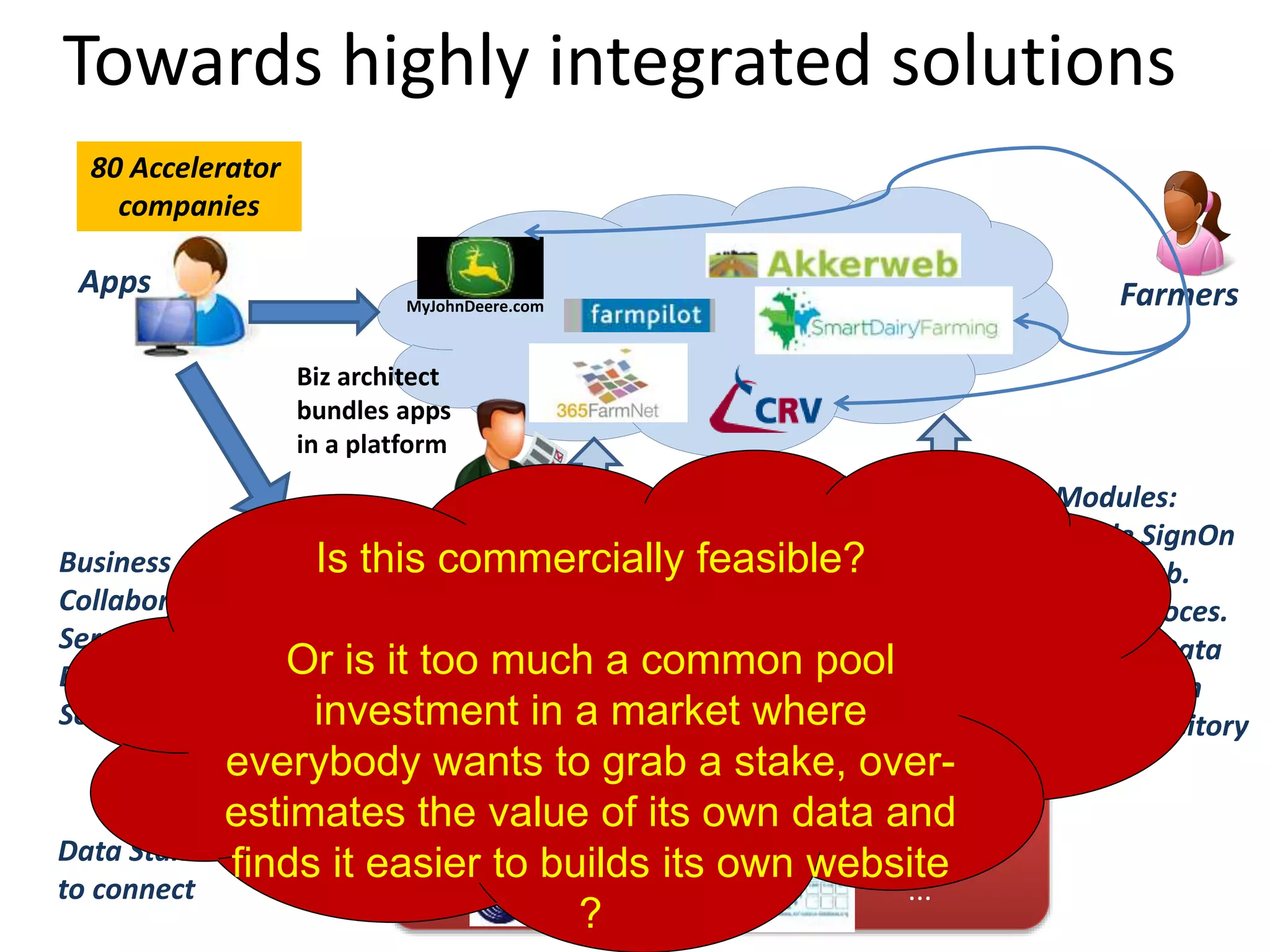
Towards highly integrated solutions
Platforms in the cloud of input suppliers and food processors:
• What is the scope (connect only machinery or also with chemical
companies and accountants ?)
• Reduce costs of linking individually with many other platforms and
software packages (especially in chains that are not integrated)
• Is it possible to use apps with their own business model, so that the
platform does not have to pay all their costs? >> can (non-strategic)
apps be available on several platforms?
• How to prevent that farmers complain to have to pay for basis apps
(e.g. weather service) more than once?
MyJohnDeere.com Farmers
Biz architect
bundles apps
in a platform
...
80 Accelerator
companies
Apps
Towards highly integrated solutions
Highly Integrated Service Solutions
• Event-driven
• Configurable
• Customizable
• Service model
Data (Standardisation) Services
AdaptEPCIS
MyJohnDeere.com
Data Standards
to connect
Business
Collaboration
Services -
Based on Open
Source Software
Farmers
Biz architect
bundles apps
in a platform
...
80 Accelerator
companies
Apps
Modules:
Single SignOn
Biz Collab.
Event Proces.
System-Data
integration
App repository
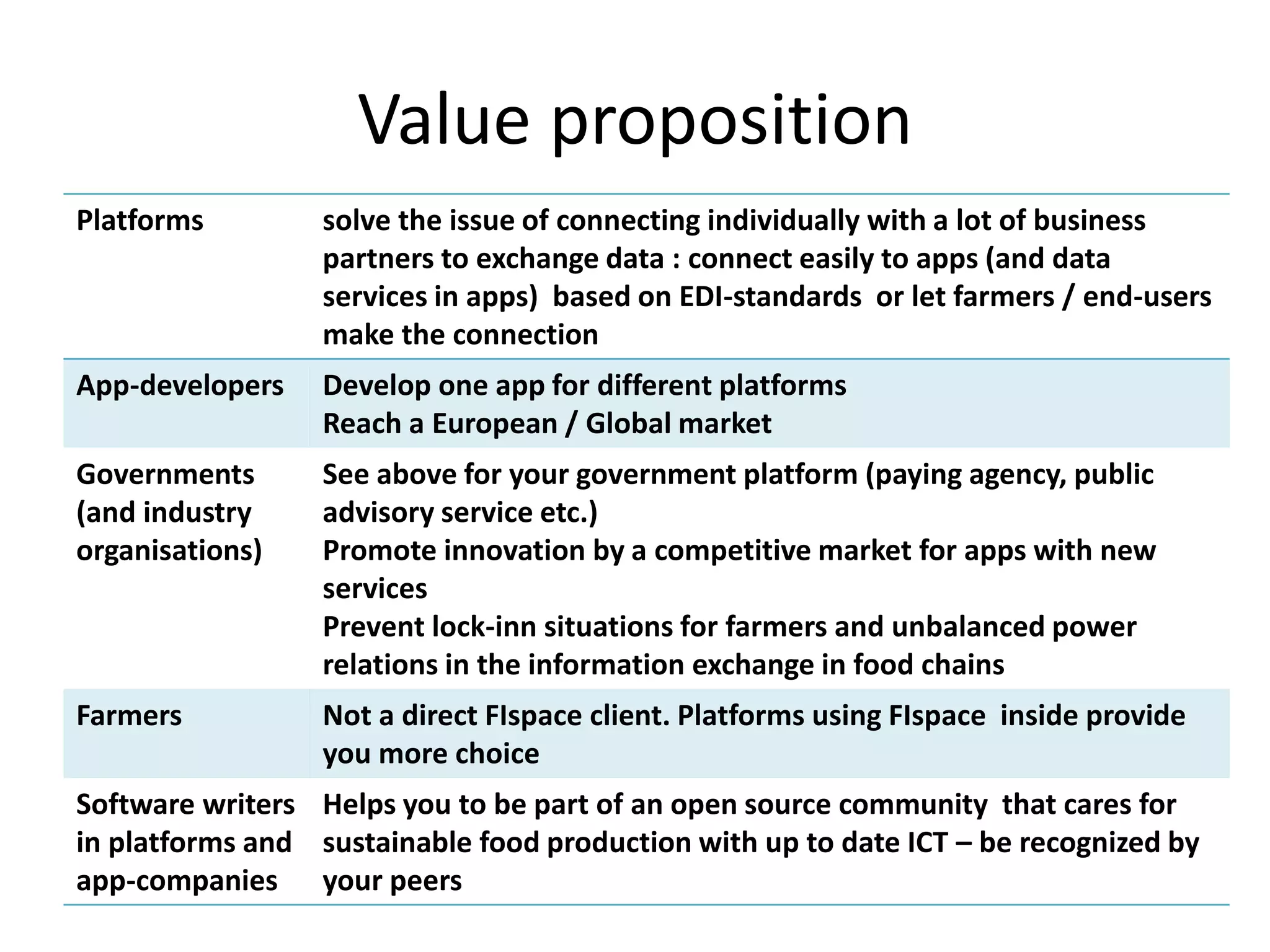
Value proposition
Platforms solve the issue of connecting individually with a lot of business
partners to exchange data : connect easily to apps (and data
services in apps) based on EDI-standards or let farmers / end-users
make the connection
App-developers Develop one app for different platforms
Reach a European / Global market
Governments
(and industry
organisations)
See above for your government platform (paying agency, public
advisory service etc.)
Promote innovation by a competitive market for apps with new
services
Prevent lock-inn situations for farmers and unbalanced power
relations in the information exchange in food chains
Farmers Not a direct FIspace client. Platforms using FIspace inside provide
you more choice
Software writers
in platforms and
app-companies
Helps you to be part of an open source community that cares for
sustainable food production with up to date ICT – be recognized by
your peers
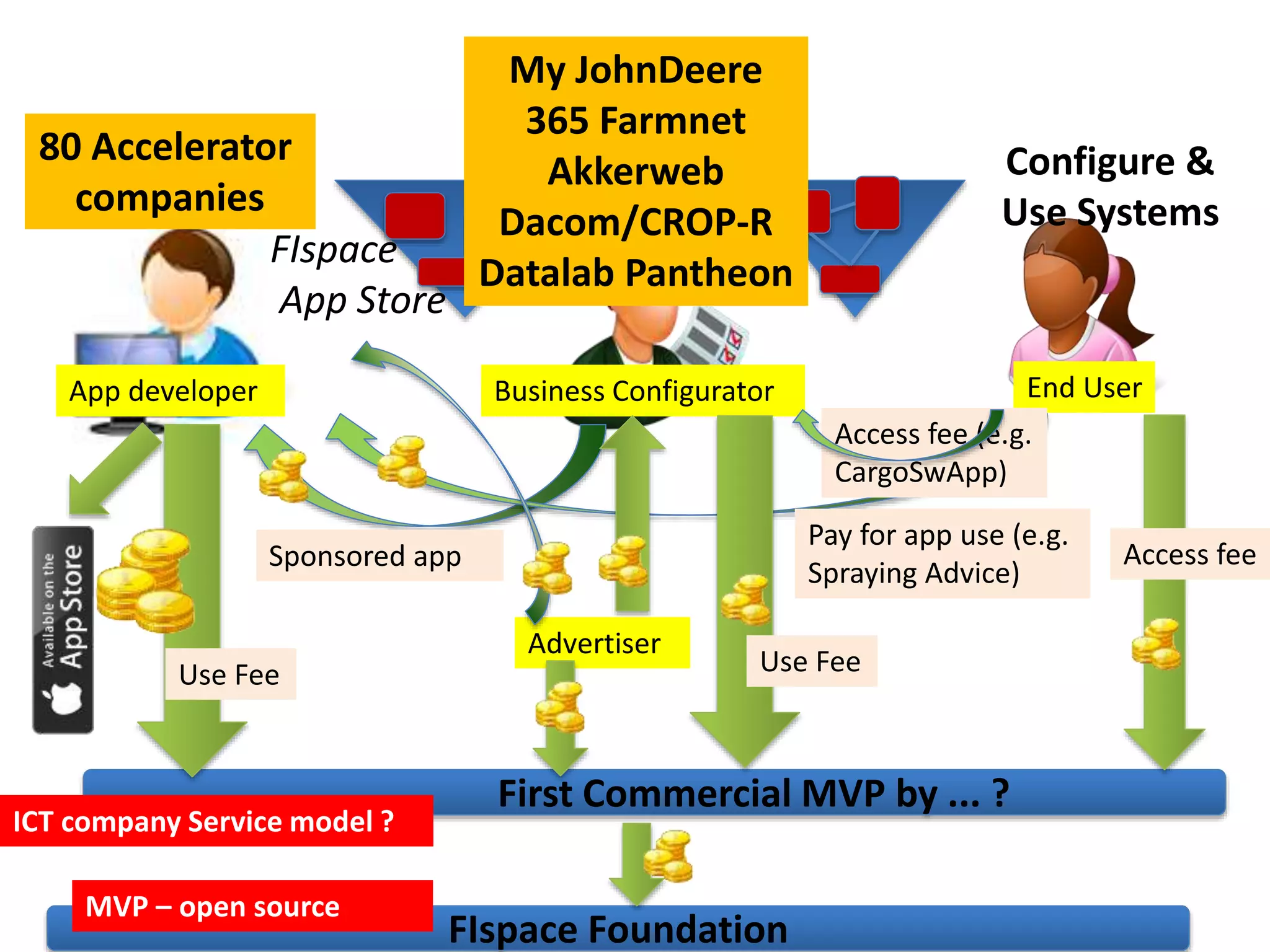
FIspace
App Store
80 Accelerator
companies
Configure &
Use Systems
First Commercial MVP by ... ?
App developer Business Configurator End User
Advertiser
Access fee
Use Fee Use Fee
Access fee (e.g.
CargoSwApp)
Pay for app use (e.g.
Spraying Advice)
Sponsored app
FIspace Foundation
MVP – open source
My JohnDeere
365 Farmnet
Akkerweb
Dacom/CROP-R
Datalab Pantheon
ICT company Service model ?
Towards highly integrated solutions
Highly Integrated Service Solutions
• Event-driven
• Configurable
• Customizable
• Service model
Data (Standardisation) Services
AdaptEPCIS
MyJohnDeere.com
Data Standards
to connect
Business
Collaboration
Services -
Based on Open
Source Software
Farmers
Biz architect
bundles apps
in a platform
...
80 Accelerator
companies
Apps
Modules:
Single SignOn
Biz Collab.
Event Proces.
System-Data
integration
App repository
Is this commercially feasible?
Or is it too much a common pool
investment in a market where
everybody wants to grab a stake, over-
estimates the value of its own data and
finds it easier to builds its own website
?
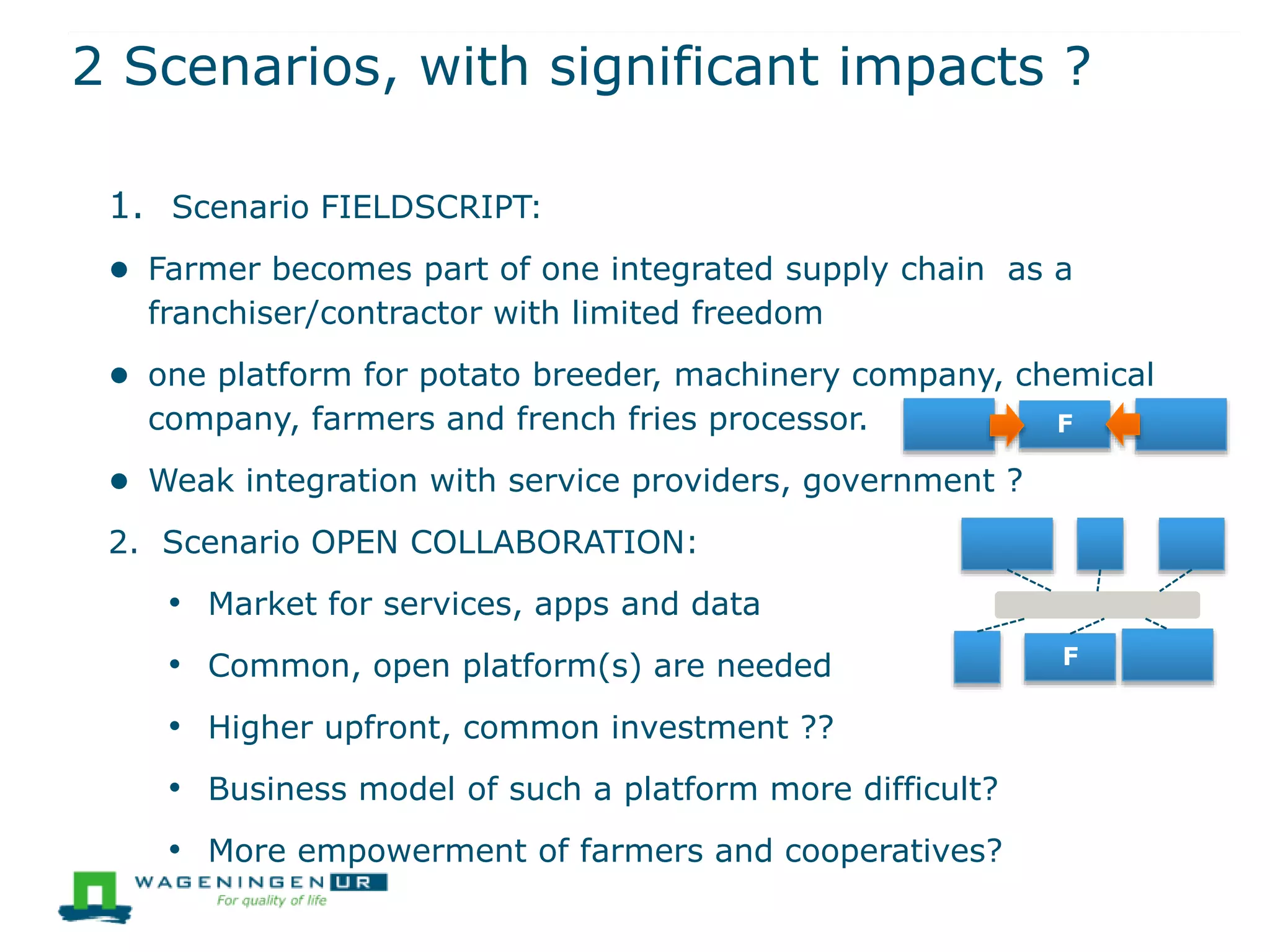
2 Scenarios, with significant impacts ?
1. Scenario FIELDSCRIPT:
● Farmer becomes part of one integrated supply chain as a
franchiser/contractor with limited freedom
● one platform for potato breeder, machinery company, chemical
company, farmers and french fries processor.
● Weak integration with service providers, government ?
2. Scenario OPEN COLLABORATION:
• Market for services, apps and data
• Common, open platform(s) are needed
• Higher upfront, common investment ??
• Business model of such a platform more difficult?
• More empowerment of farmers and cooperatives?
F
F
Points for discussion (1/2)
 Ownership of farm data: the farmer, the robot supplier
that puts the data in a database and refines it, the
accountant that has an IPR on its report?
 Liability: if it goes wrong when Dutch software is used by
a Belgian contractor in spraying potatoes in N.France with
a wrong update of the French pesticide regulations to
instruct a German spraying machine ?
 Business model (who pays what?) and governance of
ABCDEF platform:
● Farmers / cooperatives owned, pay by use?
● Neutral organisation (a Data / Platform cooperative?)
● Commercially run by an ICT company?
● Governmental infrastructure ?
Points for discussion (2/2)
 Do differences in privacy laws / worries play a role?
 Are issues of cyber-security coming up?
 Can cooperatives deal with advanced ICT-using members
and paper-oriented farmers at the same time?
 What ABCDEFs to copy from the USA, what to develop in
Europe?
 The EU is launching a big call (30 mln euro) for solving
these issues in an Internet of Things environment: can
we work together between farmers and industry to sort
these things out, using that EU support ?
Thanks for your
attention
krijn.poppe@wur.nl
www.lei.wur.nl
www.FIspace.eu

Krijn Poppe tagung dbv berlin 2015

  • 1.
    Big Data: challengesfor farmers Digitalisierung von Produktionsprozessen – Globale Konsequenzen für das Datenmanagement in der Landwirtschaft Krijn Poppe LEI Wageningen UR Based on work with Sjaak Wolfert, Cor Verdouw and others Oktober 2015
  • 3.
    Disruptive ICT Trends: Mobile/Cloud Computing – smart phones, wearables, incl. sensors  Internet of Things – everything gets connected in the internet (virtualisation, M2M, autonomous devices)  Location-based monitoring - satellite and remote sensing technology, geo information, drones, etc.  Social media - Facebook, Twitter, Wiki, etc. Big Data - Web of Data, Linked Open Data High Potential for unprecedented innovations! everywhere anything anywhere everybody
  • 4.
    Which innovations andnew business models are possible ? Precision Farming/Advice Segment Cons. supportService ++ • Prescriptive farming • Predictive maintenance • Eco-systems of apps • Regionally pooled big data analysis for science and advise (and risk mgt.) • Personalized advise by apps • Online shops • Integrated supply chains • Feedback consumer-producer • Measure, pay sustainability • Better T&T • Paperless chain • Store replenishment • Category management Sustainability HealthFood SafetyFood Security LoyaltySMEs Cost priceGRIN Cope with retail Transport Input industries Farmer Food processor Retail / consumerSoftware Provider Logistic solution providers Transport+ Collaboration and Data Exchange is needed!
  • 5.
    Data exchange byABCDEFs  Large organisations mostly have gone digital, with ERP and other systems  But between organisations (especially with SMEs) data exchange and interoperability is still very poor  While more data exchange for collaboration and business process control in the chain is needed ● As data need to be combined to create value ● The better we exchange data, the less disruptive it is for current business models and organisations There is a need for ABCDEFs: Agri-Business Collaboration & Data Exchange Facility Proprietary/closed or open ABCDEFs?
  • 6.
    Redefining Industry Boundaries(1/2) (according to Porter and Heppelmann, Harvard Business Review, 2014) 6 3. Smart, connected product + + + 2. Smart Product 1. Product
  • 7.
    Redefining Industry Boundaries(2/2) (according to Porter and Heppelmann, Harvard Business Review, 2014) 7 5. System of systems farm management system farm equipment system weather data system irrigation system seed optimizing system field sensors irrigation nodes irrigation application seed optimization application farm performance database seed database weather data application weather forecasts weather maps rain, humidity, temperature sensors farm equipment system planters tillers combine harvesters 4. Product system Is this ‘mono-equipment system’ reality? How to cope with changes in industry boundries? How many platforms should users and developers enter?
  • 8.
    Agri-Food Supply Chain Networks aremulti- dimensional • Markets allocate products to different destinations • Chains are supported by many service providers • Intensive data- exchange with governments law & regulation innovation geographic cluster horizontal fulfillment Vertical
  • 9.
    Farm Digital project SharingData with AgriPlace: Compliance Made Easy https://www.agriplace.com
  • 10.
    LESS ADMINISTRATIVE BURDEN ANDCREATING VALUE Auditors • More effective audit on farm • More new clients • Savings of >€100 per audit visit Farmers and Growers • Less time and irritation to collect data • More digital management • Savings of >€500 euro per grower Retailers • Quicker and more complete data • Better risk management • > €30 savings per farm request Importers and Food processors • Cost savings on data collection • Increase data quality • Savings > €10,000 per importer Consumers • Relation with growers • Better understanding of labels • More transparency PROTOTYPE AGRI-PLACE FMS-manage- ment software GOV. open data LEI Wageningen UR Benchmark-data
  • 11.
    The USA battleground:Monsanto (et al.) 11 PRESCRIPTIVE FARMING based on VARIABLE RATE APPLICATION
  • 12.
    USA: Farmers BusinessNetwork 12 Farmers’ owned, investment by Google Ventures Summer 2015: FBN has aggregated data from 7 million acres of farm land across 17 states, and they’re growing 30% month over month. The platform is currently able to assess the performance of 500 seeds and 16 different crops. Costs farmer $ 500 / year.
  • 13.
    USA: Farm Mobile 13 “Farmersbelieve their trust has been violated”: their data go to multinationals, that announce big future income from big data, while they have pay for everything. Farmers collect ‘crop stories’ and decide where they travel (and get a few cents per item?)
  • 14.
    Discusions among USfarmers: 14 Code of Conduct • Do I own my own data? • Who has access to my data? • Does the government have access? • Do companies gain market power on future markets ? • Is there a lock inn ? • Do I become a franchiser with the risks but not the returns?
  • 15.
    Towards the future: 15 •Farming becomes data based • Data have mainly a value if they are combined and aggregated • Huge network effects can lead to monopolies • That means that collaboration / cooperation is needed and good governance is key. • Is there a solution?
  • 16.
    Is an eco-systemof apps an alternative? FARMER SCANS PESTICIDES PACKAGE IN THE FIELD APP CONNECTS BASF FOR E-INSTRUCTION, CROP AND SOIL SPECIFIC APP ASK METEO FOR 24 hour WEATHER FORECAST BASF SENDS INSTRUCTION TO SPRAYING MACHINE ON WATER / PESTICIDE RATIO >> Machine adjusts APP CHECKS ADVISE WITH GOV.AGENCY FARMER CAN SHARE DATA WITH GOVERNMENT, SGS-AUDITOR GLOBAL GAP AND PUBLIC CAN I USE MY CURRENT SERVICE ? CAN I USE MY FMS ? DOES IT WORK WITH BAYER / DEERE DOES IT WORK WITH BRC / ISAcert Can we link apps / services in a clever way ? Leading to a market for services (apps and data)? Can this market be European (not MS), so that development costs of services (apps and data) are shared ?
  • 17.
    Towards highly integratedsolutions Platforms in the cloud of input suppliers and food processors: • What is the scope (connect only machinery or also with chemical companies and accountants ?) • Reduce costs of linking individually with many other platforms and software packages (especially in chains that are not integrated) • Is it possible to use apps with their own business model, so that the platform does not have to pay all their costs? >> can (non-strategic) apps be available on several platforms? • How to prevent that farmers complain to have to pay for basis apps (e.g. weather service) more than once? MyJohnDeere.com Farmers Biz architect bundles apps in a platform ... 80 Accelerator companies Apps
  • 18.
    Towards highly integratedsolutions Highly Integrated Service Solutions • Event-driven • Configurable • Customizable • Service model Data (Standardisation) Services AdaptEPCIS MyJohnDeere.com Data Standards to connect Business Collaboration Services - Based on Open Source Software Farmers Biz architect bundles apps in a platform ... 80 Accelerator companies Apps Modules: Single SignOn Biz Collab. Event Proces. System-Data integration App repository
  • 19.
    Value proposition Platforms solvethe issue of connecting individually with a lot of business partners to exchange data : connect easily to apps (and data services in apps) based on EDI-standards or let farmers / end-users make the connection App-developers Develop one app for different platforms Reach a European / Global market Governments (and industry organisations) See above for your government platform (paying agency, public advisory service etc.) Promote innovation by a competitive market for apps with new services Prevent lock-inn situations for farmers and unbalanced power relations in the information exchange in food chains Farmers Not a direct FIspace client. Platforms using FIspace inside provide you more choice Software writers in platforms and app-companies Helps you to be part of an open source community that cares for sustainable food production with up to date ICT – be recognized by your peers
  • 20.
    FIspace App Store 80 Accelerator companies Configure& Use Systems First Commercial MVP by ... ? App developer Business Configurator End User Advertiser Access fee Use Fee Use Fee Access fee (e.g. CargoSwApp) Pay for app use (e.g. Spraying Advice) Sponsored app FIspace Foundation MVP – open source My JohnDeere 365 Farmnet Akkerweb Dacom/CROP-R Datalab Pantheon ICT company Service model ?
  • 21.
    Towards highly integratedsolutions Highly Integrated Service Solutions • Event-driven • Configurable • Customizable • Service model Data (Standardisation) Services AdaptEPCIS MyJohnDeere.com Data Standards to connect Business Collaboration Services - Based on Open Source Software Farmers Biz architect bundles apps in a platform ... 80 Accelerator companies Apps Modules: Single SignOn Biz Collab. Event Proces. System-Data integration App repository Is this commercially feasible? Or is it too much a common pool investment in a market where everybody wants to grab a stake, over- estimates the value of its own data and finds it easier to builds its own website ?
  • 22.
    2 Scenarios, withsignificant impacts ? 1. Scenario FIELDSCRIPT: ● Farmer becomes part of one integrated supply chain as a franchiser/contractor with limited freedom ● one platform for potato breeder, machinery company, chemical company, farmers and french fries processor. ● Weak integration with service providers, government ? 2. Scenario OPEN COLLABORATION: • Market for services, apps and data • Common, open platform(s) are needed • Higher upfront, common investment ?? • Business model of such a platform more difficult? • More empowerment of farmers and cooperatives? F F
  • 23.
    Points for discussion(1/2)  Ownership of farm data: the farmer, the robot supplier that puts the data in a database and refines it, the accountant that has an IPR on its report?  Liability: if it goes wrong when Dutch software is used by a Belgian contractor in spraying potatoes in N.France with a wrong update of the French pesticide regulations to instruct a German spraying machine ?  Business model (who pays what?) and governance of ABCDEF platform: ● Farmers / cooperatives owned, pay by use? ● Neutral organisation (a Data / Platform cooperative?) ● Commercially run by an ICT company? ● Governmental infrastructure ?
  • 24.
    Points for discussion(2/2)  Do differences in privacy laws / worries play a role?  Are issues of cyber-security coming up?  Can cooperatives deal with advanced ICT-using members and paper-oriented farmers at the same time?  What ABCDEFs to copy from the USA, what to develop in Europe?  The EU is launching a big call (30 mln euro) for solving these issues in an Internet of Things environment: can we work together between farmers and industry to sort these things out, using that EU support ?
  • 25.

Editor's Notes

  • #3 2
  • #5 Note that for most of these
  • #8 Current Farm management systems are not capable to do what is suggested in the picture. Therefore we have developed FIspace!
  • #9 8