DIGITALIZATION TO TRANSFORM AGRICULTURE
IN AFRICA - COVID 19 & Beyond
FAO-AfDB Webinar Series
10 June 2020
2ScaleInnovationfromShutterstock.com
Trade disruptions through imposition of trade barriers for
agricultural inputs and outputs
Disruption of production including missing crop cycles, or
precautionary changes in cropping pattern (staple self-sufficiency)
Logistics and distribution disruptions across and within countries
associated with input supply, closure of markets, consumer
movement restriction and other restrictions
Labour shortages associated with the lockdown regarding both
local and migrant labour
Liquidity problems for agrifood firms due to lockdowns
Demand side shifts Reduction in consumption of fresh fruits &
vegetables in favor of stables and long shelf-life food
COVID-19: MAIN IMPACTS ON AGRICULTURE
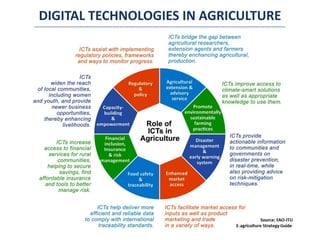
DIGITAL TECHNOLOGIES IN AGRICULTURE
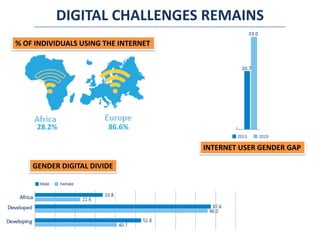
DIGITAL CHALLENGES REMAINS
GENDER DIGITAL DIVIDE
% OF INDIVIDUALS USING THE INTERNET
28.2% 86.6%
INTERNET USER GENDER GAP
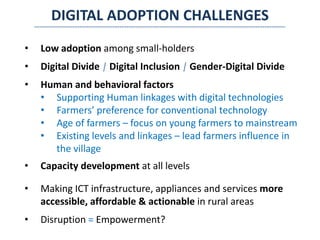
DIGITAL ADOPTION CHALLENGES
• Low adoption among small-holders
• Digital Divide | Digital Inclusion | Gender-Digital Divide
• Human and behavioral factors
• Supporting Human linkages with digital technologies
• Farmers’ preference for conventional technology
• Age of farmers – focus on young farmers to mainstream
• Existing levels and linkages – lead farmers influence in
the village
• Capacity development at all levels
• Making ICT infrastructure, appliances and services more
accessible, affordable & actionable in rural areas
• Disruption = Empowerment?
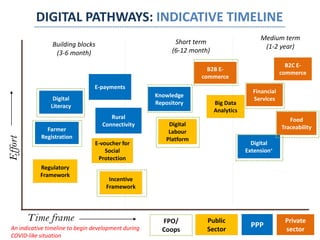
Effort
Time frame
Farmer
Registration
Big Data
Analytics
E-voucher for
Social
Protection
Knowledge
Repository
Regulatory
Framework
Short term
(6-12 month)
Incentive
Framework
Building blocks
(3-6 month)
Digital
Literacy
Medium term
(1-2 year)
E-payments
Rural
Connectivity Digital
Labour
Platform
B2C E-
commerce
Financial
Services
Public
Sector
PPP
Food
Traceability
Private
sector
B2B E-
commerce
Digital
Extension+
An indicative timeline to begin development during
COVID-like situation
DIGITAL PATHWAYS: INDICATIVE TIMELINE
FPO/
Coops
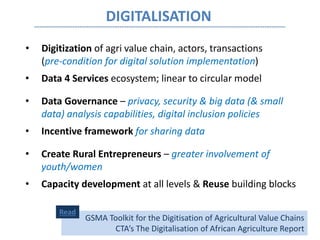
DIGITALISATION
GSMA Toolkit for the Digitisation of Agricultural Value Chains
CTA’s The Digitalisation of African Agriculture Report
Read
• Digitization of agri value chain, actors, transactions
(pre-condition for digital solution implementation)
• Data 4 Services ecosystem; linear to circular model
• Data Governance – privacy, security & big data (& small
data) analysis capabilities, digital inclusion policies
• Incentive framework for sharing data
• Create Rural Entrepreneurs – greater involvement of
youth/women
• Capacity development at all levels & Reuse building blocks
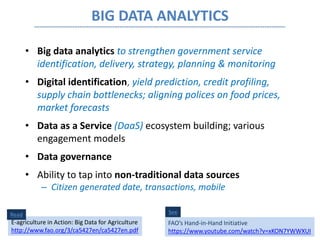
BIG DATA ANALYTICS
• Big data analytics to strengthen government service
identification, delivery, strategy, planning & monitoring
• Digital identification, yield prediction, credit profiling,
supply chain bottlenecks; aligning polices on food prices,
market forecasts
• Data as a Service (DaaS) ecosystem building; various
engagement models
• Data governance
• Ability to tap into non-traditional data sources
– Citizen generated date, transactions, mobile
See
FAO’s Hand-in-Hand Initiative
https://www.youtube.com/watch?v=xKON7YWWXUI
E-agriculture in Action: Big Data for Agriculture
http://www.fao.org/3/ca5427en/ca5427en.pdf
Read
DIGITAL FINANCIAL SERVICES
• Preference for cash -> Value creation by DFS
• Capacity | Next mile connectivity
• Innovative & relevant financing models – peer-to-peer
lending
• Supports building agri-services (subsidies, insurance,
logistics, mechanization)
• Managing diverse partnerships; opportunities for
newer actors providing financial services
• Regulations, KYC, AML
UNCDF Global Strategy: Leaving No One Behind in the Digital Era
ITU Focus Group on Digital Financial Services
Read
DIGITAL AGRICULTURE EXTENSION+
• Digital content creation – RLOs
• Support extension actors - Facilitating two-way,
peer-to-peer knowledge sharing
• Target multiple delivery medium - SMS, call
centers, IVRs, videos, television, radio, social
networks
• Village Knowledge Centres - Built trusts, creates
rural entrepreneurs
• Actionable, hyper-local advisories – data
harmonization
• Build on and strengthen existing rural linkages
FAO’s Extension and advisory services: at the frontline
of the response to COVID-19 to ensure food security
Read
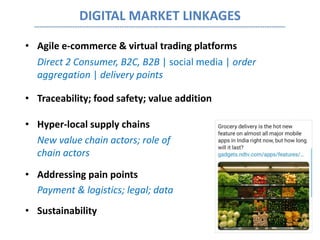
DIGITAL MARKET LINKAGES
• Agile e-commerce & virtual trading platforms
Direct 2 Consumer, B2C, B2B | social media | order
aggregation | delivery points
• Traceability; food safety; value addition
• Hyper-local supply chains
New value chain actors; role of existing value-
chain actors
• Addressing pain points
Payment & logistics; legal; data
• Sustainability
INFRASTRUCTURE & REGULATIONS
• Hard Infrastructure
Connectivity (Mobile-networks, IoTs service providers)
Data collection, storage, insights and dissemination
• Soft Infrastructure
E-Government frameworks & services
Regulatory framework for improved data governance
Interoperability (platform, data & application)
Incentives for improve participation in the digital
ecosystem
Open data
• Public-Private partnerships (ex: MNOs)
• Economies of scale & scope
• Handling regulatory uncertainties
STRENGTHENING DIGITAL ECOSYSTEM IN AFRICA
• Regulatory Framework: Develop the regulatory and
institutional framework required to integrate their digital
economies
• Legal Framework: Legal and regulatory framework to enables
digital transactions
• Data Governance: Legislation to regulate data and consumer
protection, data ownership, security and e-transactions
• Infrastructure (digital & physical): Improving digital
infrastructure. Investing in roads, storage facilities,
warehouses, and regional trade facilities.
• Capacities: Improvement in technical education, capacity
development at all levels to participate in the digital
ecosystem.
• Policies: To encourage innovation, incentives to uptake of
digital services/solutions.
Twitter: @thisisgerard | @carlobravi61
Gerard Sylvester | Carlo Bravi
gerard.sylvester@fao.org | carlo.bravi@fao.org
www.fao.org
THANK YOU

Digitalization to transform African Agriculture

  • 1.
    DIGITALIZATION TO TRANSFORMAGRICULTURE IN AFRICA - COVID 19 & Beyond FAO-AfDB Webinar Series 10 June 2020 2ScaleInnovationfromShutterstock.com
  • 2.
    Trade disruptions throughimposition of trade barriers for agricultural inputs and outputs Disruption of production including missing crop cycles, or precautionary changes in cropping pattern (staple self-sufficiency) Logistics and distribution disruptions across and within countries associated with input supply, closure of markets, consumer movement restriction and other restrictions Labour shortages associated with the lockdown regarding both local and migrant labour Liquidity problems for agrifood firms due to lockdowns Demand side shifts Reduction in consumption of fresh fruits & vegetables in favor of stables and long shelf-life food COVID-19: MAIN IMPACTS ON AGRICULTURE
  • 3.
  • 4.
    DIGITAL CHALLENGES REMAINS GENDERDIGITAL DIVIDE % OF INDIVIDUALS USING THE INTERNET 28.2% 86.6% INTERNET USER GENDER GAP
  • 5.
    DIGITAL ADOPTION CHALLENGES •Low adoption among small-holders • Digital Divide | Digital Inclusion | Gender-Digital Divide • Human and behavioral factors • Supporting Human linkages with digital technologies • Farmers’ preference for conventional technology • Age of farmers – focus on young farmers to mainstream • Existing levels and linkages – lead farmers influence in the village • Capacity development at all levels • Making ICT infrastructure, appliances and services more accessible, affordable & actionable in rural areas • Disruption = Empowerment?
  • 6.
    Effort Time frame Farmer Registration Big Data Analytics E-voucherfor Social Protection Knowledge Repository Regulatory Framework Short term (6-12 month) Incentive Framework Building blocks (3-6 month) Digital Literacy Medium term (1-2 year) E-payments Rural Connectivity Digital Labour Platform B2C E- commerce Financial Services Public Sector PPP Food Traceability Private sector B2B E- commerce Digital Extension+ An indicative timeline to begin development during COVID-like situation DIGITAL PATHWAYS: INDICATIVE TIMELINE FPO/ Coops
  • 7.
    DIGITALISATION GSMA Toolkit forthe Digitisation of Agricultural Value Chains CTA’s The Digitalisation of African Agriculture Report Read • Digitization of agri value chain, actors, transactions (pre-condition for digital solution implementation) • Data 4 Services ecosystem; linear to circular model • Data Governance – privacy, security & big data (& small data) analysis capabilities, digital inclusion policies • Incentive framework for sharing data • Create Rural Entrepreneurs – greater involvement of youth/women • Capacity development at all levels & Reuse building blocks
  • 8.
    BIG DATA ANALYTICS •Big data analytics to strengthen government service identification, delivery, strategy, planning & monitoring • Digital identification, yield prediction, credit profiling, supply chain bottlenecks; aligning polices on food prices, market forecasts • Data as a Service (DaaS) ecosystem building; various engagement models • Data governance • Ability to tap into non-traditional data sources – Citizen generated date, transactions, mobile See FAO’s Hand-in-Hand Initiative https://www.youtube.com/watch?v=xKON7YWWXUI E-agriculture in Action: Big Data for Agriculture http://www.fao.org/3/ca5427en/ca5427en.pdf Read
  • 9.
    DIGITAL FINANCIAL SERVICES •Preference for cash -> Value creation by DFS • Capacity | Next mile connectivity • Innovative & relevant financing models – peer-to-peer lending • Supports building agri-services (subsidies, insurance, logistics, mechanization) • Managing diverse partnerships; opportunities for newer actors providing financial services • Regulations, KYC, AML UNCDF Global Strategy: Leaving No One Behind in the Digital Era ITU Focus Group on Digital Financial Services Read
  • 10.
    DIGITAL AGRICULTURE EXTENSION+ •Digital content creation – RLOs • Support extension actors - Facilitating two-way, peer-to-peer knowledge sharing • Target multiple delivery medium - SMS, call centers, IVRs, videos, television, radio, social networks • Village Knowledge Centres - Built trusts, creates rural entrepreneurs • Actionable, hyper-local advisories – data harmonization • Build on and strengthen existing rural linkages FAO’s Extension and advisory services: at the frontline of the response to COVID-19 to ensure food security Read
  • 11.
    DIGITAL MARKET LINKAGES •Agile e-commerce & virtual trading platforms Direct 2 Consumer, B2C, B2B | social media | order aggregation | delivery points • Traceability; food safety; value addition • Hyper-local supply chains New value chain actors; role of existing value- chain actors • Addressing pain points Payment & logistics; legal; data • Sustainability
  • 12.
    INFRASTRUCTURE & REGULATIONS •Hard Infrastructure Connectivity (Mobile-networks, IoTs service providers) Data collection, storage, insights and dissemination • Soft Infrastructure E-Government frameworks & services Regulatory framework for improved data governance Interoperability (platform, data & application) Incentives for improve participation in the digital ecosystem Open data • Public-Private partnerships (ex: MNOs) • Economies of scale & scope • Handling regulatory uncertainties
  • 13.
    STRENGTHENING DIGITAL ECOSYSTEMIN AFRICA • Regulatory Framework: Develop the regulatory and institutional framework required to integrate their digital economies • Legal Framework: Legal and regulatory framework to enables digital transactions • Data Governance: Legislation to regulate data and consumer protection, data ownership, security and e-transactions • Infrastructure (digital & physical): Improving digital infrastructure. Investing in roads, storage facilities, warehouses, and regional trade facilities. • Capacities: Improvement in technical education, capacity development at all levels to participate in the digital ecosystem. • Policies: To encourage innovation, incentives to uptake of digital services/solutions.
  • 14.
    Twitter: @thisisgerard |@carlobravi61 Gerard Sylvester | Carlo Bravi gerard.sylvester@fao.org | carlo.bravi@fao.org www.fao.org THANK YOU