BIG IDEAS

Climate resilient communities for
improving rural livelihoods

S

mallholder farmers are reliant mainly on rainfed areas.

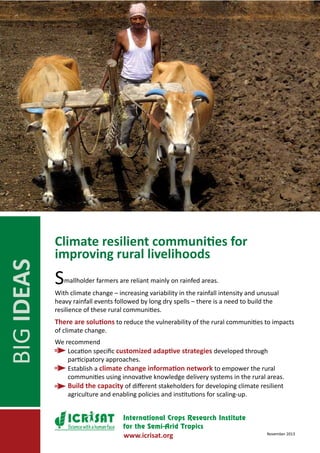
With climate change – increasing variability in the rainfall intensity and unusual
heavy rainfall events followed by long dry spells – there is a need to build the
resilience of these rural communities.

There are solutions to reduce the vulnerability of the rural communities to impacts
of climate change.

We recommend
	
Location specific customized adaptive strategies developed through
participatory approaches.
	
Establish a climate change information network to empower the rural
communities using innovative knowledge delivery systems in the rural areas.
	
Build the capacity of different stakeholders for developing climate resilient
agriculture and enabling policies and institutions for scaling-up.

Science with a human face

www.icrisat.org

November 2013
Scientific solutions and proof of concept

â–Şâ–Ş

Selected villages will be studied and climate adaptive
strategies developed, implemented and evaluated.
A proof of concept will be established by building

â–Şâ–Ş

climate resilient communities.

The solutions will be context specific including:
â–Şâ–Ş
â–Şâ–Ş

Taking into account the local catchment level,
including the multi-sectoral activities.
Enhancing crop, soil, water and other inputs
use efficiency to increase production and
profits.

Approach
â–Şâ–Ş
â–Şâ–Ş
â–Şâ–Ş
â–Şâ–Ş

Participatory development of solutions

that engage and empower the community.
A consortium of different institutions
to harness the power of public-private
partnerships.
Involvement of women and youth to build
sustainability of the interventions.

Enabling institutions and policy guidelines

â–Şâ–Ş
â–Şâ–Ş

Diversification of on-farm and other livelihood
options.
Other methods for sustainable intensification
on-farm.
Harnessing the power of new scientific tools
like ICT, GIS, simulation models and remote
sensing.
Considering the whole value chain through to
processing and markets.

Scaling up
The proof of concept for climate resilient
communities will be clearly defined models, sites of
learning and have an inventory of tested adaptation
and mitigation strategies.
Established information networks in one community
will be tapped for information sharing in other
communities.

to support the science-based solutions.

Involvement

Contact

Support development of proof of concept for
selected communities.

Suhas P Wani, Research Program Director (Acting),
Resilient Dryland Systems
Email: s.wani@cgiar.org

Assist with the scaling up of a network of climate
resilient communities.

2

A concept note for

Ensuring nutritional security in rural India

8 climate change scr

  • 1.
    BIG IDEAS Climate resilientcommunities for improving rural livelihoods S mallholder farmers are reliant mainly on rainfed areas. With climate change – increasing variability in the rainfall intensity and unusual heavy rainfall events followed by long dry spells – there is a need to build the resilience of these rural communities. There are solutions to reduce the vulnerability of the rural communities to impacts of climate change. We recommend Location specific customized adaptive strategies developed through participatory approaches. Establish a climate change information network to empower the rural communities using innovative knowledge delivery systems in the rural areas. Build the capacity of different stakeholders for developing climate resilient agriculture and enabling policies and institutions for scaling-up. Science with a human face www.icrisat.org November 2013
  • 2.
    Scientific solutions andproof of concept â–Şâ–Ş Selected villages will be studied and climate adaptive strategies developed, implemented and evaluated. A proof of concept will be established by building â–Şâ–Ş climate resilient communities. The solutions will be context specific including: â–Şâ–Ş â–Şâ–Ş Taking into account the local catchment level, including the multi-sectoral activities. Enhancing crop, soil, water and other inputs use efficiency to increase production and profits. Approach â–Şâ–Ş â–Şâ–Ş â–Şâ–Ş â–Şâ–Ş Participatory development of solutions that engage and empower the community. A consortium of different institutions to harness the power of public-private partnerships. Involvement of women and youth to build sustainability of the interventions. Enabling institutions and policy guidelines â–Şâ–Ş â–Şâ–Ş Diversification of on-farm and other livelihood options. Other methods for sustainable intensification on-farm. Harnessing the power of new scientific tools like ICT, GIS, simulation models and remote sensing. Considering the whole value chain through to processing and markets. Scaling up The proof of concept for climate resilient communities will be clearly defined models, sites of learning and have an inventory of tested adaptation and mitigation strategies. Established information networks in one community will be tapped for information sharing in other communities. to support the science-based solutions. Involvement Contact Support development of proof of concept for selected communities. Suhas P Wani, Research Program Director (Acting), Resilient Dryland Systems Email: s.wani@cgiar.org Assist with the scaling up of a network of climate resilient communities. 2 A concept note for Ensuring nutritional security in rural India