M.MANJUNATH
14051026
 IN the term ‘Oligopoly’ has been derived from
Greek words ‘ OLIGI’ means ‘few’ and
‘POLEIN’ means ‘seller’.
 A few dominant sellers sell ‘DIFFERENTIATED’
(OR) ‘HOMOGENOUS’ Products under
continuous Rivals action .
 Oligopoly looks Similar to other markets
forms as there can be many sellers ( like in
monopolistic competition) but a few very
lager sellers dominate the market.
What is Oligopoly ?
 Few Sellers:- Small no: of large firms compete..
 Entry Barriers :- No legal barriers ; only economic
in nature ..
 Huge Investment is requirements .
 Strong consumer loyalty for existing brands .
Features of ‘OLIGOPOLY’
 KINKED DEMAND CURVE .
 PRICING UNDER COLLUSION
 PRICING UNDER PRICE LEADERSHIP
3 Kinds of Pricing in ‘OLIGOPOLY MARKET’
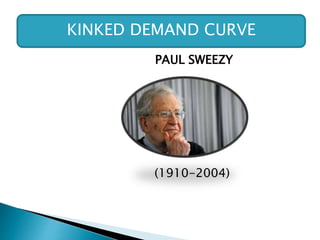
KINKED DEMAND CURVE
PAUL SWEEZY
(1910-2004)
 If a firm decrease price , others will also do
the same so, The firm initially faces a highly
elastic demand curve.
 A price reduction will gave some gains to the
firm initially, but due to similar reaction by
rivals, this increase in demand will not give
sustained.
 If a firm increases it’s price, others will not
follow. Firm will lose large no:of its customers
to rivals due to substitution effect.
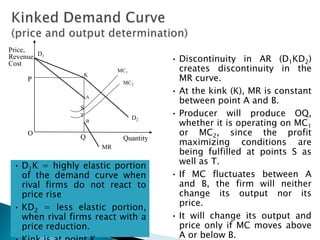
• Discontinuity in AR (D1KD2)
creates discontinuity in the
MR curve.
• At the kink (K), MR is constant
between point A and B.
• Producer will produce OQ,
whether it is operating on MC1
or MC2, since the profit
maximizing conditions are
being fulfilled at points S as
well as T.
• If MC fluctuates between A
and B, the firm will neither
change its output nor its
price.
• It will change its output and
price only if MC moves above
A or below B.
• D1K = highly elastic portion
of the demand curve when
rival firms do not react to
price rise
• KD2 = less elastic portion,
when rival firms react with a
price reduction.
D1
D2
K
A
B
MR
Quantity
O
MC1
MC2
P
Q
S
T
Price,
Revenue,
Cost
 Collusion is an agreement, usually secretive,
which occurs between two (or) more persons
to deceive , mislead , (or) defraud others of
their legal rights IT can involve “Wage fixing
between the colluding parties .
 Uniform Prices
 A penalty for Price discounts.
 Advance notice of price changes
 Information Exchange
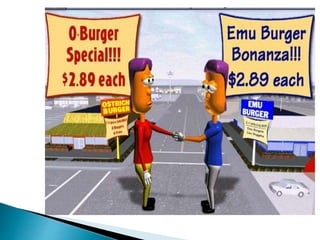
 Leader fix the prices for entire industries.
 AS a result of price war – it emerged as winner
 Agreement among various firms with regard to
price – Formal or Informal .
 Price leadership of Dominant firm major
supply .
 Barometrice:- old experiment firm
 Aggressive :- Dominant firm to eliminate
rivals.
Oligopoly market
Oligopoly market
Oligopoly market

Oligopoly market

  • 1.
  • 3.
     IN theterm ‘Oligopoly’ has been derived from Greek words ‘ OLIGI’ means ‘few’ and ‘POLEIN’ means ‘seller’.  A few dominant sellers sell ‘DIFFERENTIATED’ (OR) ‘HOMOGENOUS’ Products under continuous Rivals action .  Oligopoly looks Similar to other markets forms as there can be many sellers ( like in monopolistic competition) but a few very lager sellers dominate the market. What is Oligopoly ?
  • 4.
     Few Sellers:-Small no: of large firms compete..  Entry Barriers :- No legal barriers ; only economic in nature ..  Huge Investment is requirements .  Strong consumer loyalty for existing brands . Features of ‘OLIGOPOLY’
  • 5.
     KINKED DEMANDCURVE .  PRICING UNDER COLLUSION  PRICING UNDER PRICE LEADERSHIP 3 Kinds of Pricing in ‘OLIGOPOLY MARKET’
  • 6.
    KINKED DEMAND CURVE PAULSWEEZY (1910-2004)
  • 7.
     If afirm decrease price , others will also do the same so, The firm initially faces a highly elastic demand curve.  A price reduction will gave some gains to the firm initially, but due to similar reaction by rivals, this increase in demand will not give sustained.  If a firm increases it’s price, others will not follow. Firm will lose large no:of its customers to rivals due to substitution effect.
  • 9.
    • Discontinuity inAR (D1KD2) creates discontinuity in the MR curve. • At the kink (K), MR is constant between point A and B. • Producer will produce OQ, whether it is operating on MC1 or MC2, since the profit maximizing conditions are being fulfilled at points S as well as T. • If MC fluctuates between A and B, the firm will neither change its output nor its price. • It will change its output and price only if MC moves above A or below B. • D1K = highly elastic portion of the demand curve when rival firms do not react to price rise • KD2 = less elastic portion, when rival firms react with a price reduction. D1 D2 K A B MR Quantity O MC1 MC2 P Q S T Price, Revenue, Cost
  • 10.
     Collusion isan agreement, usually secretive, which occurs between two (or) more persons to deceive , mislead , (or) defraud others of their legal rights IT can involve “Wage fixing between the colluding parties .
  • 11.
     Uniform Prices A penalty for Price discounts.  Advance notice of price changes  Information Exchange
  • 14.
     Leader fixthe prices for entire industries.  AS a result of price war – it emerged as winner  Agreement among various firms with regard to price – Formal or Informal .
  • 15.
     Price leadershipof Dominant firm major supply .  Barometrice:- old experiment firm  Aggressive :- Dominant firm to eliminate rivals.