
VOLUME RENDERING OF
UNSTRUCTURED TETRAHEDRAL GRIDS
Flow
• Introduction
• Problem Formulation
• Tetrahedral Interpolation
• Implementation
• Results
• Demo
• Endnotes
04-06-2014
Nitesh Bhatia | CPDM
2
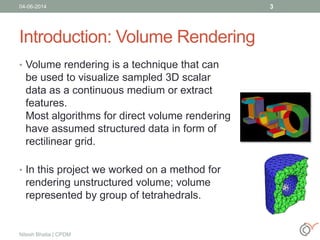
Introduction: Volume Rendering
• Volume rendering is a technique that can
be used to visualize sampled 3D scalar
data as a continuous medium or extract
features.
Most algorithms for direct volume rendering
have assumed structured data in form of
rectilinear grid.
• In this project we worked on a method for
rendering unstructured volume; volume
represented by group of tetrahedrals.
04-06-2014
Nitesh Bhatia | CPDM
3
Problem Formulation
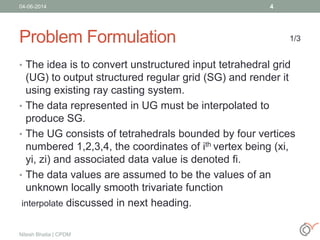
• The idea is to convert unstructured input tetrahedral grid
(UG) to output structured regular grid (SG) and render it
using existing ray casting system.
• The data represented in UG must be interpolated to
produce SG.
• The UG consists of tetrahedrals bounded by four vertices
numbered 1,2,3,4, the coordinates of ith vertex being (xi,
yi, zi) and associated data value is denoted fi.
• The data values are assumed to be the values of an
unknown locally smooth trivariate function
interpolate discussed in next heading.
04-06-2014
Nitesh Bhatia | CPDM
4
1/3
Problem Formulation
• Let P = (x,y,z) be the point at which the value of interpolation function is
to be estimated.
Two different interpolation schemes are followed here:
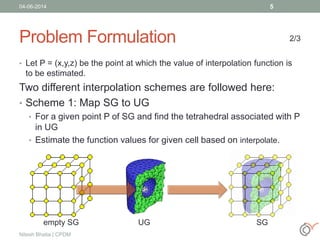
• Scheme 1: Map SG to UG
• For a given point P of SG and find the tetrahedral associated with P
in UG
• Estimate the function values for given cell based on interpolate.
04-06-2014
Nitesh Bhatia | CPDM
5
empty SG UG SG
2/3
Problem Formulation
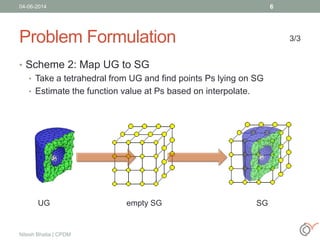
• Scheme 2: Map UG to SG
• Take a tetrahedral from UG and find points Ps lying on SG
• Estimate the function value at Ps based on interpolate.
04-06-2014
Nitesh Bhatia | CPDM
6
UG empty SG SG
3/3
Tetrahedral Interpolation: interpolate
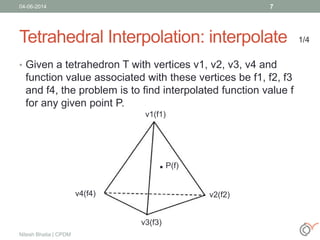
• Given a tetrahedron T with vertices v1, v2, v3, v4 and
function value associated with these vertices be f1, f2, f3
and f4, the problem is to find interpolated function value f
for any given point P.
04-06-2014
Nitesh Bhatia | CPDM
7
.P(f)
v1(f1)
v2(f2)v4(f4)
v3(f3)
1/4
Tetrahedral Interpolation: interpolate
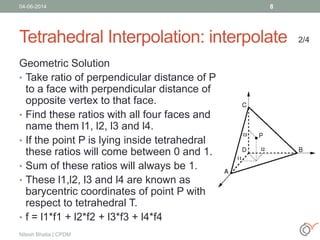
Geometric Solution
• Take ratio of perpendicular distance of P
to a face with perpendicular distance of
opposite vertex to that face.
• Find these ratios with all four faces and
name them l1, l2, l3 and l4.
• If the point P is lying inside tetrahedral
these ratios will come between 0 and 1.
• Sum of these ratios will always be 1.
• These l1,l2, l3 and l4 are known as
barycentric coordinates of point P with
respect to tetrahedral T.
• f = l1*f1 + l2*f2 + l3*f3 + l4*f4
04-06-2014 8
2/4
Nitesh Bhatia | CPDM
Tetrahedral Interpolation: interpolate
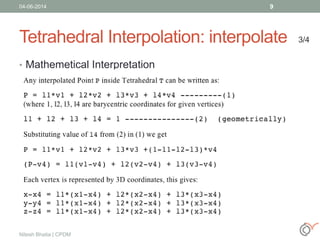
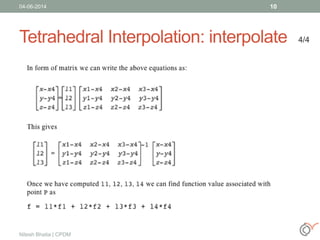
• Mathemetical Interpretation
04-06-2014
Nitesh Bhatia | CPDM
9
3/4
Tetrahedral Interpolation: interpolate
04-06-2014
Nitesh Bhatia | CPDM
10
4/4
Implementation
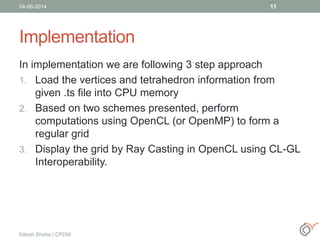
In implementation we are following 3 step approach
1. Load the vertices and tetrahedron information from
given .ts file into CPU memory
2. Based on two schemes presented, perform
computations using OpenCL (or OpenMP) to form a
regular grid
3. Display the grid by Ray Casting in OpenCL using CL-GL
Interoperability.
04-06-2014
Nitesh Bhatia | CPDM
11
Implementation: Description
Step1:
• The data set given .ts file is form of list of vertices with 3D
coordinates and associated function value and then a list of
tetrahedrons with asociated 4 vertices.
• We are first loading this information into memory.
• While loading the vertices we are computing minimum and
maximum values for (x,y,z) coordinates and storing it as minX,
minY, minZ, maxX, maxY, maxZ.
• We are then finding the difference between these minimum and
maximum values and storing it as diffX, diffY, diffZ.
• We are then computing diff equal to maximum of diffX, diffY
and diffZ.
• We are then finding dimensions of our bounding box with side
equal to diff.
04-06-2014
Nitesh Bhatia | CPDM
12
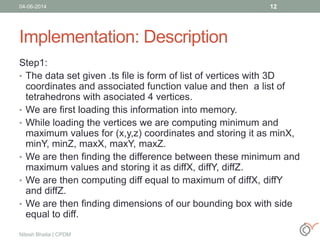
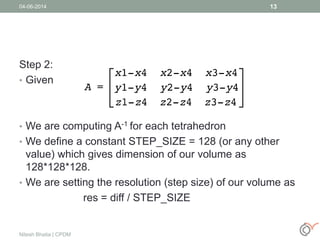
Step 2:
• Given
• We are computing A-1 for each tetrahedron
• We define a constant STEP_SIZE = 128 (or any other
value) which gives dimension of our volume as
128*128*128.
• We are setting the resolution (step size) of our volume as
res = diff / STEP_SIZE
04-06-2014
Nitesh Bhatia | CPDM
13
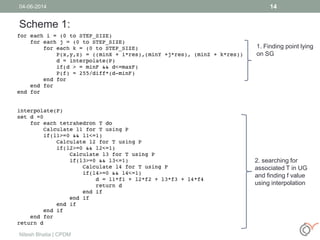
Scheme 1:
04-06-2014
Nitesh Bhatia | CPDM
14
1. Finding point lying
on SG
2. searching for
associated T in UG
and finding f value
using interpolation
• This scheme is implemented in both OpenCL and
OpenMP
• In OpenMP implementation we are adding following two
lines as compiler directive in starting of loop:
• #paragma omp set_num_threads(8)
• #paragma omp parallel for shared(i,j,k)
• In OpenCL implementation we are setting our dimensions
as 1D with
• size_t global_size = {STEP_SIZE * STEP_SIZE * STEP_SIZE}
• Here we are Parallelizing in terms of volume element
04-06-2014
Nitesh Bhatia | CPDM
15
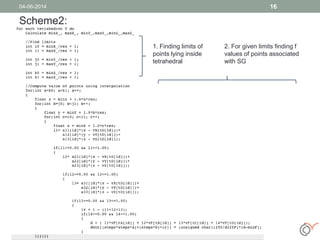
Scheme2:
04-06-2014
Nitesh Bhatia | CPDM
16
1. Finding limits of
points lying inside
tetrahedral
2. For given limits finding f
values of points associated
with SG
• Scheme 2 is implemented in OpenCL. We are setting our
dimensions as 1D with
size_t global_size = tet_qty
• Here we are Parallelizing in terms of tetrahedral quantity
Step 3:
• We are then giving this 1D grid of function values to
existing ray tracer (provided by nVidia in their SDK) as
input.
04-06-2014
Nitesh Bhatia | CPDM
17
Results
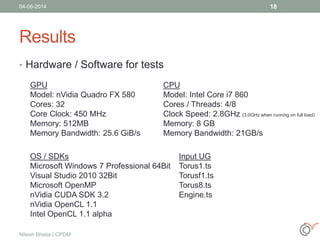
• Hardware / Software for tests
04-06-2014
Nitesh Bhatia | CPDM
18
GPU
Model: nVidia Quadro FX 580
Cores: 32
Core Clock: 450 MHz
Memory: 512MB
Memory Bandwidth: 25.6 GiB/s
CPU
Model: Intel Core i7 860
Cores / Threads: 4/8
Clock Speed: 2.8GHz (3.0GHz when running on full load)
Memory: 8 GB
Memory Bandwidth: 21GB/s
OS / SDKs
Microsoft Windows 7 Professional 64Bit
Visual Studio 2010 32Bit
Microsoft OpenMP
nVidia CUDA SDK 3.2
nVidia OpenCL 1.1
Intel OpenCL 1.1 alpha
Input UG
Torus1.ts
Torusf1.ts
Torus8.ts
Engine.ts
04-06-2014
Nitesh Bhatia | CPDM
19
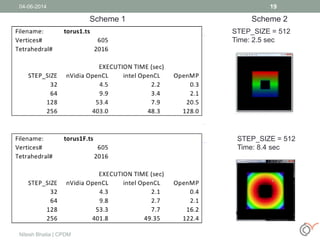
Scheme 1 Scheme 2
STEP_SIZE = 512
Time: 8.4 sec
STEP_SIZE = 512
Time: 2.5 sec
04-06-2014
Nitesh Bhatia | CPDM
20
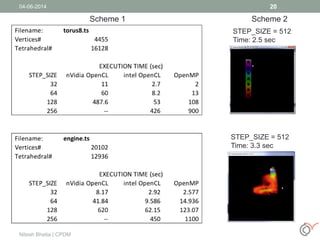
Scheme 1 Scheme 2
STEP_SIZE = 512
Time: 2.5 sec
STEP_SIZE = 512
Time: 3.3 sec
04-06-2014
Nitesh Bhatia | CPDM
21
04-06-2014
Nitesh Bhatia | CPDM
22
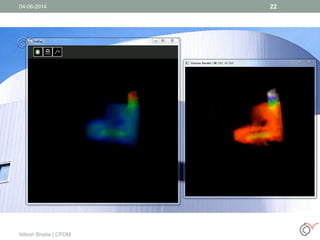
• Demo Video URL:
https://www.youtube.com/watch?v=CaBuZ7
se7-o
04-06-2014
Nitesh Bhatia | CPDM
23
Impressions
• Learning OpenCL was a challenging task but we it was
interesting.
• Debugging OpenCL is difficult task as stream output
(“printf” function) cannot be called in openCL kernel. In
Intel’s compiler is based on OpenCL 1.1 in which “printf” is
supported.
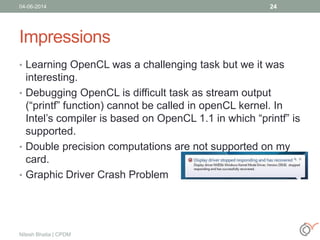
• Double precision computations are not supported on my
card.
• Graphic Driver Crash Problem
04-06-2014
Nitesh Bhatia | CPDM
24
“We now know a thousand ways not to
build a light bulb”
04-06-2014
Nitesh Bhatia | CPDM
25
THANKS !

Volume Rendering of Unstructured Tetrahedral Grids using Intel / nVidia OpenCL

  • 1.
  • 2.
    Flow • Introduction • ProblemFormulation • Tetrahedral Interpolation • Implementation • Results • Demo • Endnotes 04-06-2014 Nitesh Bhatia | CPDM 2
  • 3.
    Introduction: Volume Rendering •Volume rendering is a technique that can be used to visualize sampled 3D scalar data as a continuous medium or extract features. Most algorithms for direct volume rendering have assumed structured data in form of rectilinear grid. • In this project we worked on a method for rendering unstructured volume; volume represented by group of tetrahedrals. 04-06-2014 Nitesh Bhatia | CPDM 3
  • 4.
    Problem Formulation • Theidea is to convert unstructured input tetrahedral grid (UG) to output structured regular grid (SG) and render it using existing ray casting system. • The data represented in UG must be interpolated to produce SG. • The UG consists of tetrahedrals bounded by four vertices numbered 1,2,3,4, the coordinates of ith vertex being (xi, yi, zi) and associated data value is denoted fi. • The data values are assumed to be the values of an unknown locally smooth trivariate function interpolate discussed in next heading. 04-06-2014 Nitesh Bhatia | CPDM 4 1/3
  • 5.
    Problem Formulation • LetP = (x,y,z) be the point at which the value of interpolation function is to be estimated. Two different interpolation schemes are followed here: • Scheme 1: Map SG to UG • For a given point P of SG and find the tetrahedral associated with P in UG • Estimate the function values for given cell based on interpolate. 04-06-2014 Nitesh Bhatia | CPDM 5 empty SG UG SG 2/3
  • 6.
    Problem Formulation • Scheme2: Map UG to SG • Take a tetrahedral from UG and find points Ps lying on SG • Estimate the function value at Ps based on interpolate. 04-06-2014 Nitesh Bhatia | CPDM 6 UG empty SG SG 3/3
  • 7.
    Tetrahedral Interpolation: interpolate •Given a tetrahedron T with vertices v1, v2, v3, v4 and function value associated with these vertices be f1, f2, f3 and f4, the problem is to find interpolated function value f for any given point P. 04-06-2014 Nitesh Bhatia | CPDM 7 .P(f) v1(f1) v2(f2)v4(f4) v3(f3) 1/4
  • 8.
    Tetrahedral Interpolation: interpolate GeometricSolution • Take ratio of perpendicular distance of P to a face with perpendicular distance of opposite vertex to that face. • Find these ratios with all four faces and name them l1, l2, l3 and l4. • If the point P is lying inside tetrahedral these ratios will come between 0 and 1. • Sum of these ratios will always be 1. • These l1,l2, l3 and l4 are known as barycentric coordinates of point P with respect to tetrahedral T. • f = l1*f1 + l2*f2 + l3*f3 + l4*f4 04-06-2014 8 2/4 Nitesh Bhatia | CPDM
  • 9.
    Tetrahedral Interpolation: interpolate •Mathemetical Interpretation 04-06-2014 Nitesh Bhatia | CPDM 9 3/4
  • 10.
  • 11.
    Implementation In implementation weare following 3 step approach 1. Load the vertices and tetrahedron information from given .ts file into CPU memory 2. Based on two schemes presented, perform computations using OpenCL (or OpenMP) to form a regular grid 3. Display the grid by Ray Casting in OpenCL using CL-GL Interoperability. 04-06-2014 Nitesh Bhatia | CPDM 11
  • 12.
    Implementation: Description Step1: • Thedata set given .ts file is form of list of vertices with 3D coordinates and associated function value and then a list of tetrahedrons with asociated 4 vertices. • We are first loading this information into memory. • While loading the vertices we are computing minimum and maximum values for (x,y,z) coordinates and storing it as minX, minY, minZ, maxX, maxY, maxZ. • We are then finding the difference between these minimum and maximum values and storing it as diffX, diffY, diffZ. • We are then computing diff equal to maximum of diffX, diffY and diffZ. • We are then finding dimensions of our bounding box with side equal to diff. 04-06-2014 Nitesh Bhatia | CPDM 12
  • 13.
    Step 2: • Given •We are computing A-1 for each tetrahedron • We define a constant STEP_SIZE = 128 (or any other value) which gives dimension of our volume as 128*128*128. • We are setting the resolution (step size) of our volume as res = diff / STEP_SIZE 04-06-2014 Nitesh Bhatia | CPDM 13
  • 14.
    Scheme 1: 04-06-2014 Nitesh Bhatia| CPDM 14 1. Finding point lying on SG 2. searching for associated T in UG and finding f value using interpolation
  • 15.
    • This schemeis implemented in both OpenCL and OpenMP • In OpenMP implementation we are adding following two lines as compiler directive in starting of loop: • #paragma omp set_num_threads(8) • #paragma omp parallel for shared(i,j,k) • In OpenCL implementation we are setting our dimensions as 1D with • size_t global_size = {STEP_SIZE * STEP_SIZE * STEP_SIZE} • Here we are Parallelizing in terms of volume element 04-06-2014 Nitesh Bhatia | CPDM 15
  • 16.
    Scheme2: 04-06-2014 Nitesh Bhatia |CPDM 16 1. Finding limits of points lying inside tetrahedral 2. For given limits finding f values of points associated with SG
  • 17.
    • Scheme 2is implemented in OpenCL. We are setting our dimensions as 1D with size_t global_size = tet_qty • Here we are Parallelizing in terms of tetrahedral quantity Step 3: • We are then giving this 1D grid of function values to existing ray tracer (provided by nVidia in their SDK) as input. 04-06-2014 Nitesh Bhatia | CPDM 17
  • 18.
    Results • Hardware /Software for tests 04-06-2014 Nitesh Bhatia | CPDM 18 GPU Model: nVidia Quadro FX 580 Cores: 32 Core Clock: 450 MHz Memory: 512MB Memory Bandwidth: 25.6 GiB/s CPU Model: Intel Core i7 860 Cores / Threads: 4/8 Clock Speed: 2.8GHz (3.0GHz when running on full load) Memory: 8 GB Memory Bandwidth: 21GB/s OS / SDKs Microsoft Windows 7 Professional 64Bit Visual Studio 2010 32Bit Microsoft OpenMP nVidia CUDA SDK 3.2 nVidia OpenCL 1.1 Intel OpenCL 1.1 alpha Input UG Torus1.ts Torusf1.ts Torus8.ts Engine.ts
  • 19.
    04-06-2014 Nitesh Bhatia |CPDM 19 Scheme 1 Scheme 2 STEP_SIZE = 512 Time: 8.4 sec STEP_SIZE = 512 Time: 2.5 sec
  • 20.
    04-06-2014 Nitesh Bhatia |CPDM 20 Scheme 1 Scheme 2 STEP_SIZE = 512 Time: 2.5 sec STEP_SIZE = 512 Time: 3.3 sec
  • 21.
  • 22.
  • 23.
    • Demo VideoURL: https://www.youtube.com/watch?v=CaBuZ7 se7-o 04-06-2014 Nitesh Bhatia | CPDM 23
  • 24.
    Impressions • Learning OpenCLwas a challenging task but we it was interesting. • Debugging OpenCL is difficult task as stream output (“printf” function) cannot be called in openCL kernel. In Intel’s compiler is based on OpenCL 1.1 in which “printf” is supported. • Double precision computations are not supported on my card. • Graphic Driver Crash Problem 04-06-2014 Nitesh Bhatia | CPDM 24
  • 25.
    “We now knowa thousand ways not to build a light bulb” 04-06-2014 Nitesh Bhatia | CPDM 25 THANKS !