Chapter 3: Microscopic
observation of microorganisms
PHR- 110 (Pharmaceutical Microbiology-1)
1
Course Instructor-
Md. Samiul Alam Rajib
Senior Lecturer
Department of Pharmacy
BRAC University
In this chapter students will learn
about-
 Different types of Microscopy such as
Bright field, dark field, fluorescence
and phase contrast microscopy,
electron microscopy.
 Preparations of microscopic
examinations, wet mount and hanging
drop techniques, fixed and stained
smears.
 microbiological stains: simple and
differential staining methods
Scale
3
Discovery of Microorganisms
Antony van
Leeuwenhoek
(1632-1723)
first person to
observe and
describe
micro-
organisms
accurately
4
Figure 1.1b
Lenses and the Bending of
Light
 Light is refracted (bent) when passing
from one medium to another
 Refractive index
A measure of how greatly a substance
slows the velocity of light
 Direction and magnitude of bending
is determined by the refractive
indexes of the two media forming the
interface
5
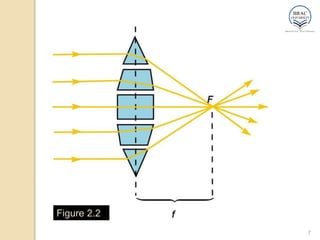
Lenses
 Focus light rays at a specific place
called the focal point
 Distance between center of lens and
focal point is the focal length
 Strength of lens related to focal length
short focal length more magnification
6
7
Figure 2.2
The Light Microscope
 Different types
Bright-field microscope
Dark-field microscope
Phase-contrast microscope
Fluorescence microscopes
 Compound microscopes
 Image formed by action of 2 lenses
8
The Bright-Field Microscope
 Produces a dark image against a
brighter background
 Has several objective lenses
Parfocal microscopes remain in focus
when objectives are changed
 Total magnification
product of the magnifications of the ocular
lens and the objective lens
9
10
Figure 2.3
11
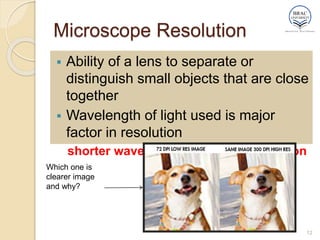
Microscope Resolution
 Ability of a lens to separate or
distinguish small objects that are close
together
 Wavelength of light used is major
factor in resolution
shorter wavelength  greater resolution
12
Which one is
clearer image
and why?
13
14
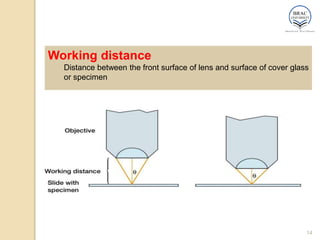
Working distance
Distance between the front surface of lens and surface of cover glass
or specimen
15
Why oil is used in oil immersion
microscopy?
The Dark-Field Microscope
 Produces a bright image of the object
against a dark background
 Used to observe living, unstained
preparations
16
17
The Phase-Contrast
Microscope
 Enhances the contrast between
intracellular structures having
slight differences in refractive
index
 Excellent way to observe living
cells
18
19
20
The Differential Interference
Contrast Microscope
 Creates image by detecting
differences in refractive indices and
thickness of different parts of
specimen
 Excellent way to observe living cells
21
The Fluorescence Microscope
 Exposes specimen to ultraviolet,
violet, or blue light
 Specimens usually stained with
fluorochromes
 Shows a bright image of the object
resulting from the fluorescent light
emitted by the specimen
22
23
24
Preparation and Staining of
Specimens
 Increases visibility of specimen
 Accentuates specific morphological
features
 Preserves specimens
25
Fixation
 Process by which internal and
external structures are preserved and
fixed in position
 Process by which organism is killed
and firmly attached to microscope
slide
Heat fixing
preserves overall morphology but not internal
structures
Chemical fixing
protects fine cellular substructure and
morphology of larger, more delicate
organisms
26
Dyes and Simple Staining
Dyes
 Make internal and external structures of
cell more visible by increasing contrast
with background
 Have two common features
 Chromophore groups
Chemical groups with conjugated double bonds
Give dye its color
 Ability to bind cells
27
Dyes and Simple Staining
simple staining
 A single staining agent is used
 Basic dyes are frequently used
dyes with positive charges
e.g., crystal violet
28
Differential Staining
Divides microorganisms into groups
based on their staining properties
e.g., Gram stain
e.g., acid-fast stain
29
Gram staining
 Most widely used differential staining
procedure
 Divides Bacteria into two groups
based on differences in cell wall
structure
30
31
primary
stain
mordant
counterstain
decolorization
positive
negative
32
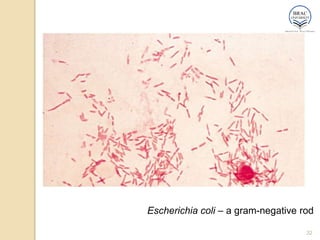
Escherichia coli – a gram-negative rod
Acid-fast staining
 particularly useful for staining
members of the genus Mycobacterium
e.g., Mycobacterium tuberculosis – causes
tuberculosis
e.g., Mycobacterium leprae – causes leprosy
◦ high lipid content in cell walls is
responsible for their staining
characteristics
33
Staining Specific Structures
Negative staining
 Often used to visualize capsules
surrounding bacteria
 Capsules are colorless against a
stained background
34
Staining Specific Structures
 Spore staining
double staining technique
bacterial endospore is one color and
vegetative cell is a different color
 Flagella staining
mordant applied to increase thickness
of flagella
35
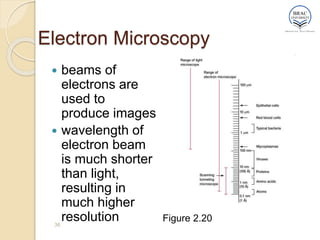
Electron Microscopy
 beams of
electrons are
used to
produce images
 wavelength of
electron beam
is much shorter
than light,
resulting in
much higher
resolution
36
Figure 2.20
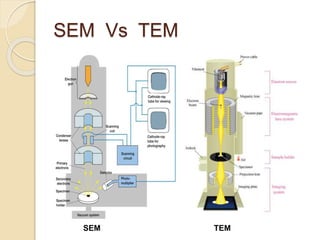
The Scanning Electron
Microscope (SEM)
 uses electrons reflected from the
surface of a specimen to create
image
 produces a 3-dimensional image of
specimen’s surface features
37
38
Figure 2.27
The Transmission Electron
Microscope (TEM)
 electrons scatter when they pass
through thin sections of a specimen
 transmitted electrons (those that do
not scatter) are used to produce
image
 denser regions in specimen, scatter
more electrons and appear darker
39
40
TEM
SEM Vs TEM
SEM TEM
Specimen Preparation
 analogous to procedures used for
light microscopy
 for transmission electron microscopy,
specimens must be cut very thin
 specimens are chemically fixed and
stained with electron dense material
42
Other preparation methods
 shadowing
◦ coating specimen with a thin film of a
heavy metal
 freeze-etching
◦ freeze specimen then fracture along lines
of greatest weakness (e.g., membranes)
43
44
Figure 2.25
45
Ebola
46
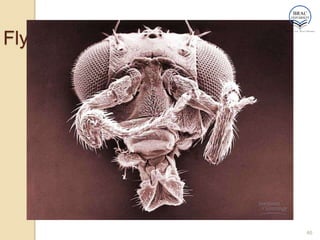
Fly head
Newer Techniques in
Microscopy
 confocal
microscopy and
scanning probe
microscopy
 have extremely
high resolution
 can be used to
observe
individual atoms
47
Figure 2.20
Confocal Microscopy
 confocal scanning laser microscope
 laser beam used to illuminate spots on
specimen
 computer compiles images created
from each point to generate a 3-
dimensional image
48
49
Figure 2.29
50
Figure 2.30
Scanning Probe Microscopy
 scanning tunneling microscope
◦ steady current (tunneling current)
maintained between microscope probe
and specimen
◦ up and down movement of probe as it
maintains current is detected and used
to create image of surface of specimen
51
Scanning Probe Microscopy
 atomic force microscope
◦ sharp probe moves over surface of
specimen at constant distance
◦ up and down movement of probe as it
maintains constant distance is detected
and used to create image
52
Magnification calculation of
compound microscopy
For tube length L = 10cm
objective focal length fo = 40 mm
and eyepiece focal length fe = 50 mm
Linear magnification of the objective lens
= ?
Angular magnification of the eyepeiece= ?
Total magnification = ?

10731570.ppt

  • 1.
    Chapter 3: Microscopic observationof microorganisms PHR- 110 (Pharmaceutical Microbiology-1) 1 Course Instructor- Md. Samiul Alam Rajib Senior Lecturer Department of Pharmacy BRAC University
  • 2.
    In this chapterstudents will learn about-  Different types of Microscopy such as Bright field, dark field, fluorescence and phase contrast microscopy, electron microscopy.  Preparations of microscopic examinations, wet mount and hanging drop techniques, fixed and stained smears.  microbiological stains: simple and differential staining methods
  • 3.
  • 4.
    Discovery of Microorganisms Antonyvan Leeuwenhoek (1632-1723) first person to observe and describe micro- organisms accurately 4 Figure 1.1b
  • 5.
    Lenses and theBending of Light  Light is refracted (bent) when passing from one medium to another  Refractive index A measure of how greatly a substance slows the velocity of light  Direction and magnitude of bending is determined by the refractive indexes of the two media forming the interface 5
  • 6.
    Lenses  Focus lightrays at a specific place called the focal point  Distance between center of lens and focal point is the focal length  Strength of lens related to focal length short focal length more magnification 6
  • 7.
  • 8.
    The Light Microscope Different types Bright-field microscope Dark-field microscope Phase-contrast microscope Fluorescence microscopes  Compound microscopes  Image formed by action of 2 lenses 8
  • 9.
    The Bright-Field Microscope Produces a dark image against a brighter background  Has several objective lenses Parfocal microscopes remain in focus when objectives are changed  Total magnification product of the magnifications of the ocular lens and the objective lens 9
  • 10.
  • 11.
  • 12.
    Microscope Resolution  Abilityof a lens to separate or distinguish small objects that are close together  Wavelength of light used is major factor in resolution shorter wavelength  greater resolution 12 Which one is clearer image and why?
  • 13.
  • 14.
    14 Working distance Distance betweenthe front surface of lens and surface of cover glass or specimen
  • 15.
    15 Why oil isused in oil immersion microscopy?
  • 16.
    The Dark-Field Microscope Produces a bright image of the object against a dark background  Used to observe living, unstained preparations 16
  • 17.
  • 18.
    The Phase-Contrast Microscope  Enhancesthe contrast between intracellular structures having slight differences in refractive index  Excellent way to observe living cells 18
  • 19.
  • 20.
  • 21.
    The Differential Interference ContrastMicroscope  Creates image by detecting differences in refractive indices and thickness of different parts of specimen  Excellent way to observe living cells 21
  • 22.
    The Fluorescence Microscope Exposes specimen to ultraviolet, violet, or blue light  Specimens usually stained with fluorochromes  Shows a bright image of the object resulting from the fluorescent light emitted by the specimen 22
  • 23.
  • 24.
  • 25.
    Preparation and Stainingof Specimens  Increases visibility of specimen  Accentuates specific morphological features  Preserves specimens 25
  • 26.
    Fixation  Process bywhich internal and external structures are preserved and fixed in position  Process by which organism is killed and firmly attached to microscope slide Heat fixing preserves overall morphology but not internal structures Chemical fixing protects fine cellular substructure and morphology of larger, more delicate organisms 26
  • 27.
    Dyes and SimpleStaining Dyes  Make internal and external structures of cell more visible by increasing contrast with background  Have two common features  Chromophore groups Chemical groups with conjugated double bonds Give dye its color  Ability to bind cells 27
  • 28.
    Dyes and SimpleStaining simple staining  A single staining agent is used  Basic dyes are frequently used dyes with positive charges e.g., crystal violet 28
  • 29.
    Differential Staining Divides microorganismsinto groups based on their staining properties e.g., Gram stain e.g., acid-fast stain 29
  • 30.
    Gram staining  Mostwidely used differential staining procedure  Divides Bacteria into two groups based on differences in cell wall structure 30
  • 31.
  • 32.
    32 Escherichia coli –a gram-negative rod
  • 33.
    Acid-fast staining  particularlyuseful for staining members of the genus Mycobacterium e.g., Mycobacterium tuberculosis – causes tuberculosis e.g., Mycobacterium leprae – causes leprosy ◦ high lipid content in cell walls is responsible for their staining characteristics 33
  • 34.
    Staining Specific Structures Negativestaining  Often used to visualize capsules surrounding bacteria  Capsules are colorless against a stained background 34
  • 35.
    Staining Specific Structures Spore staining double staining technique bacterial endospore is one color and vegetative cell is a different color  Flagella staining mordant applied to increase thickness of flagella 35
  • 36.
    Electron Microscopy  beamsof electrons are used to produce images  wavelength of electron beam is much shorter than light, resulting in much higher resolution 36 Figure 2.20
  • 37.
    The Scanning Electron Microscope(SEM)  uses electrons reflected from the surface of a specimen to create image  produces a 3-dimensional image of specimen’s surface features 37
  • 38.
  • 39.
    The Transmission Electron Microscope(TEM)  electrons scatter when they pass through thin sections of a specimen  transmitted electrons (those that do not scatter) are used to produce image  denser regions in specimen, scatter more electrons and appear darker 39
  • 40.
  • 41.
  • 42.
    Specimen Preparation  analogousto procedures used for light microscopy  for transmission electron microscopy, specimens must be cut very thin  specimens are chemically fixed and stained with electron dense material 42
  • 43.
    Other preparation methods shadowing ◦ coating specimen with a thin film of a heavy metal  freeze-etching ◦ freeze specimen then fracture along lines of greatest weakness (e.g., membranes) 43
  • 44.
  • 45.
  • 46.
  • 47.
    Newer Techniques in Microscopy confocal microscopy and scanning probe microscopy  have extremely high resolution  can be used to observe individual atoms 47 Figure 2.20
  • 48.
    Confocal Microscopy  confocalscanning laser microscope  laser beam used to illuminate spots on specimen  computer compiles images created from each point to generate a 3- dimensional image 48
  • 49.
  • 50.
  • 51.
    Scanning Probe Microscopy scanning tunneling microscope ◦ steady current (tunneling current) maintained between microscope probe and specimen ◦ up and down movement of probe as it maintains current is detected and used to create image of surface of specimen 51
  • 52.
    Scanning Probe Microscopy atomic force microscope ◦ sharp probe moves over surface of specimen at constant distance ◦ up and down movement of probe as it maintains constant distance is detected and used to create image 52
  • 53.
    Magnification calculation of compoundmicroscopy For tube length L = 10cm objective focal length fo = 40 mm and eyepiece focal length fe = 50 mm Linear magnification of the objective lens = ? Angular magnification of the eyepeiece= ? Total magnification = ?