Primitive Molecular 
Manufacturing 
Chris Phoenix 
Tihamer Toth Toth-Fejel 
NIAC Fellows Meeting, March 15 15-16
Small is Beautiful 
ÎÎScaling laws: throughput ~ size^ size^-4 
ÎÎ10 cm tool: 3 GY. 100 nm tool: 100 sec. 
ÎÎPower density ~ size^ size^-1 
ÎÎDigital logic likes to be small 
ÎÎAccess atoms ÆÆ Digital construction 
ÎÎLow wear, high strength, superlubricity 
ÎÎDigital design bottom bottom-up, like computers
Molecular Manufacturing 
ÎÎBuilding precise, useful nanoscale 
structures with nanoscale tools 
ÎÎEngineering approach to nanoscale 
ÎÎMolecular fabrication 
ÎÎAssembly and operations 
ÎÎInformation handling 
ÎÎReliability 
ÎÎEventual goal: Large, high high-performance 
products including manufacturing tools
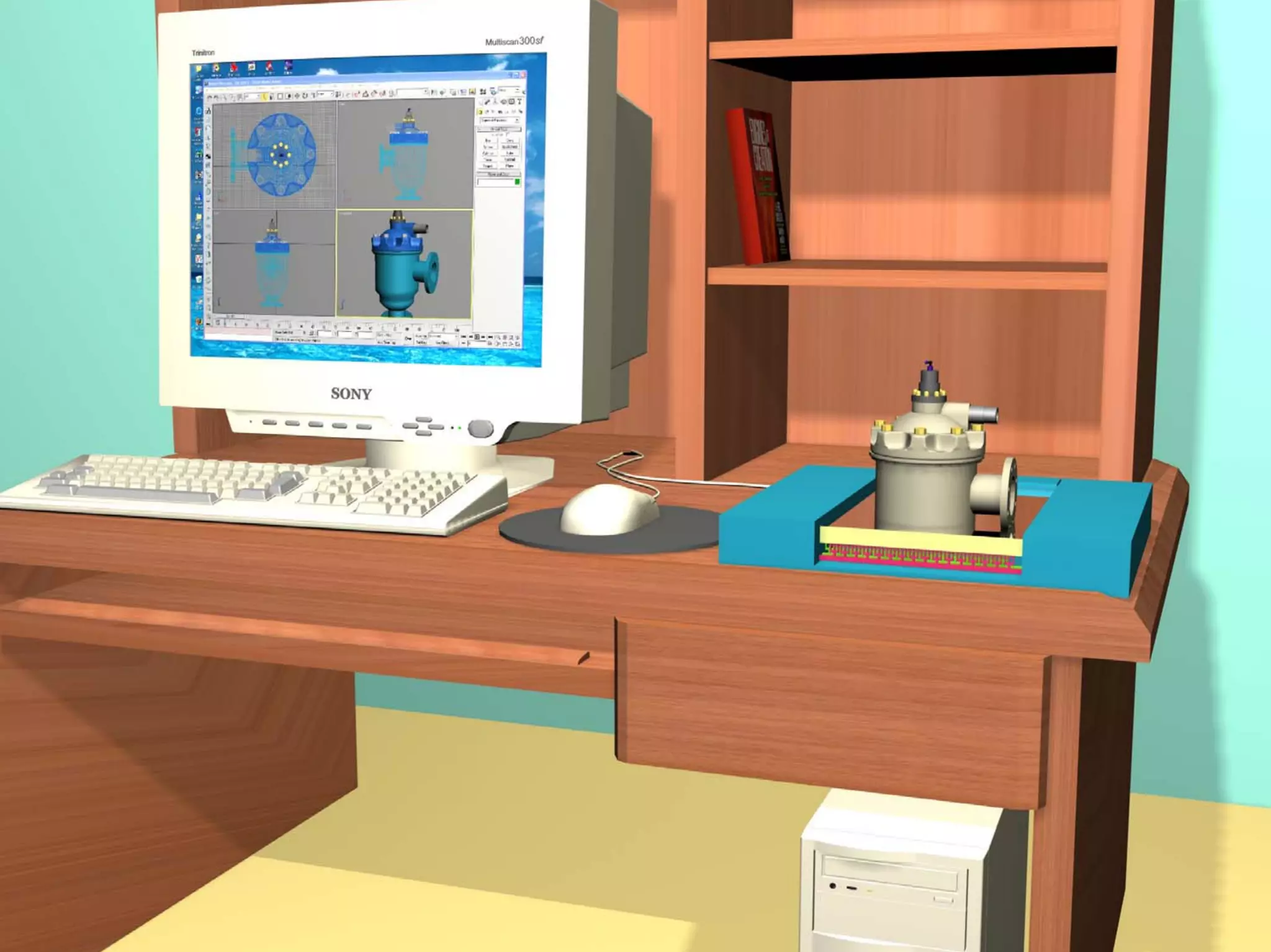
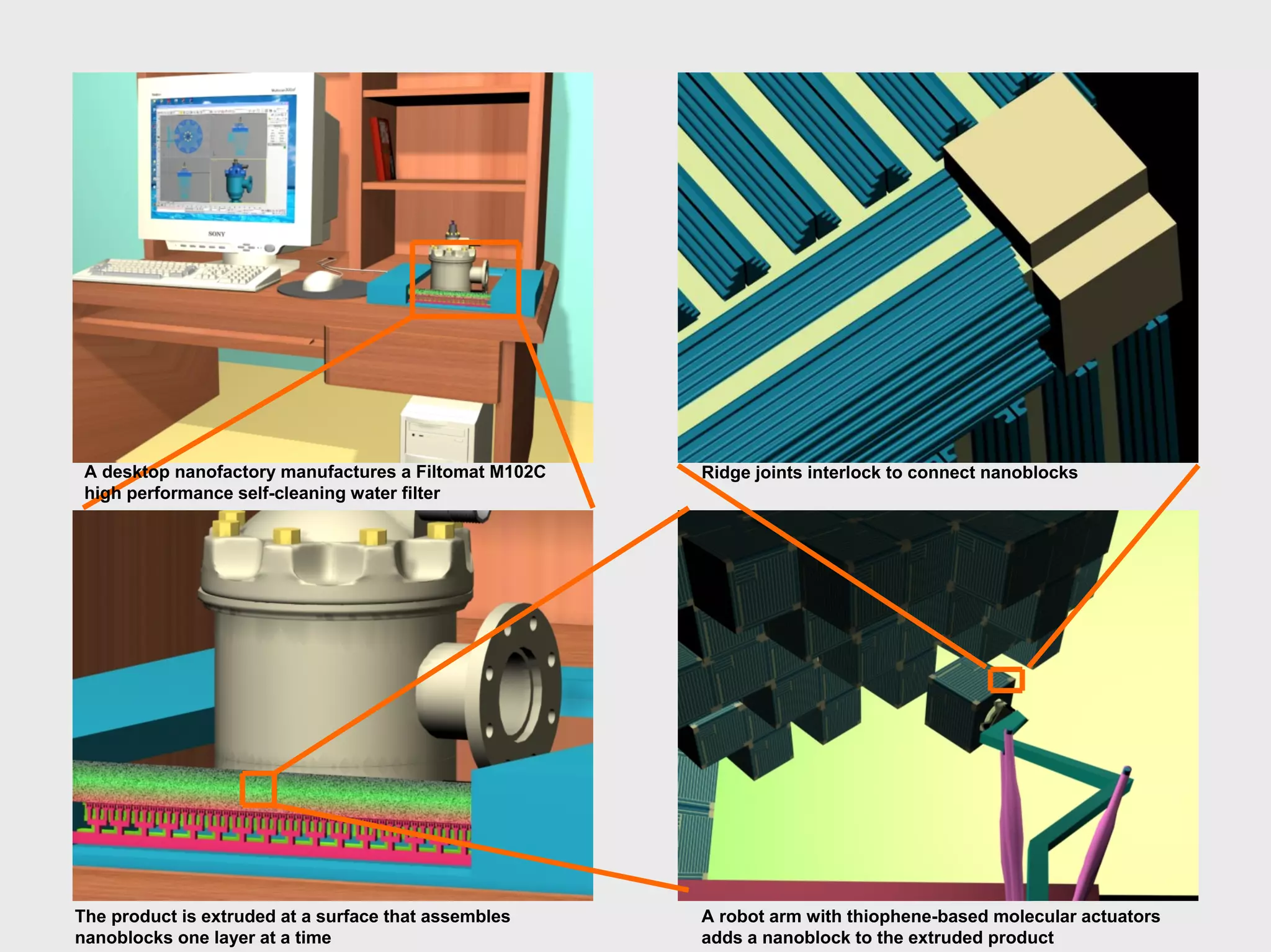
A desktop nanofactory manufactures a FiltomatM102C high performance self-cleaning water filterA robot arm with thiophene-based molecular actuators adds a nanoblock to the extruded product Ridge joints interlock to connect nanoblocks The product is extruded at a surface that assemblesnanoblocks one layer at a time
Outline 
ÎÎFoundational approach 
ÎÎUltimate goal 
ÎÎExisting capabilities 
ÎÎRoadmap
Information Delivery 
ÎÎExisting manufacturing technologies: 
A few KB per second 
ÎÎGoal: 
A few GB per second 
ÎÎThis requires: 
ÎÎVery small tools 
(or massively parallel medium medium-small tools) 
ÎÎReliable operations
Small is Beautiful 
ÎÎScaling laws: throughput ~ size^ size^-4 
ÎÎ10 cm tool: 3 GY. 100 nm tool: 100 sec. 
ÎÎPower density ~ size^ size^-1 
ÎÎDigital logic likes to be small 
ÎÎAccess atoms ÆÆ Digital construction 
ÎÎLow wear, high strength, superlubricity 
ÎÎDigital design bottom bottom-up, like computers
Rapid Design 
ÎÎOnce you get a set of reliable tools… 
You can combine them to make new tools 
ÎÎOnce you can build lots of variants… 
You can do evolutionary design 
ÎÎWith high performance and small parts… 
You can afford to use levels of abstraction
Planar Assembly 
ÎÎScaling laws indicate that deposition 
speed is independent of block/robot size 
ÎÎRobots can be sub sub-micron size 
(Human cell = 20 micron) 
ÎÎRapid joining should allow cm/sec 
deposition 
ÆÆ Build large products directly from sub sub- 
micron blocks 
(Build sub sub-micron blocks directly from atoms atoms……)
Molecular fabrication 
ÎÎToday: Bulk chemistry 
ÎÎEnvironmentally controlled polymer 
fabrication 
ÎÎSequence of operations 
ÎÎLight (“DNA Chip”) 
ÎÎGoal: Mechanically controlled reactions 
ÎÎSequence 
ÎÎPosition
Mechanosynthesis: 
Just a Tool 
ÎÎCan be either “solution phase” or 
“machine phase” 
ÎÎMechanical control of reactions: More a 
style than a restriction 
ÎÎControl can be direct or indirect 
ÎÎImplies precise nanoscale tools –– which 
we want anyway
Error Handling in 
Generational Manufacturing 
ÎÎIn molecular devices, errors are digital 
ÎÎError rates vary by many orders of 
magnitude 
ÎÎIn small self self-contained devices, you just 
need an error rate less than the number of 
operations 
ÎÎIn large devices, you will have errors 
ÎÎYou need to work around them, not pass 
them on
Nanoscale Toolkit 
ÎÎWe want tools that are: 
ÎÎReliable 
ÎÎDependable 
ÎÎEasy to characterize 
ÎÎVery flexible 
ÎÎShort Short-term tools 
Actuators; Binding/recognition; Conductors; 
Sensors; Bonding; Structure 
ÎÎLong Long-term tools 
Digital logic; Bearings; Mechanosynthesis
The Ultimate Goal 
ÎÎTabletop nanofactoy 
ÎÎProduces its own mass in ~1 hour 
ÎÎUses simple feedstock 
ÎÎDirect computer control; Rapid prototyping 
ÎÎPowerful nanoscale toolkit 
ÎÎVery high performance products 
ÎÎEasy product design 
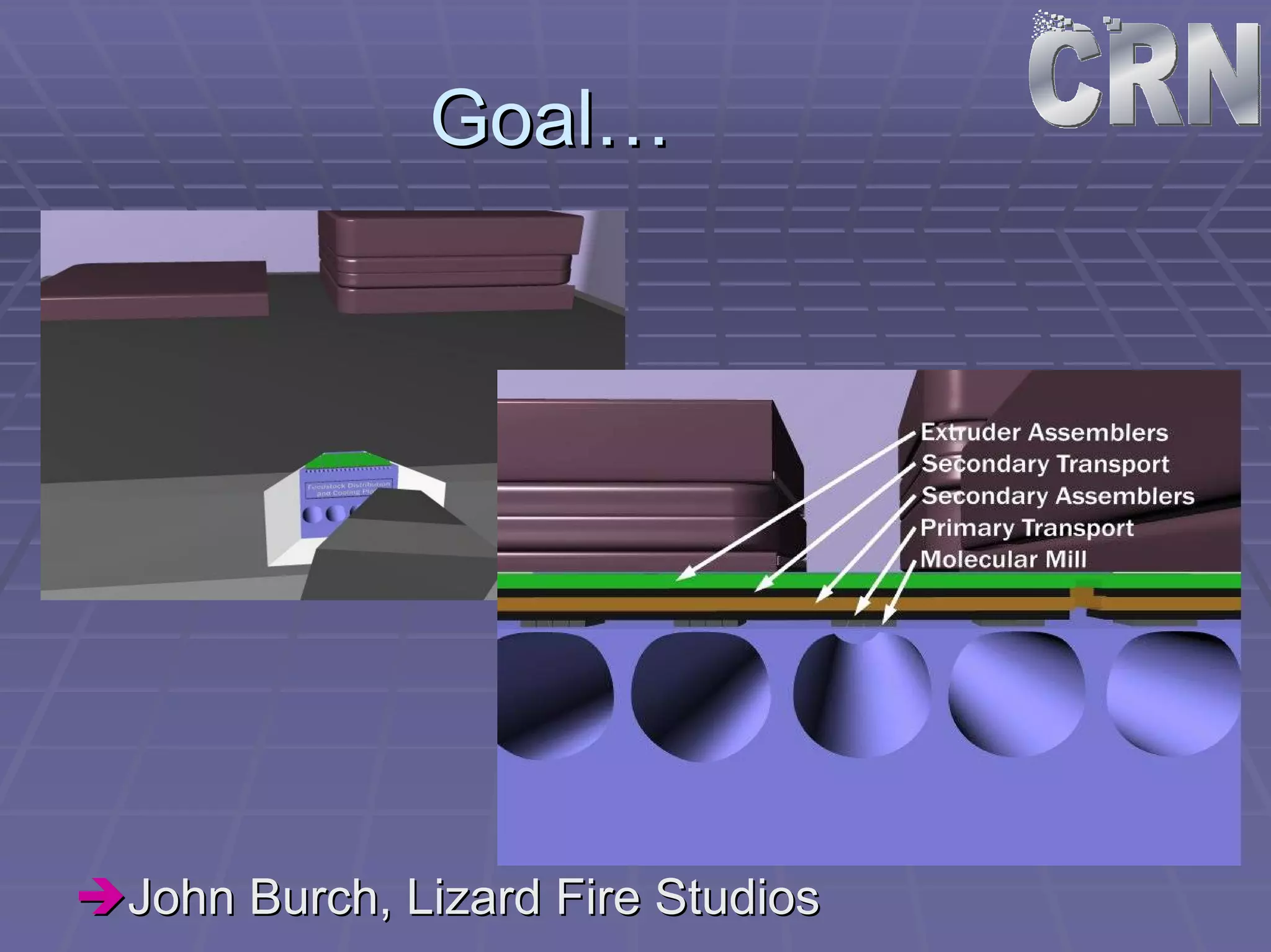
ÎÎBurch/Drexler animation (with real 
chemistry)
Where To Start 
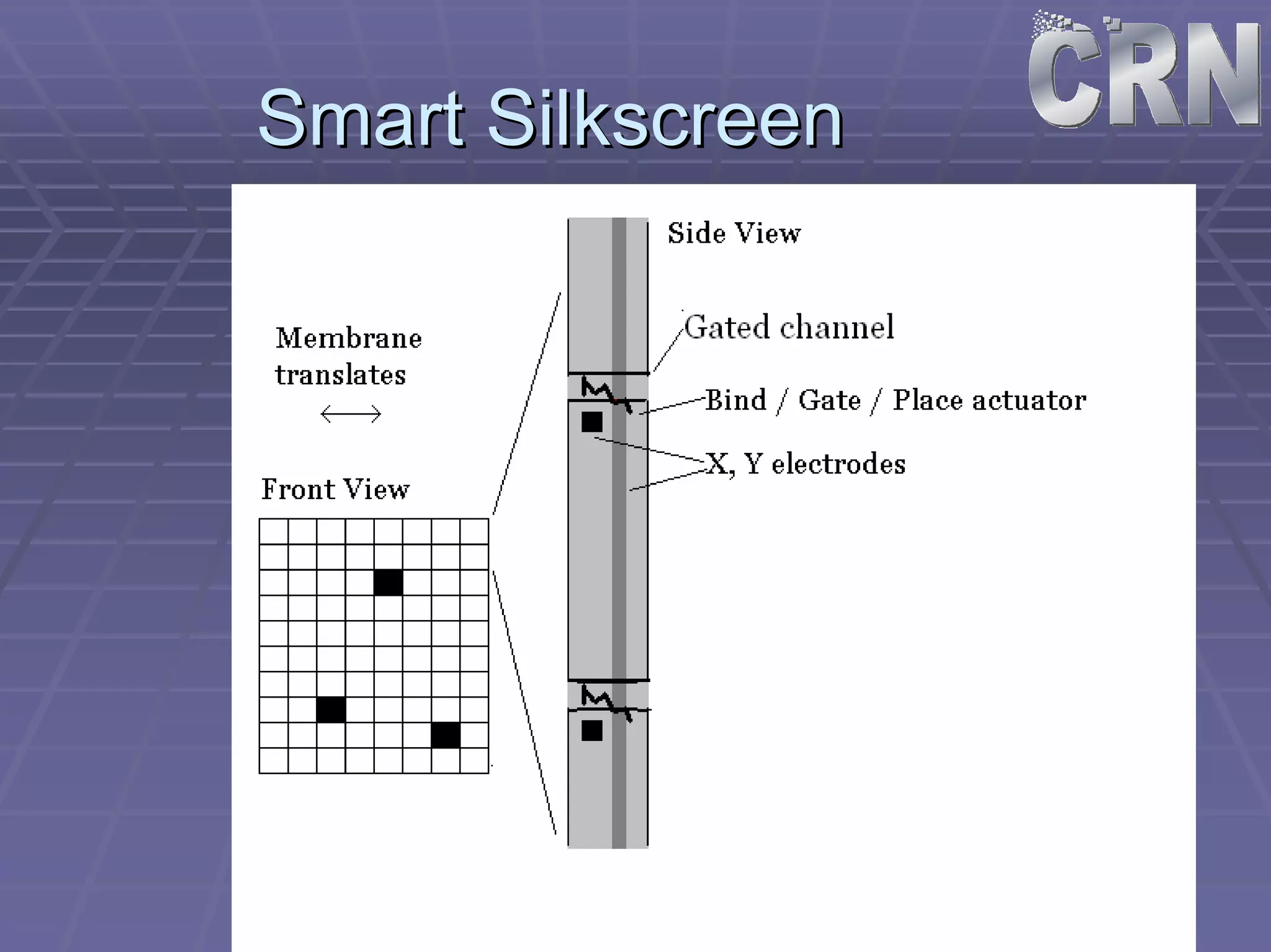
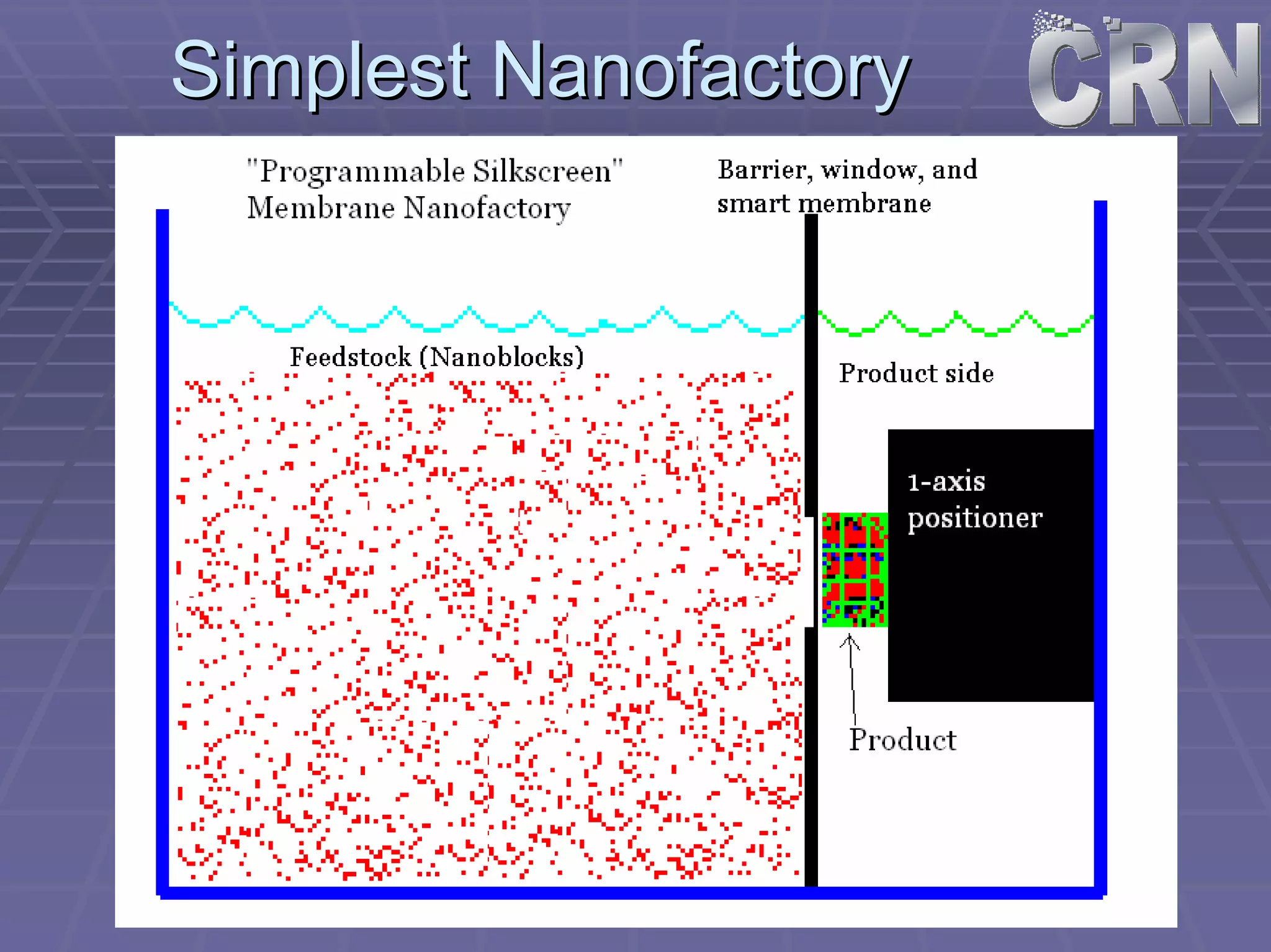
ÎÎSimple 2D array of block block-placing 
equipment 
ÎÎA “membrane” separating loose blocks 
from product 
ÎÎSelective placement of blocks, optionally 
followed by strengthening connections 
ÎÎBlocks (5 5-20 nm?) are pre pre-made 
ÎÎChemistry 
ÎÎSelf assembly 
ÎÎTemplating Templating, mechanosynthesis 
,
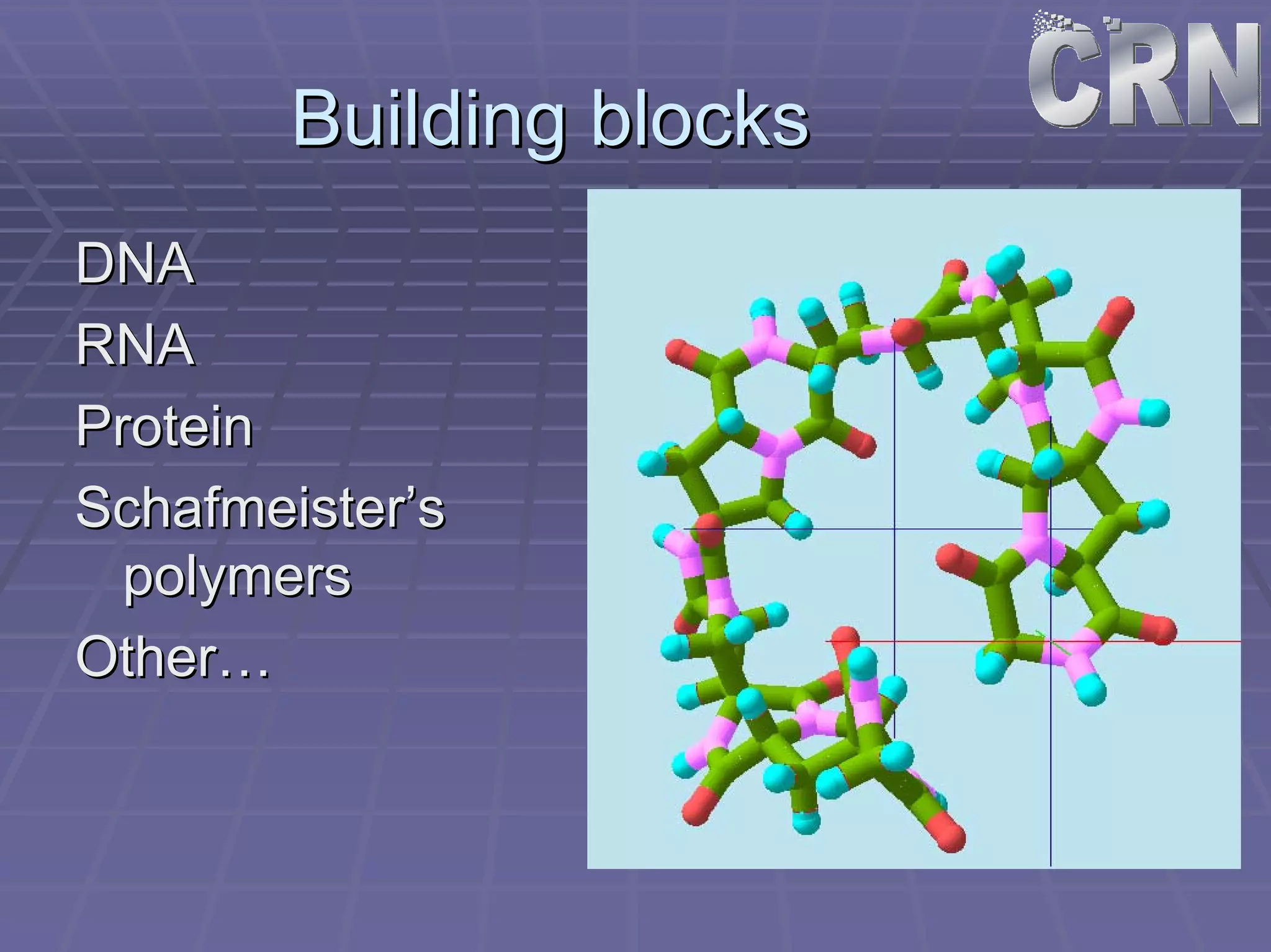
Building blocks 
DNA 
RNA 
Protein 
Schafmeister’s 
polymers 
Other…
Binding and Bonding 
ÎÎCovalent 
ÎÎMetal ligation 
ÎÎDative 
ÎÎHydrogen 
ÎÎCharge/Dipole 
ÎÎVan der Waals (“surface forces”)
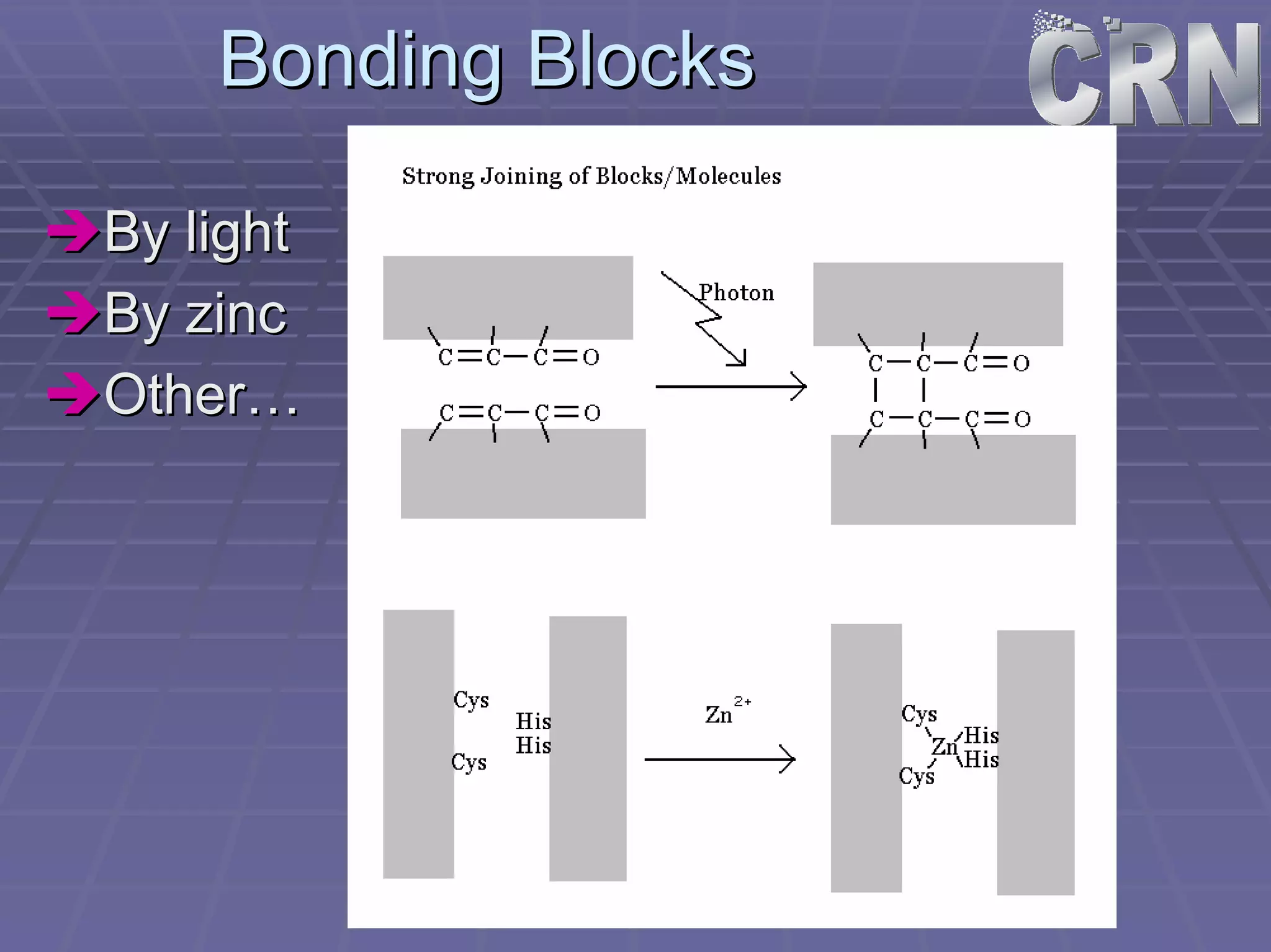
Bonding Blocks 
ÎÎBy light 
ÎÎBy zinc 
ÎÎOther…
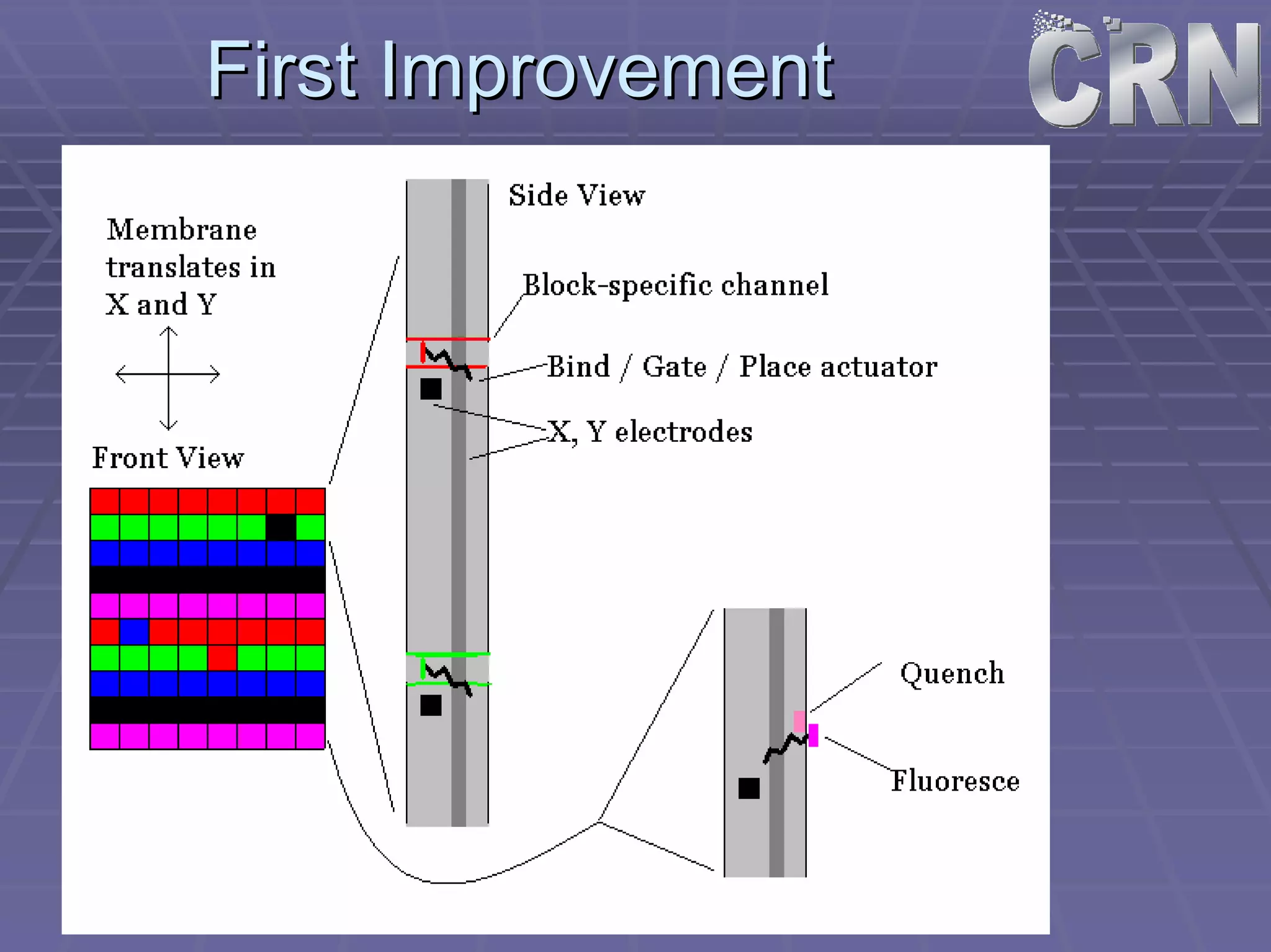
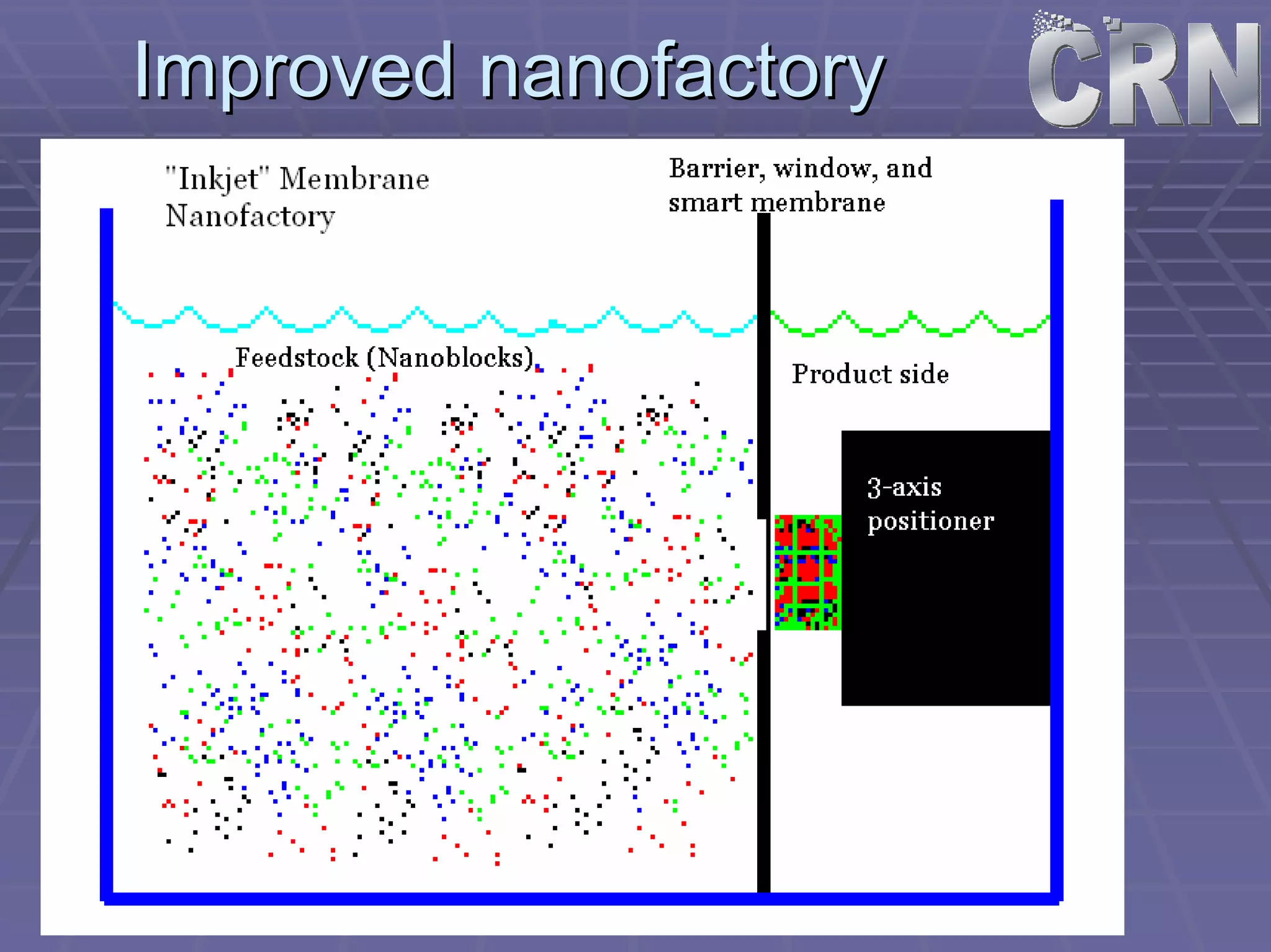
Smart Silkscreen
Simplest Nanofactory
First Improvement
Improved nanofactory
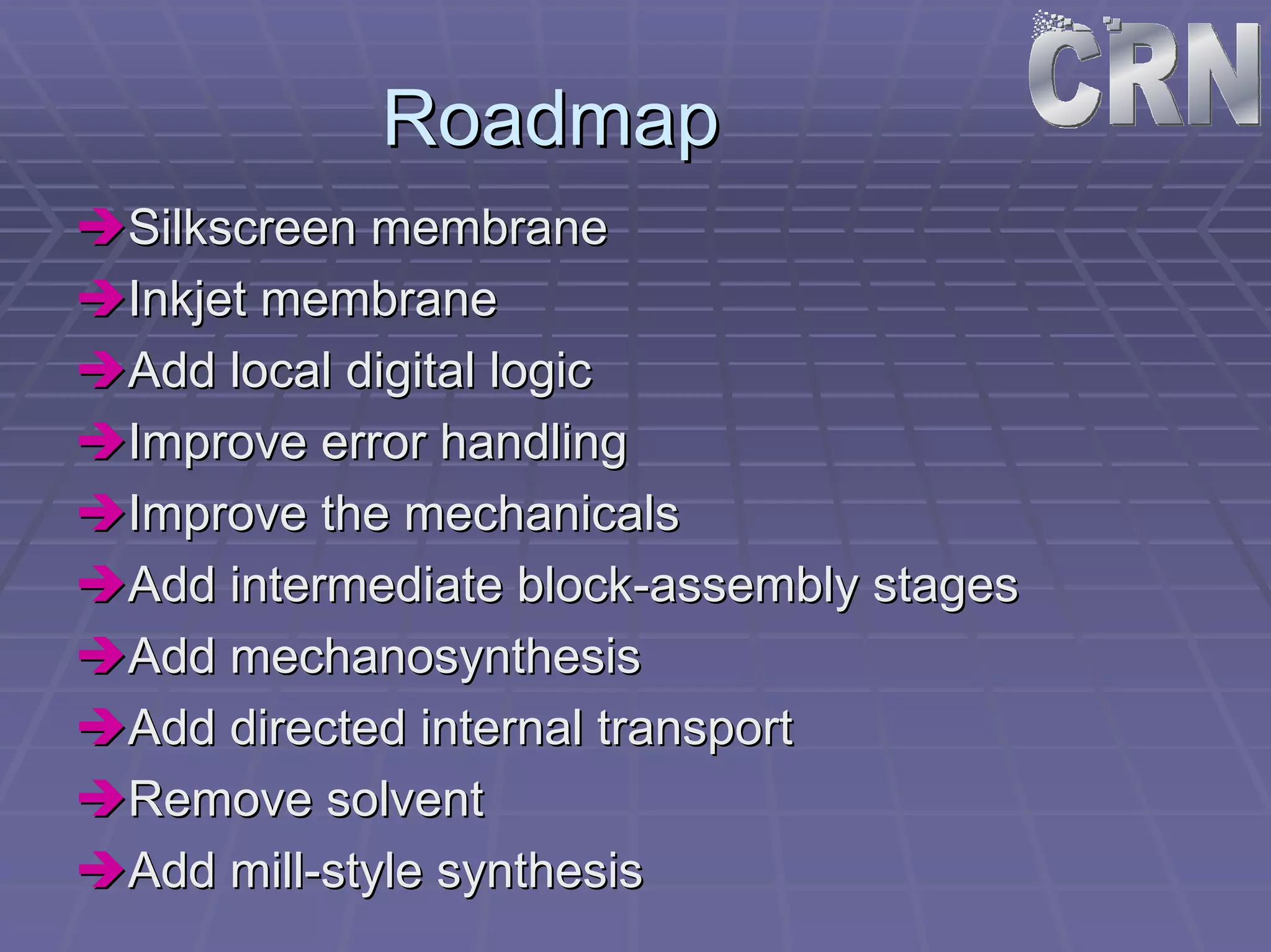
Roadmap 
ÎÎSilkscreen membrane 
ÎÎInkjet membrane 
ÎÎAdd local digital logic 
ÎÎImprove error handling 
ÎÎImprove the mechanicals 
ÎÎAdd intermediate block block-assembly stages 
ÎÎAdd mechanosynthesis 
ÎÎAdd directed internal transport 
ÎÎRemove solvent 
ÎÎAdd mill mill-style synthesis
Goal… 
ÎÎJohn Burch, Lizard Fire Studios
Local digital logic 
ÎÎHP’s “crossbar” claims storage, 
amplification, logic 
ÎÎMechanical logic? Nanoscale machines 
move at GHz speeds…
Improve error handling 
ÎÎWith primitive membrane and small area, 
you can handle errors from the top 
ÎÎWith internal function, you need 
redundancy 
ÎÎLocal error handling reduces data flow 
ÎÎEspecially the difficult back back-channel
Improve the mechanicals 
ÎÎActuators 
ÎÎDNA (tweezers, rotary motors) 
ÎÎATP (ATP synthase synthase, , kinesin kinesin, etc.) 
, ÎÎIon (linear rotaxane dimers dimers, contractile polymers) 
, ÎÎRedox (rotaxane rotaxane, VPL, etc.) 
, ÎÎPhoto or electrochemical ( pseudorotaxanes pseudorotaxanes) 
ÎÎElectrostatic 
ÎÎBearings 
ÎÎSingle bond 
ÎÎCompliant (squishy) 
ÎÎSuperlubricity
Intermediate block assembly 
ÎÎCombine molecules into blocks 
ÎÎImprove throughput 
ÎÎEnhance flexibility 
ÎÎAdd “fins” or other structure on the 
feedstock side to supply the assembly 
plane
Mechanosynthesis 
ÎÎSimpler, cheaper feedstock 
ÎÎSmaller, less error error-prone feedstock intake 
ÎÎWider range of components 
ÎÎLow level programmability (faster R&D) 
ÎÎSmaller features? 
ÎÎHigher bond density?
Directed internal transport 
ÎÎShuffle product components within the 
factory 
ÎÎSpecialization and optimization of factory 
equipment 
ÎÎEfficient handling of product voids 
ÎÎEfficient handling of errors (redundancy)
Remove solvent 
ÎÎLess drag; more throughput; higher 
efficiency 
ÎÎFeedstock can still be delivered in solution 
ÎÎLimits choice of actuators 
ÎÎMay require different synthetic reactions 
ÎÎThis may be a good thing! 
ÎÎBetter materials 
ÎÎMore extreme reactions
Mill Mill-style synthesis 
ÎÎLess flexible but a lot faster than robot robot- 
style synthesis 
ÎÎEasier to recover reaction energy (stiffer 
equipment, smoother motion) 
ÎÎLess computation per operation 
ÎÎLess beneficial for component assembly, 
but may still be useful
Conclusion 
ÎÎToday: We can build and join precise 
molecular parts. 
ÎÎWith this NIAC project, we have begun 
design of a system that can do precise, 
programmed, actuated assembly of 
molecular parts. 
ÎÎFrom there, incremental steps lead to 
desktop nanofactory.
Who we are 
ÎÎCenter for Responsible Nanotechnology: 
Research and education on advanced 
nanotech capabilities and implications 
ÎÎResearchers: 
ÎÎChris Phoenix, CRN Director of Research 
cphoenix@crnano.org 
ÎÎTihamer Toth Toth-Fejel

1030 phoenix[1]

  • 1.
    Primitive Molecular Manufacturing Chris Phoenix Tihamer Toth Toth-Fejel NIAC Fellows Meeting, March 15 15-16
  • 2.
    Small is Beautiful ÎÎScaling laws: throughput ~ size^ size^-4 ÎÎ10 cm tool: 3 GY. 100 nm tool: 100 sec. ÎÎPower density ~ size^ size^-1 ÎÎDigital logic likes to be small ÎÎAccess atoms ÆÆ Digital construction ÎÎLow wear, high strength, superlubricity ÎÎDigital design bottom bottom-up, like computers
  • 3.
    Molecular Manufacturing ÎÎBuildingprecise, useful nanoscale structures with nanoscale tools ÎÎEngineering approach to nanoscale ÎÎMolecular fabrication ÎÎAssembly and operations ÎÎInformation handling ÎÎReliability ÎÎEventual goal: Large, high high-performance products including manufacturing tools
  • 5.
    A desktop nanofactorymanufactures a FiltomatM102C high performance self-cleaning water filterA robot arm with thiophene-based molecular actuators adds a nanoblock to the extruded product Ridge joints interlock to connect nanoblocks The product is extruded at a surface that assemblesnanoblocks one layer at a time
  • 6.
    Outline ÎÎFoundational approach ÎÎUltimate goal ÎÎExisting capabilities ÎÎRoadmap
  • 7.
    Information Delivery ÎÎExistingmanufacturing technologies: A few KB per second ÎÎGoal: A few GB per second ÎÎThis requires: ÎÎVery small tools (or massively parallel medium medium-small tools) ÎÎReliable operations
  • 8.
    Small is Beautiful ÎÎScaling laws: throughput ~ size^ size^-4 ÎÎ10 cm tool: 3 GY. 100 nm tool: 100 sec. ÎÎPower density ~ size^ size^-1 ÎÎDigital logic likes to be small ÎÎAccess atoms ÆÆ Digital construction ÎÎLow wear, high strength, superlubricity ÎÎDigital design bottom bottom-up, like computers
  • 9.
    Rapid Design ÎÎOnceyou get a set of reliable tools… You can combine them to make new tools ÎÎOnce you can build lots of variants… You can do evolutionary design ÎÎWith high performance and small parts… You can afford to use levels of abstraction
  • 10.
    Planar Assembly ÎÎScalinglaws indicate that deposition speed is independent of block/robot size ÎÎRobots can be sub sub-micron size (Human cell = 20 micron) ÎÎRapid joining should allow cm/sec deposition ÆÆ Build large products directly from sub sub- micron blocks (Build sub sub-micron blocks directly from atoms atoms……)
  • 11.
    Molecular fabrication ÎÎToday:Bulk chemistry ÎÎEnvironmentally controlled polymer fabrication ÎÎSequence of operations ÎÎLight (“DNA Chip”) ÎÎGoal: Mechanically controlled reactions ÎÎSequence ÎÎPosition
  • 12.
    Mechanosynthesis: Just aTool ÎÎCan be either “solution phase” or “machine phase” ÎÎMechanical control of reactions: More a style than a restriction ÎÎControl can be direct or indirect ÎÎImplies precise nanoscale tools –– which we want anyway
  • 13.
    Error Handling in Generational Manufacturing ÎÎIn molecular devices, errors are digital ÎÎError rates vary by many orders of magnitude ÎÎIn small self self-contained devices, you just need an error rate less than the number of operations ÎÎIn large devices, you will have errors ÎÎYou need to work around them, not pass them on
  • 14.
    Nanoscale Toolkit ÎÎWewant tools that are: ÎÎReliable ÎÎDependable ÎÎEasy to characterize ÎÎVery flexible ÎÎShort Short-term tools Actuators; Binding/recognition; Conductors; Sensors; Bonding; Structure ÎÎLong Long-term tools Digital logic; Bearings; Mechanosynthesis
  • 15.
    The Ultimate Goal ÎÎTabletop nanofactoy ÎÎProduces its own mass in ~1 hour ÎÎUses simple feedstock ÎÎDirect computer control; Rapid prototyping ÎÎPowerful nanoscale toolkit ÎÎVery high performance products ÎÎEasy product design ÎÎBurch/Drexler animation (with real chemistry)
  • 16.
    Where To Start ÎÎSimple 2D array of block block-placing equipment ÎÎA “membrane” separating loose blocks from product ÎÎSelective placement of blocks, optionally followed by strengthening connections ÎÎBlocks (5 5-20 nm?) are pre pre-made ÎÎChemistry ÎÎSelf assembly ÎÎTemplating Templating, mechanosynthesis ,
  • 17.
    Building blocks DNA RNA Protein Schafmeister’s polymers Other…
  • 18.
    Binding and Bonding ÎÎCovalent ÎÎMetal ligation ÎÎDative ÎÎHydrogen ÎÎCharge/Dipole ÎÎVan der Waals (“surface forces”)
  • 19.
    Bonding Blocks ÎÎBylight ÎÎBy zinc ÎÎOther…
  • 20.
  • 21.
  • 22.
  • 23.
  • 24.
    Roadmap ÎÎSilkscreen membrane ÎÎInkjet membrane ÎÎAdd local digital logic ÎÎImprove error handling ÎÎImprove the mechanicals ÎÎAdd intermediate block block-assembly stages ÎÎAdd mechanosynthesis ÎÎAdd directed internal transport ÎÎRemove solvent ÎÎAdd mill mill-style synthesis
  • 25.
    Goal… ÎÎJohn Burch,Lizard Fire Studios
  • 26.
    Local digital logic ÎÎHP’s “crossbar” claims storage, amplification, logic ÎÎMechanical logic? Nanoscale machines move at GHz speeds…
  • 27.
    Improve error handling ÎÎWith primitive membrane and small area, you can handle errors from the top ÎÎWith internal function, you need redundancy ÎÎLocal error handling reduces data flow ÎÎEspecially the difficult back back-channel
  • 28.
    Improve the mechanicals ÎÎActuators ÎÎDNA (tweezers, rotary motors) ÎÎATP (ATP synthase synthase, , kinesin kinesin, etc.) , ÎÎIon (linear rotaxane dimers dimers, contractile polymers) , ÎÎRedox (rotaxane rotaxane, VPL, etc.) , ÎÎPhoto or electrochemical ( pseudorotaxanes pseudorotaxanes) ÎÎElectrostatic ÎÎBearings ÎÎSingle bond ÎÎCompliant (squishy) ÎÎSuperlubricity
  • 29.
    Intermediate block assembly ÎÎCombine molecules into blocks ÎÎImprove throughput ÎÎEnhance flexibility ÎÎAdd “fins” or other structure on the feedstock side to supply the assembly plane
  • 30.
    Mechanosynthesis ÎÎSimpler, cheaperfeedstock ÎÎSmaller, less error error-prone feedstock intake ÎÎWider range of components ÎÎLow level programmability (faster R&D) ÎÎSmaller features? ÎÎHigher bond density?
  • 31.
    Directed internal transport ÎÎShuffle product components within the factory ÎÎSpecialization and optimization of factory equipment ÎÎEfficient handling of product voids ÎÎEfficient handling of errors (redundancy)
  • 32.
    Remove solvent ÎÎLessdrag; more throughput; higher efficiency ÎÎFeedstock can still be delivered in solution ÎÎLimits choice of actuators ÎÎMay require different synthetic reactions ÎÎThis may be a good thing! ÎÎBetter materials ÎÎMore extreme reactions
  • 33.
    Mill Mill-style synthesis ÎÎLess flexible but a lot faster than robot robot- style synthesis ÎÎEasier to recover reaction energy (stiffer equipment, smoother motion) ÎÎLess computation per operation ÎÎLess beneficial for component assembly, but may still be useful
  • 34.
    Conclusion ÎÎToday: Wecan build and join precise molecular parts. ÎÎWith this NIAC project, we have begun design of a system that can do precise, programmed, actuated assembly of molecular parts. ÎÎFrom there, incremental steps lead to desktop nanofactory.
  • 35.
    Who we are ÎÎCenter for Responsible Nanotechnology: Research and education on advanced nanotech capabilities and implications ÎÎResearchers: ÎÎChris Phoenix, CRN Director of Research cphoenix@crnano.org ÎÎTihamer Toth Toth-Fejel