
Leading Molecules from Bench to Bedside
in Academic World
Manu Nair - Mayo Clinic Ventures
July 26, 2012
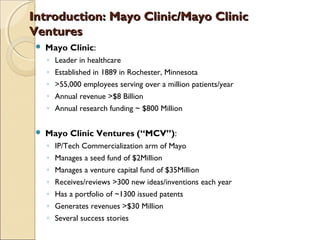
Introduction: Mayo Clinic/Mayo ClinicIntroduction: Mayo Clinic/Mayo Clinic
VenturesVentures
 Mayo Clinic:
◦ Leader in healthcare
◦ Established in 1889 in Rochester, Minnesota
◦ >55,000 employees serving over a million patients/year
◦ Annual revenue >$8 Billion
◦ Annual research funding ~ $800 Million
 Mayo Clinic Ventures (“MCV”):
◦ IP/Tech Commercialization arm of Mayo
◦ Manages a seed fund of $2Million
◦ Manages a venture capital fund of $35Million
◦ Receives/reviews >300 new ideas/inventions each year
◦ Has a portfolio of ~1300 issued patents
◦ Generates revenues >$30 Million
◦ Several success stories
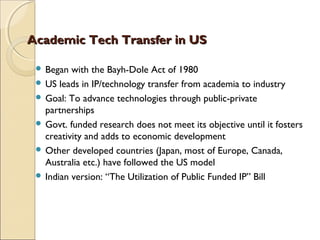
Academic Tech Transfer in USAcademic Tech Transfer in US
 Began with the Bayh-Dole Act of 1980
 US leads in IP/technology transfer from academia to industry
 Goal: To advance technologies through public-private
partnerships
 Govt. funded research does not meet its objective until it fosters
creativity and adds to economic development
 Other developed countries (Japan, most of Europe, Canada,
Australia etc.) have followed the US model
 Indian version: “The Utilization of Public Funded IP” Bill
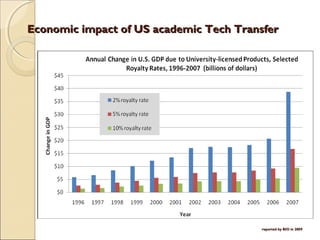
Economic impact of US academic Tech TransferEconomic impact of US academic Tech Transfer
reported by BIO in 2009reported by BIO in 2009
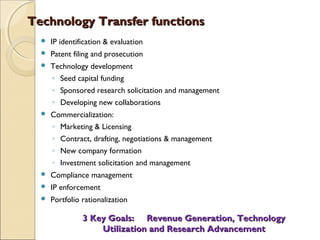
Technology Transfer functionsTechnology Transfer functions
 IP identification & evaluation
 Patent filing and prosecution
 Technology development
◦ Seed capital funding
◦ Sponsored research solicitation and management
◦ Developing new collaborations
 Commercialization:
◦ Marketing & Licensing
◦ Contract, drafting, negotiations & management
◦ New company formation
◦ Investment solicitation and management
 Compliance management
 IP enforcement
 Portfolio rationalization
3 Key Goals:3 Key Goals: Revenue Generation, TechnologyRevenue Generation, Technology
Utilization and Research AdvancementUtilization and Research Advancement
Healthcare technologies in Tech TransferHealthcare technologies in Tech Transfer
 Therapeutics (includes vaccines)
 Diagnostics (includes predictors and prognostics)
 Devices
 Software (Healthcare IT)
 Clinical Know-How
 Biospecimens
 Research reagents
* Forbes 2012* Forbes 2012
 Inadequate Govt. funding for translational research
 High regulatory burden (unless qualifies for “Orphan” indication)
 Long and costly development path
 Tough patent landscape & high cost of prosecution
 Cost of IP enforcement
 Difficulty in early-stage licensing/partnering
◦ High failure rate & resulting risk aversion of industry
◦ Differences in perceived value
 Change in venture capital investment landscape
 Developing a therapeutic could cost up to $1Bill*
Challenges in developing therapeuticsChallenges in developing therapeutics
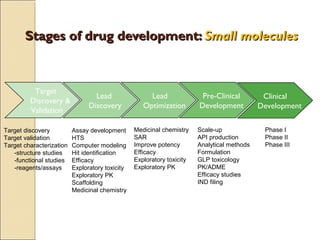
Stages of drug development:Stages of drug development: Small moleculesSmall molecules
Target discovery
Target validation
Target characterization
-structure studies
-functional studies
-reagents/assays
Assay development
HTS
Computer modeling
Hit identification
Efficacy
Exploratory toxicity
Exploratory PK
Scaffolding
Medicinal chemistry
Medicinal chemistry
SAR
Improve potency
Efficacy
Exploratory toxicity
Exploratory PK
Scale-up
API production
Analytical methods
Formulation
GLP toxicology
PK/ADME
Efficacy studies
IND filing
Phase I
Phase II
Phase III
Target
Discovery &
Validation
Lead
Discovery
Lead
Optimization
Pre-Clinical
Development
Clinical
Development
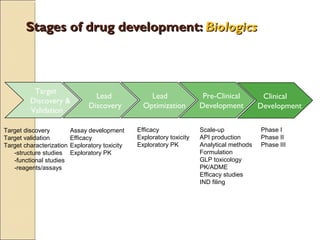
Target discovery
Target validation
Target characterization
-structure studies
-functional studies
-reagents/assays
Assay development
Efficacy
Exploratory toxicity
Exploratory PK
Efficacy
Exploratory toxicity
Exploratory PK
Scale-up
API production
Analytical methods
Formulation
GLP toxicology
PK/ADME
Efficacy studies
IND filing
Phase I
Phase II
Phase III
Target
Discovery &
Validation
Lead
Discovery
Lead
Optimization
Pre-Clinical
Development
Clinical
Development
Stages of drug development:Stages of drug development: BiologicsBiologics
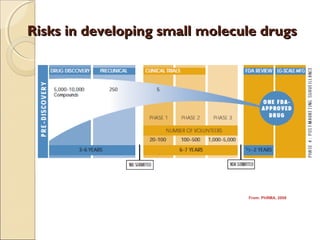
Risks in developing small molecule drugsRisks in developing small molecule drugs
From: PhRMA, 2008
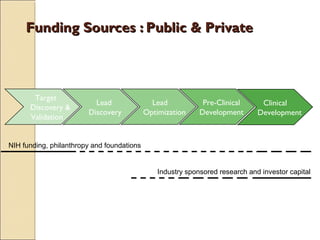
Funding Sources : Public & PrivateFunding Sources : Public & Private
Target
Discovery &
Validation
Lead
Discovery
Lead
Optimization
Pre-Clinical
Development
Clinical
Development
Industry sponsored research and investor capital
NIH funding, philanthropy and foundations
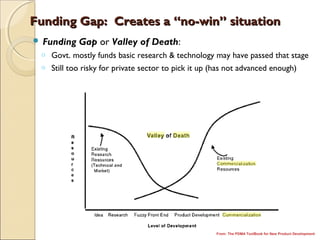
Funding Gap: Creates a “no-win” situationFunding Gap: Creates a “no-win” situation
 Funding Gap or Valley of Death:
o Govt. mostly funds basic research & technology may have passed that stage
o Still too risky for private sector to pick it up (has not advanced enough)
From: The PDMA ToolBook for New Product Development
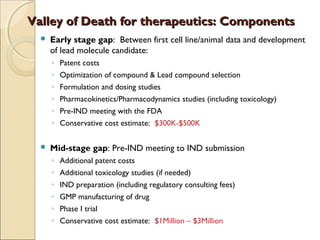
Valley of Death for therapeutics: ComponentsValley of Death for therapeutics: Components
 Early stage gap: Between first cell line/animal data and development
of lead molecule candidate:
◦ Patent costs
◦ Optimization of compound & Lead compound selection
◦ Formulation and dosing studies
◦ Pharmacokinetics/Pharmacodynamics studies (including toxicology)
◦ Pre-IND meeting with the FDA
◦ Conservative cost estimate: $300K-$500K
 Mid-stage gap: Pre-IND meeting to IND submission
◦ Additional patent costs
◦ Additional toxicology studies (if needed)
◦ IND preparation (including regulatory consulting fees)
◦ GMP manufacturing of drug
◦ Phase I trial
◦ Conservative cost estimate: $1Million – $3Million
Valley of Death: Components (Cont’d)Valley of Death: Components (Cont’d)
 Late-stage gap: Phase II and III trials
◦ Complex multi-center trials required
◦ Very expensive: Could cost several hundred million dollars
(depending on disease indication)
◦ Easier to fill this gap: partnering with investors/industry is easier
at this stage
◦ Goal is to advance technologies to partnering
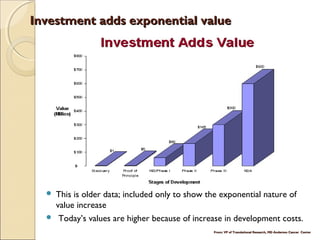
Investment adds exponential valueInvestment adds exponential value
From: VP of Translational Research, MD Anderson Cancer CenterFrom: VP of Translational Research, MD Anderson Cancer Center
 This is older data; included only to show the exponential nature of
value increase
 Today’s values are higher because of increase in development costs.
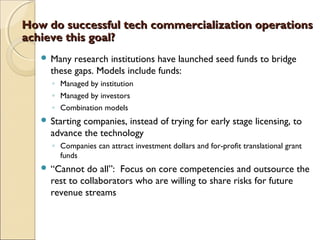
How do successful tech commercialization operationsHow do successful tech commercialization operations
achieve this goal?achieve this goal?
 Many research institutions have launched seed funds to bridge
these gaps. Models include funds:
◦ Managed by institution
◦ Managed by investors
◦ Combination models
 Starting companies, instead of trying for early stage licensing, to
advance the technology
◦ Companies can attract investment dollars and for-profit translational grant
funds
 “Cannot do all”: Focus on core competencies and outsource the
rest to collaborators who are willing to share risks for future
revenue streams
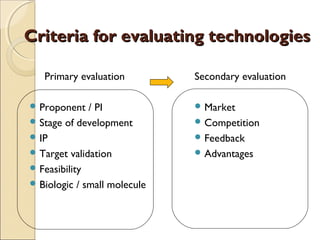
Criteria for evaluating technologiesCriteria for evaluating technologies
Primary evaluation
 Proponent / PI
 Stage of development
 IP
 Target validation
 Feasibility
 Biologic / small molecule
Secondary evaluation
 Market
 Competition
 Feedback
 Advantages
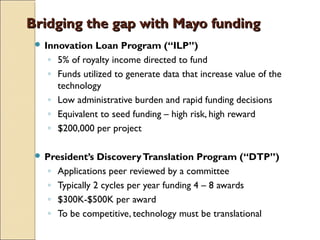
Bridging the gap with Mayo fundingBridging the gap with Mayo funding
 Innovation Loan Program (“ILP”)
◦ 5% of royalty income directed to fund
◦ Funds utilized to generate data that increase value of the
technology
◦ Low administrative burden and rapid funding decisions
◦ Equivalent to seed funding – high risk, high reward
◦ $200,000 per project
 President’s DiscoveryTranslation Program (“DTP”)
◦ Applications peer reviewed by a committee
◦ Typically 2 cycles per year funding 4 – 8 awards
◦ $300K-$500K per award
◦ To be competitive, technology must be translational
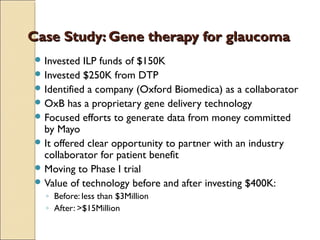
Case Study: Gene therapy for glaucomaCase Study: Gene therapy for glaucoma
 Invested ILP funds of $150K
 Invested $250K from DTP
 Identified a company (Oxford Biomedica) as a collaborator
 OxB has a proprietary gene delivery technology
 Focused efforts to generate data from money committed
by Mayo
 It offered clear opportunity to partner with an industry
collaborator for patient benefit
 Moving to Phase I trial
 Value of technology before and after investing $400K:
◦ Before: less than $3Million
◦ After: >$15Million
What is the “Mayo way”?What is the “Mayo way”?
 Seed capital funds managed by MCV
 Thoroughly evaluate the opportunities to invest
 Partner with industry at the earliest opportunity
 Co-invest venture capital fund with large VCs to provide
larger investments
 Leverage Mayo’s large clinical capabilities
Questions?Questions?
For More Details Visit
www.bananaip.com/sinapse-blog

Leading Molecules to Market - An overview on licensing

  • 1.
    Leading Molecules fromBench to Bedside in Academic World Manu Nair - Mayo Clinic Ventures July 26, 2012
  • 2.
    Introduction: Mayo Clinic/MayoClinicIntroduction: Mayo Clinic/Mayo Clinic VenturesVentures  Mayo Clinic: ◦ Leader in healthcare ◦ Established in 1889 in Rochester, Minnesota ◦ >55,000 employees serving over a million patients/year ◦ Annual revenue >$8 Billion ◦ Annual research funding ~ $800 Million  Mayo Clinic Ventures (“MCV”): ◦ IP/Tech Commercialization arm of Mayo ◦ Manages a seed fund of $2Million ◦ Manages a venture capital fund of $35Million ◦ Receives/reviews >300 new ideas/inventions each year ◦ Has a portfolio of ~1300 issued patents ◦ Generates revenues >$30 Million ◦ Several success stories
  • 3.
    Academic Tech Transferin USAcademic Tech Transfer in US  Began with the Bayh-Dole Act of 1980  US leads in IP/technology transfer from academia to industry  Goal: To advance technologies through public-private partnerships  Govt. funded research does not meet its objective until it fosters creativity and adds to economic development  Other developed countries (Japan, most of Europe, Canada, Australia etc.) have followed the US model  Indian version: “The Utilization of Public Funded IP” Bill
  • 4.
    Economic impact ofUS academic Tech TransferEconomic impact of US academic Tech Transfer reported by BIO in 2009reported by BIO in 2009
  • 5.
    Technology Transfer functionsTechnologyTransfer functions  IP identification & evaluation  Patent filing and prosecution  Technology development ◦ Seed capital funding ◦ Sponsored research solicitation and management ◦ Developing new collaborations  Commercialization: ◦ Marketing & Licensing ◦ Contract, drafting, negotiations & management ◦ New company formation ◦ Investment solicitation and management  Compliance management  IP enforcement  Portfolio rationalization 3 Key Goals:3 Key Goals: Revenue Generation, TechnologyRevenue Generation, Technology Utilization and Research AdvancementUtilization and Research Advancement
  • 6.
    Healthcare technologies inTech TransferHealthcare technologies in Tech Transfer  Therapeutics (includes vaccines)  Diagnostics (includes predictors and prognostics)  Devices  Software (Healthcare IT)  Clinical Know-How  Biospecimens  Research reagents
  • 7.
    * Forbes 2012*Forbes 2012  Inadequate Govt. funding for translational research  High regulatory burden (unless qualifies for “Orphan” indication)  Long and costly development path  Tough patent landscape & high cost of prosecution  Cost of IP enforcement  Difficulty in early-stage licensing/partnering ◦ High failure rate & resulting risk aversion of industry ◦ Differences in perceived value  Change in venture capital investment landscape  Developing a therapeutic could cost up to $1Bill* Challenges in developing therapeuticsChallenges in developing therapeutics
  • 8.
    Stages of drugdevelopment:Stages of drug development: Small moleculesSmall molecules Target discovery Target validation Target characterization -structure studies -functional studies -reagents/assays Assay development HTS Computer modeling Hit identification Efficacy Exploratory toxicity Exploratory PK Scaffolding Medicinal chemistry Medicinal chemistry SAR Improve potency Efficacy Exploratory toxicity Exploratory PK Scale-up API production Analytical methods Formulation GLP toxicology PK/ADME Efficacy studies IND filing Phase I Phase II Phase III Target Discovery & Validation Lead Discovery Lead Optimization Pre-Clinical Development Clinical Development
  • 9.
    Target discovery Target validation Targetcharacterization -structure studies -functional studies -reagents/assays Assay development Efficacy Exploratory toxicity Exploratory PK Efficacy Exploratory toxicity Exploratory PK Scale-up API production Analytical methods Formulation GLP toxicology PK/ADME Efficacy studies IND filing Phase I Phase II Phase III Target Discovery & Validation Lead Discovery Lead Optimization Pre-Clinical Development Clinical Development Stages of drug development:Stages of drug development: BiologicsBiologics
  • 10.
    Risks in developingsmall molecule drugsRisks in developing small molecule drugs From: PhRMA, 2008
  • 11.
    Funding Sources :Public & PrivateFunding Sources : Public & Private Target Discovery & Validation Lead Discovery Lead Optimization Pre-Clinical Development Clinical Development Industry sponsored research and investor capital NIH funding, philanthropy and foundations
  • 12.
    Funding Gap: Createsa “no-win” situationFunding Gap: Creates a “no-win” situation  Funding Gap or Valley of Death: o Govt. mostly funds basic research & technology may have passed that stage o Still too risky for private sector to pick it up (has not advanced enough) From: The PDMA ToolBook for New Product Development
  • 13.
    Valley of Deathfor therapeutics: ComponentsValley of Death for therapeutics: Components  Early stage gap: Between first cell line/animal data and development of lead molecule candidate: ◦ Patent costs ◦ Optimization of compound & Lead compound selection ◦ Formulation and dosing studies ◦ Pharmacokinetics/Pharmacodynamics studies (including toxicology) ◦ Pre-IND meeting with the FDA ◦ Conservative cost estimate: $300K-$500K  Mid-stage gap: Pre-IND meeting to IND submission ◦ Additional patent costs ◦ Additional toxicology studies (if needed) ◦ IND preparation (including regulatory consulting fees) ◦ GMP manufacturing of drug ◦ Phase I trial ◦ Conservative cost estimate: $1Million – $3Million
  • 14.
    Valley of Death:Components (Cont’d)Valley of Death: Components (Cont’d)  Late-stage gap: Phase II and III trials ◦ Complex multi-center trials required ◦ Very expensive: Could cost several hundred million dollars (depending on disease indication) ◦ Easier to fill this gap: partnering with investors/industry is easier at this stage ◦ Goal is to advance technologies to partnering
  • 15.
    Investment adds exponentialvalueInvestment adds exponential value From: VP of Translational Research, MD Anderson Cancer CenterFrom: VP of Translational Research, MD Anderson Cancer Center  This is older data; included only to show the exponential nature of value increase  Today’s values are higher because of increase in development costs.
  • 16.
    How do successfultech commercialization operationsHow do successful tech commercialization operations achieve this goal?achieve this goal?  Many research institutions have launched seed funds to bridge these gaps. Models include funds: ◦ Managed by institution ◦ Managed by investors ◦ Combination models  Starting companies, instead of trying for early stage licensing, to advance the technology ◦ Companies can attract investment dollars and for-profit translational grant funds  “Cannot do all”: Focus on core competencies and outsource the rest to collaborators who are willing to share risks for future revenue streams
  • 17.
    Criteria for evaluatingtechnologiesCriteria for evaluating technologies Primary evaluation  Proponent / PI  Stage of development  IP  Target validation  Feasibility  Biologic / small molecule Secondary evaluation  Market  Competition  Feedback  Advantages
  • 18.
    Bridging the gapwith Mayo fundingBridging the gap with Mayo funding  Innovation Loan Program (“ILP”) ◦ 5% of royalty income directed to fund ◦ Funds utilized to generate data that increase value of the technology ◦ Low administrative burden and rapid funding decisions ◦ Equivalent to seed funding – high risk, high reward ◦ $200,000 per project  President’s DiscoveryTranslation Program (“DTP”) ◦ Applications peer reviewed by a committee ◦ Typically 2 cycles per year funding 4 – 8 awards ◦ $300K-$500K per award ◦ To be competitive, technology must be translational
  • 19.
    Case Study: Genetherapy for glaucomaCase Study: Gene therapy for glaucoma  Invested ILP funds of $150K  Invested $250K from DTP  Identified a company (Oxford Biomedica) as a collaborator  OxB has a proprietary gene delivery technology  Focused efforts to generate data from money committed by Mayo  It offered clear opportunity to partner with an industry collaborator for patient benefit  Moving to Phase I trial  Value of technology before and after investing $400K: ◦ Before: less than $3Million ◦ After: >$15Million
  • 20.
    What is the“Mayo way”?What is the “Mayo way”?  Seed capital funds managed by MCV  Thoroughly evaluate the opportunities to invest  Partner with industry at the earliest opportunity  Co-invest venture capital fund with large VCs to provide larger investments  Leverage Mayo’s large clinical capabilities
  • 21.
    Questions?Questions? For More DetailsVisit www.bananaip.com/sinapse-blog