Medical Device
Opportunities
A venture perspective
Roger Kitterman
Partners Healthcare
Personal Background
• Managing Partner of the Innovation Fund at
Partners HealthCare
• Started VC career in 1994
• Started several venture-backed companies
Venture Environment
• Declining VC investment in life sciences
– $$ invested in startups down 64% 2007-2012
– Only 11 new healthcare funds raised in 2012 (39 in
2006)
– Q1 2013 had the fewest initial investments in life
sciences since 1995 – down 75% since the 2007
peak
• Strategics stepping in earlier – but mainly for
therapeutics
Life Sciences Losing
Share of Venture Dollars
Fewer life science venture
funds being raised
Corporate investors increasingly
active early – in biotech
Exits are coming back – still an M&A market
How to identify commercial potential
• It depends
• Start at the end – what is the market need
• Market size
• Unmet medical need
• Competition
• Better faster cheaper is hard
• Path to market – cost to get there
• Need to have versus nice to have
• If you can’t understand the need, chances are the
opportunity is limited
Patenting
• Biomedical products require large investment to bring to market
• Public domain: what belongs to everyone belongs to no one
• Provisional patent filings act as placeholders for 1 year
• First utility filings typically run $25,000 legal fees
• Foreign filing typically $150,000 fees
• “Prophetic” patents generally not valued as much as reduction to practice
• Only a tiny fraction of patents issued ever generate revenue
Patent value
•Composition is better than method of use
• Breadth versus depth
• Product margin
• Stacking
•What do the claims really allow
• How developed is the underlying technology
•Freedom to operate versus patentability
How VCs value a startup
•Too early stage for traditional valuation methods like
discounted cash flow
•Use multiple methods
•Comparables
•Skip to the exit point and work backwards
•How much are later stage companies worth
•How much capital and in what form does it take to get
there
•Must fit general guidelines
•Competing term sheets exist but are rare
What is Due Diligence?
•Investor research to test the business plan
•Assumptions are challenged – support your assertions
with evidence
•Diligence process often reshapes the plan
•Emphasis on customer/purchaser/user interviews
•Expect 3-6 month process from start to closing
•Requires high effort from entrepreneurial team
FDA route? Data submission requirements? Clinical trial design? Budget?Regulatory Path
Existing or new CPT/ISDN9 code? Private pay? Incremental or replacement?Reimbursement
Exit path? Potential acquirers? ROI? Comparables?Exit
Capital raised to date? Sources? Timetable of cash requirements vs milestones. Cap table? Pro forma P&L with milestone
overlay? Pre-$ valuation and amount sought. Use of funds? Deal terms.
Financing
Team background? Directors? SAB? Staffing plan? Organizational structure? Operational plan?Management
Barriers to competition. Patent filings? Breadth and strength of claims? Prosecution status? Patentability analysis? Freedom
to operate assessment? License terms?
IP
Revenue sources? Product economics? COGS? Margin? Distribution costs? Partnering? Who benefits/who’s hurt?Business Model
Describe target market segments and adoption criteria. Develop market size model with unit volume, penetration
curve, pricing, etc. Go to market strategy ?
Market
Current and emerging players? Basis of sustainable advantage: compare features and performance characteristics.Competition
How is the product enabled? What is the underlying science and engineering? How is it different from the alternatives? Status
of technology development? Proof of principle? Publications? Validation? In vitro/in vivo data? Prototype available?
Technology
Describe the offering. What does the product/service do? How does it affect clinical decision making? How does is fit into
clinician workflow? What product does it replace? Historical genesis.
Product
What is the problem addressed? How does the solution satisfy the unmet need? Who values that? Cost/benefit?Value Proposition
Due Diligence Rubric
Therapeutics Devices Diagnostics HCIT
Time to market 10-12 years 2-5 years 2-8 years < 1 year
Time to exit ~5 years Significant sales ~5 years 2-5 years
Investment to
market
$250MM $10MM $25MM+ $0+
Investment to exit $100MM $30MM+ $25MM+ $5-50MM
FDA Major issue Increasing issue Increasing Usually nonissue
Reimbursement Limited exposure Important problem Important
problem
Generally not
reimbursed
Stage to show for
funding
Two years from
clinical, animal
data
Prototype with
evidence
Prospective data
analysis
Adoption
Market minimum
size
$350MM, $1B
better
$200MM, $1B
better
Varies, must be
large
$200MM
minimum
Leading risk Will it work and
can we get it
through FDA
Adoption rate Will it work well
enough to be
adopted
Adoption
Rules of Thumb
Medical Devices
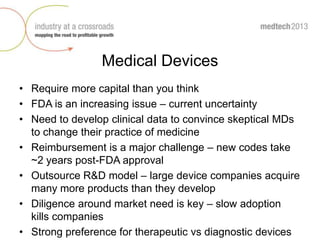
• Require more capital than you think
• FDA is an increasing issue – current uncertainty
• Need to develop clinical data to convince skeptical MDs
to change their practice of medicine
• Reimbursement is a major challenge – new codes take
~2 years post-FDA approval
• Outsource R&D model – large device companies acquire
many more products than they develop
• Diligence around market need is key – slow adoption
kills companies
• Strong preference for therapeutic vs diagnostic devices
MEDTECH 2013: Morning Plenary, Roger Kitterman, Managing Partner of Innovation Fund, Partners Healthcare

MEDTECH 2013: Morning Plenary, Roger Kitterman, Managing Partner of Innovation Fund, Partners Healthcare

  • 2.
    Medical Device Opportunities A ventureperspective Roger Kitterman Partners Healthcare
  • 3.
    Personal Background • ManagingPartner of the Innovation Fund at Partners HealthCare • Started VC career in 1994 • Started several venture-backed companies
  • 4.
    Venture Environment • DecliningVC investment in life sciences – $$ invested in startups down 64% 2007-2012 – Only 11 new healthcare funds raised in 2012 (39 in 2006) – Q1 2013 had the fewest initial investments in life sciences since 1995 – down 75% since the 2007 peak • Strategics stepping in earlier – but mainly for therapeutics
  • 5.
    Life Sciences Losing Shareof Venture Dollars
  • 6.
    Fewer life scienceventure funds being raised
  • 7.
  • 8.
    Exits are comingback – still an M&A market
  • 9.
    How to identifycommercial potential • It depends • Start at the end – what is the market need • Market size • Unmet medical need • Competition • Better faster cheaper is hard • Path to market – cost to get there • Need to have versus nice to have • If you can’t understand the need, chances are the opportunity is limited
  • 10.
    Patenting • Biomedical productsrequire large investment to bring to market • Public domain: what belongs to everyone belongs to no one • Provisional patent filings act as placeholders for 1 year • First utility filings typically run $25,000 legal fees • Foreign filing typically $150,000 fees • “Prophetic” patents generally not valued as much as reduction to practice • Only a tiny fraction of patents issued ever generate revenue
  • 11.
    Patent value •Composition isbetter than method of use • Breadth versus depth • Product margin • Stacking •What do the claims really allow • How developed is the underlying technology •Freedom to operate versus patentability
  • 12.
    How VCs valuea startup •Too early stage for traditional valuation methods like discounted cash flow •Use multiple methods •Comparables •Skip to the exit point and work backwards •How much are later stage companies worth •How much capital and in what form does it take to get there •Must fit general guidelines •Competing term sheets exist but are rare
  • 13.
    What is DueDiligence? •Investor research to test the business plan •Assumptions are challenged – support your assertions with evidence •Diligence process often reshapes the plan •Emphasis on customer/purchaser/user interviews •Expect 3-6 month process from start to closing •Requires high effort from entrepreneurial team
  • 14.
    FDA route? Datasubmission requirements? Clinical trial design? Budget?Regulatory Path Existing or new CPT/ISDN9 code? Private pay? Incremental or replacement?Reimbursement Exit path? Potential acquirers? ROI? Comparables?Exit Capital raised to date? Sources? Timetable of cash requirements vs milestones. Cap table? Pro forma P&L with milestone overlay? Pre-$ valuation and amount sought. Use of funds? Deal terms. Financing Team background? Directors? SAB? Staffing plan? Organizational structure? Operational plan?Management Barriers to competition. Patent filings? Breadth and strength of claims? Prosecution status? Patentability analysis? Freedom to operate assessment? License terms? IP Revenue sources? Product economics? COGS? Margin? Distribution costs? Partnering? Who benefits/who’s hurt?Business Model Describe target market segments and adoption criteria. Develop market size model with unit volume, penetration curve, pricing, etc. Go to market strategy ? Market Current and emerging players? Basis of sustainable advantage: compare features and performance characteristics.Competition How is the product enabled? What is the underlying science and engineering? How is it different from the alternatives? Status of technology development? Proof of principle? Publications? Validation? In vitro/in vivo data? Prototype available? Technology Describe the offering. What does the product/service do? How does it affect clinical decision making? How does is fit into clinician workflow? What product does it replace? Historical genesis. Product What is the problem addressed? How does the solution satisfy the unmet need? Who values that? Cost/benefit?Value Proposition Due Diligence Rubric
  • 15.
    Therapeutics Devices DiagnosticsHCIT Time to market 10-12 years 2-5 years 2-8 years < 1 year Time to exit ~5 years Significant sales ~5 years 2-5 years Investment to market $250MM $10MM $25MM+ $0+ Investment to exit $100MM $30MM+ $25MM+ $5-50MM FDA Major issue Increasing issue Increasing Usually nonissue Reimbursement Limited exposure Important problem Important problem Generally not reimbursed Stage to show for funding Two years from clinical, animal data Prototype with evidence Prospective data analysis Adoption Market minimum size $350MM, $1B better $200MM, $1B better Varies, must be large $200MM minimum Leading risk Will it work and can we get it through FDA Adoption rate Will it work well enough to be adopted Adoption Rules of Thumb
  • 16.
    Medical Devices • Requiremore capital than you think • FDA is an increasing issue – current uncertainty • Need to develop clinical data to convince skeptical MDs to change their practice of medicine • Reimbursement is a major challenge – new codes take ~2 years post-FDA approval • Outsource R&D model – large device companies acquire many more products than they develop • Diligence around market need is key – slow adoption kills companies • Strong preference for therapeutic vs diagnostic devices