1
10 STEP
Marketing Plan for NIKE
Tanya Marie Labrador
October 2010
5 Steps for Part 1
(PTM and Positioning)
1. Nike PTM is active people who enjoy high-
quality sporting goods, especially footwear.
2. Good association with no. 1 sports/ fashion
brand
3. Adidas, Fila, Reebok, Puma
4. Other brands don’t sell accessories such as
sunglasses, jewelries and apparel
5. The market size is $19.2 Billion.
5 Steps for Part 2
(Marketing Mix & Strategy)
6. Sports apparel (Footwear)
7. Based on the basis of premium segment
as target customers
8. Uses famous athletes as brand
ambassadors, TV ads, targeted advertising
in print ads and sports events
(sponsorships)
9. Distributed worldwide (Nike stores
across the globe)
10. Market Leader – Nike is a global brand
(enormous brand awareness)
4
Positioning to the
Primary Target Market
Part 1:
Steps 1 to 5
1. Nike’s primary target
market (PTM) are teens
 Demographics (18-40 [largest are teens],
M/F, social class AB, single/ married)
 Lifestyle (active teens, athletic/ sporty
individuals, casual lifestyle with
fashionable taste)
 Behavior (sneakers as fashion statement,
fitness craze, multipurpose shoes, “hip”,)
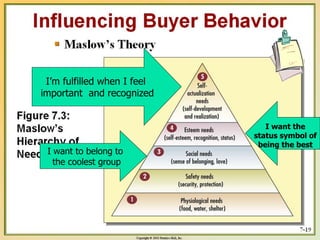
I want to belong to
the coolest group
I’m fulfilled when I feel
important and recognized
I want the
status symbol of
being the best
2. Nike PTM’s NWE
Teens need -
To belong (social), be recognized (self-Esteem), know
they are important & self fulfilled (Self
actualization)
Teens choose Nike over other brands because of ….
Quality, Durability, Style, good reputation, breakthrough
design and technology of products, packaging, sense
of being associated with the best, no. 1 brand;
Teens expect this when they use Nike products:
Cool, Confident, Stylish, having a positive attitude
when they exercise/ workout
3a. Nike has several
competitors
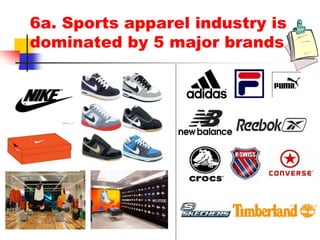
 Direct: Adidas, Fila, Puma, Reebok, New
Balance, And One, Umbro
 Indirect: Non-athletic footwear brands,
Crocs, K-swiss, Converse, Sketchers,
Timberland
 Variables: Age, Price, lifestyle, specific use,
desirability of product, brand
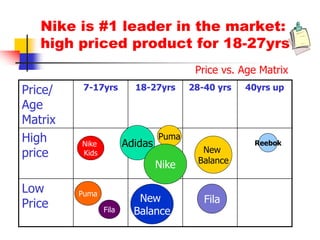
Nike is #1 leader in the market:
high priced product for 18-27yrs
Price/
Age
Matrix
7-17yrs 18-27yrs 28-40 yrs 40yrs up
High
price
Low
Price
Adidas
Puma
New
Balance
Reebok
New
Balance
Nike
Kids
Fila
Price vs. Age Matrix
Nike
Puma
Fila
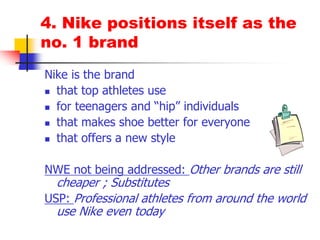
4. Nike positions itself as the
no. 1 brand
Nike is the brand
 that top athletes use
 for teenagers and “hip” individuals
 that makes shoe better for everyone
 that offers a new style
NWE not being addressed: Other brands are still
cheaper ; Substitutes
USP: Professional athletes from around the world
use Nike even today
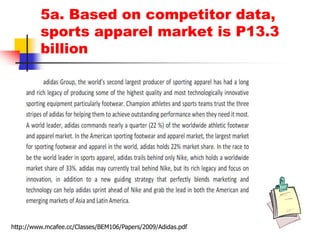
5a. Based on competitor data,
sports apparel market is P13.3
billion
http://www.mcafee.cc/Classes/BEM106/Papers/2009/Adidas.pdf
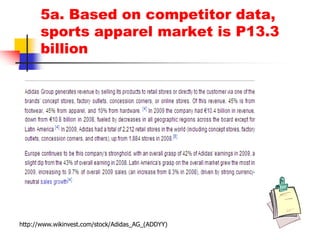
5a. Based on competitor data,
sports apparel market is P13.3
billion
http://www.wikinvest.com/stock/Adidas_AG_(ADDYY)
5b. Based on Nike data, Nike
share is 33% from total market
size of $278.4 billion
1. Nike sales is $18.6 billion
2. Market share is 33%
3. Total sports apparel market size is
$278.4B as of 2007
(http://www.marketingcharts.com/direct/global-sports-equipment-
apparel-and-footwear-market-nearly-280b-5548/)
5c. Consumer data indicates
a size of $ 278.4 billion
Nike’s demand:
6,877,800,000 worldwide population,
33% market share, $ 278.4 B market
size
91.8B (33% of market share)/ 22,000
stores = $4172.72 sales per store/ yr
5. Concluded that sports
apparel market is 278.4 billion
1. Competitor data = $ 13.3 B
2. Company data = $ 18.6 B
3. Usage data = $ 278.4 B
16
The Marketing Mix Strategy
Part 2:
Steps 6 to 10
6a. Sports apparel industry is
dominated by 5 major brands
6b. Product Description
 Nike’s is known for their footwear. It has designed a
whole line up of footwear for almost every sport.
 Different types of shoes: running, basketball, soccer,
cross training, football, tennis, golf
 2.5c – 6y for kids
 5.5 – 11 inches for women
 7 – 15 inches for men
7. Price-
Nike is 30% premium priced
than 2nd leading competitor
 Nike Trainers = $80
 Nike Shox = $73
 Nike Air Max = $78
 Nike Air Jordan = $150
 Lunarglide = $85 - $100
Nike as a brand commands high
premiums and is often more expensive
than products of its competitors.
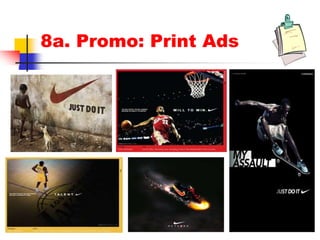
8a. Promo: Print Ads
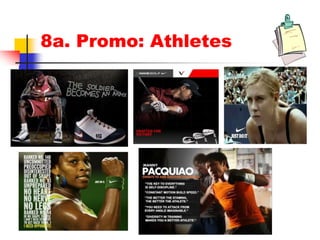
8a. Promo: Athletes
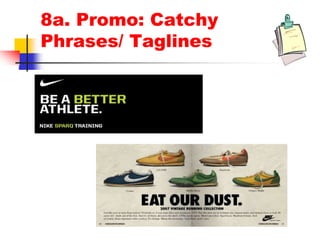
8a. Promo: Catchy
Phrases/ Taglines
8b. Competitor promo
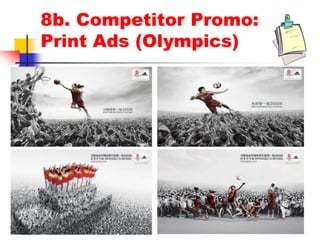
8b. Competitor Promo:
Print Ads (Olympics)
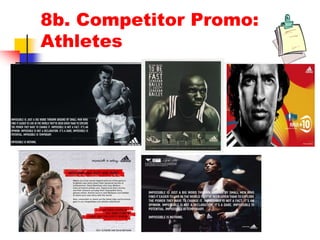
8b. Competitor Promo:
Athletes
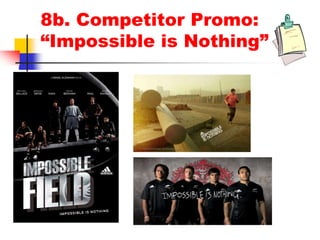
8b. Competitor Promo:
“Impossible is Nothing”
8b. Competitor promo
Nike ads are powerful and positive that
stays in everyone’s memory.
Their ads exude greatness and are loaded
with look of triumph.
9. Nike products are
distributed worldwide
 Malls
 Retail stores
 Partnered stores
 Factory outlets
 Worldwide
 Online stores
 Shipping
 Cash and Credit transaction
10. Nike is a market leader
 Nike’s main strategy rests on a favorable brand
image. In order to maintain and sustain this image,
the company makes huge investments in advertising
and brand promotion.
 It benefits from subcontracting their products to low
cost manufacturers (cheap labor = high selling price)
 Consistent and timely shipment of goods
 Has an excellent, premium priced and excellent
product distribution worldwide.
30
SUMMARY
5 Steps for Part 1
(PTM and Positioning)
1. Nike PTM is active people who enjoy high-
quality sporting goods, especially footwear.
2. Good association with no. 1 sports/ fashion
brand
3. Adidas, Fila, Reebok, Puma
4. Other brands don’t sell accessories such as
sunglasses, jewelries and apparel
5. The market size is $19.2 Billion.
5 Steps for Part 2
(Marketing Mix & Strategy)
6. Sports apparel (Footwear)
7. Based on the basis of premium segment
as target customers
8. Uses famous athletes as brand
ambassadors, TV ads, targeted advertising
in print ads and sports events
(sponsorships)
9. Distributed worldwide (Nike stores
across the globe)
10. Market Leader – Nike is a global brand
(enormous brand awareness)
33
10 STEP
Marketing Plan for NIKE
Tanya Marie Labrador
October 2010

10 step marketing for nike

  • 1.
    1 10 STEP Marketing Planfor NIKE Tanya Marie Labrador October 2010
  • 2.
    5 Steps forPart 1 (PTM and Positioning) 1. Nike PTM is active people who enjoy high- quality sporting goods, especially footwear. 2. Good association with no. 1 sports/ fashion brand 3. Adidas, Fila, Reebok, Puma 4. Other brands don’t sell accessories such as sunglasses, jewelries and apparel 5. The market size is $19.2 Billion.
  • 3.
    5 Steps forPart 2 (Marketing Mix & Strategy) 6. Sports apparel (Footwear) 7. Based on the basis of premium segment as target customers 8. Uses famous athletes as brand ambassadors, TV ads, targeted advertising in print ads and sports events (sponsorships) 9. Distributed worldwide (Nike stores across the globe) 10. Market Leader – Nike is a global brand (enormous brand awareness)
  • 4.
    4 Positioning to the PrimaryTarget Market Part 1: Steps 1 to 5
  • 5.
    1. Nike’s primarytarget market (PTM) are teens  Demographics (18-40 [largest are teens], M/F, social class AB, single/ married)  Lifestyle (active teens, athletic/ sporty individuals, casual lifestyle with fashionable taste)  Behavior (sneakers as fashion statement, fitness craze, multipurpose shoes, “hip”,)
  • 6.
    I want tobelong to the coolest group I’m fulfilled when I feel important and recognized I want the status symbol of being the best
  • 7.
    2. Nike PTM’sNWE Teens need - To belong (social), be recognized (self-Esteem), know they are important & self fulfilled (Self actualization) Teens choose Nike over other brands because of …. Quality, Durability, Style, good reputation, breakthrough design and technology of products, packaging, sense of being associated with the best, no. 1 brand; Teens expect this when they use Nike products: Cool, Confident, Stylish, having a positive attitude when they exercise/ workout
  • 8.
    3a. Nike hasseveral competitors  Direct: Adidas, Fila, Puma, Reebok, New Balance, And One, Umbro  Indirect: Non-athletic footwear brands, Crocs, K-swiss, Converse, Sketchers, Timberland  Variables: Age, Price, lifestyle, specific use, desirability of product, brand
  • 9.
    Nike is #1leader in the market: high priced product for 18-27yrs Price/ Age Matrix 7-17yrs 18-27yrs 28-40 yrs 40yrs up High price Low Price Adidas Puma New Balance Reebok New Balance Nike Kids Fila Price vs. Age Matrix Nike Puma Fila
  • 10.
    4. Nike positionsitself as the no. 1 brand Nike is the brand  that top athletes use  for teenagers and “hip” individuals  that makes shoe better for everyone  that offers a new style NWE not being addressed: Other brands are still cheaper ; Substitutes USP: Professional athletes from around the world use Nike even today
  • 11.
    5a. Based oncompetitor data, sports apparel market is P13.3 billion http://www.mcafee.cc/Classes/BEM106/Papers/2009/Adidas.pdf
  • 12.
    5a. Based oncompetitor data, sports apparel market is P13.3 billion http://www.wikinvest.com/stock/Adidas_AG_(ADDYY)
  • 13.
    5b. Based onNike data, Nike share is 33% from total market size of $278.4 billion 1. Nike sales is $18.6 billion 2. Market share is 33% 3. Total sports apparel market size is $278.4B as of 2007 (http://www.marketingcharts.com/direct/global-sports-equipment- apparel-and-footwear-market-nearly-280b-5548/)
  • 14.
    5c. Consumer dataindicates a size of $ 278.4 billion Nike’s demand: 6,877,800,000 worldwide population, 33% market share, $ 278.4 B market size 91.8B (33% of market share)/ 22,000 stores = $4172.72 sales per store/ yr
  • 15.
    5. Concluded thatsports apparel market is 278.4 billion 1. Competitor data = $ 13.3 B 2. Company data = $ 18.6 B 3. Usage data = $ 278.4 B
  • 16.
    16 The Marketing MixStrategy Part 2: Steps 6 to 10
  • 17.
    6a. Sports apparelindustry is dominated by 5 major brands
  • 18.
    6b. Product Description Nike’s is known for their footwear. It has designed a whole line up of footwear for almost every sport.  Different types of shoes: running, basketball, soccer, cross training, football, tennis, golf  2.5c – 6y for kids  5.5 – 11 inches for women  7 – 15 inches for men
  • 19.
    7. Price- Nike is30% premium priced than 2nd leading competitor  Nike Trainers = $80  Nike Shox = $73  Nike Air Max = $78  Nike Air Jordan = $150  Lunarglide = $85 - $100 Nike as a brand commands high premiums and is often more expensive than products of its competitors.
  • 20.
  • 21.
  • 22.
  • 23.
  • 24.
  • 25.
  • 26.
  • 27.
    8b. Competitor promo Nikeads are powerful and positive that stays in everyone’s memory. Their ads exude greatness and are loaded with look of triumph.
  • 28.
    9. Nike productsare distributed worldwide  Malls  Retail stores  Partnered stores  Factory outlets  Worldwide  Online stores  Shipping  Cash and Credit transaction
  • 29.
    10. Nike isa market leader  Nike’s main strategy rests on a favorable brand image. In order to maintain and sustain this image, the company makes huge investments in advertising and brand promotion.  It benefits from subcontracting their products to low cost manufacturers (cheap labor = high selling price)  Consistent and timely shipment of goods  Has an excellent, premium priced and excellent product distribution worldwide.
  • 30.
  • 31.
    5 Steps forPart 1 (PTM and Positioning) 1. Nike PTM is active people who enjoy high- quality sporting goods, especially footwear. 2. Good association with no. 1 sports/ fashion brand 3. Adidas, Fila, Reebok, Puma 4. Other brands don’t sell accessories such as sunglasses, jewelries and apparel 5. The market size is $19.2 Billion.
  • 32.
    5 Steps forPart 2 (Marketing Mix & Strategy) 6. Sports apparel (Footwear) 7. Based on the basis of premium segment as target customers 8. Uses famous athletes as brand ambassadors, TV ads, targeted advertising in print ads and sports events (sponsorships) 9. Distributed worldwide (Nike stores across the globe) 10. Market Leader – Nike is a global brand (enormous brand awareness)
  • 33.
    33 10 STEP Marketing Planfor NIKE Tanya Marie Labrador October 2010