




Strategic Management
Nur Athirah Bt Yusoff
American multinational corporation that is engaged in the design, development,
manufacturing and worldwide marketing and selling of footwear, apparel,
equipment, accessories and services. Headquartered near Beaverton, Oregon.
Nike produces a wide range of sports equipment. First products were track
running shoes. Currently make shoes, jerseys, shorts, cleats, base layers, etc. for
a wide range of sports, including track and field, baseball, ice hockey, tennis,
association football (soccer), lacrosse, basketball, and cricket. Nike Air Max is a
line of shoes first released by Nike, Inc. in 1987.
“To bring inspiration and innovation to every athlete in the world”
“To continue to offers quality products with increasing growth in the industry
and expanding globally”
“To be the most respected and successful enterprise, delighting customers with a
wide range of products and solutions in the automobile industry with the best
people and the best technology”
“The Adidas Group to be the global leader in the sporting goods industry with
brands built on a passion for sport and sporting lifestyle”
Adidas Group, was founded in a small town in Bavaria,
Adidas is a global public company and is one of the largest sports brands in
the state-of-the-art sports footwear and clothing to accessories such as
bags, watches, eyewear and other sports-related goods and equipment.
Employing over 46,000 employer worldwide, with 170 subsidiaries including
Reebok, Taylor Made-Adidas Golf, Rockport and CCM-Hockey.
Group HQ are in Herzogenaurach,
1) Focus on broad differentiation strategy :-
• Corporate level strategy focuses on innovation ,trying to produce new products , services
and processes in order to cope up with the competition.
• In 2014 centralized Sales Strategy & Excellency team was created to support all market
across the globe and managed by the Global Sales function. This created a global sales
function which were responsible for commercial activities and a global brands function
which were responsible for the marketing of both brands.
• The global sales function two departments, wholesale and retail.
Multi- brand strategy :-
• Diverse brand portfolio which allowed to cater all segments of market
• This helped them to keep a unique identity and concentrate on their core competencies.
Distribution channels in different countries (Evaluate the customer behavior) :-
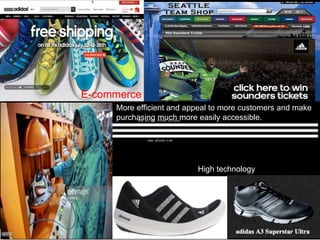
• E-commerce
E-commerce
High technology
More efficient and appeal to more customers and make
purchasing much more easily accessible.
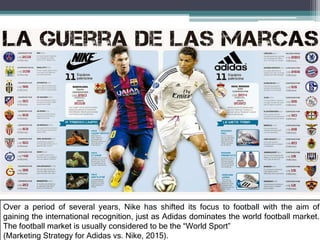
Over a period of several years, Nike has shifted its focus to football with the aim of
gaining the international recognition, just as Adidas dominates the world football market.
The football market is usually considered to be the “World Sport”
(Marketing Strategy for Adidas vs. Nike, 2015).
Adidas sports products are
divided into three main
categories:
1)Adidas performance shoes,
eye wear and perfume.
2) Adidas original superstar
sneakers, and Vintage clothing.
3) Bags, belts, hand gloves and
style caps (Hollister, 2008).
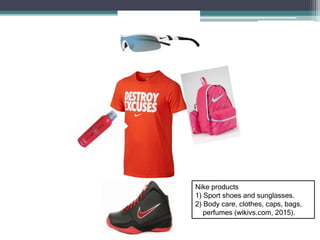
Nike products
1) Sport shoes and sunglasses.
2) Body care, clothes, caps, bags,
perfumes (wikivs.com, 2015).
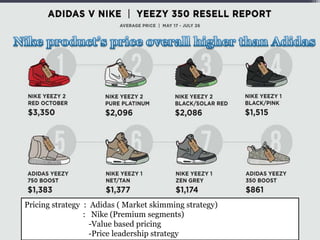
Pricing strategy : Adidas ( Market skimming strategy)
: Nike (Premium segments)
-Value based pricing
-Price leadership strategy
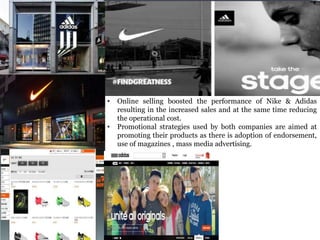
• Online selling boosted the performance of Nike & Adidas
resulting in the increased sales and at the same time reducing
the operational cost.
• Promotional strategies used by both companies are aimed at
promoting their products as there is adoption of endorsement,
use of magazines , mass media advertising.
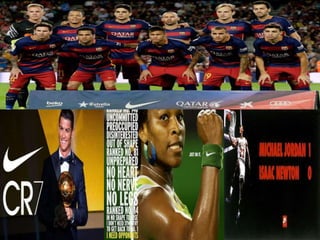
Nike as being innovator and creative,
with new innovations and designs of
new shoes styles. The major target
audience is the football players and
athletes, who are instilled with the
competitive idea to improve
performance.
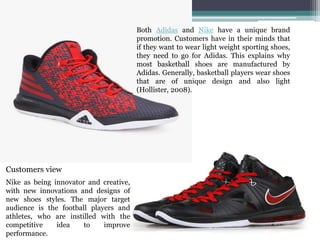
Both Adidas and Nike have a unique brand
promotion. Customers have in their minds that
if they want to wear light weight sporting shoes,
they need to go for Adidas. This explains why
most basketball shoes are manufactured by
Adidas. Generally, basketball players wear shoes
that are of unique design and also light
(Hollister, 2008).
Customers view
Nike and Adidas use celebrity
advertisement, which can
sometimes lead to the creation
of negative images, especially
when the celebrity engaged in
unethical behaviors.
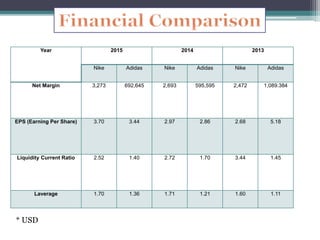
Year 2015 2014 2013
Nike Adidas Nike Adidas Nike Adidas
Net Margin 3,273 692,645 2,693 595,595 2,472 1,089.384
EPS (Earning Per Share) 3.70 3.44 2.97 2.86 2.68 5.18
Liquidity Current Ratio 2.52 1.40 2.72 1.70 3.44 1.45
Laverage 1.70 1.36 1.71 1.21 1.60 1.11
* USD
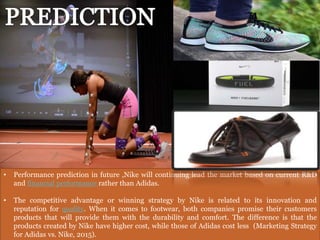
• Performance prediction in future ,Nike will continuing lead the market based on current R&D
and financial performance rather than Adidas.
• The competitive advantage or winning strategy by Nike is related to its innovation and
reputation for quality. When it comes to footwear, both companies promise their customers
products that will provide them with the durability and comfort. The difference is that the
products created by Nike have higher cost, while those of Adidas cost less (Marketing Strategy
for Adidas vs. Nike, 2015).
Adidas vs Nike

Adidas vs Nike

  • 1.
  • 2.
    American multinational corporationthat is engaged in the design, development, manufacturing and worldwide marketing and selling of footwear, apparel, equipment, accessories and services. Headquartered near Beaverton, Oregon. Nike produces a wide range of sports equipment. First products were track running shoes. Currently make shoes, jerseys, shorts, cleats, base layers, etc. for a wide range of sports, including track and field, baseball, ice hockey, tennis, association football (soccer), lacrosse, basketball, and cricket. Nike Air Max is a line of shoes first released by Nike, Inc. in 1987. “To bring inspiration and innovation to every athlete in the world” “To continue to offers quality products with increasing growth in the industry and expanding globally”
  • 3.
    “To be themost respected and successful enterprise, delighting customers with a wide range of products and solutions in the automobile industry with the best people and the best technology” “The Adidas Group to be the global leader in the sporting goods industry with brands built on a passion for sport and sporting lifestyle” Adidas Group, was founded in a small town in Bavaria, Adidas is a global public company and is one of the largest sports brands in the state-of-the-art sports footwear and clothing to accessories such as bags, watches, eyewear and other sports-related goods and equipment. Employing over 46,000 employer worldwide, with 170 subsidiaries including Reebok, Taylor Made-Adidas Golf, Rockport and CCM-Hockey. Group HQ are in Herzogenaurach,
  • 5.
    1) Focus onbroad differentiation strategy :- • Corporate level strategy focuses on innovation ,trying to produce new products , services and processes in order to cope up with the competition. • In 2014 centralized Sales Strategy & Excellency team was created to support all market across the globe and managed by the Global Sales function. This created a global sales function which were responsible for commercial activities and a global brands function which were responsible for the marketing of both brands. • The global sales function two departments, wholesale and retail. Multi- brand strategy :- • Diverse brand portfolio which allowed to cater all segments of market • This helped them to keep a unique identity and concentrate on their core competencies. Distribution channels in different countries (Evaluate the customer behavior) :- • E-commerce
  • 6.
    E-commerce High technology More efficientand appeal to more customers and make purchasing much more easily accessible.
  • 12.
    Over a periodof several years, Nike has shifted its focus to football with the aim of gaining the international recognition, just as Adidas dominates the world football market. The football market is usually considered to be the “World Sport” (Marketing Strategy for Adidas vs. Nike, 2015).
  • 13.
    Adidas sports productsare divided into three main categories: 1)Adidas performance shoes, eye wear and perfume. 2) Adidas original superstar sneakers, and Vintage clothing. 3) Bags, belts, hand gloves and style caps (Hollister, 2008).
  • 14.
    Nike products 1) Sportshoes and sunglasses. 2) Body care, clothes, caps, bags, perfumes (wikivs.com, 2015).
  • 15.
    Pricing strategy :Adidas ( Market skimming strategy) : Nike (Premium segments) -Value based pricing -Price leadership strategy
  • 16.
    • Online sellingboosted the performance of Nike & Adidas resulting in the increased sales and at the same time reducing the operational cost. • Promotional strategies used by both companies are aimed at promoting their products as there is adoption of endorsement, use of magazines , mass media advertising.
  • 17.
    Nike as beinginnovator and creative, with new innovations and designs of new shoes styles. The major target audience is the football players and athletes, who are instilled with the competitive idea to improve performance. Both Adidas and Nike have a unique brand promotion. Customers have in their minds that if they want to wear light weight sporting shoes, they need to go for Adidas. This explains why most basketball shoes are manufactured by Adidas. Generally, basketball players wear shoes that are of unique design and also light (Hollister, 2008). Customers view
  • 18.
    Nike and Adidasuse celebrity advertisement, which can sometimes lead to the creation of negative images, especially when the celebrity engaged in unethical behaviors.
  • 19.
    Year 2015 20142013 Nike Adidas Nike Adidas Nike Adidas Net Margin 3,273 692,645 2,693 595,595 2,472 1,089.384 EPS (Earning Per Share) 3.70 3.44 2.97 2.86 2.68 5.18 Liquidity Current Ratio 2.52 1.40 2.72 1.70 3.44 1.45 Laverage 1.70 1.36 1.71 1.21 1.60 1.11 * USD
  • 20.
    • Performance predictionin future ,Nike will continuing lead the market based on current R&D and financial performance rather than Adidas. • The competitive advantage or winning strategy by Nike is related to its innovation and reputation for quality. When it comes to footwear, both companies promise their customers products that will provide them with the durability and comfort. The difference is that the products created by Nike have higher cost, while those of Adidas cost less (Marketing Strategy for Adidas vs. Nike, 2015).